What Is a CT Cabinet in Electrical Systems?
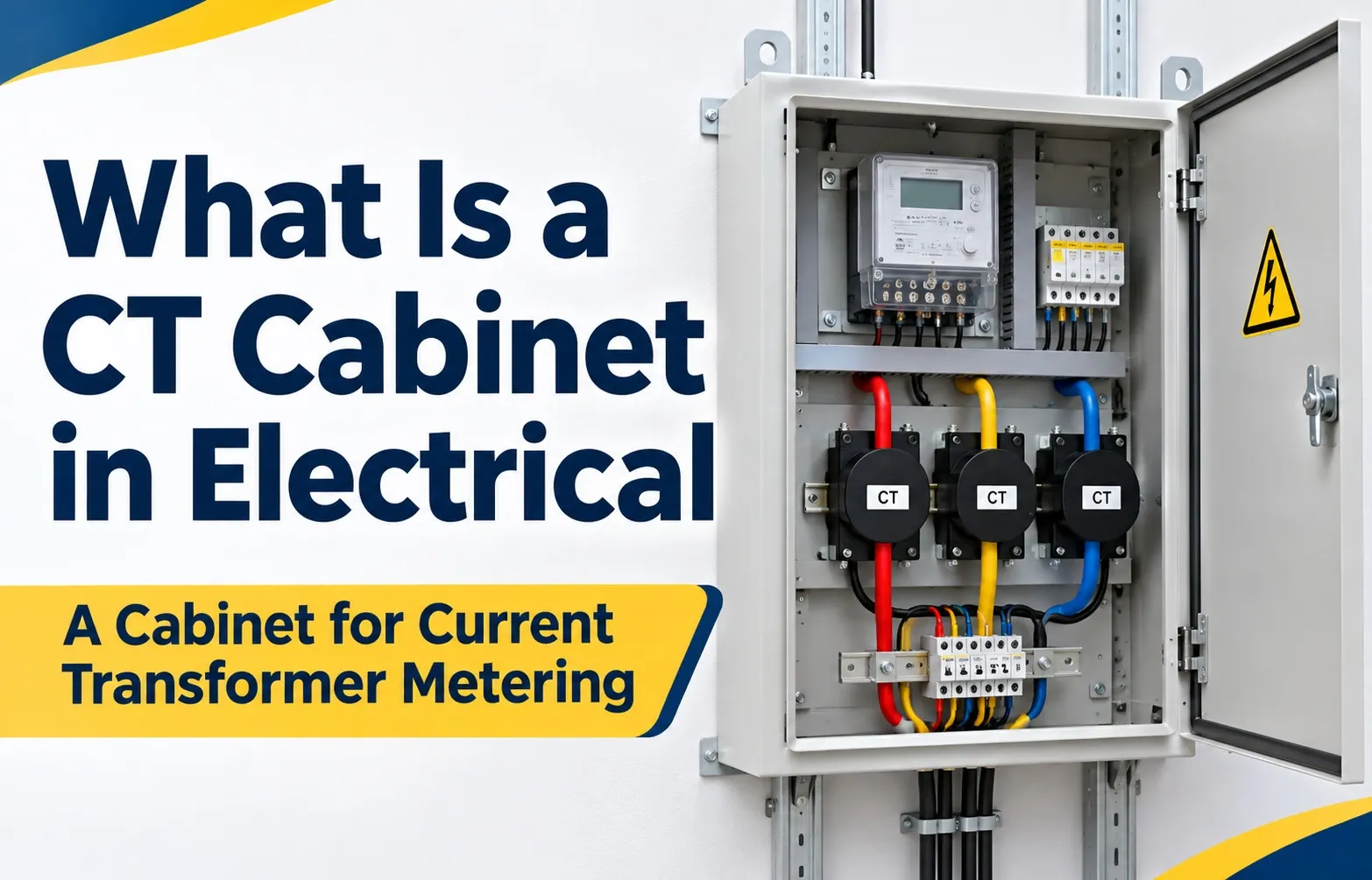 A CT cabinet (Current Transformer cabinet) is a protective, utility-sealable electrical enclosure that houses current transformers to measure high-amperage electrical services safely. Instead of routing full building current through a standard meter, the CTs step down high primary currents (400A to 1000A+) into a proportional, low-level secondary current—typically 1A or 5A—for accurate utility revenue metering.
In electrical wiring, CT stands for Current Transformer, an instrument transformer engineered specifically for current sensing and circuit protection. Standard self-contained, direct-connect meter sockets are thermally limited to around 200A (or up to 320A in specialized residential classes), making a dedicated CT enclosure essential for larger commercial, industrial, and multi-family power services.
How a CT Cabinet Works
A CT cabinet operates on electromagnetic induction, isolating high-voltage, high-current service conductors from sensitive measurement instruments. Rather than breaking the main power path to pass through a meter, heavy feeder cables or busbars run directly through the center window of each current transformer.
- Primary Current Sensing: High-amperage phase conductors (such as 400A, 800A, or 1200A service feeders) pass straight through the magnetic core of the CTs inside the cabinet.
- Proportional Step-Down Transformation: The alternating magnetic field induces a scaled-down current in the CT secondary windings based on a fixed turns ratio, such as 400:5 or 800:5 (where 400A or 800A on the primary side produces exactly 5A on the secondary side).
- Secondary Signal Transmission: Small-gauge secondary wires carry this safe 1A or 5A signal out of the CT cabinet to a remote meter socket, digital power monitor, or protective relay.
- Multiplier Billing Calculation: The utility meter reads the low secondary current and applies the programmed CT ratio multiplier to record exact kilowatt-hour (kWh) consumption.
Why High-Amperage Services Require CT Cabinets
Routing 600A or 1000A directly through a conventional meter base would require massive meter jaws and generate destructive heat. A dedicated CT cabinet solves both electrical engineering and utility compliance challenges in high-capacity installations.
- Prevents Meter Thermal Overload: Stepping down primary current keeps heat dissipation inside the meter socket minimal, preventing melted meter jaws, arcing, and fire hazards.
- Protects Personnel from Live Busbars: The heavy steel or aluminum enclosure creates a physical barrier around exposed high-energy busbars and termination lugs, reducing arc-flash exposure during routine meter reading or testing.
- Shields Hardware from Environmental Damage: Properly rated enclosures protect sensitive transformer windings and secondary connections from moisture, dust, corrosion, and mechanical impact.
- Ensures Tamper-Evident Utility Security: Electric utilities equip CT cabinet doors with padlock hasps and numbered security seals so unauthorized personnel cannot bypass or alter revenue metering connections.
- Supports Protective Relaying and Sub-Metering: Beyond utility billing, industrial facilities use CT cabinets to feed overload relays, power quality analyzers, and building energy management systems without interrupting main power distribution.
What Goes Inside a CT Cabinet? Key Components & CT Types
Inside a CT cabinet, heavy-duty busbars or service conductors, current transformers (CTs), secondary wiring, terminal blocks, and grounding hardware work together to step down high current for safe metering. Understanding what goes in a CT cabinet helps electricians, engineers, and property owners verify proper layout before utility inspection.
Depending on the utility company and service size, some enclosures arrive pre-equipped with factory busbars and mounting brackets, while others act as clean termination boxes where field conductors pass through current transformers. Clear spacing, secure terminations, and tamper-evident sealing remain central across every design.
Core Internal Hardware Components
A properly built CT cabinet keeps high-amperage primary paths organized and isolated from low-current metering circuits. Each internal component plays a distinct role in accurate current measurement and safe maintenance.
- Busbars & Landing Lugs: Factory-installed copper or aluminum busbars in a bussed CT cabinet provide rigid mounting points and heavy-duty mechanical lugs for line and load conductors, whereas an unbussed CT cabinet (termination style) leaves the interior open for continuous feeder cables and suitable lugs.
- Current Transformers (CTs): Precision ring or bar-type transformers mounted around the phase conductors or busbars step down high primary current to a standardized secondary current output.
- Secondary Wiring & Terminal Blocks: Insulated secondary leads (commonly labeled X1/X2 or S1/S2) route from the CTs to shorting-type terminal blocks or a meter test switch for safe calibration and testing.
- Grounding/Bonding Bus: A dedicated equipment grounding and bonding bus ties metallic enclosure parts and required secondary reference points together in compliance with electrical code.
- Utility Padlock/Seal Provisions: Reinforced door latches, hasps, and seal wire holes allow the utility provider to lock and seal the CT compartment against unauthorized access.
Window (Donut-Type) vs. Bar-Type CTs
Choosing between a window-type CT and a bar-type CT depends on conductor geometry, available space, and service amperage. Both designs step down current by electromagnetic induction, but they mount differently within the enclosure.
- Window-Type (Donut CT): A circular or oval donut CT has an open center window through which insulated primary cables or busbars pass directly. They are compact, cost-effective, and widely used with continuous service conductors in commercial panels and cabinets.
- Bar-Type CT: Built with a solid conductive bar integrated through the core, a bar-type CT bolts directly inline into the primary current path via bolted terminal pads. They handle high mechanical and thermal stresses well in heavy commercial or industrial switchgear where rigid bus connections are preferred.
Practical Field Inspection Tip
During utility service inspections, keep primary conductors centered inside each CT window and free of tight bends or crowding against the transformer core. Off-center cables, pinched insulation, or blocked access to secondary terminals can trigger an immediate utility rejection and delay power energizing.
- Center Conductors in the Window: Route feeder cables straight through the middle of each donut CT rather than letting them rest hard against one inner wall.
- Maintain Clear Bend Radius & Clearance: Leave enough slack and working room around lugs and secondary leads so technicians can inspect labels and test connections safely.
Common Types of CT Cabinets, Mounting Styles & NEMA Ratings
Selecting the right CT cabinet requires matching the enclosure’s physical mounting style, metal construction, and NEMA environmental rating to the site’s amperage and exposure conditions. Indoor electrical rooms, exterior commercial walls, and harsh industrial facilities each demand specific cabinet classifications and regional utility standards such as EUSERC standards.
Major electrical enclosure manufacturers build CT cabinets in standardized structural formats so contractors can meet utility clearances without custom fabrication delays. Identifying the installation environment first prevents premature enclosure corrosion, water intrusion, and failed utility inspections.
Mounting Configurations (Wall-Mounted, Pad-Mounted & Freestanding)
The physical footprint and weight of incoming service conductors largely dictate how a CT cabinet is anchored on site. Smaller commercial services mount directly onto structural walls, whereas heavy industrial feeders require ground-level concrete pads.
- Wall-Mounted CT Cabinet: Ideal for 400A to 800A commercial and multi-family services, a wall-mounted CT cabinet attaches directly to masonry, concrete, or reinforced exterior walls using heavy-duty mounting flanges or Unistrut channels.
- Pad-Mounted CT Cabinet: Designed for 1000A+ services and underground utility feeds, a pad-mounted CT cabinet bolts onto a poured concrete pad to support heavy multi-barrel busbars and large-diameter parallel feeder cables.
- Freestanding CT Enclosure: Built with integrated floor legs or a pedestal base, a freestanding CT enclosure is used inside large industrial electrical rooms or substations where wall support is unavailable and bottom-entry conduit sweeps are required.
Enclosure Materials & NEMA Ratings Comparison
Every CT cabinet carries a NEMA rating that defines its level of protection against dust, rain, sleet, and corrosive agents. Pairing the proper NEMA rating with the right metal alloy ensures long-term durability and utility compliance.
- Galvanized Steel vs. Aluminum: Galvanized steel offers high structural rigidity for outdoor NEMA 3R cabinets, while an aluminum enclosure reduces overall lifting weight and resists rust naturally in humid regions.
- Stainless Steel for Extreme Sites: Specifying a stainless steel NEMA 4X cabinet eliminates rusting around door hinges and utility lock hasps in salt-spray or chemical processing zones.
When Is a CT Cabinet Required? (400A vs. 600A vs. 1000A Rules)
A CT cabinet is required whenever electrical service amperage exceeds what a direct-connected meter socket can safely handle or when local utility rules mandate current-transformer metering. Knowing when is a CT cabinet required depends on service size, single-phase vs. three-phase configuration, voltage class, and utility tariff rules.
Much of the confusion seen on electrical forums stems from utilities setting different cutoffs for self-contained metering versus CT metering. Checking both electrical load calculations and utility service standards before ordering gear prevents costly change orders.
Does a 400 Amp Service Need a CT Cabinet?
Whether a 400 amp service needs a CT cabinet depends primarily on phase configuration and your utility company’s metering policy. Many single-phase residential setups avoid a separate CT enclosure, while commercial services frequently require one.
- Single-Phase Residential & Class 320 Meter Base: Many single-phase 400A services use a Class 320 meter base (rated for 320A continuous and 400A non-continuous duty) with self-contained metering, eliminating a standalone 400 Amp CT cabinet where approved by the utility.
- Three-Phase 400A & Strict 200A Cutoffs: Three-phase 400A commercial services—or utilities that cap self-contained metering at 200A—typically require a dedicated 400A CT cabinet paired with a transformer-rated meter socket.
600 Amp and 1000 Amp+ Commercial & Industrial Thresholds
As electrical services scale into heavy commercial and industrial loads, conductor sizes and continuous currents push well past direct-metering limits. At these levels, current transformers become standard across almost all utility providers.
- 600 Amp CT Cabinet Applications: A 600 amp CT cabinet is commonly required on light-to-mid commercial buildings, retail centers, and large agricultural or shop services where continuous loads exceed self-contained socket ratings.
- 1000 Amp CT Cabinet & Higher Services: A 1000 amp CT cabinet (or 1200A–2000A+ switchgear CT section) is standard for hospitals, data centers, manufacturing plants, and large multi-tenant complexes using parallel feeders or busbars.
Utility Service Handbook & NEC Working Clearances
Even when an enclosure meets basic hardware specs, utilities enforce strict approval lists and physical access rules before energizing a service. Always review your local electric utility’s service handbook alongside the National Electrical Code (NFPA 70).
- Verify Approved Equipment & Tariffs: Confirm acceptable CT cabinet models, mounting heights, and utility tariff rules with the serving utility before purchasing materials.
- Maintain NEC 110.26 Working Clearance: Keep required front working space depth, width, and headroom completely clear of obstructions so technicians can safely service and inspect the equipment.
CT Cabinet vs. Transformer vs. Standard Meter Socket: Key Differences
Understanding the difference between a CT cabinet vs transformer and a standard direct-connect meter base prevents costly equipment mix-ups during commercial and residential builds. While all three sit along electrical distribution paths, each device serves a completely different engineering role.
A CT cabinet houses an instrument transformer for safe current measurement, a step-down voltage transformer changes primary voltage to power building loads, and a standard meter socket measures full load current directly up to its rating limit.
Side-by-Side Comparison Table
The comparison below breaks down how a CT cabinet, a step-down voltage transformer, and a standard direct-connect meter socket differ in function, current capacity, output, and placement.
Why You Cannot Use a CT Cabinet to Change Voltage
A CT cabinet cannot step down or step up system voltage because current transformers are designed strictly for current measurement vs. voltage transformation of building power. Passing 480V or 240V service power through a CT cabinet does not deliver usable branch circuit voltage to outlets, motors, or panels.
- Measurement vs. Power Delivery: CTs generate a low-amperage proportional signal for meters and relays, whereas a step-down voltage transformer transfers full usable electrical power at a lower voltage level.
- Separate Equipment Roles: If a project needs both high-amperage metering and lower utilization voltage (such as stepping 480V down to 208Y/120V), both a CT metering arrangement and a dedicated step-down transformer must be specified.
How to Wire and Ground a CT Cabinet: Key Rules & Safety Precautions
Knowing how to wire a CT cabinet safely requires separating high-amperage primary feeder connections from low-current secondary metering circuits and following strict code and utility rules. Always consult your local utility service standards, a proper CT cabinet wiring diagram, and a licensed electrician before performing any work near energized conductors.
Properly connecting and grounding a CT cabinet protects personnel, prevents meter registration errors, and avoids severe equipment damage. Every phase conductor, polarity marker, and secondary circuit lead must match design and utility specifications.
CT Cabinet Wiring Overview (Primary Conductors & Secondary Loop)
Understanding how to connect a CT transformer and how to install a CT starts with keeping primary power paths and secondary metering leads cleanly organized. High current passes through the primary side while a scaled signal runs to the metering side.
- Route Primary Line & Load Conductors: Bring incoming utility line conductors (L1, L2, and L3 on three-phase systems) through the CTs or line busbar lugs, and route outgoing load conductors to the main service disconnect or distribution panel.
- Run Secondary Leads to a Shorting Block or Test Switch: Connect the CT secondary terminals (such as X1/X2 or S1/S2) using twisted or neatly bundled secondary conductors routed to a shorting block / test switch or meter test assembly.
- Connect to the Transformer-Rated Meter Socket: Wire the test switch outputs to the meter socket and potential/voltage reference circuits as required by the utility so revenue metering receives accurate current and voltage signals.
Polarity Alignment (H1 Toward Line / Utility Side)
Correct CT polarity (H1/H2, X1/X2) ensures that current direction and phase relationships match the meter’s internal calculations. Reversed polarity can cause incorrect billing registers, phase angle errors, or improper relay operation.
- Orient H1 Toward the Line Source: Align the primary polarity mark (H1 or polarity dot) facing the incoming utility supply/line side, with H2 facing the load side unless specified otherwise by the utility standard.
- Match Secondary Polarity Consistently: Keep secondary polarities (X1/X2 or S1/S2) consistent across all phases and through the test switch to the meter socket.
Does a CT Cabinet Need to Be Grounded?
Yes—a CT cabinet must be properly grounded and bonded in accordance with NEC Article 250 grounding and bonding rules and local utility requirements. Grounding protects against shock from faulted metal enclosures and stabilizes the secondary measurement circuit.
- Enclosure & Equipment Grounding: Bond the metallic CT cabinet enclosure and any internal equipment grounding bus to the grounding electrode system and equipment grounding conductor path per NEC Article 250.
- Neutral Bonding Placement: Follow NEC Article 250 rules for main bonding jumpers and system bonding—do not improvise neutral-to-ground bonds ahead of or separate from approved service disconnect points without verifying code and utility rules.
- Secondary Circuit Grounding: Ground one designated side of each CT secondary winding (per utility and NEC secondary grounding requirements) so secondary insulation failure cannot elevate the entire secondary loop to hazardous high voltage.
Critical Safety Warning — Never Open-Circuit a Live CT Secondary
Warning: Never leave a CT secondary circuit open while primary current is flowing through the conductor or busbar. An open-circuited current transformer acts like a step-up transformer with an unloaded secondary and can generate dangerously high voltages that cause severe electric shock, arc flash, insulation breakdown, or permanent CT failure.
- Short Secondary Terminals Before Disconnecting Meters: Always close the shorting links on the shorting block / test switch (or follow approved utility shorting procedures) before removing a meter or opening secondary leads on a live circuit.
- De-Energize When Permitted & Qualified: Follow lockout/tagout (LOTO) and arc-flash PPE requirements, and rely on qualified electrical personnel for all CT cabinet wiring and testing.
How Much Does a CT Cabinet Cost?
Understanding how much does a CT cabinet cost helps project owners, contractors, and estimators budget accurately for high-amperage commercial or industrial services. Typical CT cabinet cost ranges from roughly $350 to $900 for standard 400A enclosures and can reach $2,000 to $4,500+ for heavy-duty 1000A+ or corrosion-resistant stainless steel units.
Final project expenses depend on whether you are pricing a bare enclosure or a complete metering installation with busbars, current transformers, and labor. Always verify utility-approved models and local permitting requirements before locking in your equipment budget.
Average Equipment Cost by Amperage & NEMA Rating
Equipment pricing scales with physical cabinet dimensions, busbar hardware, amperage capacity, and enclosure alloy. The tiers below reflect common commercial and industrial pricing ranges for the enclosure itself.
- 400A NEMA 3R Enclosures ($350–$900+): Basic unbussed or entry-level 400A NEMA 3R cabinets typically sit near the lower end of this range, while factory-bussed or utility-specific 400A units can climb higher depending on brand and bus configuration.
- 600A–800A Commercial Cabinets ($800–$1,800+): Mid-sized commercial CT cabinets with heavier gauges, larger wire-bending space, or bussed interiors generally fall into this bracket.
- 1000A+ & NEMA 4X Stainless Steel Cabinets ($2,000–$4,500+): Large high-amperage enclosures, pad-mounted configurations, or stainless steel NEMA 4X cabinets for harsh environments command the highest equipment costs.
4 Factors That Impact Total Installed Cost
An enclosure price tag is only part of the budget during a commercial electrical service upgrade cost calculation. Four primary factors determine the final installed price.
- Bussed vs. Unbussed Internal Configuration: A bussed vs. unbussed CT enclosure differs in factory copper or aluminum busbars and pre-mounted lugs, which add material cost up front but can save field labor on heavy feeders.
- Utility-Supplied vs. Contractor-Supplied CTs & Meter Socket: Many electric utilities supply and install the revenue CTs and meter themselves, whereas private sub-metering or specific utility tariffs may require the contractor to furnish CTs, test switches, or meter bases.
- Indoor NEMA 1 vs. Outdoor NEMA 3R/4X Material: NEMA 3R pricing and NEMA 4X stainless steel pricing run higher than indoor NEMA 1 cabinets due to weatherproofing, galvanized or stainless alloys, and heavier-duty construction.
- Licensed Electrician Labor, Conduit Runs & Utility Fees: Heavy feeder terminations, secondary conduit runs to the meter socket, grounding work, permit pulls, and utility metering fees often equal or exceed the cabinet price itself.
Frequently Asked Questions About Electrical CT Cabinets
What does CT mean in electrical?
In electrical systems, CT stands for Current Transformer, an instrument transformer that measures alternating current by stepping down high primary current to a lower, proportional secondary current (commonly 1A or 5A). This allows billing meters, relays, and monitoring instruments to safely read high-amperage circuits without carrying full service current.
Can a CT cabinet be installed outdoors?
Yes, an outdoor CT cabinet can be installed outside when built with an approved weatherproof rating, such as NEMA 3R for rain, sleet, and ice protection or NEMA 4X for corrosive and washdown environments. Always confirm approved enclosure styles, mounting heights, and utility seal rules with your local electric utility first.
Who supplies the current transformers inside a CT cabinet?
In most commercial and residential utility installations, the property owner or electrical contractor purchases and mounts the CT cabinet, while utility-supplied CTs and the revenue meter are provided and installed by the electric utility. For private sub-metering or non-utility monitoring systems, the project owner or contractor supplies the CTs directly.
What is the difference between a bussed and unbussed CT cabinet?
A bussed vs. unbussed CT cabinet comes down to internal conductor hardware: bussed cabinets include factory copper or aluminum busbars and CT mounting points, while unbussed cabinets provide an open interior where continuous feeder cables pass through window-type CTs and land on suitable lugs.

Home Improvement Researchers & Guides Editors
Meet the Nest Team, a collective of dedicated researchers, home improvement enthusiasts, and industry writers sharing practical guides, thorough category research, and trusted solutions for residential repairs and thoughtful home upkeep.