What Does RTU Stand For in HVAC?
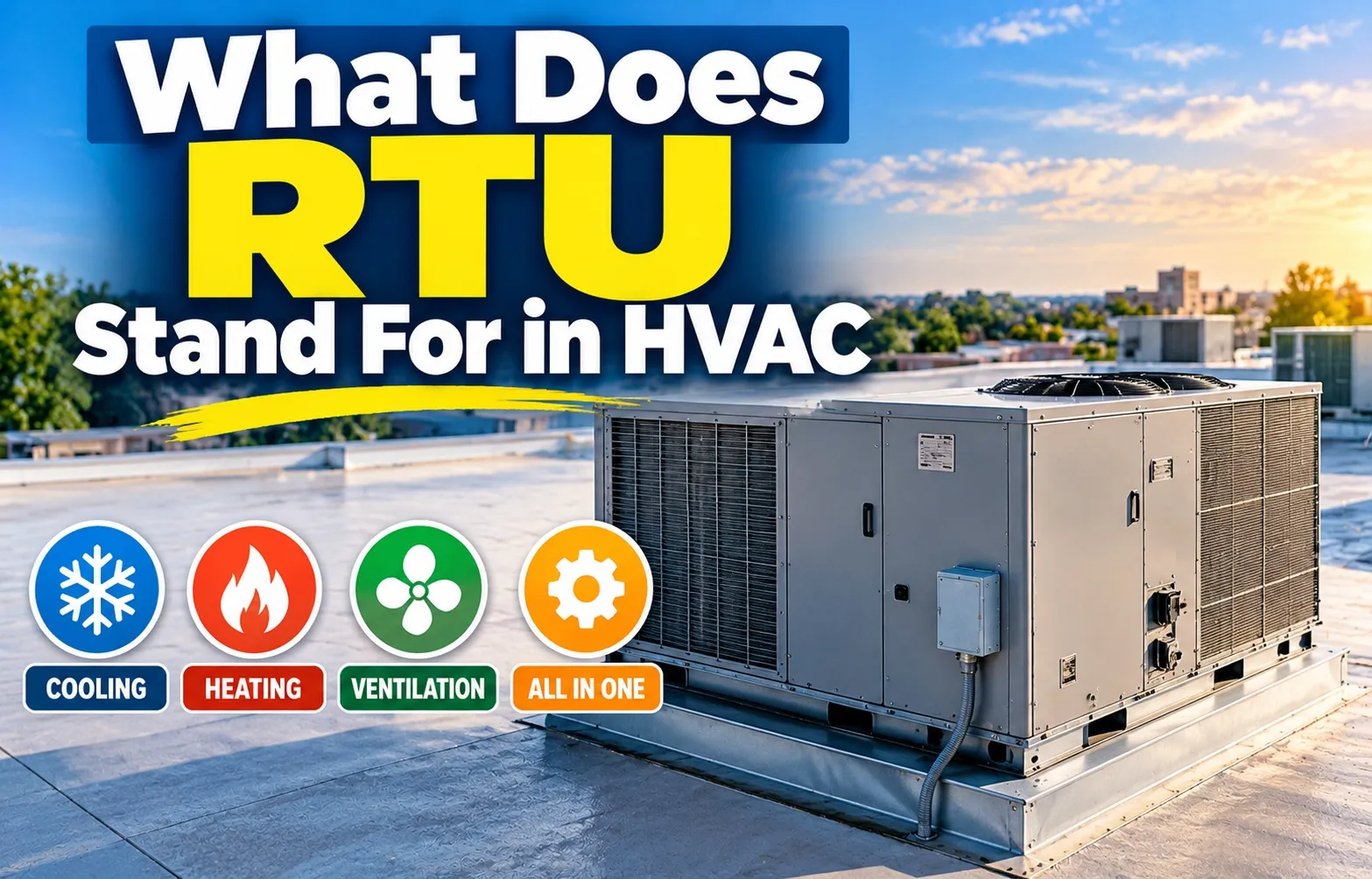 RTU stands for Rooftop Unit in HVAC (Heating, Ventilation, and Air Conditioning). It refers to a self-contained, packaged heating and cooling system installed on the exterior roof of commercial, industrial, or institutional buildings.
Engineers and building managers rely on RTUs to deliver centralized temperature regulation, humidity control, and ventilation across expansive indoor footprints without occupying internal floor space.
Defining RTU (Rooftop Unit) in Commercial Climate Control
In commercial HVAC applications, a Rooftop Unit consolidates all primary heating, cooling, and air-handling components within a single heavy-duty exterior casing. Rather than splitting equipment between internal utility rooms and outdoor condensing pads, the entire refrigeration and heating process occurs on the roof.
Rooftop Units are engineered specifically to streamline climate management across diverse commercial properties:
- Commercial Retail & Department Stores: Provides balanced airflow across large open sales floors.
- Educational Facilities & Schools: Delivers continuous fresh air intake to satisfy strict indoor air quality (IAQ) standards.
- Industrial Warehouses & Logistics Centers: Maintains stable ambient temperatures for inventory protection over high-cubic footages.
- Multi-Story Office Complexes: Enables zoned climate control tailored to specific tenant spaces or floor layouts.
According to the Trane Commercial Engineering Glossary, a rooftop unit is classified as a factory-assembled packaged system that connects directly to a building’s ductwork system through structural roof openings.
How an RTU Operates as a “Packaged” System
An RTU operates as a self-contained packaged system, meaning every critical mechanical component is pre-engineered, piped, and wired inside a single weather-resistant cabinet at the manufacturing facility before delivery.
Unlike residential split systems that divide the compressor and evaporator between inside and outside locations, a packaged RTU houses all core climate elements together:
- Vapor-Compression Cooling Circuit: Integrates hermetic scroll compressors, evaporator coils, expansion valves, and outdoor condenser coils in one continuous loop.
- Integrated Heating Module: Utilizes either a natural gas heat exchanger, electric resistance heating elements, or a reversible heat pump valve to generate warm air during cold cycles.
- Centrifugal Air Handler & Blower Motor: Draws return air from the building interior, mixes it with outdoor fresh air, and forces conditioned air down into supply ductwork.
- Protective Heavy-Gauge Enclosure: Encapsulates all moving components inside an insulated, galvanized steel cabinet designed to resist rain, snow, ultraviolet exposure, and wind loads.
Air flows continuously through the RTU via two primary roof penetrations: the return duct opening pulling air out of the building, and the supply duct opening distributing conditioned air throughout the facility.
What Does an RTU Look Like & How Is It Built?
A commercial rooftop unit appears as a large, heavy-duty rectangular metal cabinet positioned securely on top of a building’s roof. This weather-resistant casing houses all primary cooling, heating, and air-handling components in a single centralized system.
Understanding the exterior structure and internal layout of an RTU helps facility managers, technicians, and building owners evaluate installation requirements, maintenance access, and airflow efficiency.
Physical Exterior: Heavy-Duty Casing & Roof Curb Mounting
The exterior of a rooftop unit is constructed from heavy-gauge galvanized steel treated with weather-resistant coatings to withstand extreme temperatures, precipitation, and ultraviolet exposure.
Key structural elements of the exterior include:
- Roof Curb: A raised structural steel frame installed over a roof penetration that supports the heavy unit and creates a weather-tight seal.
- Weather-Resistant Enclosure: Access panels and hinged doors sealed with gaskets to prevent moisture ingress while allowing technician entry for servicing.
- Supply and Return Duct Connections: Aligned directly with the roof curb openings to channel conditioned air down into the building and pull return air back up.
Key Internal Components: Compressors Coils Blowers & Heating Elements
Inside the protective metal cabinet, an RTU functions as an all-in-one thermodynamic system. Every mechanical part is pre-engineered and connected in a single chassis to deliver complete climate control.
The primary internal components consist of:
- Compressor and Coils: The vapor-compression refrigeration circuit houses scroll compressors along with evaporator and condenser coils to transfer heat.
- Heating Section: Incorporates a gas-fired furnace heat exchanger or electric resistance heat strips for winter heating cycles.
- Centrifugal Blower Fan: A high-capacity fan driven by a powerful motor that pushes conditioned air through the building’s ductwork network.
- Fresh Air Dampers: Intake vents that regulate the mixture of indoor return air and outdoor fresh air to maintain indoor air quality.
The Role of the Economizer: Utilizing Free Cooling
An economizer is a critical energy-saving subsystem built into commercial RTUs. It monitors outdoor environmental conditions using dedicated temperature and humidity sensors to determine when outdoor air can be used for cooling.
Key operational benefits of the economizer include:
- Free Cooling Activation: During cool weather, outdoor air is drawn directly into the building, reducing or completely eliminating compressor operation.
- Energy Efficiency: Significantly lowers electrical consumption and utility costs for commercial facilities during spring and autumn seasons.
- Indoor Air Quality Compliance: Automatically adjusts fresh air dampers to fulfill ventilation codes and maintain healthy indoor oxygen levels.
RTU vs. AHU vs. DOAS: What Is the Difference?
While RTUs, AHUs, and DOAS units all manage indoor climate and air movement, they differ significantly in system architecture, equipment location, and operational roles. Understanding these differences prevents costly equipment misallocations in commercial HVAC design.
The primary distinction lies in packaging: an RTU is a complete all-in-one system, an AHU is an indoor air-moving component that pairs with external heating/cooling sources, and a DOAS specifically conditions outdoor ventilation air to improve indoor air quality (IAQ).
Comparison Matrix: RTU vs. AHU vs. DOAS
RTU vs. Air Handling Unit (AHU): Packaged vs. Split Configuration
The core structural difference between an RTU and an Air Handling Unit (AHU) lies in refrigeration independence. An RTU contains the compressor, coils, burners, and fans inside one exterior housing.
Conversely, an indoor AHU acts strictly as an air distributor that requires connections to remote hydronic thermal plants or outdoor condensing units:
- Thermal Media Source: AHUs rely on a remote chilled water loop from an central chiller and hot water from an external boiler, whereas RTUs generate their own heating and cooling internally.
- Footprint & Location: AHUs occupy valuable internal floor space within dedicated mechanical rooms, while RTUs free up interior square footage by utilizing idle roof space.
- Ductwork & Static Pressure: AHUs handle high static pressure demands across complex duct networks in high-rise buildings, while RTUs are optimized for direct vertical supply into low-rise structures.
RTU vs. Dedicated Outdoor Air System (DOAS): Fresh Air Load Handling
While an RTU conditions a mixture of recirculated indoor return air and a minor percentage of fresh air, a Dedicated Outdoor Air System (DOAS) is specifically designed to handle 100% outdoor air intake.
DOAS units specialize in removing latent moisture loads from outside air before introducing it into a building’s primary climate control network:
- Outdoor Air Mix: A standard RTU typically operates on 10% to 20% fresh outdoor air mixed with 80% return air, whereas a DOAS processes 100% fresh outside air continuously.
- Humidity & Latent Load Control: DOAS units decouple moisture removal from sensible cooling, conditioning raw outside air to exact dew points to prevent mold growth and optimize indoor air quality (IAQ).
- System Synergy: In modern sustainable designs, a DOAS works alongside primary RTUs or terminal units, handling heavy ventilation loads so the RTUs can operate at peak energy efficiency.
Why Are RTUs Installed on Roofs?
Installing commercial HVAC units on roofs is a standard engineering practice that maximizes indoor floor space, isolates mechanical noise from building occupants, and centralizes maintenance operations away from customer areas.
By moving heavy heating and cooling equipment overhead, commercial property owners preserve valuable square footage for revenue-generating activities while maintaining efficient thermal control across the entire building envelope.
Primary Advantages: Space Saving Noise Reduction & Modular Expansion
Roof placement provides critical operational and architectural benefits for commercial real estate owners. It eliminates the need for bulky indoor mechanical rooms, directly optimizing usable floor space.
- Floor Space Optimization: Frees up interior square footage for retail displays, office cubicles, or storage inventory instead of housing large climate equipment.
- Acoustic Dampening: Keeps noisy compressors, blowers, and high-torque motors outside and overhead, preventing disruptive sound vibrations inside workspaces.
- Multi-Zone Control & Scalability: Allows facility managers to install multiple rooftop units tailored to specific zones, simplifying future modular expansion as building footprints grow.
Ideal Building Types: Retail Warehouses Schools & Commercial Offices
Rooftop units are uniquely suited for low-rise, sprawling commercial and industrial structures that require heavy-duty thermal capacity and straightforward duct distribution.
Common property types that rely heavily on rooftop HVAC configuration include:
- Retail Strip Malls & Big-Box Stores: Delivers high-volume conditioned air uniformly across large, open retail floors without interior partition interference.
- Industrial Warehouses & Distribution Centers: Manages high-cubic-foot spaces efficiently, protecting stored goods from extreme seasonal temperature shifts.
- Educational Facilities & Schools: Integrates high-capacity fresh air ventilation to satisfy stringent indoor air quality (IAQ) and occupancy standards.
- Suburban Commercial Office Buildings: Provides independent zoning for various tenants or departments across flat-roof architectural layouts.
Engineering Challenges: Roof Structural Load & Weather Exposure
Despite their widespread utility, rooftop unit installations present distinct engineering challenges that require careful structural evaluation and professional crane hoisting during placement.
Key engineering factors managed during RTU deployment include:
- Structural Load Calculations: Commercial roofs must be engineered and reinforced to support the immense dead weight and dynamic vibration forces of heavy mechanical equipment.
- Roof Penetrations & Curb Flashing: Proper flashing and waterproof sealing around the roof curb are essential to prevent costly water leaks during severe storms.
- Severe Weather Exposure: Continuous exposure to ultraviolet radiation, high winds, heavy snow, and hail demands durable cabinet construction and regular weatherproofing maintenance.
Commercial RTU Cost Sizing, & Maintenance Insights
Managing commercial rooftop units involves balancing initial capital expenditures against long-term operational and repair costs. Financial planning requires a clear understanding of equipment pricing, labor requirements, and economic repair thresholds.
Facilities teams rely on strategic lifecycle management—incorporating sizing factors, repair-versus-replace guidelines, and routine preventive maintenance—to minimize total cost of ownership and prevent unexpected system downtime.
How Much Does a Commercial RTU Cost to Buy and Install?
The total cost to acquire and install a commercial rooftop unit typically ranges from $7,000 to $35,000+ per unit, depending heavily on cooling capacity (tonnage), efficiency ratings, heating configurations, and roof accessibility.
Equipment and installation pricing breaks down into three primary expense categories:
- Base Equipment Cost: A standard 3-ton to 5-ton commercial unit ranges between $4,000 and $9,000, while large high-capacity units (15 to 25+ tons) can range from $15,000 to $30,000+ for the hardware alone.
- Installation Labor & Crane Services: Rigging, hoisting, roof curb adaptation, and electrical/gas hookups generally add $3,000 to $10,000+ in specialized labor and crane rental fees.
- Ductwork Adaptations & Controls: Fabricating duct transitions, installing programmable commercial thermostats, or integrating building automation system (BAS) controls adds variable scope cost.
Understanding the HVAC $5,000 Rule for RTU Replacement vs. Repair
When an aging rooftop unit experiences a major component failure—such as a cracked heat exchanger or a seized scroll compressor—facility managers use the $5,000 Rule to decide whether to repair or replace the system.
To apply the rule, multiply the estimated cost of the repair by the age of the unit in years:
- If the result exceeds $5,000: Replacement is generally the most cost-effective decision (e.g., a $750 repair on an 8-year-old unit equals $6,000, favoring full unit replacement).
- If the result is under $5,000: Proceeding with the repair is typically recommended, provided the system has been well-maintained.
Because commercial RTUs have an average unit lifespan of 15 to 20 years, applying this economic rule prevents property managers from sinking major capital into units nearing the end of their functional service life.
Routine Preventative Maintenance Checklist for Rooftop Equipment
Because rooftop units operate in harsh exterior environments year-round, implementing a rigorous quarterly maintenance schedule is essential to preserve energy efficiency and prevent premature compressor failure.
A standard preventative maintenance checklist for commercial RTUs includes:
- Filter Changes: Inspect and replace pleated air filters quarterly to maintain designed static pressure and airflow across coils.
- Coil Cleaning: Wash evaporator and outdoor condenser coils annually to remove dirt, debris, and atmospheric grime that degrade heat transfer.
- Belt Tensioning & Inspection: Check blower fan drive belts for wear, cracking, or slippage, adjusting tension or replacing belts as needed.
- Condensate Line Clearing: Flush drain pans and condensate lines to prevent blockages that cause indoor water leaks and roof deck moisture damage.
- Electrical & Mechanical Checks: Inspect contactors, tighten electrical terminals, lubricate fan bearings, and verify proper refrigerant charge and operating pressures.
Frequently Asked Questions About HVAC RTUs
Addressing common technical and operational questions helps building managers, engineers, and property owners clarify equipment functionality and disambiguate industry terminology.
Below are direct responses to frequent queries regarding rooftop unit classification, electrical acronym overlaps, leading manufacturers, and expected system longevity.
Is an RTU considered a furnace or an air conditioner?
An RTU is considered both an air conditioner and a heating unit combined into a single system, known technically as a packaged unit or packaged heat pump.
Instead of choosing between a furnace or an air conditioner, an RTU incorporates both climate control functions within one cabinet:
- Cooling Cycle: Uses an internal vapor-compression refrigeration circuit (compressor, expansion valve, and coils) to function as a high-capacity air conditioner.
- Heating Cycle: Houses an integrated natural gas furnace heat exchanger, electric resistance heat strips, or a reversing heat pump valve to provide building heating.
What does RTU stand for in electrical vs. HVAC contexts?
In HVAC contexts, RTU stands for Rooftop Unit, referring to a physical heating and cooling package installed on a building’s roof.
In electrical engineering, industrial automation, and SCADA control systems, RTU stands for Remote Terminal Unit:
- HVAC RTU (Rooftop Unit): A mechanical climate control system that conditions, filters, and distributes air throughout commercial facilities.
- Electrical RTU (Remote Terminal Unit): A microprocessor-based electronic device that monitors telemetry data, communicates with sensors, and interfaces with SCADA systems to manage electrical grids or industrial automation.
What are the top commercial RTU brands?
Several major original equipment manufacturers (OEMs) dominate the commercial rooftop unit market, producing systems ranging from light commercial models to massive industrial custom units.
The leading commercial RTU manufacturers include:
- Trane: Renowned for high reliability, advanced digital controls, and energy-efficient commercial performance.
- Carrier: Offers versatile packaged systems with extensive variable-speed compressor options and modular designs.
- Lennox Commercial: Known for light commercial units with high Seasonal Energy Efficiency Ratio (SEER) ratings and advanced economizer controls.
- York (Johnson Controls): Provides robust industrial units designed for ease of maintenance and integration into Building Automation Systems (BAS).
- AAON: Specializes in premium, highly customizable, and heavy-duty rooftop equipment with precise humidity and air quality management.
How long do commercial rooftop units typically last?
The average system lifespan of a commercial rooftop unit is 15 to 20 years when properly maintained with quarterly service inspections.
Key factors that influence how long an RTU remains operational include:
- Preventative Maintenance Routine: Regular filter replacements, coil cleanings, and belt adjustments significantly extend equipment life.
- Geographic Location & Weather Exposure: Units installed in harsh coastal environments exposed to salt air or extreme freezing weather may experience faster casing and coil corrosion.
- Operating Duty Cycle: Systems running 24/7 in high-load industrial facilities experience greater mechanical wear than those operating on standard commercial office schedules.

Oscar Vance | Master Plumber & Drainage Expert
Meet Oscar Vance, a licensed master plumber sharing practical solutions on residential repairs, preventive maintenance, and thoughtful home upkeep.