Why Working Capital Matters for HVAC Companies
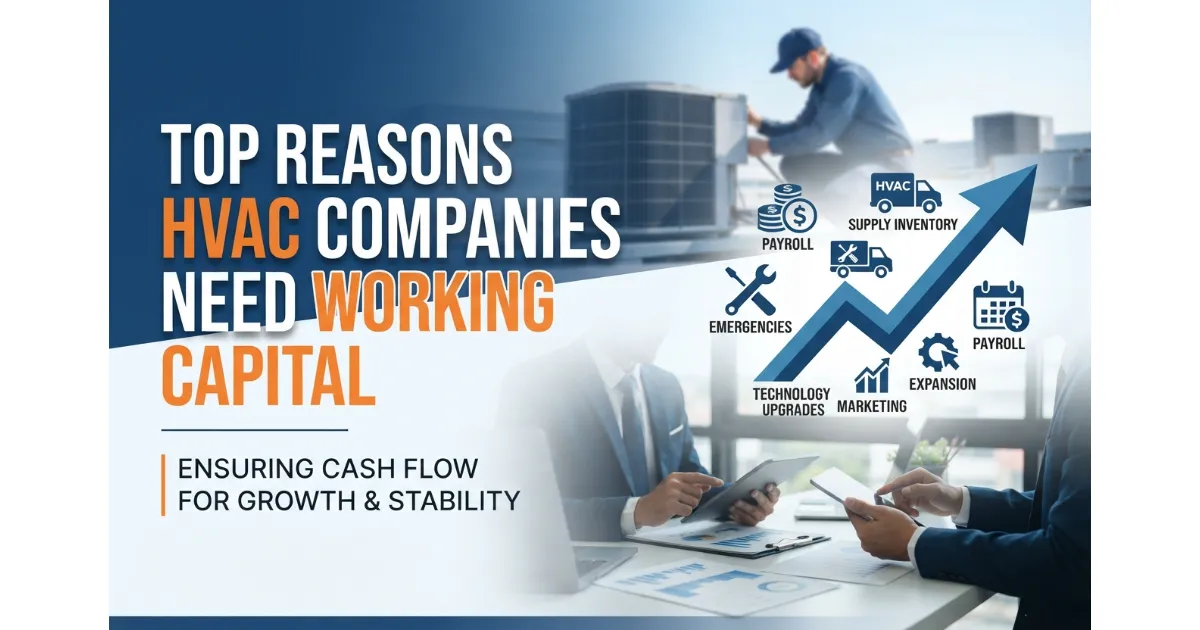 Working capital is the financial lifeblood that allows HVAC companies to cover daily operational expenses, bridge cash flow gaps, and sustain operations during slow seasons. For heating, ventilation, and air conditioning businesses, managing this metric is essential for weathering extreme seasonal revenue swings.
Without adequate working capital, even a profitable HVAC business can struggle to purchase emergency inventory, pay technicians during shoulder months, or invest in vital marketing campaigns. Understanding and optimizing your cash flow ensures long-term operational resilience and business growth.
- Managing Seasonal Demand: Learn how to navigate extreme revenue fluctuations between freezing winters and scorching summers.
- Covering Operational Expenses: Discover strategies to consistently fund payroll, fuel, equipment, and insurance.
- Bridging Cash Flow Gaps: Master techniques to handle delayed accounts receivable from residential and commercial clients.
- Fueling Business Growth: Uncover methods to reinvest in fleet expansion, technician training, and advanced software systems.
What Is Working Capital And Why It’s Different for HVAC
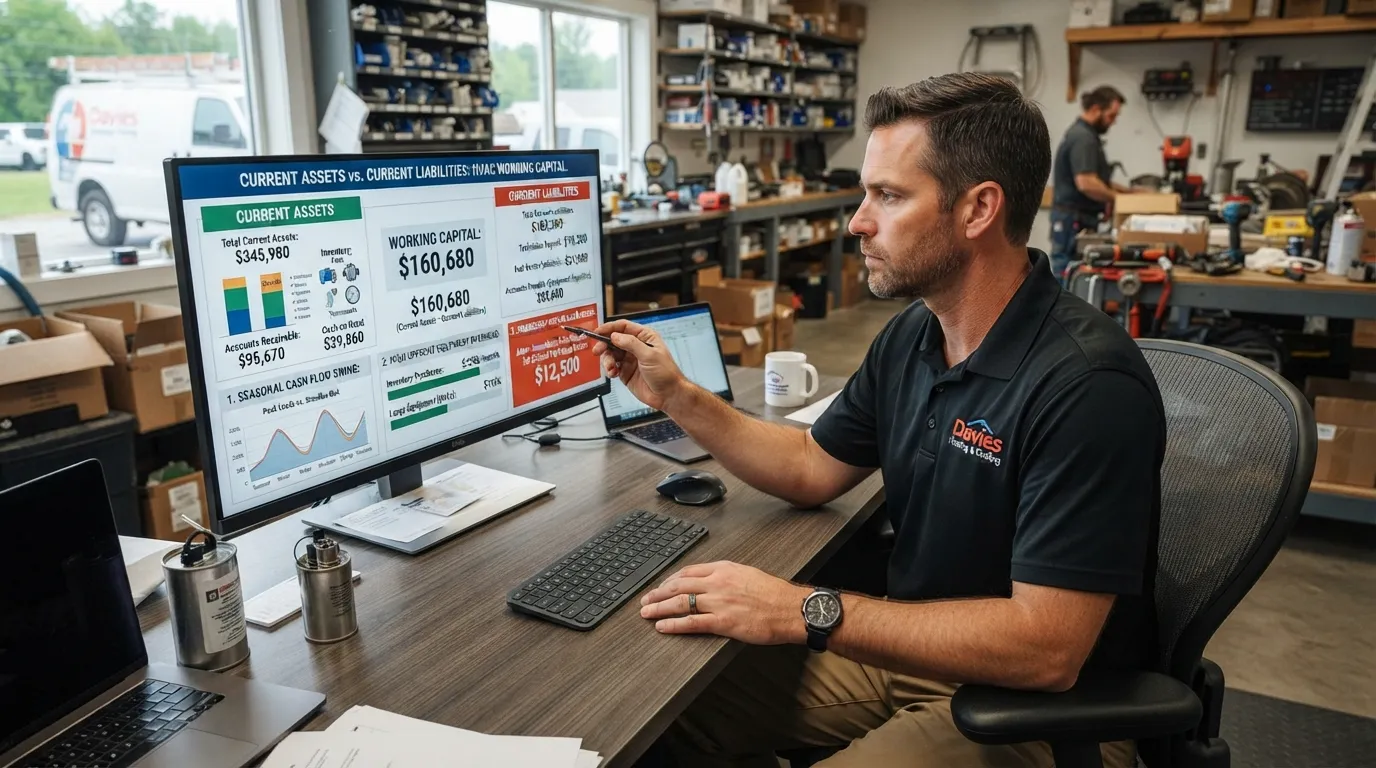 Working capital represents the essential financial cushion that fuels day-to-day operations by measuring current assets against current liabilities. For heating and cooling contractors, maintaining positive liquidity prevents sudden operational shutdowns and secures ongoing business continuity.
What Working Capital Means for a Service-Based Business
Working capital functions as the primary driver behind your company’s immediate financial agility and daily stability. It ensures you have immediate liquid funds available to cover payroll, purchase replacement parts, and pay utility bills before customer invoices are fully settled.
- Immediate Liquidity: Cash on hand and short-term assets ready to deploy for urgent business needs.
- Liability Management: The ability to clear short-term debts, supplier invoices, and credit lines on time.
- Operational Continuity: Uninterrupted daily service delivery without relying entirely on immediate customer payments.
Why HVAC Businesses Face Unique Cash Flow Pressure
HVAC contractors deal with intense financial volatility driven by severe weather patterns, escalating labor shortages, and constant equipment price inflation. These macro-struggles make standard cash flow management much harder compared to traditional retail or steady office businesses.
- Labor Shortages & Rising Wages: Competing for certified NATE technicians requires higher hourly wages and competitive benefits, driving up fixed payroll burdens.
- Supply Chain Volatility: Fluctuating costs for copper, refrigerants, and replacement units force contractors to tie up massive capital in inventory.
- Regulatory & Licensing Expenses: Continuous compliance, EPA certifications, and mandatory vehicle insurance add heavy overhead expenses that drain available cash.
Top Reasons HVAC Companies Need Working Capital
Working capital serves as the vital financial buffer that allows heating, ventilation, and air conditioning contractors to sustain daily operations, scale seamlessly, and survive revenue droughts. Without proper liquidity, even high-volume HVAC companies face severe disruptions during unexpected market shifts.
Managing Seasonal Demand and Slow Periods
HVAC businesses experience extreme revenue swings dictated by regional weather patterns, moving from frantic peak loads to dormant shoulder seasons. For example, a mid-size contractor operating in a harsh cold-climate region may see a 60% drop in revenue during spring, requiring substantial liquid reserves to cover fixed costs.
- Shoulder Season Survival: Funding rent, insurance, and administrative salaries when repair calls drop drastically.
- Regional Adaptation: Balancing cash flow reserves differently depending on whether your market experiences freezing winters or scorching, AC-reliant summers.
- Off-Season Maintenance Specials: Financing discounted preventive maintenance campaigns to generate baseline cash flow during lulls.
Pre-Stocking Inventory and Critical Parts
Emergency service calls demand immediate access to replacement inventory like igniters, flame sensors, pleated filters, and blower motors. A mid-size HVAC company managing 10 service trucks often requires upwards of $45,000 in working capital to pre-stock these core parts ahead of a severe weather storm season.
- Bulk Purchasing Power: Securing wholesale discounts on refrigerants and copper lines before seasonal price inflation hits.
- Truck Stock Readiness: Equipping every technician vehicle to maximize first-time fix rates without supply delays.
- Emergency Preparedness: Stockpiling high-demand replacement units to capitalize on sudden extreme weather surges.
Covering Payroll and Overtime During Peak Season
Extreme heatwaves and deep freezes trigger massive spikes in emergency repair requests, forcing technicians into heavy overtime hours. Meeting these bi-weekly payroll obligations before customer service invoices are paid requires immediate, flexible capital.
- Overtime Funding: Paying time-and-a-half wages promptly to keep top technicians motivated during 70-hour work weeks.
- Staff Retention: Preventing payroll delays that routinely drive skilled trade workers to competing local contractors.
- Subcontractor Payouts: Covering third-party installation crews immediately upon project completion.
Bridging Customer Payment Delays
Commercial contracts and large residential system installations often operate on rigid 30- to 60-day accounts receivable payment terms. Working capital bridges the massive cash flow gap between finishing a multi-thousand dollar installation and actually collecting the funds from clients.
- Accounts Receivable Lag: Sustaining operations while waiting for corporate or property management clients to clear vendor invoices.
- Material Cost Offset: Absorbing upfront equipment costs without stalling other active residential jobs.
- Collections Management: Cushioning the business against slow-paying accounts or delayed insurance claim payouts.
Fulfilling Tax and Vendor Obligations
HVAC business owners must navigate rigid compliance deadlines, including quarterly tax filings, commercial vehicle insurance premiums, and vendor financing notes. Missing these strict deadlines triggers costly penalties and harms commercial credit lines.
- Quarterly Tax Reserves: Setting aside accurate tax allocations consistently regardless of current monthly revenue highs.
- Commercial Vehicle Notes: Managing monthly lease or loan payments for wrapped service fleets and diagnostic tools.
- Vendor Credit Terms: Clearing supplier balances promptly to maintain high-priority status for scarce parts.
Hiring and Training New Staff Ahead of Revenue
Scaling an HVAC business requires onboarding and certifying new technicians weeks before they generate positive net revenue. Working capital covers recruiting costs, background checks, and classroom training periods safely.
- Recruitment Investments: Funding digital job boards, headhunters, and referral bonuses to attract NATE-certified talent.
- Onboarding & Apprenticeship: Paying new apprentices during ride-along training phases before they run solo service calls.
- Safety & Technical Compliance: Financing ongoing EPA certification updates and specialized manufacturer training programs.
How Much Working Capital Does an HVAC Business Actually Need?
Calculating the exact working capital required for an HVAC business depends heavily on your fleet size, seasonal revenue volatility, and overhead expenses. As a dependable industry standard, HVAC contractors should maintain enough liquid cash reserves to cover three to six months of fixed operating expenses.
Having this financial cushion ensures you can weather slow shoulder seasons, unexpected equipment breakdowns, and delayed customer payments without taking on high-interest emergency debt.
A Simple Formula to Estimate Your Working Capital Needs
The standard accounting formula for working capital measures current assets against current liabilities. However, for practical operational planning, HVAC owners should focus specifically on monthly cash burn rates and fixed expense coverage.
- Step 1: Calculate Monthly Fixed Costs: Add up non-negotiable monthly expenses including shop rent, truck lease payments, insurance premiums, software subscriptions, and baseline administrative salaries.
- Step 2: Factor in Variable Overheads: Include average monthly outlays for fuel, standard parts inventory, and customer acquisition marketing spend.
- Step 3: Multiply by Target Months: Multiply your total monthly burn rate by three for a lean reserve, or up to six months for optimal safety during severe regional downturns.
Example Calculation for a Small vs Mid-Size HVAC Company
To put concrete numbers into perspective, working capital requirements scale directly with your operational footprint and active fleet size. Here is how cash reserve requirements break down across different business scales.
- Small HVAC Business (2 Trucks): Monthly operating costs typically hover around $15,000. Maintaining a 3-month safety cushion requires at least $45,000 in accessible working capital.
- Mid-Size HVAC Company (10 Trucks): Monthly operating expenses easily reach $75,000 to $90,000 due to heavier technician payroll and commercial insurance. To survive a harsh seasonal slump, this business needs a working capital reserve between $225,000 and $270,000.
Working Capital Loans vs. Equipment Financing
When HVAC business owners face a cash flow squeeze or need to expand operations, choosing the right financing product is crucial. Mixing up working capital loans with equipment financing can lead to higher interest rates, mismatched repayment terms, and unnecessary financial strain.
Understanding the distinct purpose of each financing vehicle allows you to fund your daily operational gaps or physical assets efficiently without compromising your long-term balance sheet.
Working Capital Loans What They Cover
Working capital loans and business lines of credit provide unsecured or secured cash injections designed specifically to fund short-term operational expenses. They bridge the gap when cash flow temporarily dips below operating costs.
- Core Coverages: Ideal for paying technician payroll during slow shoulder months, covering emergency tax bills, or launching local marketing campaigns.
- Repayment Structure: Typically structured as short-term term loans (6 to 24 months) or revolving lines of credit with weekly or monthly payments.
- Collateral Requirements: Often unsecured (relying heavily on business credit history and revenue performance) or backed by blanket liens on business assets.
Equipment Financing What It Covers
Equipment financing functions as a self-collateralized loan specifically earmarked for purchasing physical business assets like service vans, diagnostic meters, or warehouse stock. The asset itself acts as the security for the loan.
- Core Coverages: Dedicated exclusively to buying or leasing new wrapped service vehicles, heavy lifting equipment, or recovery machines.
- Repayment Structure: Longer repayment terms aligned directly with the expected useful lifespan of the machinery (typically 3 to 7 years).
- Financial Advantage: Preserves your cash on hand and revolving credit lines for day-to-day operational emergencies and unexpected overhead expenses.
Best Financing Options for Seasonal Trade Businesses
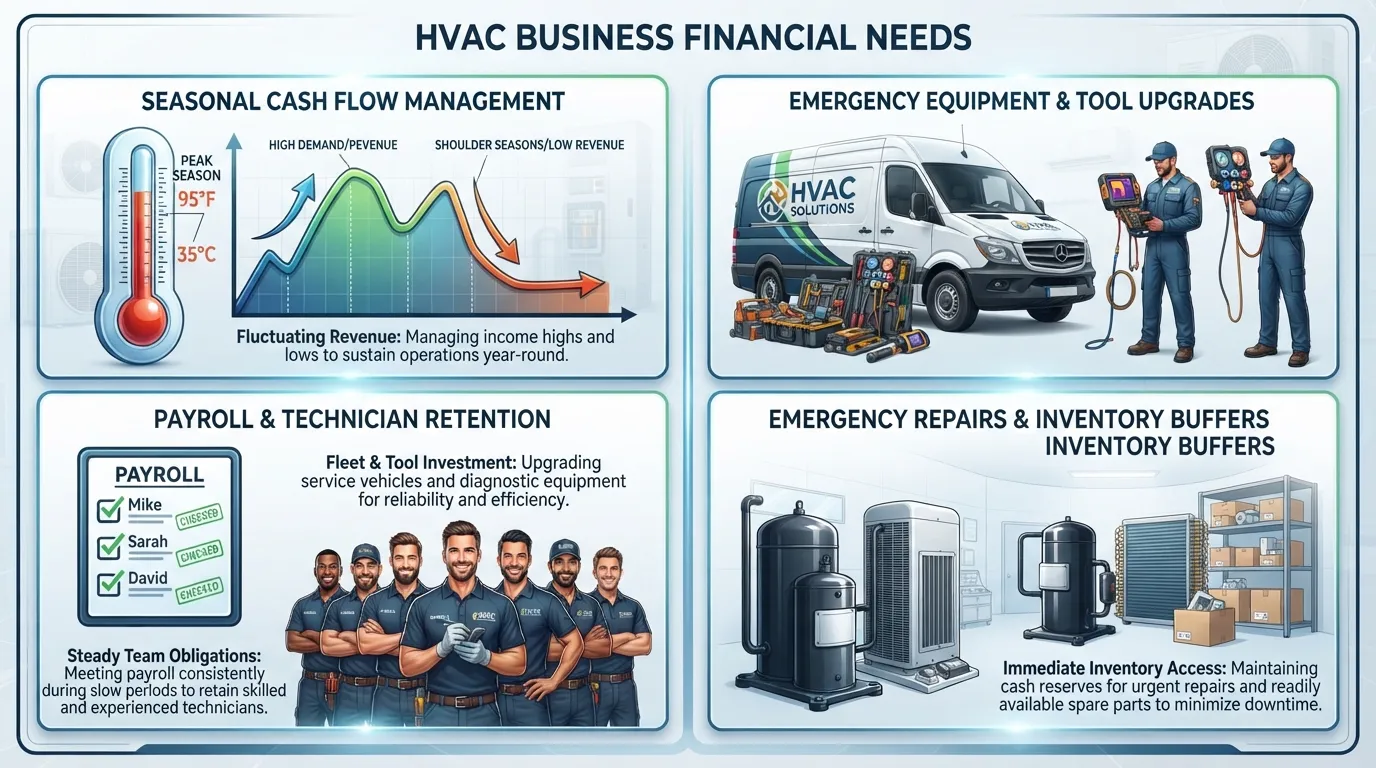 Seasonal trade businesses like HVAC contractors, plumbing companies, and roofing operations experience distinct cyclical revenue patterns that clash with fixed year-round overhead. Traditional term loans with rigid monthly payment schedules can suffocate a contractor during an unexpected shoulder-season slump.
Implementing flexible financing structures specifically designed for cyclical industries ensures your business can borrow when revenue dips and rapidly pay down balances when peak cooling or heating seasons drive high cash inflows.
Why Seasonal Trade Businesses Need Flexible Financing
Unlike steady retail or subscription businesses, seasonal contractors must accumulate surplus capital during peak months to survive lulls, or rely on specialized credit lines to bridge revenue troughs. Standard commercial loans often lack the draw-and-repay agility required by weather-driven trades.
- Cyclical Cash Flow Synchronization: Aligning repayment obligations directly with active service seasons rather than forcing flat payments through slow quarters.
- Agile Inventory Scaling: Deploying rapid capital to secure bulk parts before seasonal rushes without tying up permanent cash reserves.
- Multi-Trade Parallels: Sharing similar financing requirements with plumbing and roofing contractors who also battle weather-dependent project volumes.
Revolving Lines of Credit vs. Lump-Sum Loans for Seasonal Cash Flow
Choosing between a revolving line of credit and a lump-sum term loan dictates how efficiently you handle unexpected operational expenses. For seasonal trade businesses, revolving options generally provide superior liquidity management.
- Revolving Credit Advantage: Borrow up to an approved limit, draw funds only when needed for payroll or emergency repairs, and pay interest strictly on the utilized amount.
- Lump-Sum Limitations: Traditional term loans deliver cash all at once, triggering immediate interest accrual across the entire principal even if the funds sit unused.
- Structured Program Guidelines: Government-backed initiatives, such as SBA 7(a) working capital programs, offer maximum repayment terms up to 10 years, providing structured long-term relief for qualifying small businesses.
How Working Capital Saved an HVAC Business
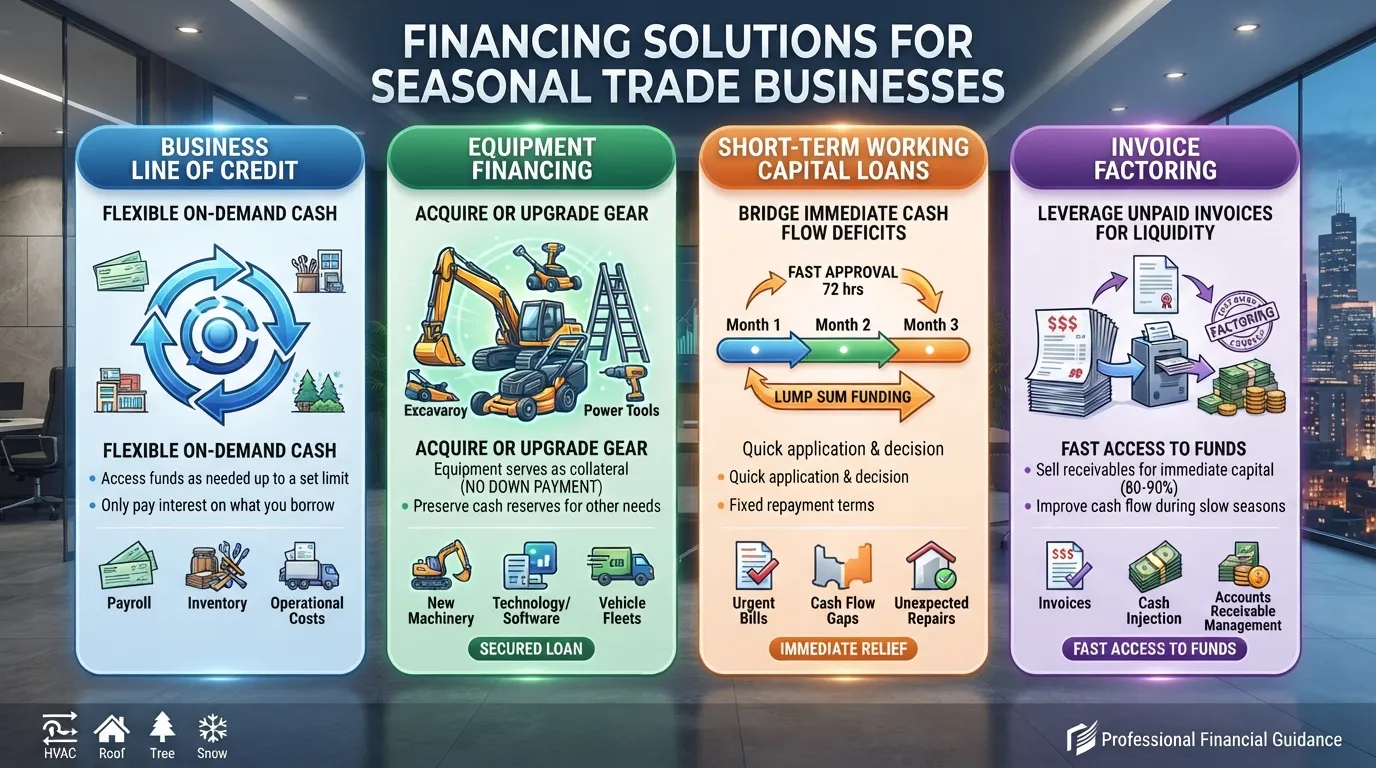 Theoretical strategies only go so far; seeing how working capital strategies protect a real contracting business highlights their true value. Reviewing an anonymized operational case study reveals how proactive liquidity management rescues a company from unexpected regional weather shifts.
Examining this practical scenario demonstrates the direct link between having accessible credit lines and maintaining uninterrupted business operations during severe market downturns.
Case Example A Mild Season Cash Flow Crisis and How It Was Solved
Consider “Apex Heating & Air,” a mid-size contractor operating 12 service trucks in a region that experienced an unusually mild winter. Because heating calls plummeted by 50%, their anticipated peak-season revenue vanished, leaving them unable to cover fixed shop rent and technician base salaries.
- The Crisis Point: Accounts receivable slowed to a crawl while mandatory payroll and vehicle lease payments remained fixed, creating an immediate $60,000 cash flow deficit.
- The Strategic Intervention: Rather than missing payroll or laying off veteran NATE-certified technicians, the owner drew upon a pre-arranged revolving line of credit.
- The Result: The credit line bridged the 90-day seasonal gap, allowing Apex to retain its expert staff, pivot quickly into early spring maintenance promotions, and bounce back profitably once summer cooling demand surged.
The Rise of Private Equity in HVAC What It Means for Working Capital
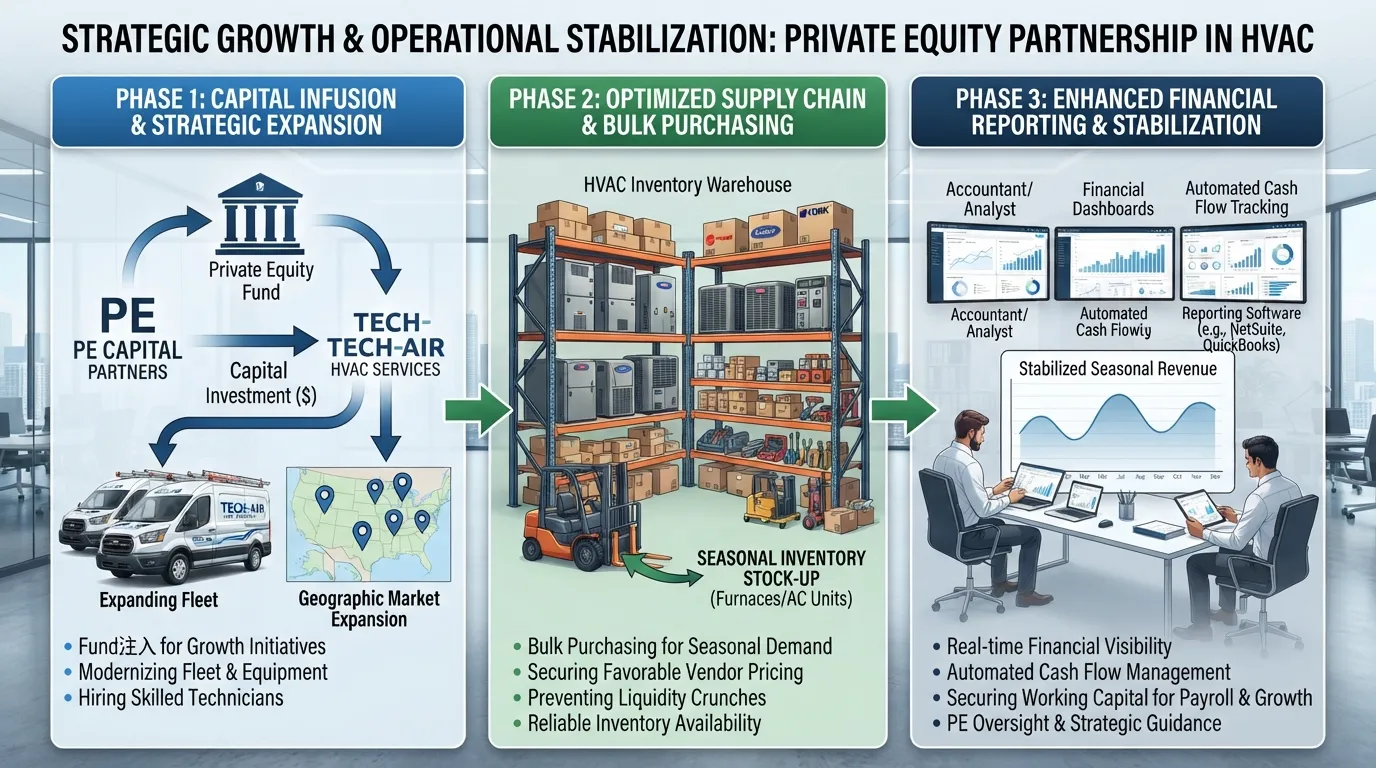 Private equity (PE) firms have aggressively targeted the heating, ventilation, and air conditioning sector, acquiring independent local contractors at a rapid pace. This wave of consolidation is transforming family-owned operations into large regional home-services giants.
Understanding why financial buyers are pouring capital into the trades illuminates how institutional investors view cash flow stability, recurring revenue models, and working capital management in modern service businesses.
Why PE Firms Are Consolidating HVAC Companies
Private equity firms love the HVAC industry because it combines essential service needs with highly predictable, recurring revenue streams. Homeowners and commercial property managers cannot ignore broken heating or cooling systems, creating an inelastic demand curve.
- Recurring Maintenance Agreements: Annual service contracts generate reliable year-round cash flow that appeals directly to institutional investors.
- Fragmented Market Opportunity: The industry is dominated by thousands of independent, mom-and-pop operators ripe for roll-up strategies and regional monopolies.
- Cross-Selling Potential: Large platforms easily bundle plumbing, electrical, and indoor air quality services into a single customer base.
How Working Capital Plays a Role in HVAC Acquisitions and Growth
When private equity firms acquire an HVAC business, optimizing working capital is one of the very first operational levers they pull. Institutional buyers streamline inventory management, negotiate aggressive vendor payment terms, and inject sophisticated credit lines to accelerate rapid multi-location expansion.
- Working Capital Optimization: PE operators audit accounts receivable and inventory turnover to free up trapped cash and improve overall liquidity ratios.
- Centralized Purchasing Power: Leveraging massive buying networks to slash equipment and parts costs across newly acquired regional branches.
- Aggressive Growth Funding: Using strong balance sheets and structured debt to fuel rapid geographic expansion and competitor buyouts.
Frequently Asked Questions
Navigating business finance in the heating, ventilation, and air conditioning industry raises many specific questions. Reviewing these direct answers helps clarify operational liquidity strategies, loan qualifications, and cash flow management.
Why would a company need working capital?
Companies need working capital to bridge cash flow gaps, fund daily operational expenses, and survive seasonal revenue fluctuations. For HVAC contractors, it ensures uninterrupted payroll during slow shoulder months, covers emergency inventory purchases before major storms, and handles strict vendor and tax obligations.
- Payroll Stability: Paying technicians consistently during unexpected weather slumps.
- Inventory Readiness: Pre-stocking crucial replacement parts and units ahead of peak seasons.
- Expense Management: Clearing short-term liabilities while waiting on 30-to-60-day commercial client payments.
How much working capital does an HVAC business need?
As a dependable industry guideline, HVAC businesses should maintain enough liquid cash reserves to cover three to six months of fixed operating expenses. Your exact requirement scales directly with your monthly overhead burn rate and active fleet size.
- Lean Cushion (3 Months): Suitable for established businesses with steady commercial contracts and moderate seasonal volatility.
- Extended Buffer (6 Months): Essential for contractors operating in extreme climate regions prone to severe weather swings and unpredictable slow periods.
What’s the difference between a working capital loan and equipment financing?
A working capital loan provides short-term cash injections to fund daily operating expenses like payroll, marketing, and taxes. In contrast, equipment financing is an asset-secured loan earmarked exclusively for purchasing physical machinery, service vans, or heavy shop tools.
- Working Capital Loans: Unsecured or revolving lines designed for short-term liquidity and cash flow smoothing.
- Equipment Financing: Secured loans tied directly to the lifespan and value of physical operational assets.
Can a new HVAC business qualify for working capital financing?
Yes, though approval requirements depend heavily on personal credit scores, initial business revenue history, and available collateral. Lenders typically look for at least six months to one year of operating history and steady monthly cash flow.
- Credit and Revenue Standards: Demonstrating consistent customer deposits and solid personal credit significantly improves approval odds.
- Alternative Lenders: Online business lenders offer faster approval for newer startups, though often with higher interest rates than traditional banks.
Conclusion and Key Takeaways
Mastering working capital is the ultimate differentiator between HVAC contractors who merely survive seasonal weather shifts and those who scale profitably into dominant regional market leaders. Protecting your liquidity ensures your business remains resilient against unpredictable demand.
By implementing disciplined cash reserve formulas, choosing the right financing structures, and planning ahead for equipment and payroll demands, you eliminate cash flow anxiety. Prioritizing working capital optimization unlocks the true long-term value and operational freedom of your heating and cooling business.
- Maintain a 3 to 6 Month Buffer: Keep adequate liquid reserves to comfortably cover your fixed overhead during slow shoulder seasons.
- Match Financing to the Need: Utilize working capital loans or lines of credit for short-term operational expenses, and reserve equipment financing strictly for physical vehicle and machinery purchases.
- Plan for Cyclical Swings: Anticipate labor, inventory, and tax obligations well in advance to prevent emergency cash crunches.

Oscar Vance | Master Plumber & Drainage Expert
Meet Oscar Vance, a licensed master plumber sharing practical solutions on residential repairs, preventive maintenance, and thoughtful home upkeep.