Is HVAC a Good Business to Start? Validation Hook
 Starting an HVAC business offers exceptional profit potential driven by non-discretionary consumer demand and high-margin recurring service contracts. However, success requires navigating labor shortages, upfront equipment costs, and rigorous technical licensing requirements.
Is HVAC a Good Business to Start in 2026?
Entering the HVAC market in 2026 remains a highly lucrative entrepreneurial path due to relentless demand and structural industry tailwinds. Climate shifts and aging residential infrastructure guarantee that heating and cooling repairs are never optional for property owners.
- Recession-Resistant Demand: Emergency repairs and system replacements happen regardless of broader economic downturns.
- Recurring Revenue Models: Preventative maintenance agreements transform one-time service calls into predictable year-round cash flow.
- High Ticket Services: Full system installations and major retrofits generate substantial revenue per transaction compared to standard handyman services.
Is the HVAC Industry Oversaturated?
While local markets feature plenty of independent contractors and national franchises, true saturation is rare for operators who prioritize operational excellence. The real bottleneck in the industry is not customer demand, but a persistent shortage of skilled technicians.
- The Skilled Labor Gap: Retiring baby boomers outpace new technician certifications, limiting the capacity of legacy competitors.
- Differentiated Service Wins: Companies leveraging modern digital dispatching, transparent pricing, and rapid response times easily capture market share.
- Geographic Growth: Rapid suburban expansion creates greenfield opportunities where local HVAC infrastructure is underdeveloped.
Can You Really Become a Millionaire in HVAC?
Building a seven-figure HVAC enterprise is entirely realistic by scaling beyond a single-truck operation into a multi-technician service fleet. Wealth generation stems from transitioning away from field labor and focusing purely on business systems, marketing, and asset acquisition.
- Fleet Scaling: Moving from one truck to a fleet of five to ten vans unlocks exponential revenue multiplication.
- Enterprise Valuation: Established HVAC companies with loyal customer bases command high valuation multiples when exiting or selling.
- High Margins on Parts: Equipment markups and specialized service labor yield strong net profit margins for well-managed companies.
The $5,000 Rule & Core HVAC Business Fundamentals
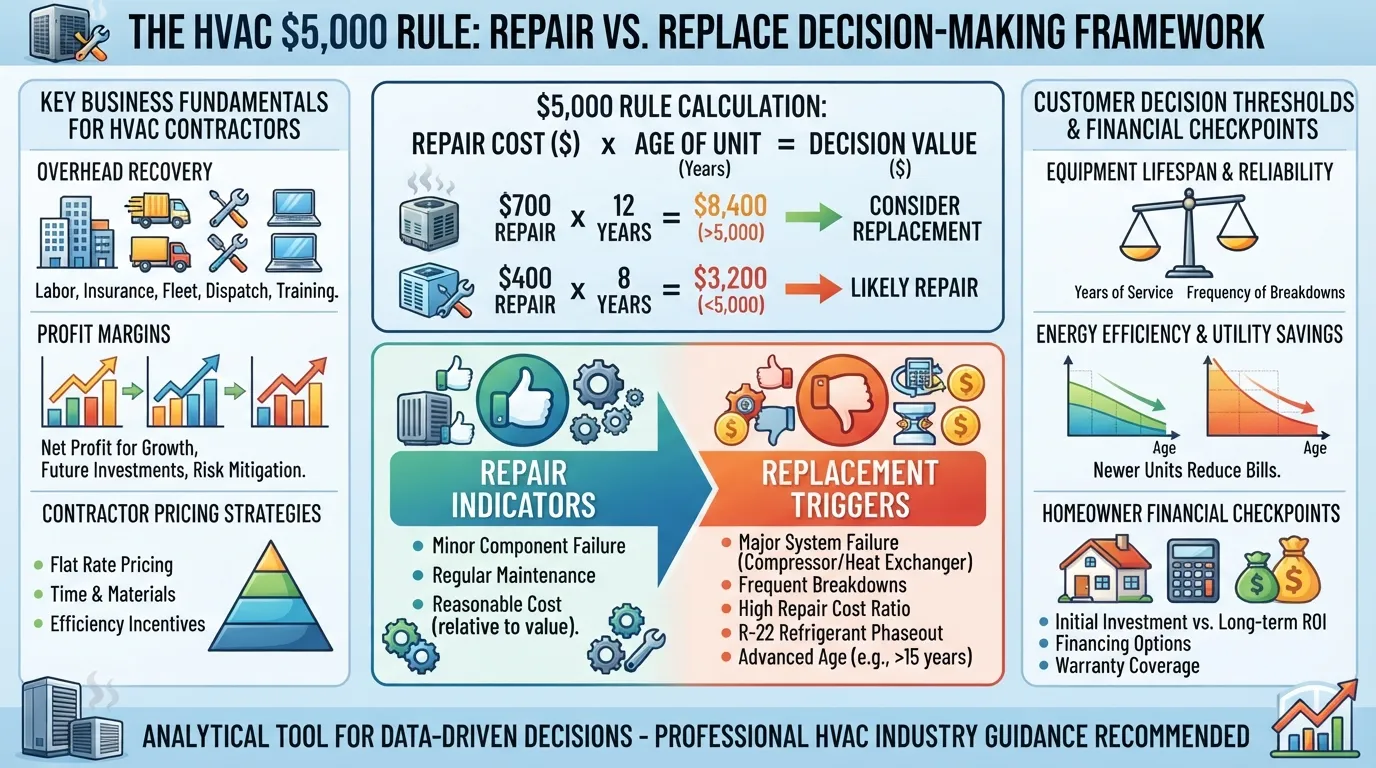 Mastering financial benchmarks like the $5,000 rule safeguards your HVAC business against unprofitable estimates and cash flow bottlenecks. Structured job costing ensures every service call accurately absorbs overhead while protecting net profit margins per job.
What Is the $5,000 Rule in HVA?
The $5,000 rule is a diagnostic formula used to evaluate whether a client should repair or replace an existing heating and cooling system. You multiply the age of the unit in years by the estimated repair cost; if the resulting product exceeds $5,000, full system replacement is generally the financially sound choice.
- The Core Calculation: System Age ($) \times$ Repair Quote ($) = Decision Metric.
- Consumer Guidance: For example, a 10-year-old unit needing a $600 repair yields $6,000, pointing strongly toward replacement over a temporary fix.
- Sales Conversion Hook: Contractors who explain this rule build instant trust, positioning themselves as objective advisors rather than aggressive salespeople.
Why This Rule Matters for Pricing and Cash Flow
Understanding consumer decision frameworks allows smart contractors to align their pricing tiers and upgrade incentives with homeowner psychology. When customers understand replacement economics, closing high-ticket installation jobs becomes significantly easier.
- Overhead Recovery: Higher conversion rates on full system replacements secure the substantial cash flow needed to cover technician salaries and fleet expenses.
- Preventing Callback Losses: Discouraging clients from pouring money into dying units prevents cheap band-aid repairs that lead to disgruntled customer callbacks and warranty losses.
- Predictable Revenue Streams: Shifting customer focus from minor fixes to major installations boosts average ticket value and long-term business valuation.
How to Apply the $5,000 Rule When Estimating Jobs
Integrating the $5,000 rule into your field-bidding process creates a standardized framework that field technicians can effortlessly communicate to homeowners. Consistency in quoting protects your margins and establishes brand authority in competitive local markets.
- Standardized Diagnostic Checklists: Train dispatchers and service techs to log equipment age alongside part failure costs during every initial inspection.
- Transparent Presentation: Show customers the math explicitly on your digital invoice software to justify why a replacement quote provides better long-term value.
- Financing Integration: Pair the $5,000 threshold directly with monthly financing options to turn high-replacement sticker shock into manageable payment plans.
Licenses Certifications & Legal Setup
 Launching a legally compliant HVAC enterprise requires strict adherence to federal environmental rules, structured business entities, and state-mandated contractor licensing. Securing proper credentials protects your company from severe financial liabilities and heavy regulatory fines.
EPA Section 608 Certification: What It Covers and How to Get It
Federal law mandates that any technician handling or recovering regulated refrigerants must hold an active EPA Section 608 Technician Certification. The exam is broken down into specific segments covering small appliances, high-pressure systems, and universal handling guidelines.
- Core & Specialized Types: Technicians must pass the Core section alongside Type I, Type II, or Type III examinations depending on equipment scale.
- Universal Status: Passing all equipment categories grants Universal certification, allowing technicians to service any residential or commercial unit.
- Compliance Mandate: Operating without certified personnel exposes your business to federal audits and immediate shutdown of refrigerant-related operations.
Registering Your Business: EIN LLC vs Sole Proprietorship
Structuring your business entity correctly separates personal assets from commercial liabilities while establishing your tax identity. An Employer Identification Number (EIN) is required to open business bank accounts and hire payroll employees.
- Limited Liability Company (LLC): Provides essential legal shielding against personal asset seizure if a commercial lawsuit or property damage claim occurs.
- EIN Registration: Free to acquire directly through the IRS website, enabling clean corporate tax reporting and contractor verification.
- Corporate Bank Separation: Mixing personal and business funds pierces the corporate veil, destroying your LLC liability protection.
State & Local Contractor Licensing Requirements
Beyond federal environmental mandates, individual states enforce rigid HVAC contractor licensing criteria that typically require verified field experience and board exams. Operating without a state license is classified as a misdemeanor or felony in many jurisdictions.
- Experience Prerequisites: Most states demand between two to four years of documented journeyman-level field experience before sitting for the master contractor exam.
- Bonding and Surety: State boards require surety bonds to guarantee that consumers are financially protected against incomplete or substandard work.
- Local Permits: Municipalities often require local permits and secondary local business tax receipts for major system installations.
HVAC Licensing Requirements in Texas
Texas regulates the industry through the Texas Department of Licensing and Regulation (TDLR), offering specific Class A and Class B Air Conditioning and Refrigeration Contractor licenses.
- Class A License: Permits work on any size system without weight or capacity restrictions for residential or commercial properties.
- Class B License: Restricts contractors to residential systems up to 25 tons and commercial systems up to 15 tons.
- Experience Verification: Applicants must prove at least 48 months of practical experience within the past 72 months under a licensed contractor.
HVAC Licensing Requirements in Florida
Florida enforces strict statewide contractor standards via the Department of Business and Professional Regulation (DBPR), dividing licenses into Certified and Registered categories.
- Certified Contractor (CAC or CFC): Allows you to contract and operate anywhere within the state of Florida without local board restrictions.
- Registered Contractor: Confines your operational scope strictly to specific local municipalities where you have successfully registered your competency card.
- Financial & Background Checks: Applicants must clear comprehensive credit checks, criminal background screenings, and maintain active liability bonds.
Insurance You Legally Need: General Liability Workers’ Comp Commercial Auto
Commercial insurance is your ultimate safeguard against catastrophic financial loss resulting from property damage, workplace injuries, or vehicle accidents. Most general contractors and commercial clients require proof of insurance before issuing subcontracts.
- General Liability Insurance: Covers accidental property damage or bodily injury caused during routine service calls or system installations.
- Workers’ Compensation: Legally required once you cross state employee thresholds, covering medical bills and lost wages if a technician is injured on the job.
- Commercial Auto Insurance: Protects your service fleet, specialized tools, and ladder racks against highway collisions and cargo theft.
HVAC Startup Costs: Full Breakdown
Launching a professional HVAC business requires strategic capital allocation, spanning specialized diagnostic tools, reliable transport, and initial working capital. Total startup expenses range dramatically based on whether you launch as a lean solo operator or scale immediately with a commercial fleet.
Startup Cost Table: Tools Vehicle Licensing Insurance Marketing
Calculating accurate initial expenses prevents undercapitalization and cash flow failure during your first year of operation. The comprehensive startup cost breakdown below details the essential investment categories required to launch a fully compliant, professional HVAC enterprise from day one.
Low-Cost Way to Start Owner-Operator Model
Launching an owner-operator model allows skilled technicians to enter the market with minimal startup capital by leveraging existing personal vehicles and focusing exclusively on service calls. This lean bootstrap approach minimizes financial risk while building a loyal residential client base.
- Use Existing Transport: Convert a personal truck or SUV with a secure ladder rack instead of buying a commercial van immediately.
- Prioritize Diagnostics & Repair: Focus capital on high-margin diagnostic work and preventative maintenance rather than costly bulk inventory.
- Bootstrap Marketing: Leverage word-of-mouth referrals, local community groups, and free Google Business Profile optimization to secure early clients.
Full-Scale Startup Cost With Crew and Fleet
Building a full-scale HVAC enterprise from day one requires a substantial capital injection ranging from fifty thousand to over one hundred thousand dollars to fund commercial vehicles and payroll. This institutional approach prioritizes rapid market penetration and multi-technician service coverage.
- Multi-Vehicle Fleets: Purchasing or leasing multiple custom-wrapped service vans to deploy several technicians simultaneously across your target territory.
- Advanced Dispatch Software: Investing in enterprise field service management software, CRM tools, and dedicated customer service representatives.
- Aggressive Paid Acquisition: Funding high-budget digital ad campaigns, local SEO dominance, and direct mail to ensure immediate job volume.
How Profitable Is an HVAC Business?
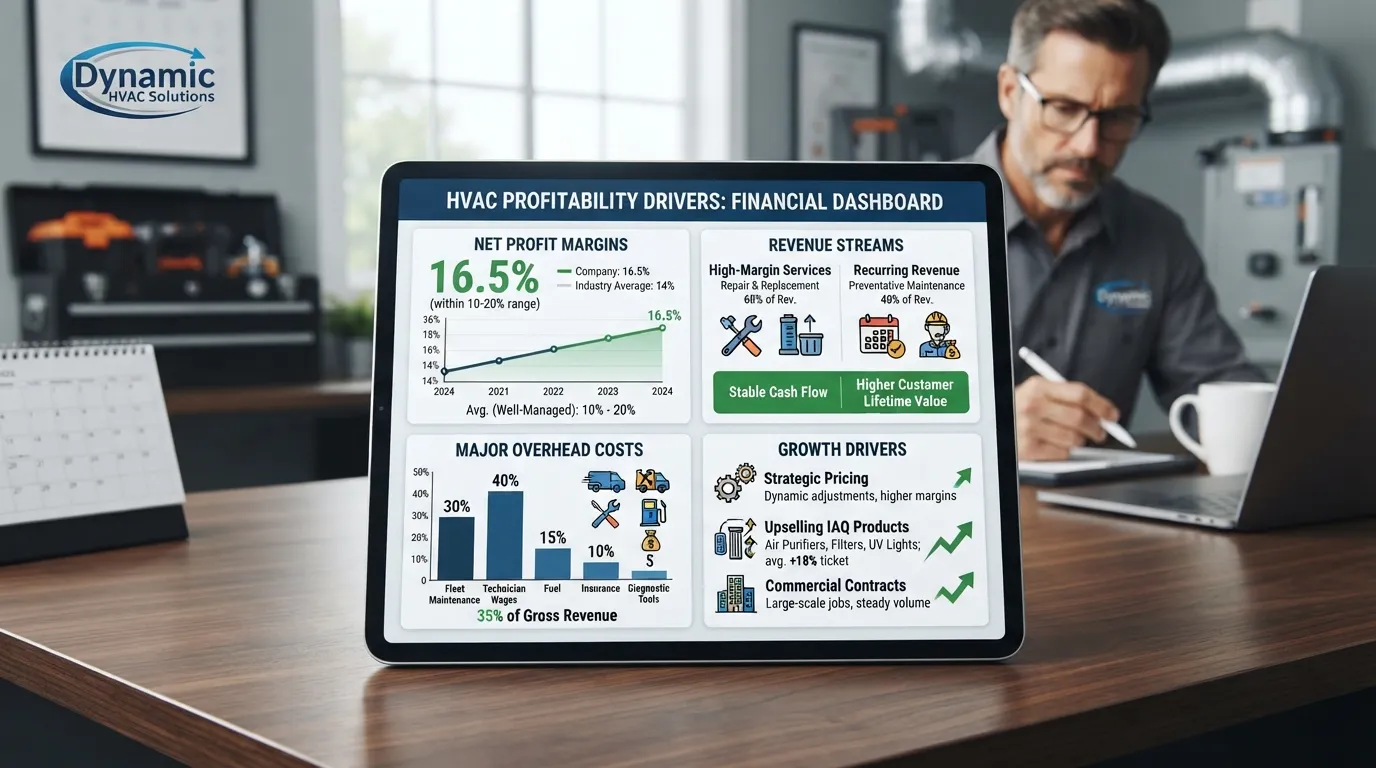 Operating an HVAC enterprise yields exceptional profitability when managed with strict overhead control and high-ticket service strategies. Net income scales dramatically as companies transition from solo operators into multi-truck service fleets generating consistent recurring revenue.
HVAC Business Owner Salary: What the Data Shows
Industry data indicates that established HVAC business owners earn an average annual net profit ranging from $100,000 to over $300,000. Owner earnings directly correlate with company size, operational efficiency, and the proportion of high-margin installation work versus emergency service calls.
- Solo Owner-Operator Average: Independent technicians running a single van typically net between $85,000 and $130,000 in take-home pay.
- Fleet Owner Earnings: Owners managing three to five technicians routinely generate net business profits exceeding $250,000 annually.
- Profit Reinvestment: Successful founders frequently reinvest a portion of early profits into additional vans and specialized inventory to fuel compounding growth.
Can an HVAC Business Owner Make $100,000+ a Year?
Reaching and surpassing the $100,000 annual profit milestone is entirely achievable within the first two years of operation by maintaining high labor utilization rates. Capitalizing on high-ticket system replacements and preventative maintenance agreements accelerates income growth far beyond standard field technician wages.
- High Average Ticket Value: Full residential HVAC system replacements range from $7,000 to $15,000, yielding strong gross margins per job.
- Maintenance Contract Stability: Annual service agreements lock in recurring upfront cash flow while securing future repair and replacement leads.
- Billable Hour Optimization: Maximizing technician billable hours and minimizing windshield time directly drives owner profitability.
Profit Margins: Residential vs. Commercial HVAC
Choosing between residential and commercial markets dictates your pricing structure, cash flow velocity, and net profit margins. Both sectors offer distinct financial advantages depending on your company’s capitalization and workforce skill level.
- Residential Profit Margins: Residential replacement and repair work typically yields higher net profit margins (15% to 25%) due to urgent consumer demand and equipment markups.
- Commercial Cash Flow: Commercial contracts offer massive project values and predictable multi-year service agreements, though profit margins can be narrower (10% to 18%) due to competitive bidding.
- Payment Velocity: Residential customers pay upon job completion, whereas commercial clients often operate on 30-to-60-day net payment terms requiring strong working capital reserves.
The $100K Cash Reserve Rule Explained
Maintaining a robust cash reserve is the primary differentiator between HVAC businesses that survive seasonal market shifts and those that fail within the first three years. The $100K cash reserve benchmark protects your operations against delayed commercial receivables, seasonal slow periods, and sudden equipment failures.
- Seasonal Demand Flips: Cushioning your bank accounts prepares your business for spring and fall shoulder months when heating and cooling repair requests dip temporarily.
- Payroll Protection: Ensuring payroll funds remain untouched guarantees technician retention even if major commercial clients delay invoice payments.
- Inventory Purchasing Power: Having liquid cash on hand allows you to buy replacement units and high-demand parts in bulk at manufacturer-discounted rates.
Financial Management That Keeps HVAC Businesses Alive
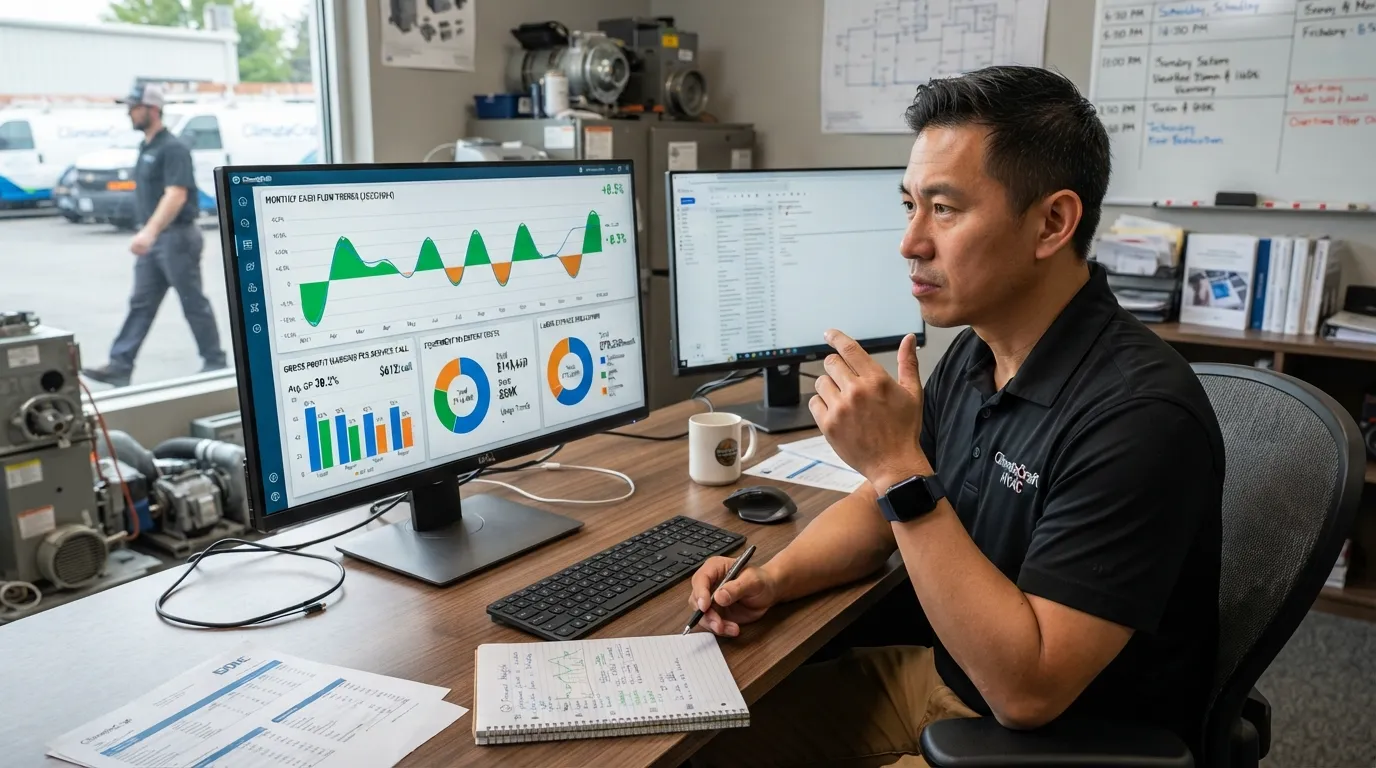 Proper financial management is the backbone of any sustainable HVAC business, protecting you from cash flow crunches, unexpected tax liabilities, and underpriced service calls. Implementing robust accounting software and disciplined cost-plus pricing ensures long-term enterprise growth and stability.
Why You Need a CPA From Day One
Partnering with a Certified Public Accountant (CPA) from day one is essential for avoiding costly tax mistakes, structuring your entity correctly, and maximizing depreciation deductions on service vehicles and specialized tools. An experienced trade accountant transforms raw financial data into actionable growth insights and protects you from federal audits.
- Strategic Entity Structuring: Your CPA ensures your LLC or corporation is taxed under the most advantageous classification to minimize self-employment tax liabilities.
- Fleet Asset Depreciation: Expert management of Section 179 tax deductions allows you to write off heavy commercial vehicle purchases quickly.
- Quarterly Tax Compliance: Automated estimated tax filings prevent painful IRS penalties and year-end cash flow surprises.
Pricing: Stop Undercharging
Many new HVAC owners fail because they price jobs based on guesswork rather than comprehensive overhead recovery formulas. Implementing a structured cost-plus pricing model guarantees that every service call accurately accounts for direct labor, parts, vehicle expenses, and your target net profit margin.
- The Cost-Plus Formula: Calculate your true hourly cost including overhead, multiply by a standard markup factor of 2.0 to 2.5, and establish fixed flat-rate pricing tiers.
- Labor Burden Calculation: Remember that an employee’s true cost goes far beyond their hourly wage, factoring in payroll taxes, insurance, and benefits.
- Eliminating Gut-Check Bidding: Standardized pricing sheets eliminate technician hesitation and ensure consistent profitability across all jobs.
Accounting & Field Service Software
Integrating specialized field service management software with powerful accounting platforms like QuickBooks streamlines invoicing, inventory tracking, and payment collections. Automating these administrative workflows eliminates manual data entry errors and accelerates your daily cash flow velocity.
- QuickBooks Integration: Syncing your field invoicing directly with QuickBooks keeps your general ledger updated in real time without double data entry.
- Mobile Field Invoicing: Empowering technicians to collect credit card payments and signature approvals on-site drastically cuts down accounts receivable collection times.
- Inventory Management: Automated stock tracking prevents trucks from running out of essential refrigerants and capacitors mid-job.
Cash Flow Management During Slow Seasons
Navigating seasonal shoulder months requires proactive financial planning to ensure payroll and vehicle leases are fully covered when heating and cooling repair requests dip temporarily. Diversifying into indoor air quality upgrades and preventative maintenance agreements stabilizes revenue throughout the year.
- Shoulder Month Mitigation: Launch targeted marketing campaigns for duct cleaning and indoor air quality upgrades during spring and fall lulls.
- Maintenance Agreement Buffers: Prepaid annual maintenance contracts generate reliable upfront cash injections that cushion your bank accounts during slow periods.
- Revolving Credit Lines: Securing a commercial line of credit before you need it ensures you can easily cover payroll during unexpected market downturns.
Building Operations Tools Equipment & Vendor Relationships
Establishing an efficient operational infrastructure separates high-earning HVAC enterprises from struggling contractors. Investing in professional-grade diagnostic equipment, strategic vehicle organization, and reliable distributor relationships ensures seamless daily execution in the field.
Essential Tools & Equipment Checklist for a New HVAC Business
Equipping your service vehicle with high-grade diagnostic and recovery tools prevents costly return trips and guarantees compliance with federal environmental regulations. A professional startup toolkit must cover electrical testing, refrigerant handling, and precise airflow measurement.
- Refrigerant Recovery Machine & Tank: Essential for legally pulling down and storing system refrigerant during repairs and replacements.
- Digital Manifold Gauges: Accurate pressure readings for diagnosing subcooling and superheat metrics across different refrigerant types.
- Vacuum Pump & Micron Gauge: Critical for achieving a deep vacuum to dehydrate linesets prior to system startup.
- Electrical Multimeter: Designed for testing voltage, microfarads on capacitors, and continuity on compressor windings.
Setting Up Your Service Vehicle
Your service vehicle functions as your mobile workshop, showroom, and primary brand billboard on the road. Organizing your van with custom shelving, bin systems, and secure ladder racks ensures rapid tool retrieval and prevents damaged inventory.
- Custom Interior Shelving: Heavy-duty metal racks organized with labeled bins for capacitors, contactors, fittings, and universal motors.
- Secure Tool Mounts: Dedicated floor or wall brackets to lock down recovery tanks, nitrogen bottles, and torch kits during transit.
- Professional Fleet Branding: Clean vinyl wraps displaying your company name, license number, and emergency phone number to capture inbound leads while parked.
Building Relationships With Parts Distributors Credit Terms Explained
Establishing strong accounts with major local HVAC distributors grants you access to wholesale pricing, priority equipment allocation, and vital commercial credit terms. Cultivating a close relationship with your local branch manager ensures you secure parts faster during peak seasonal heatwaves.
- Net-30 Commercial Credit: Negotiating 30-day payment terms allows you to complete large installations and collect customer payments before settling supplier invoices.
- Dealer Program Perks: Partnering closely with major equipment manufacturers unlocks co-op marketing funds, extended warranties, and dealer recognition programs.
- Priority Counter Service: Building rapport with counter staff guarantees fast parts identification and preferential loading during emergency breakdown calls.
Field Service Management Software for Scheduling & Dispatch
Modern field service management (FSM) software automates your dispatching, customer communications, and mobile invoicing workflows to eliminate operational bottlenecks. Leveraging cloud-based dispatching tools ensures zero dropped calls and maximized daily job completion rates for your technicians.
- Real-Time Dispatching: Drag-and-drop scheduling boards match incoming emergency calls with the nearest available technician based on GPS tracking.
- Automated Customer SMS Reminders: Automated text notifications inform homeowners when a technician is en route, significantly reducing no-show appointments.
- Digital Pricebooks: Integrated mobile pricebooks empower technicians to present clear, tiered repair and replacement options directly from a tablet.
Hiring & Building Your Team
 Transitioning from a solo technician into an executive CEO requires mastering strategic hiring, employee retention, and scalable client acquisition. Building a dependable team allows you to step out of the daily truck grind and focus entirely on high-level business growth.
When to Hire Your First Technician
Deciding to hire your first HVAC technician depends on achieving consistent revenue stability and hitting strict operational capacity limits. Bringing on help too early can drain cash reserves, while waiting too long leads to missed service calls and severe owner burnout.
- The 80% Utilization Threshold: Hire when you are consistently booked out more than a week in advance and routinely turning away profitable service calls.
- Stable Cash Flow Buffer: Ensure you have at least three months of payroll reserves banked before bringing on a full-time W-2 technician.
- Administrative Readiness: Set up reliable dispatch software, payroll processing, and commercial insurance coverage prior to your first hire’s start date.
Finding and Retaining Skilled HVAC Technicians
The persistent skilled trades shortage means that attracting and keeping top-tier technicians requires offering competitive compensation, ongoing training, and a positive company culture. Cultivating strong internal loyalty protects your investment and prevents costly workforce turnover.
- Competitive Compensation & Benefits: Offer top-market hourly wages, commission incentives, health insurance, and paid time off to attract experienced talent.
- Continuous Professional Development: Sponsor advanced manufacturer certifications and technical workshops so your team can master modern smart-home and variable-speed systems.
- Clear Internal Career Paths: Provide transparent advancement tracks allowing technicians to progress into lead installers, service managers, or operational supervisors.
How to Attract Clients With Little Experience or Network
Launching an HVAC business without an established local network requires aggressive digital positioning and hyper-local marketing strategies to capture immediate emergency demand. Leveraging high-intent digital channels bridges the gap while you build long-term word-of-mouth referral networks.
- Google Business Profile Dominance: Optimize your local listing with verified service categories, professional truck wrap photos, and rapid review collection to capture top-map pack rankings.
- Targeted Local Service Ads (LSAs): Utilize pay-per-lead search platforms to appear instantly at the very top of mobile searches for emergency heating and cooling repairs.
- Strategic Subcontracting: Partner with busy general contractors, property managers, and home warranty companies to secure steady, recurring sub-tier service work.
Avoiding Owner Burnout: Moving From Technician to CEO
Many blue-collar entrepreneurs get trapped working 80 hours a week inside their business instead of working on building an enterprise. Transitioning successfully from a wrench-turning technician to an executive CEO requires delegating field operations and trusting your administrative systems.
- Embracing Delegation: Hand off dispatching, invoicing, and basic maintenance calls to hired staff so you can focus entirely on marketing and financial strategy.
- Standardizing Operating Procedures: Document every administrative and technical workflow in a digital operations manual to ensure consistent service quality across your entire crew.
- Stepping Out of the Truck: Commit to permanently leaving the service van parked once your management and overhead revenue can reliably support your full-time executive salary.
Marketing & Local SEO for HVAC Companies
Dominating your local market requires a rigorous local SEO strategy and a high-converting digital presence to capture emergency service calls. Implementing structured optimization tactics ensures your company outranks legacy competitors on Google’s map pack for high-intent search terms.
Local SEO for HVAC: Ranking for Furnace Repair Near Me
Ranking at the top of organic search results for lucrative commercial terms like “furnace repair near me” requires a combination of localized service page architecture and consistent citation building. Optimizing your website for hyper-local geographic keywords ensures search engines match your business with homeowners experiencing immediate heating and cooling emergencies.
- Dedicated City Landing Pages: Build individual service pages for every distinct suburb or neighborhood you service to capture precise geographic search intent.
- Schema Markup Integration: Implement LocalBusiness and HVACBusiness schema markup across your site to help search crawlers verify your operating hours, address, and service area.
- Fast Mobile Page Speed: Optimize your site speed to ensure distressed homeowners can load your emergency contact numbers instantly on mobile devices.
Optimizing Your Google Business Profile
Your Google Business Profile (GBP) is the most powerful local marketing asset in your arsenal, dictating whether you appear in the top three map listings. Optimizing your profile with precise category selections, geotagged project photos, and consistent NAP (Name, Address, Phone) data drives immediate inbound phone volume.
- Primary & Secondary Categories: Set “HVAC Contractor” as your primary category, supplemented by relevant secondary tags like “Air Conditioning Repair Service” and “Furnace Repair Service.”
- Geotagged Project Media: Regularly upload high-resolution photos of your service vans, diagnostic work, and completed installations to signal active local operations.
- Regular GBP Posts: Publish weekly Google Posts highlighting seasonal maintenance tips, special promotions, and emergency availability to boost algorithmic engagement.
Getting More 5-Star Reviews
Consistent five-star reviews serve as foundational social proof that builds instant trust and dramatically boosts your local map pack ranking. Implementing an automated review collection workflow immediately following successful service calls ensures a steady stream of fresh customer testimonials.
- Immediate Post-Service SMS Script: “Hi [Client Name], thanks for choosing [Company Name] today! If [Technician Name] provided 5-star service, could you take 30 seconds to leave us a quick review here: [Direct Review Link]? We truly appreciate your support!”
- Automated Follow-Up Sequences: Use field service software to automatically trigger review requests via email and text message within two hours of job completion.
- Professional Review Management: Respond promptly and professionally to every review—both positive and negative—to demonstrate active customer care to prospective clients.
Referral Programs That That Actually Work
Word-of-mouth recommendations convert at a higher rate than any paid digital channel, making structured referral programs a cornerstone of sustainable HVAC growth. Incentivizing your existing residential base transforms loyal homeowners into active brand advocates.
- Cash or Credit Rewards: Offer a $50 credit toward future maintenance services or a direct cash reward for every client who books a system repair or replacement via a referral.
- VIP Maintenance Perks: Provide free priority dispatching or waived diagnostic fees for customers who successfully refer two new homeowners to your annual maintenance plan.
- Automated Referral Reminders: Include polite referral reminders inside your annual preventative maintenance renewal letters and automated post-service thank you emails.
Networking With Builders Realtors & Property Investors
Forming strategic B2B partnerships with local home builders, real estate agents, and property management portfolio investors secures reliable, recurring commercial project volume. Aligning your business with real estate professionals positions your company as the go-to contractor for pre-sale HVAC inspections and emergency repairs.
- Real Estate Inspection Partnerships: Partner with local home inspectors and realtors to offer fast turnaround on pre-purchase HVAC certifications and minor repairs.
- Property Management Contracts: Secure recurring multi-unit service and maintenance agreements with local landlords managing residential rental portfolios.
- New Construction Bidding: Connect with custom home builders early in the architectural planning phase to bid on high-margin complete ductwork and system installations.
Recurring Revenue: Maintenance Agreements
 Locking in recurring revenue through structured preventative maintenance agreements transforms an unpredictable seasonal trade into a stable, high-valuation enterprise. Cultivating a dedicated membership base guarantees year-round cash flow and secures first-access rights to high-margin system replacements.
Why Maintenance Agreements Are the Backbone of Stable Revenue
Preventative maintenance agreements stabilize your annual cash flow by flattening out the severe revenue dips during spring and fall shoulder months. Transitioning customers from one-time emergency repair callers into recurring members significantly increases lifetime customer value and business valuation multiples.
- Shoulder Season Cash Injections: Prepaid annual membership renewals generate reliable working capital during transitional months when emergency service calls slow down.
- First-Right for Replacements: Regular bi-annual home visits allow your technicians to identify failing equipment early, securing full system replacement jobs before competitors get the call.
- Guaranteed Fleet Utilization: Maintenance visits can be scheduled dynamically during slow weekdays to keep your technicians fully billable and productive.
How to Structure a Maintenance Plan Pricing Tiers Example
Designing a tiered maintenance program gives homeowners clear options while maximizing your recurring profit margins. A successful membership model should offer compelling perks that incentivize customers to upgrade to premium annual packages.
- Standard Tier ($150/Year): Includes one annual AC tune-up, one heating check, standard filter replacements, and 10% off any necessary repair parts.
- Premium Tier ($250/Year): Includes bi-annual visits, priority emergency dispatching, waived diagnostic fees, and 15% off parts and labor.
- Commercial/VIP Tier ($450/Year): Tailored for larger homes or multi-zone systems, featuring free drain-line clearings, comprehensive safety inspections, and 20% off all major repairs.
Converting One-Time Customers Into Recurring Members
The ideal time to pitch an annual maintenance plan is immediately after a technician successfully resolves an emergency repair and earns the homeowner’s trust. Training your field team to present memberships as a risk-free protection plan drives high conversion rates on every service call.
- The Cost-Savings Pitch: Explain how the diagnostic fee waiver and repair discounts on their current invoice practically pay for the membership fee upfront.
- Automated Renewal Funnels: Utilize field service software to send automated email and SMS prompts when a customer’s seasonal tune-up window opens.
- Technician Incentives: Offer your field technicians a direct cash spiff or commission bonus for every annual maintenance agreement they sell on-site.
Why HVAC Businesses Fail And How to Avoid It
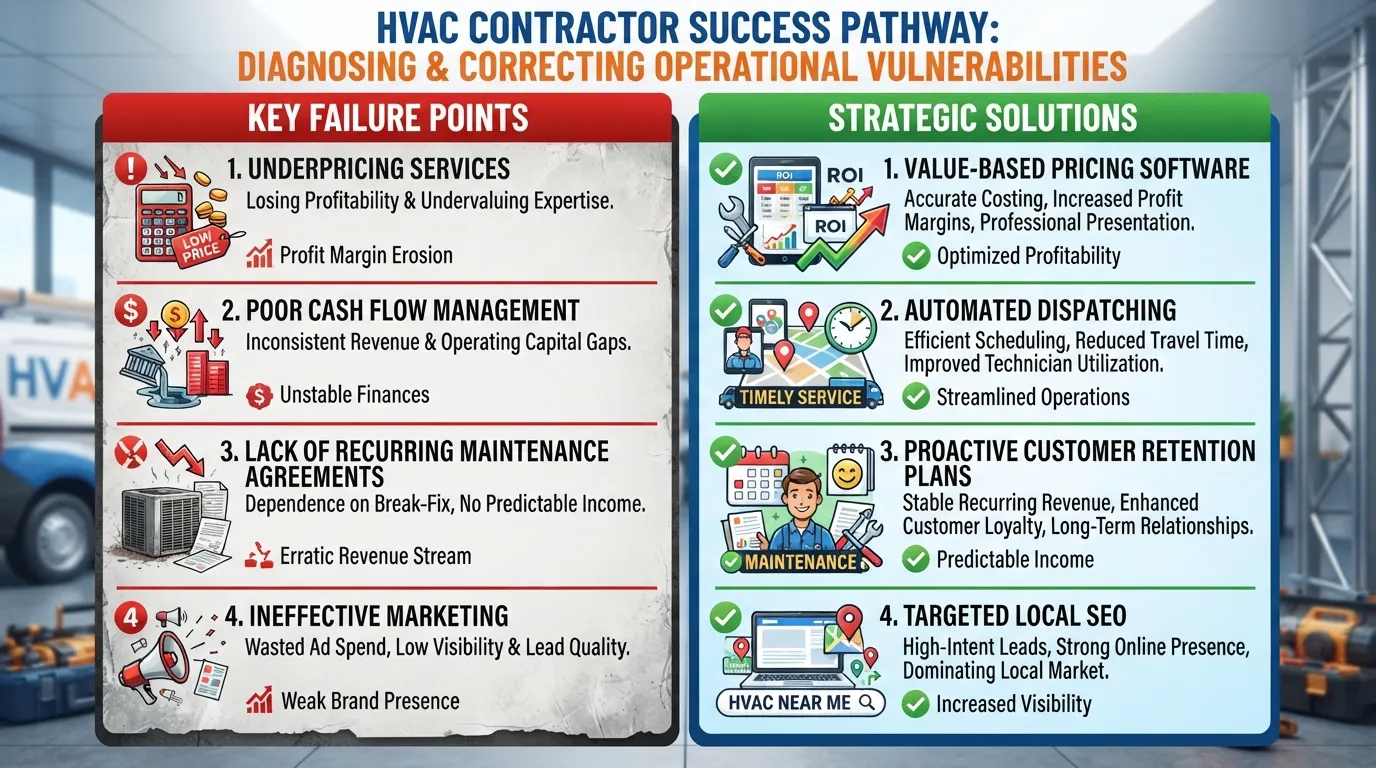 Operating a successful HVAC business demands much more than top-tier technical repair skills; it requires rigorous financial discipline, cash flow management, and scalable systems. Understanding the primary failure points allows new operators to proactively safeguard their enterprise against common pitfalls.
What Percentage of HVAC Businesses Fail? Direct Answer
Industry failure statistics indicate that roughly 45% to 50% of new HVAC businesses close their doors within the first five years of operation, mirroring general small business mortality rates. However, aggressive startups that lack proper capitalization or underprice their services often see even higher casualty rates during their initial twelve months.
- Year-One Vulnerability: Overcapitalization strains and cash flow crunches cause a significant percentage of new ventures to fold before finishing their first full year.
- The Profit vs. Volume Trap: Many operators mistake high gross revenue for net profitability, burning through cash reserves on unprofitable, low-bid service calls.
- Technical Skill vs. Management: Exceptional field mechanics often struggle with executive leadership, failing to build administrative systems or delegate daily tasks.
Top Reasons HVAC Businesses Struggle or Shut Down
Pinpointing why contractors fail reveals recurring operational errors that sabotage otherwise talented technicians. Recognizing these core vulnerabilities helps you insulate your business from unexpected insolvency.
- Severe Undercapitalization: Running out of liquid cash before securing enough recurring maintenance contracts or high-ticket system replacement jobs.
- Underpricing and Poor Job Costing: Charging hourly rates based on competitor guesswork without properly factoring in true labor burden, vehicle overhead, and insurance.
- Seasonal Cash Flow Mismanagement: Failing to bank cash during peak summer and winter months, leaving the business unable to cover payroll and lease payments during shoulder seasons.
How to Avoid the Most Common Failure Points
Building a resilient, long-lasting HVAC enterprise requires implementing strict financial controls, automated processes, and data-driven pricing models from day one. Protecting your bottom line ensures your company outlasts local competitors and achieves sustainable multi-truck scaling.
- Maintain a 3-Month Emergency Buffer: Keep dedicated cash reserves untouched in a separate account to absorb delayed commercial invoices and seasonal slowdowns.
- Adopt Flat-Rate Cost-Plus Pricing: Utilize structured pricing matrices that guarantee a 25% to 35% net profit margin on every repair and replacement job.
- Invest in Automation Early: Deploy field service management software and automated review collection tools to maximize operational efficiency and eliminate administrative bottlenecks.
The Future of HVAC Business 2026 and Beyond
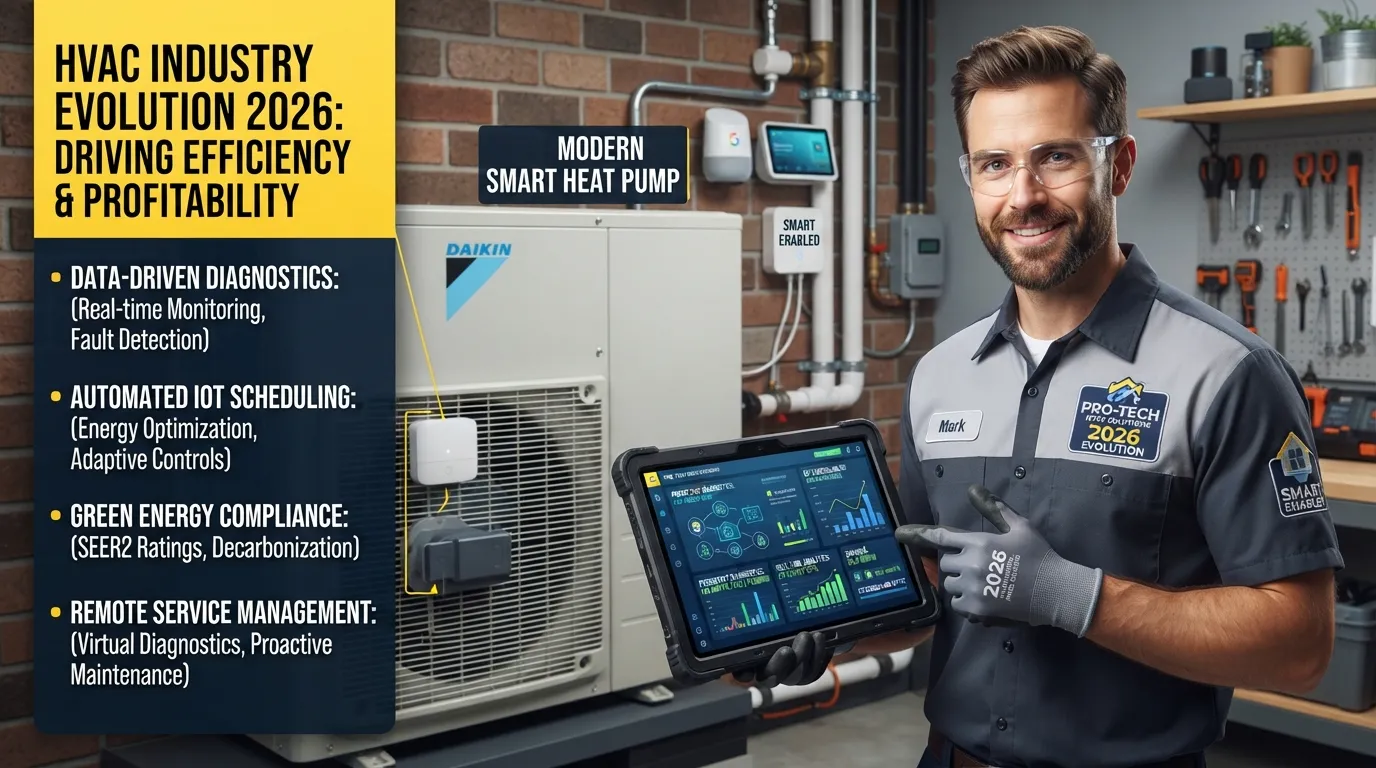 The HVAC industry is undergoing a massive transformation driven by rapid technological advancements, strict environmental regulations, and accelerating electrification mandates. Contractors who align their business models with emerging high-efficiency trends are exceptionally positioned to dominate local markets and secure long-term profitability.
Heat Pumps & Energy-Efficiency Demand
Modern consumers are rapidly shifting away from traditional fossil-fuel heating units in favor of ultra-efficient electric heat pump systems. Driven by stringent environmental standards and appealing consumer rebates, the global heat pump sector continues to expand at a double-digit compound annual growth rate, making it a primary profit driver for progressive contractors.
- Electrification Momentum: Homeowners increasingly replace outdated gas furnaces with advanced heat pumps capable of maintaining high efficiency even during sub-zero winter temperatures.
- Government Rebate Integration: Mastering federal tax credits and local utility rebates allows contractors to close high-ticket green energy installations with minimal customer price resistance.
- Low-GWP Refrigerant Compliance: Transitioning technical service protocols to handle eco-friendly refrigerants ensures full regulatory alignment with updated environmental standards.
Smart HVAC & IoT Monitoring
The integration of Internet of Things (IoT) sensors and smart thermostats is revolutionizing how heating and cooling systems are diagnosed, monitored, and serviced. Forward-thinking HVAC businesses leverage cloud-connected diagnostic platforms to transition from reactive emergency repairs to proactive predictive maintenance.
- Predictive Remote Diagnostics: IoT sensors stream real-time equipment performance data directly to your office, allowing your team to spot failing components before a breakdown occurs.
- Automated Service Alerts: Connected smart thermostats notify your dispatch team when a client’s system is operating outside normal parameters, locking in automatic service calls.
- Smart Building Ecosystems: Commercial and high-end residential clients increasingly demand automated climate control integration, opening lucrative new revenue streams for tech-savvy contractors.
Why Skilled-Trade Businesses Are Positioned to Boom in 2026
As digital automation reshapes white-collar industries, physical skilled trades continue to experience unprecedented, recession-resistant demand. The intersection of aging residential infrastructure, extreme weather volatility, and a persistent technical workforce shortage creates an ideal economic climate for modern blue-collar entrepreneurs.
- Recession-Resistant Essential Services: Essential heating and cooling repairs cannot be outsourced or automated away by software, ensuring permanent local demand.
- High Enterprise Valuation Multiples: Well-structured HVAC companies featuring recurring maintenance agreements and modern digital dispatch systems command top-tier acquisition values.
- Technology-Enabled Scaling: Entrepreneurs who combine old-school craftsmanship with modern field service software and automated digital marketing can rapidly scale multi-truck empires.
Frequently Asked Questions Direct PAA Capture
Get immediate, direct answers to the most common questions regarding starting, scaling, and managing a profitable HVAC business in today’s competitive market.
What is the $5,000 rule for HVAC?
The $5,000 rule is a diagnostic formula used to determine whether to repair or replace an aging HVAC system. Multiply the age of the unit in years by the estimated repair cost in dollars; if the result exceeds $5,000, full system replacement is generally recommended over a temporary repair.
How profitable is an HVAC business?
An HVAC business is highly profitable, with net profit margins typically ranging from 15% to 25% for residential operations. Established business owners running multi-truck fleets routinely generate net annual incomes exceeding $200,000 to $300,000 through high-ticket system replacements and recurring maintenance agreements.
Can HVAC make $100,000 a year?
Yes, an HVAC business owner can easily make $100,000 or more a year, often achieving this milestone within their first two years of operation. Solo owner-operators typically net between $85,000 and $130,000, while multi-technician fleet owners scale well past six figures.
What percent of HVAC businesses fail?
Roughly 45% to 50% of new HVAC businesses fail within the first five years, mirroring general small business failure rates. The primary drivers of early mortality include undercapitalization, poor job costing, underpricing services, and seasonal cash flow mismanagement.
Why is the HVAC industry struggling?
The HVAC industry faces structural challenges primarily driven by a severe shortage of certified skilled technicians and rising equipment costs. Additionally, independent contractors often struggle with administrative burnout, pricing inefficiency, and navigating complex environmental refrigerant regulations.
Can you be a millionaire from HVAC?
Yes, you can become a millionaire by building a scalable HVAC enterprise that moves beyond a single-truck operation into a multi-technician service fleet. True wealth generation comes from building recurring maintenance contracts, maximizing fleet capacity, and creating a sellable corporate asset.
Is HVAC becoming oversaturated?
While local markets feature numerous independent contractors, true market saturation is rare for operators who leverage modern digital marketing and rapid response times. The real industry bottleneck is a lack of qualified labor rather than a shortage of customer demand.
What licenses are needed to start an HVAC business?
Starting an HVAC business requires a federal EPA Section 608 technician certification for handling refrigerants, an official business entity registration or LLC with an EIN, a state-mandated contractor license, and adequate commercial general liability and workers’ compensation insurance.
Conclusion Your Path to a Successful HVAC Business
Launching and scaling a profitable HVAC business requires a perfect balance of rigorous technical expertise, disciplined financial management, and aggressive local marketing. By combining foundational legal compliance with recurring maintenance models and modern digital optimization, you position your enterprise for long-term dominance in a recession-resistant industry.
Key Takeaways Recap
Building a multi-million-dollar HVAC enterprise is entirely achievable when you follow a structured operational blueprint rather than relying on guesswork. Master these core milestones to ensure sustainable growth from day one.
- Secure Essential Credentials: Obtain your EPA Section 608 certification, state contractor license, and adequate liability insurance before taking on jobs.
- Master Your Financials: Implement strict cost-plus pricing, maintain a robust cash reserve, and partner with a qualified trade CPA immediately.
- Build Recurring Revenue: Launch preventative maintenance membership tiers to secure predictable cash flow during seasonal shoulder months.
- Dominate Local Search: Optimize your Google Business Profile and leverage automated review collection workflows to capture high-intent emergency service calls.
Your Next Step
Success in the trades belongs to entrepreneurs who take decisive, calculated action rather than waiting for the perfect moment. Use the insights, formulas, and operational frameworks outlined in this guide to build your business plan, register your entity, and take your first official step toward building a thriving HVAC empire.

Oscar Vance | Master Plumber & Drainage Expert
Meet Oscar Vance, a licensed master plumber sharing practical solutions on residential repairs, preventive maintenance, and thoughtful home upkeep.