What Causes High Head Pressure in HVAC?
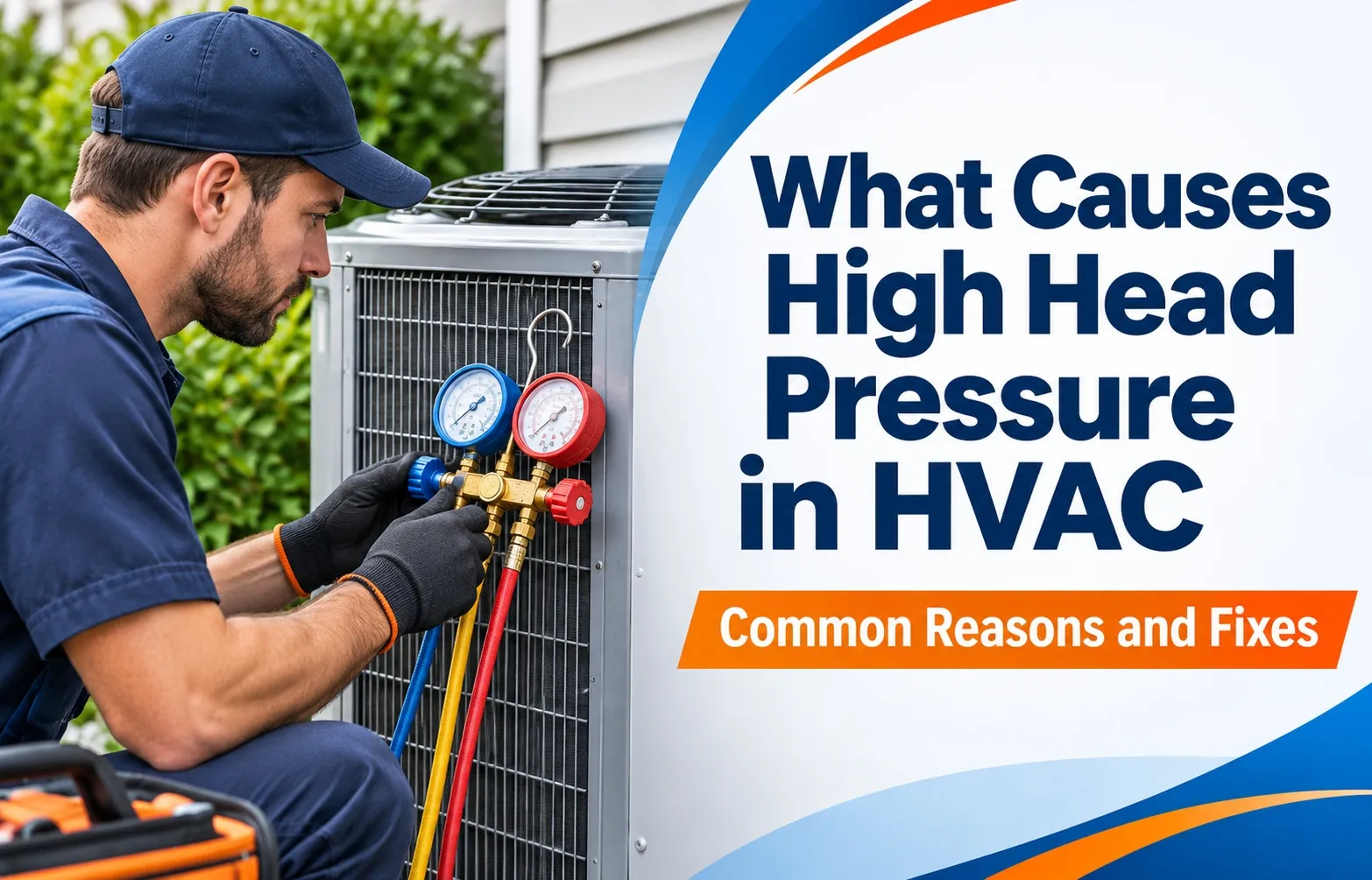 High head pressure in an HVAC system happens when the condenser cannot reject heat fast enough while the compressor continues pumping hot refrigerant vapor into the high side of the refrigeration loop. Elevated discharge pressure forces the compressor to work harder, raises operating temperatures, and eventually trips the high-pressure safety switch.
- Dirty or damaged condenser coils: Dirt, lint, grease, and bent aluminum fins insulate the tubing and block heat rejection into the outdoor air.
- Condenser fan motor or capacitor failure: A weak run capacitor, seized fan motor, or backward fan blade pitch starves the coil of cooling airflow.
- Blocked outdoor airflow or hot air recirculation: Overgrown shrubs, tight fences, or debris around the cabinet trap hot exhaust air and pull it back through the coil.
- Refrigerant overcharge: Excess refrigerant floods the condenser tubing, reducing the surface area available for vapor condensation and spiking liquid-line pressure.
- Non-condensables in the system: Air, nitrogen, or moisture left behind from an incomplete vacuum evacuation collect at the top of the condenser and raise pressure without condensing.
- Liquid-line or metering device restrictions: A clogged filter drier, kinked copper line, or stuck thermostatic expansion valve (TXV) backs up refrigerant on the high side.
- Extreme ambient heat or indoor airflow faults: Outdoor temperatures exceeding 95°F—or a dirty indoor air filter when a heat pump runs in heating mode—push condensing temperatures above normal limits.
Technician Rule of Thumb: Always verify outdoor airflow, fan rotation, and coil cleanliness before attaching manifold gauges or adjusting refrigerant charge—over 70% of high head pressure callbacks stem from airflow and heat-transfer restrictions rather than an overcharged system.
How High Head Pressure Happens in Cooling vs. Heating Mode
In HVAC diagnostics, head pressure refers to the high-side discharge pressure created between the compressor outlet and the metering device inlet. Because the refrigeration circuit is a closed loop, any obstruction that slows heat release at the condensing coil immediately raises pressure throughout the high side of the system.
The Condensing Process in Standard Cooling Mode
During air conditioning operation, the outdoor condensing unit must reject both the indoor heat absorbed by the evaporator and the heat of compression added by the compressor motor. When outdoor airflow drops or coil fins foul, the refrigerant vapor cannot shed latent heat quickly enough to undergo normal condensation into a subcooled liquid.
- Heat rejection stall: Uncondensed refrigerant vapor accumulates inside the condenser tubes, driving saturation temperature and discharge pressure upward.
- Rising compression ratio: As head pressure climbs against normal suction pressure, the compressor draws higher amperage and generates excessive discharge heat.
- Safety shutdown: Once high-side pressure crosses the equipment threshold—often around 600 to 650 PSI on R-410A systems—the high-pressure lockout switch opens to prevent mechanical damage.
Why Heat Pumps Experience High Head Pressure in Heating Mode
When a heat pump shifts into heating mode, the reversing valve redirects hot discharge gas from the compressor straight into the indoor air handler instead of the outdoor unit. This reversal turns the indoor coil into the active condenser, meaning indoor airflow restrictions directly trigger high head pressure.
- Clogged return air filters: Heavy dust buildup restricts airflow across the indoor coil, preventing room air from absorbing heat from the hot refrigerant gas.
- Closed or blocked supply registers: Shutting vents in unused rooms increases static pressure and reduces total air volume moving across the indoor heat exchanger.
- Indoor blower motor or wheel faults: A failing blower capacitor, incorrect fan speed tap, or dust-caked blower wheel slows heat transfer and trips high-pressure controls during cold weather.
Top 7 Causes of High Head Pressure With Field Diagnostic Steps
Pinpointing what causes high head pressure in HVAC systems requires separating external heat-transfer bottlenecks from internal refrigerant or metering faults. Use the field checks below to isolate the exact root cause before making adjustments or opening the refrigerant circuit.
1. Dirty, Fouled, or Damaged Condenser Coils
Accumulated yard debris, cottonwood fluff, kitchen grease, and bent or corroded aluminum fins block heat transfer through the outdoor coil. When fins are choked or flattened, hot refrigerant vapor stays trapped inside the tubes and drives discharge pressure upward.
- Visual and fin inspection: Shine a flashlight through the coil core from the outside to spot matted debris, oil residue, or crushed fins restricting airflow.
- Temperature split check: Measure outdoor ambient dry-bulb temperature and compare it against the condensing saturation temperature on your gauge set—an elevated split points to poor coil heat rejection.
2. Condenser Fan Motor, Blade, or Capacitor Failure
A weakened dual-run capacitor, worn fan motor bearings, or an incorrectly pitched or backward-spinning fan blade reduces air volume across the coil. Insufficient condenser airflow lowers mass flow of cooling air and forces the compressor to reject heat into stagnant air.
- Electrical and capacitor testing: Check capacitor microfarad ratings against nameplate tolerances using a multimeter set to capacitance, and verify supply voltage.
- Amp draw and rotation check: Clamp the fan motor lead to compare running amps against rated load amps (RLA), and confirm the blade discharges air straight up and out the top grille.
3. Blocked Outdoor Clearance and Hot Air Recirculation
Tight privacy fences, overgrown shrubs, stacked materials, or nearby condensers can trap warm exhaust air around the unit. Instead of drawing fresh ambient air, the fan pulls heated discharge air back into the coil intake, escalating head pressure.
- Clearance measurement: Verify open clearance around the cabinet perimeter and unobstructed vertical discharge space above the fan shroud.
- Recirculation check: Hold a lightweight tissue or check air temperature just outside the coil intake—if intake air runs noticeably warmer than ambient shade temperature, hot air is recirculating.
4. Refrigerant Overcharge
Adding too much refrigerant fills the lower passes of the condenser coil with liquid, shrinking the area available for vapor to condense. As liquid backs up on the high side, head pressure climbs and liquid-line temperatures rise above normal design values.
- Subcooling verification: Compare liquid-line temperature at the service valve against condensing saturation temperature—high head pressure paired with high subcooling strongly indicates an overcharge.
- Charge history review: Check for recent top-offs or unweighed additions made without checking manufacturer charging charts or subcooling targets.
5. Non-Condensables (Air, Nitrogen, or Moisture) in the System
Air, leftover nitrogen, or moisture entering during installation or service cannot condense at normal condenser temperatures and pressures. These non-condensables collect at the top of the condenser coil and add partial pressure on top of the refrigerant.
- Gauge needle behavior: Watch the high-pressure gauge needle for rapid jitter or erratic bouncing while the system runs steady.
- Non-condensable check: Shut the unit off and compare actual coil/line temperature against the pressure-temperature (PT) chart reading—a significantly higher pressure than temperature indicates trapped non-condensables from incomplete evacuation.
6. Liquid-Line or Metering Device Restrictions (Filter Drier & TXV)
A clogged liquid-line filter drier, a pinched or kinked copper line, or a restricted thermostatic expansion valve (TXV) or piston chokes refrigerant flow out of the high side. Pressure builds behind the restriction while downstream components experience starved refrigerant flow.
- Filter drier temperature drop: Measure pipe temperature on both sides of the liquid-line filter drier—a noticeable temperature drop across the drier signals an internal restriction.
- Subcooling and superheat clues: High head pressure with elevated subcooling and high superheat can point to a metering restriction or starved evaporator, whereas a bad TXV that stays partially closed restricts mass flow and alters pressure balance.
7. Extreme Ambient Temperatures or Excessive Indoor Heat Load
High outdoor temperatures—commonly above 95°F to 105°F—reduce the temperature difference driving heat out of the condenser coil. Heavy indoor heat loads, such as pulling down a hot home after a long outage or thermostat setpoint jump, also push extra heat into the loop.
- Ambient vs. design baseline: Check outdoor ambient temperature and compare operating head pressure against expected readings for high-heat conditions rather than mild weather.
- Pull-down monitoring: Observe whether discharge pressure stabilizes as indoor temperature drops toward setpoint or remains abnormally high during steady-state operation.
Differential Diagnosis Matrix: Telling High Head Pressure Causes Apart
Reading discharge pressure alone cannot identify the root fault because multiple mechanical and refrigerant problems spike the high-side gauge. Comparing suction pressure, subcooling, and superheat on a calibrated manifold gauge set reveals how refrigerant is actually moving through the circuit.
Gauge Pattern Comparison Table (Head Pressure, Suction Pressure & Subcooling)
Why Dirty Condensers and Restrictions Affect Suction Pressure Differently
Field technicians often debate whether a fouled condenser raises or lowers suction pressure, and the answer depends on how severely heat transfer is degraded and what metering device the unit uses. Understanding mass flow through the metering device separates a dirty coil from an internal blockage during differential diagnosis.
- High head pressure with normal suction pressure: On TXV-equipped systems, the valve modulates to maintain target superheat even as condenser pressure climbs, often holding suction pressure steady while discharge pressure spikes.
- How severe condenser fouling shifts mass flow: If a clogged condenser prevents complete vapor condensation, warm two-phase refrigerant reaches the metering device and reduces refrigerant mass flow into the evaporator, which can eventually pull suction pressure down.
- Why restrictions drop suction immediately: A clogged filter drier, pinched liquid line, or stuck-closed metering device starves the evaporator right away, creating the classic combination of high head pressure, high subcooling, low suction pressure, and elevated superheat.
Warning Signs and Dangers of Ignoring High Head Pressure
You should worry about high head pressure as soon as discharge pressure pushes past normal operating limits, trips a high-pressure switch, or forces the compressor to draw excessive current. Catching high head pressure symptoms early prevents rapid thermal stress on the compressor and protects electrical components from failure.
Observable Symptoms in the Home and at the Condenser
Both indoor comfort clues and outdoor equipment behavior signal that heat rejection is failing. Watch for these high head pressure symptoms during cooling or heating operation:
- Warm air blowing from vents: Reduced heat transfer and altered refrigerant flow prevent proper indoor cooling or steady heating output.
- Short cycling and high-pressure lockout: A high-pressure switch or high-pressure cutout opens the control circuit when head pressure peaks, shutting down the compressor until pressure drops and restarting repeatedly.
- Tripped circuit breaker: Rising head pressure increases mechanical resistance on the compressor, driving amp draw above circuit or overload limits.
- Unusually hot liquid line: The small copper liquid line leaving the condenser feels excessively hot to the touch when heat is not rejecting properly.
- Strained compressor hum or vibration: Working against high discharge pressure causes louder mechanical noise, casing vibration, or brief compressor stalls.
Long-Term Mechanical Damage to the Compressor
Running an HVAC system with sustained high head pressure elevates discharge temperature inside the compressor shell. High heat accelerates lubricant breakdown and places extreme mechanical load on internal valves, bearings, and motor windings.
If high head pressure goes uncorrected, progressive damage can turn a simple maintenance fix into a major equipment replacement:
- Compressor overheating and motor burnout: Elevated discharge temperature and high amp draw overheat motor windings, risking thermal overload failure or compressor seizure.
- Oil breakdown and acid formation: Extreme heat degrades POE or mineral refrigeration oil, increasing friction and forming corrosive acids that damage winding insulation.
- Blown gaskets, seals, or service valves: Excessive high-side pressure stresses compressor discharge valves, shaft seals, and Schrader or service valve cores, creating refrigerant leaks.
- High-pressure relief valve activation: On systems equipped with a pressure relief device, sustained overpressure can vent refrigerant to prevent rupture, leaving the unit undercharged and inoperable.
How to Check and Reduce High Head Pressure Safely
Knowing how to check head pressure HVAC systems safely starts with separating basic airflow maintenance from high-voltage electrical and pressurized refrigerant work. Homeowners can perform simple exterior and airflow checks safely, while refrigerant recovery, evacuation, and component repairs require a licensed technician.
Safe Step-by-Step Checks Homeowners Can Do First
To reduce high head pressure caused by restricted airflow without risking shock or coil damage, follow these basic homeowner steps before calling for service:
- Shut off power at the disconnect box: Switch off thermostat cooling and pull the disconnect block or open the disconnect box before inspecting or cleaning near the outdoor unit.
- Clear at least 24 inches around the condenser: Remove leaves, grass clippings, weeds, stored items, and overhanging branches so air moves freely into the cabinet and upward out of the fan grille.
- Replace dirty indoor air filters: Swap out clogged return filters—especially when a heat pump is running in heating mode—to restore steady indoor airflow.
- Gently rinse condenser coil cleaning debris with a hose: Spray from the top down using low-pressure tap water from a standard garden hose, never a high-pressure washer that can bend delicate coil fins.
Professional HVAC Technician Repairs and Head Pressure Controls
Checking head pressure accurately with a manifold gauge set requires working around live high-voltage circuits and pressurized refrigerant lines. Under EPA Section 608 refrigerant regulations, handling, recovering, and charging regulated refrigerants requires certified technicians with proper recovery and evacuation equipment.
- Electrical and motor diagnostics: Technicians test run capacitors, verify voltage under load, check condenser fan motor amp draw, and correct fan rotation or blade pitch issues.
- Subcooling and superheat measurement: Using calibrated digital gauges and pipe clamp thermometers, technicians evaluate true subcooling and superheat rather than relying on raw pressure alone.
- Refrigerant recovery and deep evacuation: To overcome head pressure from overcharge or non-condensables, a technician performs refrigerant recovery, pulls a deep vacuum verified with a micron gauge below 500 microns, and weighs in factory charge.
- Restriction repair and head pressure control: Technicians replace clogged filter driers or faulty TXVs and install fan-cycling switches or low-ambient head pressure control devices where operating conditions require head pressure management.
Frequently Asked Questions About HVAC Head Pressure
What is a normal head pressure for an HVAC system?
There is no single normal PSI because head pressure shifts with outdoor temperature and refrigerant type. Add roughly a 15°F to 25°F condenser temperature split to outdoor ambient temperature, then read the matching pressure on a pressure-temperature chart for R-410A, R-32, R-454B, or legacy R-22.
Will low refrigerant (Freon) cause high head pressure?
No, low refrigerant charge typically causes low suction pressure and low head pressure rather than high discharge pressure. In rare edge cases, an undercharged system can show elevated head pressure if a severe condenser airflow blockage or liquid-line restriction traps pressure locally.
Can a bad TXV cause high head pressure?
A faulty thermostatic expansion valve (TXV) usually lowers suction pressure and raises superheat when stuck closed or starving the coil. However, if refrigerant backs up into the condenser or receiver beyond normal capacity, high-side pressure can rise alongside abnormal subcooling and superheat readings.
What causes high head pressure in commercial refrigeration systems?
In commercial refrigeration, high head pressure often stems from fouled air-cooled or water-cooled condensers, failed fan cycling controls, or overfilled receivers. High ambient heat loads, dirty condenser coils, and non-condensable gases also push discharge pressure above safe operating limits in walk-in coolers and display cases.

Oscar Vance | Master Plumber & Drainage Expert
Meet Oscar Vance, a licensed master plumber sharing practical solutions on residential repairs, preventive maintenance, and thoughtful home upkeep.