Schedule 40 vs Schedule 80 PVC Key Differences at a Glance
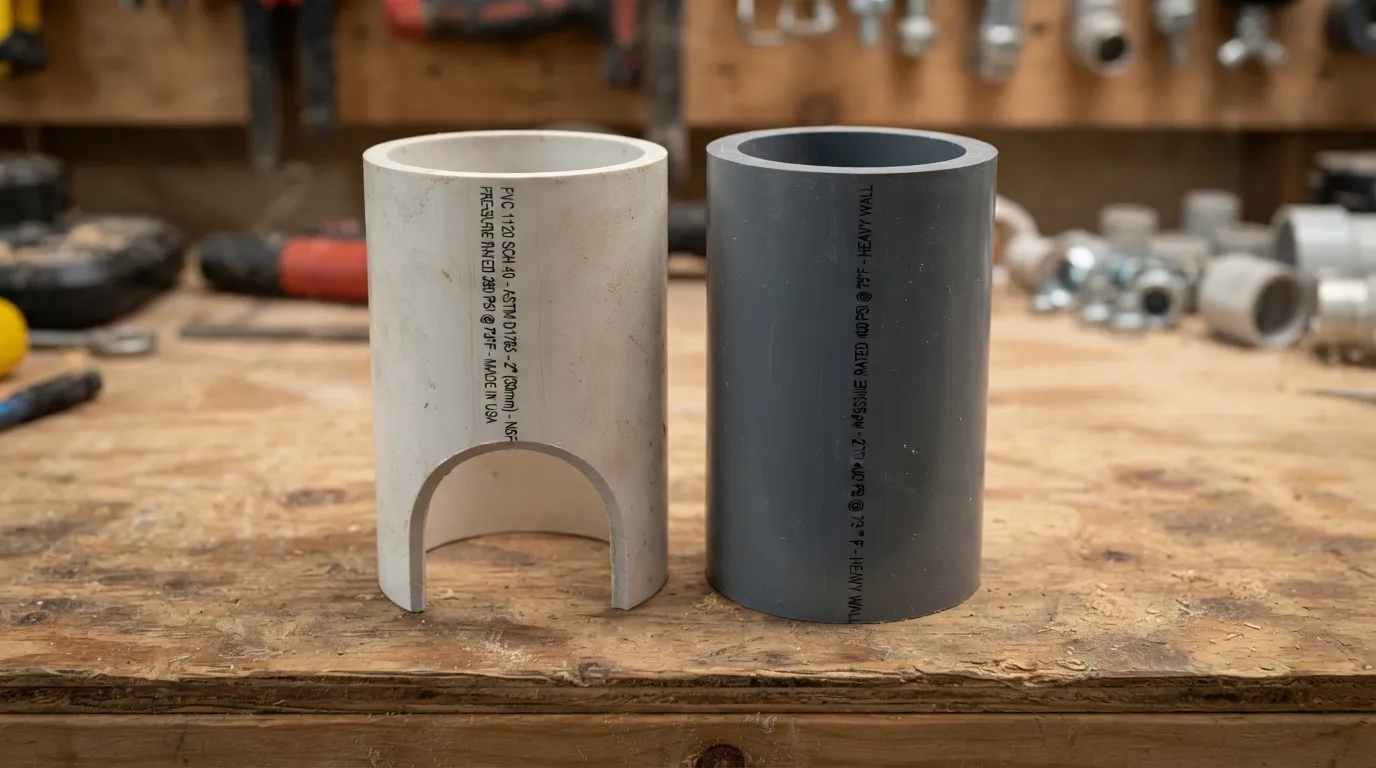
Schedule 40 and Schedule 80 PVC pipes differ primarily in wall thickness, pressure ratings, and internal diameters, while sharing the exact same outside diameter to ensure universal fitting compatibility. Selecting the correct schedule is critical for matching fluid pressure requirements in residential, commercial, and industrial plumbing applications.
- Wall Thickness: Schedule 80 features a significantly thicker wall than Schedule 40 to withstand higher internal pressures.
- Pressure Rating: Schedule 40 handles lower PSI thresholds, whereas Schedule 80 is engineered for high-pressure industrial systems.
- Internal Diameter: Because Schedule 80’s extra thickness is added inward, its internal diameter (ID) is smaller than Schedule 40 for the same nominal pipe size.
What Does Schedule Mean in PVC Pipe?
In PVC piping systems, the schedule number directly defines the pipe’s wall thickness class for a given Nominal Pipe Size (NPS). Rather than indicating a specific millimeter or inch measurement, higher schedule ratings correspond to thicker walls, heavier weights, and significantly higher internal pressure ratings.
- Wall Thickness Class: Dictates the precise amount of material used during manufacturing.
- Pressure Capacity: Higher schedule numbers safely withstand greater psi levels before failure.
- NPS Correlation: Works directly alongside Nominal Pipe Size to standardize pipe dimensions globally.
Why Outside Diameter Stays the Same Across Schedules
The outside diameter (OD) of a PVC pipe remains completely constant across different schedules for the same nominal size. This clever engineering standardization ensures that standard fittings, valves, and connectors fit universally regardless of whether you choose a standard or heavy-walled variant.
- Universal Fittings: Standard elbows, couplings, and tees fit interchangeably across different schedules.
- Inner Diameter Trade-off: As the schedule number increases, the inner diameter shrinks because extra material builds inward.
- Simplified Inventory: Contractors can use uniform connection parts without matching specialized outer diameters.
PVC Schedule vs Steel Pipe Schedule
A common point of confusion is comparing PVC schedule numbers directly to traditional steel pipe schedules. While both systems trace their structural roots back to ANSI/ASME pipe schedule standards, the actual wall thicknesses, material strengths, and pressure performance differ drastically between plastics and metals.
- ANSI/ASME Standards: Both systems adopt similar numbering conventions originally derived from historical steel sizing.
- Material Divergence: Steel handles extreme temperatures and high-stress environments that would quickly deform PVC.
- Legacy Variances: Legacy steel ratings like Sch 30 differ heavily in physical dimensions from modern plastic equivalents.
Schedule 40, 80 and 120: Where They Sit
Navigating various ratings involves understanding where options like Schedule 40, Schedule 80, and heavy-duty Sch 120 fit into real-world applications. Schedule 40 serves standard residential plumbing, Schedule 80 provides robust industrial pressure capability, and Schedule 120 represents extreme wall thickness for specialized high-pressure demands.
- Schedule 40: The most common choice for residential water supply, irrigation, and drain lines (typically white).
- Schedule 80: Features thicker walls and darker grey coloration, engineered specifically for heavy industrial chemical processing.
- Schedule 120: An ultra-heavy wall classification standing as the highest schedule tier for extreme mechanical demands.
Schedule 40 vs Schedule 80 PVC Thickness and Dimensions
Precision matters when evaluating physical pipe metrics. Utilizing calipers on standard nominal sizes reveals exact outer diameter (OD), wall thickness, and inside diameter (ID) variations governed strictly by ASTM D1785 standards, dictating flow capacity and structural integrity across every commercial application.
- ASTM D1785 Compliance: Ensures uniform manufacturing tolerances for both commercial and residential piping.
- Caliper Verification: Essential tool for installers to physically verify exact wall classifications on unlabelled stock.
- Comprehensive Pipe Dimensions Chart: Guides engineers in selecting proper sizing without guessing internal capacities.
How Thicker Walls Reduce Inside Diameter and Flow
Because external diameters remain identical across schedules to accommodate universal fittings, adding structural material to Schedule 80 forces the wall thickness inward. This reduction in inside diameter directly restricts overall water volume capacity and increases internal fluid velocity.
- Inward Expansion: Extra resin builds toward the center, shrinking the clear pathway for liquids.
- Volume Constraint: Less cross-sectional area means lower total volumetric throughput at equivalent pressure.
- Friction Loss Impact: Restricted pathways elevate fluid resistance, creating higher turbulence along interior walls.
When the Flow Loss Actually Matters
Minor reductions in inside diameter rarely impact brief residential supply runs, but flow loss becomes critical in long-distance pipe layouts, high-pressure industrial pumping systems, and multi-zone agricultural irrigation setups where cumulative friction losses degrade performance.
- Long Pipe Runs: Extended distances compound friction losses, making the wider ID of Schedule 40 advantageous.
- Pump Efficiency: Heavy flow restrictions force booster pumps to work harder, increasing energy consumption.
- Irrigation Zones: Balanced water delivery across multiple sprinkler heads requires accounting for internal diameter constraints.
Schedule 40 vs Schedule 80 PVC Pressure Rating
Schedule 80 PVC pipe consistently delivers a higher working pressure rating than Schedule 40 across all nominal sizes due to its thicker wall construction. At a baseline temperature of 73°F, pressure ratings decrease as pipe diameters increase, adhering strictly to manufacturer’s technical FAQ guidelines and ASTM D1785 standards.
- Baseline Testing: All standard ratings are established at a controlled ambient temperature of 73°F.
- Pressure Class: Reflects maximum continuous working pressure with safety factors built-in.
- Burst Pressure: Actual failure thresholds are significantly higher than rated working pressures.
Why Larger Pipe Has a Lower Pressure Rating
Larger diameter pipes possess lower maximum pressure ratings because internal stress increases proportionally with the surface area of the pipe wall. As diameter expands, fluid force exerts greater outward tension on the material, requiring thicker walls to maintain equivalent safety factors.
- Wall Stress Dynamics: Wider circumferences multiply the total force exerted by fluid against interior boundaries.
- Geometric Limitations: Maintaining high PSI in large diameters demands exponentially thicker material.
- Water Hammer Risks: Pressure spikes from rapid valve closures impact larger pipes more severely.
How Temperature Reduces PVC Pressure Rating
Ambient and fluid temperatures heavily dictate PVC performance, requiring strict temperature derating since maximum service capacity drops rapidly as heat increases. Because PVC softens under thermal exposure, ratings decline steeply as temperatures approach the 140°F upper threshold limit.
- 100°F Derating Factor: Multiply base PSI by 0.62 to account for mild warmth.
- 110°F Derating Factor: Multiply base PSI by 0.51 as thermal expansion begins affecting structural rigidity.
- 120°F to 130°F Range: Apply factors of 0.40 and 0.31 respectively for high-heat environments.
- 140°F Upper Threshold: Multiply base PSI by 0.22, representing the absolute maximum continuous service temperature for standard PVC.
Why Threaded PVC Needs a Thicker Wall
Cutting threads into a PVC pipe removes material from the wall, effectively cutting the pressure rating in half compared to unthreaded solvent-welded systems. Consequently, installation guidelines mandate using Schedule 80 for any application requiring threaded connections to compensate for this structural loss.
- Material Removal: Cutting tapered threads reduces structural wall thickness by up to 50 percent.
- Threaded Joints: Vulnerable junction points that require thicker walls to prevent splitting under pressure.
- Schedule Selection: Schedule 40 is generally unsuited for direct threading in high-pressure lines.
Is Schedule 80 PVC Better Than Schedule 40?
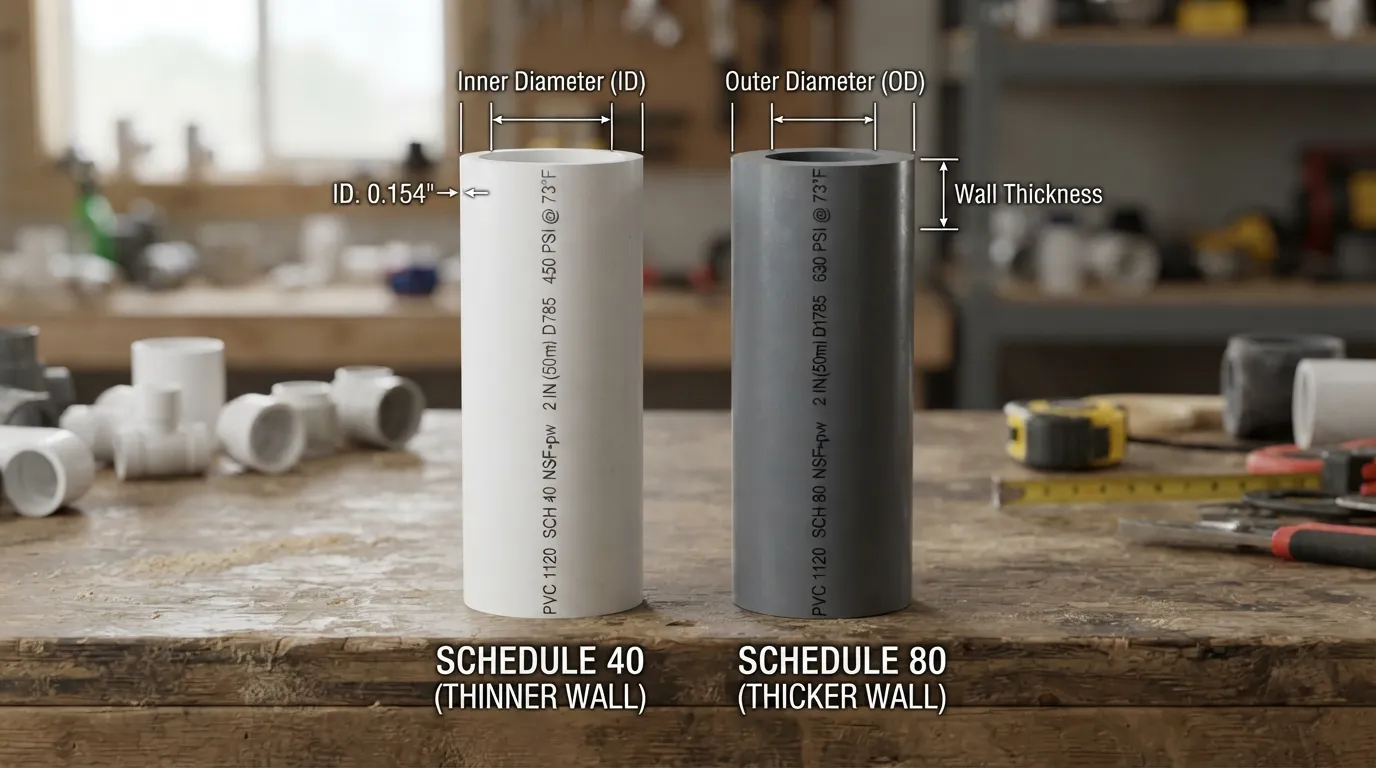
Schedule 80 PVC outperforms Schedule 40 in demanding environments that demand superior structural strength, physical impact resistance, and safe threading capabilities. Because of its dense PVC compound and thick walls, it excels in industrial fluid transport and harsh settings.
- Higher Pressure Tolerance: Safely handles significantly higher psi loads without risk of catastrophic bursting.
- Impact Resistance: Resists accidental external damage from heavy job-site machinery or harsh handling.
- Threaded Connections: Provides adequate material depth for secure pipe threading without failing.
Disadvantages of Schedule 80 PVC
Despite its superior strength, Schedule 80 features notable drawbacks that make it impractical for everyday use, including higher financial investment, increased physical weight, and reduced interior flow efficiency. These trade-offs require careful planning during system design.
- Higher Material Cost: Significantly more expensive per foot than its standard counterpart due to extra resin.
- Increased Weight: Heavier pipes complicate overhead hanging, transportation, and installation labor.
- Reduced Inside Diameter: Thicker walls constrict internal pathways, leading to lower volumetric flow rates.
Why Schedule 80 Is Often Unnecessary in Homes
Residential plumbing systems typically operate at modest water pressures ranging from 40 to 80 psi, rendering Schedule 80 a costly and unnecessary overkill for household applications. Standard Schedule 40 more than satisfies residential building code demands with room to spare.
- Standard Pressures: Normal home water supply levels stay well below the threshold requiring heavy-duty walls.
- Budget Efficiency: Homeowners save substantially by avoiding the inflated material costs of industrial-grade plastics.
- Ease of Installation: Standard pipes are lighter, faster to cut, and simpler to solvent-weld in tight residential spaces.
Does Thicker Mean Stronger Against Chemicals?
A common misconception is that a thicker wall directly increases chemical resistance, but chemical compatibility is entirely determined by the base PVC compound rather than physical thickness. Extra thickness merely extends the structural service life before harsh chemicals eventually degrade the material.
- Material Composition: Chemical resistance depends strictly on polymer chemistry, not pipe thickness.
- Corrosion Barrier: Thicker walls provide a longer sacrificial buffer against aggressive industrial agents.
- Extended Longevity: While material properties remain identical, extra mass delays structural breakdown from exposure.
Can You Mix Schedule 40 and Schedule 80 PVC?
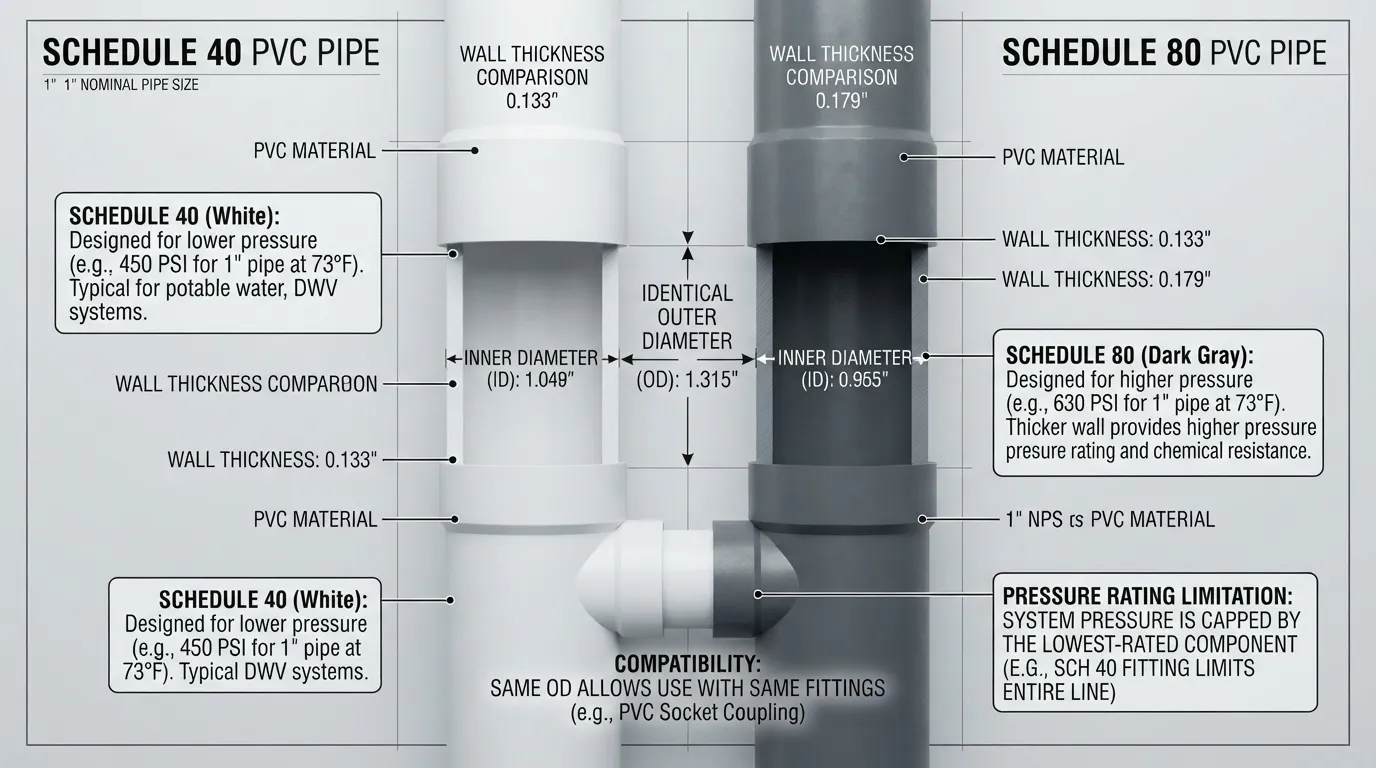
Yes, you can safely mix Schedule 40 and Schedule 80 PVC components because both systems share identical outside diameters (OD) for matching nominal sizes. This shared exterior geometry allows pipes and fittings from different schedules to slide together seamlessly into standard sockets without sizing mismatches.
- Identical Outside Diameters: Ensures standard sockets accept both standard and heavy-walled pipes interchangeably.
- Socket Depth Alignment: Standard insertion depths apply uniformly across both classification types for secure bonding.
- Mixed Schedule Systems: Allows builders to combine components based on specific pressure or budget requirements.
The Weakest Component Sets the System Pressure
In any mixed schedule layout, the overall working pressure of the entire assembly is strictly limited by its weakest component. Pairing a heavy-duty Schedule 80 pipe with a lower-rated Schedule 40 fitting means the system can only handle the lower Schedule 40 pressure threshold safely.
- Weakest Link Rule: Overall system reliability depends entirely on the lowest-rated part in the active circuit.
- Component Limits: Schedule 40 fittings used alongside Schedule 80 pipes create an immediate structural bottleneck.
- Safety Margins: Always design system pressure limits around the rating of the fitting rather than the thicker pipe.
Solvent Cement and Primer for Mixed Joints
Mixing schedules does not change chemical bonding requirements, meaning standard PVC primer and solvent cement work perfectly for mixed joints. The chemical welding process fuses the plastic molecules together regardless of wall thickness, provided you allow adequate cure time before testing.
- Standard Chemical Bonding: Standard PVC cement creates a unified molecular weld across different wall profiles.
- Proper Primer Application: Essential for softening the plastic surfaces before cement application on both components.
- Adequate Cure Time: Follow manufacturer guidelines strictly to let the solvent fully evaporate before applying pressure.
Transition Points and Threaded Adapters
Transitioning between schedules often involves using specialized Schedule 80 threaded adapters to handle mechanical stress points safely. Because threading compromises wall strength, utilizing heavy-duty Schedule 80 male or female adapters at connection junctions prevents premature structural failure.
- Threaded Adapter Selection: Choose Schedule 80 components for threaded junctures to compensate for material loss.
- Mechanical Stress Points: Reinforces critical areas where pipe connects directly to valves, pumps, or metal lines.
- Seamless Transitions: Bridges the gap safely between rigid industrial equipment and standard distribution piping.
Schedule 40 vs Schedule 80 PVC Plumbing: Which One for Your Project?
Selecting the correct PVC schedule depends on your specific application, local building codes, and environmental exposure. This decision matrix cuts through ambiguity to provide a definitive recommendation for every major project type.
- Matrix Utility: Instantly matches project requirements with the appropriate structural classification.
- Safety Margins: Built on industry-standard engineering parameters and plumbing code compliance.
- Cost Optimization: Prevents overspending on heavy industrial stock where standard materials suffice.
Drain Waste and Vent DWV Lines
Schedule 40 PVC is the universal industry standard for Drain, Waste, and Vent (DWV) lines governed by ASTM D2665. Because these systems operate under gravity flow rather than high internal pressure, heavy-duty walls provide zero functional benefit while increasing unnecessary project costs.
- Gravity Flow Mechanics: Waste lines do not experience internal working pressure, making Schedule 40 ideal.
- Code Acceptance: Universally approved by municipal plumbing codes for residential and commercial drainage.
- Cost Efficiency: Lightweight and affordable, allowing smooth installation for complex drain layouts.
Residential Water Supply and Main Water Line
Residential cold water supply lines and main water service entries typically utilize Schedule 40 pipe, but you must always verify local plumbing codes and municipal regulations before installation. Furthermore, remember that standard PVC cannot handle hot water; interior hot distribution requires switching to CPVC or PEX materials.
- Local Code Verification: Municipalities maintain strict rules regarding potable water lines and approved NSF/ANSI 61 components.
- Hot Water Restrictions: Standard PVC deforms under high heat, necessitating CPVC or PEX for hot water lines.
- Main Service Entry: Ensure proper trench depth and bedding protect the pipe from shifting soil loads.
Irrigation and Sprinkler Systems
Irrigation and underground sprinkler networks rely primarily on Schedule 40 PVC due to its ideal balance of flow capacity, burst strength, and budget friendliness. While main supply headers occasionally use thicker walls near pump stations, lateral zones function efficiently with standard pipe.
- Flow Optimization: Wider inside diameters minimize friction loss across long residential yard layouts.
- Seasonal Durability: Withstands normal municipal water pressures and cyclic valve hammer when winterized properly.
- Easy Repairs: Compatible with standard fittings and primers for quick mid-season mainline fixes.
Swimming Pool and Spa Plumbing
Swimming pool and spa plumbing frequently incorporates a mixed strategy, using Schedule 40 for long underground runs and Schedule 80 around high-pressure equipment zones. High-powered pool pumps, filter connections, and threaded valve adapters benefit immensely from the structural rigidity of Schedule 80.
- Underground Runs: Schedule 40 handles subterranean pool loops cost-effectively under proper backfill.
- Equipment Pads: Heavy vibration and high psi near pumps make Schedule 80 ideal for pad manifolds.
- Threaded Integrity: Resists cracking when screwing fittings directly into pool pumps and salt generators.
Chemical Transfer and Industrial Fluids
Industrial chemical transfer applications demand Schedule 80 PVC to secure a reliable margin of safety against aggressive compounds and mechanical wear. While the base plastic compound provides chemical resistance, the extra wall thickness serves as a vital sacrificial buffer against corrosive degradation.
- Corrosive Environments: Protects industrial systems carrying acids, salts, and harsh treatment solutions.
- Extended Lifespan: Slower structural thinning ensures prolonged operation before replacement is necessary.
- Rigid Standards: Aligns with strict industrial plant engineering protocols and safety inspections.
Buried vs Exposed Runs
Environmental factors like sunlight and soil pressure heavily dictate your material choice between exposed outdoor runs and buried installations. Exposed pipes face ultraviolet (UV) degradation and physical impacts, whereas buried lines contend with earth weight and shifting ground forces.
- Exposed Outdoor Runs: Require UV protection, painting, or Schedule 80 upgrades to resist accidental impact.
- Buried Lines: Rely heavily on proper trench bedding and backfill compaction rather than sheer wall thickness.
- Thermal Expansion: Surface-mounted outdoor lines need expansion loops to manage temperature swings.
Our Recommendation by User Type
To eliminate ambiguity, your project choice should align precisely with your user profile and application demands rather than defaulting to guesswork. Review this final breakdown to secure the right material on your first try.
- Homeowners & DIYers: Stick to Schedule 40 for standard irrigation, drainage, and cold water supply projects to save money and ease installation.
- Licensed Contractors: Follow local inspector guidelines meticulously, utilizing Schedule 40 for standard builds and switching to Schedule 80 for threaded and high-stress joints.
- Industrial Engineers: Specify Schedule 80 exclusively for chemical processing lines, high-pressure loops, and high-impact mechanical environments.
Schedule 40 vs Schedule 80 PVC Electrical Conduit
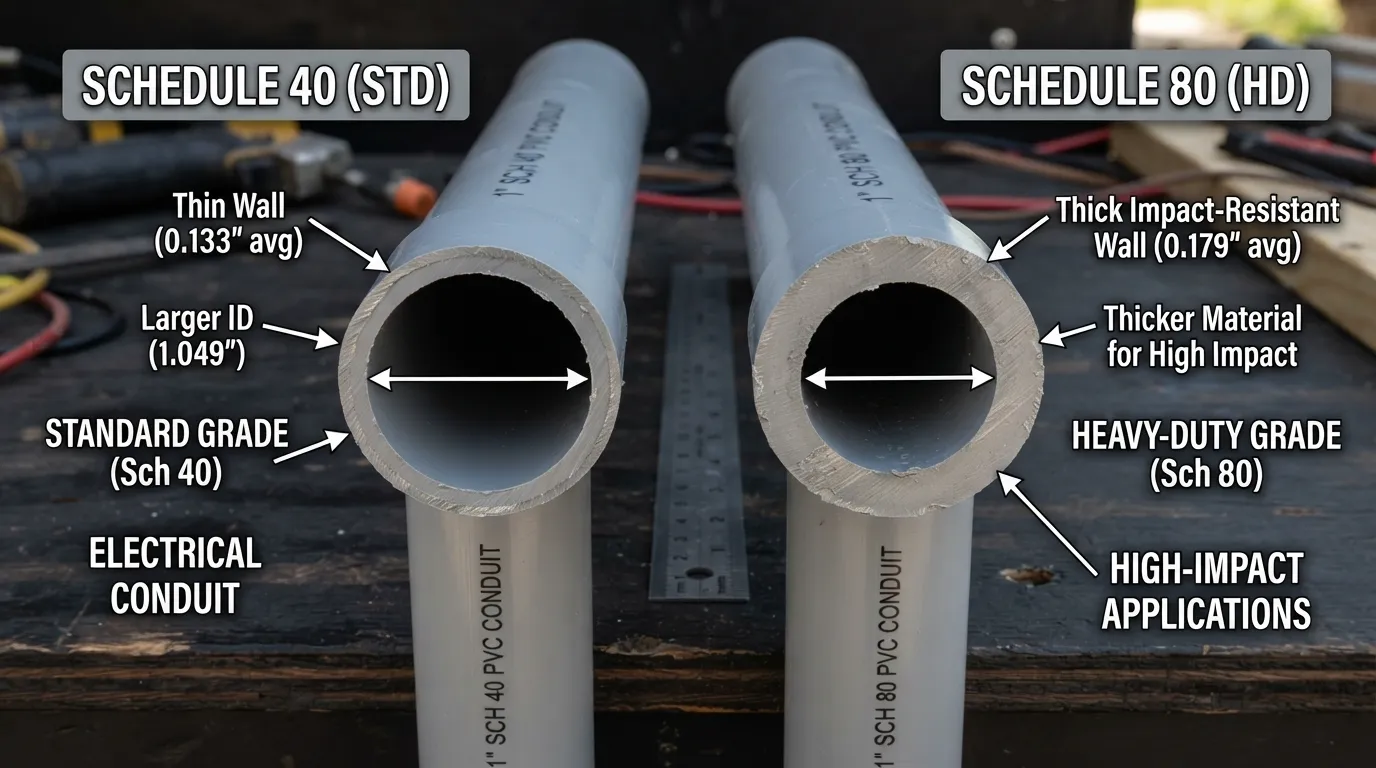
Schedule 40 rigid PVC conduit (RNC) serves as the industry standard for underground installations, concrete encasements, and protected runs where structural loads are uniformly distributed by surrounding earth or building cavities. Because these environments shield the gray raceway from heavy external impacts, standard-wall thickness provides ample mechanical protection while maintaining lower material costs.
- Underground Burial: Safely handles direct earth burial when trenched to compliant depths specified by electrical codes.
- Protected Cavities: Performs reliably inside walls, ceilings, and concealed structural spaces away from machinery.
- Cost Optimization: Minimizes expenses on large commercial runs by utilizing standard-weight material profiles.
Schedule 80 Conduit: Exposed Runs Where Physical Damage Is Possible
According to NEC Article 352, Schedule 80 rigid PVC conduit must be utilized in areas where raceways are exposed to physical damage, such as exterior drops, commercial loading zones, and low-wall runs. Its extra-heavy wall construction provides superior impact resistance against accidental collisions from hand trucks, lawn equipment, and vehicular traffic.
- NEC Article 352 Compliance: Mandates extra-heavy walls wherever inspectors identify potential mechanical hazards.
- Surface Protection: Shields internal electrical conductors effectively along exterior building walls and pole risers.
- Impact Resiliency: Withstands heavy physical blows that would easily shatter or crack standard Schedule 40 lines.
Wall Thickness Fill and Bend Considerations
Because Schedule 80 conduit features a thicker interior wall while maintaining the same outer diameter as Schedule 40, its reduced inside diameter directly impacts maximum wire fill capacities. Electricians must calculate conduit fill percentages carefully to prevent excessive pulling tension and insulation damage during cable installation.
- Reduced Inside Diameter: Restricts total cross-sectional area available for pulling multiple electrical conductors.
- Conduit Fill Limits: Requires strict adherence to NEC chapter tables to avoid overheating and overcrowding bundles.
- Pulling Tension: Smaller clearances increase friction during long wire pulls, requiring proper lubricants and careful routing.
Conduit Fittings and Expansion Joints
Rigid PVC conduit systems experience significant thermal expansion and contraction across seasonal temperature swings, making proper expansion fittings mandatory on long exterior runs. Both Schedule 40 and Schedule 80 components share identical outer diameters, allowing them to utilize the same UL-listed solvent-welded fittings and accessories.
- Thermal Movement: Unchecked expansion causes conduit runs to bow, snap, or pull out of couplings if mismanaged.
- Expansion Fittings: Telescoping joints absorb linear expansion safely along long, straight outdoor wall mounts.
- UL-Listed Hardware: Ensures entire raceway assemblies meet rigorous electrical safety standards from fittings to boxes.
Plumbing Pipe vs Conduit Why They Are Not Interchangeable
Using Schedule 80 PVC plumbing water pipe as a substitute for electrical conduit constitutes a direct code violation under NEC Article 352.6, which mandates that electrical raceways be specifically listed and marked for electrical use. Plumbing pipes lack essential UV inhibitors, smooth inner finishes designed for wire pulls, and required third-party electrical safety labels.
- NEC Listing Mandate: Electrical inspectors reject unlisted materials regardless of physical dimensional similarities.
- UV Stabilization: Gray electrical conduit contains specialized weather-resistant compounds preventing premature breakdown in sunlight.
- Interior Smoothness: Conduit interiors are engineered to protect delicate wire insulation from abrasion during high-tension pulls.
Schedule 40 vs Schedule 80 PVC Price Comparison
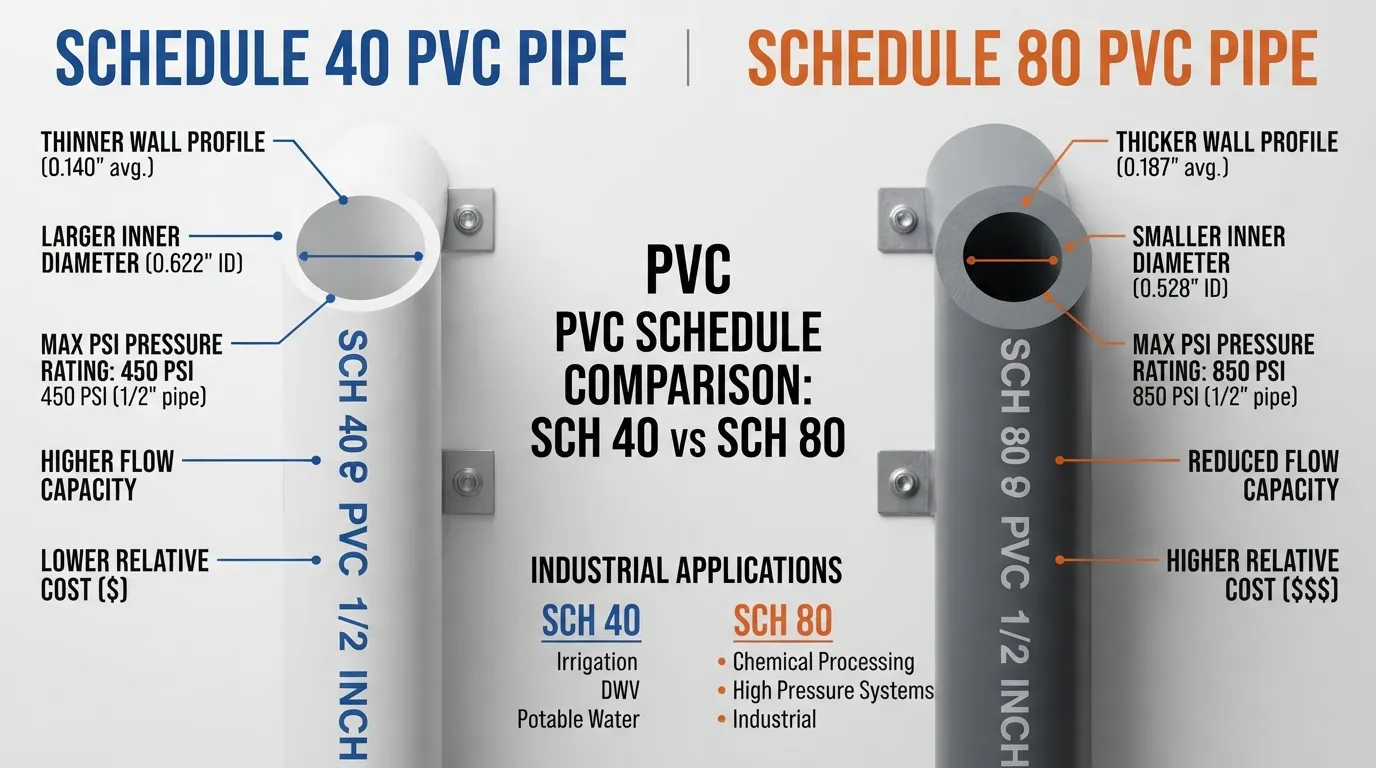
Schedule 80 PVC pipe consistently carries a higher material cost than Schedule 40, typically ranging from 30% to 60% more expensive depending on the nominal pipe size, raw resin market fluctuations, and regional supplier pricing. Because Schedule 80 requires significantly more raw PVC compound during extrusion, manufacturers price the heavy-walled stock at a clear premium.
- Material Premium: Expect to pay substantially more per foot for extra-heavy-walled stock.
- Size Variations: Price gaps widen on larger diameter pipes where resin volume increases exponentially.
- Supplier Factors: Local distribution logistics and wholesale availability heavily influence final per-foot expenses.
Fittings and Installation Cost Differences
The total financial impact extends beyond raw pipe pricing into specialized Schedule 80 fittings, valves, and components, which also command higher market rates. Furthermore, increased material weight can slightly elevate labor effort during manual handling and overhead positioning.
- Fittings Expenses: Molded heavy-duty elbows and tees cost more to produce and purchase.
- Valve Investments: Industrial-grade ball valves and check valves designed for high-psi systems add to expenses.
- Labor Considerations: Heavier components require more care to maneuver, marginally impacting installation velocity.
Is the Extra Cost Worth It?
Determining whether Schedule 80 justifies its higher price tag depends entirely on your project’s environmental demands and risk tolerance. While overspending on residential low-pressure lines wastes budget, investing in heavy-duty walls prevents costly industrial downtime, burst failures, and regulatory compliance violations.
- Residential Value: Paying extra for household plumbing or simple irrigation provides zero functional return.
- Industrial Protection: The higher expense is fully justified when transporting aggressive chemicals or managing high-psi pumps.
- Risk Mitigation: Upfront spending on proper ratings avoids catastrophic property damage and emergency repair labor.
Schedule 40 and Schedule 80 PVC vs CPVC
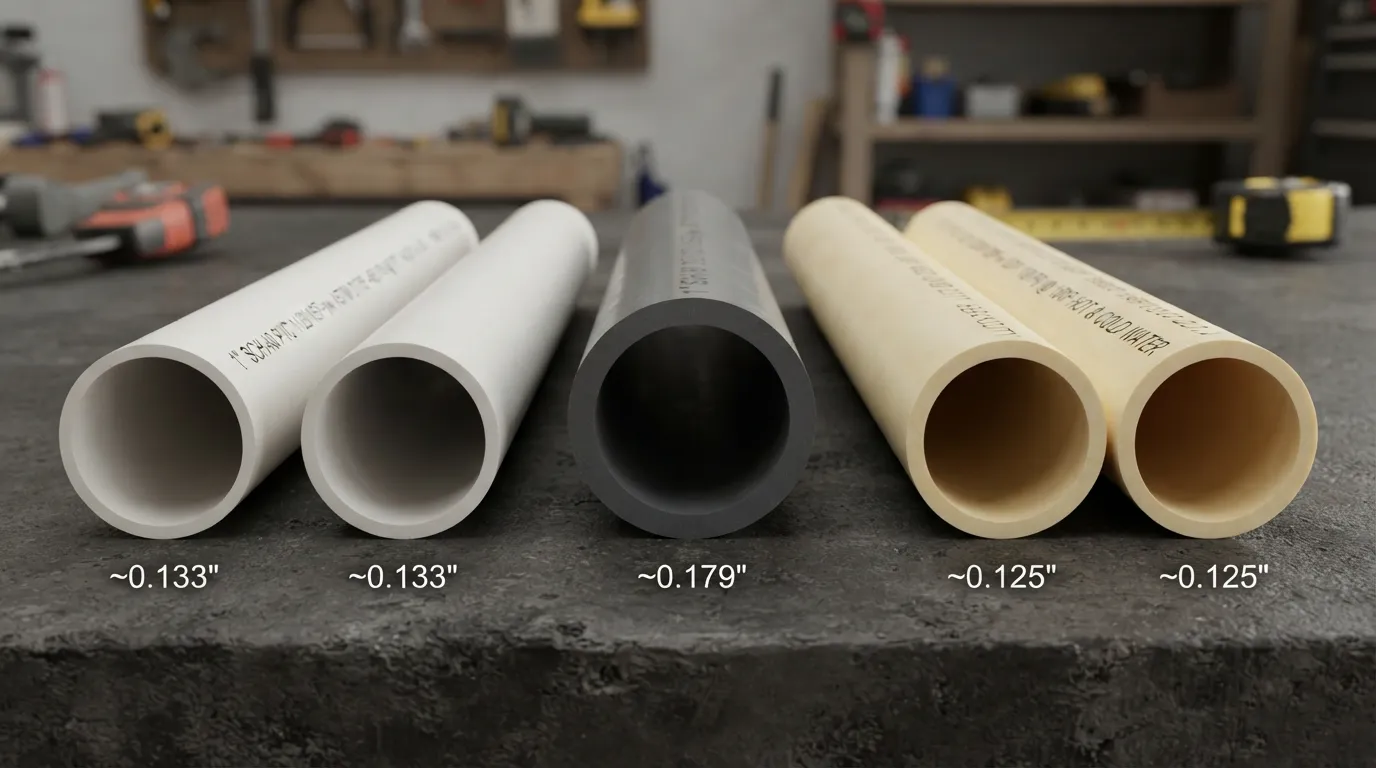
Standard PVC is chemically unsuited for hot water distribution because its maximum continuous service temperature is capped at 140°F. Exceeding this thermal threshold causes standard PVC pipes to soften, deform, and lose structural integrity, leading to catastrophic system failure under normal water pressures.
- Thermal Softening: High heat compromises the polymer matrix, resulting in drooping or sagging lines.
- Pressure Degradation: As heat rises, pressure ratings drop rapidly, eliminating safe operational margins.
- Building Code Violations: Plumbing codes strictly prohibit standard PVC use for domestic hot water supply.
CPVC Temperature and Pressure Advantages
Chlorinated PVC (CPVC) undergoes an extra chlorination process that significantly boosts its heat tolerance, allowing it to safely handle continuous temperatures up to 200°F while maintaining high pressure ratings. This makes CPVC an ideal rigid plastic solution for residential and commercial hot water supply lines.
- 200°F Heat Capacity: Withstands the high temperatures generated by standard household and commercial water heaters.
- Chlorine Resistance: Resists oxidative degradation from treated municipal water supplies at elevated temperatures.
- Rigid Distribution: Provides a rigid plastic alternative to metal pipes without thermal expansion issues.
CPVC Schedule 40 and Schedule 80
Similar to traditional PVC, CPVC is manufactured in both Schedule 40 and Schedule 80 wall thicknesses, utilizing identical nominal pipe size dimensions and outside diameters. This standardization allows CPVC to integrate seamlessly with standard fittings while delivering superior thermal performance.
- Schedule 40 CPVC: Utilized primarily for standard hot and cold water distribution lines within temperature limits.
- Schedule 80 CPVC: Deployed in industrial chemical processing where both high heat and corrosive fluid resistance are required.
- Dimensional Consistency: Shares matching outer diameters with PVC, though specialized CPVC solvent cement is mandatory.
Choosing Between PVC CPVC and PEX for Home Supply Lines
Selecting the right material for home supply lines requires balancing temperature requirements, installation flexibility, and cost. While PVC handles cold exterior runs and drainage, CPVC and PEX dominate interior hot and cold distribution networks.
- PVC Application: Reserved exclusively for cold water supply mains, irrigation, and drainage lines.
- CPVC Choice: Ideal for rigid hot water distribution and retrofitting older home supply branches.
- PEX Versatility: Flexible cross-linked polyethylene has largely overtaken rigid plastics for modern interior home repiping.
Installation Tips and Common Mistakes When Choosing PVC Schedules
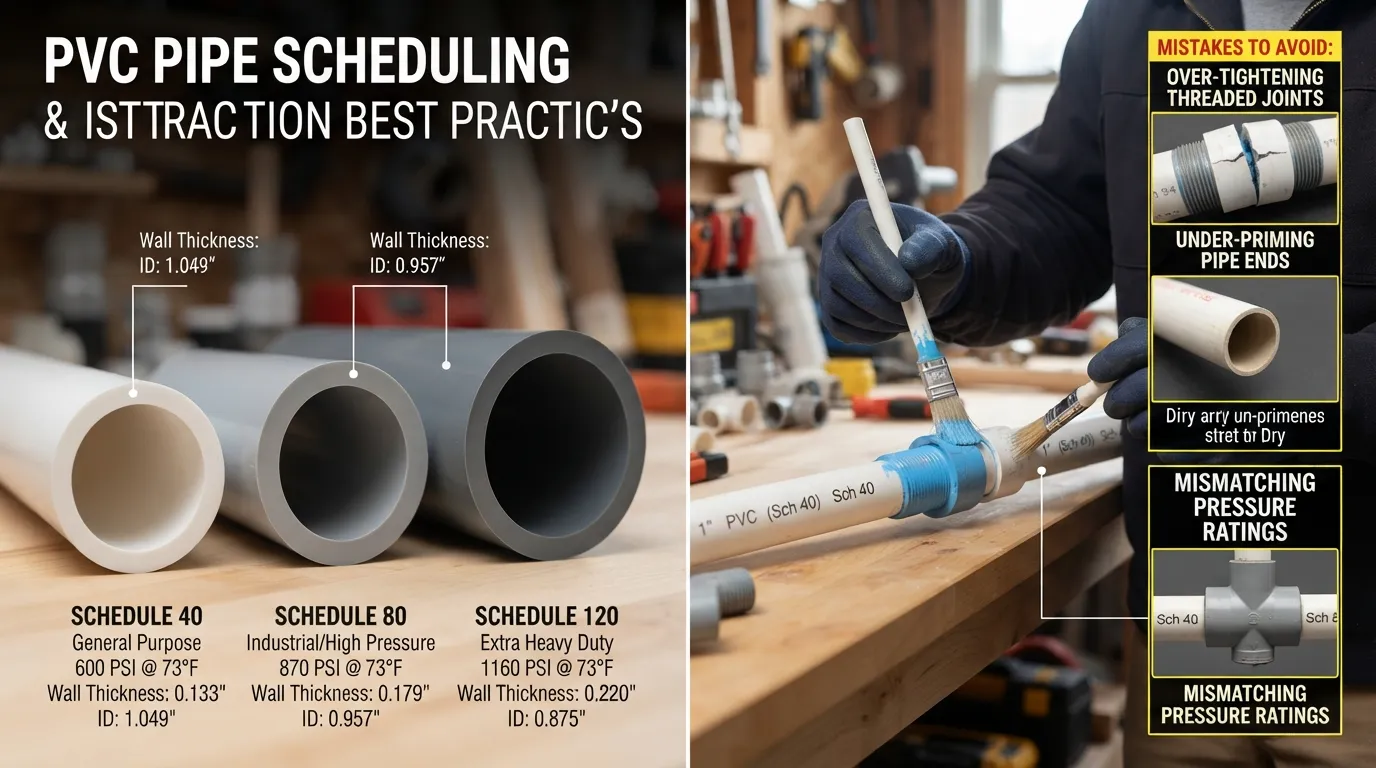
Verifying the manufacturer’s ink stamp printed directly along the pipe exterior is a critical first-step check before installation. This stamp confirms the exact schedule rating, ASTM compliance standards (such as ASTM D1785), and sanitary certifications like NSF-pw, ensuring the material is rated safely for potable water and appropriate structural use.
- Ink Stamp Verification: Inspects uninstalled stock to confirm whether you are handling Schedule 40 or Schedule 80.
- NSF-pw Certification: Guarantees the PVC compound meets strict safety limits for drinking water delivery.
- Physical Caliper Check: Use digital calipers on unmarked or weathered off-cuts to measure exact wall thickness when stamps are missing.
Match the Schedule To the Fitting and Valve Rating
A frequent error during assembly is pairing heavy-duty Schedule 80 pipes with lower-rated Schedule 40 fittings or lightweight utility valves. Because the system’s structural integrity defaults to its weakest component, ensuring every fitting, union, and valve matches or exceeds the pipe schedule prevents premature joint blowout under pressure.
- Weakest Link Principle: System pressure limits drop instantly to match whichever fitting has the thinner wall.
- Valve Selection: High-pressure isolation valves and actuators must align with the operational schedule of the line.
- Mismatched Junctions: Avoid mixing lower-tier fittings on high-stress industrial or pump discharge manifolds.
Primer, Cement and Cure Time Mistakes
Improper chemical preparation—such as skipping purple primer, failing to deburr cut edges, or rushing the cure time—accounts for the vast majority of field joint leaks. Solvent welding relies on chemical fusion rather than simple gluing, requiring precise application steps and adequate drying windows before applying internal pressure.
- Deburring and Chamfering: Filing away sharp interior burrs prevents turbulent flow and protects against dry joints.
- Primer Application: Softens the exterior plastic surface to allow the solvent cement to bond molecularly.
- Cure Time Compliance: Rushing pressure testing before solvents fully cure traps vapors and causes joint separation.
Avoid Threading Sch 40 Where Pressure Is High
Attempting to cut tapered pipe threads into thin-walled Schedule 40 pipe creates a dangerous structural vulnerability by stripping away up to half of the material depth. Always specify Schedule 80 or utilize reinforced male/female threaded adapters wherever mechanical connections are mandatory in pressurized systems.
- Material Loss: Threading cuts deep grooves that drastically weaken standard-wall pipe boundaries.
- High-Pressure Zones: Pressurized lines will split or crack at threaded roots if thin-walled stock is used.
- Reinforced Adapters: Use heavy-duty molded threaded components to handle mechanical torque safely.
Support Spacing, Expansion and Sunlight Exposure
Failing to account for thermal expansion, wide support spacing, or ultraviolet degradation leads to sagging, pipe distortion, and catastrophic cracking over time. Rigid plastics expand and contract significantly with temperature swings, requiring proper hanger intervals and protection against direct sunlight.
- Support Intervals: Horizontal lines require frequent hangers to prevent sagging between anchoring points.
- Thermal Movement: Install expansion loops or offsets on long straight runs to absorb linear heat expansion.
- UV Degradation: Unprotected outdoor PVC degrades under direct sunlight unless painted with water-based latex or shielded.
Field Checklist Before You Pressure Test
Executing a systematic field check before introducing water or air pressure safeguards the installation crew and ensures regulatory compliance. Follow this structured checklist before executing your final pressure test:
- Verify that all solvent-welded joints have exceeded their required cure time based on ambient temperature and humidity.
- Confirm that every pipe section, fitting, and valve matches the targeted pressure class for the system design.
- Inspect all vertical and horizontal runs to ensure proper support spacing and secure anchoring are in place.
- Check that all trapped air has been safely bled out of the network before ramping up test pressure.
- Isolate sensitive gauges and low-pressure components before conducting high-psi hydrostatic testing.
Frequently Asked Questions
Schedule 80 is not universally better; it is only superior when you require higher pressure capacity, physical impact resistance, or threaded connections. For standard residential plumbing, irrigation, and drainage, Schedule 40 is preferred because it costs less, weighs less, and offers higher interior flow volume.
Can you use Schedule 80 fittings on Schedule 40 pipe?
Yes, you can use Schedule 80 fittings on Schedule 40 pipe because both systems share identical outside diameters for matching nominal sizes. However, the system’s maximum pressure rating will still be limited by the lower-rated component, which is the Schedule 40 pipe.
Which PVC schedule is the strongest?
Higher schedule numbers indicate thicker walls, making Schedule 120 and Schedule 80 significantly stronger and capable of handling much higher pressures than Schedule 40. Thicker walls provide greater structural mass to resist internal fluid pressure and external mechanical stresses.
When should you use Schedule 80 PVC?
You should use Schedule 80 PVC in industrial fluid processing, high-pressure pump lines, chemical transfer systems, exposed outdoor runs prone to physical damage, and any application requiring threaded pipe joints. It is engineered specifically for demanding environments where standard walls would fail.
What is the working pressure of Schedule 40 PVC?
The working pressure of Schedule 40 PVC varies by pipe size at a baseline temperature of 73°F, ranging from 600 psi for a 1/2-inch pipe down to 220 psi for a 4-inch pipe. These ratings decrease rapidly as temperatures rise above ambient levels.
What is the thickness of Schedule 40 PVC pipe?
Schedule 40 wall thickness varies depending on the nominal size, measuring 0.109 inches for a 1/2-inch pipe, 0.133 inches for a 1-inch pipe, and 0.237 inches for a 4-inch pipe. These dimensions are strictly regulated under ASTM D1785 standards.
What is the difference between Schedule 30 and Schedule 40 PVC?
Schedule 30 represents a thinner, legacy or specialty wall classification with lower pressure and structural ratings compared to standard Schedule 40. Schedule 40 is the modern mainstream standard widely approved for residential pressure and drainage applications.
Can Schedule 40 PVC be used for hot water?
No, standard Schedule 40 PVC cannot be used for hot water because its maximum continuous service temperature is capped at 140°F. Exceeding this limit causes the pipe to soften and deform; hot water supply lines require CPVC or PEX materials instead.
Is Schedule 80 PVC allowed for drain lines?
While Schedule 80 PVC is technically allowed for drain lines, it is rarely used because gravity drainage systems do not require high-pressure walls. Using Schedule 80 for drains adds unnecessary material costs and heavier weight with zero functional advantage over standard Schedule 40.

Oscar Vance | Master Plumber & Drainage Expert
Meet Oscar Vance, a licensed master plumber sharing practical solutions on residential repairs, preventive maintenance, and thoughtful home upkeep.