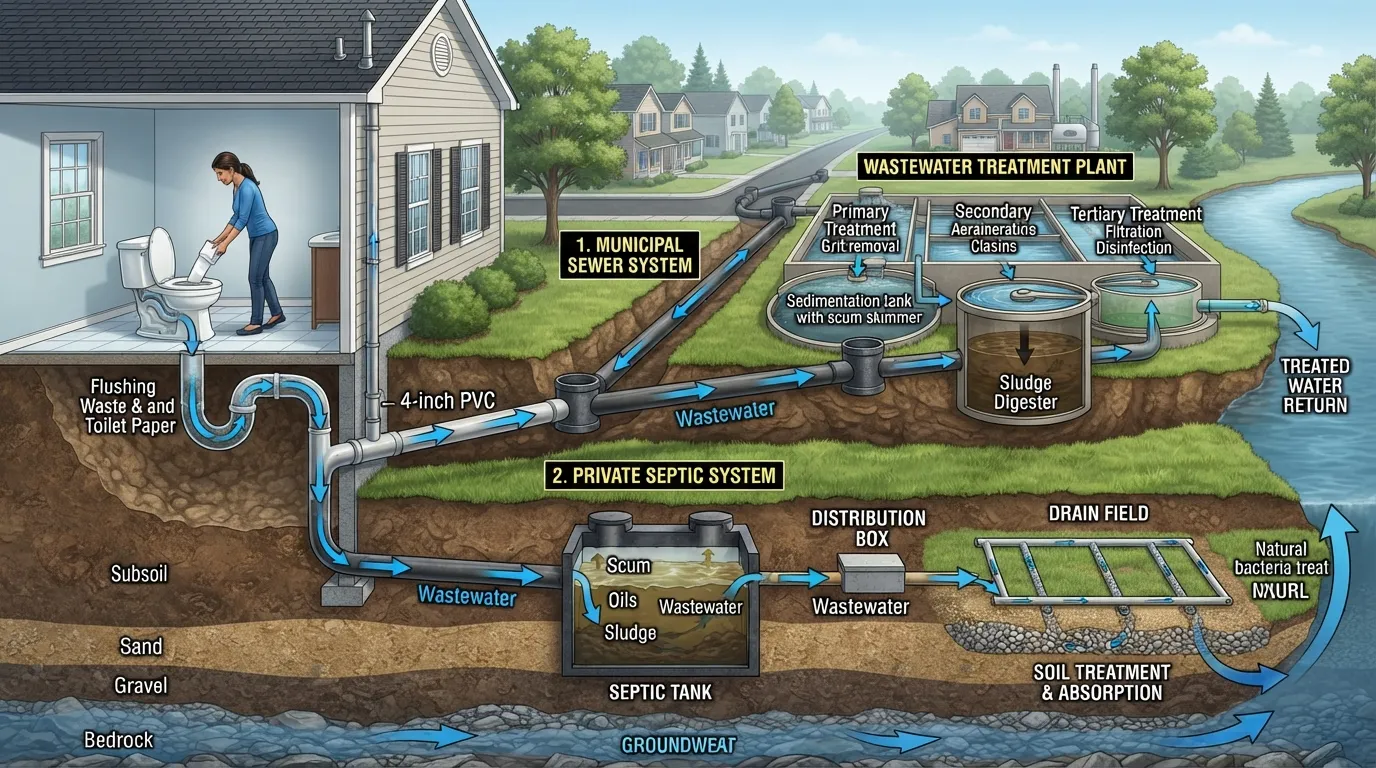
When you flush a toilet, the waste does not simply disappear. The toilet water, human waste, and toilet paper move through your home’s drain pipes and then follow one of two main routes: a municipal sewer system that carries wastewater to a treatment plant, or a private septic system that treats wastewater on your property.
If your home is connected to a public sewer, the wastewater usually travels through underground pipes to a wastewater treatment plant. There, solids are separated from the water, microorganisms help remove organic pollution, the water is disinfected, and the treated water may eventually be discharged to a river, lake, coastal water, or reused. If you have a septic system, the wastewater goes into an underground septic tank before the liquid portion moves into a drainfield and is further treated by the soil.
The easiest way to remember the journey:
Toilet → home drain pipes → city sewer and treatment plant or → septic tank and drainfield.
Where Does Waste Go When You Flush the Toilet?
The exact destination depends on how your property handles wastewater. I like to think of it as a fork in the road: one path leads away from your property through a public sewer network, while the other keeps the first stages of treatment right at your home.
| Your system | Where the flush goes | What happens next |
|---|---|---|
| Municipal sewer | Home drain → sewer lateral → sewer main | Wastewater is carried to a treatment plant. |
| Private septic system | Home drain → underground septic tank | Solids stay in the tank while liquid effluent moves to a drainfield. |
What Happens Immediately After You Flush?
Before sewage reaches a city sewer or septic tank, it has to leave the toilet and travel through your home’s plumbing. That first part of the journey happens surprisingly quickly.
- Water enters the bowl. When you activate the flush, water stored in the toilet tank or supplied by the flushing system enters the bowl and pushes the contents toward the outlet.
- Waste passes through the toilet’s trapway. The curved passage inside the toilet helps create the flushing action while also maintaining a water seal that helps keep sewer gases from entering the room.
- The mixture enters the home’s drain piping. Wastewater moves into branch drains, soil or waste stacks, and eventually the main building drain.
- It leaves the building. From there, it enters either a public sewer connection or a private septic system.
Gravity does much of the work. Properly installed drain and sewer pipes are sloped so wastewater continues moving downstream. In areas where gravity alone cannot carry sewage to its destination, pumping or lift stations may be used.
If You Have a City Sewer, Where Does Toilet Water Go?
If your property is connected to a municipal sewer, your toilet wastewater joins wastewater from sinks, showers, washing machines, and other plumbing fixtures. It usually leaves your property through a building sewer or lateral and enters a larger public sewer main.
↓
Home Drain Pipes
↓
Sewer Lateral
↓
Public Sewer Main
↓
Wastewater Treatment Plant
Sewer mains form an underground network. Smaller pipes feed into larger ones as wastewater travels toward a treatment facility. Most systems use gravity wherever possible, although pumps may be needed where terrain makes a continuous downhill route impossible.
What Happens at the Wastewater Treatment Plant?
Treatment plants are not all identical, so the exact equipment and treatment level can vary by location. However, a conventional municipal plant generally uses several stages to separate solids, reduce organic pollution, and make the wastewater safer before discharge or reuse.
1. Screens Remove Large Debris
Wastewater first passes through screens that catch larger objects that should not be moving through treatment equipment. This can include wipes, plastics, hygiene products, and other debris that people incorrectly send down drains and toilets.
2. Heavier Solids Settle Out
In primary treatment, wastewater is allowed to slow down in settling tanks or clarifiers. Heavier solids sink toward the bottom and form sludge, while floating materials such as grease and scum can be removed from the surface.
3. Microorganisms Treat Organic Pollution
The water still contains dissolved and suspended organic material after primary settling. During secondary biological treatment, microorganisms consume much of this material. Many plants provide oxygen to support this biological process.
4. More Solids Are Separated
Biological treatment creates additional suspended material, including masses of microorganisms. A later settling stage can separate these solids from the treated water.
5. The Water Is Disinfected
Before treated wastewater leaves the plant, many facilities disinfect it to reduce disease-causing microorganisms. The method varies. Treatment facilities may use chlorine, ultraviolet light, or other approved processes depending on the plant and local requirements.
6. Treated Water Is Discharged or Reused
Once treatment is complete, the resulting water—often called treated effluent—may be released to a permitted receiving water such as a river, lake, or coastal area, or it may receive additional treatment for reuse. The exact destination depends on the local wastewater system.
What Actually Happens to the Human Waste?
This is the part many explanations skip. The water and the solid waste do not necessarily end up in exactly the same place.
The Liquid Portion
The wastewater moves through the treatment process until pollutants and microorganisms have been reduced enough for the treated effluent to be discharged or reused according to the local system.
The Solid Portion
Solids removed during treatment become sludge. Treatment plants may thicken, stabilize, digest, dewater, or otherwise process this material. Its final destination can include permitted land application as treated biosolids, landfill disposal, incineration, or other local management methods.
So your poop does not simply remain intact and travel all the way through a treatment plant before being dumped somewhere. It becomes part of a wastewater mixture and is progressively separated, biologically broken down, treated, and managed in different forms.
What If Your Home Uses a Septic Tank?
Rural properties and homes outside public sewer service often use septic systems. In that case, flushing your toilet does not send the wastewater to a municipal treatment plant. The first treatment stages happen underground on your own property.
↓
Home Drain
↓
Septic Tank
↓
Drainfield
↓
Soil Treatment
- Wastewater enters the septic tank. All household wastewater connected to the system flows into a buried watertight tank.
- Solids and liquids separate. Heavier solids settle at the bottom as sludge, while fats, oils, and lighter floating material form a scum layer near the top.
- Bacteria partially break down organic material. Anaerobic biological activity occurs inside the tank, but it does not make all accumulated solids disappear.
- Liquid effluent leaves the tank. The liquid portion flows from the tank into a drainfield through distribution and perforated piping.
- The soil provides additional treatment. As effluent moves through the soil, natural physical and biological processes help remove contaminants.
Because solids continue accumulating in a septic tank, they eventually have to be removed through routine pumping. A septic tank is therefore not a bottomless underground container where waste permanently disappears.
The U.S. Environmental Protection Agency provides a useful explanation of conventional septic systems in its guide to how septic systems work.
Does Toilet Waste Go Into the Ocean?
Usually, raw toilet waste does not simply travel straight from your toilet into the ocean when your home is connected to a functioning municipal wastewater system.
The wastewater first goes through treatment. After treatment, the cleaned effluent may be discharged into a river, lake, estuary, or coastal water depending on where you live and how the local treatment system is designed. Water discharged upstream can also eventually make its way toward the ocean as part of the natural watershed.
There are exceptions during system failures, sewer overflows, or other unusual events, but these are not the normal intended route for household sewage.
What Happens to Toilet Paper After You Flush It?
Toilet paper is specifically designed to break apart much more easily in water than products such as wipes or paper towels. Once flushed, it travels through the same drain and sewer or septic route as the rest of the wastewater.
In a municipal treatment system, toilet-paper fibers become part of the suspended and organic material handled by screening, settling, and biological treatment. In a septic system, the material enters the tank and contributes to the solids that settle and break down over time.
Toilet paper and wipes are not the same thing. Even products marketed as flushable wipes generally do not break apart like toilet paper and can contribute to plumbing and sewer blockages. The safest rule is to flush only human waste and toilet paper unless your local wastewater authority specifically advises otherwise.
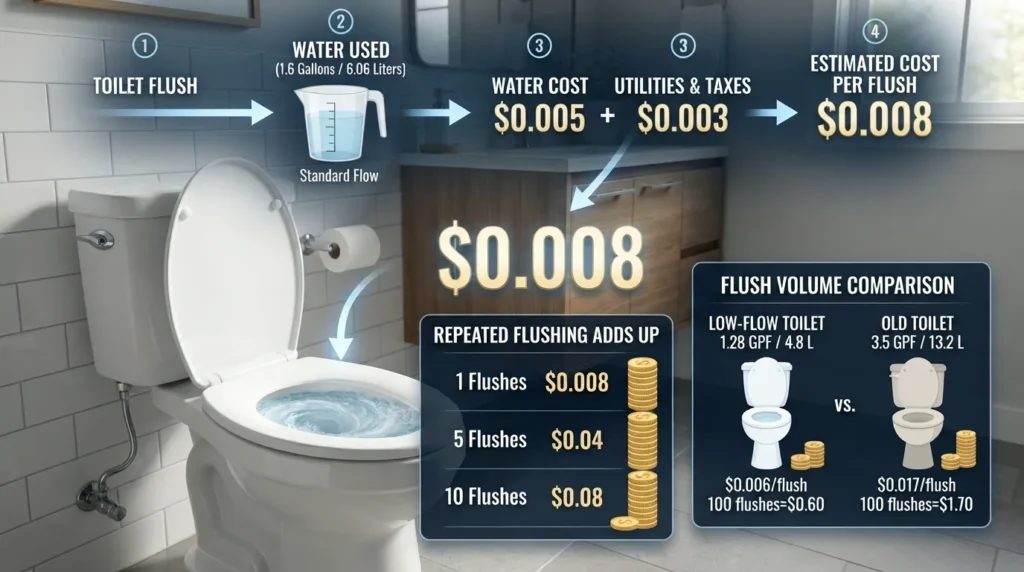
Does Flushing the Toilet Waste Water?
Every normal toilet flush uses water, but that does not automatically make the water use wasteful. Toilets are a basic sanitation system, and flushing is how waste is safely moved away from living areas.
Unnecessary flushing, a leaking toilet, or an inefficient older fixture can use more water than necessary. If you regularly hear your toilet refilling when nobody has used it, or water continuously trickles into the bowl, a leak may be worth investigating.
Why the Exact Journey Can Be Different From One Home to Another
The basic sewer-versus-septic explanation covers most homes, but local infrastructure can change the details. That is why two people can flush identical toilets and have their wastewater follow quite different routes.
- Terrain: gravity sewers work well downhill, while low areas may require pumps or lift stations.
- Treatment-plant design: different plants use different combinations of physical, biological, chemical, and advanced treatment processes.
- Local discharge rules: treated effluent may go to surface water or receive further treatment for reuse.
- Property type: homes outside municipal sewer coverage may rely on septic or another approved onsite wastewater system.
- System condition: blockages, damaged pipes, septic failures, or sewer overflows can interrupt the normal route.
What Should You Avoid Flushing?
Understanding where toilet waste goes also explains why your toilet should not be treated like a trash can. Materials that do not break apart easily can clog your home’s plumbing, damage pumps, accumulate in septic tanks, or create problems at wastewater treatment facilities.
As a practical rule, avoid flushing items such as:
- wet wipes and cleaning wipes;
- paper towels and tissues designed to stay strong when wet;
- sanitary pads and tampons;
- cotton swabs and cotton balls;
- dental floss;
- diapers;
- grease, fats, and cooking oil;
- household trash or plastic.
What disappears from the bowl is still somewhere in the wastewater system, so flushing inappropriate objects simply moves the problem farther downstream.
How Can You Tell Whether Your Toilet Goes to a Sewer or Septic Tank?
If you are unsure which path your own toilet waste follows, start with your utility bill or property records. A recurring municipal sewer charge usually indicates a public sewer connection. Homes with septic systems commonly have a septic tank and drainfield on the property and require periodic septic service.
If the answer is still unclear, your local public works department, wastewater utility, health department, property records office, or septic professional can usually confirm how the property is served.
What Happens After You Flush a Toilet, From Start to Finish?
If you want the entire journey in one sequence, this is the simplest version:
- You flush, and water carries waste through the toilet trapway.
- The wastewater enters your home’s drain system.
- It leaves the building through the main drain or building sewer.
- It enters either a municipal sewer or an onsite septic tank.
- Municipal wastewater travels through sewer mains to a treatment plant.
- At the plant, large debris and settleable solids are removed.
- Biological treatment reduces organic pollution in the water.
- The water is further clarified and commonly disinfected.
- Treated effluent is discharged or reused according to the local system.
- Removed solids are separately treated and managed.
If you have septic instead, steps five through ten are replaced by the septic-tank and drainfield process: solids remain in the tank, liquid effluent moves into the drainfield, and the soil provides further treatment.
A Few Common Questions
Where does human waste go after a sewage treatment plant?
By the time wastewater leaves the plant, human waste has been separated and transformed through several treatment processes. The treated liquid may be discharged or reused, while separated sewage solids are processed separately and may become treated biosolids or be disposed of through other approved methods.
Where does all our toilet waste go?
Most household toilet waste goes either to a municipal wastewater treatment plant or to an onsite septic system. Which one applies depends on the wastewater infrastructure serving the property.
Can toilet waste come back into the house?
It can if there is a serious drain blockage, sewer backup, failed pump, damaged sewer line, or septic problem. Sewage backing up into a toilet, tub, shower, or floor drain is not normal and should be treated as a plumbing or wastewater-system problem that needs prompt attention.
Does a septic tank completely break down human waste?
No. Bacteria break down some organic material, but solids still accumulate inside the tank. That is why septic tanks need periodic pumping rather than being left indefinitely.
The Simple Way to Picture It
The next time you flush, picture a transportation and treatment system rather than a hole where waste disappears.
In a sewered home, the waste travels through your plumbing, joins the underground sewer network, reaches a wastewater treatment plant, and is separated into water and solids that follow different treatment paths. In a septic home, the waste goes to a tank on the property, where solids settle while liquid moves to a drainfield for additional treatment in the soil.
Either way, the purpose is the same: move human waste safely away from living spaces and treat it before it returns to the wider environment.
Useful References
For a detailed explanation of onsite wastewater treatment, see the
U.S. EPA guide to how septic systems work.
For additional background on municipal wastewater treatment processes, see the
U.S. EPA information on sewage treatment plants.