Tank vs Tankless Water Heater
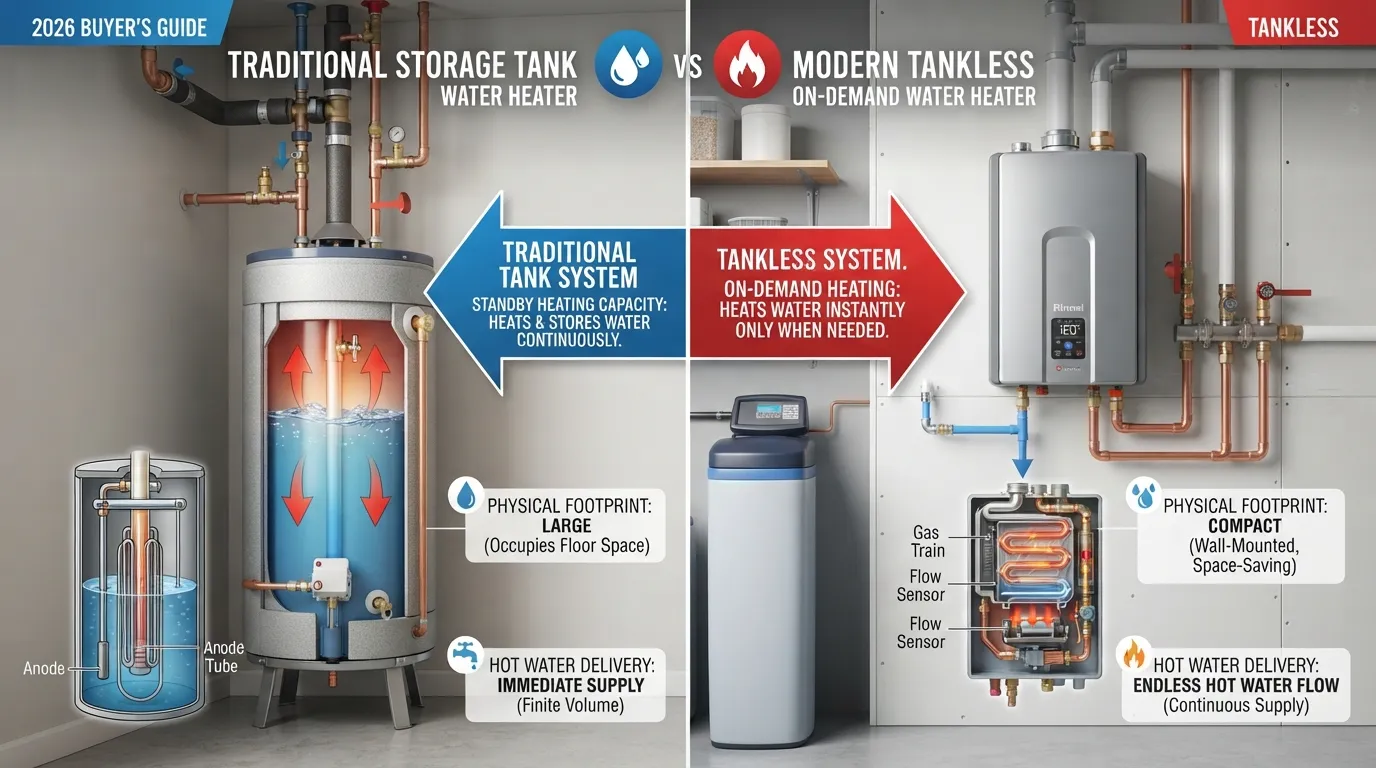
Choosing between a traditional tank water heater and a modern tankless system comes down to balancing upfront investment with long-term energy savings. A tank water heater stores and continually heats 30 to 50 gallons of water, whereas a tankless water heater provides instant, on-demand hot water only when you turn on the tap.
Tank vs Tankless Water Heater The Core Difference
Traditional systems suffer from standby heat loss because they keep a large reservoir of water hot 24/7, even when no one is home. Conversely, on-demand hot water systems heat water directly as it flows through the unit, eliminating energy waste but potentially struggling with high simultaneous household demand.
- Tank Systems: Lower initial purchase price, easier installation, but higher ongoing utility bills due to continuous heating cycles.
- Tankless Systems: Higher upfront cost and complex retrofitting, but superior energy efficiency and a much longer operational lifespan.
How Tank and Tankless Water Heaters Actually Work
Understanding the mechanical differences between water heating systems helps homeowners choose the right equipment for their household demands. While both units deliver hot water to your faucets and appliances, their internal operations and energy consumption patterns are fundamentally distinct.
How a Tank Storage Water Heater Works
A storage water heater operates by filling a heavy-duty steel container with water and keeping it hot continuously. A typical household utilizes a 40–80 gallon tank that constantly maintains water temperature using an internal thermostat.
- Cold water enters through a dip tube, forcing hot water upward and out toward your home’s plumbing lines.
- The system cycles on and off throughout the day and night to combat natural heat loss through the tank walls.
- Sediment naturally builds up at the bottom over time, requiring periodic flushing to maintain operational efficiency.
How a Tankless On-Demand Water Heater Works
A wall-mounted unit eliminates the storage reservoir entirely, heating water only when a hot water tap is opened. When you demand hot water, the system detects the incoming flow and rapidly activates its heating components.
- Water passes through a series of super-heated coils inside the compact chassis, providing continuous hot water on demand.
- The output capacity is strictly governed by the flow rate (GPM), which dictates how many fixtures can run simultaneously.
- Because water is only heated during active use, standby energy waste is completely eliminated from the cycle.
Gas vs Electric Mechanism Difference
Both storage and tankless configurations can run on either natural gas/propane or electricity, impacting their internal heating mechanisms and power requirements. Choosing the right power source affects installation complexity and overall recovery speed.
- Gas Systems: Utilize a powerful gas burner or electronic ignition system to rapidly transfer high levels of heat through a combustion chamber or heat exchanger.
- Electric Systems: Rely on internal electric element components (in tanks) or heavy-duty electric resistance coils (in tankless models) to warm the water stream.
Gas vs Electric 4-Way Type Comparison
Comparing water heaters requires examining both the tank style and the energy source, as gas and electric models perform vastly differently. Evaluating a gas tank water heater versus its electric counterpart, or assessing a gas tankless system against an electric tankless setup, reveals critical differences in installation and performance.
Gas Tank vs Gas Tankless Water Heater
Gas-powered units are known for high recovery rates and powerful heating capabilities, but their infrastructure needs vary dramatically by model. A traditional gas tank relies on atmospheric venting, whereas tankless versions often require specialized venting and fuel delivery updates.
- Gas Tank: Uses a standard metal flue to exhaust combustion gases safely out of the home with minimal modification.
- Gas Tankless: Demands a larger natural gas line and dedicated PVC or stainless steel venting requirement to handle higher combustion output safely.
- Performance: Both provide fast hot water, but gas tankless units deliver endless hot water once ignited, unlike the limited capacity of a storage tank.
Electric Tank vs Electric Tankless Water Heater
Electric water heaters are easier to place anywhere in a home because they do not require gas lines or outdoor venting. However, the immense power draw of electric tankless units creates unique electrical infrastructure challenges.
- Electric Tank: Operates on standard 240-volt home circuits, making direct replacement straightforward and budget-friendly.
- Electric Tankless: Draws massive amounts of electrical current, frequently requiring a major electrical panel upgrade and multiple dedicated heavy-gauge wire runs.
- Efficiency: While electric storage tanks suffer from continuous standby heat loss, electric tankless units save energy despite demanding high momentary electrical loads.
Which Fuel Type Suits Your Home Setup?
Your existing home architecture largely dictates which category of water heater you can install without incurring massive renovation expenses. Evaluating structural readiness prevents unexpected budget overruns during installation.
- Choose Gas If: Your home already features a robust gas supply line and proper venting clearance near the installation site.
- Choose Electric If: Your property lacks gas infrastructure, or if you want to avoid combustion exhaust management altogether in an apartment or tight utility closet.
Cost Comparison Upfront Installation & Long-Term
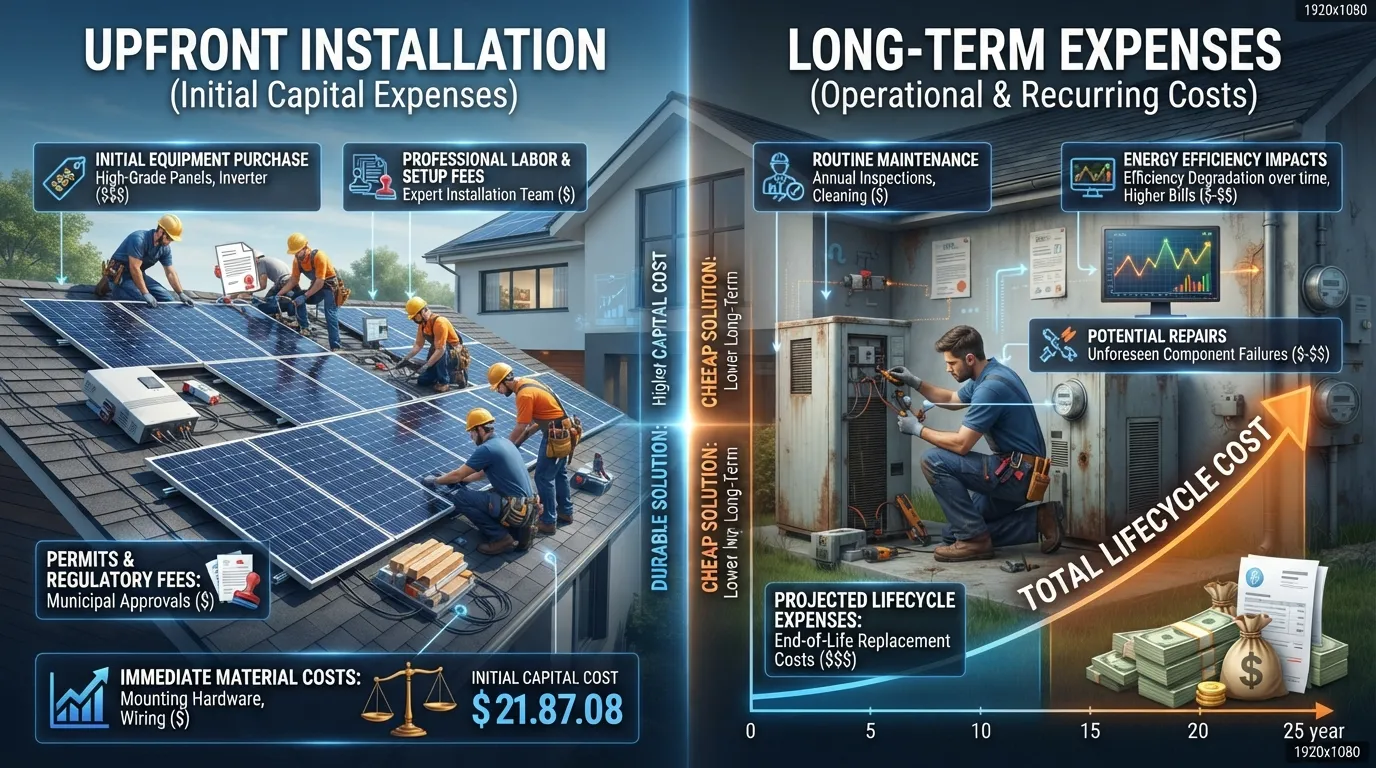
Evaluating water heater expenses requires looking past the initial price tag to analyze true operating budgets and long-term financial impact. While traditional systems demand lower upfront capital, on-demand alternatives offer energy efficiency that directly influences your overall total cost of ownership and future ROI.
Upfront Unit Cost Tank $300–$2,000 Tankless: $1,000–$3,000
Upfront equipment pricing reveals a substantial gap between conventional storage systems and advanced on-demand alternatives. A standard tank water heater typically ranges from $300 to $2,000 depending on tank capacity and fuel source, whereas a residential tankless unit runs between $1,000 and $3,000 for the hardware alone.
- Tank Unit Price: Lower baseline manufacturing costs make standard storage tanks accessible for immediate budget replacements.
- Tankless Unit Price: Higher technology complexity, advanced digital controls, and dual heat exchangers drive up the baseline equipment unit price.
Installation Cost Breakdown
The total installation cost often surprises homeowners because retrofitting a house for a tankless system requires extensive labor and structural adjustments. Swapping an old tank for a new one takes a couple of hours, whereas moving to a tankless configuration frequently demands specialized venting, upgraded gas plumbing, or a major electrical upgrade.
- Venting Modifications: Tankless units expel cooler, highly acidic exhaust that cannot use standard metal flues, requiring dedicated PVC or stainless steel venting materials.
- Utility Infrastructure: High-capacity gas burners require wider gas lines, while electric tankless models require multiple dedicated high-voltage circuit breakers.
- Labor Time: Complex retrofitting labor can push total tankless installation expenses between $1,500 and $3,500 above the unit price.
10-Year Total Cost of Ownership Comparison
Calculating a 10-year total cost of ownership reveals how monthly utility savings help offset the steep initial investment of a modern system. Although tankless units require a higher initial outlay, their lower standby energy consumption and doubled lifespan yield a measurable ROI by year eight or nine.
- Tank Financial Profile: Lower entry cost, but higher ongoing utility bills and an expected replacement cycle within 8 to 12 years.
- Tankless Financial Profile: Heavy upfront investment followed by reduced monthly utility bills and a durable 20+ year operational lifespan.
Energy Efficiency & Real Electric Bill Impact
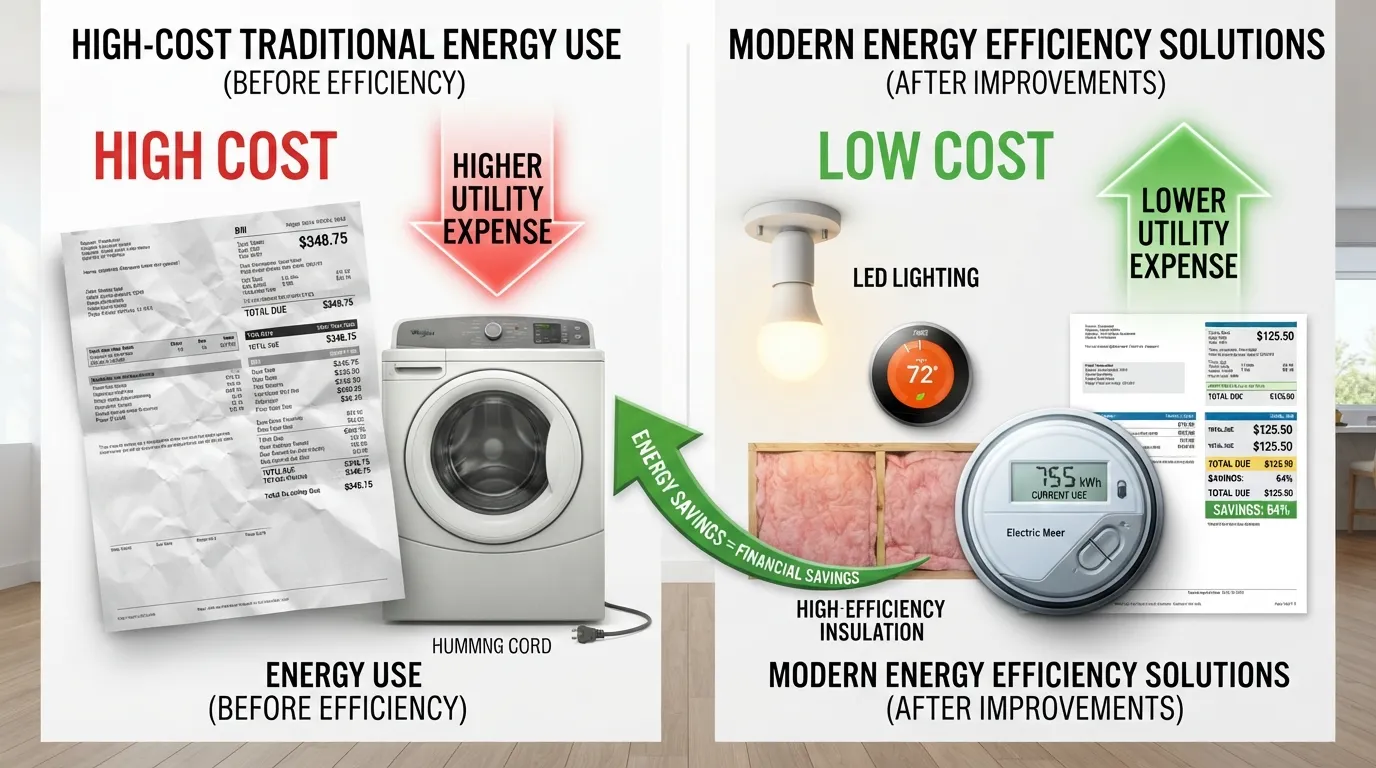
Homeowners switching to a modern water heating system often wonder how their utility statements will shift over time. Tankless water heaters reduce annual energy consumption by eliminating continuous heating cycles, translating to noticeable savings on monthly utility bills compared to traditional storage tanks.
Standby Heat Loss Explained Why Tanks Waste Energy
Traditional tank water heaters suffer from constant standby heat loss, wasting energy 24 hours a day. Because a storage tank keeps 40 to 50 gallons of water hot continuously, the unit repeatedly fires up even when no one is home, driving up baseline utility expenses.
Storage tanks feature an energy factor (EF) or Uniform Energy Factor (UEF) rating that typically ranges between 0.60 and 0.70. This lower rating highlights significant efficiency losses due to thermal radiation.
- Thermal Radiation: Heat constantly escapes through the insulated steel tank walls into the surrounding utility room or basement.
- Constant Cycling: The internal heating element or burner must engage periodically just to maintain the user-defined water temperature.
Tankless Energy Savings: 24%–40% Breakdown
Tankless water heaters achieve remarkable efficiency by heating water strictly on demand. According to energy efficiency studies, homes that use moderate amounts of hot water daily can experience a significant energy savings percentage of up to 34% compared to standard storage tanks.
Modern gas and electric tankless models boast UEF ratings between 0.82 and 0.96, meaning nearly all consumed fuel or power directly converts into usable hot water.
- Demand-Driven Operation: Energy is consumed solely during active tap usage, dropping standby waste to absolute zero.
- Efficiency Trade-Offs: Overall savings scale based on daily consumption patterns, maximizing efficiency for smaller or average-sized households.
Real Electric Bill Impact Example
A common homeowner question asks whether an electric bill spikes when transitioning to a tankless system. While electric tankless units draw high momentary amperage, any net electric bill increase is usually offset by the complete removal of continuous standby losses.
For an average household spending $40 monthly to heat water with a standard electric tank, shifting to an electric tankless configuration can reduce that specific portion of the statement by $10 to $15 each month.
- Annual Utility Reduction: Typical families save roughly $100 to $150 annually on their combined utility costs after upgrading.
- Peak Load Considerations: Spreading out heavy hot water activities prevents high concurrent electrical draws, keeping overall monthly usage optimized.
Lifespan & Maintenance Requirements
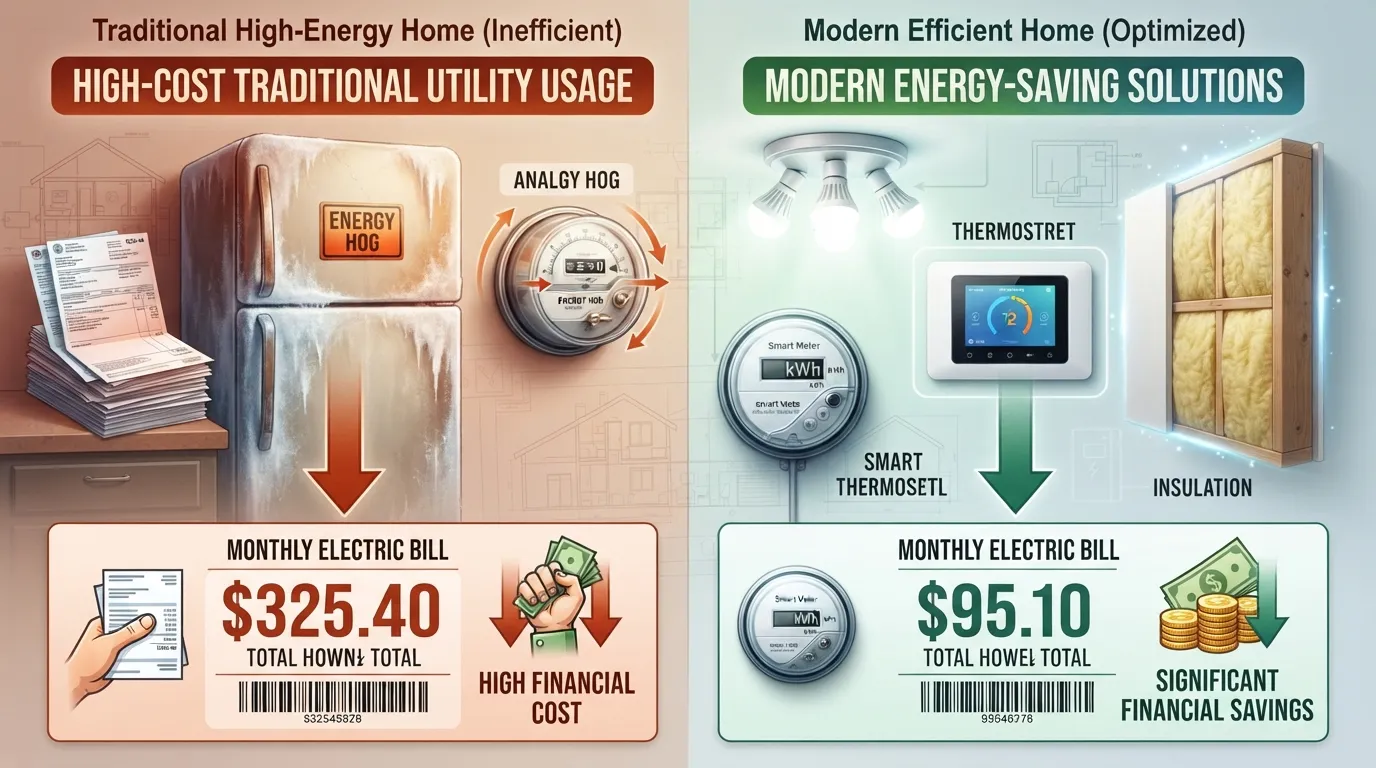
Long-term durability and maintenance routines differ significantly between traditional storage tanks and modern on-demand systems. Understanding the lifespan expectancy and required upkeep helps homeowners protect their investment and avoid unexpected plumbing emergencies.
Tank Lifespan: 8–12 Years
A standard storage water heater typically lasts between 8 and 12 years before internal corrosion compromises the steel vessel. The constant expansion and contraction of the metal tank under high water pressure eventually leads to structural fatigue and leaks.
- Anode Rod Degradation: A sacrificial anode rod protects the inner tank lining from rust, but it requires regular inspection and replacement every 3 to 5 years.
- Tank Failure Warning: Pooling water around the base of the unit or discolored rusty output typically signals that the tank has reached the end of its operational lifecycle.
Tankless Lifespan: 15–20 Years
Tankless water heaters offer an extended lifespan of 15 to 20 years, outlasting conventional storage units by nearly a decade. Because these systems do not hold water under constant pressure, their internal components experience far less continuous structural stress.
- Replaceable Components: Electronic control boards, sensors, and individual heating modules can be swapped out easily without replacing the entire housing chassis.
- Longevity Factors: Proper water filtration and routine preventative maintenance are vital to achieving the maximum manufacturer-rated lifespan.
Maintenance Tasks: Sediment Flushing vs Descaling
Both system types demand regular upkeep to prevent sediment buildup and mineral scaling caused by hard water. However, the procedures differ between storage tanks and tankless models.
- Annual Flushing (Tanks): Requires connecting a garden hose to the bottom drain valve to clear out accumulated calcium and debris from the reservoir base.
- Chemical Descaling (Tankless): Requires pumping a food-grade vinegar solution through dedicated isolation valves to dissolve internal scale inside the heat exchanger.
Which One Is Right for You? Sizing & Decision Guide
Choosing the ideal water heater requires evaluating your unique household habits, daily consumption volumes, and peak usage patterns. Finding the right balance between storage capacity and simultaneous hot water demand ensures your family never runs out of hot water during busy morning routines.
How Household Size Affects Your Choice
Your household size directly dictates whether a traditional storage tank or an on-demand system will serve your property efficiently. Larger families with overlapping schedules require careful calculation of the necessary GPM (gallons per minute) to prevent lukewarm showers.
- Small Households (1–2 people): Benefit greatly from tankless units due to low baseline usage and minimal standby waste.
- Large Families (4+ people): Must evaluate whether their electrical or gas infrastructure can support a high-flow tankless model or if a large 50-to-80-gallon storage tank is more practical.
Is a 40-Gallon Tank Enough for a Family of 5?
A standard 40-gallon storage tank is generally inadequate for a family of 5 if multiple fixtures operate at the same time. Because a 40-gallon tank only yields about 30 to 35 usable gallons before needing a recovery cycle, simultaneous showers and appliance usage will quickly deplete the hot water supply.
- Capacity Limits: A family of five typically exhausts a 40-gallon tank within 15 to 20 minutes of heavy use.
- Alternative Solution: Larger households require either a 50+ gallon storage tank, dual tankless units, or a high-capacity gas tankless system rated for 8+ GPM.
Simultaneous Usage Consideration
Assessing your peak hour usage involves adding up the flow rates of every appliance and fixture you might run at once. Running a shower, dishwasher, and washing machine simultaneously demands a high overall flow rate calculator estimate to avoid performance bottlenecks.
- Shower Fixtures: Standard showerheads consume roughly 2.0 to 2.5 GPM, while high-flow rain heads can require 3.0 GPM or more.
- Appliance Draws: Dishwashers and washing machines pull approximately 1.0 to 2.0 GPM during active fill cycles.
Simple Sizing Table Mini GPM Guide
The Honest Take Why Some Plumbers Don’t Recommend Tankless
While tankless water heaters receive heavy praise for their energy efficiency, experienced plumbers often voice practical concerns that manufacturers tend to downplay. Understanding the disadvantages of tankless systems helps homeowners look beyond marketing claims and evaluate whether an on-demand setup truly fits their daily lifestyle.
Common Complaints Plumbers Hear About Tankless Units
Service professionals frequently field homeowner frustration regarding unexpected operational quirks after upgrading to a tankless configuration. Unlike storage tanks that deliver a steady, predictable stream of hot water, on-demand units rely on complex electronics and immediate sensor triggers that can introduce minor operational friction.
- Initial Ignition Delays: Water must travel through the pipes and trigger the flow sensor before heating begins, causing a brief wait time at the faucet.
- Maintenance Sensitivity: Neglecting annual descaling will quickly trigger error codes, shut down the unit, and require costly professional intervention.
Downsides of Tankless Water Heaters
Examining technical limitations reveals why a plumber recommendation sometimes favors conventional storage models depending on the home’s architecture. On-demand systems face specific engineering hurdles that traditional tanks avoid entirely.
- Cold Water Sandwich Effect: Turning a hot water tap off for a few seconds and turning it back on can send a brief slug of ice-cold water through the pipes as the burner reignites.
- Flow Rate Limitations: Exceeding the maximum GPM rating splits the hot water output across fixtures, causing noticeable temperature drops during concurrent household use.
- Repair Complexity: High repair complexity means specialized diagnostic tools and costly proprietary replacement parts are often required when electronic components fail.
Why Traditional Tanks Still Make Sense for Many Homes
Traditional storage water heaters remain the default choice for millions of households because of their simplicity, lower upfront capital requirement, and forgiving nature with hard water. A conventional tank delivers reliable hot water to multiple fixtures simultaneously without worrying about electronic flow sensors or minimum activation thresholds.
- Uninterrupted Delivery: Storage tanks release all stored hot water instantly upon opening a tap, regardless of how many fixtures are running at once.
- Budget-Friendly Service: Local handymen or standard plumbers can easily service, flush, or replace parts on traditional tanks without specialized manufacturer training.
Real Homeowner Experiences
Gathering unbiased feedback from residential forums highlights a common theme among long-term users balancing both systems. While energy savings are real, many homeowner experience accounts emphasize that the heavy upfront installation costs and strict maintenance routines require serious consideration before making the switch.
- The Financial Reality: Users note that while monthly utility bills drop immediately, the massive initial installation quote takes years of energy savings just to break even.
- The Verdict: Homeowners living in areas with extremely hard water frequently report wishing they had installed better filtration systems or stuck with conventional tanks to minimize scaling headaches.
Regulations Phase-Outs & 2026 Tax Credits
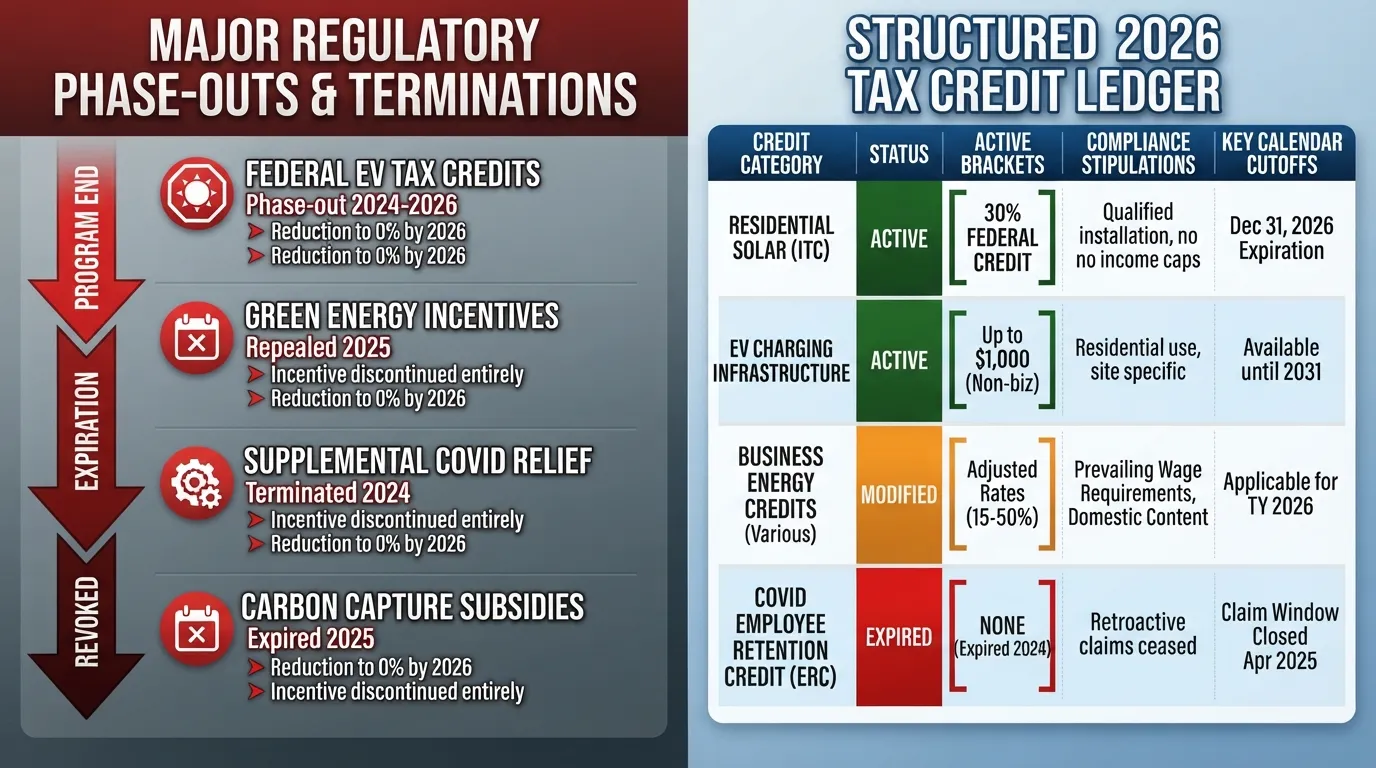
Navigating modern water heater standards requires staying informed about changing federal energy regulations and available financial incentives. Understanding upcoming efficiency mandates and federal programs ensures you maximize savings while purchasing compliant equipment for your home.
Are Traditional Tank Water Heaters Being Phased Out?
Traditional tank water heaters are not being entirely banned or phased out of the residential market, but stricter federal efficiency mandates are continually raising the baseline manufacturing requirements. These regulations aim to reduce overall carbon footprints and lower household energy waste across the country.
- Market Availability: Standard storage tanks remain fully legal to purchase and install, provided they meet current government energy performance minimums.
- Technological Shifts: Manufacturers are increasingly favoring hybrid heat pump technology for larger electric tanks to meet stringent federal efficiency ratings easily.
Truth Behind the 2027 Ban Claims
Recent online rumors regarding a complete federal ban on standard water heaters have caused significant confusion among homeowners preparing for upcoming replacements. Clarifying the Department of Energy guidelines reveals that upcoming updates target efficiency thresholds rather than outlawing specific product styles.
- DOE Efficiency Standards: The updated DOE efficiency standards mandate higher UEF requirement levels for newly manufactured units, effectively phasing out less efficient baseline models.
- Impact on Consumers: Homeowners can still buy and repair existing tank styles, but new inventory will feature advanced insulation and improved heat exchangers to comply with updated regulations.
2026 Federal Tax Credits for Energy-Efficient Water Heaters
Upgrading to a high-efficiency water heater qualifies homeowners for significant government financial incentives designed to offset steep installation costs. Under current federal guidelines, qualifying units can earn substantial tax rebates when filing tax returns.
- Energy Efficient Home Improvement Credit: Eligible heat pump and high-efficiency tankless models qualify for valuable tax credits under Section 25C of the tax code.
- Filing Requirements: Claiming these financial benefits requires filing IRS Form 5695 alongside your annual return, ensuring your chosen equipment meets strict ENERGY STAR certification guidelines.
DIY Installation & Permit Legality
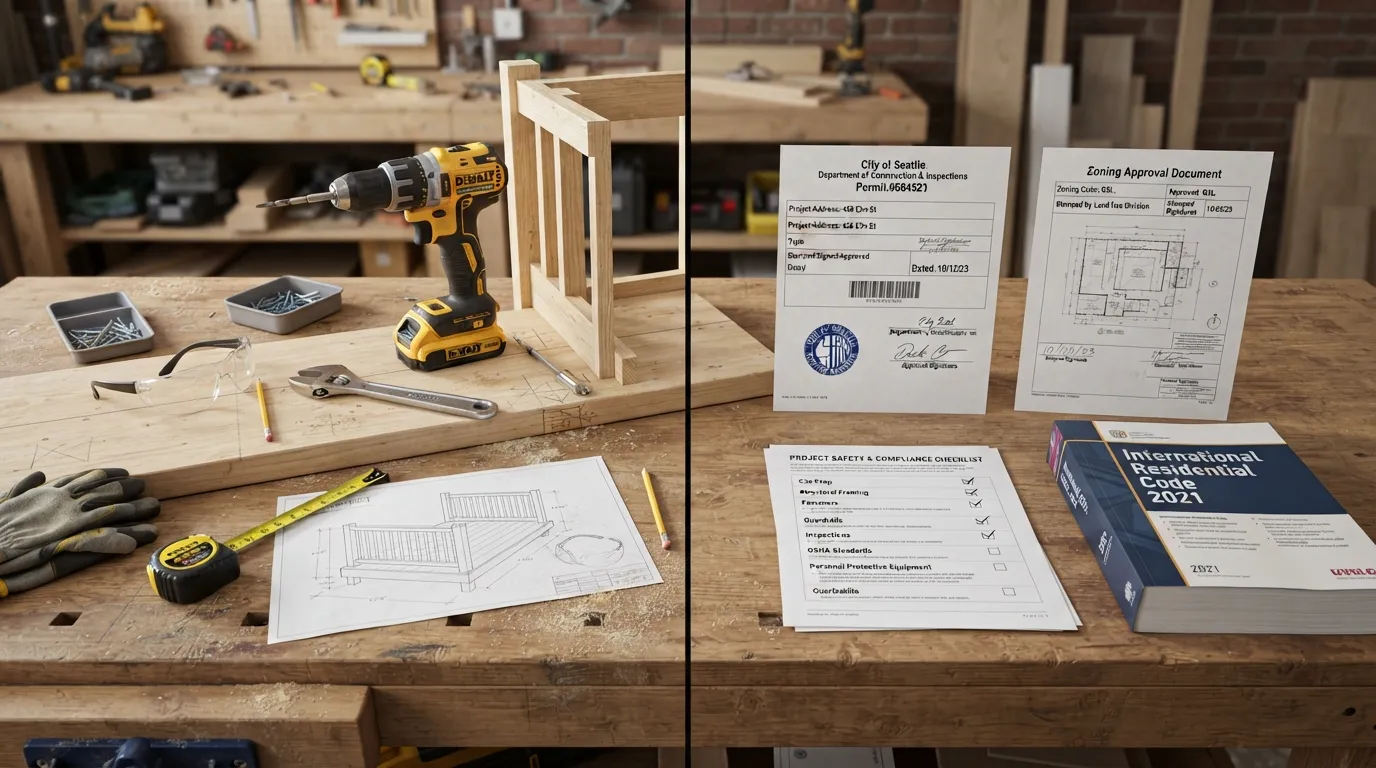
Attempting a water heater replacement as a weekend project requires careful evaluation of safety regulations, municipal laws, and technical skill. Understanding the legal boundaries between DIY work and professional contracting ensures your home remains compliant and safe.
Can You Legally Install Your Own Water Heater?
In many jurisdictions, homeowners are legally permitted to perform a DIY installation on their own primary residence, provided the work adheres strictly to local building codes. However, “legal to do” does not mean “recommended,” as water heaters involve high-pressure water, electrical hazards, or combustible gases.
- Homeowner Exemptions: Some municipalities allow owner-occupants to pull their own plumbing permits without a contractor license.
- Inspection Mandates: Even authorized DIY installations typically require a mandatory municipal inspection after completion to verify safety compliance.
When a Licensed Plumber Is Required
Certain aspects of water heater installation carry severe safety risks that legally or practically necessitate a licensed plumber or certified technician. Attempting high-risk modifications without professional training can result in code violations, personal injury, or voided equipment warranties.
- Gas Line Safety: Modifying, extending, or connecting rigid natural gas or propane lines demands precise leak testing and professional expertise to prevent deadly gas leaks.
- Electrical Upgrades: Upgrading breaker panels or running heavy-duty 240-volt wiring for electric tankless systems requires a licensed electrician to meet electrical codes.
Permit Requirements Overview
Securing an official building permit is a standard legal prerequisite for replacing a water heater in almost all residential areas. Ignoring local permit requirements can create severe complications when attempting to sell your home in the future.
- Local Building Code Variations: Regulations vary widely by state and municipality regarding seismic strapping, expansion tanks, and backflow preventers.
- Insurance Protection: Professional installation backed by a pulled permit ensures your homeowner’s insurance policy remains fully valid in the event of accidental water damage.
Hybrid Heat Pump Water Heaters The Third Option
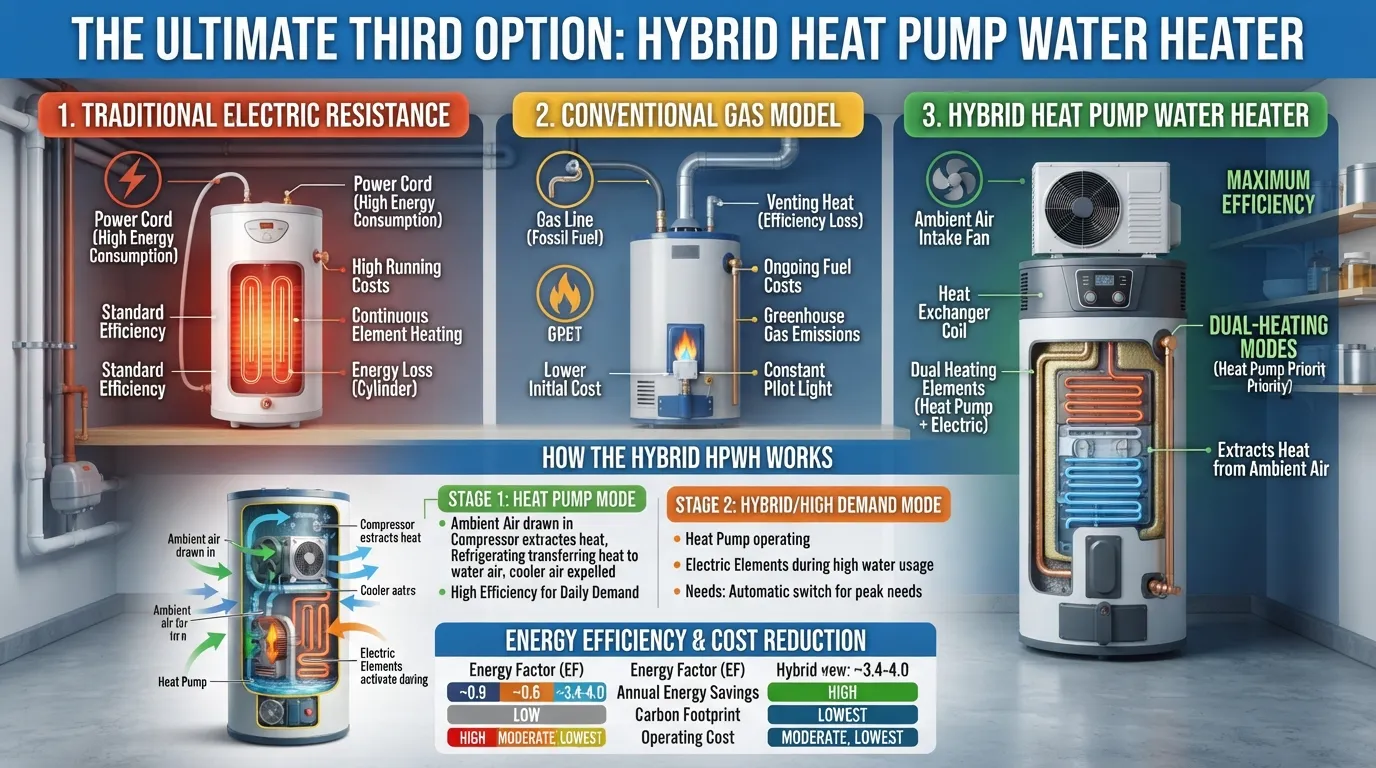
When comparing traditional storage tanks against on-demand systems, many homeowners overlook the most energy-efficient choice available. A hybrid water heater—commonly referred to as a heat pump water heater—combines traditional storage capabilities with advanced thermodynamic technology to maximize utility savings.
What Is a Hybrid Heat Pump Water Heater?
A hybrid system uses surrounding ambient air to warm your household water instead of relying exclusively on electric resistance coils. An integrated heat pump located on top of the tank pulls in warm air, extracts the thermal energy, and transfers it directly into the water reservoir.
- Dual Operation Modes: The unit automatically switches to standard electric resistance heating only when hot water demand exceeds the heat pump’s recovery speed.
- Space and Climate Requirements: Because these units extract heat from the surrounding air, they require approximately 1,000 cubic feet of unconditioned space and function best in utility rooms that stay above 40°F.
How It Compares to Tank and Tankless Options
Evaluating an electric heat pump against standard storage tanks and tankless systems reveals a unique balance of high efficiency, lower operating costs, and moderate space requirements.
- Versus Standard Tanks: Hybrid units use up to 70% less electricity than conventional storage tanks, dramatically cutting monthly utility bills.
- Versus Tankless Systems: While tankless units save space, hybrid water heaters offer a lower upfront purchase price and much simpler retrofitting because they connect to standard electrical wiring and plumbing lines.
When a Hybrid Model Might Be the Better Choice
Choosing a hybrid water heater is often the smartest strategy for homeowners who want massive energy savings without paying for expensive electrical panel upgrades or specialized gas venting.
- High Energy Efficiency Goals: An exceptional energy factor comparison shows that hybrid models achieve UEF ratings over 3.0, outperforming both standard tanks and electric tankless units.
- Basement or Garage Placement: Installing the unit in a spacious garage or basement allows the heat pump to operate efficiently while naturally dehumidifying the surrounding indoor air.
Pros and Cons Summary Table
Reviewing a direct comparison summary of both water heating systems helps crystallize your final purchasing decision. Weighing the advantages and disadvantages of each setup ensures your chosen equipment aligns with your home’s infrastructure and budget.
Tank Water Heater: Pros & Cons
Traditional storage tanks offer dependable, straightforward performance with minimal upfront financial strain, though they come with ongoing efficiency trade-offs.
- Pros: Lower upfront purchase price, simple replacement installation, and the ability to run multiple hot water fixtures simultaneously without flow restrictions.
- Cons: Continuous standby heat loss drives up monthly utility bills, shorter 8 to 12 year lifespan, and a bulky footprint that takes up valuable floor space.
Tankless Water Heater: Pros & Cons
Modern on-demand systems deliver exceptional longevity and energy efficiency, but require a significant upfront capital investment and careful attention to maintenance.
- Pros: Endless on-demand hot water, compact wall-mounted design that saves space, high energy efficiency, and a durable 20+ year operational lifespan.
- Cons: High initial equipment and installation costs, potential flow rate limits during heavy concurrent usage, and strict annual descaling requirements.
Frequently Asked Questions
Find direct answers to the most common questions regarding tank and tankless water heaters, installation requirements, maintenance, and energy efficiency standards.
Why do plumbers not recommend tankless water heaters?
Some plumbers hesitate to recommend tankless units because of their high installation costs, complex retrofitting requirements, and sensitivity to hard water. Neglecting annual maintenance causes mineral scaling that can quickly shut down the system and lead to costly repairs.
Why do people still use tank water heaters?
Traditional tanks remain popular because of their low upfront purchase price, straightforward replacement process, and ability to deliver hot water to multiple fixtures simultaneously without flow rate limitations.
What are the downsides of tankless water heaters?
Key disadvantages include a steep initial equipment and installation price, potential flow rate limits during heavy concurrent usage, initial ignition delays, and the dreaded cold water sandwich effect.
Are tank water heaters being phased out?
Traditional storage tanks are not being banned, but stricter federal efficiency mandates are raising baseline manufacturing standards. Manufacturers are leaning toward high-efficiency designs like hybrid heat pump tanks to meet these rules.
What is the average lifespan of a water heater tank?
A standard storage water heater typically lasts between 8 and 12 years before internal rust and tank fatigue cause structural leaks.
Are regular water heaters going to be illegal in 2027?
No federal law bans regular water heaters in 2027. Upcoming Department of Energy standards simply require higher energy efficiency ratings for newly manufactured units.
How much does your electric bill go up with a tankless water heater?
Electric tankless units draw high momentary electrical current, but they eliminate continuous standby heat loss. For most homes, monthly utility savings offset the energy draw, resulting in a net decrease or neutral impact on bills.
Is there a tax credit for tankless water heaters in 2026?
Yes, qualifying high-efficiency tankless gas water heaters and heat pump systems are eligible for valuable federal tax credits under the Energy Efficient Home Improvement Credit.
Am I allowed to replace my own hot water heater?
Many local building codes permit homeowner DIY replacements on a primary residence, though a mandatory municipal inspection is typically required upon completion.
Is a 40-gallon water heater enough for a family of 5?
A 40-gallon storage tank is generally insufficient for a family of 5 during peak usage hours, as concurrent morning showers will quickly exhaust the hot water supply.
What is a good GPM for a tankless water heater?
A flow rate between 5.0 and 8.0 GPM is typically required for a standard family home, depending on how many showers and appliances run simultaneously.
Final Verdict Conclusion
Deciding between a traditional storage tank and a modern on-demand system ultimately depends on your household size, budget, and long-term home improvement goals. Evaluating your specific lifestyle requirements ensures you select the heating solution that offers the best balance of comfort, reliability, and value.
Choose a Tank If
A conventional storage water heater remains the smartest and most economical choice for many homeowners who prioritize low upfront costs and simple maintenance routines.
- Budget Sensitivity: You want a reliable replacement system with lower upfront equipment and installation expenses.
- Hard Water Areas: Your local water supply has high mineral content and you want a forgiving system that requires less frequent descaling.
- High Simultaneous Demand: Your household frequently runs multiple showers and appliances at the exact same time without worrying about flow rate limits.
Choose Tankless If
Investing in a modern tankless water heater is ideal for homeowners looking to maximize energy efficiency, save physical space, and enjoy endless hot water.
- Long-Term Value: You plan to stay in your home long enough to recoup the higher initial investment through cumulative utility bill savings.
- Space Constraints: You need to reclaim valuable floor space in a cramped utility closet, basement, or apartment.
- Environmental Goals: You want to eliminate continuous standby heat loss and reduce your household’s overall carbon footprint.
Our Recommendation Summary
Both water heater styles offer distinct advantages, meaning the “best” choice is entirely subjective to your home’s unique infrastructure. Assess your electrical panel, gas line capacity, and daily hot water volume carefully before making a final investment.
- The Short-Term Winner: Traditional tanks win on convenience, price point, and hassle-free installation.
- The Long-Term Winner: Tankless systems win on energy efficiency, lifespan, and modern performance capabilities.

Oscar Vance | Master Plumber & Drainage Expert
Meet Oscar Vance, a licensed master plumber sharing practical solutions on residential repairs, preventive maintenance, and thoughtful home upkeep.
Pingback: Water Heater Pilot Light Won't Stay Lit? Causes & Safe Fixes