Polarized Electrical Receptacle Explained
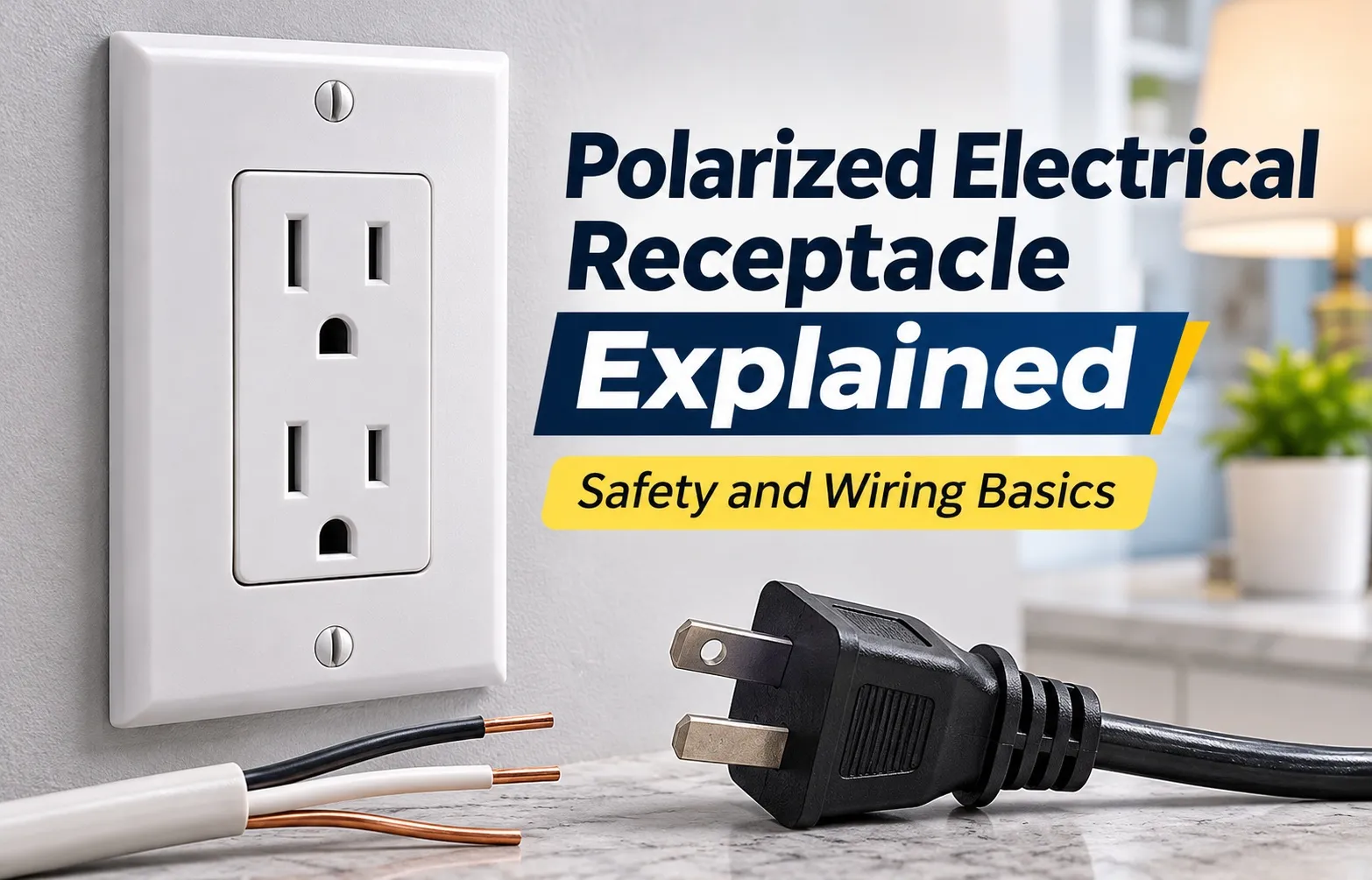 A polarized electrical receptacle is an AC power wall outlet engineered with asymmetrical slots—one wider than the other—to ensure an electrical plug can only be inserted in a single, correct orientation. This mechanical design forces the live current to flow through the intended internal path of an appliance, maintaining consistent polarity and protecting users from severe electrical shock hazards.
What Is a Polarized Electrical Receptacle?
A polarized electrical receptacle is a standard home safety outlet designed to complete an alternating current (AC) circuit in a fixed, unidirectional manner. By enforcing physical alignment between the plug and the outlet, it guarantees that electrical voltage travels safely from the power supply, through the device’s power switch, and back out through the neutral return line.
The core functions of a polarized receptacle include:
- Directional Current Control: Ensures electricity enters the appliance strictly through the hot line and returns safely via the neutral line.
- Mechanical Keying: Uses unequal slot lengths so non-reversible two-prong plugs physically fit only one way.
- Standardized Compliance: Adheres to North American NEMA standards (such as NEMA 1-15R and NEMA 5-15R) for residential alternating current power distribution.
At a Glance: Identifying Hot, Neutral, and Ground Slots
Visual identification of a polarized wall outlet is straightforward once you know the standard slot size difference established by electrical codes. Every modern polarized receptacle features distinct physical markers for each connection point.
Here is how to identify the slots on a standard vertical outlet:
- Neutral Slot (Left Side): The longer, wider slot on the left connects to the white neutral wire. It completes the circuit by carrying power back to the main breaker panel.
- Hot Slot (Right Side): The shorter, narrower slot on the right connects to the black live wire. It delivers 120 volts of continuous AC power from the breaker panel to the outlet.
- Ground Slot (Bottom Center): The rounded or U-shaped hole at the bottom connects to the bare copper or green ground wire. Found on three-prong receptacles, it provides a safe discharge path directly to the earth in the event of a short circuit.
This physical design prevents reverse polarity, ensuring that even simple two-prong appliances maintain a safe internal current path whenever they are plugged into a wall outlet.
Anatomy & Mechanical Differences of Outlets
Understanding the internal and external physical structure of a polarized electrical receptacle requires examining its dimensional asymmetry and terminal wiring. Standard NEMA 1-15 and NEMA 5-15 outlets rely on precise slot geometry and color-coded terminal screws to manage 120 volts safely.
Anatomy Breakdown: Left vs. Right Slot Dimensions
The physical construction of a polarized receptacle enforces safety through unequal slot dimensions. This mechanical asymmetry prevents plugs from being inserted backwards, protecting downstream circuits.
- Left Slot Geometry: Built longer to accommodate the neutral blade of a polarized plug, ensuring the return path remains wide and unconstrained.
- Right Slot Geometry: Built shorter and narrower to match the live hot blade, locking in standard orientation.
- NEMA Standard Compliance: Complies with NEMA 1-15 (two-prong polarized) and NEMA 5-15 (three-prong grounded) specifications used across North American residential wiring systems.
Color-Coded Terminal Screws: Brass, Silver, and Green
Behind the faceplate, the internal wiring of an electrical receptacle depends on standardized color-coded terminal screws. These indicators match specific wire types to prevent dangerous installation errors.
- Brass Terminal Screws: Connect directly to the hot insulated wire delivering 120 volts from the circuit breaker panel.
- Silver Terminal Screws: Connect to the neutral insulated wire completing the circuit return path back to the service panel.
- Green Ground Screw: Connects to the bare copper or green insulated ground wire, providing a fault-protection pathway to earth.
Comparison Table: Hot Slot vs. Neutral Slot vs. Ground Hole
The Physics of Safety – How Polarization Prevents Shocks
Electrical safety hinges on strictly controlling exactly where and how continuous live power enters an appliance. Polarization ensures that when an appliance is switched off, its internal electrical pathways remain completely dead and safe to handle.
The Role of Switch Placement in Circuit Safety
The core engineering logic of a polarized electrical receptacle revolves around precise switch placement. To protect consumers, appliance manufacturers design power switches to interrupt the hot wire before the current reaches the broader machinery.
- Isolating the Voltage: Breaking the hot connection ensures internal components are immediately deprived of voltage when the device is turned off.
- Preventing Energized States: If the switch were on the neutral wire instead, electrical circuit completion would stop, but the device’s internal wiring would remain energized and highly dangerous.
- Mechanical Enforcement: A polarized plug forces the wide blade into the neutral slot, physically guaranteeing the appliance switch successfully targets the incoming hot live wire.
Real-World Hazard: The Threaded Lamp Socket Example
The most common and dangerous example of reversed polarity occurs within a standard household lamp socket. Electrical manufacturing standards dictate that the incoming hot wire must connect exclusively to the small, insulated contact point at the bottom center of the bulb.
- The Outer Shell Risk: The large, threaded outer shell of the socket is designed to connect to the neutral wire.
- Accidental Electrocution: If a non-polarized or incorrectly wired plug reverses this flow, the easily touchable outer shell receives continuous live power.
- The Shock Hazard: Changing a lightbulb in a reverse-polarized lamp creates an immediate shock hazard, as a person’s fingers can easily brush the energized threaded metal while completing the circuit to the ground.
How Proper Polarization Eliminates Shock Hazards
Proper directional power flow through a polarized electrical receptacle actively prevents a user’s body from becoming a pathway to the earth. It is a vital defense mechanism against the dangers of an energized chassis.
By enforcing this strict current orientation, polarization achieves the following safety standards:
- Protects the Outer Casing: Guarantees that any metallic exterior parts remain isolated from live voltage, neutralizing the threat of an energized chassis.
- Secures Internal Wiring: Ensures that all internal components beyond the power switch are physically cut off from the electrical grid when not in use.
- Stops Unintentional Grounding: Eliminates the risk of sudden electrical circuit completion through a human user who touches a faulty appliance while standing on a grounded surface.
Polarized vs. Non-Polarized vs. Grounded Outlets
Understanding the difference between 2-prong polarized, 2-prong non-polarized, and 3-prong grounded receptacles is critical for evaluating household electrical safety. Electrical standards established by the National Electrical Code standards dictate how different outlet types handle live power, neutral return current, and fault protection.
Two-Prong Polarized Outlets vs. Modern Three-Prong Grounded Outlets
While both 2-prong polarized and 3-prong grounded receptacles ensure directional current flow, their levels of user protection differ significantly. The main distinction lies in how each system handles excess electrical faults.
- Two-Prong Polarized Outlets (NEMA 1-15R): Align hot and neutral current flow using unequal slot sizes, but lack an equipment ground path for sudden fault currents.
- Three-Prong Grounded Outlets (NEMA 5-15R): Combine hot-neutral directional alignment with a dedicated safety ground wire (connected to a bare copper or green wire) to instantly trip the breaker during a short circuit.
- Safety Upgrade Path: Replacing an ungrounded 2-prong outlet with a 3-prong receptacle requires a continuous ground path back to the service panel or appropriate GFCI protection per code rules.
Why Some Plugs Aren’t Polarized (The Double Insulation Concept)
Many modern electronics—such as phone chargers, electric shavers, and power tool battery docks—feature non-polarized plugs with two identical narrow prongs. These devices can be safely inserted into an outlet in either direction due to double insulation engineering.
Double insulation protects users without requiring directional plug orientation by using the following techniques:
- Non-Conductive Plastic Housing: The entire exterior structure is encased in non-conductive plastic, completely isolating internal electrical components from the user.
- Dual Mechanical Barriers: Two independent layers of electrical insulation separate all live internal wiring from accessible surfaces, eliminating the risk of an energized chassis.
- Zero Metal Touchpoints: Because there are no exposed conductive metal parts, maintaining specific hot-versus-neutral alignment inside the device is unnecessary.
Small Appliances vs. Heavy Equipment: Requirements Explained
Appliance size, power draw, and outer material determine whether a device uses a non-polarized 2-prong plug, a polarized 2-prong plug, or a 3-prong grounded plug.
- Non-Polarized 2-Prong Devices: Low-power, double insulated electronics with non-conductive plastic housing (e.g., cell phone chargers, wireless speakers).
- Polarized 2-Prong Devices: Single-insulated appliances with exposed metal or specific switch pathways (e.g., table lamps, toasters, curling irons) requiring strict hot/neutral alignment.
- Grounded 3-Prong Devices: High-draw appliances or metal-housed equipment (e.g., refrigerators, microwave ovens, power tools) requiring a dedicated safety ground wire to handle potential electrical faults.
Dangers of Reverse Polarity & DIY Hazards
Incorrectly wired wall outlets and improper DIY modifications create severe safety hazards that compromise household electrical systems. Understanding the risks of hot-neutral reversal and dangerous adapter shortcuts helps prevent accidental electrocution and property damage.
What Happens When Polarity Is Reversed? (Reverse Polarity Risks)
Reverse polarity occurs when the hot and neutral wires are mistakenly swapped during outlet installation, leaving internal components continuously energized even when switched off. This dangerous hot-neutral reversal creates hidden shock potentials and severe appliance damage risks across household circuits.
Key consequences of a miswired, reverse-polarity outlet include:
- Continuous Live Voltage: Internal switches fail to isolate power, leaving internal parts live even in the “off” position.
- Elevated Shock Potential: Users touching exposed metal components face an immediate risk of severe electrical shock.
- Appliance Damage: Sensitive electronics and motorized devices can overheat or experience premature electrical failure.
Can You File Down the Wide Blade of a Polarized Plug? (Critical Safety Warning)
Filing down the wider blade of a polarized plug to force it into an old unguided outlet is an extremely hazardous DIY modification that eliminates critical shock protections. This unsafe practice bypasses intentional design safety features, drastically increasing the danger of electrical shocks and structural fires.
Why altering modified plugs is dangerous:
- Loss of Circuit Orientation: Reversing the plug forces live current onto vulnerable outer shells or uninsulated internal chassis components.
- Increased Fire Risk: Forced connections can cause loose fits, localized overheating, arcing, and electrical fires.
- Bypassing Manufacturer Protections: Defeats the engineering safeguards intended to prevent accidental contact with live alternating current.
Can You Plug a Non-Polarized Plug Into a Polarized Outlet?
Plugging a non-polarized two-prong plug into a polarized electrical receptacle is completely safe and fully compatible. Because non-polarized plugs feature two identical narrow blades, they fit naturally into both polarized and unpolarized wall outlets without compromising device or circuit safety.
Safety aspects of using non-polarized plugs in polarized outlets:
- Universal Blade Fit: Narrow blades slide smoothly into either slot without forcing or altering the physical structure of the plug.
- Double Insulation Support: Devices using non-polarized plugs rely on complete plastic housings rather than directional alignment for safety.
- No Code Violations: Inserting a standard narrow-bladed plug into a polarized outlet complies entirely with standard electrical guidelines.
How to Test & Troubleshoot Outlet Polarity at Home
Verifying correct outlet wiring protects household appliances and prevents electrical shocks. Homeowners can safely check outlet polarity and identify miswirings using simple diagnostic tools like a plug-in receptacle tester or a digital multimeter.
Using an Inexpensive 3-Prong Receptacle Tester
A standard 3-prong receptacle tester is the fastest, safest tool for checking outlet wiring. Users simply plug it into the wall outlet and interpret the indicator lights against the legend printed on the device body.
- LED Light Patterns: Different light combinations instantly reveal correct wiring, open grounds, open neutrals, or dangerous reverse polarity.
- Immediate Feedback: Flags miswired terminal connections instantly without exposing the user to live internal wires or metal contact points.
- Affordable Diagnosis: Provides an accessible, user-friendly way to audit every room in a home before plugging in sensitive electronics.
Testing Polarity with a Digital Multimeter (Step-by-Step)
For detailed diagnostic verification, a digital multimeter offers precise electrical measurement. This method requires careful handling of probe tips to measure voltage differences between individual receptacle slots.
- Set the Multimeter: Turn the selector dial to AC voltage at a setting higher than 120 volts (typically 200V or 600V range).
- Measure Hot to Neutral: Insert the black probe into the wide neutral slot and the red probe into the narrow hot slot to verify a stable 120-volt reading.
- Measure Hot to Ground: Insert the red probe into the hot slot and the black probe into the ground hole to ensure proper earth continuity and voltage drop.
How to Fix Reverse Polarity Safely (When to Call an Electrician)
Discovering reverse polarity or faulty wiring requires immediate attention to eliminate shock and fire hazards. While some homeowners experienced with basic electrical work can correct simple screw misconnections, professional help ensures complete safety and code compliance.
- Circuit Power Cutoff: Always shut off power at the main breaker panel before removing any outlet cover plates or touching internal wiring.
- Correct Wire Placement: Ensure the black live wire connects exclusively to the brass terminal screw and the white neutral connects to the silver screw.
- Calling a Licensed Electrician: Engage a licensed electrician if wiring is outdated, brittle, or if you encounter complex multi-wire branch circuits.
Frequently Asked Questions About Polarized Receptacles
Addressing common questions about household outlets, adapter plugs, and safety upgrades helps homeowners maintain secure, code-compliant electrical systems.
What is the difference between polarized and non-polarized outlets?
A polarized outlet features unequal slot sizes (a wider left neutral slot and a narrower right hot slot) to enforce proper single-direction plug insertion. A non-polarized outlet has two identical narrow slots, allowing plugs to be inserted in either orientation regardless of internal switch placement.
- Polarized Outlets: Direct the current flow through specific internal appliance pathways to reduce shock hazards.
- Non-Polarized Outlets: Found primarily in ungrounded older installations, lacking physical slot size enforcement for safety.
Are old 2-prong unpolarized outlets dangerous to use today?
Yes, unpolarized 2-prong outlets present heightened electrical risks because they allow modern polarized plugs to be inserted backwards, creating reverse polarity conditions. They also lack a dedicated ground pathway for fault protection.
- No Ground Protection: Unpolarized 2-prong receptacles cannot safely divert fault currents away from connected equipment.
- Incompatible Blades: Attempting to insert a wider blade of a polarized plug into an unpolarized slot can lead to unsafe forcing or modified plugs.
Can I replace a 2-prong polarized outlet with a 3-prong outlet without rewiring?
You cannot directly swap an ungrounded 2-prong receptacle for a standard 3-prong grounded outlet without installing a safety ground wire or using GFCI protection. Upgrading safely without complete house rewiring requires specific National Electrical Code methods.
- GFCI Protection Solution: Installing an ungrounded 2-prong replacement with a GFCI receptacle allows 3-prong usage while protecting against ground faults.
- Clear Labeling Requirements: Outlets upgraded via GFCI without an actual ground wire must be labeled “No Equipment Ground.”
- Avoid Adapter Plugs: Three-to-two prong adapter plugs should not be used unless the center tab is anchored to a verified metal box ground.
Do modern electronic chargers need polarized prongs?
Most modern smart chargers for mobile phones, laptops, and small consumer electronics do not require polarized prongs. These devices are built using double insulation standards that safely isolate electrical currents without directional plug alignment.
- Double Insulated Enclosures: Fully plastic outer shells prevent electrical contact with internal components.
- Low Voltage Conversion: Internal transformers convert incoming AC power into low-voltage DC current before it leaves the power adapter brick.
- Surge Protection Note: While individual chargers use non-polarized blades, plugging them into multi-outlet surge protection strips still benefits from grounded, polarized wall feeds.

Oscar Vance | Master Plumber & Drainage Expert
Meet Oscar Vance, a licensed master plumber sharing practical solutions on residential repairs, preventive maintenance, and thoughtful home upkeep.