The Private Equity Gold Rush in Home Services and HVAC Roll-Ups
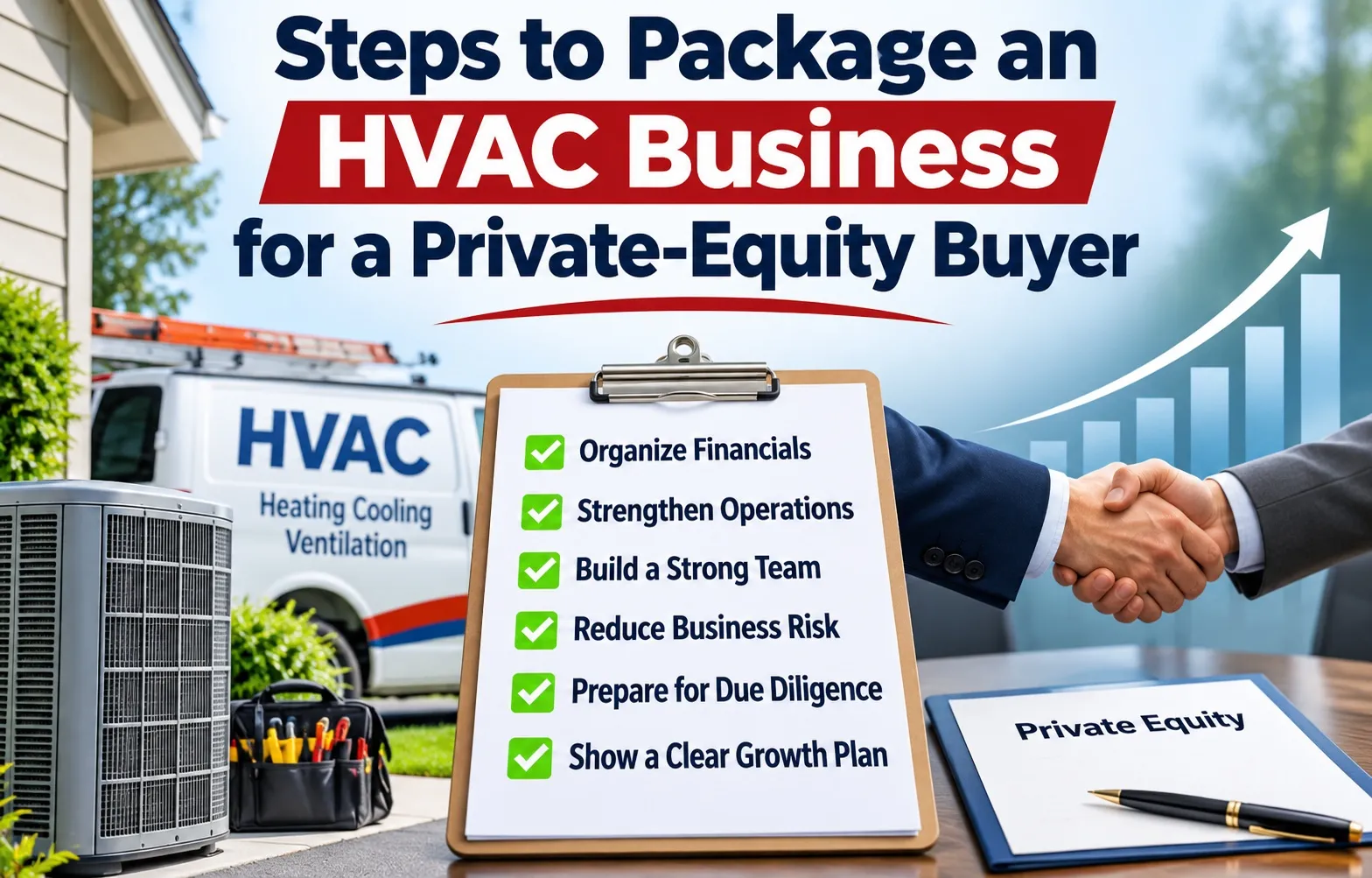 Private equity firms and institutional roll-up platforms are aggressively acquiring HVAC businesses due to predictable, recession-resistant cash flows and fragmented regional markets ripe for consolidation. Positioning your enterprise for this high-stakes M&A landscape requires a meticulous 12-to-24-month strategic overhaul.
Why PE Firms Love the HVAC Industry
Institutional investors target residential and commercial HVAC contractors because climate control services are non-discretionary. Aging housing infrastructure guarantees continuous emergency repair demand, while shifting weather patterns drive urgent equipment replacements.
- Recession-resistant consumer demand driven by essential home infrastructure needs.
- High-margin service calls that naturally transition into lucrative equipment upgrade leads.
- Fragmented local markets that allow acquirers to scale rapidly via multi-city footprint expansion.
- Predictable cash generation supported by routine maintenance and seasonal tune-up schedules.
Platform Companies vs. Regional Add-On Acquisitions
Understanding how private equity categorizes your business dictates your valuation multiple and negotiation leverage. Institutional buyers distinguish between primary platform investments and smaller regional add-on acquisitions.
- Platform Companies: Larger enterprises generating significant EBITDA with an existing executive management team, serving as the foundational hub for future regional acquisitions.
- Add-On Acquisitions: Smaller local contractors acquired and integrated directly under an existing platform’s regional umbrella to consolidate local market share.
- Valuation Impact: Platform entities command higher institutional valuation multiples due to their operational independence and established middle management layers.
The 12-to-24-Month Pre-Sale Preparation Timeline
Maximizing enterprise valuation requires treating your exit strategy like an institutional project executed over a disciplined 2-year runway. Rushing the transaction process invariably leaves millions on the table during due diligence.
- Months 1 to 6: Transition books from cash-basis to GAAP accrual accounting and begin stripping out personal owner expenses to clean up EBITDA.
- Months 7 to 12: Institutionalize operations by deploying field service software, enforcing strict SOPs, and building recurring maintenance membership pools.
- Months 13 to 18: Establish a second-in-command management layer to completely remove owner dependency from daily dispatch and sales.
- Months 19 to 24: Assemble the virtual data room, engage boutique M&A investment bankers, and launch competitive bidding processes among prospective private equity buyers.
Financial Scrubbing & The Quality of Earnings (QoE) Readiness Test
Private equity buyers will heavily discount or outright walk away from an HVAC business relying on casual cash-basis bookkeeping. Transitioning to institutional-grade, GAAP-compliant financial reporting is the foundational prerequisite to surviving due diligence and commanding premium valuation multiples.
Moving from Cash-Basis to GAAP Accrual Accounting
Cash-basis accounting fails to accurately capture accounts receivable, accrued inventory, and deferred maintenance contract revenue. Institutional buyers demand accrual statements to understand your true operating liabilities, cash velocity, and actual profitability at any given moment.
- Reconcile accounts payable and accounts receivable to reflect real-time operational obligations.
- Partner with an industry-specialized M&A CPA to convert historical books seamlessly.
- Recognize service revenue when earned rather than strictly when cash hits the bank account.
- Ensure proper inventory valuation for parts, refrigerants, and replacement equipment stock.
Calculating True Adjusted EBITDA (Removing Personal & One-Off Expenses)
Calculating true Adjusted EBITDA requires stripping out non-operational, personal, and one-off expenses hidden within contractor P&Ls. Private equity firms evaluate what the business earns purely as a standalone, professionally managed operating entity.
- Remove personal vehicle leases, fuel cards, and insurance policies run through the business.
- Adjust family payroll down or up to reflect fair market value for executive management roles.
- Isolate one-time legal settlements, emergency equipment purchases, or non-recurring expenses.
- Normalize owner’s discretionary perks to present clean, institutional operating earnings.
Preparing for the Institutional Quality of Earnings (QoE) Audit
A Quality of Earnings audit is a rigorous independent financial investigation executed by buyers to verify your reported earnings. Failing a QoE audit results in drastic purchase price reductions, escrow holdbacks, or total deal termination at the closing table.
- Audit internal accounting records against filed federal and state tax returns for discrepancies.
- Establish a clear working capital peg to prevent unexpected cash adjustments during closing.
- Document customer lifetime value metrics and seasonal revenue fluctuations transparently.
- Pre-emptively identify accounting weaknesses before external auditors discover red flags.
Building a 3-Year Auditable Financial Paper Trail
Institutional buyers require a pristine, verifiable three-year financial paper trail to establish historical growth trends and seasonal cash flow stability. Incomplete or messy records instantly trigger severe valuation penalties and prolonged due diligence cycles.
- Maintain monthly Profit & Loss statements and balance sheets for the past 36 consecutive months.
- Archive signed corporate tax returns matching internal bookkeeping figures precisely.
- Keep commercial bank statements accessible to cross-reference large cash inflows and deposits.
- Organize vendor invoices and customer financing settlements for cross-examination.
Optimizing Revenue Quality & Valuation Multiplier Drivers
Private equity firms do not just look at top-line revenue; they pay premium valuation multiples for predictable, high-quality cash flows. Transitioning your HVAC company away from volatile, one-off project work toward structured recurring service agreements drastically reduces perceived investor risk and maximizes your final buyout multiple.
The Power of Annual Maintenance Agreements (AMAs) & Recurring Revenue
Annual Maintenance Agreements form the bedrock of institutional value by generating dependable, year-round recurring revenue that cushions seasonal weather drops. PE buyers assign significantly higher multiples to recurring service contract income because it guarantees customer retention and predictable future cash flows.
- Package bi-annual tune-ups, priority dispatch, and repair discounts into pre-paid annual subscriptions.
- Target a minimum threshold of 25% to 35% of total annual revenue originating directly from active maintenance memberships.
- Leverage automated renewal funnels to maintain high contract retention year after year.
- Use routine maintenance visits as high-conversion touchpoints for equipment replacements and indoor air quality upgrades.
Targeting the Ideal Install-to-Service Revenue Mix (35/65 or 40/60)
A balanced revenue distribution between equipment replacements and ongoing service/repair work proves that your business thrives across all economic cycles. Over-indexing purely on massive commercial installs creates volatile revenue swings that deter risk-averse institutional investors.
- Maintain a healthy operational balance of roughly 35% to 40% equipment installation and 60% to 65% service and repair work.
- Ensure your dispatch team actively routes minor diagnostic and repair calls to balance technician utilization.
- Protect gross profit margins by balancing high-ticket install revenue with high-margin recurring repair agreements.
- Demonstrate stable seasonal performance across both cooling and heating cycles to due diligence teams.
Mitigating Customer Concentration and Single-Client Risk (<10%)
Customer concentration is an immediate deal-breaker during private equity underwriting if a single client controls too much revenue. Institutional buyers require diversified customer bases to ensure the loss of one major account will not destabilize enterprise operations.
- Ensure no single residential or commercial client accounts for more than 10% of your total gross annual revenue.
- Diversify your commercial accounts across property management firms, retail outlets, and multi-family residential complexes.
- Distribute residential marketing across broad geographic territories rather than relying on a single neighborhood.
- Document diversified billing logs to prove a stable, fragmented customer roster to auditors.
Micro-KPI Benchmarks PE Analysts Look For (Churn Rate & Average Ticket Size)
Private equity financial analysts audit granular operational metrics to gauge the operational efficiency and customer health of your HVAC business. Hailing superior micro-KPI benchmarks validates your pricing power and customer satisfaction during the QoE review.
- Keep annual member churn rate below 5% to 8% to prove high customer loyalty and service satisfaction.
- Optimize average ticket size on service calls by training technicians on transparent, diagnostic-driven solutions.
- Track technician conversion rates from standard diagnostic visits to closed repair or replacement quotes.
- Monitor callback rates closely, keeping warranty callbacks under 2% to ensure elite workmanship quality.
De-risking Operations, Management Layers, & Removing Key-Person Dependency
Private equity buyers heavily penalize or walk away from businesses suffering from severe owner dependency, where daily survival hinges on the founder handling dispatch, sales, and customer relations. Eliminating this risk requires formalizing management layers, modernizing your CRM tech stack, and locking down workforce stability.
Eliminating the “Owner-Operator Penalty” (Stepping Out of Dispatch & Sales)
The “owner-operator penalty” occurs when private equity underwriters discount company valuations because the founder is the primary revenue generator and operational linchpin. Transitioning out of daily dispatch and high-ticket sales is mandatory to prove the business can operate profitably without your constant physical presence.
- Delegate incoming emergency call routing and scheduling entirely to trained dispatch staff.
- Transfer key commercial accounts and high-value residential client relationships into a shared central database.
- Step back from field estimates, allowing senior service technicians and sales leads to close proposals independently.
- Document your personal closing and estimation workflows into repeatable playbooks for incoming management.
Installing a Second-in-Command (General Manager & Service Manager Layers)
Institutional investors require a professionalized management hierarchy that can execute corporate growth strategies without founder oversight. Installing an experienced General Manager and specialized Service Managers proves the business possesses true institutional scalability.
- Hire or promote a capable General Manager to oversee daily administrative, financial, and operational execution.
- Appoint dedicated Service Managers to handle technician coaching, quality control, and field productivity tracking.
- Document comprehensive Standard Operating Procedures (SOPs) governing every administrative and technical workflow.
- Establish clear organizational charts that isolate daily departmental responsibilities away from executive ownership.
Modernizing Operations with Field Management Software (ServiceTitan & Housecall Pro)
Outdated paperwork and fragmented local tools create opaque auditing trails that scare off institutional buyers. Modernizing your software stack with elite CRM architecture ensures clean, transparent operational data during due diligence.
- Deploy enterprise-grade field management platforms like ServiceTitan or Housecall Pro to streamline dispatch and invoicing.
- Maintain clean, auditable digital histories tracking equipment service records, customer invoices, and technician notes.
- Utilize automated reporting features to generate instant KPI dashboards for prospective acquisition audits.
- Eliminate paper invoices and manual bookkeeping to ensure real-time visibility across all operational channels.
Securing Workforce Stability & Technician Retention (Non-Competes and Retention Bonuses)
Skilled HVAC technicians are the primary lifeblood of service operations, making labor retention a critical audit point for institutional buyers. Mitigating key-person risk and workforce turnover through enforceable agreements and retention incentives safeguards enterprise value before the sale closes.
- Ensure all technicians and field supervisors sign legally sound, enforceable non-compete and confidentiality clauses.
- Implement structured employee retention bonuses and performance-based incentive tiers tied to post-sale commitments.
- Foster transparent career advancement pathways to minimize technician turnover and recruitment overhead costs.
- Mitigate key-person risk by cross-training field personnel so no single technician controls a major client segment.
Decoding PE Deal Structures, Valuation Multiples, and Virtual Data Rooms
Private equity transaction structures combine upfront cash, retained equity roll-over, and conditional earnouts tied to future performance milestones. Mastering these financial mechanics alongside clean Virtual Data Room preparation ensures you maximize net proceeds and successfully close the acquisition.
Understanding HVAC EBITDA Multiples (Platform vs. Add-On Valuations)
Private equity firms value HVAC contractors using multiples of Adjusted EBITDA, with large standalone platforms commanding significantly higher multiples than smaller regional add-ons. Institutional buyers scale their valuation offers based on your revenue volume, geographic footprint, and operational maturity.
- Platform acquisitions typically command premium EBITDA multiples due to established management structures and multi-market scale.
- Regional add-on acquisitions are valued at lower multiples when integrated into existing parent corporations.
- Scale, recurring revenue percentage, and local market dominance directly drive multiple expansion.
- Professionalized accounting and transparent audits eliminate valuation discounts during initial underwriting.
Anatomy of a PE Offer: Cash at Close, Rollover Equity, & Earnouts
A standard private equity purchase offer rarely pays 100% cash upfront, instead blending immediate liquidity with retained equity stakes and performance-based earnout targets. Reviewing industry M&A benchmark studies helps owners evaluate how these deal components impact total net wealth generation.
- Cash at Close: Typically accounts for 60% to 80% of the total purchase price, delivered immediately upon closing.
- Rollover Equity: Reinvesting a portion of your sale proceeds into the parent private equity vehicle to share in future secondary buyout upside.
- Performance Earnouts: Contingent cash payouts released only if the business achieves agreed-upon revenue or EBITDA growth milestones post-sale.
- Escrow Holdbacks: A small percentage of cash held in reserve for 12 to 18 months to cover potential post-closing indemnity claims.
Building the Virtual Data Room (VDR) and Confidential Information Memorandum (CIM)
Assembling a pristine Virtual Data Room (VDR) and working with boutique investment bankers to draft a compelling Confidential Information Memorandum (CIM) accelerates due diligence and sparks competitive bidding. Presenting institutional-grade documentation eliminates friction and protects transaction momentum.
- Partner with an experienced M&A advisor or boutique investment banker to craft an aggressive, professional CIM.
- Pre-load the VDR with 3 years of audited financials, employee rosters, sample customer contracts, and equipment leases.
- Organize corporate governance records, fleet vehicle titles, and commercial real estate deeds for instant inspection.
- Restrict document access permissions inside the VDR to safeguard sensitive proprietary data from competing market players.

Oscar Vance | Master Plumber & Drainage Expert
Meet Oscar Vance, a licensed master plumber sharing practical solutions on residential repairs, preventive maintenance, and thoughtful home upkeep.