What Do You Need to Start an HVAC Business?
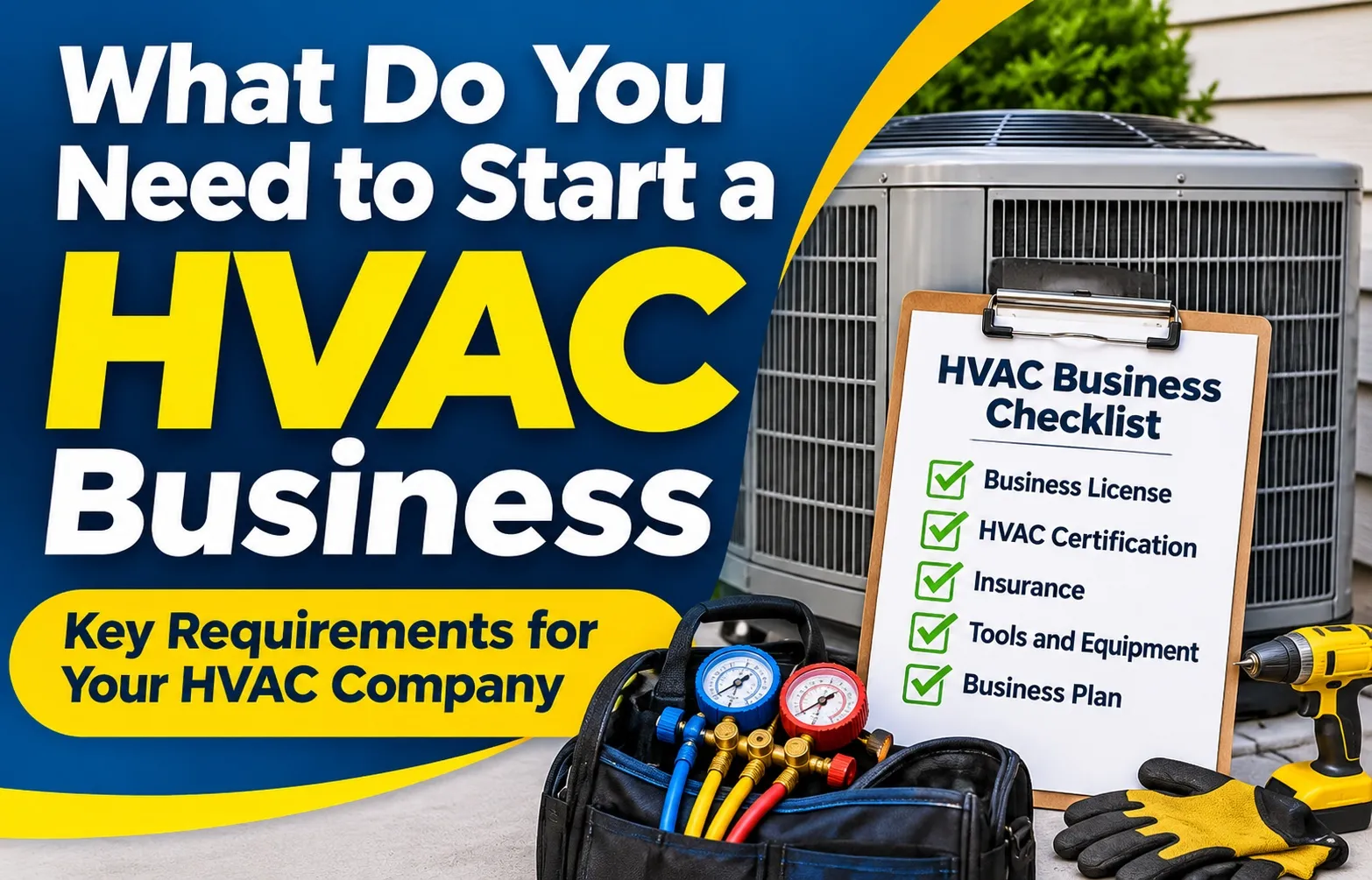 Starting an HVAC business requires federal EPA Section 608 certification, state contractor licensing, commercial liability insurance, specialized diagnostic equipment, and a registered legal entity like an LLC. Most startup contractors need between $15,000 and $50,000 in working capital to launch operations legally and safely.
The 5 Essential Pillars of Starting an HVAC Business
Launching a successful heating, ventilation, and air conditioning company depends on five core operational foundations. Meeting these core HVAC business requirements ensures full legal compliance, protects your financial assets, and creates an efficient system for acquiring residential and commercial clients from day one.
- Legal Structuring & Business Formation: Registering your company as an LLC or S-Corp shields personal assets from business liabilities and opens the door for an IRS Employer Identification Number (EIN) and commercial banking.
- Trade Licensing & Certification: Holding an EPA Section 608 Universal Certification is mandatory for refrigerant handling nationwide, alongside state mechanical contractor licenses required for pulling permits.
- Risk Management & Insurance: Securing commercial general liability insurance, commercial auto coverage, workers’ compensation, and contractor surety bonds protects against job-site property damage and personal injuries.
- Diagnostic Equipment & Fleet Vehicles: Outfitting a reliable service van with digital manifolds, vacuum pumps, refrigerant recovery units, leak detectors, and essential replacement inventory ensures high first-time fix rates.
- Field Service Management (FSM) & Operations: Implementing dispatching and accounting software streamlines job scheduling, invoice automation, flat-rate pricing, and customer relationship management.
Legal Structuring and Entity Formation for HVAC Contractors
Forming an official business entity establishes the legal foundation of your HVAC company, protects your personal wealth from trade liabilities, and ensures full compliance with federal and state tax authorities. Completing your structural registration early enables you to open commercial supply accounts, secure business insurance, and execute customer contracts legally.
Choosing the Right Business Structure (LLC vs. S-Corp vs. Sole Proprietorship)
Selecting the appropriate legal structure directly impacts your personal asset vulnerability, tax obligations, and ongoing administrative requirements. HVAC contracting involves high-voltage electrical work, pressurized gases, and structural modifications, making asset protection a top operational priority when selecting your business entity.
- Sole Proprietorship: The simplest structure to establish, but it offers zero liability protection. Your personal assets—including your home, savings, and vehicles—remain fully exposed to business debts, equipment accidents, and customer lawsuits.
- Limited Liability Company (LLC): The industry standard for independent HVAC contractors. An LLC creates a distinct legal boundary between personal assets and corporate liabilities while providing pass-through taxation to simplify annual filing.
- S-Corporation Election: An optimal tax structure for established or rapidly growing HVAC firms. Electing S-Corp tax status allows owner-operators to draw a reasonable salary while taking remaining profits as distribution dividends, significantly lowering self-employment tax liabilities.
Securing Your Employer Identification Number (EIN) and State Tax ID
An Employer Identification Number (EIN) acts as your company’s federal tax social security number, issued directly by the Internal Revenue Service (IRS). Obtaining an EIN is completely free and mandatory before hiring technicians, opening commercial bank accounts, or applying for distributor credit terms.
- Apply for an IRS EIN: Register online through the official IRS portal to receive your unique federal tax identification number immediately upon application.
- Register with State Tax Authorities: File for a state tax identification number through your state’s department of revenue to establish accounts for state income tax withholding and employee payroll reporting.
- Set Up Sales Tax Compliance: Establish a sales and use tax account with your state to handle tax collection on retail equipment sales, replacement parts, and billable service calls.
For official federal regulatory oversight guidelines on refrigerant management and technician compliance once your entity is active, consult the EPA Section 608 Technician Certification Guidelines.
Operating Permits and Municipal Privilege Licenses
Operating legally requires obtaining local municipality compliance documents alongside your federal and state tax registrations. Local authorities enforce licensing rules to ensure heating and cooling contractors meet community zoning, safety, and operational standards.
- Municipal Privilege Licenses: Local city or county clerk offices require a general business license or privilege permit to operate a commercial or home-based trade business within their jurisdiction.
- Local Mechanical & Building Permits: Operating as a registered contractor allows your business to apply for and pull specific installation, ductwork modification, and equipment replacement permits required by local building departments.
- Zoning & Signage Compliance: Verify local municipal zoning codes for your shop address, sheet metal fabrication yard, or service vehicle parking layout to prevent local ordinance violations.
Mandatory Licensing and Technical Certification
Navigating heating and cooling regulations requires strict adherence to federal environmental standards and state mechanical licensing boards. Securing federal refrigerant handling credentials and establishing state-approved contractor qualifications protect your enterprise from severe legal penalties while building consumer trust.
Federal Requirement: EPA Section 608 Certification (Type I, II, III, and Universal)
Federal law under Clean Air Act Section 608 mandates that any technician buying, handling, recovering, or servicing regulated refrigerants must pass a proctored EPA certification exam. Operating without this federal credential exposes your business to federal fines exceeding tens of thousands of dollars per violation.
Acquiring EPA credentials requires choosing the right certification tier based on the specific equipment your company intends to service in residential or commercial settings.
- Type I Certification: Authorizes technicians to service and maintain small appliances containing five pounds or less of refrigerant, such as domestic refrigerators and window AC units.
- Type II Certification: Required for servicing, recovering, and repairing high-pressure appliances, including residential split systems, heat pumps, and commercial air conditioning units.
- Type III Certification: Focuses on low-pressure commercial chillers, large-scale industrial cooling systems, and specialized vacuum-tight mechanical equipment.
- Universal Certification: Combines Type I, II, and III credentials into a single designation, making it the essential choice for business owners and lead technicians handling diverse jobs.
State & Local Contractor Licenses (Class A vs. Class B Mechanical Licenses)
State contractor boards require specialized mechanical licenses to pull local installation permits, bid on commercial projects, and legally employ trade technicians. Licensing thresholds, testing prerequisites, and bond mandates vary significantly by state and municipal jurisdiction.
Reviewing local licensing tier structures helps business owners determine whether they qualify for unrestricted contracting or need restricted trade approvals.
- Class A Mechanical License: Typically grants unrestricted contracting authority, allowing your business to work on commercial and residential systems of any tonnage, BTU capacity, or contract valuation.
- Class B Mechanical License: Imposes strict limitations on system size, tonnage, or total project cost, restricting contractors primarily to residential or light-commercial service work.
- State Licensing Board Examinations: Applicants must pass rigorous written trade exams covering local building codes, mechanical engineering principles, safety protocols, and business law.
- Experience Verification: Most state boards require proof of two to four years of verifiable field experience as a journeyman technician before approving an independent contractor license application.
How to Start an HVAC Business with No Experience: The Qualifying Party (QP) Blueprint
Entrepreneurs without a formal technical background can legally launch and scale an HVAC company by employing a licensed master technician who acts as the designated Qualifying Party (QP). The QP satisfies the state board’s technical competency and experience requirements on behalf of your corporate entity.
Structuring a Qualifying Party partnership requires careful legal agreements, clear profit-sharing definitions, and strict compliance with state board governance rules.
- Designating a Qualifying Party: The QP legally links their personal license to your business entity, allowing the company to pull municipal permits and bid on major mechanical projects.
- Structuring Employment or Equity Agreements: Compensate your QP competitively through a mix of base salary, performance bonuses, or equity ownership to ensure long-term operational commitment.
- State Board Compliance Audits: Ensure your QP remains actively employed and in good standing with the state contractor board, as losing your qualifying party can immediately suspend company licensing.
- Delegating Field Operations: While the QP manages technical compliance and quality control, you can focus fully on business management, marketing, financial planning, and customer service.
Insurance, Surety Bonds, and Risk Management
Protecting your HVAC business against financial liabilities, equipment loss, and workplace injuries requires a tailored risk management strategy. Securing comprehensive insurance coverage and surety bonding ensures compliance with state contractor boards, satisfies commercial client prerequisites, and safeguards your corporate assets during field operations.
Essential Coverage: General Liability and Commercial Auto Insurance
Commercial general liability and auto policies form the primary line of defense against job-site property damage, catastrophic personal injuries, and vehicle collisions. HVAC operations carry inherent risks involving high voltage, combustible gases, and pressurized refrigerants, making these insurance policies mandatory for daily service.
- Commercial General Liability Insurance: Protects your business against third-party claims involving bodily injury or property damage, such as water damage from clogged condensate drain lines or fire caused by brazing accidents. Standard policies typically maintain $1,000,000 per occurrence and $2,000,000 aggregate limits.
- Commercial Auto Insurance: Covers service vans, utility trucks, and hauling trailers against traffic accidents, collision repairs, and liability claims. Standard personal auto policies exclude vehicles used for commercial trade, transport of hazardous materials, or on-site tool haulage.
- Completed Operations Coverage: Embedded within general liability to protect your business against property damage or system failure claims arising months after a service or installation project has been completed.
Workers’ Compensation and Inland Marine Equipment Riders
Safeguarding your workforce and specialized diagnostic tools against accident or theft requires dedicated policy endorsements. State laws mandate workers’ compensation upon hiring staff, while equipment riders protect valuable field tools anywhere they travel.
- Workers’ Compensation Insurance: Covers medical care, lost wages, and rehabilitation costs for technicians injured on the job, such as suffering heat exhaustion in attics or ladder falls. Most states require this coverage as soon as you hire your first employee or subcontractor.
- Inland Marine Equipment Riders: Extends property damage and theft coverage to high-value tools, recovery machines, vacuum pumps, thermal imagers, and inventory while in transit or stored temporarily on active job sites.
- Tool & Equipment Floating Coverage: Protects mobile technicians from financial losses caused by vehicle break-ins, shop fires, or equipment drops while moving between service calls.
Surety Bonds: Meeting State Board Financial Security Requirements
Contractor surety bonds guarantee financial restitution to property owners or government bodies if your business fails to meet building codes, perform contractual duties, or settle supplier bills. Obtaining a surety bond is frequently a prerequisite for state contractor license issuance.
- Contractor License Bonds: Required by state contractor licensing boards to ensure your HVAC business operates ethically, adheres to local mechanical codes, and pays required municipal permit fees.
- Performance and Payment Bonds: Essential for commercial HVAC contractors submitting bids on major building projects, guaranteeing that work will be completed according to specification and that sub-tier suppliers will be paid.
- Bond Credit Assessment: Premium costs for surety bonds depend primarily on the company owner’s personal credit history, financial statements, and business operating track record, typically running between 1% and 3% of the total bond value.
Startup Costs, Financial Planning, and Pricing Models
Estimating capital requirements accurately and establishing clear financial controls prevents early cash flow bottlenecks in an HVAC business. Developing a realistic startup budget, securing wholesale supplier credit, and choosing an effective pricing model ensures immediate profitability and operational stability.
Granular Startup Cost Breakdown (Lean Mobile Setup vs. Full Service Shop)
Initial capital requirements depend on whether you launch as a solo mobile technician or establish a brick-and-mortar operation with a fleet. Evaluating these budget tiers helps target the right initial working capital investment for your specific launch scale.
- Lean Mobile Setup: Operating from a single utility van minimizes overhead, allowing a solo owner-operator to reach profitability quickly with a lower initial investment.
- Full-Service Commercial Shop: Involves leasing facility space, purchasing multiple service vans, hiring technicians, and maintaining extensive shop inventory for rapid service deployment.
- Essential Working Capital: Maintaining cash reserves equivalent to three to six months of operating expenses protects against seasonal revenue fluctuations during shoulder months.
Opening Commercial Distributor Accounts (Net 30/60 Terms)
Partnering with wholesale supply houses gives your business access to commercial trade pricing, specialized equipment brands, and working credit lines. Opening commercial accounts enables you to purchase equipment and materials for large installations without paying cash upfront.
- Establishing Credit Lines: Applying for Net 30 or Net 60 trade credit terms allows you to complete installation jobs and collect customer payments before paying the supplier invoice.
- Selecting Supply House Partners: Build relationships with multiple regional distributors to ensure access to diverse HVAC equipment brands, local inventory availability, and emergency after-hours pickup.
- Managing Supplier Credit Limits: Making timely payments on your initial credit terms builds vendor trust, increases credit limits, and establishes positive commercial trade credit history.
Pricing Strategies: Flat-Rate Pricing vs. Time and Materials
Selecting an effective billing structure determines your profit margins and influences customer trust. Modern service contractors use standardized pricing models to ensure consistent margins across all service calls.
- Flat-Rate Pricing: Quotes a fixed price for repairs using a standardized service menu regardless of labor time. This rewards technician efficiency, protects profit margins, and provides transparent pricing upfront.
- Time and Materials (T&M): Bills customers a fixed hourly rate plus the cost of replacement parts. While common for custom commercial projects, it can limit profitability on quick residential repairs and lead to customer price disputes.
- Determining Your Billable Hour Cost: Calculate overhead costs, technician compensation, fuel, and target profit margins to establish minimum billable rates for your service offerings.
Essential Tools, Vehicle Fleet, and Equipment Inventory
Outfitting your HVAC business with professional-grade diagnostic instruments, heavy recovery hardware, and a well-organized fleet vehicle ensures high first-time fix rates and seamless field operations. Equipping your technicians with reliable tools minimizes return trips to supply houses and guarantees precise installations from day one.
Core Diagnostic and Hand Tools for Every Tech
Equipping every technician with accurate diagnostic tools ensures rapid troubleshooting and precise system analysis. High-grade testing meters, leak detectors, and manifold gauges prevent misdiagnoses, save billable hours, and protect delicate electronic components during electrical and mechanical system evaluations.
- Digital Manifold Gauges: Measures system pressures, superheat, and subcooling accurately across various modern refrigerants.
- True-RMS Digital Multimeters: Essential for testing high-voltage circuits, compressor windings, and control board inputs safely.
- Electronic Leak Detectors: Advanced sensors that pinpoint microscopic refrigerant leaks in indoor evaporator coils or outdoor condensing units.
- Hand Tool Sets: Insulated screwdrivers, adjustable wrenches, tubing cutters, and flaring tools designed for copper line-set work.
Heavy Recovery Equipment, Vacuum Pumps, and Nitrogen Sets
Executing EPA-compliant refrigerant recovery and achieving deep system evacuation requires specialized heavy-duty machinery. Industrial vacuum pumps, electronic recovery units, and nitrogen pressure testing sets eliminate moisture and contaminants before charging modern cooling systems with high-pressure refrigerants.
- Refrigerant Recovery Machine: Heavy-duty portable units designed to safely extract regulated refrigerants into certified recovery cylinders.
- Two-Stage Vacuum Pumps: High-CFM pumps that pull systems down below 500 microns to boil off residual moisture and non-condensables.
- Nitrogen Purging Regulators: Regulated dry nitrogen sets used for pressure testing line sets and preventing oxidation during copper brazing.
Fleet Vehicle Setup: Shelving, Ladder Racks, and Essential Truck Stock
Organizing your service fleet with custom modular shelving, secure interior bins, and roof-mounted ladder racks maximizes daily job efficiency. Stocking each service vehicle with high-turnover replacement parts ensures technicians complete routine repairs on the initial service visit without delays.
- Modular Storage Shelving: Heavy-duty steel shelving and lockable small-parts bins that prevent tool damage during transit.
- Roof Ladder Racks: Secure hydraulic or drop-down ladder racks configured to safely transport extension and A-frame ladders.
- Truck Stock Inventory: High-demand electrical components including dual-run capacitors, hard start kits, universal contactors, and control transformers.
- Consumables and Hardware: Sheet metal screws, electrical connectors, wire nuts, PVC fittings, and roll insulation stocked for immediate installation.
Modern Tech Stack and Field Operations Management
Modernizing your HVAC field operations with specialized software streamlines customer scheduling, eliminates paper-based dispatch errors, and accelerates cash flow through mobile payment processing. Implementing a connected technology stack gives small contractors a competitive advantage through seamless job tracking, automated customer communications, and real-time financial reporting.
Implementing Field Service Management (FSM) Software
Field Service Management (FSM) platforms serve as the central operational hub for dispatching technicians, tracking job progress, and managing customer relationships (CRM). Replacing manual whiteboards and paper tickets with FSM software optimizes travel routes, reduces idle driving time, and keeps customers updated with automated SMS arrival notifications.
- Cloud Dispatching & Scheduling: Platforms like ServiceTitan, Housecall Pro, or Jobber enable drag-and-drop scheduling, real-time GPS technician tracking, and instant job assignment based on skills or geographical proximity.
- Integrated Customer Relationship Management (CRM): Centralizes customer service histories, equipment serial numbers, maintenance agreement schedules, and warranty details in a single digital database accessible by office staff and field techs.
- Automated Service Reminders: Sends automated SMS text alerts and email confirmations for upcoming service appointments, reducing no-shows and improving overall customer satisfaction.
Accounting and Invoicing Automation (QuickBooks Setup)
Syncing your FSM software with accounting platforms like QuickBooks Online automates expense tracking, eliminates duplicate data entry, and provides real-time financial reporting. Automated job-costing features help business owners monitor gross profit margins on individual installation and repair jobs instantly upon invoice completion.
- Seamless FSM-to-Accounting Synchronization: Automatically transfers completed field invoices, customer records, and inventory usage directly into your accounting software to maintain accurate profit-and-loss statements.
- Automated Mobile Invoicing: Enables technicians to generate itemized, professional digital invoices on mobile tablets directly from the job site as soon as service work is completed.
- Real-Time Sales Tax & Payroll Management: Simplifies state sales tax remittance, supplier expense tracking, and technician payroll management through centralized digital record-keeping.
On-Site Payment Processing and Digital Estimate Approvals
Equipping field technicians with mobile payment gateways and digital estimate approval tools shortens the payment collection cycle from weeks to seconds. Accepting payments on-site improves working capital reserves and eliminates the administrative costs associated with chasing unpaid invoices.
- Mobile Payment Gateways: Allows technicians to process credit cards, debit cards, and ACH payments on mobile card readers or tablets before leaving the customer’s property.
- Digital Estimate Approvals: Presents multi-option repair or replacement proposals directly on mobile screens, allowing customers to approve work and sign contracts electronically with a tap.
- Integrated Financing Options: Offers embedded consumer financing solutions through mobile invoicing platforms, enabling customers to secure instant approval for high-ticket equipment installations.
Marketing, Local SEO, and Customer Acquisition
Dominating local search results and building consistent customer acquisition channels ensures a steady flow of high-margin heating and repair calls. Implementing targeted digital marketing strategies, optimizing local search presence, and establishing B2B trade partnerships drives predictable long-term revenue growth for your HVAC enterprise.
Claiming and Optimizing Your Google Business Profile
Optimizing your Google Business Profile (GBP) is the single most effective Local SEO strategy for capturing high-intent “near me” emergency service calls. An active, review-optimized profile positions your HVAC company directly in Google’s Local Pack map results where homeowners look first during system breakdowns.
- Profile Verification and NAP Consistency: Ensure your Business Name, Address, and Phone Number (NAP) match your official licensing and website records precisely across all online directories.
- Automated Review Generation Workflows: Deploy automated SMS and email review requests immediately following completed service calls to accumulate 5-star Google reviews consistently.
- Service Area and Category Optimization: Select exact HVAC categories and define specific municipal service radius borders to target high-value neighborhoods effectively.
Local Service Ads (LSA) and Pay-Per-Click Marketing Strategies
Google Local Services Ads (LSA) place your HVAC business above standard organic search results and traditional pay-per-click ads, charging only for verified leads rather than raw clicks. Combining LSA campaigns with targeted Google Ads captures immediate emergency dispatch calls during peak summer heatwaves and winter freezes.
- Google Guaranteed Badge: Earning the Google Guaranteed badge through background checks and license verification builds instant customer trust and boosts conversion rates.
- Geographic and Service Targeting: Restrict paid search campaigns to specific zip codes and high-margin service categories, such as emergency AC repairs or complete system replacements.
- Call Tracking and Conversion Auditing: Implement dedicated call tracking numbers and conversion pixels to measure exact return on ad spend (ROAS) across all marketing campaigns.
Building B2B Partnerships with Property Managers and General Contractors
Establishing long-term B2B trade partnerships with local property managers, real estate agencies, and general contractors generates reliable, recurring revenue independent of seasonal residential weather swings. Commercial property contracts provide steady preventive maintenance work and large-scale system upgrade projects.
- Commercial Maintenance Agreements: Offer customized preventive maintenance contracts for apartment complexes, retail strip centers, and local office parks to secure predictable monthly cash flow.
- Local Builder Networks: Partner with residential general contractors and custom home builders to handle HVAC duct design and equipment installations on new construction projects.
- Real Estate Inspection Referral Programs: Network with home inspectors and real estate agents to provide rapid HVAC evaluations and repair estimates for home buyers and sellers.
Frequently Asked Questions About Starting an HVAC Business
Starting an HVAC contracting company brings common financial, regulatory, and operational questions regarding initial investment, profitability, and industry feasibility. Below are clear, direct answers to the most frequently asked questions about launching and managing a heating and cooling enterprise.
How much money do I need to start an HVAC company?
Starting a solo mobile HVAC business typically requires between $15,000 and $30,000 in initial startup capital to cover licensing, commercial insurance, essential diagnostic tools, and truck inventory. Establishing a full-service commercial shop with multiple fleet vehicles, warehouse space, and employees requires $50,000 to $100,000+ in working capital.
What is the $5,000 rule in HVAC?
The $5,000 rule is an industry benchmark used to help property owners decide whether to repair or replace an aging HVAC system. Multiply the age of the equipment (in years) by the total estimated repair cost (in dollars); if the final result exceeds $5,000, replacing the unit is generally more cost-effective than repairing it.
Can anyone start an HVAC business without experience?
Yes, entrepreneurs without technical experience can legally start an HVAC company by hiring a licensed master technician to serve as the company’s Qualifying Party (QP). The QP applies their credentials and verifiable experience to satisfy state contractor board licensing mandates, allowing the non-technical owner to focus on business management and sales.
Is owning an HVAC business profitable in 2026?
Yes, owning an HVAC company remains highly profitable, with well-managed contractors achieving gross profit margins of 45% to 55% and net profit margins between 10% and 20%. Steady demand driven by modern energy-efficiency regulations, smart home integrations, and high-margin recurring maintenance agreements ensures strong return on investment (ROI).
What is the average failure rate for new HVAC businesses?
The HVAC business failure rate is roughly 20% in the first year and approximately 50% within the first five years, closely matching broader trade contractor averages. The primary causes of business failure include undercapitalization, poor job-costing, mispriced labor rates, and inadequate working capital management during seasonal shoulder months.

Oscar Vance | Master Plumber & Drainage Expert
Meet Oscar Vance, a licensed master plumber sharing practical solutions on residential repairs, preventive maintenance, and thoughtful home upkeep.