Introduction & The HVAC Career Progression Path
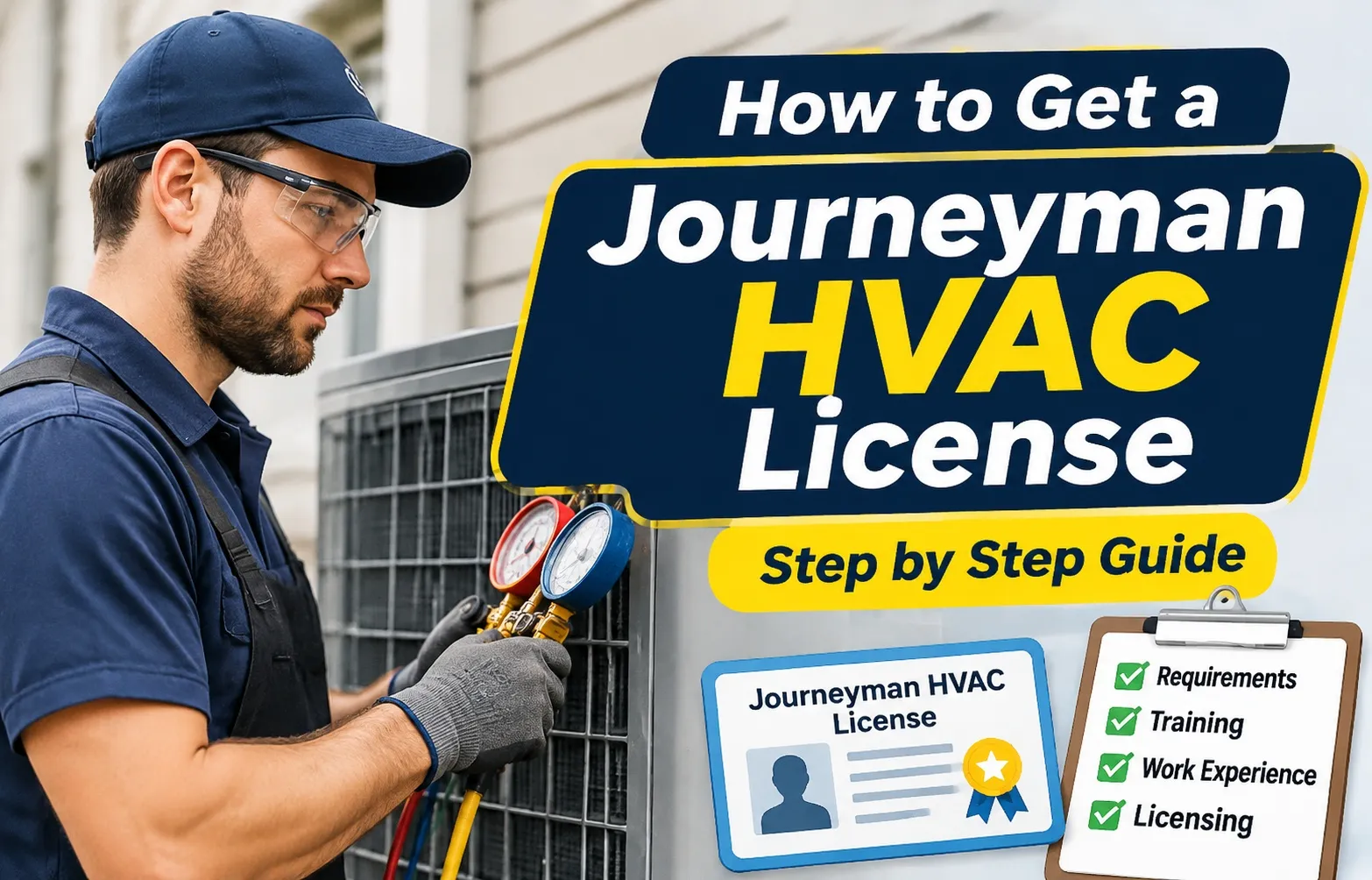 Transitioning from an entry-level technician to a licensed professional is the most pivotal milestone in a heating, ventilation, and air conditioning career. Earning an official certification unlocks higher pay, legal independence on job sites, and long-term career stability.
What is an HVAC Journeyman License and Why Do You Need It?
An HVAC journeyman license is a government-issued credential that proves a technician has mastered the technical, electrical, and mechanical principles of heating and cooling systems. It certifies that you possess the advanced competency required to install, maintain, and repair complex commercial and residential units without direct, on-site supervision.
Securing this trade certification directly impacts your professional trajectory and daily operations:
- Legal Authorization: Many jurisdictions strictly prohibit technicians from pulling permits or performing independent installations without a valid journeyman or contractor credential.
- Significant Wage Increase: Licensed journeymen command substantially higher hourly wages or salary tiers compared to unregistered apprentices or helpers.
- Career Advancement: Holding a journeyman card is a mandatory prerequisite for eventually testing for a master mechanical or independent contractor license.
The Career Ladder: Apprentice vs. Journeyman vs. Master Contractor
Understanding the standard industry hierarchy helps clarify why moving up the ladder is essential for maximizing earning potential and professional freedom. The mechanical trade is structured into three primary tiers:
- Apprentice: An entry-level worker who is learning the trade through a combination of classroom instruction and hands-on training. Apprentices must work under the direct supervision of a licensed journeyman or master technician at all times.
- Journeyman: A fully qualified professional who has completed their required hours, passed the state or municipal licensing exam, and earned the legal right to work independently on job sites.
- Master Contractor: The highest tier in the trade. Master contractors can run their own independent businesses, pull commercial permits, hire technicians, and supervise apprentices and journeymen.
Navigating this progression systematically ensures you build the hands-on expertise required to pass your board exams on the first attempt and secure long-term success in the mechanical services industry.
Core Prerequisites & Educational Requirements
Qualifying for a professional trade license starts with meeting foundational state and municipal eligibility standards. Knowing these exact prerequisites before submitting your application prevents costly delays and ensures you meet every legal threshold.
Basic Eligibility: Age and High School Diploma/GED Requirements
Licensing boards enforce strict administrative baselines to verify that candidates possess the foundational maturity and academic background required for high-risk mechanical work. Most state labor departments and contractor boards require applicants to meet two mandatory prerequisites:
- Age Minimum: Candidates must be at least 18 years old at the time of application and exam registration due to liability laws and workplace safety regulations.
- Educational Credential: Applicants must hold a verified high school diploma or a General Educational Development (GED) certificate to prove baseline literacy and problem-solving competency.
Failing to meet these baseline administrative requirements will result in an immediate rejection of your licensing application, regardless of your practical mechanical skills.
Formal Trade School vs. Independent Study: Which Path is Faster?
Preparing for your mechanical training involves choosing between structured classroom education and self-paced independent study. Each pathway impacts the speed at which you accumulate required hours and prepare for board evaluations:
- Formal Trade School or Community College: Enrolling in a dedicated program provides accelerated, hands-on mechanical training, structured blueprint reading, and safety courses. Many state boards credit structured classroom hours directly toward your total required apprenticeship experience.
- Independent Study and Direct Employment: Working full-time as an unregistered helper while studying code books independently allows you to earn an income immediately. However, this route generally requires a longer calendar timeline to accumulate the necessary verified field hours.
Evaluating your personal financial situation and local board rules will help determine which educational route accelerates your journey to becoming a certified professional.
Mandatory Federal Requirement – EPA Section 608 Certification
Handling regulated refrigerants on active heating and cooling units requires mandatory federal clearance before you can legally service equipment. Securing this credential is a critical stepping stone in your mechanical career timeline.
Why EPA Section 608 Certification is Non-Negotiable
Under Section 608 of the federal Clean Air Act, the Environmental Protection Agency strictly prohibits individuals from releasing ozone-depleting substances or modern hydrofluorocarbons into the atmosphere during service, maintenance, or repair.
Failing to acquire this federal credential carries severe professional consequences:
- Federal Legal Violations: Working on charged systems without certification violates federal law, exposing both technicians and employing contractors to heavy civil penalties.
- Mandatory Board Prerequisite: Most state licensing boards and apprenticeship committees require proof of EPA certification before approving your application for a journeyman exam.
- Employment Barricades: Contractors cannot legally dispatch technicians to service residential or commercial cooling circuits without verified refrigerant handling credentials.
Choosing the Right Certification Type (Type I, II, III, or Universal)
The examination is divided into distinct categories depending on the scale and application of the equipment you intend to service. Selecting the appropriate category ensures you have full legal coverage on job sites:
- Type I: Covers servicing, recovery, and repair on small appliances containing five pounds or less of refrigerant (e.g., household refrigerators, window air conditioning units).
- Type II: Focuses on high-pressure and very high-pressure appliances, including residential split systems, heat pumps, and commercial chillers.
- Type III: Regulates low-pressure appliances, such as large commercial industrial chillers handling low-pressure compounds.
- Universal Certification: Awarded to candidates who successfully pass all three core sections (Type I, II, and III) along with the core exam. This provides unrestricted clearance across all commercial and residential sectors.
How to Study for and Pass the EPA Test Quickly
Passing the exam on your first attempt requires targeted preparation using approved study guides, practice question banks, and video walk-throughs. Because the exam questions are standardized, candidates can easily prepare in under a week.
Key study strategies to accelerate your preparation include focusing heavily on recovery techniques, leak repair thresholds, evacuation requirements, and safety protocols outlined in the official EPA manual.
Gaining and Logging Verified On-the-Job Experience Hours
Accumulating and verifying practical field experience is the most demanding requirement in your career progression. Meeting board thresholds requires consistent record-keeping and direct oversight from licensed professionals.
Understanding State Hour Requirements (2,000 to 8,000+ Hours)
State licensing boards mandate thousands of hours of documented field work to ensure every technician has handled diverse installation, diagnostic, and repair scenarios under live working conditions.
Hour thresholds vary significantly based on your geographical region and prior educational credits:
- Apprenticeship Benchmarks: Most jurisdictions require between 4,000 and 8,000 hours of verified on-the-job experience, which generally translates to two to four years of full-time employment.
- Trade School Credits: Graduating from an accredited technical program can sometimes substitute for a portion of the required field hours, shortening your timeline.
- Supervised Execution: Every single logged hour must be earned while working under the direct supervision of a licensed master technician or qualified contractor.
How to Track and Log Your Apprenticeship Hours Accurately
Maintaining meticulous records protects you against missing signatures or audit rejections when submitting your application to the state board. Implementing a reliable tracking system from day one is essential.
- Daily Work Logs: Record your daily hours, specific tasks performed (e.g., electrical troubleshooting, duct fabrication, refrigerant charging), and the job site location in a dedicated logbook.
- Regular Employer Sign-Offs: Have your supervising master technician or employer review and sign your experience logs monthly or quarterly rather than waiting years until application time.
- Official State Board Forms: Transfer your accumulated data onto your state’s official verification forms to ensure compliance with formatting rules. You can review official documentation guidelines via the Idaho Division of Occupational Professional Licenses portal.
What to Do If Your Employer Refuses to Sign Off Your Hours
Encountering an uncooperative employer or experiencing sudden company closures can jeopardize years of accumulated field documentation if you lack backup verification.
Protect your career investment by taking proactive steps if signature disputes arise:
- W2s and Paystubs: Keep copies of all tax documents, payroll statements, and job assignment sheets proving your active employment history during those specific dates.
- Third-Party Affidavits: Many state boards accept notarized affidavits from other certified colleagues or general contractors who witnessed your active labor on job sites.
- Board Mediation: Contact your local licensing board’s compliance department to file a formal inquiry if an employer withholds valid signatures without legal justification.
State-by-State HVAC Requirements At-a-Glance
Navigating heating and cooling credentials requires understanding that regulations change drastically across different jurisdictions. Because rules shift from state to state and even city to city, reviewing regional benchmarks prevents compliance issues.
Why HVAC Licensing Laws Vary by State and Municipality
Unlike federal certifications like EPA Section 608, trade licenses are governed by local authorities to ensure technicians meet regional building codes, climate demands, and safety standards.
Key administrative factors driving these regional differences include:
- State vs. Local Oversight: Some states issue statewide mechanical licenses through a centralized department, while others leave regulation entirely up to municipal building departments or county boards.
- Reciprocity Agreements: Certain states recognize credentials from neighboring regions, allowing technicians to transfer their status without retaking exams, while others demand completely separate testing.
- Code Adoption Variations: Regional boards update building codes, electrical standards, and mechanical guidelines at different intervals, influencing exam contents and prerequisite hours.
State-by-State Requirements Comparison Table
Reviewing cross-jurisdictional standards helps clarify the different expectations enforced by regional boards across the country:
Mastering the Journeyman Licensing Exam
Passing the state or municipal licensing exam is the final hurdle standing between you and your professional credential. Mastering the structure of the test and practicing code lookup techniques are vital for a first-attempt pass.
What Topics Are Covered on the Journeyman Exam?
The licensing exam rigorously tests your comprehensive understanding of theoretical concepts and practical field applications. Test questions are weighted across several core domains.
Main subject areas typically tested on board exams include:
- Mechanical Codes: Regulations governing duct sizing, ventilation requirements, combustion air supplies, and exhaust systems.
- Electrical Circuits: Troubleshooting control wiring, motor loads, transformer sizing, and safety disconnects.
- Heating and Cooling Theory: Thermodynamic principles, superheat and subcooling calculations, and psychrometrics.
Allowed Code Books: IMC (International Mechanical Code) and NEC (National Electrical Code)
Most journeyman exams are administered as an open-book test, meaning you are permitted to bring specific reference texts into the testing center. Knowing how to navigate these texts quickly is far more important than memorization.
Key reference materials allowed in testing rooms include:
- International Mechanical Code (IMC): The foundational rulebook covering system installation, ductwork, and equipment clearances.
- National Electrical Code (NEC): The benchmark standard for safely installing electrical wiring and equipment in residential and commercial units.
- Approved Tabbing Systems: Most boards allow pre-printed index tabs on your code books, provided they do not contain handwritten notes or prohibited inserts.
Passing Score Realities and Practical Exam Prep Tips
State boards typically enforce a passing score of 70% to 72%. Because the time limit per question is strict, failing to practice your navigation skills under timed conditions can lead to running out of time.
Implement these study strategies to ensure exam success:
- Timed Code Practice: Spend weeks practicing how to locate obscure code clauses within two minutes using your index and table of contents.
- Calculator Familiarity: Use the exact model of scientific calculator allowed by your testing center so you do not waste seconds figuring out functions on exam day.
- Mock Board Exams: Take full-length practice tests under realistic testing conditions to build mental endurance and identify weak subject areas.
Submitting Your Application, Documentation, and Fees
Completing the final administrative paperwork correctly ensures your licensing application moves smoothly through the board’s review process without unnecessary delays. Gathering every required document before submission prevents rejections.
Required Documents Checklist (ID, Training Proof, Hour Logs)
State licensing boards enforce rigorous document verification standards to authenticate your identity, education, and field experience before approving your exam registration or issuing credentials.
Ensure your application packet contains the following mandatory items:
- Government-Issued Identification: A valid driver’s license or passport proving you meet the minimum age requirement of 18 years old.
- Educational Verification: Official copies of your high school diploma, GED certificate, or trade school transcripts.
- Verified Hour Logs: Signed and notarized apprenticeship logs or employer affidavits documenting your required field experience hours.
- EPA Certification Card: A copy of your Universal or targeted EPA Section 608 certification card.
Application and Examination Fees Breakdown
Submitting your licensing packet requires paying non-refundable administrative and testing fees directly to the state board or third-party testing vendor.
Typical financial costs associated with the final submission include:
- Application Processing Fee: A baseline administrative charge ranging from $50 to $150 to review your transcripts, background checks, and hour logs.
- Examination Fee: The separate registration cost required by testing providers to sit for the written journeyman trade and code exam.
- Background Check and Fingerprinting Fees: Fingerprint processing costs if your state board mandates a criminal history background check for trade licensing.
What Happens After You Submit? (Processing Times and License Issuance)
Once your completed application and fees are submitted, the state licensing board initiates an internal review to verify all credentials and background checks.
Understanding the final stages helps you plan your career transition:
- Review and Processing Window: Board reviews typically take anywhere from two to six weeks depending on seasonal volume and document accuracy.
- Exam Authorization Letter: Upon approval, you will receive an authorization notice allowing you to schedule your official licensing exam with the designated testing center.
- License Issuance or Temporary Permits: Once you pass the board exam and submit your passing scores, your official journeyman card or a temporary work permit will be issued.
Frequently Asked Questions
Reviewing common queries about the trade helps clarify accelerated learning paths, age factors, online resources, and interstate license transfers.
How to get a journeyman HVAC license online?
While you can complete theoretical training, exam prep courses, and EPA certification classes online, you cannot get a journeyman HVAC license entirely online. State and municipal boards legally require verified, hands-on field experience hours and proctored physical examinations that must be completed in person.
Utilizing a comprehensive online study guide can help you master mechanical codes and electrical theory from home, but you must still log your physical apprenticeship hours under a master technician.
What’s the fastest you can get your HVAC license?
The fastest timeframe to earn a journeyman license is typically two to four years. This timeline depends heavily on your state’s minimum hour requirements and whether you fast-track your education.
Accelerating your timeline involves enrolling in an intensive technical trade school, accumulating maximum weekly field hours through a full-time apprenticeship, and passing your board exams on the very first attempt.
Is 35 too old to get into HVAC and get licensed?
Entering the heating and cooling trade at age 35 or older is entirely common and often advantageous. The age factor brings valuable maturity, work ethic, and problem-solving skills that employers actively seek in technicians.
Many career changers successfully transition into the industry through evening trade programs or direct apprenticeship roles, enjoying robust salaries and long-term job security.
How do I transfer my HVAC license to another state (Reciprocity)?
Transferring your credential to a new region depends entirely on interstate reciprocity agreements. Some states maintain direct agreements that allow qualified journeymen to transfer their license after paying a fee and passing a local code test.
If no formal agreement exists between your origin state and destination, you may be required to submit documentation proving your experience hours and sit for the new state’s board exam directly.

Oscar Vance | Master Plumber & Drainage Expert
Meet Oscar Vance, a licensed master plumber sharing practical solutions on residential repairs, preventive maintenance, and thoughtful home upkeep.