What is a Studor Vent in Plumbing?
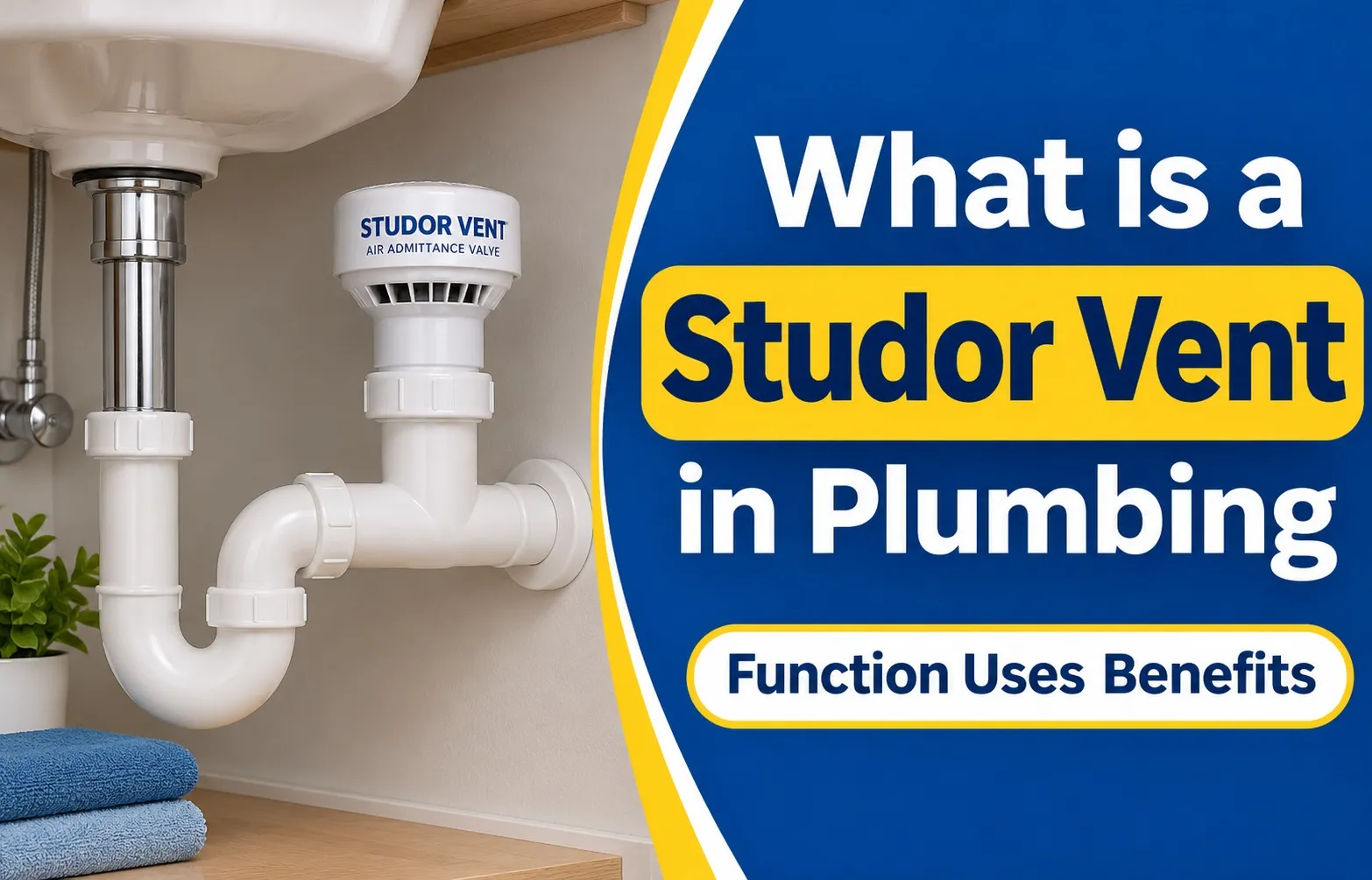 A Studor vent—officially known in the plumbing industry as an Air Admittance Valve (AAV)—is a mechanical one-way valve installed on indoor drain lines to equalize air pressure without requiring a vent pipe routed through the roof. It opens automatically to let fresh air enter the drain-waste-vent (DWV) system when wastewater flows out, then snaps shut via gravity to block hazardous sewer gases from escaping into your home.
Unlike traditional open-air vent stacks that rely on continuous outdoor airflow, an AAV remains completely sealed during normal household conditions. This self-contained design makes it a practical engineering solution for fixtures located far away from main vertical soil stacks.
Studor Vent vs. Air Admittance Valve (AAV): What’s the Difference?
There is no mechanical or functional difference between a Studor vent and an Air Admittance Valve; Studor is simply the pioneering brand name that popularized AAV technology in residential and commercial construction. Much like calling any facial tissue a “Kleenex,” plumbers and homeowners routinely use “Studor vent” as a universal term for any mechanical plumbing vent valve.
- Air Admittance Valve (AAV): The official engineering classification used in national building codes, inspection checklists, and ASSE testing standards.
- Studor Vent: A specific line of patented AAV products (such as the Studor Mini-Vent and Redi-Vent) known for their precision-weighted internal diaphragms.
- Alternative Manufacturers: Companies like Oatey (Sure-Vent) and RectorSeal produce identical code-approved AAVs that operate on the exact same pressure-activated principle.
Why Modern Plumbing Needs Air Admittance Valves
Every plumbing fixture relies on a curved pipe section called a P-trap that holds a small reservoir of standing water to block sewer odors and methane gas. When large volumes of water rush down a drain pipe, they create a powerful vacuum (negative pressure) behind the flow that can pull that protective water seal right out of the P-trap.
Modern architectural trends—such as open-concept kitchen islands, basement wet bars, and attic bathroom conversions—often place sinks in areas where running a vertical vent pipe up through walls and roof framing is structurally impossible or cost-prohibitive. An Air Admittance Valve solves this physics problem directly beneath the fixture:
- Prevents Trap Siphonage: Feeds immediate makeup air into the drain branch the instant negative pressure develops, keeping the P-trap water barrier intact.
- Eliminates Gurgling Drains: Stops air bubbles from fighting against draining water, resulting in quiet, rapid fixture drainage.
- Simplifies Remodeling Layouts: Allows plumbers to vent isolated fixtures locally without cutting into load-bearing headers or penetrating waterproof roof membranes.
How Does a Studor Vent Work?
A Studor vent operates on a simple yet ingenious pressure-differential mechanism that replaces traditional open-air roof stacks. By responding instantly to changes in air pressure inside the drain pipe, the internal rubber diaphragm lifts to admit air during discharge and drops securely back into place when drainage stops.
Phase 1: Resting State (Sealing Sewer Gas out of Your Home)
When no water is flowing through your plumbing fixtures, the Air Admittance Valve remains completely closed. Gravity pulls the internal rubber diaphragm or sealing membrane downward against a precision-machined seat, creating an airtight seal.
- Sewer Gas Barrier: This hermetic closure stops foul methane and sewer odors from entering living spaces.
- Water Seal Protection: Working in tandem with the P-trap water seal, it establishes a double line of defense against unwanted odors.
- Atmospheric Isolation: The DWV system stays isolated until a pressure change demands mechanical valve activation.
Phase 2: Drainage & Negative Pressure (Opening for Air Intake)
When you empty a sink basin or bathtub, a heavy volume of wastewater rushes downward past the trap weir. This rushing water displaces air and creates a powerful vacuum, or negative pressure, immediately behind the column of fluid.
- Vacuum Creation: Without an air supply, this suction pulls air from the nearest available opening, which would normally siphon water right out of the P-trap.
- Diaphragm Lifting: The negative pressure pulls upward against the lightweight internal rubber diaphragm, unseating it instantly.
- Air Intake: Room air is sucked into the drain branch from the surrounding space, instantly neutralizing the vacuum and keeping wastewater moving smoothly.
Phase 3: Gravity Reset (Instant Automatic Closure)
The moment the fixture finishes draining, the column of wastewater exits the branch line, and the pressure inside the pipe equalizes with standard atmospheric pressure. With the vacuum gone, the lifting force disappears entirely.
- Gravity-Operated Seal: The weighted rubber diaphragm immediately falls back onto its seating ring under its own weight.
- System Closure: The vent reseals itself tightly, locking in all internal gases and vapors before any backward leakage can occur.
- Cycle Readiness: The valve remains in this dormant, sealed position until the next time a plumbing fixture is discharged.
Traditional Roof Vents vs. Studor Vents (Pros & Cons)
Choosing between an atmospheric vent stack and a Studor vent comes down to structural access, remodeling budget, and local plumbing codes. While traditional roof vents handle both positive and negative air pressure passively for the life of a building, Air Admittance Valves drastically cut installation labor and solve complex architectural layouts where running pipes through ceilings is impractical.
Key Advantages of Air Admittance Valves
Air Admittance Valves eliminate the need to route long runs of PVC or ABS piping through finished walls, ceilings, and exterior roof decks. For homeowners and remodeling contractors, this streamlined approach delivers immediate financial and structural benefits:
- Substantial Retrofit Cost Savings: Avoids tearing open drywall, boring through structural joists, and hiring roofers to flash new roof penetrations, often saving hundreds or thousands of dollars per fixture.
- Solves Kitchen Island Plumbing: Provides an effortless venting solution for freestanding kitchen island sinks where running a conventional dry vent straight up to the ceiling is structurally impossible.
- Eliminates Roof Leak Risks: Because no pipe exits the roofline, you avoid potential water intrusion around degraded rubber roof boots and flashing seals.
- Prevents Cold-Weather Freeze-Ups: Traditional roof vent terminals can accumulate frost and ice in sub-zero climates, choking off airflow; indoor AAVs operate inside conditioned spaces protected from freezing temperatures.
Limitations & Disadvantages of Studor Vents
Despite their convenience, mechanical vents are not a universal replacement for open-air plumbing stacks. Because they contain moving parts and only operate in one direction, they carry specific engineering constraints:
- Cannot Relieve Positive Pressure: An AAV is strictly a one-way intake valve; it cannot vent positive backpressure generated by upper-floor drainage surges or municipal sewer backups.
- Mechanical Wear and Lifespan: Unlike passive open pipes that last indefinitely, an AAV relies on an internal rubber diaphragm that eventually wears out and requires replacement every 15 to 30 years.
- Strict Accessibility Rules: Building codes prohibit sealing Studor vents inside closed walls, meaning you must dedicate cabinet space or install a removable louvered access panel.
- Jurisdictional Code Restrictions: While widely accepted under modern national standards, certain strict municipalities and local inspectors still restrict or prohibit AAVs in new construction.
Comparison Matrix: Atmospheric Vent Stacks vs. AAVs
Evaluating both venting methods side-by-side highlights how each system manages airflow, installation complexity, and long-term maintenance:
Plumbing Building Codes & Installation Rules (IPC vs. UPC)
Before installing an Air Admittance Valve, you must verify which plumbing code governs your municipality and follow exact vertical clearance standards. While mechanical vents are widely approved across North America, building inspectors strictly enforce certification marks, trap-weir height minimums, and open-air accessibility rules to prevent sewer gas leaks and system failures.
International Plumbing Code (IPC) vs. Uniform Plumbing Code (UPC) Mandates
In the United States, residential and commercial plumbing systems fall primarily under either the International Plumbing Code (IPC) or the Uniform Plumbing Code (UPC). Each model code treats mechanical venting differently, and every installed valve must carry third-party testing certifications under ASSE 1051 (for individual and branch fixtures) or ASSE 1050 (for stack-type applications).
- International Plumbing Code (IPC): Fully recognizes and permits ASSE 1051 and ASSE 1050 Air Admittance Valves as approved alternatives to atmospheric vents for individual fixtures, branch drains, and circuit vents, provided at least one main open-air vent stack extends outdoors through the roof.
- Uniform Plumbing Code (UPC): Historically restricts mechanical vents and does not approve AAVs as a blanket standard in the base code text; however, many UPC-governed states and local jurisdictions adopt specific amendments allowing them for island sinks and retrofit remodels upon inspector approval.
- Mandatory Outdoor Stack Rule: Regardless of local code variations, a building can never rely 100% on Studor vents—at least one continuous open-air vent pipe must penetrate the roof to relieve positive pressure surges from municipal sewer lines.
Critical Clearance & Height Specs (4 Inches Above Trap Weir Rule)
An Air Admittance Valve relies entirely on gravity to close its internal diaphragm, meaning improper angling or low placement will cause water backup and permanent seal failure. Plumbers must adhere to strict dimensional clearances relative to the fixture drain and P-trap:
- Minimum 4-Inch Height Above Trap Weir: Individual fixture AAVs must be installed at least 4 inches above the horizontal branch drain (the top lip of the P-trap weir). Installing the valve too low allows wastewater from a clogged sink to flood directly into the valve body and foul the rubber seal.
- 6-Inch Attic or Stack Clearance: When venting a main stack or terminating in an attic space, codes require the valve to sit a minimum of 6 inches above the highest flood-level rim of the fixtures served or above attic insulation.
- Strict Vertical Orientation: The valve must be mounted plumb (straight up and down) within a maximum tolerance of 15 degrees from vertical so gravity pulls the diaphragm evenly onto its seat.
- Surrounding Air Gap: Leave at least 1 to 2 inches of unobstructed clearance around the top and sides of the valve cap so it can be easily unscrewed by hand during future replacements.
Accessibility Requirements: Why You Cannot Seal an AAV Inside Drywall
Because a Studor vent contains a moving rubber diaphragm that will eventually wear out, building codes strictly forbid enclosing the valve inside a sealed wall cavity. Every AAV installation must satisfy two non-negotiable operational conditions:
- Unrestricted Free Air Movement: The valve cannot operate in an airtight box; it needs a continuous supply of ambient room air to draw into the drain line whenever negative pressure develops.
- Direct Service Access: A homeowner or plumber must be able to reach, inspect, and unscrew the valve without cutting into drywall, tile, or structural framing.
If an AAV is installed inside a wall stud bay rather than openly under a sink cabinet, you must install a removable louvered access panel directly over the valve. The louvers allow room air to enter freely while giving immediate tool-free access for maintenance. For complete manufacturer specifications and regional compliance charts, consult the Oatey Technical Guide on AAV Code Compliance & Standards.
Where and When Can You Use a Studor Vent?
Air Admittance Valves offer flexible venting solutions for various residential and commercial plumbing layouts, but building codes strictly govern where they can be deployed based on fixture discharge rates and air displacement needs. Understanding these application boundaries ensures your plumbing system drains rapidly without compromising sanitary seals.
Ideal Applications: Kitchen Island Sinks, Basements & Remodels
AAVs shine brightest in architectural setups where running a traditional dry vent pipe through ceilings or exterior roof decks is physically impossible or cost-prohibitive. They provide reliable local venting for isolated fixtures without requiring major structural tear-outs.
- Kitchen Island Sinks: Freestanding kitchen islands lack nearby walls for vertical vent stacks, making an under-sink AAV the standard code-compliant solution for local airflow.
- Basement & Below-Grade Remodels: Connecting new fixtures to overhead vent lines through finished concrete slabs or drywall is often impractical, making local AAV branches ideal for basement bathroom additions.
- Distant Utility Sinks & Vanities: Remote laundry tubs or powder room sinks situated far from the primary wet-vent stack can be vented independently without tearing open finished walls.
Can You Use a Studor Vent on a Toilet? (The High-Volume Airflow Truth)
While homeowners frequently ask if a Studor vent can handle a toilet directly, building codes and fluid dynamics strictly prohibit standard AAVs on standalone toilet drains. Toilets require specialized engineering because of how they discharge waste.
- Massive Water & Air Displacement: Toilets dump gallons of water instantly, creating a massive surge of positive and negative pressure that a small one-way mechanical valve cannot safely regulate alone.
- High Fixture Unit Ratings (DFU): Toilets carry high drainage fixture unit ratings that require full-sized, two-way open-air roof stacks to prevent pressure blowback and sluggish flushing.
- The Indirect Wet Venting Exception: An AAV can indirectly vent a bathroom group containing a toilet only if the valve is installed on an approved wet-vented branch line serving a sink or lavatory upstream, in compliance with IPC standards.
Can a Shower and Toilet Share an AAV-Vented Line?
Connecting a high-volume shower and toilet to a shared drain line requires careful attention to fixture unit ratings and venting hierarchy to prevent cross-siphonage and slow draining. Improperly balanced branch lines will cause gurgling and trap siphoning.
- Branch Sizing & Layout: Showers and bathtubs pull heavy volumes of water that can choke smaller drain lines if the combined fixture unit load exceeds local branch diameter limits.
- Upstream Vent Positioning: If a shower and toilet share a drainage branch, any approved AAV must be positioned correctly on an upstream wet-vented sink line that handles the combined DFU load safely.
- Code Compliance Check: Always cross-reference local municipal amendments, as some regional jurisdictions enforce stricter limitations on combining high-discharge fixtures under mechanical vent systems.
Troubleshooting Bad Smells & Failing Studor Vents
When a plumbing system emits foul odors or drains sluggishly, the Air Admittance Valve is one of the first components to inspect. Because mechanical valves rely on moving rubber parts, they eventually experience wear, material fatigue, or debris accumulation that requires accurate diagnosis and quick replacement.
How Long Do Studor Vents Last? (Lifespan & Wear Factors)
High-quality Studor vents are engineered to last between 20 to 30 years, enduring approximately 500,000 operational cycles under normal household conditions. However, actual service life varies significantly based on environmental conditions, chemical exposure, and mechanical stress within the drain network.
- Cycle Fatigue: Frequent water discharge in busy kitchen sinks accelerates the mechanical wear on the inner flexible rubber diaphragm.
- Chemical Degradation: Harsh commercial drain-cleaning chemicals or heavy cabinet vapors can cause rubber seals to harden, warp, or crack prematurely.
- Debris Accumulation: Airborne dust, lint, and grease particles can settle on the internal valve seat, preventing a complete hermetic seal when closed.
Symptoms of a Stuck-Open Valve (Sewer Gas Smell Under Sink)
A persistent sewer gas odor lingering underneath your kitchen or bathroom sink is the classic indicator of a stuck-open valve failure. When the internal rubber seal degrades or becomes wedged open, methane and foul sewer vapors escape freely into your cabinet space.
- Foul Odors: A distinct rotten-egg or sewage smell that intensifies noticeably when plumbing fixtures are used nearby.
- Degraded Diaphragm: The flexible rubber membrane loses its elasticity, sagging away from the valve seat instead of resting flat.
- Trapped Debris: Small particulate matter lodges between the seating ring and the seal, leaving a microscopic gap for air and gases to leak.
Symptoms of a Stuck-Closed Valve (Gurgling Drains & Slow Flow)
When a Studor vent becomes stuck in the closed position, it starves your drain pipes of essential makeup air. This failure creates severe negative pressure vacuum blocks, leading to slow drainage, loud gurgling noises, and potential P-trap siphoning.
- Gurgling Sounds: Air bubbles forcing their way back up through the sink drain basin as heavy water rushes down the waste pipe.
- Sluggish Draining: Water pools in the sink because the trapped vacuum fights against the descending column of liquid.
- Stuck Mechanism: Mineral deposits, sticky residue, or mechanical jamming cause the diaphragm to bind tightly against its housing.
Simple DIY Test & Replacement Guide
Replacing a faulty Air Admittance Valve is a straightforward DIY plumbing task that requires no special tools or professional assistance. Most replacement valves feature standard threaded connections that can be uninstalled and swapped out in less than ten minutes.
- Locate and Clear: Open the sink cabinet and locate the vertical pipe assembly where the AAV sits at least 4 inches above the trap weir.
- Unscrew the Old Valve: Firmly grip the old valve body by hand and rotate it counter-clockwise to disconnect the male/female thread connection.
- Inspect Threads: Clean the adapter threads on the PVC pipe and check for any residual plumber’s tape or accumulated debris.
- Apply Teflon Tape: Wrap fresh thread seal (Teflon) tape clockwise 2 to 3 times around the male pipe threads to ensure a secure, waterproof seal.
- Install the New Valve: Hand-tighten the new AAV clockwise onto the pipe until snug, taking care not to over-tighten and crack the plastic housing.
Frequently Asked Questions
Do Studor vents smell when working properly?
A properly functioning Studor vent is completely odorless because its internal rubber diaphragm seals shut via gravity the instant drainage stops. If you detect a rotten-egg or sewer gas smell beneath your sink, the valve’s internal seal has likely worn out, become obstructed by debris, or failed in the open position and needs immediate replacement.
- Normal Operation: Provides an airtight mechanical barrier that locks methane and sewer gases inside the drain pipe.
- Odor Diagnosis: Any noticeable smell indicates seal fatigue or improper installation below the trap weir.
How close should a vent be to a P-trap?
Building codes mandate specific minimum and maximum distances between a P-trap and its vent connection to prevent vacuum siphoning while maintaining smooth wastewater flow. Under standard plumbing codes, the vent must never be placed closer than twice the pipe diameter from the trap weir, while maximum horizontal distances depend on the drain pipe size.
- Minimum Distance (Crown Venting Rule): At least 2 pipe diameters away from the P-trap weir (for example, at least 3 inches away on a 1.5-inch drain pipe) to prevent debris from clogging the vent throat.
- Maximum Distance (IPC Standards): Up to 6 feet away for a 1.5-inch drain pipe, and up to 8 feet away for a 2-inch drain pipe.
- Vertical Height Requirement: The Air Admittance Valve itself must terminate at least 4 inches above the horizontal trap arm.
Can a Studor vent be installed horizontally?
No, you cannot install a Studor vent horizontally because it relies entirely on gravity to pull its internal sealing diaphragm closed. Mounting an Air Admittance Valve sideways or upside down prevents the seal from seating evenly, allowing hazardous sewer gases to leak continuously into your home.
- Strict Vertical Alignment: The valve must be mounted straight up and down (plumb) within a maximum tolerance of 15 degrees from vertical.
- Tight Cabinet Workaround: If horizontal space under a sink is restricted, use 45-degree or 90-degree elbows to offset the riser pipe before mounting the valve vertically at the top.
Does every bathroom need its own main stack vent through the roof?
Every bathroom does not require its own dedicated roof penetration, provided all fixtures connect into a properly sized wet-vented branch or tie into the home’s existing primary roof stack. While at least one continuous open-air vent stack must extend through the roof to relieve positive sewer pressure, individual bathroom sinks or remote fixtures can utilize approved Air Admittance Valves where local codes permit.
- Primary Stack Requirement: Every building must maintain at least one atmospheric vent stack terminating outdoors above the roofline.
- Shared Branch Venting: Multiple bathroom fixtures can share a single main stack or approved wet-vent network when sized according to drainage fixture unit (DFU) limits.

Oscar Vance | Master Plumber & Drainage Expert
Meet Oscar Vance, a licensed master plumber sharing practical solutions on residential repairs, preventive maintenance, and thoughtful home upkeep.