How Long Does It Take to Start an HVAC Business
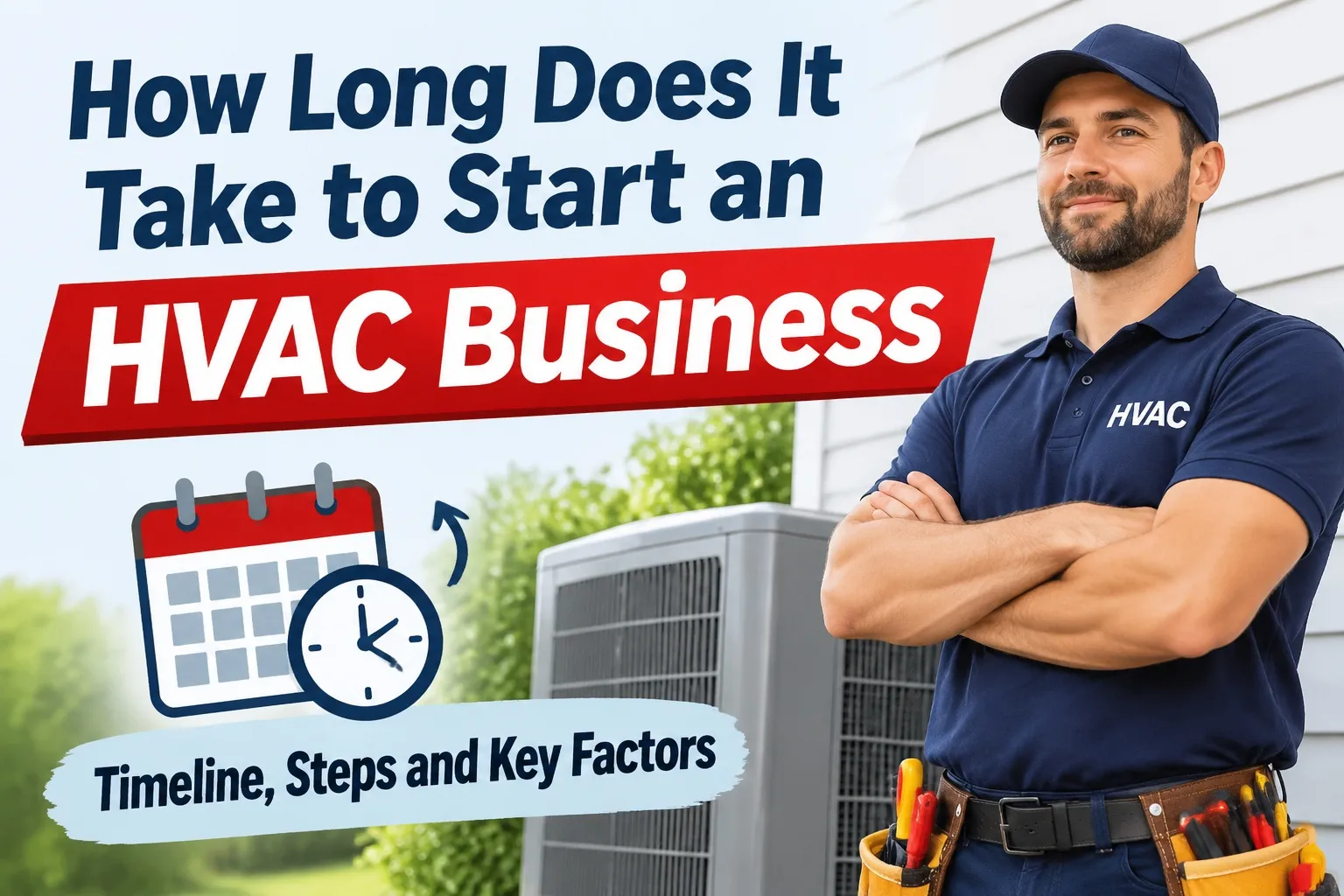 The time required to launch a heating, ventilation, and air conditioning company ranges from 30 days to five years, depending on your existing credentials, capital availability, and state licensing laws. Choosing the right entry model determines how quickly you can legally pull permits, purchase wholesale equipment, and generate revenue.
Path 1: 1 to 3 Months (The Fast Track for Certified Technicians)
If you are already an active journeyman HVAC tech or master contractor with verifiable field experience, you can launch an independent operation in 30 to 90 days. Because you have already satisfied state trade-hour mandates, your focus shifts entirely to administrative setup and fleet procurement.
- Week 1–2 (Entity & Licensing): Register your LLC, secure your Employer Identification Number (EIN), and transfer or register your state contractor license under your new business name.
- Week 3–6 (Insurance & Supply Houses): Bind general liability, commercial auto, and workers’ compensation policies while opening net-30 credit lines with local HVAC wholesale distributors.
- Week 7–12 (Fleet, Tools & Franchising): Outfitting a service van with recovery machines, vacuum pumps, and truck stock takes two to six weeks. Alternatively, established franchise systems like One Hour Heating & Air Conditioning typically complete onboarding, territory mapping, and launch readiness within a 90-day HVAC franchise timeline.
Path 2: 2 to 5 Years (Starting From Scratch via Trade School & Apprenticeship)
Entering the heating and cooling industry with zero technical background requires a multi-year commitment before you can legally operate as a licensed contractor. Most U.S. jurisdictions strictly prohibit unlicensed individuals from installing systems or handling refrigerants independently.
- Trade School Training (6 to 24 Months): Complete an accredited HVAC-R technical program to learn thermodynamics, electrical schematics, brazing, and pass your mandatory EPA Section 608 certification exam.
- Apprenticeship & Journeyman Hours (2 to 4 Years): Work full-time under a licensed contractor to accumulate the verifiable field experience required by state licensing boards—typically 4,000 to 8,000 documented hours.
- Master Contractor Exam & Launch (2 to 4 Months): Once your hours are approved, pass the state business, law, and mechanical master contractor exam, secure your surety bond, and transition into business ownership.
Path 3: 3 to 6 Months (The Business Owner / Non-Technical Investor Path)
Entrepreneurs, sales professionals, or mechanical engineers without field-service licenses can launch an HVAC company in three to six months by separating business operations from technical compliance. Instead of spending years in the field, you recruit a qualifying credential holder to anchor the company.
- Hiring a Responsible Managing Employee (RME): You must employ a licensed master HVAC contractor as your RME or Master of Record. Their license allows your company to legally pull municipal mechanical permits and purchase regulated refrigerants.
- Structuring Compliance & Compensation: Because the RME assumes regulatory liability for your crew’s workmanship, recruiting and vetting the right candidate typically takes 60 to 120 days and requires competitive base pay plus profit-sharing or equity incentives.
- Operational Launch: While finalizing your RME agreement, you can simultaneously build your brand, deploy field service management software, and establish local lead-generation campaigns so technicians have booked calls on day one.
Breakdown of What Impacts Your Launch Timeline
Executing an orderly operational launch ensures you avoid costly regulatory violations, supply shortages, and cash flow bottlenecks during your first year in business. Building a sustainable heating and cooling contracting company requires methodically working through four distinct developmental stages.
Step 1: Trade Training, Field Hours, and EPA Certification (0–4 Years)
Acquiring mandatory federal and state trade credentials forms the uncompromised foundation of your startup timeline. You must obtain an EPA Section 608 Universal certification, which is required by federal law for anyone purchasing refrigerants or opening refrigerant circuits.
- Federal Refrigerant Compliance: Passing Type I, Type II, and Type III exams grants you Universal status, allowing you to legally handle all regulated HVAC refrigerants without violating Clean Air Act guidelines.
- State Experience Verification: Most state licensing boards require documenting 4,000 to 8,000 hours of verifiable field experience under a licensed journeyman or master technician before you can test for your independent contractor license.
Step 2: Business Registration, Bonding, and Insurance (2–4 Weeks)
Establishing proper legal structures safeguards your personal assets and grants you authorization to pull municipal mechanical permits. Registering your LLC and securing an EIN can be completed online through your state secretary of state office in a matter of days.
- Contractor Surety Bonds: Local municipalities and state licensing boards require a $5,000 to $25,000 surety bond to protect consumers against incomplete workmanship or code violations.
- Commercial Coverage: Protect your operations by binding general liability insurance (typically $1M/$2M aggregate limits), commercial auto coverage for your service fleet, and mandatory workers’ compensation.
Step 3: Securing Financing, Wholesale Credit Lines, and Equipment (3–8 Weeks)
Establishing relationships with supply chain partners determines how fast your technicians can turn around emergency service calls. Opening commercial accounts with major wholesale HVAC distributors allows you to purchase replacement coils, compressors, and sheet metal on net-30 terms.
- Truck Stock Inventory: Outfitting service vans requires stocking high-turnover parts such as contactors, run capacitors, transformers, hard-start kits, and universal thermostats.
- Diagnostic & Recovery Gear: Equip every technician with digital manifold gauges, high-vacuum pumps, refrigerant recovery units, and combustion analyzers to ensure precision diagnostics.
Step 4: Setting Up Field Service Software and Local Lead Generation (2–4 Weeks)
Streamlining dispatch operations and customer acquisition from day one separates profitable trade contractors from struggling startups. Integrating modern digital tools ensures transparent bookkeeping and rapid customer response times.
- Field Service Management: Implement dispatch and CRM platforms like Jobber or ServiceTitan to manage work orders, mobile invoicing, and automated customer notifications.
- Accounting & Pricing: Set up QuickBooks and utilize a transparent flat-rate pricing book instead of unpredictable hourly billing to protect your profit margins.
- Local Visibility: Verify your Google Business Profile, launch hyper-localized service campaigns, and establish immediate review-collection workflows to drive incoming emergency calls.
State-by-State Licensing Nuances (Why Location Changes Your Timeline)
Your geographic location is one of the biggest variables dictating how quickly you can open your doors, because HVAC contractor licensing in the United States is regulated at either the state or municipal level. While some states enforce a rigid four-year experience mandate before you can even sit for an exam, others allow you to launch immediately once you pass a local city or county trade test.
Strict Licensing States (e.g., Texas, California, Florida)
States with centralized contractor boards enforce strict, non-negotiable timelines to protect consumers and uphold mechanical building codes. If you operate in these jurisdictions, no amount of startup capital can bypass the mandatory multi-year field experience requirements.
- Texas (TDLR): The Texas Department of Licensing and Regulation requires applicants for an Air Conditioning and Refrigeration Contractor license to document at least 48 months of practical work experience under a licensed contractor within the past 72 months before taking the state exam.
- California (CSLB): To obtain a C-20 Warm-Air Heating, Ventilating and Air-Conditioning Contractor license from the California Contractors State License Board, you must prove four full years of journeyman-level experience, pass both trade and law exams, and undergo criminal background fingerprinting.
- Florida (DBPR): Florida mandates four years of proven HVAC experience (or a combination of accredited college credits and field work), passing a rigorous state contractor board exam, and demonstrating personal financial stability via credit reports.
- Reciprocity Agreements: If you already hold an active master license in a strict state, check for state-to-state reciprocity agreements—such as between Louisiana, Arkansas, and Texas—which can waive the trade exam and cut your relocation launch timeline down to 30 to 60 days.
Local/Municipal-Only States (e.g., Colorado, Illinois, New York)
Several states do not issue a statewide HVAC contractor license, instead delegating regulatory authority directly to individual cities, counties, or local building departments. While this decentralized model can accelerate your initial launch in a single town, expanding across county lines introduces unique administrative delays.
- Faster Single-City Entry: In states like Illinois (outside of Chicago’s specific municipal mandates) or parts of Colorado, you only need your federal EPA Section 608 certification, general business registration, and local permit registration to begin operating—often cutting setup time down to a few weeks.
- Multi-City Expansion Hurdles: Operating across a major metro area in New York or Colorado often requires applying for separate municipal mechanical licenses, submitting distinct surety bonds, and passing individual city exams for every suburb you service.
- Verification Delays: Local building departments frequently review license applications at monthly board meetings, meaning missing a single submission deadline can add 30 to 60 days to your permitting timeline.
Can You Start an HVAC Business With No Experience? (The Honest Truth)
You can legally own and launch an HVAC company with zero field experience, but you cannot personally perform installations, handle regulated refrigerants, or pull mechanical permits without state-mandated credentials. Non-technical founders succeed by focusing on sales, marketing, and operations while partnering with or acquiring licensed trade talent.
Why You Cannot Legally DIY Technical Work Without Credentials
Attempting to bypass trade licensing by performing service calls yourself exposes your company to severe federal fines, voided insurance policies, and immediate shutdown orders. Heating and cooling systems involve high-voltage electricity, pressurized refrigerants, and combustible gases that carry strict legal liabilities.
- Federal Refrigerant Violations: Purchasing or venting regulated refrigerants without an active EPA Section 608 certification violates the federal Clean Air Act and carries civil penalties exceeding $44,000 per day per violation.
- Permit Pulling Restrictions: Municipal building departments strictly prohibit unlicensed individuals from submitting mechanical permit pulling applications for new furnace, heat pump, or ductwork installations.
- Insurance & Engineering Limits: Commercial general liability insurers will deny claims if unlicensed personnel perform the work. Even founders with a formal mechanical engineering background must still satisfy state hands-on field experience hours before holding a master contractor license.
The Partnership & Acquisition Models for Non-Technicians
Entrepreneurs, sales leaders, and operations managers bypass the multi-year apprenticeship timeline by structuring their business around proven ownership models. Instead of spending four years in the field, you leverage capital and business acumen to build around licensed professionals.
- Partnering with a Technical Co-Founder: Form a joint venture with an experienced master HVAC technician who wants to own a business but lacks administrative or marketing skills. Offering a 30% to 50% equity split aligns incentives so your technical co-founder manages field quality while you drive customer acquisition.
- Buying an Existing HVAC Business: Acquiring a retiring contractor’s operation allows you to skip the startup phase entirely and generate revenue on day one. Look for established companies with an active service agreement base, trained technicians, and recurring preventative maintenance contracts.
- Hiring a Qualifying License Holder: In states that allow Responsible Managing Employees (RMEs), you can recruit a senior master technician as a salaried qualifier while building out a fleet of EPA-certified service technicians beneath them.
Startup Costs & Cash Flow Runway
Surviving your first year in business requires more than just technical skill and a service vehicle; it demands a robust working capital runway. As experienced contractors frequently emphasize, anyone can lease a van by Friday, but maintaining operations through seasonal cash-flow dips requires substantial financial planning.
Minimum Lean Startup Budget vs. Full-Scale Launch ($15,000 – $100,000+)
Launching an HVAC contractor business requires careful capital allocation across vehicles, professional-grade tooling, and regulatory compliance. While a lean solo operator working out of a personal vehicle can scrape by with minimal initial expenses, scaling a professional service company demands significant upfront funding.
- Vehicle Acquisition: Commercial van leases or down payments typically run $3,000 to $8,000 upfront, plus monthly financing and custom company lettering or wraps.
- Diagnostic & Recovery Tooling: High-vacuum pumps, digital manifold gauges, refrigerant recovery machines, and combustion analyzers require $3,000 to $7,000 in specialized equipment.
- Insurance Down Payments: Binding commercial auto, general liability, and workers’ compensation policies often requires substantial upfront premium deposits before coverage activates.
- Initial Marketing Capital: Allocating $1,500 to $4,000 monthly for digital advertising, local service ads, and brand awareness ensures a steady pipeline of emergency repair calls.
How Long Until an HVAC Business Becomes Profitable?
Most independent HVAC startups experience a break-even timeline of 6 to 18 months, depending on local market competition and overhead management. Reaching consistent profitability requires protecting your gross profit margin while building recurring revenue streams that buffer against seasonal weather fluctuations.
- Preventative Maintenance Agreements: Selling bi-annual maintenance club memberships creates predictable recurring revenue, smoothing out cash flow during shoulder seasons when heating and cooling loads drop.
- Commercial Net-30 Terms: Establishing supply house credit accounts allows you to purchase replacement parts and equipment on net-30 terms, preserving your working capital runway while waiting for client invoice collections.
- Gross Profit Margin Protection: Maintaining a healthy gross profit margin on parts and flat-rate labor ensures your business can comfortably absorb unexpected warranty callbacks and overhead spikes.
Frequently Asked Questions
Is owning an HVAC business profitable, and can you make $100,000 a year?
Yes, owning an HVAC business is highly profitable, and an HVAC business owner salary frequently exceeds $100,000 annually once operations stabilize. Well-run residential heating and cooling companies typically generate 10% to 20% net profit margins, meaning a solo operator or small two-truck shop easily surpasses six figures in total owner compensation.
- Solo Operator Benchmarks: A single-truck owner-operator generating $200,000 to $250,000 in annual revenue regularly nets $75,000 to $110,000 after expenses.
- Multi-Truck Scaling: Expanding to a team of three to five technicians routinely pushes total owner income—combining W-2 salary and profit distributions—into the $150,000 to $250,000+ range.
What is the $5,000 rule in HVAC?
The HVAC $5,000 rule is an industry guideline used to help homeowners decide whether to repair an aging unit or invest in a full system replacement. Contractors multiply the age of the HVAC equipment (in years) by the estimated repair cost; if the total exceeds $5,000, replacing the system is recommended.
- Formula Example: A 12-year-old air conditioner requiring a $500 compressor or coil repair equals $6,000 ($12 times 500$), signaling that replacement offers better long-term value.
- Sales & Trust Building: New business owners use this transparent benchmark during service calls to educate customers objectively and boost high-ticket installation conversions without high-pressure sales tactics.
What percentage of HVAC businesses fail in the first few years?
Roughly 20% of new HVAC businesses fail within their first year, and nearly 50% close within five years, aligning with broader U.S. Bureau of Labor Statistics small business failure rate data. Some industry estimates place first-year solo contractor attrition even higher when technicians launch without adequate cash reserves or pricing systems.
- Underpricing & Overhead Recovery: Many new owners price jobs based on their old hourly wage rather than calculating true overhead recovery—failing to factor in insurance, vehicle depreciation, and unbillable drive time.
- Seasonal Cash Flow Dips: Failing to reserve summer peak profits to survive mild spring and autumn shoulder seasons is the primary cause of early insolvency.
Can you start HVAC as a side hustle before going full-time?
You can legally start an HVAC business part-time on evenings and weekends only if you hold active state contractor licenses, carry dedicated commercial general liability insurance, and avoid violating your current employer’s non-compete or conflict-of-interest agreements. Operating uninsured “side work” creates severe financial and legal exposure.
- Employer Conflict Risks: Soliciting your current employer’s customers, using company-owned recovery tools, or buying parts on their wholesale account can result in immediate termination and civil lawsuits.
- Scheduling & Warranty Limits: Emergency cooling and heating breakdowns happen during standard weekday business hours, making it difficult to guarantee reliable response times or honor manufacturer parts warranties while working a full-time day job.

Oscar Vance | Master Plumber & Drainage Expert
Meet Oscar Vance, a licensed master plumber sharing practical solutions on residential repairs, preventive maintenance, and thoughtful home upkeep.