What Does ACV Mean in a Roofing Quote?
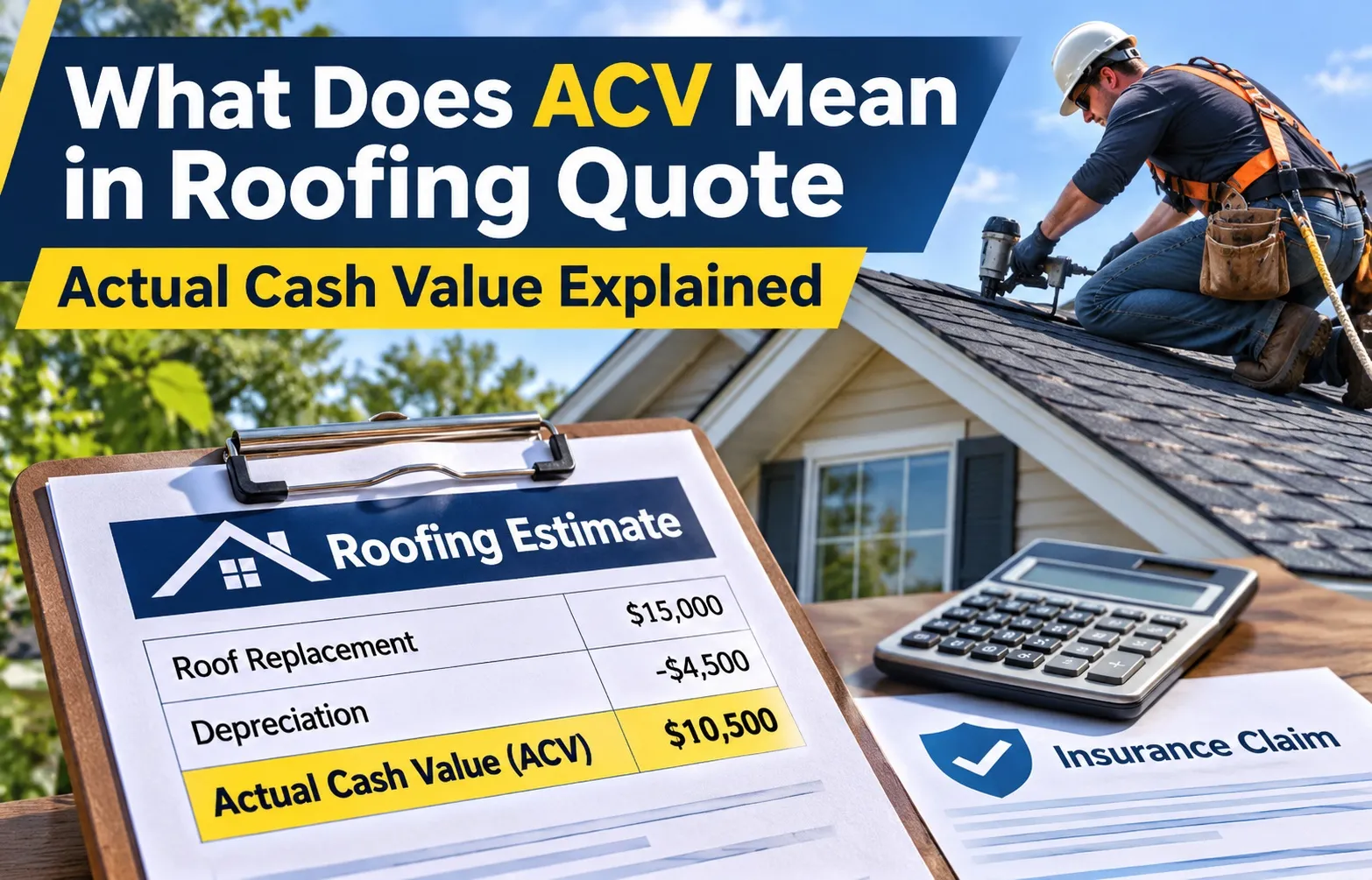 When reviewing a roofing quote or insurance estimate after a storm, Actual Cash Value (ACV) represents the estimated monetary worth of your roof at its current age, factoring in normal wear, tear, and depreciation. Unlike the full cost of a brand-new installation, an ACV payout reflects how much value the roof has already used up over its lifespan.
Homeowners often encounter this term when dealing with property insurance claims or contractor estimates following storm damage. Understanding this financial figure is crucial for calculating your exact out-of-pocket expenses before approving any roof replacement work.
What is Actual Cash Value (ACV)?
Actual Cash Value is calculated by taking the current replacement cost of your roof and subtracting accumulated depreciation based on its age and expected longevity. Insurance adjusters and roofing contractors use this metric to determine the baseline payout for damaged building materials.
- Replacement Cost (RCV): The total current price of materials and labor needed to install a brand-new roof.
- Depreciation: The monetary reduction in value applied by insurers based on how many years the roof has already been in service.
- Deductible: Your agreed-upon out-of-pocket policy responsibility subtracted directly from the final calculation.
Because depreciation heavily lowers the initial payout, an ACV figure is almost always lower than the total contractor quote. Recognizing this mathematical difference prevents unexpected financial shock when your initial insurance check arrives.
Why Your Roofing Quote Mentions ACV
Roofing quotes and insurance estimates explicitly detail ACV to establish legal and financial transparency regarding policy limits and claim disbursements. Insurers utilize ACV payouts to reflect the pre-loss condition of an older roof rather than granting an immediate financial windfall for a brand-new system.
- Policy Endorsements: Many homeowners discover their insurance policies automatically transition from replacement cost to ACV once shingles pass a certain age threshold (typically 10 to 15 years).
- Contractor Transparency: Professional roofing contractors itemize ACV alongside replacement cost to show exactly how much insurance funds will cover versus what financing or out-of-pocket funds are required.
- Claim Compliance: Adjusters provide ACV line items to adhere strictly to property insurance contract stipulations and state regulatory guidelines.
Reviewing these line items carefully ensures you know whether your quote represents an initial actual cash payment or the final cost after depreciation is fully recovered.
ACV vs. RCV: The Key Differences Every Homeowner Must Know
Choosing between Actual Cash Value (ACV) and Replacement Cost Value (RCV) determines your financial exposure when filing a roof insurance claim. While ACV lowers your monthly insurance premiums by factoring in age and depreciation, RCV provides robust financial protection by covering the full cost of brand-new materials without deductions.
ACV (Actual Cash Value) Defined
An Actual Cash Value policy compensates you for the depreciated worth of your roof at the exact time damage occurs. Insurance companies factor in years of wear and tear, meaning older roofs receive significantly smaller payouts that leave homeowners responsible for the remaining balance.
- Lower Monthly Premiums: Homeowners pay less for insurance because the insurer’s potential financial liability decreases as the roof ages.
- Automatic Endorsements: Many insurers enforce policy endorsements that automatically switch a roof from RCV to ACV once it reaches 10 to 15 years of age.
- Higher Out-of-Pocket Costs: Because depreciation is subtracted from the payout, policyholders must cover the substantial price gap to complete repairs.
ACV policies are often chosen to lower immediate recurring expenses, but they create severe financial risks when severe weather strikes an aging roof.
Replacement Cost Value (RCV) Defined
A Replacement Cost Value policy pays what it actually costs to repair or replace your roof with brand-new materials of comparable kind and quality at current market rates. This approach eliminates depreciation deductions, ensuring maximum financial protection after storm or wind damage.
- Comprehensive Payouts: Insurers cover the full cost of new materials and labor minus only your standard policy deductible.
- Loss Settlement Provisions: Policies outline specific guidelines where initial ACV is disbursed, followed by recoverable depreciation once construction is verified as completed.
- Higher Premiums: Premium rates are elevated because the insurance company assumes the full financial burden of a modern, expensive roof replacement.
When evaluating which coverage type is better, RCV is universally recommended for homeowners wanting complete peace of mind and minimal out-of-pocket vulnerability.
Side-by-Side Comparison Table (ACV vs. RCV)
Anatomy of a Roofing Quote: Spotting ACV and RCV Line Items
Reading a roofing estimate or insurance settlement requires knowing how adjusters and contractors separate costs. Spotting specific line items like materials cost, labor cost, and depreciation helps you track exactly how your net claim amount is calculated.
Contractor quotes and insurance adjuster sheets look intimidating at first glance, but they follow a strict itemized structure designed to catalog every shingle, vent, and hour of labor.
How Insurance and Contractor Estimates are Itemized
Insurance companies and professional roofing contractors typically use standardized estimating software to generate comprehensive line items. Each physical component of your roof system is broken down into precise unit measurements.
- Line Item Descriptions: Every task—such as tear-off, underlayment installation, shingle replacement, and flashing—gets its own dedicated row with exact quantities and unit costs.
- Materials vs. Labor Separation: Estimates clearly segregate the physical materials cost from the labor cost required for installation and debris disposal.
- Depreciation and Deductibles: The final summary sections apply age-based depreciation deductions and your policy deductible to reveal the initial payout versus the recoverable balance.
Comparing your contractor quote directly against the adjuster estimate ensures no damaged items, local code requirements, or square footage measurements were missed.
Reading Your Line-by-Line Breakdown
Examining a sample line-by-line summary demystifies how numbers flow from raw replacement costs down to your final payout check. Below is a simplified representation of how an ACV-based insurance estimate presents these financial figures.
Reviewing this structure allows homeowners to immediately identify whether withheld depreciation is recoverable once the contractor finishes building the new roof.
How Insurance Companies Calculate Roof Depreciation (With Math Example)
Insurance companies use a precise mathematical formula to calculate roof depreciation, turning raw age and wear into a dollar-value deduction. Understanding this formula helps homeowners accurately project their initial payout and out-of-pocket expenses before hiring a contractor.
Because property insurance contracts govern how material value declines over time, knowing the exact math prevents unexpected financial surprises when reviewing your insurance claim summary.
The Standard ACV Calculation Formula
The core depreciation formula subtracts both accumulated wear and your policy deductible from the total replacement cost. Insurance adjusters apply this standardized equation to every claim to determine the exact cash value payout disbursed to the policyholder.
- The Core Equation: Actual Cash Value equals Replacement Cost minus Total Depreciation minus Policy Deductible.
- Replacement Cost Baseline: The total current market price required to purchase brand-new roofing materials and pay professional labor rates.
- Depreciation Rate: The percentage of value lost based on the age of the roof relative to its expected total functional lifespan.
Mastering this calculation allows policyholders to evaluate whether their settlement accurately reflects standard insurance industry practices.
Step-by-Step Math Breakdown ($20,000 Roof Example)
Walking through a concrete financial scenario clarifies how a standard $20,000 roof replacement breaks down on an insurance estimate. By applying age-based wear and a standard deductible, you can instantly see how much cash the insurer provides upfront.
- Total Replacement Cost: $20,000 to replace the complete roofing system with new materials.
- Depreciation Deduction: A roof that is 10 years old with a standard 20-year asphalt shingle lifespan has lost half its useful life, resulting in a $10,000 depreciation reduction.
- Deductible Removal: Subtracting a standard $2,000 policy deductible from the remaining subtotal.
- Initial Payout Calculation: $20,000 replacement cost minus $10,000 depreciation minus $2,000 deductible leaves an initial payout of $8,000.
This initial check covers only a fraction of the total project cost, leaving significant out-of-pocket costs unless the depreciation is fully recoverable under your policy terms.
How Roof Age and Material Lifespan Drive Depreciation
Material type and age dictate how aggressively an insurance company depreciates a roof during a claim assessment. Standard asphalt shingles, metal roofs, and tile systems each degrade at different rates, directly impacting your financial recovery.
- Expected Lifespan Thresholds: Most standard shingle roofs are rated for a 20-to-30-year lifespan, meaning insurance adjusters depreciate them on a straight-line annual percentage basis (typically 3% to 5% per year).
- The 20-Year-Old Roof Reality: A 20-year-old roof is often valued near zero under strict ACV rules, meaning the initial payout will be heavily reduced or denied depending on specific policy endorsements.
- Material Durability Factors: Premium materials like slate or tile retain higher cash values longer because their engineered durability extends far beyond standard asphalt shingles.
Evaluating your roof’s exact age against its rated lifespan gives you a realistic expectation of the depreciation deductions you will face on an insurance estimate.
What Happens Next? Recoverable Depreciation & the Roofing Supplement Process
Receiving an initial insurance check that falls far short of your contractor’s total estimate can cause immediate panic, but understanding recoverable depreciation changes everything. Most homeowner policies hold back a portion of funds until the work is completed, meaning you will not necessarily have to pay thousands of dollars out of pocket.
Navigating the claims process successfully requires knowing how withheld funds are released and how professional contractors handle insurance adjustments.
Understanding Recoverable vs. Non-Recoverable Depreciation
Recoverable depreciation represents the withheld dollar amount that the insurance company will pay out once your roof replacement is officially finished and verified. In contrast, non-recoverable depreciation is permanently lost funds associated with older, heavily degraded roofs under strict actual cash value policies.
- Recoverable Depreciation Mechanics: Your initial insurance check covers the ACV minus your deductible. Once your roofing contractor finishes the installation and submits an invoice, the insurer releases the held-back depreciation funds.
- Non-Recoverable Endorsements: Some policies state that depreciation is completely non-recoverable, leaving the homeowner fully responsible for the gap between the ACV payout and the actual replacement cost.
- Proof of Completion: Insurance carriers require a certificate of completion or final invoice from your contractor before disbursing the final recoverable depreciation check.
Reviewing your policy declarations page beforehand ensures you know whether your withheld depreciation will be returned once construction wraps up.
How Roofing Contractors Use Supplements to Close the Gap
Even with an RCV policy, initial insurance estimates frequently miss hidden damages, local building code requirements, or specialized material costs. Professional roofing contractor negotiation bridges this financial gap through a formal supplement request.
- Identifying Omissions: Contractors inspect the property thoroughly to find items the insurance adjuster missed, such as ice and water shield, steep-slope charges, or local code upgrades.
- Submitting the Supplement: The contractor submits line-item documentation directly to the insurance carrier requesting additional funds to cover necessary work.
- Deductible Responsibility: Homeowners must remember that their deductible responsibility remains fixed; insurance fraud laws strictly prohibit contractors from waiving or absorbing your deductible.
Through careful documentation and professional supplement coordination, your contractor ensures that your total claim payout accurately reflects every dollar needed to restore your roof completely.
Understanding Your Roofing Insurance Claim & ACV
Visual expert walkthroughs provide invaluable clarity when navigating complex insurance claims and estimating total roof replacement costs. Watching an experienced professional break down actual claim adjustments helps demystify paperwork and clarifies how payouts are structured.
Utilizing a comprehensive video guide bridges the gap between confusing insurance jargon and practical homeowner action, ensuring you stay informed throughout every phase of your project.
Watch: Breaking Down Insurance Claims and ACV Payouts
Review the embedded expert walkthrough below to get a clear visual breakdown of how the insurance claim process works, how depreciation affects your initial settlement, and what steps you can take to manage your out-of-pocket expenses effectively.
As you watch the breakdown, pay close attention to these key aspects of your insurance claim:
- Claim Lifecycle: A step-by-step visual demonstration of filing, adjuster inspection, and receiving initial settlement checks.
- Cost Correlation: How professional contractor estimates align with insurance adjuster line-item valuations.
- Deductible & Depreciation Impact: Recognizing how age-related deductions directly alter your bottom-line financial responsibility.
Frequently Asked Questions About Roof ACV Quotes
Navigating home insurance policies and roofing estimates often raises complex legal and financial questions. Reviewing these expert answers helps you make informed decisions during your home repair process.
How do I know if my policy is ACV or RCV?
You can quickly determine your coverage type by reviewing the declarations page of your active insurance policy. This summary page outlines your specific loss settlement provisions right next to your dwelling coverage limits.
- Locating the Declarations Page: Look for sections labeled “Loss Settlement” or “Property Coverage Endorsements” in your policy packet or online insurance portal.
- Identifying ACV Terminology: If your policy specifies “Actual Cash Value” for roof surfaces or lists age-related depreciation schedules, you have an ACV setup.
- Contacting Your Agent: If your paperwork is ambiguous, calling your insurance provider directly clarifies whether your roof is insured for replacement cost or depreciated value.
Knowing your policy type before filing a claim prevents unexpected out-of-pocket costs when contractor estimates arrive.
Is a 20-year-old roof covered under an ACV policy?
A 20-year-old roof is typically covered under an ACV policy, but the payout may be heavily reduced or limited by specific policy conditions. Because standard asphalt shingles have a finite expected lifespan, extreme age triggers steep depreciation deductions.
- High Depreciation Impact: A 20-year-old roof has often lost 80% to 100% of its calculated value under standard depreciation tables, resulting in a minimal initial payout.
- Potential Roof Exclusions: Some insurers enforce strict roof exclusion clauses or mandatory ACV endorsements once roofs cross the 15-year age threshold.
- Filing a Storm Damage Claim: When submitting a storm damage claim on an older roof, expect the insurer to pay only the depreciated ACV amount minus your deductible.
For more detailed guidance on handling storm damage and understanding settlement rights, you can review the NAIC storm recovery consumer guide.
Can a roofing contractor waive my insurance deductible?
No, a roofing contractor cannot legally waive, absorb, or discount your insurance deductible. Offering a deductible waiver constitutes insurance fraud in many jurisdictions because it misrepresents the true total cost of repairs to the insurance carrier.
- Legal Obligations: Your policy contract requires you to pay your specific deductible amount out of pocket for any approved claim.
- Fraudulent Practices: Contractors who offer to “absorb your deductible” or promise a “free roof” by inflating initial invoice line items violate state insurance laws.
- Contractor Integrity: Always partner with reputable professionals who provide transparent estimates and adhere strictly to legal insurance settlement guidelines.
Insisting on honest itemization protects you from legal liabilities and ensures your insurance claim proceeds smoothly to completion.

Oscar Vance | Master Plumber & Drainage Expert
Meet Oscar Vance, a licensed master plumber sharing practical solutions on residential repairs, preventive maintenance, and thoughtful home upkeep.