What Is a CRAC Unit in HVAC?
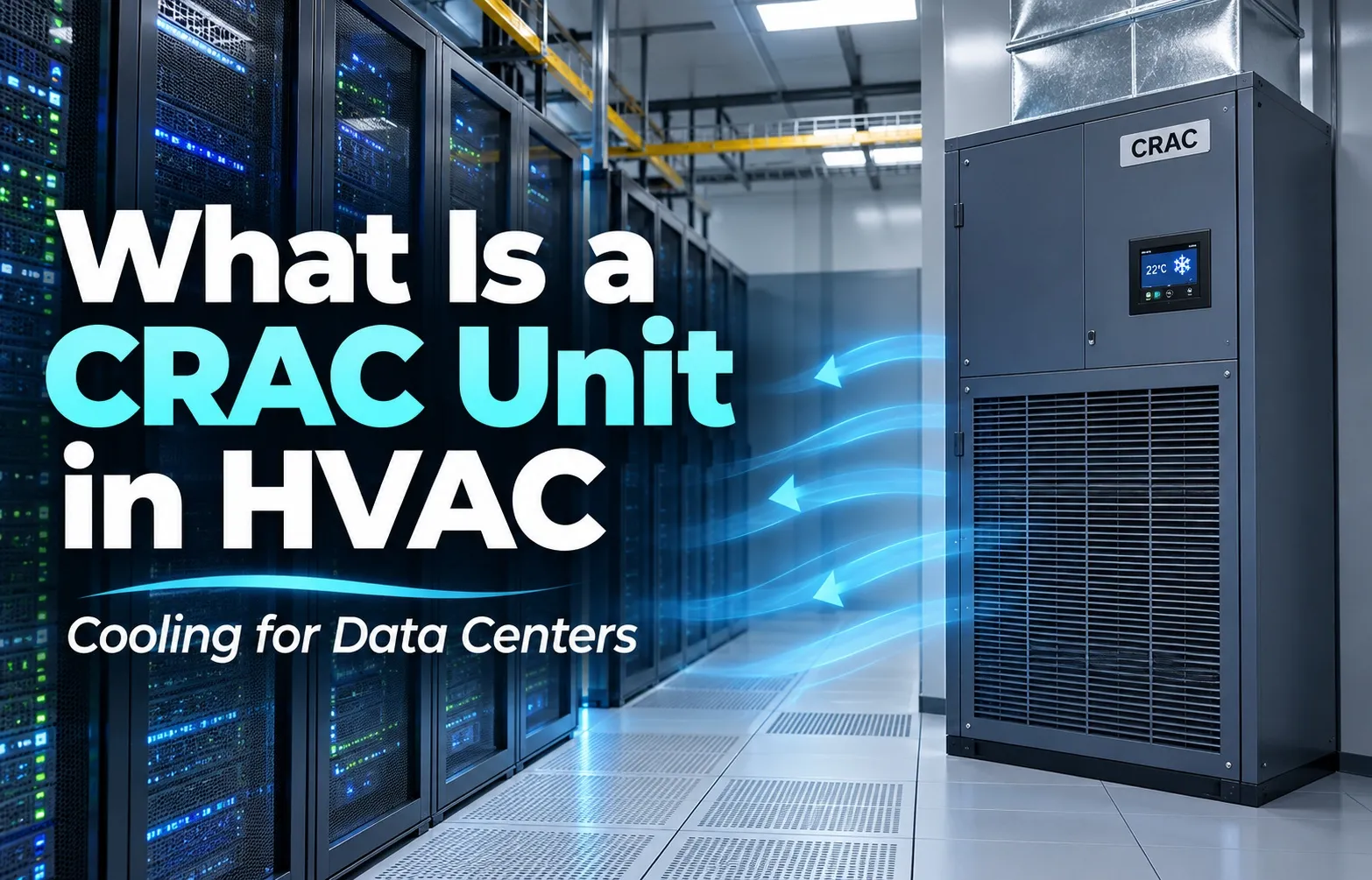 A CRAC unit (Computer Room Air Conditioning unit) is a specialized precision HVAC system engineered to maintain exact temperature, relative humidity, and airflow in data centers, server rooms, and telecom closets. Unlike standard comfort air conditioners designed for human occupancy, CRAC units operate continuously 24/7 to remove intense, dry heat generated by electronic hardware.
Because servers, network switches, and power distribution equipment run nonstop, even brief thermal spikes or humidity fluctuations can trigger hardware throttling, permanent component failure, or costly downtime. Precision computer room cooling stabilizes the indoor microclimate year-round regardless of outdoor weather extremes.
What Does CRAC Stand For?
In commercial and industrial HVAC engineering, CRAC stands for Computer Room Air Conditioner (or Computer Room Air Conditioning). It belongs to the category of precision cooling equipment rather than standard comfort air conditioning.
- Purpose-Built Architecture: Every component inside a CRAC unit—from heavy-duty compressors to high-static blowers—is rated for uninterrupted year-round duty cycles.
- Micro-Environmental Control: Precision sensors regulate temperature within ±1°F (±0.5°C) and relative humidity within ±2% to ±5%, protecting sensitive circuit boards from environmental stress.
- High Airflow Volume: CRAC systems move significantly more cubic feet per minute (CFM) of air per ton of cooling than commercial rooftop units to prevent localized hot spots inside dense server racks.
Why Standard Comfort HVAC Fails in Server Rooms
Installing a standard commercial or residential air conditioner inside a server room or UPS room frequently leads to premature equipment failure and unstable operating conditions. Standard HVAC systems are built around human comfort, whereas IT spaces present completely different thermodynamic demands.
- Sensible Heat vs. Latent Heat Loads: Human occupants add moisture (latent heat) through breathing and perspiration, so comfort AC units spend roughly 25% to 30% of their capacity removing humidity. Servers produce almost 100% dry sensible heat loads, meaning a comfort AC over-dries the room and wastes cooling capacity.
- Electrostatic Discharge (ESD) Risks: When standard air conditioners strip too much moisture from a server closet, relative humidity drops below 30%. Dry air builds static electricity that can discharge into microchips and destroy sensitive electronics during routine maintenance.
- Condensation and Corrosion: Conversely, if humidity climbs above 60% due to poor moisture regulation, microscopic condensation forms on cold metal surfaces, accelerating circuit corrosion and short circuits.
- 24/7 Continuous Operation vs. Intermittent Duty: Comfort HVAC units cycle on and off based on daytime building occupancy and struggle during winter months when outdoor temperatures drop. CRAC units feature low-ambient controls that enable reliable heat rejection 8,760 hours a year, even in sub-zero winter conditions.
How Does a CRAC Unit Work?
A CRAC unit works by drawing warm exhaust air from IT racks, absorbing heat through a direct expansion (DX) refrigerant loop, regulating moisture and dust, and supplying cooled air back into the room. Most installations use a split system DX layout that pairs an indoor cooling cabinet with an outdoor external condenser to expel heat outside the facility.
Unlike comfort HVAC systems that react slowly to room-wide averages, a CRAC unit pairs high-volume air movement with tight environmental control loops. Proper airflow separation between hot server exhaust and cold rack intakes prevents warm air recirculation and thermal hot spots.
The 4-Stage Direct Expansion (DX) Refrigeration Cycle
A DX CRAC unit creates cooling inside its own closed refrigerant circuit rather than relying on a central chilled-water plant. In a split system DX arrangement, the indoor unit houses the evaporator coil, blowers, and controls, while refrigerant lines connect to a remote outdoor condenser (or dry cooler/cooling tower on water- or glycol-cooled models).
- Evaporator Coil Heat Absorption: Internal blowers pull warm return air from the room across the cold evaporator coil, where low-pressure liquid refrigerant boils into vapor and absorbs heat from the air.
- Compressor Pressurization: The compressor draws in the low-pressure refrigerant vapor and raises its pressure and temperature so it can release heat at higher ambient outdoor temperatures.
- External Condenser Heat Rejection: Hot high-pressure refrigerant travels through the refrigerant loop to the external condenser, where outdoor fans or fluid loops reject the absorbed heat to the outside air.
- Expansion and Return Loop: After rejecting heat and condensing back toward a liquid state, the refrigerant passes through an expansion device that drops its pressure and temperature before re-entering the evaporator coil.
Precision Humidity & Particulate Filtration Control
Maintaining strict relative humidity and clean air inside a server room protects circuit boards from static discharge, moisture buildup, and dust accumulation. Every air pass through the cabinet integrates moisture and particulate management alongside sensible cooling.
- Humidification: When dry air or sensible cooling pushes relative humidity below target thresholds, an integrated humidifier adds controlled moisture vapor to prevent static electricity risks.
- Dehumidification: If excess moisture enters the space, the cooling coil condenses water vapor out of the airstream into a condensate drain pan, with reheat or staged capacity preventing overcooling.
- Air Filtration: High-efficiency air filtration traps dust, lint, and airborne particulates before they settle on server fans, heat sinks, or coil fins.
Airflow Delivery Topologies: Downflow, Upflow, and Front-Flow
Choosing the right airflow path depends on floor construction, rack density, and whether the room uses hot-aisle/cold-aisle containment. Matching the unit’s discharge direction to the room layout minimizes bypass air and keeps cold supply air reaching server fronts.
- Raised-Floor Plenum Precision: Downflow units pressurize an underfloor plenum so conditioned air exits through perforated tiles directly in front of server racks.
- Containment Alignment: Pairing downflow or ducted upflow units with hot-aisle/cold-aisle containment stops hot exhaust air from mixing back into cold intake streams.
Main Components of a CRAC System
A CRAC unit integrates heavy-duty refrigeration hardware, high-efficiency air movers, moisture conditioning devices, and microprocessor controls inside a single insulated cabinet. When facility engineers review a manufacturer catalogue PDF from OEMs such as Liebert/Vertiv, Stulz, or Trane, they evaluate each subsystem for 24/7 reliability and part-load efficiency.
Unlike standard commercial rooftop units built with belt-driven blowers and fixed-capacity compressors, precision cooling cabinets use modulating components that adjust output to match fluctuating server rack loads without temperature swings.
Core Cooling & Air-Moving Hardware
The mechanical core of a direct expansion CRAC cabinet transfers sensible heat from server exhaust air into a refrigerant circuit and rejects that heat outdoors. Modern precision systems rely on four primary mechanical assemblies to maintain continuous airflow and stable discharge temperatures.
- Variable-Speed Compressor: Digital scroll or inverter-driven variable-speed compressors modulate refrigerant mass flow between roughly 20% and 100% capacity, preventing destructive short-cycling during low IT load periods.
- Evaporator Coil: Oversized, high-face-area copper-tube and aluminum-fin evaporator coils maximize sensible heat transfer while minimizing latent moisture removal and air-side pressure drop.
- EC (Electronically Commutated) Fans: Direct-drive backward-curved plug fans powered by brushless DC EC (Electronically Commutated) fans eliminate belt wear, cut fan energy draw by up to 30% compared to legacy AC induction blowers, and adjust airflow smoothly based on rack static pressure.
- Condenser Heat Rejection Options: Depending on site infrastructure, the indoor cabinet pairs with a remote air-cooled condenser mounted on a roof or pad, a water-cooled condenser tied to a cooling tower, or a glycol-cooled condenser paired with an outdoor dry cooler to prevent winter freeze-ups.
Environmental Conditioning & Microprocessor Controls
Beyond sensible cooling, a CRAC unit actively regulates moisture balance, airborne particulate cleanliness, and automated fault reporting across the facility network. Catalogue specification sheets detail these subsystems to ensure compliance with strict data center environmental envelopes.
- Steam Humidifier: Immersed-electrode or infrared steam humidifiers inject clean, mineral-free vapor into the supply airstream whenever winter dry air or sensible cooling pushes relative humidity below target setpoints.
- Reheat Coil: Multi-stage electric resistance elements or hot-gas reheat coils warm overcooled air back to setpoint during dehumidification cycles so humidity drops without chilling the server room below safe thresholds.
- MERV Filtration: Deep-pleat MERV filtration banks (typically MERV 8 to MERV 13 or higher) capture dust, cardboard fibers, and airborne debris before particulates can coat server heat sinks or obstruct coil fins.
- Microprocessor Controller & BMS Integration: An onboard microprocessor controller monitors supply/return temperature and relative humidity sensors, coordinates lead-lag unit rotation, and communicates alarms and energy telemetry to the facility Building Management System (BMS) over Modbus, BACnet, or SNMP protocols.
CRAC vs. CRAH: What’s the Difference?
A CRAC (Computer Room Air Conditioner) cools room air using an onboard or split DX refrigeration circuit and compressor, whereas a CRAH (Computer Room Air Handler) blows air across a chilled water coil fed by a central chiller plant. Both move conditioned air through server rooms, but they separate where refrigeration occurs and how cooling scales.
Selecting between them depends on room size, available chilled-water infrastructure, and target PUE (Power Usage Effectiveness). Self-contained DX units fit smaller rooms and standalone sites, while chilled-water air handlers suit larger facilities with central plant capacity.
Side-by-Side Comparison: CRAC vs. CRAH Units
Although CRAC and CRAH cabinets often share similar floor footprints and airflow configurations, their internal heat-exchange medium changes capital cost, plant complexity, and service routines.
Field Engineering Insights: Choosing Between DX and Chilled Water
Controls specialists and commissioning engineers evaluate practical constraints beyond headline tonnage before locking in a DX or chilled-water design. Each architecture introduces distinct piping, efficiency, and operational trade-offs in live facilities.
- Line-Set Distance Limits in DX Systems: Split DX CRAC layouts face manufacturer limits on refrigerant line-set distance, vertical lift, and oil return, making long runs between indoor cabinets and remote condensers difficult without added engineering complexity.
- Central Plant Efficiency & Waterside Economizer Gains: Large chilled-water plants achieve higher cooling efficiency at scale and support a waterside economizer in cooler weather, lowering compressor runtime and improving facility PUE (Power Usage Effectiveness).
- Standalone Simplicity vs. Hydronic Redundancy: A DX CRAC isolates faults to a single refrigeration loop, whereas a CRAH system relies on shared chillers, pumps, and headers that require coordinated valve isolation and failure testing during commissioning.
- Building Automation & Control Coordination: Under building automation sequences, DX units stage compressors and fans to hold supply temperature, while CRAH controllers modulate chilled-water control valves and pump differential pressure alongside central plant staging.
CRAC Unit vs. Standard Comfort HVAC Systems
A CRAC unit is engineered for continuous, high-sensible IT cooling and tight humidity control, whereas standard comfort air conditioning is designed for intermittent human occupancy with greater latent moisture removal. Comparing both systems clarifies why server rooms cannot rely on ordinary office or residential HVAC equipment.
Industry benchmarks under ASHRAE TC 9.9 Thermal Guidelines define controlled temperature and humidity envelopes for datacom equipment. Precision CRAC units hold those environmental limits reliably, while comfort HVAC systems prioritize occupant thermal comfort over equipment protection.
Technical Comparison Table: Precision CRAC vs. Comfort HVAC
Key engineering differences in Sensible Heat Ratio (SHR), duty cycle, moisture stability, and airflow volume separate precision CRAC hardware from standard comfort HVAC equipment.
The Risk of Using Comfort AC in a Server Closet
Deploying comfort HVAC inside a server room or network closet creates recurring operational hazards that compromise IT uptime. Even when a unit appears to cool adequately on day one, unmonitored environmental drift and mechanical wear accumulate rapidly.
- Compressor Short-Cycling in Winter: Standard outdoor condensers lack winter head-pressure controls and can trip on low pressure or suffer compressor short-cycling when servers demand cooling during cold weather.
- Over-Dehumidification and Static Damage: Lower coil temperatures and high latent capacity strip moisture from the air, dropping relative humidity (RH) and increasing static discharge risk across sensitive electronics.
- Premature Equipment Burnout: Comfort blowers, contactors, and bearings are not rated for uninterrupted year-round duty under high heat loads, leading to early component failure and unplanned outages following ASHRAE thermal guidelines reviews.
Common Applications, Capacity Sizing & CRAC Unit Cost
CRAC units are deployed across mission-critical facilities where continuous heat removal and strict environmental stability protect high-value electronics. Typical precision systems span from compact 5-ton server room cabinets to 10 to 30 tons (120,000 to 360,000 BTU/hr) or higher for larger IT spaces, with final budgets shaped by redundancy, heat load, and installation scope.
Planners size precision cooling around measured IT heat dissipation—converting watts to British thermal units per hour (where 1 ton equals 12,000 BTU/hr)—rather than rough square footage alone. Adding redundant capacity ensures cooling continues uninterrupted if a single unit goes offline for service or fault recovery.
Where CRAC Units Are Deployed
Any facility housing heat-dense electronics that cannot tolerate thermal drift or static buildup benefits from dedicated computer room cooling. Common deployments include:
- Enterprise Data Centers & Edge Computing Facilities: Supports high-density server racks, storage arrays, and edge nodes that generate concentrated sensible heat around the clock.
- MDF/IDF Telecom Closets: Keeps core network switches, patch panels, and fiber distribution gear within safe operating temperatures inside tight telecom rooms.
- UPS & Battery Rooms: Controls ambient temperatures around uninterruptible power supply cabinets and battery banks, where excess heat accelerates battery degradation.
- Medical Imaging Suites & Cleanroom Laboratories: Stabilizes temperature and humidity around sensitive diagnostic scanners, analytical instruments, and controlled testing environments.
Typical Cooling Capacities & Redundancy (N+1) Sizing
Selecting the right cooling capacity requires matching sensible heat output in tonnage and BTU/hr to rack power density, room envelope losses, and uptime targets. Facilities routinely evaluate capacities across tiers and apply N+1 redundancy so one backup unit covers a single unit failure.
- Small Server Rooms & Telecom Closets (5 to 10 Tons / 60,000 to 120,000 BTU/hr): Fits compact server rooms or IDF/MDF closets with modest rack counts and lower heat loads.
- Midsize Server Rooms & Edge Sites (10 to 30 Tons / 120,000 to 360,000 BTU/hr): Covers multi-rack server rooms, edge data centers, and larger UPS or equipment rooms.
- High-Density & Enterprise Halls (30+ Tons / 360,000+ BTU/hr): Achieved through multiple parallel precision units or larger chilled-water configurations where load scaling demands higher airflow and modular staging.
- Why N+1 Redundancy Matters: In an N+1 layout, N units carry the full peak IT load while +1 standby unit provides failover protection and allows rotation or maintenance without thermal spikes.
How Much Does a CRAC Unit Cost? (Equipment & Installation Drivers)
CRAC unit cost varies widely depending on tonnage, condenser architecture, factory options, and site installation complexity. Small low-capacity precision units can start in the low thousands of dollars, while mid-to-high tonnage systems with external condensers, humidifiers, reheat, and field installation routinely reach tens of thousands of dollars—and full multi-unit room builds can exceed $100,000 once electrical, containment, and controls work are included.
- Why Engineers Consult OEM Catalogue Specs Before Quoting: Two units with identical nominal tonnage can deliver different sensible capacities, static pressure ratings, and sound levels. Reviewing official OEM catalogue specs confirms exact sensible kW, airflow CFM, condenser matching, and electrical requirements before locking in final pricing.
Frequently Asked Questions About CRAC Units
These concise answers address common buyer and facility questions about precision cooling equipment, operating lifespans, thermal targets, and major manufacturers.
Is a CRAC unit a split system?
A CRAC unit can be configured as either a split system HVAC layout or a self-contained packaged unit. In a split DX design, the indoor cabinet houses the evaporator coil, blowers, and controls while connecting to a remote outdoor condenser, whereas packaged units integrate heat rejection inside or directly adjacent to the cabinet.
- Split DX Layout: Separates indoor air handling from outdoor condenser heat rejection using insulated refrigerant piping.
- Packaged or Chilled-Water Layout: Consolidates cooling hardware or pairs an indoor handler with a central chilled-water plant.
What is the difference between a CRAC unit and standard HVAC?
A CRAC unit is built for 24/7 continuous operation, high sensible heat removal from electronics, and tight humidity control, whereas standard HVAC prioritizes intermittent human occupancy and higher latent moisture removal. Comfort systems also lack low-ambient winter controls and high airflow-per-ton ratings required by server rooms.
- Thermal Focus: High sensible heat handling for IT gear versus occupant comfort and moisture removal.
- Duty Cycle: Continuous year-round operation versus occupancy-driven cycling.
How long does a CRAC unit last?
A CRAC unit typically lasts 15 to 20 years under continuous operation when backed by scheduled preventative maintenance, though some well-serviced cabinets run longer with major component replacements. Compressors, fan bearings, humidifiers, and control boards experience wear over time, making maintenance discipline critical to full CRAC unit lifespan.
- Maintenance Impact: Regular coil cleaning, filter changes, and refrigerant/electrical checks prevent premature compressor and fan failures.
- Replacement Signals: Rising repair costs, aging refrigerants, or high energy draw often prompt lifecycle evaluation around years 10 to 15.
What temperature should a server room be kept at?
ASHRAE guidelines set the ASHRAE recommended temperature range at 64.4°F to 80.6°F (18°C to 27°C) at IT equipment air intakes. Modern facilities avoid overcooling below this range because excessively low setpoints waste energy and increase cooling costs without improving hardware reliability.
- Balanced Operation: Operating inside the recommended band balances equipment reliability with lower cooling energy use.
- Airflow Consistency: Monitoring rack intake temperatures prevents hot spots while avoiding unnecessary overcooling.
Who are the top CRAC unit manufacturers?
Leading precision cooling manufacturers include Vertiv Liebert, Stulz, Schneider Electric (including APC precision cooling lines), and Trane, alongside specialized suppliers such as Data Aire. Engineers compare OEM specification sheets for sensible capacity, fan efficiency, condenser options, and controls compatibility.
- Established Precision Brands: Vertiv Liebert, Stulz, Schneider Electric, and Data Aire specialize in mission-critical computer room cooling.
- Broad Commercial HVAC OEMs: Trane offers commercial and precision cooling equipment across varied facility scales.

Oscar Vance | Master Plumber & Drainage Expert
Meet Oscar Vance, a licensed master plumber sharing practical solutions on residential repairs, preventive maintenance, and thoughtful home upkeep.