Exact Poop Smell Clearing Times by Bathroom Setup
 Airflow volume and indoor humidity determine how rapidly odor molecules dilute and exit a room. A standard residential bathroom requires 8 to 10 Air Changes Per Hour (ACH) to clear airborne sulfur gases efficiently, which explains why clearing times vary dramatically across different bathroom layouts.
How Long Does Poop Smell Last in a Bathroom Without a Fan or Window?
In a windowless bathroom without an exhaust fan—common in basement half-baths, older apartments, and interior office restrooms—poop smell typically lasts 1 to 3 hours. Because there is no mechanical exhaust rated in Cubic Feet per Minute (CFM) to pull contaminated air upward, stagnant air holds sulfur compounds at nose level.
Without active air circulation, odor clearing relies entirely on slow passive diffusion:
- Minimal Door-Gap Exchange: Only a tiny fraction of air escapes underneath a closed door, keeping airborne concentrations noticeable for over an hour.
- Surface Absorption: When gases cannot exit through a vent, they settle onto cool porcelain, unsealed grout, and fabric towels, slowly releasing odor back into the room.
- HVAC Recirculation Delays: If the bathroom only has a central air supply register and no return vent, positive pressure pushes odors into adjacent hallways unless the door stays open.
Why Flushing Doesn’t Make the Smell Disappear Immediately
Flushing removes solid waste from the bowl, but it does not remove the odor molecules that already escaped into the room before you pressed the handle. Warm waste releases volatile gases the instant it hits cooler toilet water, causing odor plumes to rise into the breathing zone within seconds.
Two physical reactions keep the smell suspended even after the toilet bowl is clean:
- Pre-Flush Gas Diffusion: Methane, hydrogen sulfide, and skatole disperse rapidly through warm indoor air long before the water refills the bowl.
- The Toilet Plume Effect: Flushing with the toilet lid open generates turbulent water agitation, launching microscopic aerosolized particles up to 5 feet into the air where they linger until ventilation clears them.
5 Factors That Make Bathroom Odors Linger Longer
Even with identical toilet habits, bathroom odors can clear in 10 minutes in one home and hang in the air for over two hours in another. Chemical gas density, indoor moisture levels, porous room materials, and mechanical airflow bottlenecks dictate how stubbornly odor molecules remain trapped.
1. Volatile Sulfur Compounds in Your Stool (Hydrogen Sulfide, Skatole & Indole)
The chemical makeup of your stool directly controls how heavy and persistent the resulting odor becomes. When gut bacteria ferment sulfur-rich foods—such as eggs, red meat, garlic, cruciferous vegetables, and dairy—they produce dense gases like hydrogen sulfide (H2S), methanethiol, skatole, and indole.
Because these sulfur compounds have a higher molecular weight than standard indoor air, they resist upward dispersion and hang lower in the room:
- Hydrogen Sulfide (H2S) & Methanethiol: Responsible for sharp, rotten-egg and rotting-cabbage notes that register immediately on human olfactory receptors even at tiny concentrations.
- Skatole & Indole: Nitrogen-containing organic compounds formed from tryptophan breakdown that cling aggressively to airborne moisture and clothing fibers.
- Digestive Transit & Malabsorption: Loose stools or undigested fats release volatile gases faster upon hitting water, creating a denser initial odor plume than well-formed waste.
2. High Bathroom Humidity and Warm Air
Using the toilet immediately after a hot shower dramatically extends odor clearing times because high relative humidity acts as a molecular anchor. Warm water vapor suspended in the air binds directly with water-soluble gases like hydrogen sulfide, slowing down natural dissipation.
Elevated bathroom moisture alters indoor air behavior in three measurable ways:
- Heavier Odor Droplets: Gas molecules attached to microscopic steam droplets become too heavy to rise cleanly into ceiling exhaust vents.
- Delayed Evaporation: High relative humidity prevents moisture films on tile walls and mirrors from evaporating, holding trapped odor compounds against cold surfaces.
- Enhanced Olfactory Sensitivity: Warm, humid air keeps nasal passages moist, making human smell receptors noticeably more sensitive to lingering sulfur notes.
3. Porous Fabrics Acting Like Odor Sponges
Bathrooms filled with soft textiles hold onto smells far longer than minimalist spaces with bare tile and glass. Porous surfaces—including woven cotton fibers, fabric shower curtains, plush bath mats, and unsealed wooden vanities—absorb volatile organic compounds like microscopic sponges.
Once these materials trap airborne gases, they slowly off-gas the smell back into the bathroom over several hours:
- Damp Bath Towels & Rugs: Wet cotton fibers absorb airborne sulfur compounds up to three times faster than dry fabrics.
- Fabric Shower Curtains & Liners: Large vertical surface areas catch rising warm air plumes directly beside the toilet.
- Unsealed Grout & Wood Cabinetry: Microscopic pores in unsealed tile grout and particleboard absorb humid odor molecules that standard surface wiping cannot reach.
4. Exhaust Fan Buildup and Low CFM Ratings
A bathroom fan running loudly does not guarantee that it is actually moving air out of the room. Over time, lint, toilet paper dust, and humid grime coat the fan grille and impeller blades, reducing airflow efficiency by up to 50% and turning a 10-minute clear time into 45 minutes.
Several mechanical issues commonly choke bathroom exhaust performance:
- Undersized CFM Capacity: Builders often install cheap 50 CFM fans in large bathrooms that require 80 to 110 CFM to achieve proper air exchange rates.
- Clogged Fan Cover Grilles: Thick dust buildup blocks intake slots, forcing the motor to spin without pulling contaminated air upward.
- Lack of Makeup Air: If the gap under a closed bathroom door is too tight, the fan creates a vacuum and stalls instead of exhausting odor molecules outside.
5. Hidden Plumbing Issues vs. Residual Waste
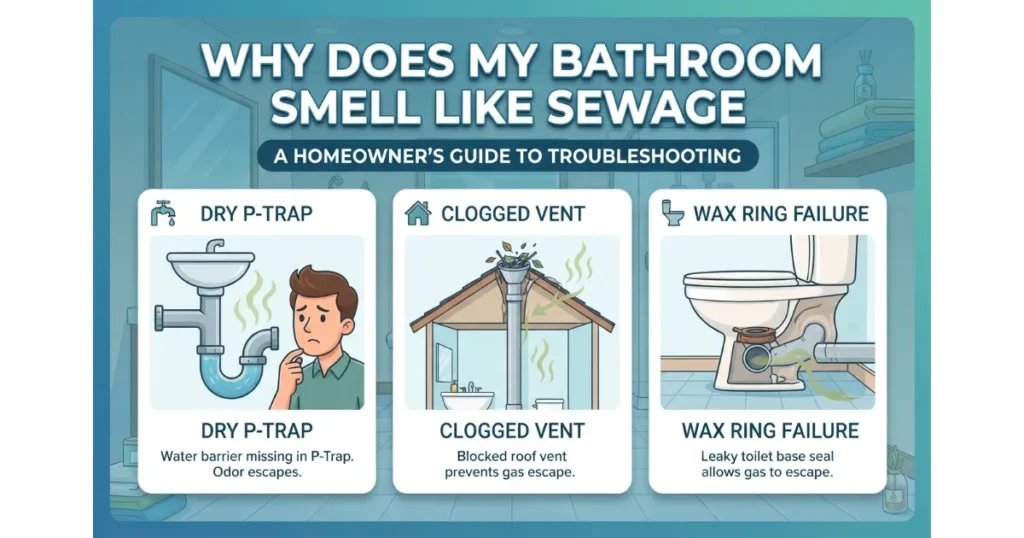
When a foul poop or rotten-egg smell lingers for days—or returns every morning even when nobody has used the toilet—the culprit is mechanical rather than biological. In these cases, sewer gas from your home’s drain lines is leaking directly into the bathroom.
Three specific plumbing failures mimic lingering bathroom waste odors:
- Dried-Out P-Trap: Rarely used floor drains, guest sinks, or tubs lose their water seal through evaporation, allowing raw sewer gas to rise freely through the pipe.
- Failed Toilet Wax Ring: When the wax seal between the toilet base and floor flange cracks or compresses, sewer gases seep out around the base every time water drains nearby.
- Blocked Plumbing Vent Stack: Leaves, snow, or debris clogging the roof vent pipe create negative drain pressure that siphons water out of toilet bowls and drain traps.
If your bathroom continues smelling like sewage long after thorough cleaning and ventilation, follow a step-by-step bathroom sewage odor troubleshooting guide to inspect your drain traps, toilet base seal, and roof vent lines.
How to Get Rid of Poop Smell in a Bathroom Fast
Stopping a bathroom from smelling after pooping requires acting within the first 60 seconds before airborne VOCs saturate the room. Combining rapid waste removal, forced air exchange, and true odor neutralizers clears lingering smells much faster than heavy perfumes alone.
Step 1: Do an Immediate “Courtesy Flush” (Cuts Odor by Up to 70%)
Flushing the instant waste enters the water cuts lingering odor sharply by submerging solids before volatile sulfur compounds diffuse into the room. Always lower the toilet lid before pressing the flush lever so odor gases and spray stay contained beneath the seat.
Making a courtesy flush part of your routine stops odor buildup at the source:
- Immediate Containment: Removes waste within seconds so gases cannot continuously rise into warm bathroom air.
- Reduced Surface Cling: Prevents prolonged gas exposure on nearby towels, bath mats, and wall tiles.
- Lid-Closed Advantage: Keeps aerosolized droplets and odor plumes from launching upward during the flush cycle.
Step 2: Create Cross-Ventilation or “Door Fanning” (Best for Fanless Bathrooms)
When a bathroom lacks a working exhaust fan, forcing air movement physically pushes stagnant odor-laden air out into a larger space. Open a nearby hallway window or crack a door opposite an airflow source to establish cross-ventilation.If the room is completely enclosed, use manual air displacement to break up trapped pockets of gas:
- Door Fanning Technique: Swing the bathroom door smoothly back and forth 8 to 10 times to pump stale air out and draw fresher air in.
- Cross-Ventilation Drafts: Opening a window or hallway air path creates pressure differences that pull airborne VOCs out faster than still air.
- Fan-to-Door Gap: If you do have an exhaust fan, leave the door slightly ajar so fresh air replaces the exhausted air smoothly.
Step 3: Neutralize Odor Molecules Instead of Masking Them
An odor neutralizer chemically binds, absorbs, or breaks down foul compounds, whereas a standard air freshener simply layers perfume over bad smells. Mixing heavy floral sprays with sulfur gases often produces a harsh, cloying scent that lingers uncomfortably.
Choose targeted neutralizers depending on whether you need fast air cleanup or ongoing odor control:
- Activated Charcoal: Porous carbon traps airborne VOCs and sulfur gases through adsorption for continuous room freshness.
- Enzymatic Cleaner: Breaks down organic waste residue and odor-causing microbes on surfaces rather than covering them up.
- Baking Soda & White Vinegar: Baking soda absorbs mild odors in small spaces, while dilute white vinegar helps neutralize alkaline odor compounds during cleanup.
Step 4: Use Pre-Poop Essential Oil Bowl Sprays
Pre-poop toilet sprays work before waste hits the water by creating an essential oil barrier across the surface of the bowl. This thin lipid film traps odor gases underwater so they cannot float upward into the bathroom air.
Using a bowl spray right before sitting changes how odors behave from the start:
- Surface Lipid Film: Oils float on top of the water and capture volatile sulfur molecules beneath the surface layer.
- Preventive Control: Stops odor escape at the bowl rather than chasing airborne molecules around the room afterward.
- Lighter Aftermath: Leaves less residual smell in the air compared to spraying heavy aerosol mist after finishing.
Step 5: The Wet Towel Wave Trick (Emergency Hotel/Guest Hack)
In a pinch with no spray or exhaust fan, waving a clean, damp towel through the air helps capture airborne VOCs in fine moisture droplets. Damp fabric grabs suspended particles and odor molecules as it moves through the space.
Keep this emergency trick quick and clean so you do not transfer moisture onto clean linens:
- Light Dampness Only: Lightly dampen a clean washcloth or hand towel with cool water, wring it out well, and wave it gently in the upper air.
- Avoid Soaking Fabrics: Do not use a dripping-wet towel or a bath towel that you plan to press against your face or body later.
- Follow With Airing: Pair the towel wave with door fanning or an open door so trapped molecules exit the room completely.
Why Does Poop Smell Last in a Bathroom Even After Cleaning?
When poop smell lingers in a bathroom for 24 to 48 hours after scrubbing the bowl, the odor is usually coming from trapped organic residue and porous textiles rather than the air. Standard surface wiping misses microscopic bacteria colonies hidden inside toilet hardware, floor grout, and damp fabrics.
Missed Micro-Splatter Under the Toilet Rim and Hinges
Swishing a brush inside the toilet basin leaves behind invisible micro-splatter tucked beneath the upper rim jets and inside plastic toilet seat hinges. Warm bathroom humidity activates this trapped bacteria biofilm, releasing continuous foul odors for up to two days until those hidden crevices are disinfected.
Target these overlooked hardware zones during your cleaning routine:
- Toilet Rim Jets: Squirt thick toilet bowl cleaner directly upward beneath the overhang and scrub with an angled rim brush to remove hidden waste buildup.
- Toilet Seat Hinges & Bolts: Pop open quick-release hinge caps to wipe away dried splatter and moisture trapped around mounting screws.
- Underside of the Lid & Seat Bumpers: Spray disinfectant under the seat and around rubber bumpers, letting it sit for 5 minutes before wiping clean.
Odor Trapped in Dirty Bath Mats and Towels
Mopping the bathroom floor will not clear a lingering smell if plush bath mats and hanging towels already absorbed humid odor particles. Cotton and microfiber textiles hold volatile sulfur compounds deep inside their weave and slowly release the scent back into the room every time the air warms up.
Proper bath mat laundering strips trapped odor molecules from soft bathroom fabrics immediately:
- Hot Water & White Vinegar Wash: Launder bath mats and hand towels on a hot cycle with regular detergent plus 1 cup of distilled white vinegar to neutralize trapped odor compounds.
- Skip Heavy Fabric Softeners: Liquid softeners coat fibers in a waxy film that locks residual bacteria and smells inside the fabric.
- Complete High-Heat Drying: Dry damp textiles thoroughly before returning them to the bathroom so lingering moisture cannot trap new odors.
Bleach vs. Enzyme Cleaners on Grout and Base Bolts
Pouring standard chlorine bleach around the base of a toilet whitens surface stains on porous tile grout without eliminating the source of persistent waste odors. Because porous grout and caulk absorb microscopic splashes, an enzymatic cleaner is required to digest trapped organic residue completely.
Understanding how each chemical reacts with bathroom surfaces prevents recurring smells:
- Why Bleach Falls Short: Chlorine oxidizes surface pigments and evaporates quickly, leaving deep-seated organic compounds inside unsealed grout lines untouched.
- How Enzymatic Cleaners Work: Specialized bio-enzymes break down uric acid, fecal proteins, and bacteria biofilm at the molecular level until the odor source disappears.
- Base Cap & Caulking Treatment: Saturate the grout perimeter and plastic base bolt caps with an enzymatic cleaner, allowing it to air-dry naturally for maximum penetration.
Frequently Asked Questions About Lingering Poop Odor
Does poop smell eventually go away on its own?
Yes, poop smell always goes away on its own, even in a completely sealed room with zero ventilation. Without airflow, airborne gas molecules naturally disperse, settle onto surfaces, and break down within 1 to 3 hours depending on room temperature and humidity.
- Natural Dispersion: Odor molecules gradually spread out until concentrations drop below human detection thresholds.
- When It Does Not Fade: If a smell lasts beyond 4 hours in an unused room, check for dirty bath mats or a dry drain trap.
How long does poop smell stay on clothes and skin?
On skin, thorough washing with warm water and soap removes residual odor immediately. However, if airborne VOCs become trapped inside polyester and cotton fibers, the smell can cling to clothing for several hours until the garments are aired out outdoors or laundered.
- Synthetic vs. Natural Fabrics: Polyester traps oily, sulfur-based odor compounds more stubbornly than breathable cotton weaves.
- Fast Fabric Refresh: Stepping outside into fresh moving air for 10 to 15 minutes helps dissipate trapped surface gases from clothing.
How long should you leave the bathroom fan on after pooping?
Leave a standard bathroom exhaust fan running for 15 to 20 minutes after flushing to clear lingering odor completely. This runtime allows a typical 50 to 80 CFM fan to achieve an effective air exchange rate of at least 2 to 3 full room air changes.
- Keep the Door Cracked: Leaving a 1-inch gap at the door lets fresh makeup air enter so the fan vents efficiently.
- Timer Switch Convenience: Installing a 20-minute countdown wall timer prevents wasted electricity while ensuring complete odor removal.
Does lighting a match actually remove poop smell?
No, lighting a match does not remove or destroy fecal odor molecules in the air. Burning match heads release sulfur dioxide, a pungent gas that temporarily numbs your olfactory receptors and masks the smell rather than clearing the room.
- Sensory Masking Only: Volatile sulfur compounds from waste remain suspended in the bathroom air until ventilated out.
- Safer Alternatives: Pair an exhaust fan with a pre-flush essential oil spray or activated charcoal bag instead of open flames.

Oscar Vance | Master Plumber & Drainage Expert
Meet Oscar Vance, a licensed master plumber sharing practical solutions on residential repairs, preventive maintenance, and thoughtful home upkeep.