How Long Do Commercial HVAC Systems Last?
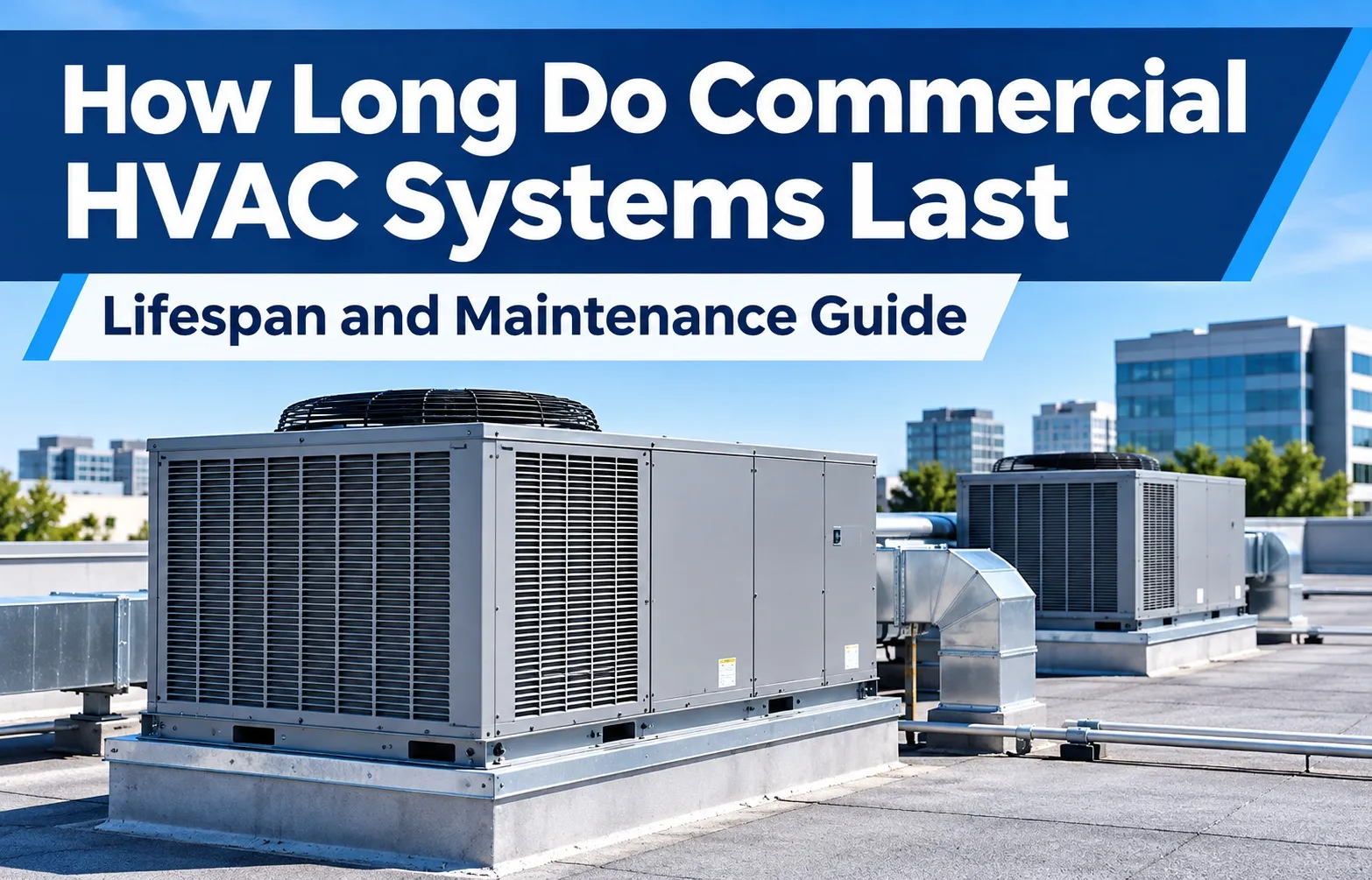 Commercial HVAC systems typically last between 15 and 20 years on average. Depending on the specific equipment architecture, operational duty cycle, local environmental factors, and preventive maintenance rigor, the functional lifespan of commercial heating and cooling equipment ranges from 10 to over 35 years.
Facility managers and commercial property owners can estimate equipment longevity by evaluating the base engineering design of each system type:
- Light Commercial & Packaged Rooftop Units (RTUs): 10 to 20 years under standard operating conditions.
- Heavy Commercial Chillers: 20 to 30 years with scheduled mechanical overhauls and water treatment.
- Commercial Boilers: 20 to 35+ years, with cast iron models consistently reaching the upper limit.
- Commercial Split Systems & VRF/VRV Units: 10 to 15 years due to higher continuous mechanical stress.
Average Lifespan of Commercial HVAC Equipment
The standard benchmark for commercial HVAC lifespan across North American commercial properties is 15 to 20 years. However, total operating hours dictate real-world equipment failure far more accurately than chronological age alone.
A system operating on a standard 40-hour weekly office schedule undergoes significantly less mechanical fatigue than an identical system running 24/7 in a data center or manufacturing plant. Routine maintenance impact also creates up to a 10-year swing in operational life, as unmaintained commercial units experience accelerated compressor degradation and heat exchanger burnout well before reaching their baseline median service life.
Understanding these equipment lifespan ranges provides building managers with the necessary baseline data to plan capital replacement schedules, avoid catastrophic system downtime, and optimize annual maintenance expenditure.
ASHRAE Benchmark Equipment Life Expectancy Chart
Official service life baselines from engineering authorities establish the foundation for commercial building operations, capital budget planning, and system longevity estimates. Rather than relying on speculative estimates, facility engineers utilize standardized technical datasets to determine when mechanical components transition from manageable operational expenses to high-risk capital liabilities.
Official ASHRAE Service Life Baselines
The American Society of Heating, Refrigerating and Air-Conditioning Engineers (ASHRAE) publishes definitive equipment life expectancy data based on nationwide operational studies. According to technical baselines published in the ABM Commercial Equipment Standards, commercial HVAC assets exhibit wide variations in useful service life depending on design complexity and mechanical load.
- Centrifugal & Water-Cooled Chillers: 23 to 25+ years (median baseline).
- Air-Cooled Reciprocating / Screw Chillers: 15 to 20 years.
- Commercial Water-Tube & Fire-Tube Boilers: 24 to 30 years.
- Single-Zone & Multi-Zone Rooftop Packaged Units: 15 years.
- Variable Air Volume (VAV) Terminal Boxes: 20 years.
Rooftop Package Units (RTUs) vs. Split Systems (10 to 20 Years)
Packaged rooftop units (RTUs) remain the standard heating and cooling solution for low-rise commercial structures, retail spaces, and commercial warehouses. Built with integrated compressors, condenser coils, and blower fans in a single weatherized cabinet, standard RTUs deliver a service life of 15 to 20 years under normal operation.
Commercial split systems separate the indoor air handler from the outdoor condensing unit. While offering installation flexibility, split systems frequently experience higher thermal strain and refrigerant piping vibration, yielding an average operational lifespan of 10 to 15 years.
Commercial Boilers: Steel, Cast Iron & Condensing (20 to 35+ Years)
Commercial boilers deliver the longest service life of any central thermal plant equipment. Cast iron boilers lead the category, routinely operating for 30 to 35+ years due to heavy sectional casting and high resistance to thermal shock.
- Cast Iron Boilers: 30 to 35+ years; exceptionally durable against localized chemical corrosion.
- Steel Fire-Tube & Water-Tube Boilers: 20 to 25 years; requires strict water chemistry treatment to prevent tube scaling.
- High-Efficiency Condensing Boilers: 15 to 20 years; exposed to aggressive acidic condensate that accelerates internal heat exchanger wear.
Chillers: Air-Cooled vs. Water-Cooled Systems (20 to 30 Years)
Large commercial central plants rely on chillers to manage massive cooling loads. Water-cooled chillers connected to external cooling towers operate indoors within protected mechanical rooms, protecting key components from environmental degradation and extending equipment life to 20–30 years.
Air-cooled chillers utilize outdoor condenser fans to reject heat directly to the atmosphere. Because air-cooled condenser coils endure ambient weather fluctuations, high outdoor temperatures, and airborne debris, their expected operating life averages 15 to 20 years.
VRF/VRV & Terminal Units (10 to 15 Years)
Variable Refrigerant Flow (VRF) and Variable Refrigerant Volume (VRV) systems utilize inverter-driven compressors to deliver precise zone control across multi-tenant commercial real estate. Despite their energy efficiency, complex electronics, multiple expansion valves, and extensive joint networks limit their average lifespan to 10–15 years.
Zone distribution terminal units—such as Variable Air Volume (VAV) boxes and fan coil units (FCUs)—typically last 15 to 20 years. Their longevity primarily depends on motor bearing lubrication, actuator calibration, and ductwork static pressure management.
Key Factors That Accelerate or Extend Commercial HVAC Lifespan
Commercial HVAC longevity depends less on chronological age and more on operational variables, environmental exposure, and ongoing maintenance rigor. Facility managers who control these variables can protect capital investments and extend equipment operating life by a decade, while neglected systems experience premature failure.
1. Duty Cycle & Operational Hours (24/7 vs. Standard Office Run-Time)
Running a commercial HVAC system 24/7 in data centers, server rooms, or 24-hour manufacturing facilities can reduce total equipment lifespan by up to 40% compared to standard 40-hour office schedules. Continuous runtime accelerates thermal and mechanical stress on compressor motors, fan bearings, and electrical contractors.
- Standard Office Schedules: Systems cycle off overnight and on weekends, allowing components to cool and reducing total annual run-hours.
- Continuous 24/7 Operations: High-demand environments require robust commercial-grade equipment selection, redundant staging, and accelerated component replacement intervals.
2. Unit Sizing, Load Calculations & Short-Cycling
Improperly sized commercial equipment causes constant compressor short-cycling, accelerating mechanical fatigue and destroying internal valves and motor windings prematurely. Accurate block load calculations are vital during the initial engineering phase to ensure the system matches actual building thermal loads.
- Oversized Units: Cool or heat spaces too quickly without properly dehumidifying the air, forcing the system to turn on and off continuously.
- Undersized Units: Run non-stop during peak weather extremes, driving up energy bills and burning out compressor components under continuous strain.
3. Preventive Maintenance Rigor (Quarterly vs. Reactive Repair)
Implementing a strict preventive maintenance schedule—including scheduled filter replacements, electrical contactor checks, and regular condenser coil cleaning—prevents minor wear from cascading into catastrophic failure. Reactive repair models, where units are only serviced when they break down, drastically reduce overall equipment lifespan.
Routine inspections catch minor refrigerant leaks, loose wiring, and failing fan belts before they strain the entire system. Documenting historical maintenance logs also aids in tracking system efficiency over time.
4. Environmental Stressors: Coastal Salt Air, Industrial Dust & Climate Extremes
Harsh operating environments introduce aggressive environmental stressors like coastal salt air, heavy industrial dust, and extreme ambient temperature spikes that accelerate metal corrosion and coil degradation. Rooftop units (RTUs) located in extreme climates face severe thermal expansion and contraction cycles.
- Coastal Corrosive Environments: Salt spray attacks aluminum fins and copper coils, requiring specialized epoxy coatings to prevent early refrigerant leaks.
- Industrial & Urban Particulates: Airborne dust, soot, and grease clog condenser coils quickly, restricting airflow and forcing compressors to operate at dangerously high head pressures.
5. Initial Installation Precision & Ductwork Integrity
Flawed initial installation practices, incorrect refrigerant charge, and poor static pressure management in duct networks force equipment to work harder to maintain airflow. Ensuring proper duct sealing and balancing directly reduces mechanical strain.
- Refrigerant Charge Accuracy: Overcharged or undercharged systems lose efficiency and experience severe compressor wear.
- Ductwork Static Pressure: Undersized or obstructed ductwork creates high static pressure resistance, burning out blower motors and reducing overall thermal transfer efficiency.
Financial & Tax Decision Frameworks for Property Managers
Deciding whether to repair an aging commercial HVAC system or commit to full capital replacement requires structured financial modeling. Facility managers, building owners, and CFOs must balance ongoing operational expenses (OpEx) against long-term capital investments (CapEx), tax incentives, and regulatory compliance.
The $5,000 Rule in Commercial HVAC Repair vs. Replacement
The $5,000 rule provides property managers with a quick mathematical baseline to evaluate repair feasibility against replacement necessity. Multiply the age of the commercial equipment (in years) by the total estimated repair cost (in dollars); if the resulting product exceeds $5,000, replacement is the financially prudent choice.
- Formula: (System Age in Years) × (Repair Cost in $) = Evaluation Threshold
- Calculation Example: A 14-year-old packaged rooftop unit requires a $450 repair ($14 × 450 = $6,300). Because $6,300 exceeds the $5,000 threshold, allocating funds toward a system replacement offers better long-term ROI.
- Minor Repair Example: A 10-year-old system needs a $300 belt and contractor replacement ($10 × 300 = $3,000). Since $3,000 is under the threshold, executing the repair makes fiscal sense.
The 50% Rule & Life-Cycle Cost Analysis (LCCA)
The 50% rule states that when a single repair estimate approaches or exceeds 50% of the cost of a new commercial HVAC system, replacement should be executed immediately. Continuing to fund major repairs on aging assets creates cumulative capital drain without restoring original operating efficiency.
For large-scale central plants, executives utilize a comprehensive Life-Cycle Cost Analysis (LCCA) to evaluate long-term financial impact. An LCCA accounts for the following variables over a 15- to 20-year horizon:
- Initial Capital Outlay: Purchase price, engineering design, structural modification, and crane installation fees.
- Annual Operational Costs: Estimated kilowatt-hour (kWh) electricity consumption and natural gas usage based on seasonal load profiles.
- Maintenance Expenses: Routine service contracts, oil analysis, filter replacements, and anticipated emergency repairs.
- Energy Efficiency Upgrades: Modern high-efficiency systems lower annual energy costs by 20% to 40%, offsetting initial capital costs over time.
IRS MACRS Depreciation & Cost Segregation (15-Year vs. 39-Year Asset Life)
Under standard Internal Revenue Service (IRS) guidelines, commercial HVAC equipment installed as part of a building’s central heating and cooling infrastructure is categorized as non-residential real property, subject to a standard 39-year Modified Accelerated Cost Recovery System (MACRS) depreciation schedule.
However, commercial property owners can leverage strategic tax frameworks to accelerate tax write-offs and optimize cash flow:
- Cost Segregation Study: An engineering-based cost segregation study reclassifies specific HVAC components (such as dedicated computer room air conditioners (CRAC), localized exhaust systems, or temporary split systems) into 5-year, 7-year, or 15-year asset classes rather than the default 39-year building structure life.
- Section 179 Expense Deductions: Qualified commercial HVAC equipment purchases may qualify for immediate tax deduction under tax code rules, allowing businesses to write off the full purchase price during the tax year of installation.
Refrigerant Regulations: R-22 Phaseout & Low-GWP Transitions (R-454B / A2L)
Environmental regulations dictate commercial HVAC replacement timelines regardless of mechanical condition. Legacy R-22 refrigerant has been fully phased out of production and importation, resulting in soaring recharge costs for older systems when refrigerant leaks occur.
Current industry transitions focus on replacing mid-generation refrigerants like R-410A with Next-Generation Low Global Warming Potential (Low-GWP) A2L refrigerants, such as R-454B and R-32.
- R-22 Systems: Operating an R-22 unit past its expected service life presents severe financial risk. A minor refrigerant leak can cost thousands of dollars in reclaimed gas alone, making replacement mandatory.
- R-410A Phase-Down: Global environmental accords continue to reduce R-410A production allocations, driving up servicing costs for equipment manufactured prior to recent regulatory shifts.
- Low-GWP A2L Transition (R-454B): Modern commercial units utilize mildly flammable A2L refrigerants like R-454B, which require updated leak detection systems and compatible servicing tools, making retrofits on legacy equipment impractical.
5 Critical Signs Your Commercial HVAC Needs Immediate Replacement
Identifying equipment failure before catastrophic breakdown prevents unscheduled downtime, tenant dissatisfaction, and emergency rental equipment costs. Facility managers must monitor operational benchmarks to determine when commercial heating and cooling assets reach end-of-life status.
1. Unexplained Spikes in Commercial Energy Bills
A sudden or progressive increase in monthly utility expenses without a corresponding change in weather patterns indicates severe mechanical degradation. As internal components wear, motors draw higher amperage and compressors run longer cycles to deliver identical cooling output.
- Efficiency Loss: Declining seasonal energy efficiency ratio (SEER) performance causes systems to consume up to 30% more power than baseline installation metrics.
- Frictional & Mechanical Strain: Worn bearings, scaled heat exchanger tubes, and degraded compressor valves force electrical components to operate at continuous high load.
2. Frequent Compressor Failures & Major Component Replacement
Repeated failure of critical central plant components—such as hermetic compressors, reversing valves, or variable frequency drives (VFDs)—signals systemic fatigue across the entire system. Replacing a major component on an aging unit often pushes stress to adjacent legacy parts, leading to cascading failures.
- The Repair Spiral: Spending thousands on consecutive compressor motor rewinds or coil replacements provides diminishing returns on assets past their 15-year baseline.
- Burnout Contamination: Electrical compressor burnouts release acid into the refrigerant lines, permanently contaminating systemic pipework and compromising new components.
3. Persistent Temperature Imbalances & Humidity Control Loss
Inability to maintain setpoint temperatures across commercial zones indicates lost system capacity. Worn components fail to maintain air distribution balance, causing noticeable thermal variance and degraded indoor air quality (IAQ) throughout the building.
- Loss of Dehumidification: Systems running short cycles or operating with damaged coils fail to pull latent moisture from the air, causing high indoor humidity levels and mold risk.
- Zone Discrepancies: Multi-zone units fail to modulate airflow through variable air volume (VAV) branches, resulting in hot and cold spots across tenant suites.
4. Excessive R-22 or R-410A Refrigerant Leaks
Persistent refrigerant leaks point to widespread coil oxidation, micro-fracturing in solder joints, or severe line set corrosion. Because phased-out refrigerants incur high supply costs, ongoing refrigerant leak repair quickly exceeds logical operating budgets.
- Corroded Evaporator & Condenser Coils: Age-related formicary corrosion creates pinhole leaks across aluminum and copper fins, rendering patch repairs ineffective.
- Regulatory Restrictions: Environmental mandates capping phased-down refrigerant production turn minor top-offs into significant financial liabilities.
5. Failure of the 20-Degree Delta-T Thermal Drop Test
The thermal drop test measures the temperature difference between return air entering the system and supply air exiting into the ductwork. According to the 20-degree Delta-T rule, a properly operating cooling system should produce a temperature drop of 16 to 22 degrees Fahrenheit across the evaporator coil.
- Low Delta-T (< 16°F Drop): Indicates insufficient heat absorption caused by low refrigerant charge, compressor valve leakage, or heavily fouled evaporator coils.
- High Delta-T (> 22°F Drop): Indicates severely restricted airflow through the air handler, often caused by collapsed ductwork, failing blower motors, or a cracked heat exchanger obstructing airflow pathways.
Actionable Commercial Preventive Maintenance Checklist
Implementing a structured maintenance schedule is the single most effective operational strategy to extend commercial HVAC lifespan toward the 25-year upper limit. Facility management teams that execute consistent preventive inspections reduce premature component failure, maintain baseline energy efficiency, and protect capital assets from unexpected operational downtime.
Monthly & Quarterly Task Checklist
Quarterly maintenance focuses on high-wear components, airflow integrity, and electrical safety checks. Executing these recurring tasks prevents thermal strain and reduces mechanical friction on primary system drives.
- Air Filter Replacement & Inspection: Inspect and replace pleated air filters according to the building’s required air filter MERV rating (typically MERV 13 or higher for commercial office environments) to prevent high static pressure and restricted airflow.
- Blower Motor & Belt Tensioning: Inspect drive belts for cracking, fraying, or slippage. Perform precision belt tensioning and alignment to eliminate energy loss and prevent premature motor bearing failure.
- Electrical Contactor Inspection: Check electrical contactors, relays, and terminal connections for pitting, carbon buildup, or loose wiring. Tighten connections to prevent voltage drops and electrical motor burnouts.
- Condensate Pan & Drain Line Treatment: Clear condensate drain pans, flush drain lines, and install algaecide treatment tablets to prevent standing water accumulation, microbial growth, and overflow damage.
- Preliminary Coil Cleaning: Perform visual inspections of outdoor air intakes and clear debris from condenser faces to maintain unrestricted air intake across cooling stages.
Annual Deep Inspections & Overhaul Protocols
Annual service protocols require comprehensive chemical cleaning, mechanical alignment, and thermodynamic testing. These deep maintenance procedures restore thermal transfer efficiency and preserve system integrity across extreme seasonal demands.
- Comprehensive Condenser Coil Wash: Execute a deep chemical condenser coil wash using low-pressure alkaline cleaners to strip away embedded industrial dust, grease, and oxidation without folding aluminum fins.
- Hydronic Water Treatment Schedule: For water-cooled chillers and hydronic loops, test water chemistry, analyze glycol concentration, and enforce a strict water treatment schedule to prevent scale accumulation, pitting, and tube corrosion.
- Commercial Burner Calibration: For gas-fired boilers and furnace modules, clean gas burners, inspect ignition assemblies, test safety shutoff valves, and perform flue gas analyzer testing to verify optimal combustion efficiency.
- Compressor Oil & Vibration Analysis: Draw compressor oil samples for spectrographic acidity and moisture testing. Conduct vibration analysis on large centrifugal fans and chiller pumps to detect early bearing degradation.
- Ductwork Static Pressure & Damper Calibration: Verify operation of motorized outdoor air dampers, calibrate variable air volume (VAV) actuators, and measure total external static pressure against original design specifications.
Frequently Asked Questions About Commercial HVAC Lifespan
Clear, direct answers to common questions about commercial HVAC system longevity, repair rules, and operational strategies can help guide property managers and business owners through key facility decisions.
What is the $5,000 rule in HVAC?
The $5,000 rule is a financial formula used to determine whether to repair or replace an aging HVAC system. Multiply the age of the unit in years by the estimated repair cost in dollars; if the total exceeds $5,000, replacement is generally the more cost-effective choice. If the total is less than $5,000, proceeding with the repair is typically recommended.
What is the 20 rule for HVAC systems?
The 20 rule for HVAC systems commonly refers to two key guidelines: the 20-year maximum service lifespan expectation for standard commercial units and the 20-degree Delta-T rule. The Delta-T rule dictates that a properly functioning cooling system should create a 16°F to 22°F temperature drop between the return air entering the system and the supply air exiting the evaporator coil.
How long do commercial HVAC systems last in extreme climates like California or Texas?
In regions with high thermal demands, intense summer heat, or coastal environments—such as parts of California or Texas—commercial HVAC systems typically last 10 to 15 years. Continuous heavy duty cycles and exposure to salt air or high ambient temperatures accelerate coil corrosion and compressor fatigue, reducing system longevity by 20% to 30% compared to milder climates.
Can a commercial HVAC system last 30 years?
Yes, heavy commercial heating and cooling equipment can reach or exceed 30 years of operational service. Cast iron commercial boilers and heavy-duty water-cooled centrifugal chillers routinely achieve a 30- to 35-year lifespan when operating in protected indoor mechanical rooms and backed by strict water treatment schedules and regular maintenance overhauls.
What time of year is cheapest to replace commercial HVAC units?
The off-season months of autumn (October to November) and spring (March to April) are typically the cheapest times to replace commercial HVAC units. Demand for emergency commercial repairs drops during these shoulder seasons, allowing mechanical contractors to offer competitive labor pricing, off-season equipment discounts, and flexible installation scheduling.

Oscar Vance | Master Plumber & Drainage Expert
Meet Oscar Vance, a licensed master plumber sharing practical solutions on residential repairs, preventive maintenance, and thoughtful home upkeep.