Executive S & Cost Breakdown At-A-Glance
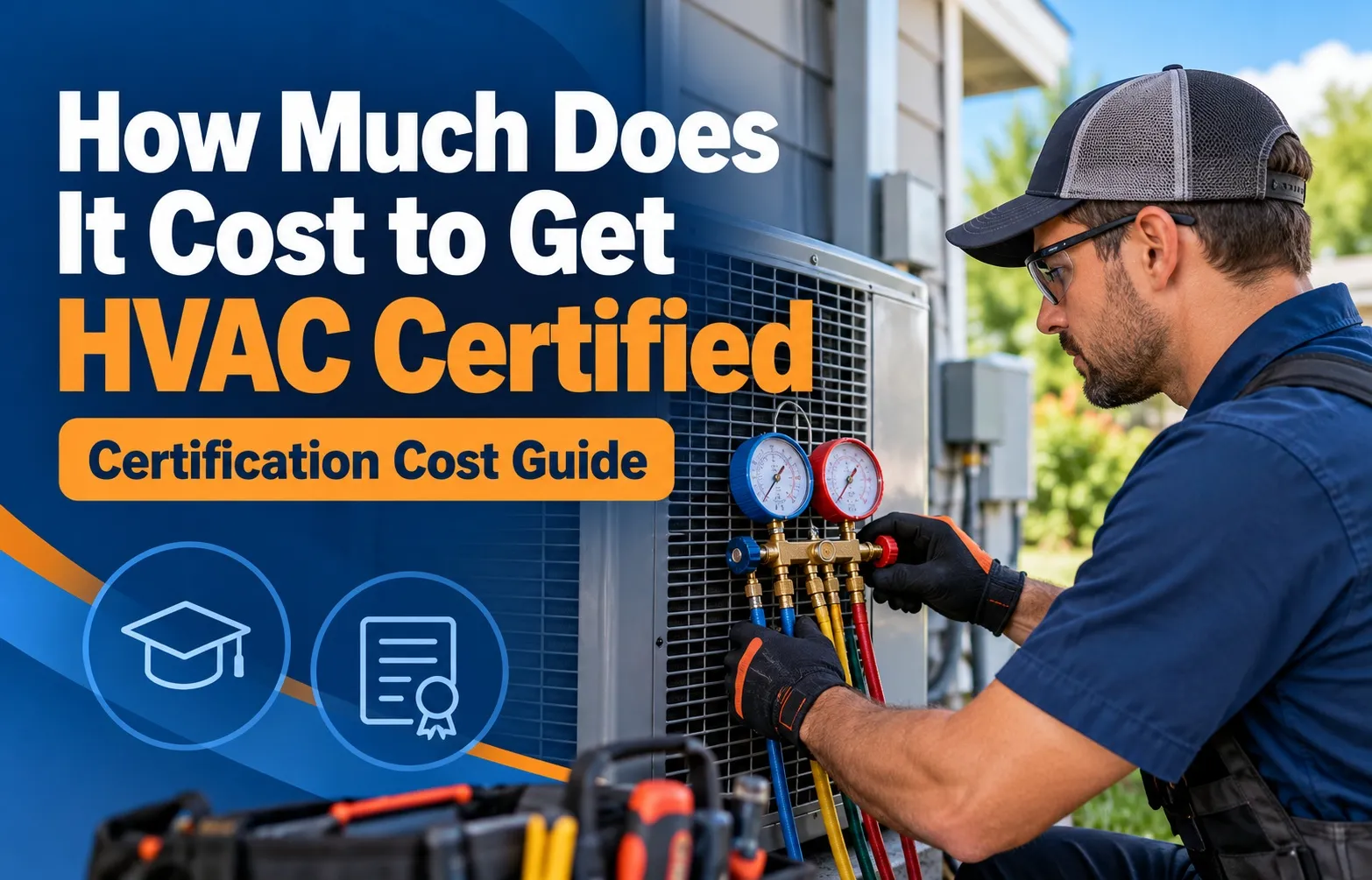 The total cost to get HVAC certified ranges from $25 to $35,000 depending on whether you take a standalone exam or complete a multi-year academic program. Technicians with existing field experience can secure mandatory credentials for under $150 through direct testing. Beginners opting for comprehensive classroom education will incur higher tuition fees alongside equipment investments.
Understanding the distinction between testing fees and tuition structures allows aspiring technicians to select the most cost-effective path for their career goals.
Certification Exam vs. Formal Trade
A widespread source of confusion for entry-level applicants is confusing a legal certification exam with a full trade school diploma. The Environmental Protection Agency (EPA) mandates testing for anyone handling controlled refrigerants, but it does not require a college degree.
- Standalone Certification Exams: Focus exclusively on verifying legal knowledge and safety protocols. You can study independently and pay a direct proctoring fee to take the EPA Section 608 exam without enrolling in trade school.
- Formal Trade School Programs: Combine hands-on shop training, theory, safety practices, and career preparation. Most post-secondary institutions bundle the Universal EPA certification exam cost directly into their base tuition packages.
Mandatory & Voluntary Certification Exam Costs
Technicians with existing field experience or those pursuing self-study can bypass expensive institutional tuition by paying strictly for direct testing fees. Securing legal compliance requires understanding the exact breakdown of mandatory federal credentials versus optional career-advancing badges.
Reviewing these testing structures helps experienced professionals budget accurately for required credentials without unnecessary spending.
EPA Section 608 Certification ($25 – $150): The Mandatory Legal Requirement
Federal law under Section 608 of the Clean Air Act requires any technician maintaining, servicing, repairing, or disposing of equipment containing regulated refrigerants to hold a valid certification. Operating without this credential carries heavy legal penalties for both technicians and employers.
- Direct Testing Fees: Ranging from $25 to $150 depending on the testing provider and whether you take a single section or the complete proctored exam.
- Lifetime Validity: EPA Section 608 certification never expires, making it a one-time out-of-pocket investment.
- Online Accessibility: Approved digital platforms and apps allow self-studiers to complete proctored exams remotely for minimal testing fees.
Breakdown of EPA Tests: Type I, Type II, Type III, and Universal
The EPA exam is divided into distinct categories based on equipment size and refrigerant pressure limits. Technicians can test for individual sections or combine them into a single comprehensive credential.
- Type I Certification: Covers small appliances containing five pounds or less of refrigerant, such as household refrigerators and window air conditioners.
- Type II Certification: Focuses on high-pressure appliances, including residential split systems, heat pumps, and commercial refrigeration units.
- Type III Certification: Targets low-pressure appliances like large industrial chillers.
- Universal Certification: Awarded to candidates who pass all three sections, granting complete clearance to handle any regulated refrigerant system.
Voluntary Industry Badges: NATE and HVAC Excellence ($200 – $500 total)
While the EPA credential satisfies legal compliance, voluntary industry certifications establish advanced technical competency and unlock higher hourly pay scales. Employers heavily favor technicians holding nationally recognized professional badges.
- NATE Certification: North American Technician Excellence testing requires passing a core theoretical exam ($50 – $100) combined with one or more specialty service or installation exams ($100 – $150 each).
- HVAC Excellence: Offers professional-level technician credentials covering specialized commercial and residential mechanical systems.
- Renewal Intervals: Unlike EPA certifications, voluntary badges typically require continuing education units (CEUs) or re-testing every two to five years.
State and Local Licensing Application Fees ($100 – $300)
Beyond federal and national credentials, many state contractor boards and local municipalities require operational permits or state licenses to perform residential and commercial service work legally.
- Initial Application Fees: Range between $100 and $300 depending on state board requirements and licensing classification (journeyman versus contractor).
- Renewal Expenses: Annual or biennial license renewals average $50 to $150 to maintain active operational status.
- Bonding and Insurance: Independent contractors must also factor in surety bond and liability insurance costs, which vary significantly by jurisdiction.
Formal Education & Training Program Costs
For complete beginners entering the trade without mechanical field experience, coupling certification testing with structured education is standard practice. Institutional pathways vary widely in cost, duration, and curriculum depth, ranging from low-cost earn-while-you-learn arrangements to intensive private technical programs.
Evaluating the financial commitment and time commitment of each route ensures new applicants select a program aligned with their personal budget and career timeline.
Union & Non-Union Apprenticeships ($500 – $2,000 over 3–5 years)
An HVAC apprenticeship offers the lowest direct out-of-pocket cost because trainees earn an hourly wage while completing required classroom instruction and supervised field hours. Sponsored programs are administered through joint apprenticeship committees, trade associations, or individual contracting companies.
- Out-of-Pocket Expenses: Direct fees are minimal ($500 to $2,000 total), usually covering personal safety gear, administrative processing, basic hand tools, and course workbooks.
- Earn-While-You-Learn Structure: Trainees typically start at 50% of a journey-level technician’s pay scale, receiving regular wage increases as hands-on shop hours and classroom milestones are met.
- Program Timeline: Requires a multi-year commitment (3 to 5 years), combining approximately 2,000 field hours per year with 144 hours of annual technical classroom instruction.
Vocational and Trade School Certificates ($1,200 – $15,000 over 6–12 months)
A vocational training program at a private technical institute or dedicated trade school focuses exclusively on job-ready skills, eliminating general education coursework to accelerate employment.
- Tuition Variations: Public vocational training programs begin around $1,200, whereas specialized private trade school certificate programs reach $15,000 depending on location and lab equipment access.
- Speed to Workforce: Certificate paths take 6 to 12 months to complete, making them ideal for candidates seeking fast entry into residential or commercial service roles.
- Curriculum Focus: Direct practical instruction in electrical troubleshooting, refrigeration cycles, brazing, airflow diagnostics, and EPA exam preparation.
Public Community College Associate Degrees ($3,500 – $4,800/year or $15,000–$35,000 total)
Earning an Associate of Applied Science (AAS) in HVAC/R through a public community college provides broad technical depth alongside general academic credentials, establishing a strong foundation for future management or engineering roles.
- In-State Community College Tuition: Public two-year institutions average $3,500 to $4,800 annually for in-state residents, bringing baseline tuition for a 2-year degree to roughly $7,000–$10,000.
- Private & Out-of-State Degree Tuition: Out-of-state tuition or private technical college degree tracks scale significantly higher, ranging from $15,000 to $35,000 for full 18-to-24-month programs.
- Career Advancement Value: Higher upfront costs are balanced by long-term flexibility, as an associate degree satisfies prerequisite requirements for commercial facilities management, controls programming, and mechanical contracting positions.
Hidden & Out-of-Pocket Career Expenses
Base tuition and examination fees rarely reflect the full financial commitment required to begin an HVAC career. Students and entry-level apprentices face significant out-of-pocket costs for essential physical gear, diagnostic instruments, reference publications, and mandatory safety equipment prior to entering a job site or shop laboratory.
Accounting for these initial gear requirements prevents unexpected budget shortfalls during training.
Essential Toolkits, Gauges, and Digital Multimeters ($500 – $3,000)
Technicians are expected to own a core set of personal diagnostic tools and hand equipment, even when working for established contractors or enrolling in trade school lab courses.
- Manifold Gauge Sets ($100 – $800): Standard mechanical 2-valve brass manifold sets begin around $100, whereas modern digital manifold gauges equipped with Bluetooth temperature clamps and micron sensors range from $300 to $800.
- Digital Multimeters ($150 – $400): Accurate True-RMS multimeters with clamp-on current measurement capabilities are mandatory for electrical troubleshooting and system diagnostics.
- Hand Tools & Safety Gear ($250 – $800): Includes insulated screwdrivers, sheet metal snips, tubing cutters, flare tools, service wrenches, safety glasses, cut-resistant gloves, and steel-toe work boots.
- Advanced Service Equipment ($500 – $1,000): Electronic refrigerant leak detectors, digital vacuum gauges, and recovery machine hoses required for field service roles.
Mandatory Study Manuals, Textbooks, and Digital Subscriptions ($500 – $1,000)
Academic programs rely heavily on specialized technical literature that is rarely covered by baseline tuition rates.
- Comprehensive Trade Textbooks: Core foundational manuals—such as Refrigeration and Air Conditioning Technology—cost between $150 and $300 per volume when purchased new.
- EPA Certification Test Prep Access: Online practice test platforms, study guides, and mobile app testing modules add $50 to $150 in digital subscription fees.
- Lab Workbooks and Safety Guides: Supplementary shop manuals and OSHA safety compliance workbooks add another $100 to $200 per semester.
Open-Book Code Books (IMC / IFGC) ($150 – $300)
State licensing boards and municipal contractor exams frequently permit applicants to bring official reference manuals into open-book examination settings.
- International Mechanical Code (IMC): Official softcover or loose-leaf code books published by the International Code Council (ICC) cost between $90 and $150.
- International Fuel Gas Code (IFGC): Dedicated fuel gas regulation reference books range from $80 to $130.
- Pre-Printed Index Tabs & Highlighting Supplies: Fast-indexing adhesive tabs designed specifically for rapid reference during timed state licensing exams cost an additional $15 to $30.
How to Get HVAC Certified for $0 or Minimum Cost
High tuition fees led many trade students to search for alternatives to expensive private technical institutes. Fortunately, multiple fully funded pathways allow aspiring technicians to earn legal credentials, gain practical experience, and receive proper equipment training with zero net out-of-pocket costs.
Exploring structured funding resources ensures candidates minimize personal financial strain while meeting mandatory industry standards under official EPA Section 608 compliance guidelines.
Earn-While-You-Learn: Joining Union Apprenticeships (UA / IBEW)
Union-sponsored training remains the gold standard for zero-cost HVAC/R education. Organizations like the United Association (UA) of Journeymen and Apprentices of the Plumbing and Pipe Fitting Industry manage comprehensive apprenticeship programs that eliminate tuition entirely.
- Full Sponsorship: Union locals cover 100% of classroom instruction, laboratory supplies, and certification exam costs in exchange for an agreement to work for union contractors upon graduation.
- Progressive Wage Scales: Trainees receive hourly pay starting on day one, receiving structured pay raises every six to twelve months as field hours accumulate.
- Benefit Packages: Trainees gain access to employer-funded health insurance, pension plans, and specialized tool allowances during their apprenticeship term.
Government Financial Aid: Pell Grants and WIOA Training Programs
Federal financial aid programs and state workforce development grants frequently cover the full cost of accredited vocational certificates and community college associate degrees for qualifying applicants.
- WIOA Grants: The Workforce Innovation and Opportunity Act (WIOA) provides federal funding administered by local career centers to cover 100% of tuition, textbooks, safety gear, and testing fees for eligible individuals.
- Federal Pell Grants: Need-based federal grants offer tuition coverage for accredited technical programs without requiring repayment.
- State Trade Grants: Local economic development offices sponsor targeted grants for high-demand skilled trades, covering out-of-pocket career expenses for resident students.
Employer Tuition Reimbursement & Hiring Bonuses
Due to ongoing skilled trade shortages, private residential and commercial HVAC companies aggressively recruit new talent by subsidizing or fully reimbursing training expenses.
- Direct Certification Sponsorship: Many contractors hire motivated trainees as helpers or dispatchers, paying directly for their EPA 608 preparatory courses and examination fees.
- Tuition Reimbursement Agreements: Companies reimburse trade school tuition through monthly paycheck bonuses over a set service period (typically 12 to 24 months).
- Tool & Equipment Allowances: Established employers frequently provide entry-level technicians with company vehicles, diagnostic gauge sets, digital multimeters, and safety gear upon hiring.
ROI and Career Value – Is HVAC Certification Worth It in 2026?
Evaluating the financial return on investment (ROI) of an HVAC certification requires comparing upfront educational expenses against entry-level earning potential and long-term salary growth. With steady demand across residential, commercial, and industrial sectors, certified technicians recover initial training costs rapidly compared to traditional four-year degree holders.
Analyzing earning potential, payback schedules, and career growth trajectories clarifies the true value of earning an HVAC credential.
Average Entry-Level Pay vs. Total Training Investment
Starting pay for entry-level technicians provides immediate financial stability, allowing new workers to recoup their baseline certification expenses quickly.
- Entry-Level Earnings: Apprentices and entry-level technicians earn between $18.00 and $24.50 per hour ($37,000 to $51,000 annually), depending on geographic location and union status.
- Low Debt Burden: Completing an EPA certification exam ($25–$150) or a trade school certificate ($1,200–$15,000) results in minimal or zero student debt compared to average bachelor degree programs.
- Immediate Earning Power: Because field training begins immediately, technicians generate income while building professional experience rather than spending four years uncompensated.
Can HVAC Techs Make $100,000 a Year? (Overtime & Specialization Realities)
Reaching a six-figure income is achievable in the HVAC trade, though it typically requires specialized certifications, advanced field experience, or substantial overtime during peak heating and cooling seasons.
- Commercial vs. Residential Career Growth: Commercial HVAC/R technicians servicing industrial chillers, supermarket refrigeration, and building automation systems earn higher base wages ($70,000 to $95,000+) than standard residential installers.
- Seasonal Overtime & On-Call Pay: Summer cooling rushes and winter heating emergencies offer abundant overtime opportunities paid at 1.5x to 2x base hourly rates, adding $15,000 to $30,000 in annual earnings.
- Specialized Credentials: Techs holding advanced certifications—such as NATE specialty badges, testing and balancing (TAB) credentials, or commercial controls licenses—command top-tier industry compensation.

Oscar Vance | Master Plumber & Drainage Expert
Meet Oscar Vance, a licensed master plumber sharing practical solutions on residential repairs, preventive maintenance, and thoughtful home upkeep.