What Is a Good Delta T in HVAC?
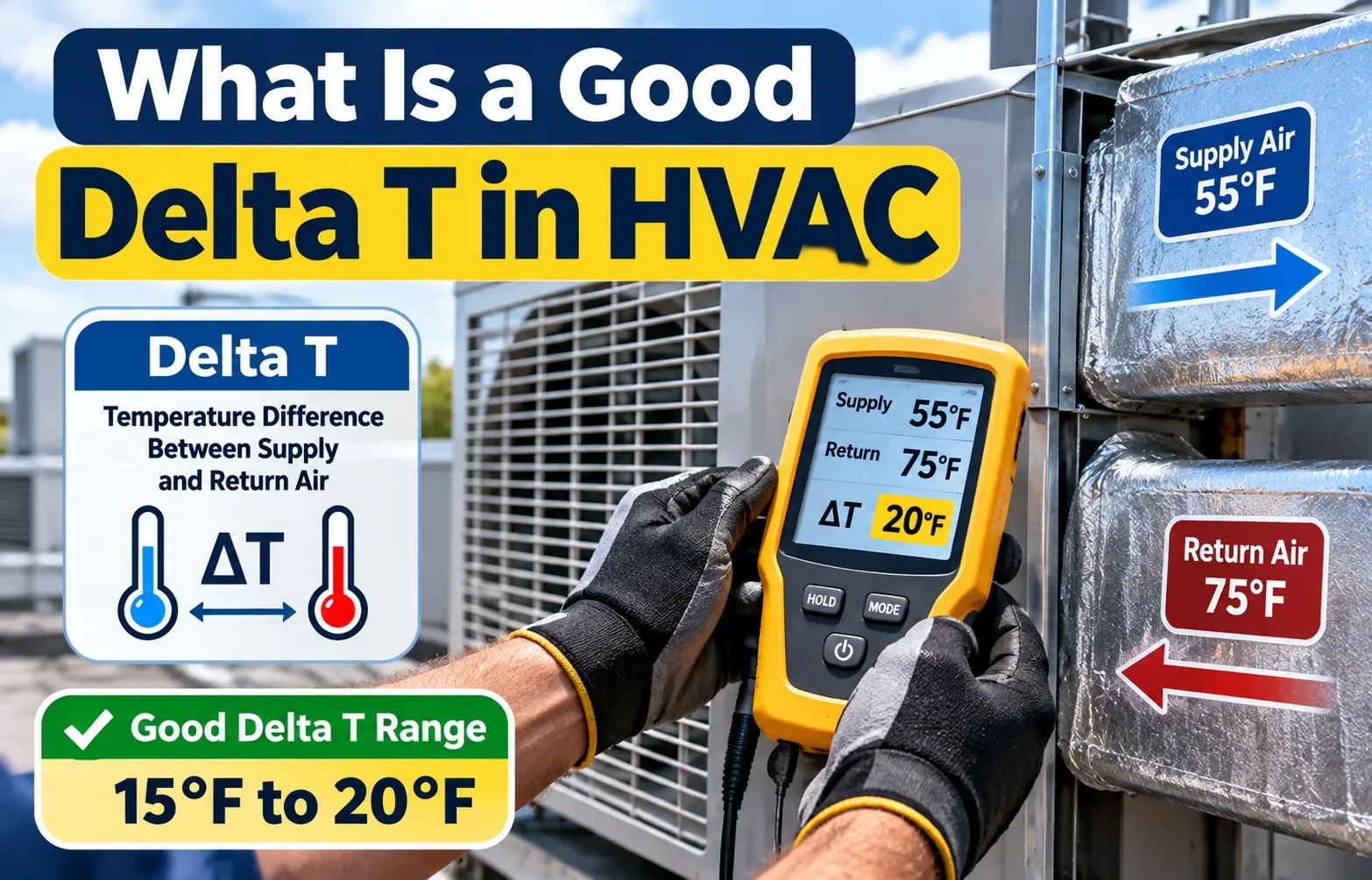 A good Delta T (ΔT) in HVAC is 16°F to 22°F for air conditioning cooling mode and 30°F to 40°F+ for gas furnace heating mode. Delta T measures the exact temperature split between warm indoor air entering the return air duct and conditioned air exiting the supply air duct.
Evaluating this temperature differential gives homeowners and technicians an immediate pass-or-fail benchmark for system performance. When a system operates within its target range, heat transfer across the evaporator coil or heat exchanger is balanced and airflow volume is properly calibrated.
- Air Conditioning (Cooling Mode): A healthy system drops indoor air temperature by 16°F to 22°F, with 20°F serving as the traditional residential baseline under moderate indoor humidity.
- Gas & Electric Furnaces (Heating Mode): Standard furnaces typically raise air temperature by 30°F to 40°F, though exact allowable temperature rise limits are stamped directly on the manufacturer’s furnace data plate.
- Heat Pumps (Heating Mode): Because heat pumps deliver gentler, lower-temperature warmth than combustion furnaces, a normal Delta T during winter operation ranges between 15°F and 25°F without auxiliary heat strips active.
- Check the Furnace Data Plate First: Always verify the exact “Temperature Rise Range” printed inside your furnace cabinet, as high-efficiency condensing furnaces may specify ranges such as 35°F to 65°F.
- Context Matters for Cooling: A reading of 15°F can still represent a healthy normal Delta T for AC on muggy days when the evaporator coil is removing heavy moisture from the indoor air.
How to Measure and Calculate HVAC Delta T Accurately
Accurately calculating Delta T requires taking temperature readings as close to the equipment as possible using a calibrated digital psychrometer or HVAC probe thermometer. Measuring directly at distant wall registers introduces false readings caused by ambient room heat gain and unconditioned duct leakage.
The Step-by-Step Delta T Formula
To determine your system’s temperature split, subtract the supply air temperature from the return air temperature using the standard mathematical equation:
ΔT = |Treturn – Tsupply|
- Worked Example: If your return air plenum measures 75°F and your supply trunk line measures 56°F, your calculation is 75 – 56 = 19°F Delta T.
- Using a Delta T Calculator HVAC Tool: Digital meters and mobile diagnostic apps automate this math, but knowing how to check Delta T HVAC manually ensures you catch sensor calibration errors instantly.
Exact Thermometer Placement (Avoiding Rookie Mistakes)
Measuring temperature splits incorrectly is the primary reason technicians misdiagnose healthy HVAC systems. Placing sensors at distant room vents allows attic, crawlspace, or wall cavity temperatures to severely distort your baseline numbers.
- Return Air Plenum Placement: Insert your probe directly into the main return duct close to the air handler cabinet, before air passes through the air filter.
- Supply Trunk Line Placement: Drill a small test port and insert your probe 3 to 5 feet downstream from the evaporator coil or furnace heat exchanger.
- Avoiding Radiant Heat Interference: Staying 3 to 5 feet away from electric heat strips or gas burner compartments prevents radiant heat from skewing your digital psychrometer readings.
Runtime & Stabilization Rules
Never test Delta T immediately after turning on a heating or cooling system, as internal components require time to normalize. You must allow the equipment to run continuously for at least 15 to 20 minutes before recording final temperatures.
- Steady-State Operation: This 15-to-20-minute window ensures that refrigerant pressures, evaporator coil surface temperatures, and combustion heat exchangers reach true thermal equilibrium.
- Consistent Thermal Performance: Waiting for steady-state operation prevents fluctuating blower speeds or multi-stage equipment shifts from creating artificial temperature spikes in your recorded data.
Low Delta T Causes & Diagnostics (When the Split Is Too Narrow)
A low Delta T HVAC reading occurs when air passes through your indoor unit without absorbing enough heat or cold, resulting in a temperature split below 16°F in cooling mode or below 30°F in heating mode. Diagnosing a narrow temperature split requires isolating heat-transfer faults from airflow and fuel delivery issues.
Cooling Mode Low Delta T (Below 16°F)
When an air conditioner produces a temperature drop below 16°F under normal indoor humidity, the evaporator coil is failing to extract sufficient heat from the passing airstream. Inspect these primary mechanical and environmental causes in order:
- Low Refrigerant Charge or Leaks: A refrigerant undercharge starves the evaporator coil of liquid refrigerant, reducing its surface area capable of boiling off and absorbing sensible heat transfer from your home’s air.
- Dirty Evaporator Coil: Thick layers of dust and biofilm act as thermal insulation across the copper tubing and aluminum fins, blocking heat absorption even when airflow volume appears adequate.
- Excessive Blower Fan Speed (CFM): When blower motor speed (CFM) is set too high, indoor air rushes past the evaporator coil too quickly to shed its heat, lowering the temperature drop across the plenum.
- Undersized Equipment or Return Duct Leakage: Torn or disconnected return ductwork in an unconditioned attic pulls 110°F+ attic air directly into the return plenum, overwhelming the cooling capacity of the unit.
Heating Mode Low Delta T (Below 30°F)
In heating mode, a temperature rise below 30°F indicates that the furnace is generating insufficient thermal energy for the volume of air moving across the heat exchanger. Focus your diagnostic checks on fuel input and electrical staging:
- Low Gas Valve Pressure or Weak Burner Output: Incorrect manifold gas valve pressure, partially clogged burner orifices, or an undersized gas supply line reduces total BTU output, leaving the heat exchanger too cool to warm the passing air properly.
- Failed Electric Heat Strips: In electric furnaces and air handlers, a burned-out heating element or faulty sequencer relay prevents one or more electric heat strips from energizing, cutting total heating capacity in half.
- Excessive Heating Blower Speed: Similar to cooling mode, an improperly configured high-speed blower tap moves air through the furnace cabinet faster than the heat exchanger can transfer warmth.
High Delta T Causes & Diagnostics (When the Split Is Too Wide)
A high Delta T HVAC reading happens when your system’s temperature split exceeds normal thresholds—climbing above 22°F in cooling mode or above 40°F to 50°F in heating mode. Homeowners often mistake an excessively wide temperature split for superior performance, but it actually indicates severe airflow restriction across the system.
Why a High Delta T Is Often a Warning Sign
When airflow restriction starves your equipment, air lingers too long over the evaporator coil or furnace heat exchanger. In cooling mode, this over-chilling drops coil temperatures below freezing. In heating mode, trapping thermal energy inside the cabinet overheats the heat exchanger and triggers internal safety controls.
- Prolonged Heat Transfer Contact: Restricted air moves slowly across internal coils, making the air entering the supply duct abnormally cold in summer or dangerously hot in winter.
- System Stress and Component Failure: Ignoring a high Delta T causes evaporator coil icing, liquid slugging in compressors, and repeated high-limit switch tripping in furnaces.
Cooling Mode High Delta T (Above 22°F)
When an air conditioner shows a temperature drop greater than 22°F, your primary focus should be inspecting total system static pressure and airflow obstructions.
- Severe Airflow Restriction: Highly restrictive MERV-13+ air filters left in service too long, closed or blocked supply registers, obstructed return grilles, or a blower wheel caked in pet hair and dust restrict cubic feet per minute (CFM).
- Evaporator Coil Freeze-Up Risk: Because restricted airflow prevents warm air from passing over the coil, refrigerant absorbs too little heat. The evaporator temperature drops below 32°F, causing moisture to freeze solid and block airflow entirely.
- Compressor Threat: Heavy ice accumulation on the coil eventually sends unevaporated liquid refrigerant back to the outdoor compressor, leading to catastrophic internal damage.
Heating Mode High Delta T (Above 40°F to 50°F)
In heating mode, an oversized temperature rise means the furnace is generating heat faster than the blower fan can safely sweep it away from the metal heat exchanger.
- Heat Exchanger Overheating: Trapped thermal energy causes the metal walls of the furnace heat exchanger to expand past normal operating limits, risking micro-cracks that could leak combustion gases.
- High-Limit Safety Switch Tripping: To prevent a fire hazard, the high-limit safety switch detects the extreme temperature spike and cuts power to the gas valve, shutting down the burners while keeping the blower running.
- Short-Cycling Behavior: This rapid safety shutdown causes your furnace to short-cycle—turning on for a few minutes, overheating instantly, shutting down, and repeating the cycle without adequately heating your home.
Why the 20°F Rule of Thumb Can Mislead You
Relying exclusively on a rigid 20°F target can cause technicians and homeowners to misdiagnose fully functioning systems. While the classic rule of thumb provides a quick ballpark check, real-world psychrometric variables—such as humidity loads, equipment staging, and heat transfer mediums—drastically shift what constitutes a normal Delta T.
The Role of Indoor Relative Humidity (Latent vs. Sensible Heat)
When an air conditioner operates in a humid home with relative humidity pushing 65% or higher, it will naturally display a narrower Delta T of 14°F to 16°F. This narrower split does not signal a failing system or refrigerant leak.
- Latent Heat Removal: The air conditioner is spending a massive portion of its total cooling capacity (BTUs) condensing water vapor out of the air (latent heat removal) rather than dropping dry-bulb air temperature (sensible cooling).
- Moisture Trade-Off: Because removing humidity requires heavy thermal energy, the air leaving the coil is cooler in moisture content but registers a smaller dry-bulb temperature drop across your thermometer.
Wet-Bulb Temperature & Psychrometric Targets
Professional HVAC technicians avoid guesswork by utilizing indoor wet-bulb temperatures and outdoor ambient dry-bulb charts. Evaluating performance through psychrometric testing accounts for exact air enthalpy.
- Target Superheat and Subcooling: Rather than looking at air splits alone, service pros verify refrigerant saturation pressures, superheat, and subcooling against manufacturer specifications.
- Engineering Standards: Certified airflow testing follows strict industry guidelines established by organizations like ASHRAE to ensure accurate psychrometric evaluations.
Variable-Speed Inverter Systems & Mini-Splits
Traditional fixed-speed air conditioners cycle fully on or off, making a steady 20°F split easier to spot during high-stage runtime. Modern variable-speed inverter systems and ductless mini-splits operate entirely differently.
- Dynamic Compressor Modulation: Inverter compressors ramp up and down continuously to match home cooling loads, causing Delta T to fluctuate dynamically throughout the day.
- Longer, Lower-Velocity Runtimes: A variable-speed air handler might run at low capacity with a milder 14°F to 17°F split for hours to maintain exact humidity and temperature control without wasting energy.
Chiller & Hydronic Systems Note
Commercial or large residential setups involving water-cooled loops operate on a completely different thermal medium than forced-air duct systems, capturing distinct search intent.
- Water-Side Temperature Split: In chilled water systems, “Delta T in a chiller” measures the water temperature difference between the entering and leaving lines at the evaporator barrel.
- Narrower Hydronic Ranges: Normal chiller water Delta T typically runs between 10°F and 12°F (e.g., 44°F entering water returning at 54°F), reflecting the high specific heat capacity of water compared to air.
Technician’s Step-by-Step Delta T Troubleshooting Checklist
Troubleshooting an abnormal temperature split systematically prevents unnecessary parts replacement and costly service calls. Follow this structured diagnostic workflow to isolate simple airflow obstructions before investigating complex refrigerant or mechanical failures.
Diagnostic Decision Matrix
Cross-reference your measured temperature split with your home’s indoor humidity and register airflow feel to identify the most probable fault immediately:
Ordered Inspection Workflow
Execute this five-step HVAC troubleshooting checklist in exact chronological order whenever your temperature split falls outside normal operating boundaries:
- Verify Thermostat Mode and Continuous Runtime: Confirm the thermostat is set to active heating or cooling (not fan-only mode) and allow the system to run uninterrupted for at least 15 to 20 minutes to stabilize internal coil and heat exchanger temperatures.
- Inspect Air Filters and Register Positions: Check the return air filter for heavy dust buildup and walk through every room to ensure all supply registers and return air grilles are fully open and unblocked by furniture or rugs.
- Check Indoor Relative Humidity Levels: Use a digital hygrometer to check indoor moisture levels; if humidity exceeds 60%, allow the air conditioner several hours to dehumidify the space before re-evaluating a narrow cooling split.
- Inspect Condenser Coil and Blower Wheel Cleanliness: Power off the system and inspect the outdoor condenser coil for matted grass clippings or cottonwood debris, and check the indoor blower wheel blades for dust buildup that reduces airflow volume.
- Call an EPA-Certified HVAC Technician: If airflow paths are completely clear and the temperature split remains abnormal, schedule an EPA-certified HVAC technician to perform superheat and subcooling refrigerant testing, gas manifold pressure adjustments, and total external static pressure checks.
Frequently Asked Questions About HVAC Delta T
Understanding specific equipment behaviors and regional rating standards prevents confusion when evaluating temperature differentials across different heating and cooling setups. These answers address the most common diagnostic questions encountered during residential system checks.
What is a bad Delta T for an air conditioner?
A bad Delta T AC reading is anything consistently below 14°F to 15°F or above 23°F to 24°F when indoor relative humidity is within a normal 40% to 55% range. Readings outside this window indicate that your system is either failing to remove heat properly or suffering from restricted airflow.
- Below 14°F (Underperforming): Typically signals a low refrigerant charge, a failing compressor, an oversized blower fan speed, or unconditioned attic air leaking into your return ductwork.
- Above 23°F (Over-Restricting): Indicates severe airflow starvation across the evaporator coil, which quickly drops coil surface temperatures below freezing and causes ice buildup.
What is a good Delta T for a heat pump in heating mode?
A healthy heat pump Delta T during winter heating mode typically ranges between 15°F and 25°F when operating solely on the outdoor compressor. Because heat pumps transfer ambient outdoor warmth rather than burning fossil fuels, their supply air feels noticeably milder than a gas furnace.
- Compressor-Only Operation: Expect supply register temperatures around 85°F to 95°F when indoor return air is 70°F.
- Auxiliary Heat Strips Engaged: When outdoor temperatures drop below freezing and electric auxiliary heat strips energize to assist the compressor, the temperature rise temporarily jumps to 30°F to 45°F.
Can a dirty air filter cause a high or low Delta T?
A clogged or dirty air filter almost always causes a high Delta T in both heating and cooling modes. Dust-packed filter media chokes air volume moving through the air handler, forcing air to linger longer over the cold evaporator coil or hot heat exchanger.
- Cooling Impact: Slower air velocity absorbs excessive cold from the coil, widening the temperature split above 22°F and risking coil freeze-up.
- Heating Impact: Restricted airflow traps heat inside the furnace cabinet, driving temperature rise past 45°F and tripping the high-limit safety switch.
What does Delta T30 and T50 mean in heating?
Delta T30 and Delta T50 refer to standardized European hydronic radiator heat-output ratings defined under the EN 442 testing standard, rather than forced-air ductwork splits. These numbers measure the temperature difference between the average water temperature inside a radiator and the surrounding room air.
- EN 442 Radiator Delta T50 (ΔT 50°C): The traditional benchmark used for high-temperature gas and oil boilers, calculated with 75°C flow water, 65°C return water, and a 20°C room temperature (70°C average water minus 20°C room = 50°C).
- Low-Temperature Delta T30 (ΔT 30°C): The modern standard used to size radiators for low-temperature air-to-water heat pumps (such as 55°C flow and 45°C return in a 20°C room), requiring larger radiator surface areas to deliver equivalent room warmth.

Oscar Vance | Master Plumber & Drainage Expert
Meet Oscar Vance, a licensed master plumber sharing practical solutions on residential repairs, preventive maintenance, and thoughtful home upkeep.