Can You Use Roofing Nails for Siding?
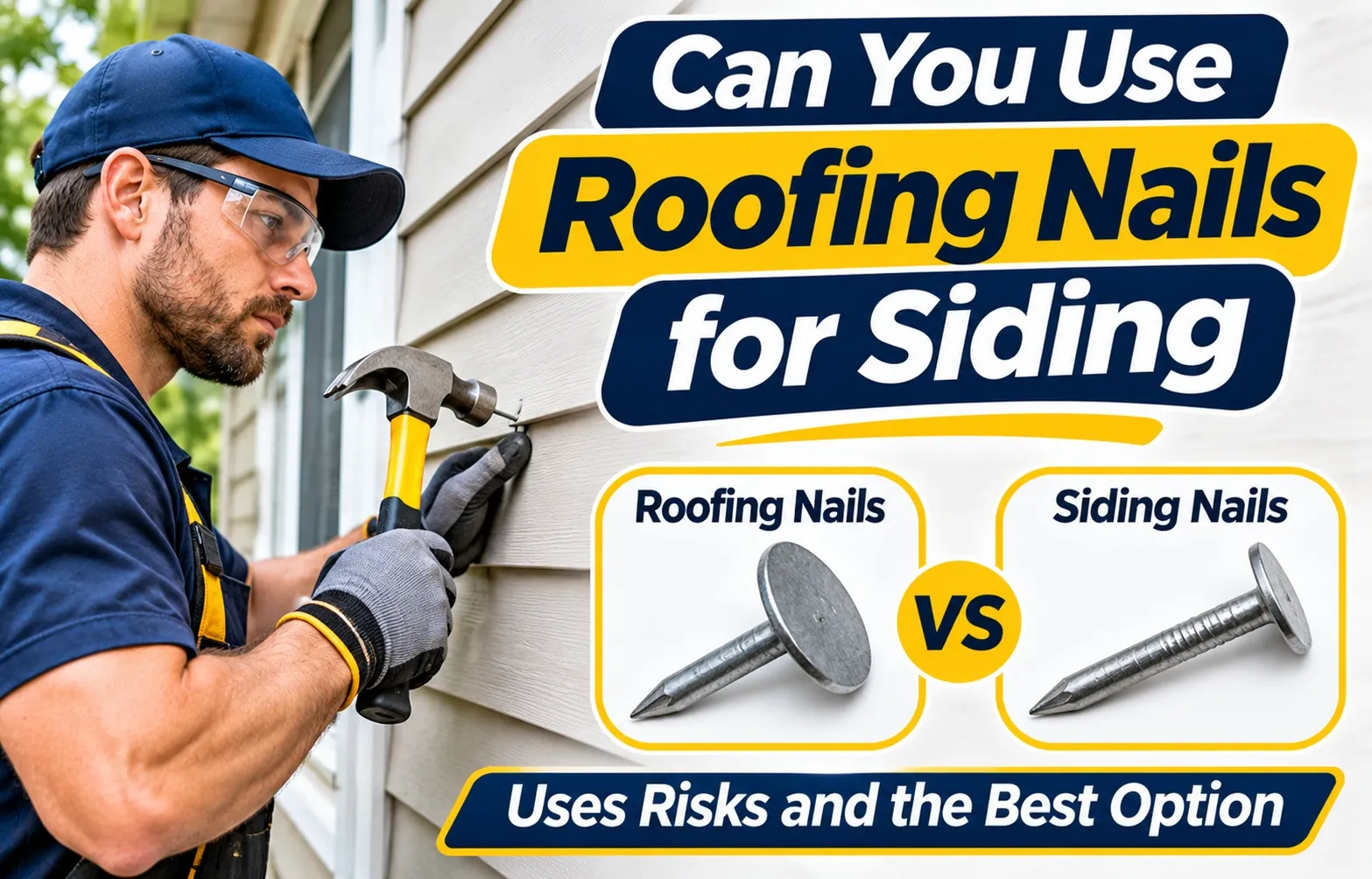 You can use roofing nails for siding only under specific conditions, such as blind-nailing fiber cement planks or hanging vinyl siding through designated nailing slots. However, standard smooth-shank roofing nails are generally not recommended for exterior cladding because their wide heads and smooth shanks lack the long-term holding power required by residential building codes.
Using improper fasteners for siding installations leads to premature wall failures, face-nailing blemishes, and voided manufacturer warranties. Professional cladding installations require high-tensile siding nails engineered to handle environmental expansion, wind uplift forces, and moisture exposure.
When It Works vs. When It Fails
Roofing nails feature an oversized, flat head designed to hold asphalt shingles flat without tearing through soft felt. Siding nails, by contrast, utilize smaller heads and textured or ringed shanks designed to lock permanently into wall framing studs.
- Where roofing nails are conditionally allowed: Blind-nailed fiber cement lap siding (where overlapping planks conceal the wide nail head) and vinyl siding slots (where loose nailing allows thermal movement).
- Where roofing nails strictly fail: Face-nailed fiber cement, T-111 panel siding, vertical engineered wood, and natural cedar cladding where nail heads remain exposed to weather and visual inspection.
- Mechanical limitations: Standard smooth-shank roofing nails offer minimal withdrawal resistance compared to ring-shank siding fasteners, increasing the risk of board loosening over time.
Material-by-Material Breakdown: Where Roofing Nails Pass and Fail
Fastener performance varies significantly across different exterior cladding materials. Evaluating roofing nails by specific siding types reveals distinct structural and aesthetic limitations that dictate when substitution fails.
Fiber Cement Lap Siding (e.g., James Hardie Plank)
James Hardie and other fiber cement manufacturers enforce strict fastener guidelines to guarantee wind resistance and structural longevity. While roofing nails can technically secure certain installations, their physical dimensions introduce critical risks.
- Blind-Nailed Method: Roofing nails are occasionally used when driven through the upper concealed edge of fiber cement lap siding. However, smooth shanks lack the required withdrawal resistance against high wind uplift.
- Face-Nailing Hazards: Driving roofing nails directly through the face of planks causes severe aesthetic dimpling because the wide flat head crushes the cement composite material.
- Ring-Shank Necessity: Industry standards mandate ring-shank siding nails to lock cement boards firmly against wall studs without backing out during seasonal moisture fluctuations.
Vinyl Siding Installation
Vinyl siding requires specialized hanging techniques rather than rigid fastening. Because vinyl expands and contracts dramatically with ambient temperature changes, fastener placement dictates whether the siding buckles or stays flat.
- Wide Head Clearance: Galvanized roofing nails feature wide heads that fit inside vinyl nailing slots without pinching the material edge.
- Thermal Movement and Expansion: Installers must maintain a precise vinyl expansion gap by driving nails loosely in the center of the mounting slots.
- Movement Freedom: Failing to leave adequate thermal movement clearance causes warping, buckling, and cracked siding panels during hot summer weather.
Engineered Wood & Panel Siding (T-111 & Lap Siding)
Panel sidings like T-111 panel siding and engineered wood lap products demand robust fasteners capable of handling heavy shear loads and structural movement. Using roofing nails on these surfaces creates both structural vulnerabilities and visual defects.
- Telegraphing Head Appearance: The oversized, flat heads of roofing nails remain prominently visible on the face of wood panels, ruining the smooth exterior finish.
- Shear Strength Deficits: Roofing nails are engineered for temporary shingle retention or light felt paper holding, not heavy vertical wood wall loads.
- Fastener Pull-Through: Smooth-shank roofing nails pull through engineered wood panels during high wind events, causing entire sections of siding to detach.
Natural Wood Siding & Cedar Shingles
Natural wood cladding requires corrosion-resistant fasteners that respect organic wood fiber movement and aesthetic grain patterns. Roofing nails are poorly suited for high-end wood siding applications.
- Corrosion Staining: Standard roofing nails lack the high-grade hot-dipped galvanized or stainless steel coatings needed to prevent ugly black tannin streaks on cedar and redwood.
- Wood Splitting: The blunt, thick tips and smooth shanks of roofing nails split delicate cedar bevel siding and shakes during driving.
- Head Visibility: Exposed flat heads disrupt the clean, rustic lines expected from premium natural wood architectural finishes.
Roofing Nails vs. Siding Nails Technical Comparison
Fastener selection directly impacts structural wall integrity, weather resistance, and building envelope longevity. Comparing the engineering specifications of roofing nails and siding nails reveals fundamental mechanical differences in head geometry, shank profile, and metallic corrosion defense.
Key Architectural Differences: Head Size, Shank Design, and Coatings
Roofing nails and siding nails are engineered to solve entirely distinct structural challenges. Roofing nails prioritize surface area clamping, whereas siding nails prioritize pull-out resistance and shear load capacity.
- Head Diameter and Profile: Roofing nails feature an enlarged head diameter (typically 3/8-inch) designed to clamp down soft asphalt shingles without tearing through. Siding nails utilize a much smaller, low-profile head (around 3/16-inch to 9/32-inch) that sits flush against cladding or buries cleanly into blind-nailing zones.
- Shank Geometry: Standard roofing nails feature a smooth shank meant for straight penetration into wood roof decking. Siding fasteners use ring-shank or screw-shank designs featuring deep raised ridges that bite into wall studs to resist withdrawal forces.
- Protective Metallurgical Coatings: Siding fasteners require heavy-duty hot-dipped galvanized (HDG) or grade 304/316 stainless steel coatings to resist harsh weather exposure, wood tannic acids, and chemical reactions with fiber cement composites.
Comparative Specifications Table
The comparative matrix below breaks down the technical differences between roofing nails and siding nails across key structural metrics.
The Physics of Fastener Failure: Why Smooth Shanks Pull Out
Siding materials experience continuous micro-movements caused by seasonal thermal expansion, humidity shifts, and structural framing settling. As wall studs absorb and release moisture, wood fibers expand and contract around driven fasteners.
- Friction Loss: Smooth-shank roofing nails rely solely on surface friction against wood grain. Repeated expansion cycles gradually loosen the wood grip, causing smooth nails to slowly back out over time.
- Wind Uplift Resistance Failure: Strong winds create suction across exterior walls. Without ring-shank grooves to interlock with wood fibers, smooth roofing nails offer minimal withdrawal power, allowing siding boards to rattle loose or detach.
- Shear Load Displacement: Heavy siding planks exert vertical downward force. Smooth nails are prone to downward bending under high shear loads, resulting in sagging wall courses and unaligned lap joints.
Tool Compatibility Can You Shoot Roofing Nails out of a Siding Gun?
Pneumatic nail gun compatibility depends heavily on fastener collation types, magazine angles, and barrel sizing. Attempting to mix roofing nailers and siding nailers or interchange their respective coil fasteners usually results in severe tool jams, misfires, and damaged exterior cladding panels.
Contractors often wonder if leftover roofing coils can be shot through a siding gun to save time on a job site. Understanding the exact mechanical differences between these pneumatic systems prevents costly equipment damage and improper wall installations.
Roofing Nailers vs. Siding Nailers: Understanding Magazine Angles & Collation
Coil roofing nailers and coil siding nailers look similar at a glance, but their internal magazines and feeding mechanisms are engineered for entirely different fastener geometries. Understanding collation styles prevents dangerous pneumatic jams.
- Collation Differences: Roofing nailer coils are typically wire-collated at a specific wire spacing, whereas siding nailers frequently utilize plastic-sheet collation or distinct wire spacing designed for ring-shank profiles.
- Canister Guide Mechanics: The internal canister guide and feed pawl of a roofing nailer are calibrated exclusively for short, stout nails with wide 3/8-inch flat heads.
- Degree and Angle Constraints: Both tools operate around a 15-degree coil angle, but subtle differences in wire gauge and head thickness prevent cross-loading between tools.
Can You Load Siding Nails into a Roofing Nail Gun?
You cannot safely or reliably load standard siding nails into a coil roofing nailer because the collation spacing and shank diameters do not match the feeding pawl. Forcing mismatched fasteners into a pneumatic tool instantly seizes the firing mechanism.
- Dimension Mismatches: Siding nails feature thicker ring-shanks and smaller heads that slip past the feeding fingers of a roofing nailer, causing catastrophic internal jams.
- Canister Adjustments: While adjusting the canister floor plate accommodates minor nail length variations, it cannot overcome incompatible wire or plastic collation spacing.
- Risk of Gun Damage: Forcing incorrect coils into a pneumatic nailer bends the driver blade and damages the internal firing chamber, often requiring professional tool repair.
What Happens When You Use the Wrong Gun/Fastener Combo (Jams & Blow-Throughs)
Using incompatible nail guns and fastener configurations creates immediate operational hazards, including chronic tool jams, bent shanks, and costly panel blow-throughs. Pneumatic pressure must match precise material thickness requirements.
- Depth of Drive Adjustment Failures: Roofing nailers operate at higher PSI ranges suited for thick plywood roof decking, which easily blows right through fragile siding materials.
- Panel Blow-Throughs: Shooting high-pressure roofing fasteners into vinyl or fiber cement shatters the material edge, destroying the structural integrity of the siding course.
- Chronic Tool Jamming: Mismatched collation wires get wedged inside the nosepiece, halting work and requiring manual clearing with pliers on the ladder.
Building Codes, Manufacturer Warranties & Financial Risks
Substitutions during exterior construction extend far beyond basic visual flaws and mechanical failures. Violating structural standards introduces severe legal, regulatory, and financial consequences that expose property owners to costly repairs and denied insurance claims.
International Residential Code (IRC) Fastener Requirements
Local municipal building codes rigidly enforce fastener standards for residential wall assemblies to guarantee structural safety during extreme weather events. Non-compliant installations fail municipal inspections and require full re-tearing of non-conforming wall panels.
- Structural Code Compliance: The International Residential Code (IRC) fastener standards mandate specific shank diameters, penetration depths into wood studs, and corrosion-resistance levels for exterior cladding systems.
- ASTM Fastener Standards: Approved fasteners must conform to strict ASTM standards (such as ASTM A153 for hot-dipped galvanizing), ensuring the metal withstands moisture, salt spray, and atmospheric oxidation over decades.
- Building Inspector Red Flags: Professional building inspectors actively check fastener heads and shank types during framing and shear-wall inspections. Using smooth-shank roofing nails on lap siding will result in an immediate failed inspection notice.
How Wrong Fasteners Void James Hardie and Vinyl Manufacturer Warranties
Cladding manufacturers spend millions engineering exterior building products, maintaining strict installation manuals to protect structural performance. Deviating from these instructions permanently invalidates product warranties.
- James Hardie Warranty Invalidations: Fiber cement warranties explicitly state that improper fasteners—such as smooth-shank roofing nails or over-driven wide-head nails that crush the plank surface—void all structural defect coverage.
- Vinyl Siding Warranty Terms: Vinyl manufacturers require specific nail slot clearances and hot-dipped galvanized fasteners. Hard-nailing or using tight-headed roofing nails that pinch the vinyl slot voids thermal expansion warranties.
- Loss of Claim Protections: When wall systems crack, warp, or detach prematurely, manufacturers send field reps to inspect fastener type and depth. Proof of unapproved nails guarantees immediate claim rejection.
The False Economy: Saving $20 on Nails vs. $2,000 Siding Repair
Using leftover roofing nails to avoid purchasing dedicated siding fasteners represents a catastrophic financial gamble. Short-term material savings are dwarfed by the massive long-term risk of wind damage and structural wall repairs.
- Wind Blow-Off Risk: Smooth-shank roofing nails lack the withdrawal power to hold siding planks against severe storm updrafts and high wind pressures, leading to entire walls tearing free from the house.
- Extensive Remediation Costs: Replacing blown-off or buckled siding requires removing damaged panels, replacing torn weather-resistive barriers (house wrap), and reinstalling new cladding from scratch.
- Insurance Claim Complications: Insurance adjusters inspecting storm damage can deny claims if the underlying cause of failure was improper installation and failure to follow local building codes.
Frequently Asked Questions PAA & Search Intent Capture
Here are answers to the most common questions homebuilders, contractors, and DIYers ask regarding fastener selection, tool interchangeability, and exterior siding installation.
Are roofing nails the same as siding nails?
No, roofing nails and siding nails are not the same. Roofing nails feature oversized flat heads (around 3/8-inch) and smooth shanks designed to hold shingles down flat without tearing asphalt felt. Siding nails have smaller low-profile heads and feature ringed or textured shanks engineered for high withdrawal power to permanently lock vertical wall cladding into stud framing.
What type of nails are best for siding installation?
The best fasteners for siding installations are hot-dipped galvanized (HDG) or grade 304/316 stainless steel siding nails with a ring-shank profile. Ring-shank nails provide superior gripping power against wood studs, preventing nails from backing out as wood expands and contracts with moisture. Stainless steel siding nails are mandatory near coastal areas and when working with natural wood like cedar to prevent dark tannin staining.
Can I use roofing nails to hang fence pickets?
No, you should not use roofing nails for fence pickets. Fence pickets endure constant structural strain, warping forces, and wind movement. Smooth-shank roofing nails will rapidly pull out of fence rails, causing pickets to sag or fall off. Use 2-inch to 2-1/2-inch ring-shank siding nails or specialized exterior wood screws to anchor fence pickets securely.
Is it better to nail or screw siding panels?
Nailing is the industry standard and preferred method for most lap siding and vinyl siding applications because pneumatic coil nailers allow rapid, uniform installation with built-in depth control. However, exterior wood screws or specialized siding screws are superior for heavy panel siding, extreme high-wind zones, or situations where maximum shear strength and pull-out resistance are required.
What size roofing nails would you use for siding if forced to adapt?
If forced to adapt roofing nails for emergency siding repairs on blind-nailed fiber cement or temporary utility structures, choose a 1-1/2-inch to 1-3/4-inch roofing nail with an 11-gauge shank. The nail must be long enough to penetrate through the siding material and shear wall sheathing into solid wood stud framing by at least 1 inch, while ensuring the head sits flush without crushing the board face.

Oscar Vance | Master Plumber & Drainage Expert
Meet Oscar Vance, a licensed master plumber sharing practical solutions on residential repairs, preventive maintenance, and thoughtful home upkeep.