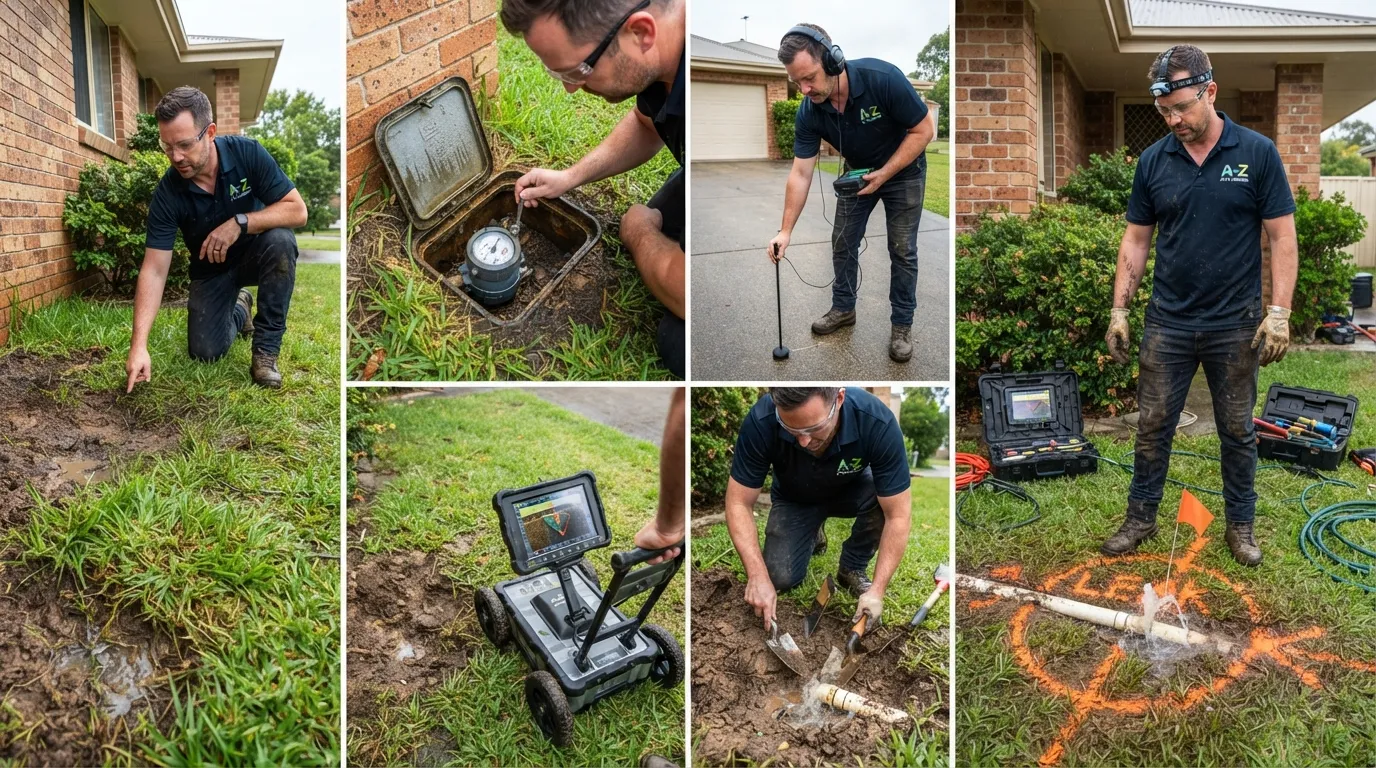
 A plumber usually finds an underground water leak by first confirming that water is escaping, narrowing down which pipe or section is leaking, tracing the buried line, and then using professional leak-detection equipment to pinpoint the most likely break before digging. Depending on the property and pipe, that may involve a water-meter test, pressure testing, acoustic listening equipment, leak-noise correlation, tracer gas, thermal imaging, or pipe-locating technology.
The important part is that a good leak investigation is rarely just “point a detector at the ground.” I’d think of it as a process of elimination: confirm the leak → identify the pipe → narrow the search area → detect the leak → verify the spot → repair only where necessary.
One distinction matters from the start: finding a buried water pipe and finding the actual leak are not the same job. A pipe locator can help establish where the line runs, while a leak detector looks for evidence of escaping water, sound, pressure loss, gas, moisture, or another abnormal condition.
How Does a Plumber Find a Water Leak Underground?
The exact sequence changes with the property, but a plumber or leak-detection technician will normally work through several stages rather than jumping straight to excavation.
- Confirm that a leak actually exists. Before trying to locate anything underground, the plumber checks whether unexplained water use or pressure loss is really occurring.
- Rule out easier-to-find indoor leaks. A running toilet, dripping fixture, irrigation problem, water heater issue, or another visible leak can sometimes explain the same symptoms.
- Work out which part of the plumbing system is affected. Isolation valves, pressure observations, meter readings, and system knowledge help narrow the investigation.
- Establish the buried pipe route. Plans, visible entry points, electromagnetic locating equipment, or ground-penetrating radar may be used when the exact route is unclear.
- Search for evidence along that route. Acoustic equipment, correlators, tracer gas, thermal imaging, soil probes, or other methods can narrow the suspected leak zone.
- Cross-check the suspected location. A professional may repeat a test or use a second method before recommending excavation, especially when the first result is uncertain.
- Mark the repair point. Once the evidence is strong enough, the smallest practical area can be opened or a suitable trenchless repair approach considered.
First, the Plumber Has to Confirm There Is a Leak
If you have a high water bill, low pressure, soggy ground, an unexplained wet patch, or the sound of running water, those signs can point toward a leak—but they do not tell you exactly where it is.
One of the simplest checks is the water meter test. With faucets, appliances, irrigation, and other known water users turned off, movement at the meter can indicate that water is still flowing somewhere on the customer side of the system. That confirms a problem worth investigating, but it does not automatically prove that the leak is underground.
The next job is isolation. A plumber may use shutoff valves and pressure testing to separate sections of the system. If a particular line loses pressure while isolated, the plumber has narrowed the problem considerably before using more advanced equipment.
Can pressure testing show the exact location?
Usually, pressure testing is better at confirming that a closed section is leaking than at showing the exact point of failure. Think of it as a narrowing tool. Once a plumber knows which buried line is losing pressure, acoustic or other locating methods can be focused on a much smaller area.
The Main Tools Plumbers Use to Locate Underground Water Leaks
There is no single detector that is best for every buried leak. Pipe material, depth, water pressure, leak size, surrounding noise, soil conditions, and whether the pipe runs under grass, concrete, or a building can all affect which method works best.
| Method | What it helps detect | When it is useful | Important limitation |
|---|---|---|---|
| Water meter / pressure test | Unexplained flow or pressure loss | Confirming and isolating a leak | Usually does not pinpoint the exact break |
| Acoustic detector / ground microphone | Sound and vibration created by escaping pressurized water | Many buried pressurized water-line leaks | Background noise, low pressure, depth, and some pipe materials can make signals harder to interpret |
| Leak-noise correlator | Leak noise arriving at two points on a pipe | Long buried lines where access is available at separated points | Requires suitable access and correct pipe information |
| Tracer gas | Gas escaping through a defect and reaching the surface | Small or difficult leaks when acoustic results are weak | Needs specialist setup and controlled testing |
| Thermal imaging | Surface temperature patterns associated with moisture or leaking water | Some slab, floor, or shallow concealed-leak situations | It sees temperature differences, not the underground pipe break itself |
| Soil probe / listening rod | Moisture changes or transmitted leak noise | Narrowing a suspected area in soil | Rain, irrigation, groundwater, and soil conditions can complicate interpretation |
| Pipe locator / GPR | The route or position of buried infrastructure | Finding where a pipe runs before leak testing or excavation | Locating the pipe does not necessarily locate the leak |
How Acoustic Leak Detection Works
Acoustic detection is one of the most useful methods for a pressurized underground water line because escaping water often creates vibration and noise as it passes through a crack, joint, or failed section of pipe.
A technician can listen at accessible points such as valves, meters, fittings, or along the ground above the pipe. Electronic equipment amplifies and filters those sounds so the technician can compare different locations instead of relying on the human ear alone.
The underground water-leak sound is not always a dramatic hiss. What the equipment picks up depends on factors such as water pressure, the size of the opening, pipe material, pipe depth, soil, pavement, and background noise. That is one reason professional interpretation matters.
What does a leak-noise correlator add?
A correlator uses sensors placed at two accessible points on the same pipe. It compares how the leak noise reaches each sensor and uses the difference to estimate where along the line the source is located. That can be especially useful when a buried main is long and listening from the surface alone would leave too large a search area.
Finding the Pipe Is Different From Finding the Leak
If nobody knows exactly where the buried water line runs, the plumber may first have to map it. This is where people sometimes confuse a water-pipe locator with a water-leak detector.
An electromagnetic locator can help trace suitable conductive pipes or a tracer associated with the line. Ground-penetrating radar may also help identify buried infrastructure in appropriate ground conditions. These tools can define the search path, but they do not automatically prove that a leak is present at a particular point.
Once the pipe route is known, the plumber can apply leak-specific methods along that route instead of searching an entire yard or slab.
A simple way to remember it:
Pipe locator: “Where does the pipe run?”
Leak detector: “Where is water escaping from that pipe?”
When Plumbers Use Tracer Gas or Thermal Imaging
Acoustic detection does not solve every case. If a leak is very small, pressure is low, the pipe does not transmit sound well, or the surrounding environment is noisy, a technician may need another way to narrow the location.
Tracer gas
With tracer-gas testing, a suitable section of pipe is isolated and tested with a detectable gas mixture using specialist equipment. Gas that escapes through a defect can migrate toward the surface, where a sensitive detector is used to narrow the suspected location. It can be useful when the leak is difficult to hear.
Thermal imaging
An infrared camera looks for temperature differences at the surface. A concealed leak may sometimes change the temperature pattern of a floor, slab, wall, or nearby material. Thermal imaging can provide a useful clue, but it normally works best as supporting evidence rather than automatic proof of the exact underground break.
Does the Detection Method Change Under a Yard, Driveway, or Slab?
Yes. The surface above the pipe changes what evidence is visible and which equipment is practical.
| Location | Useful clues | Methods that may be considered |
|---|---|---|
| Lawn or soil | Wet soil, unusually lush growth, erosion, sound | Acoustic detection, soil probing, correlation, tracer gas |
| Driveway or pavement | Cracks, damp edges, unexplained settlement, sound | Acoustic detection, correlation, pipe locating, tracer gas |
| Under a slab | Pressure loss, warm/cool areas, moisture, sound | Acoustic equipment, pressure isolation, thermal imaging, tracer gas where appropriate |
| Long buried service or main | Persistent flow, pressure problems, distant surface clues | Pipe locating, correlation, acoustic testing, targeted confirmation |
This is also why a method that worked perfectly on your neighbor’s metal service line may not be the best first choice for your property.
How Does the Plumber Know the Exact Spot Before Digging?
This is the part I would pay the most attention to if I were worried about someone unnecessarily opening a yard, driveway, or floor.
A responsible diagnosis should be based on a pattern of evidence rather than one vague signal. For example, the plumber may first confirm continuous water loss, identify the leaking branch, establish the pipe route, hear the strongest acoustic signal in one area, and then repeat the test from another position or confirm it with another method.
The goal is not mathematical perfection before the ground is opened—real sites can be complicated—but better diagnosis can reduce unnecessary excavation by shrinking the suspected area as much as practical.
Signs That Make an Underground Leak More Likely
A hidden leak may not produce an obvious puddle. I would look for a combination of symptoms rather than relying on a single sign:
- The water meter shows flow when known water users are off.
- Your water bill rises without a clear change in normal use.
- Water pressure has dropped unexpectedly.
- One part of the lawn stays wet or unusually green.
- Water pools where there has been no rain or irrigation.
- You hear hissing, rushing, or running water when fixtures are off.
- Soil is washing away or settling in one area.
- Cracks, dampness, or movement appear near a slab, foundation, or paved surface.
None of these symptoms identifies the break by itself. Irrigation, drainage, groundwater, indoor plumbing leaks, and other problems can create similar clues, which is why confirmation and isolation come before excavation.
What You Can Check Before Calling a Plumber
You do not need professional leak-detection equipment to perform the first few checks. If it is safe and you understand your plumbing setup, you can:
- Turn off faucets and make sure appliances and irrigation are not intentionally using water.
- Look at the water meter and note whether it still indicates flow.
- Check toilets, faucets, water heaters, irrigation equipment, and other accessible fixtures for obvious leaks.
- Walk the likely route of the service line and look for persistent wet soil, pooling, settlement, or unusual vegetation.
- Listen for unexplained running-water sounds when the property is otherwise quiet.
Do not start exploratory digging just because the ground looks wet. Buried electrical, gas, communications, irrigation, drainage, and other utilities may be present. The safest next step is to identify the service and buried utilities correctly before excavation.
Can You Find an Underground Water Leak With a DIY Detector or Phone App?
A simple DIY check can tell you that a leak is likely, but pinpointing a buried leak is much harder.
You can buy or rent listening equipment, but owning the tool does not automatically make the result reliable. A technician is interpreting sound intensity, frequency, pipe route, pressure, pipe material, soil, and background noise together. A strong sound at the surface is not always directly above the break.
A normal mobile phone by itself is not a substitute for professional underground leak-detection hardware. An app may display information from a compatible smart water monitor or sensor system, but the phone’s microphone alone should not be treated as a dependable way to pinpoint a buried pressurized pipe leak.
Why Some Underground Leaks Are Harder to Find Than Others
Two underground leaks can behave very differently. These factors can change what a plumber hears or sees:
- Pipe material: metal and plastic transmit leak noise differently.
- Water pressure: lower pressure may create a weaker acoustic signal.
- Leak size: a tiny defect and a major split do not produce the same clues.
- Depth: deeper pipes can make surface detection more difficult.
- Ground material: clay, sand, gravel, concrete, and pavement transmit sound and moisture differently.
- Background noise: traffic, pumps, HVAC equipment, and nearby plumbing can interfere with listening.
- Other water sources: rain, irrigation, drainage, or groundwater can make wet-ground clues misleading.
This is why the “most reliable leak detector” is usually not one universal machine. Reliability comes from choosing the right method for the conditions and verifying the result.
Not Every Plumbing Camera Can Find an Underground Water-Supply Leak
This is an easy point to miss. Video inspection is very useful for many drain and sewer problems because a camera can travel inside an accessible pipe and show cracks, roots, blockages, or other defects.
A buried pressurized drinking-water supply line is a different system. A standard sewer camera is not automatically the right tool for locating a leak in that line. The technician has to match the test to the type of pipe being investigated rather than treating every underground plumbing leak the same way.
What Usually Causes an Underground Water Line to Leak?
Locating the leak answers “where,” but the repair decision also depends on “why.” Common causes can include:
- A failed joint or connection
- Pipe deterioration or corrosion where the material is susceptible
- Ground movement or settlement
- Damage from construction or excavation
- Excessive or repeated pressure stress
- Freezing conditions in climates where buried lines are vulnerable
- Root-related movement or damage around underground piping
A single isolated break may call for a targeted repair. A badly deteriorated line with repeated failures can lead to a different recommendation. Leak detection therefore helps answer not only where to dig, but also how much of the system actually needs attention.
Questions People Often Have About Underground Leak Detection
What is the easiest way to tell if you may have a hidden water leak?
Start with the water meter after turning off known water users. If the meter still shows flow, investigate indoor fixtures and irrigation before assuming the leak is underground. It is an easy screening test, not an exact locator.
Is there a device that can detect an underground water leak?
Yes. Electronic acoustic detectors and ground microphones are common examples, while leak-noise correlators, tracer-gas detectors, thermal cameras, and other equipment can help in specific situations. The best tool depends on the pipe and site conditions.
What are three types of leak-detection methods?
Three useful categories are acoustic detection, which listens for escaping water; tracer-gas detection, which looks for gas escaping through the defect; and thermal detection, which looks for temperature patterns that may indicate concealed moisture. Pressure testing is also commonly used to confirm which section is leaking.
How long can an underground water leak go unnoticed?
There is no fixed timeline. A large break may create obvious pooling or pressure loss quickly, while a smaller buried leak may remain hidden until the meter, water bill, soil condition, or property damage provides a clue. Location matters too—a leak under porous soil can behave very differently from one trapped beneath concrete.
What is the most reliable way to locate an underground water leak?
For many pressurized buried water lines, professional acoustic detection is a strong first locating method. But I would not describe any single method as universally “most reliable.” The strongest diagnosis usually combines leak confirmation, pipe-route knowledge, an appropriate locating method, and verification before excavation.
Can a tool detect the water pipe itself underground?
Yes, depending on the pipe and site. Electromagnetic locating equipment and ground-penetrating radar are examples of technologies that may help trace buried infrastructure. Just remember that detecting the pipe route and detecting the leak point are separate tasks.
What to Expect When You Call a Plumber for a Suspected Underground Leak
If you are arranging professional leak detection, it helps to give the plumber as much useful information as possible: when you first noticed the problem, whether the meter continues to move, whether pressure has changed, where wet areas appear, whether irrigation is present, and whether you know the approximate route and material of the buried line.
From there, the plumber should be able to decide whether the job starts with ordinary plumbing diagnostics or needs specialist underground leak-detection equipment.
The key idea is simple: a plumber finds an underground water leak by narrowing uncertainty one step at a time. The best investigation confirms the leak first, identifies the correct buried line, chooses a detection method that fits the conditions, and verifies the suspected point before unnecessary digging begins.