What Does MIP Stand For in Plumbing?
MIP stands for Male Iron Pipe, a standard industry designation used to identify plumbing fittings and pipes that feature external threads. This acronym is synonymous with MPT (Male Pipe Thread) and requires a female-threaded counterpart to create a secure, leak-proof mechanical connection in water supply or gas lines.
Understanding pipe thread terminology is essential for any DIY plumbing repair or professional installation. Mixing up male and female connections can lead to damaged threads, water leaks, and failed plumbing inspections.
- External Threads: The threading is located on the outside surface of the fitting, designed to screw into a compatible component.
- Standard Sizing: MIP sizing follows standard National Pipe Thread (NPT) conventions, meaning the nominal size does not match the outer diameter measured with a tape measure.
- Universal Application: Commonly found on brass, galvanized steel, PVC, and copper adapters used to connect pipes to valves, fixtures, or appliances.
MIP Fittings Explained Thread Type Design & Material
MIP fittings are engineered to create rigid, mechanical joints across various plumbing systems by utilizing external threads designed to lock tightly into matching internal counterparts. Mastering their structure and material compatibility prevents costly installation errors and ensures long-term system integrity.
External Male Threads MIP Kaise Identify Karein
Identifying an MIP fitting is simple by examining the location of the threads. The ridges are cut into the outside surface of the pipe or adapter, allowing it to screw directly into a receiving component.
- Thread Orientation: Threads face outward, making the outer diameter the primary reference point for sizing.
- Tapered Design: Most standard MIP fittings use National Pipe Thread (NPT) tapered threads, which wedge tightly together as they are tightened to form a leak-resistant seal.
- Sealant Requirement: Because metal-on-metal or plastic-on-plastic threads alone can micro-leak, professional installation always requires PTFE thread seal tape (Teflon tape) or pipe dope.
Kya MIP Sirf Iron Se Banta Hai? Brass Copper Steel PVC Versatility
Despite the name “Male Iron Pipe,” modern MIP fittings are manufactured from a wide variety of materials to suit different plumbing applications, fluid types, and code requirements.
- Brass: Highly corrosion-resistant and durable, making it the top choice for residential water supply lines and gas connections.
- PVC & CPVC: Lightweight and chemical-resistant plastics commonly used in irrigation, pool plumbing, and cold water supply lines.
- Galvanized Steel & Black Iron: Traditional heavy-duty materials utilized in structural gas lines, air compressor systems, and older water distribution networks.
- Copper: Frequently used in conjunction with sweat-to-thread adapters for seamless transitions between rigid copper tubing and threaded valves.
MIP Fitting Ka Role FIP Ke Sath Pairing
An MIP fitting cannot connect to another male-threaded pipe; it requires a matching female counterpart known as an FIP (Female Iron Pipe) to complete the joint.
- Complementary Mechanism: The external threads of the MIP slide snugly into the internal threads of the FIP, creating a uniform, high-pressure bond.
- Transition Utility: MIP-to-FIP connections are frequently used to transition from rigid plastic or metal pipes to flexible supply lines, shut-off valves, or threaded plumbing fixtures.
- Proper Alignment: Always hand-tighten the MIP into the FIP first to avoid cross-threading before finishing with a wrench for a secure, final turn.
MIP vs NPT vs FIP vs MPT vs MHT Complete Comparison
Navigating plumbing acronyms can be confusing, especially when terms overlap or look similar. Understanding the precise definitions of MIP, NPT, FIP, MPT, and MHT ensures you purchase compatible hardware and prevent costly leaks.
Is MIP the Same as NPT? Direct Answer + Technical Nuance
No, MIP and NPT are not the exact same thing, though they are closely related. MIP refers specifically to a male-threaded pipe fitting, whereas NPT (National Pipe Thread) is the overarching technical standard that defines the thread angle, pitch, and taper.
- Design Standard: NPT is the U.S. standard for tapered threads used on pipes and fittings.
- Component Application: MIP is simply a description of a physical fitting built to follow that NPT standard.
- Interchangeability: Most standard MIP fittings you buy at a hardware store are manufactured to NPT specifications.
Can I Screw MIP into NPT? Compatibility Explained
Yes, you can easily screw an MIP fitting into an NPT-threaded connection because MIP fittings are literally built using NPT standards. The confusion usually stems from treating these terms as competing categories rather than design specifications.
- Matching Standards: As long as both components use standard tapered threading, they will screw together smoothly.
- Seal Integrity: Always apply thread seal tape to ensure the tapered threads jam tightly against each other to block fluid escape.
- Avoid Straight Threads: Never force a tapered MIP fitting into a straight thread standard (NPS) without a proper gasket, as it will leak.
MIP vs FIP Key Differences
The primary difference between MIP and FIP lies entirely in thread placement and how they pair together. MIP features external threads, while FIP features internal threads designed to receive those external ridges.
- Thread Direction: MIP threads point outward; FIP threads face inward toward the interior channel.
- Pairing Requirement: You must connect an MIP fitting to an FIP fitting; a male fitting cannot screw into another male fitting.
- Visual Identification: Look closely at the edge—if the grooves are visible on the outside, it is MIP.
What is MHT Male Hose Thread and How is it Different from MIP?
MHT stands for Male Hose Thread, which features straight, un-tapered threads designed specifically for garden hoses and outdoor spigots. Unlike MIP, which relies on tapered metal-on-metal compression to seal, MHT relies entirely on an internal rubber gasket inside a female swivel nut.
- Thread Pitch: MHT uses a coarser, straight thread pattern (typically 3/4-inch NH) instead of the tapered NPT pitch.
- Gasket Dependency: MHT connections will leak profusely without a rubber or silicone washer inside the mating female end.
- Incompatibility: You cannot screw an MHT fitting directly into a standard MIP or FIP pipe fitting without a dedicated thread adapter.
Comparison Table: Thread Types at a Glance
How to Measure MIP Thread Size Step by Step Guide
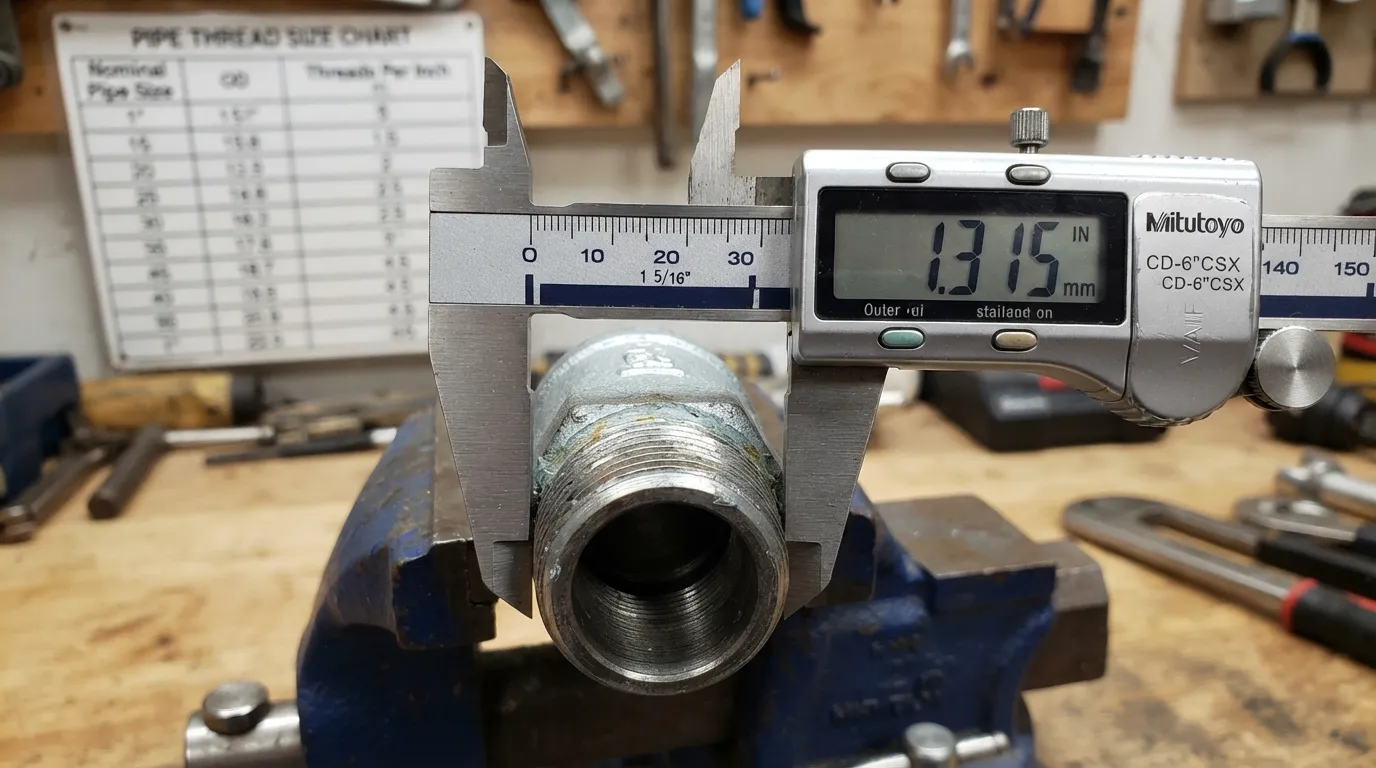
Accurately measuring an MIP fitting prevents purchasing the wrong hardware and saves you from frustrating plumbing leaks. Because pipe thread measurements do not match standard tape measure numbers, following a specific measuring workflow is crucial.
Step 1 — Measuring Outer Diameter OD
To determine the size of a male-threaded MIP fitting, use digital calipers or a tape measure to check the widest part across the external threads.
- Measure Peak-to-Peak: Place your calipers across the outer edges of the thread ridges to record the maximum outer diameter (OD).
- Compare Against Charts: Note that your measured OD will be noticeably larger than the actual nominal size printed on the packaging.
- Consistency Check: Take measurements from two different angles across the threads to account for any wear or manufacturing variance.
Step 2 — Counting Threads Per Inch TPI
Counting the exact number of ridges within a one-inch span confirms whether you are working with standard NPT plumbing threads or alternative thread pitches.
- Use a Thread Pitch Gauge: Press a standard thread pitch comb against the grooves until the teeth lock seamlessly into the valleys.
- Manual Count Method: Lay a small ruler flat against the side of the threads and count the individual ridges across a designated one-inch section.
- Verify Standard Pitch: Standard 1/2-inch and 3/4-inch NPT fittings typically feature 14 threads per inch.
Understanding Nominal Size vs Actual Size Why 1/2 MIP Isn’t Exactly 1/2 Inch
One of the biggest pitfalls for DIY plumbers is discovering that a 1/2-inch MIP fitting measures closer to 3/4 of an inch when measured with a ruler.
- Historical Standard: Nominal pipe size historically referred to the interior flow diameter rather than the outer wall or thread dimensions.
- The Outer Diameter Reality: A nominal 1/2-inch MIP fitting actually measures approximately 0.840 inches across its outer threads.
- Avoiding Errors: Always rely on standard sizing designation charts or take an old fitting directly to the hardware store for a physical match test.
- Where Are MIP Fittings Commonly Used?
MIP fittings are foundational components found across almost every residential and commercial plumbing setup. Because they provide a rock-solid, mechanical transition between pipes, valves, and appliances, they are trusted for both high-pressure fluid conveyance and critical gas lines.
Gas Line Connections Water Heaters Dryers Furnaces Ranges
MIP fittings are heavily utilized in fuel gas distribution systems because their tapered NPT threading forms an exceptionally secure seal under proper torque and sealing compound.
- Water Heaters: Tank and tankless gas water heaters use brass or steel MIP adapters to bridge rigid supply lines with flexible gas connectors.
- Furnaces & Dryers: Gas-fired appliances require certified threaded fittings to prevent hazardous fuel leaks near living spaces.
- Safety Compliance: Gas applications demand strict adherence to local building codes, frequently requiring yellow gas-rated PTFE tape or approved pipe joint compounds.
Dishwasher & Water Supply Line Adapters
Connecting modern household appliances to home plumbing systems often requires transitioning from soldered copper or rigid PEX to standard threaded shut-off valves.
- Under-Sink Valves: Angle stops and shut-off valves under sinks feature threaded outlets that accept supply line connectors.
- Dishwasher Hookups: Dedicated dishwasher elbows often use an MIP end to screw directly into the appliance water inlet valve.
- Leak Prevention: These transitional fittings make routine maintenance or appliance replacement clean and straightforward without cutting pipes.
Irrigation & Outdoor Plumbing Systems PVC MIP Plugs & Adapters
Outdoor watering networks, main water supply lines, and automated sprinkler systems rely heavily on durable plastic MIP components.
- PVC Male Adapters: Used to convert a glued PVC socket line into a threaded connection capable of receiving valves or backflow preventers.
- Winterization Plugs: PVC MIP plugs are screwed into sprinkler manifold drains before winter to clear out stagnant water and prevent freeze damage.
- High-Pressure Durability: Schedule 80 PVC MIP fittings handle continuous mainline pressure seamlessly when installed with proper thread sealant.
How to Seal MIP Fittings the Right Way
Properly sealing an MIP fitting is the single most critical step in preventing catastrophic water damage or hazardous gas leaks. Because tapered threads rely on tight mechanical friction and thread compounds to fill micro-gaps, sloppy installation guarantees a leak.
Do You Need Teflon Tape or Pipe Dope on MIP Threads?
Yes, you must always use a thread sealant on external MIP threads before engaging them with a female counterpart. Raw metal-on-metal or plastic-on-plastic threads will almost always weep under pressure.
- PTFE Tape (Teflon Tape): Wrap the tape clockwise 3 to 4 times around the external male threads, pulling tightly so it molds into the grooves. For detailed guidelines on material selection, refer to industry practices outlined by ANSI Standards.
- Pipe Dope (Thread Sealant): Liquid sealant provides excellent lubrication and acts as a robust barrier against vibration leaks.
- Combined Application: For high-pressure or gas lines, professionals often wrap Teflon tape first and smear a thin layer of approved pipe dope over the tape for maximum security.
Common Mistake Over-Tightening MIP Fittings Cracking Risk
A frequent error among DIYers is cranking down on MIP fittings with maximum force, believing tighter always means safer. In reality, over-tightening can destroy the joint entirely.
- Material Stress: Brass and PVC fittings are especially susceptible to stretching, warping, or cracking under excessive wrench torque.
- Wedge Effect: Because NPT threads are tapered, turning them too far creates an intense wedge action that can split the receiving female fitting.
- The Rule of Thumb: Hand-tighten the fitting securely, then use a wrench to turn it an additional 1 to 2 full turns—no more.
Signs of a Bad Seal & How to Fix It
Catching a faulty seal early prevents structural decay, mold growth, and high utility bills. Knowing what to look for keeps your plumbing system safe.
- Visual Indicators: Watch for slow drips, damp spots around the joint, or a faint hiss in gas applications.
- Corrective Action: Never try to tighten a leaking fitting further while the system is under pressure. Always shut off the supply, drain the line, unscrew the fitting, clean off the old tape, and reapply fresh sealant.
- Thread Inspection: Check the threads for stripping or galling during disassembly; if the metal is deformed, replace the fitting immediately.
Frequently Asked Questions About MIP Fittings
Get quick, direct answers to the most common questions plumbers and DIYers ask about MIP fittings, thread compatibility, and sizing standards.
Is MIP the Same as NPT?
No, MIP is not the exact same as NPT, but they work hand in hand. MIP (Male Iron Pipe) describes a physical fitting with external threads, while NPT (National Pipe Thread) is the standardized engineering specification that defines how those tapered threads are cut.
Can I Screw MIP into NPT?
Yes, you can easily screw an MIP fitting into an NPT-threaded connection because standard MIP fittings are manufactured precisely to NPT guidelines. Just ensure you use thread seal tape to prevent leaks.
What Does MIP Stand For in PVC?
In PVC plumbing systems, MIP still stands for Male Iron Pipe. The terminology is universal across materials, meaning a PVC MIP adapter features external plastic threads designed to screw into a female-threaded PVC component.
What Does “1/2 Inch MIP” Mean?
A 1/2-inch MIP designation refers to the nominal pipe size of the fitting, not its physical outer measurement. The actual outer diameter of a 1/2-inch MIP fitting measures roughly 0.840 inches across the threads due to historical sizing standards.
How to Measure MIP Size?
To measure an MIP fitting, use digital calipers to measure the maximum outer diameter (OD) from thread peak to thread peak. Compare your measurement against an industry NPT sizing chart to determine the correct nominal size.
What is the Difference Between MIP and FIP Pipe Fittings?
The core difference is thread orientation. MIP (Male Iron Pipe) has threads on the outside surface, whereas FIP (Female Iron Pipe) has threads on the inside surface designed to receive a male fitting.
Can I Thread NPT into FIP?
Yes, standard NPT male fittings can be screwed directly into an FIP (Female Iron Pipe) connection, as both share the exact same tapered thread standard and pitch.
Can You Connect FIP to MIP?
Yes, connecting an FIP (Female Iron Pipe) to an MIP (Male Iron Pipe) is the standard method for joining two threaded plumbing components together securely with the help of thread sealant.
Is 3/4 FIP the Same as 3/4 NPT?
An FIP fitting is a specific component (female threaded), while NPT is the standard specification. However, a 3/4-inch FIP fitting utilizes 3/4-inch NPT tapered internal threads, making them part of the exact same sizing family.
Can FIP Be Used with NPT?
Yes, FIP fittings are specifically designed to accept NPT-threaded male pipes and adapters, forming a tight, tapered, leak-resistant seal when installed correctly.
Final Thoughts on MIP Plumbing Fittings
Mastering plumbing terminology like MIP, FIP, NPT, and MPT ensures that your repairs, appliance hookups, and system modifications go smoothly without unexpected leaks or wasted hardware. Because external male threads require precise matching, proper sizing, and reliable thread sealant, taking a moment to double-check your specifications will save you time and frustration.
Whether you are working with brass gas connectors, copper adapters, or PVC irrigation lines, always remember to verify your thread type, match your MIP fittings with a compatible FIP counterpart, and avoid over-tightening. With these best practices in place, you can approach your next plumbing project with total confidence.

Oscar Vance | Master Plumber & Drainage Expert
Meet Oscar Vance, a licensed master plumber sharing practical solutions on residential repairs, preventive maintenance, and thoughtful home upkeep.