What Does MNPT Stand For
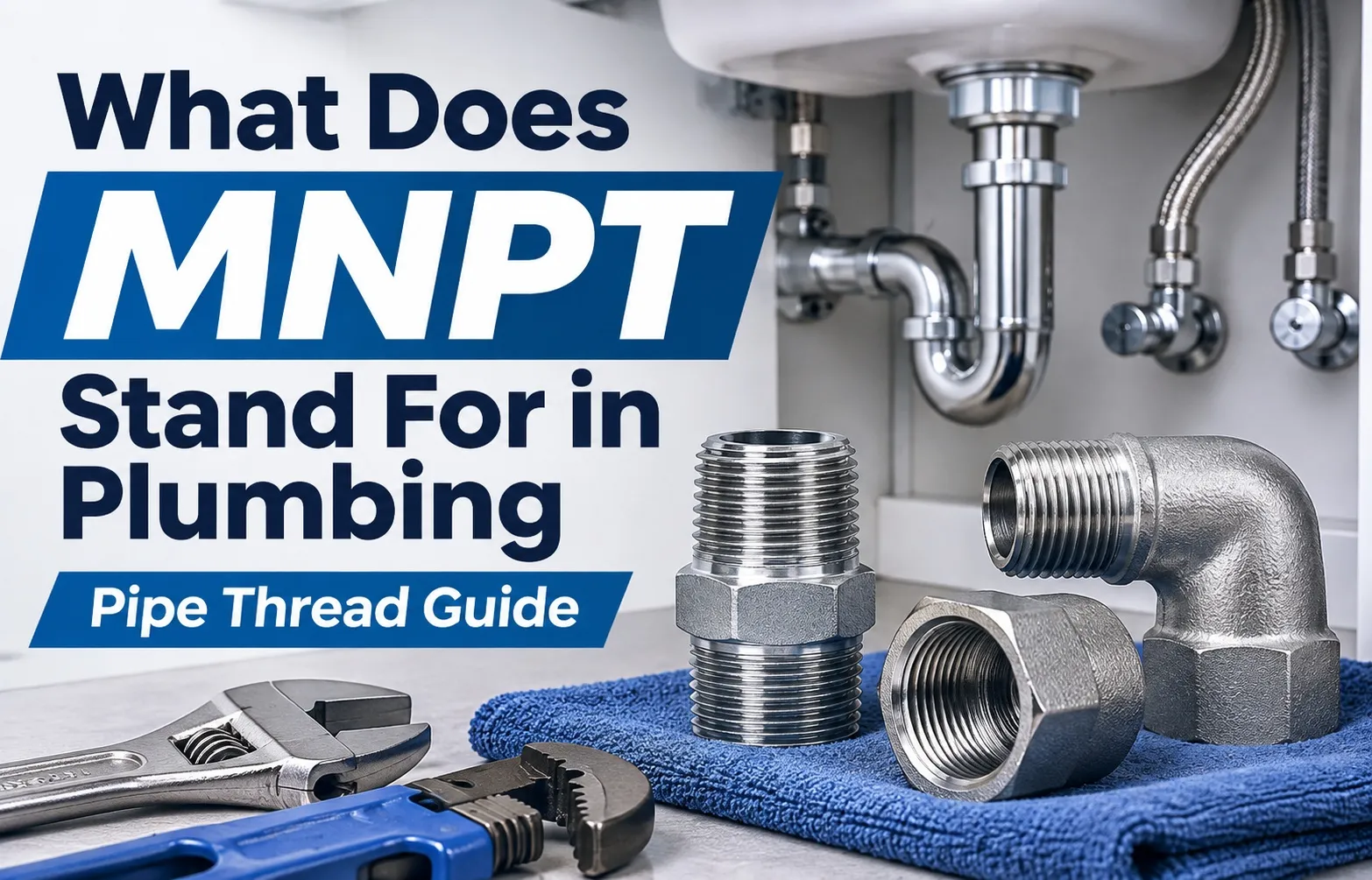 MNPT stands for Male National Pipe Thread, frequently abbreviated as MPT or Male Pipe Thread in commercial and residential applications. It designates a standardized U.S. external thread profile used on plumbing fittings and pipes to establish a secure, pressure-resistant connection when threaded into a matching component.
What MNPT Actually Means
Breaking down the acronym clarifies its precise structural role in modern plumbing systems. Each element defines a critical physical characteristic of the hardware:
- M (Male): Indicates that the spiral threads are cut on the outside surface of the pipe or adapter.
- NPT (National Pipe Thread): Represents the official American technical standard for tapered threads used on pipe joints and fittings.
This external threading ensures compatibility across standardized plumbing infrastructure, allowing contractors and technicians to pair components from different manufacturers seamlessly.
Look at Male vs. Female Pipe Connections
Plumbing assembly relies on precise mating between opposing thread types to hold structural integrity under pressure. Recognizing how these connections lock together prevents improper installations:
- Male Threads (MNPT): Act as the inserting component, featuring exterior ridges that screw into a receiving port.
- Female Threads (FNPT): Serve as the receiving component with interior grooves designed to capture male fittings.
- Tapered Engagement: The progressive taper creates a mechanical wedge as the fitting is tightened, forcing the metal or plastic threads into close contact.
How MNPT Fittings Work: The Mechanics of Tapered Threads
MNPT fittings rely on a specialized tapered design where the thread diameter gradually decreases toward the end of the pipe. This unique geometric profile generates a tight, pressure-resistant seal and a robust mechanical bond when screwed into a matching component.
The Science of Tapered Thread Angles (60-Degree Standard)
Standard National Pipe Thread configurations are manufactured with a precise 60-degree thread angle and a uniform 1-in-16 taper rate relative to the centerline. This standardized geometric angle ensures that opposing metal or plastic surfaces compress evenly under rotational torque.
- Geometric Taper: The 1-in-16 ratio means the pipe diameter narrows by exactly 3/4 inch for every foot of threaded length.
- Uniform Stress Distribution: The engineered angle spreads mechanical tension evenly across every engaged thread rotation.
How the Wedge Effect Creates a Leak-Proof Seal
As an external MNPT fitting is tightened into an internal port, the converging threads generate an intense wedging force that locks the thread flanks together. Unlike straight parallel threads that rely entirely on O-rings or flat gaskets, tapered threads achieve sealing through tight physical surface compression.
- Mechanical Wedging: Rotation forces the flanks of the male and female threads into high-pressure contact.
- The Spiral Gap Phenomenon: Because the tapered crests and roots do not completely crush together, a microscopic spiral gap remains along the helical path, necessitating a thread sealant.
Direct Pairing: MNPT Meets FNPT
MNPT fittings are engineered to screw directly into FNPT (Female National Pipe Thread) ports found on valves, pumps, and distribution manifolds. This mating process transforms the tapered geometry into a secure, high-pressure mechanical bond.
- Thread Engagement: Exterior male ridges drive securely into the matching interior grooves of the female component.
- Torque Control: Proper tightening ensures the tapered wedge locks firmly in place without over-stressing or cracking the receiving material.
Decoding Plumbing Acronyms: MNPT vs. MPT vs. MIP vs. NPT
Plumbers, hardware suppliers, and manufacturers frequently use various trade acronyms interchangeably, leading to widespread confusion for DIYers and apprentices alike. Understanding that terms like MPT, MIP, and MNPT refer to the exact same physical thread standard prevents costly mistakes when purchasing adapters and fittings.
Is MPT the Same as MNPT?
Yes, MPT and MNPT are completely identical terms used across the plumbing and industrial supply industries. Manufacturers and catalog writers often drop the “N” for brevity, but both acronyms refer strictly to Male Pipe Thread or Male National Pipe Thread.
- Standardized Thread Geometry: Whether labeled MPT or MNPT, the fitting features identical 60-degree tapered external threads.
- Retail Consistency: Hardware packaging may display either designation depending on the brand, with zero difference in pitch, angle, or compatibility.
What is MIP (Male Iron Pipe)?
MIP stands for Male Iron Pipe, an older legacy term originating from the historical era when nearly all structural pipes were manufactured from black iron or galvanized steel. Although modern plumbing relies heavily on schedule-80 PVC, brass, stainless steel, and copper, the term MIP remains deeply embedded in contractor and trade terminology.
- Historical Roots: The label reflects traditional iron piping nomenclature where external threads were universally called iron pipe threads.
- Material Independence: MIP is functionally identical to MNPT and MPT; it simply denotes an external tapered thread regardless of whether the modern fitting is made of brass, PVC, or steel.
Understanding the Broader NPT Family
To navigate any plumbing schematic or retail hardware aisle successfully, it helps to categorize these designations within the broader NPT framework. Recognizing how male and female variants correlate simplifies complex piping layouts and prevents incorrect adapter pairings:
- NPT: National Pipe Thread (the foundational American standard for tapered threads).
- Female Counterparts: Abbreviations like FNPT, FPT (Female Pipe Thread), and FIP (Female Iron Pipe) all describe internal receiving ports.
- Standardized Terminology: Mastering these interchangeable terms ensures clear communication when sourcing materials for residential or commercial installations.
MNPT Size Reference Chart: Nominal Size vs. Actual Outer Diameter (OD)
One of the most common pitfalls for DIYers and apprentices is measuring pipe threads with a standard tape measure or ruler and expecting the numbers to match nominal sizing. Understanding the exact mathematical variance between nominal callouts and physical dimensions prevents incorrect fitting purchases.
Why Pipe Sizing Confuses Beginners
The term nominal size does not reflect the actual physical width of the pipe or fitting. Historically, nominal dimensions referred to the inside diameter (ID) of early iron piping systems rather than the outer dimensions.
- The Ruler Trap: When you measure a 1/2 inch MNPT fitting across its outer threads, it measures roughly 0.84 inches instead of 0.5 inches.
- Engineering Standards: Professional configurations comply with rigorous design benchmarks established in the official ASME B1.20.1 pipe thread specifications to maintain universal manufacturing tolerances.
Complete MNPT Size, OD, and TPI Reference Table
To ensure absolute precision during installations, use this comprehensive technical reference mapping nominal callouts to their measured actual outer diameter (OD) and Threads Per Inch (TPI).
Critical Installation Rules: Avoiding Common MNPT Mistakes
Proper installation of an MNPT fitting requires strict adherence to thread mechanics and sealing guidelines. Failing to account for thread compatibility, sealant application direction, or material reactivity leads to chronic leaks and premature plumbing failure.
The Tapered (NPT) vs. Straight (NPS) Thread Trap
One of the most destructive errors installers make is attempting to mate an MNPT fitting with a straight thread port. While they look similar on a shelf, their internal geometries are fundamentally incompatible.
- Thread Profile Mismatch: NPT threads feature a 1-in-16 taper designed to wedge tight, whereas NPS (National Pipe Straight) threads run completely parallel.
- The Gasket Requirement: Forcing an MNPT male fitting into an NPS socket will not create a mechanical wedge, resulting in leaks unless a proper flat gasket, O-ring, or sealing washer is utilized.
Do MNPT Fittings Always Need Thread Sealant? (Tape vs. Pipe Dope)
Thread sealant is mandatory for all pressure-bearing MNPT connections. Because metal-on-metal or plastic-on-plastic tapered threads leave tiny helical voids, sealants fill those microscopic spaces to block fluid or gas migration.
- Sealing the Spiral Gap: Tapered crests and roots do not completely crush together, creating an open spiral channel for leaks.
- Material Selection: Technicians rely on high-grade PTFE tape (commonly known as Teflon tape) or liquid pipe joint compound (frequently called pipe dope) depending on temperature, pressure, and media type.
The Golden Rule of Wrapping Teflon Tape (Clockwise Direction & Count)
Incorrect application of sealing tape causes the material to bunch up, shred, or unspool entirely during assembly. Proper technique ensures a clean, leak-free compression joint.
- Clockwise Rotation: Always wrap the tape in a clockwise direction when looking directly at the open end of the pipe, matching the right-hand thread helix.
- Application Count: Apply 3 to 5 snug wraps while pulling tightly into the grooves, keeping the very first thread edge bare to prevent cross-threading.
Preventing Galvanic Corrosion Between Dissimilar Metals
Connecting metallic MNPT fittings to opposing metals without a barrier triggers an electrochemical reaction in the presence of water. This oversight ruins threads and degrades system integrity.
- Electrochemical Breakdown: Direct contact between active metals (such as carbon steel and copper) accelerates structural corrosion and thread seizure.
- Material Protection: Install dielectric barriers, specialized thread sealants, or isolation bushings when pairing metal lines with brass adapters or transitioning into threaded PVC fittings.
Frequently Asked Questions About MNPT and NPT Fittings
Addressing common technical inquiries ensures proper assembly, prevents leaks, and guarantees complete thread compatibility across residential and industrial plumbing systems.
Will NPT Screw Into NPT?
Yes, NPT fittings screw directly into matching NPT components because they share identical thread geometry and taper standards. When paired correctly with a thread sealant, male and female components establish a durable, leak-proof seal under operating pressure.
- Direct Compatibility: MNPT threads pair seamlessly into corresponding FNPT ports without mechanical modifications.
- Sealant Requirement: Even with identical NPT profiles, thread sealant remains mandatory to close the microscopic spiral gap.
Is NPT the Same as PVC?
No, NPT is a thread design standard, whereas PVC is a specific thermoplastic material used for manufacturing piping systems. However, many PVC pipes and molded adapters feature standard NPT threading to allow integration with metal or plastic valves.
- Thread vs. Material: NPT governs taper and angle, while PVC dictates structural rigidity and chemical resistance.
- Cross-System Connections: Threaded PVC components require careful torque control to prevent splitting the plastic female socket.
What Do Plumbers Use Instead of Teflon Tape?
Plumbers frequently use liquid pipe joint compound—commonly referred to as pipe dope—as a high-performance alternative or supplement to tape. This chemical thread sealant acts as an effective lubricant and fills complex thread voids under high-pressure conditions.
- Liquid Application: Brush-on compounds lubricate metal threads smoothly during high-torque assembly.
- Specialized Formulas: Certain joint compounds are rated specifically for high-temperature gas or chemical processing applications.
How Many Times Should You Wrap Threads with Plumbers Tape?
You should wrap standard PTFE tape around male pipe threads 3 to 5 times in a clockwise direction. Applying too few plumber tape wraps risks leaks, while over-wrapping can cause excessive friction and crack female ports.
- Optimal Thickness: Three to five clockwise rotations provide the ideal thickness to compress into the spiral gaps.
- Starting Position: Keep the very first leading thread bare to prevent tape from shredding inside the valve body.

Oscar Vance | Master Plumber & Drainage Expert
Meet Oscar Vance, a licensed master plumber sharing practical solutions on residential repairs, preventive maintenance, and thoughtful home upkeep.