Can You Really Do Plumbing Without a License?
 Whether you can legally perform plumbing work without a license depends entirely on your status as a property owner or an aspiring contractor, as well as the specific jurisdiction where the work takes place. State and local municipal codes strictly regulate plumbing trades to safeguard public infrastructure, maintain structural integrity, and protect health and safety.
While minor maintenance tasks and basic upkeep are often permitted for property owners under specific exemptions, offering professional plumbing services or handling complex installations for financial compensation without proper credentials is strictly prohibited by law.
Understanding the Legal Divide: DIY Homeowners vs. Professional Contractors
Regulatory frameworks draw a sharp legal line between working on a personal residence and operating as a commercial service provider:
- Homeowner Exemptions: Many regions allow individuals to perform select plumbing repairs on a home they personally own and occupy without holding an active professional license, subject to local building codes.
- Commercial and Paid Work: Any individual or entity offering plumbing repairs, remodeling, or installation services to clients for compensation must hold an official state-issued plumbing license.
- Permits and Inspections: Even when a homeowner exemption applies, major projects typically require formal municipal building permits and subsequent official inspections to ensure compliance.
Core Legal and Financial Risks of Non-Compliance
Attempting plumbing tasks outside of established licensing and permit regulations exposes property owners and unlicensed handymen to substantial liabilities:
- Municipal Penalties: Code enforcement authorities can issue heavy civil fines, misdemeanor charges, or formal stop-work orders for illegal plumbing activity.
- Insurance Denials: Property damage, flooding, or structural deterioration caused by unpermitted or unlicensed work can result in rejected homeowner insurance claims.
- Public Health Hazards: Faulty pipe configurations, cross-connections, or improper waste disposal can compromise drinking water safety and lead to costly remediation projects.
The Core Breakdown: When is Unlicensed Plumbing Allowed?
Navigating the legal boundaries of plumbing work requires a clear understanding of the exceptions established by state and municipal codes. While professional licensing protects public safety, specific exemptions exist for property owners working on their own residences and individuals training under certified professionals.
Recognizing the exact threshold between permissible maintenance and restricted installations ensures compliance with local laws and prevents severe municipal or financial penalties.
The Homeowner-Builder Exemption: Working on Your Own Property
Property owners enjoy specific legal protections known as the homeowner-builder exemption, which permits individuals to perform select plumbing tasks on a home they personally own and occupy without holding a professional license. However, this privilege is strictly conditional and does not exempt the project from local building codes or mandatory municipal inspections.
- Primary Residence Rule: The exemption almost universally applies only to owner-occupied single-family dwellings and does not extend to rental properties, commercial spaces, or homes intended for immediate resale.
- Permit Obligations: Even when performing DIY repairs under an exemption, property owners are frequently required to pull formal local permits before initiating work.
- Mandatory Inspections: Unlicensed work completed by a homeowner must pass municipal inspection checkpoints to verify that piping, drainage, and fixture connections comply with safety codes.
Apprentices, Trainees, and Direct Supervision Rules
Individuals entering the trade can legally perform plumbing work without an independent license if they are formally registered as an apprentice plumber or trainee with their state’s department of labor or licensing board. This legal pathway is designed to facilitate career entry while maintaining strict adherence to public safety standards through experienced oversight.
- State Registration: Apprentices must maintain active registration status and carry documentation confirming their training standing with the regulatory agency.
- Direct Supervision Mandate: Trainees cannot work autonomously; a licensed journey-level plumber or master plumber must provide continuous, direct supervision on the job site.
- Scope Restrictions: Unlicensed apprentices are restricted to tasks authorized under their training tier and cannot independently contract services or pull complex commercial permits.
Minor Maintenance vs. Major Structural Alterations
The legal distinction between permissible DIY tasks and regulated contracting rests heavily on the technical complexity and safety risks of the project. Routine maintenance involving basic plumbing fixtures can typically be managed without professional credentials, whereas modifications to pressure systems or waste networks require certified intervention.
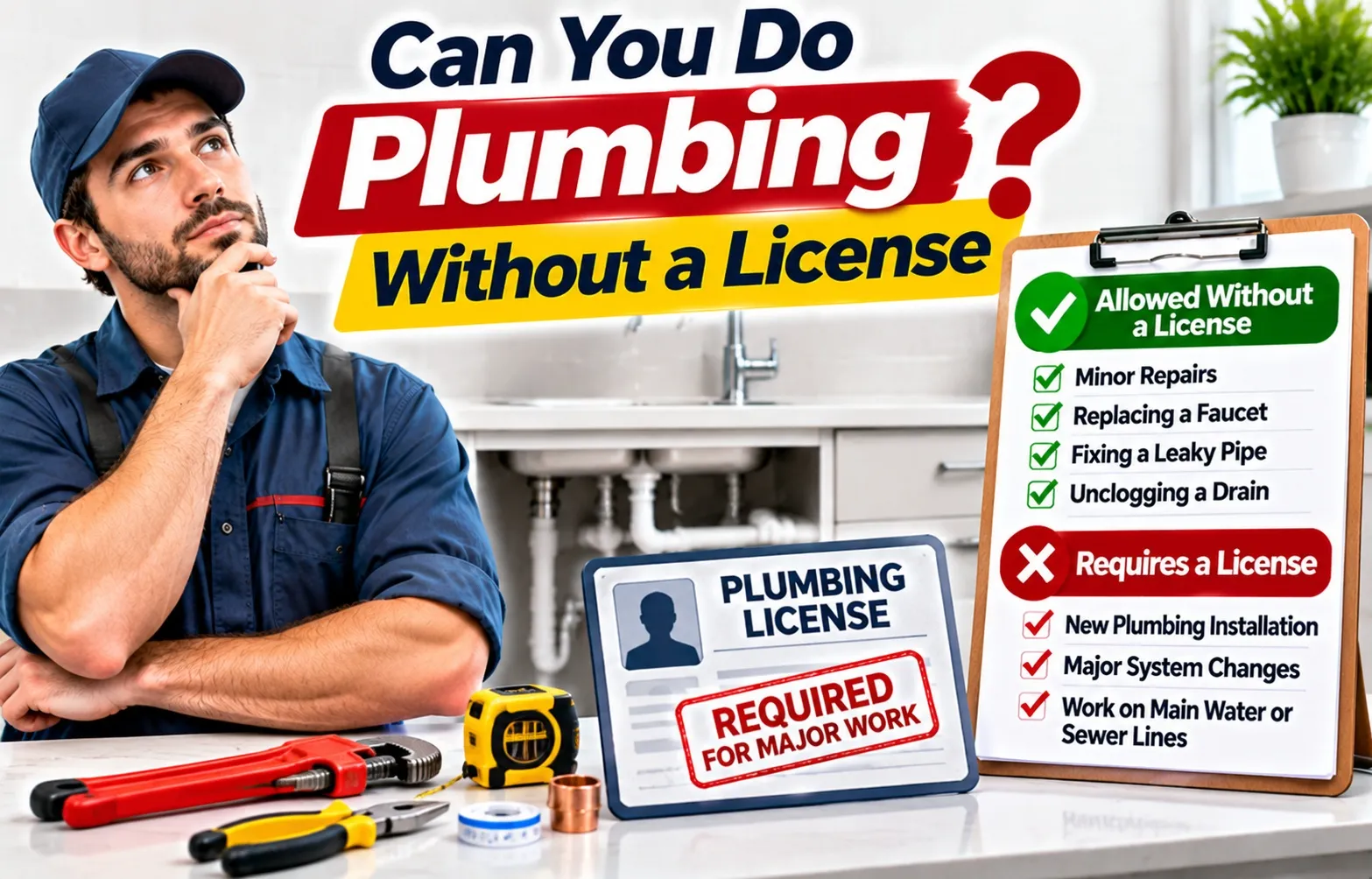
- Permissible Minor Tasks: Replacing worn-out washers, swapping standard faucets, clearing sink clogs, or installing a toilet replacement are often classified as low-risk maintenance.
- Restricted Major Projects: Altering gas supply lines, installing or replacing water heaters, moving main drain stacks, and excavating sewer connections strictly require licensed contractors.
- Risk and Liability Thresholds: Any task that impacts structural framing, water supply contamination risks, or flammable gas lines mandates professional licensing to protect structural integrity and insurance validity.
The Business Loophole: Can You Own a Plumbing Company Without a License?
Entrepreneurs frequently wonder if launching a commercial plumbing enterprise requires personal technical certification. State licensing boards draw a sharp administrative line between corporate ownership and field-level execution, allowing business registration without a personal trade license under strict structural conditions.
While an investor or manager can legally establish the corporate framework, operating without proper trade supervision violates commercial contracting statutes and triggers heavy penalties.
Owning the Business vs. Performing the Work
State laws generally permit individuals to register a business entity, secure corporate insurance, and manage the administrative operations of a plumbing company without personally holding a state-issued plumbing license. However, business ownership does not grant authorization to perform physical installations, inspect systems, or pull municipal permits.
- Corporate Structuring: LLCs, corporations, and partnerships can be formed by non-licensed individuals for trade operations.
- Operational Restrictions: Owners cannot legally step into the field to execute installations, clear main stacks, or handle regulated repairs.
- Administrative Compliance: Management must focus purely on bookkeeping, marketing, customer service, and scheduling while deferring all technical execution to certified personnel.
What is a “Qualifying Agent” or “Contractor of Record”?
To legally offer commercial plumbing services and secure municipal permits, an unlicensed business owner must legally employ a certified professional known as a qualifying agent or contractor of record. This licensed expert acts as the official technical authority responsible for code compliance and project supervision.
- Licensing Mandate: The qualifying agent must hold an active master plumber license recognized by the state licensing board.
- Regulatory Accountability: This individual links their personal credential to the business entity, assuming legal responsibility for company-wide technical work and permit filings.
- Operational Dependency: If the qualifying agent leaves the company, the business immediately loses its legal authority to bid on or perform regulated plumbing projects until a replacement is registered.
Can You Dispatch Unlicensed Handymen for Paid Jobs? (The Legal Trap)
Operating a registered plumbing business does not permit the dispatch of general, unlicensed handymen to execute regulated plumbing tasks for paying clients. Doing so triggers severe regulatory penalties, regardless of whether a qualifying agent is listed on corporate paperwork.
- Illegal Subcontracting: Uncertified technicians cannot independently perform, supervise, or bill for restricted plumbing repairs under the company banner.
- Insurance Vulnerability: Commercial liability policies routinely deny coverage for water damage or structural failures caused by uncertified workers deployed on service calls.
- Board Audits and Fines: State licensing boards regularly audit contracting companies, imposing heavy civil penalties, stop-work orders, and corporate license revocation for illegal dispatching.
State-by-State Rules: Strict vs. Lenient Jurisdictions
Plumbing regulations are not uniform nationwide, with legal enforcement varying drastically across state lines, counties, and municipal boundaries. Understanding regional differences ensures that homeowners and contractors avoid costly regulatory violations.
While some states maintain rigid statewide licensing boards with zero tolerance for uncertified work, others provide broader exemptions or delegate oversight entirely to local authorities.
Strict States (e.g., Texas & California): Zero Tolerance for Unlicensed Work
Jurisdictions like Texas and California enforce rigorous licensing statutes with zero tolerance for uncertified contractors or handymen performing paid plumbing repairs. Operating without official credentials in these high-enforcement states triggers immediate legal scrutiny and heavy penalties.
- Texas State Board of Plumbing Examiners: Enforces strict administrative oversight, requiring a state-issued license for virtually all residential and commercial plumbing tasks outside of narrow homeowner-builder exemptions.
- California State Licensing: Mandates a C-36 plumbing license for any project or repair valued over $500 in combined labor and materials, backed by rigorous background checks and verified experience hours.
- Civil Fines and Penalties: Unlicensed handymen or commercial operators caught doing unauthorized work routinely face heavy civil fines, cease-and-desist orders, and misdemeanor charges.
Lenient or Exemption-Friendly States (e.g., Georgia)
Other regions provide wider statutory latitude for property owners and specific maintenance tasks, though state frameworks still establish baseline safety standards for commercial operations. For comprehensive insights into standard trade classifications and qualification frameworks, you can review the Minnesota Department of Labor and Industry plumbing guidelines as a benchmark for multi-state regulatory comparisons.
- Georgia Plumbing Regulations: Allow broader homeowner exemptions and specific maintenance classifications, though major urban counties still require strict local permitting.
- Rural vs. Urban Enforcement: Unincorporated areas often feature fewer immediate inspections for minor repairs, but metropolitan jurisdictions maintain rigorous enforcement.
- Limitations of Leniency: Even in exemption-friendly regions, unpermitted major work involving gas lines, water heaters, or main sewer stacks remains strictly illegal without a certified professional.
Why Municipal and County Rules Override State Guidelines
State statutes provide only the minimum baseline for trade operations, meaning local municipal building departments and city ordinances frequently impose much stricter permit requirements and licensing verifications than state laws dictate.
- Local Authority Mandates: City and county building departments hold independent legal authority to enforce local amendments to international plumbing codes.
- Permit Intersections: Even if a state law permits a specific homeowner repair, local city offices may require a formal municipal permit and official inspector sign-off.
- Checking Local Jurisdiction: Property owners and contractors must always verify local municipal codes before starting any project to prevent unexpected stop-work orders and failed inspections.
The Granular Checklist: Plumbing Tasks That Need a Permit vs. No License
Navigating home repairs requires a precise understanding of which tasks you can tackle independently and which ones legally demand certified professionals and formal municipal permits. Misjudging this threshold can lead to severe structural failures, failed home sale inspections, and heavy fines.
Reviewing a granular, task-by-task breakdown helps property owners distinguish between safe routine maintenance and regulated mechanical alterations.
Tasks You Can Usually Do Without a License or Permit
Minor maintenance and cosmetic upkeep typically fall within the safe zone for DIY homeowners, provided no structural alterations or pressure line modifications are involved. These projects allow property owners to maintain functional fixtures without hiring a contractor.
- Faucet Replacement: Swapping out an existing kitchen or bathroom faucet using current supply lines and shut-off valves.
- Toilet Installation: Replacing a cracked toilet or updating wax rings and flush valves on an existing drainage flange.
- Sink Clog Clearing: Using hand plungers or standard drain snakes to clear minor blockages in traps and branch lines.
- Showerhead and Trim Updates: Replacing showerheads, handles, and escutcheon plates without altering behind-the-wall plumbing.
Major Plumbing Projects That Strictly Require a License & Permits
Any project involving high-pressure networks, flammable gases, or main waste stacks requires professional licensing and mandatory municipal building permits to safeguard public safety and property structures.
- Water Heater Replacement: Tank and tankless water heater installations require electrical, gas, or thermal expansion permits and licensed oversight.
- Gas Line Installation: Running, modifying, or repairing natural gas or propane supply lines demands certified technicians due to explosion and poisoning risks.
- Drain Stack Alterations: Cutting, relocating, or extending main vent stacks and waste lines impacts the entire sanitary system and requires a permit.
- New Plumbing Rough-Ins: Adding brand-new bathrooms or extending supply and drainage lines into unplumbed areas of a home strictly mandates licensed contractors.
Visual Guide: Watch Before You Touch Your Pipes
Before beginning any plumbing project, reviewing a visual breakdown of licensing boundaries and code requirements ensures you avoid costly mistakes. Watch the video below for a clear explanation of what tasks require professional certification.
The Hidden Risks of Unlicensed Plumbing
Bypassing professional licensing and municipal permit requirements introduces profound financial, legal, and structural dangers. Beyond immediate municipal penalties, illegal plumbing work can compromise the integrity of your home and leave you entirely unprotected when disaster strikes.
Understanding these hidden liabilities highlights why adhering to trade regulations is essential for safeguarding your property and long-term financial stability.
Heavy Fines, Misdemeanors, and Stop-Work Orders
Municipal code enforcement agencies actively penalize uncertified plumbing work, issuing immediate administrative stop-work orders and severe financial penalties. Unlicensed individuals operating as contractors face escalating criminal charges for violating trade statutes.
- Municipal Fines: Local code authorities can levy heavy civil penalties ranging from hundreds to thousands of dollars per individual violation.
- Misdemeanor Charges: Performing unpermitted commercial or paid plumbing work in strict jurisdictions is frequently classified as a criminal misdemeanor, resulting in permanent legal records.
- Stop-Work Orders: Code inspectors can legally halt all ongoing property renovations until certified professionals rectify and re-permit the faulty installations.
Code Violations and Structural Property Damage
Hidden plumbing mistakes often remain undetected behind drywall and beneath slabs until catastrophic failures occur. Improper pipe sizing, faulty pressure joints, or unvented drain configurations create chronic leaks that trigger severe structural deterioration.
- Structural Foundation Damage: Persistent, undetected water leaks silently weaken subflooring, rot timber framing, and erode concrete foundation footings.
- Mold and Health Hazards: Unregulated drainage configurations and trapped wastewater foster toxic mold growth, posing severe indoor air quality and respiratory risks.
- Failed Inspections During Sales: Unpermitted plumbing modifications invariably surface during real estate closing inspections, derailing home sales and forcing expensive retroactive repairs.
How Unpermitted Work Voids Your Homeowner’s Insurance Claims
Insurance adjusters thoroughly investigate the root cause of property damage during major claims, specifically checking for required municipal building permits. If flooding, mold, or fire stems from unpermitted work, insurance carriers routinely deny coverage.
- Water Damage Claim Denial: Carriers reject expensive payouts for ruined drywall, hardwood flooring, and personal belongings if the underlying plumbing installation lacked official permits.
- Liability Exposure: Property owners assume 100% of out-of-pocket financial liability for adjacent tenant or neighbor property damages caused by uncertified plumbing failures.
- Policy Cancellation: Discovering illegal or unpermitted modifications can prompt insurance companies to deny future claims or cancel your entire property insurance policy outright.
Frequently Asked Questions
Is it illegal to hire an unlicensed handyman for small fixes?
Whether hiring an unlicensed handyman for small repairs is illegal depends heavily on the specific jurisdiction and the nature of the task. While changing a washer or clearing a trap rarely triggers strict enforcement, hiring uncertified workers for regulated installations creates substantial unlicensed handyman liability for property owners.
- Regulatory Thresholds: In strict states like Texas or California, any paid plumbing service requires a licensed professional, making unlicensed handymen illegal for hire.
- Liability Risks: Property owners assume full financial responsibility if an uncertified handyman causes water leaks or code violations during a repair.
- Insurance Complications: Commercial or homeowner insurance policies routinely deny coverage for damages resulting from work performed by unverified workers.
Can I plumb an entire bathroom remodel by yourself?
Tackling a complete DIY bathroom remodel involves a mix of permissible cosmetic updates and strictly regulated mechanical work. While you can typically install fixtures or replace vanity tops under homeowner exemptions, running new waste lines or supply pipes yourself violates building codes in most regions.
- Rough-In Restrictions: Installing new drainage stacks, vent pipes, and behind-the-wall supply lines almost universally mandates a licensed plumber and an official permit.
- Inspection Requirements: Even if minor modifications are legally allowed, a completed bathroom remodel must pass municipal inspections before it can be closed behind drywall.
- Long-Term Integrity: Improper venting or incorrect slope on drain lines during a DIY bathroom remodel can cause chronic sewage backups and costly structural damage.
What happens if an unpermitted plumbing job is discovered during a home sale?
Unpermitted plumbing work discovered during a home sale inspection can severely disrupt real estate transactions and impact property value. Buyers and home inspectors routinely cross-reference municipal permit history with major property modifications.
- Inspection Dealbreakers: A home sale inspection can flag unpermitted water heater replacements or bathroom additions, causing buyers to demand price reductions or walk away.
- Real Estate Disclosures: Sellers are legally required to disclose known unpermitted work, and failing to do so can result in post-closing lawsuits for misrepresentation.
- Retroactive Permitting Delays: Resolving unpermitted work often requires opening up finished walls for municipal inspection, delaying closings and incurring steep retroactive fees.

Oscar Vance | Master Plumber & Drainage Expert
Meet Oscar Vance, a licensed master plumber sharing practical solutions on residential repairs, preventive maintenance, and thoughtful home upkeep.