What Is a Sound Attenuator in HVAC Systems?
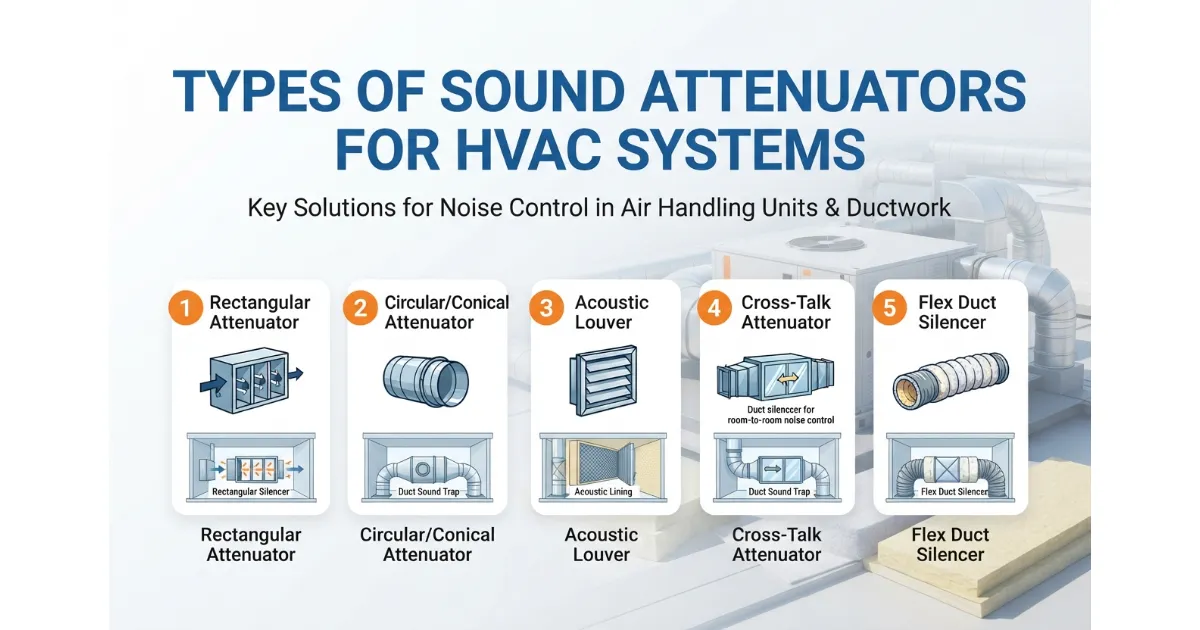 A sound attenuator in an HVAC system is a specialized noise-control device engineered to reduce airborne and ductborne noise traveling through ventilation ductwork. Also commonly referred to as a duct silencer or muffler, it absorbs fan, motor, and airflow turbulence sounds before they reach occupied spaces, ensuring optimal indoor acoustic comfort and regulatory code compliance.
Sound Attenuator vs. Duct Silencer vs. Muffler Same Thing Different Names
Industry terminology can often create confusion, but these three terms refer to the exact same acoustic control equipment. Understanding that they are interchangeable helps streamline communication with mechanical engineers, acoustical consultants, and equipment manufacturers.
- Sound Attenuator: The preferred technical and engineering term used in architectural blueprints and mechanical specifications.
- Duct Silencer: A common industry-standard term emphasizing the component’s primary function of silencing HVAC duct noise.
- Muffler: A colloquial term occasionally used interchangeably, drawing a direct parallel to automotive exhaust silencing principles.
Why Noise Control Matters in HVAC Design
Uncontrolled mechanical noise generated by air handling units, variable air volume (VAV) boxes, and high-velocity air movement can severely disrupt indoor environments. Integrating proper noise mitigation strategies directly supports human well-being and structural standards.
- Occupied Space Comfort: Lowers ambient background noise to recommended criteria (such as NC or RC ratings) in offices, hospitals, and classrooms.
- Enhanced Productivity: Minimizes acoustic distractions and cognitive fatigue in noise-sensitive professional and educational settings.
- Code Compliance: Ensures mechanical installations meet local, state, and international building codes regarding maximum permissible noise levels.
How Do Sound Attenuators Work?
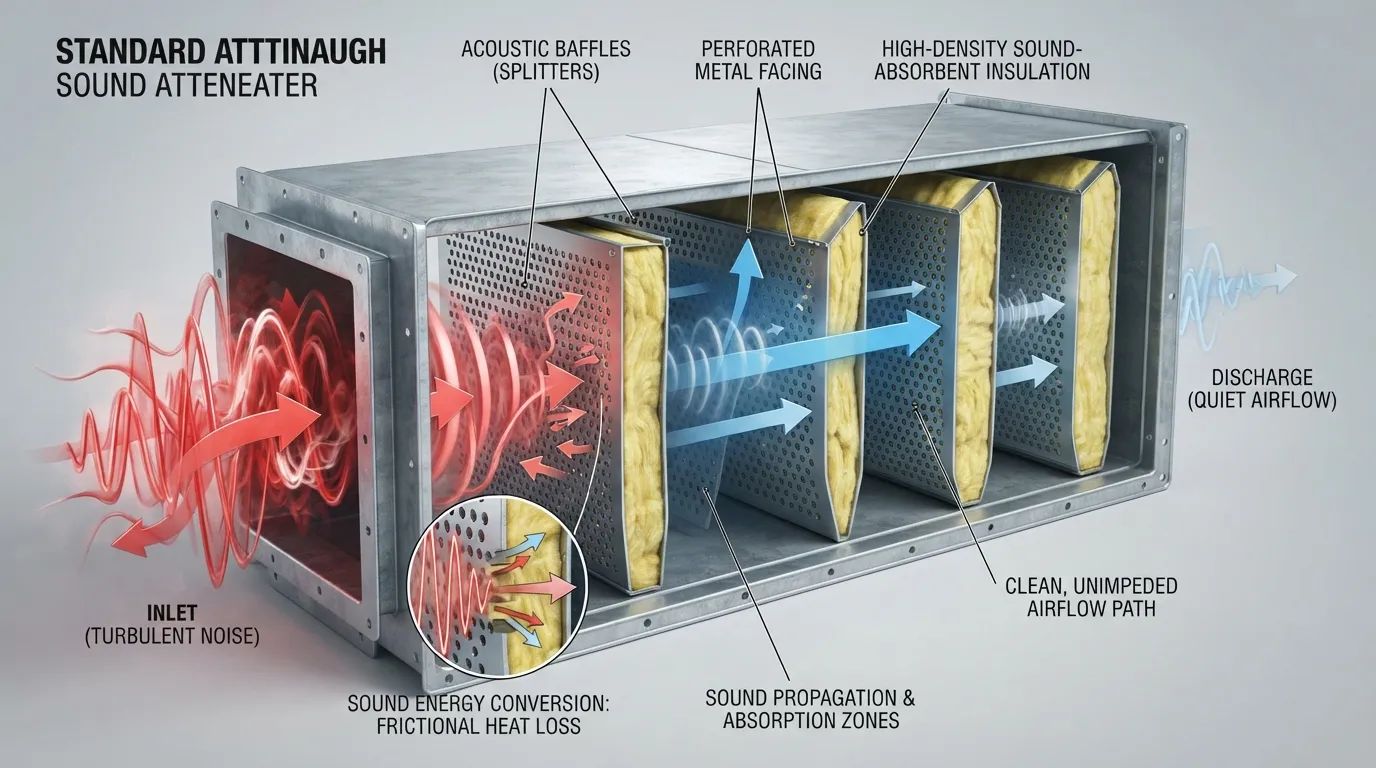 Sound attenuators reduce noise by deploying specialized physical and electro-acoustic mechanisms that target acoustic energy traveling through ventilation ducts [00:00:22]. By manipulating sound waves via friction, reflection, and phase cancellation, they significantly lower decibel levels before air enters occupied zones.
Absorption Mechanism Fiberglass Mineral Wool + Friction-to-Heat Conversion
Absorptive silencers rely on porous media such as fiberglass or mineral wool housed behind perforated metal baffles [00:00:30]. As sound waves travel down the duct, they penetrate the perforated surfaces and force air molecules within the porous material to vibrate.
- Friction Conversion: The continuous oscillation creates internal frictional resistance among the fibers.
- Thermal Dissipation: This mechanical friction converts acoustic wave energy into minute, harmless amounts of thermal heat, diminishing sound intensity.
Reflection Mechanism Baffles Reflective Surfaces Multiple Pathways
Reflective sound attenuators use engineered internal geometry, baffles, and abrupt cross-sectional area changes to disrupt wave propagation [00:00:30]. Instead of absorbing the sound, they redirect it back toward the noise source.
- Wave Interference: Reflected waves collide with incoming waves, creating destructive interference that cancels out specific frequencies.
- Path Deviation: Multiple curved pathways force sound waves to bounce repeatedly, causing energy loss with every directional shift.
Reactive Mechanism Chambers Helmholtz Resonators Gap Fill
Reactive silencers tackle low-frequency rumble—which easily passes through basic absorptive linings—by utilizing tuned acoustic chambers and expansion volumes [00:03:28].
- Expansion Chambers: Sudden changes in duct cross-section reflect specific frequency bands back toward the fan.
- Helmholtz Resonators: Tuned neck-and-cavity slots trap targeted low frequencies, forcing air inside the cavity to resonate and cancel out the incoming tone.
Diffuser Mechanism Depressive Silencers Gap Fill
Diffuser-type or depressive attenuators manage high-velocity, turbulent air discharge directly at the source, smoothing out pressure spikes before noise can fully form.
- Velocity Reduction: Gradually expanding cross-sections lower airflow velocity without causing severe static pressure loss.
- Turbulence Smoothing: Eliminates sharp pressure eddies that typically generate high broadband whistling sounds in system transitions.
Active Noise Cancellation Mechanism Gap Fill Electro-Acoustic Method
Modern advanced systems incorporate active noise control to neutralize stubborn low-frequency tones using smart electronic integration.
- Digital Sensing: Microphones pick up incoming duct noise waveforms in real-time right before they pass through the assembly.
- Anti-Phase Generation: Digital signal processors generate an exact inverse sound wave (anti-phase) through secondary speakers, actively nullifying the noise.
Types of Sound Attenuators by Noise Reduction Mechanism
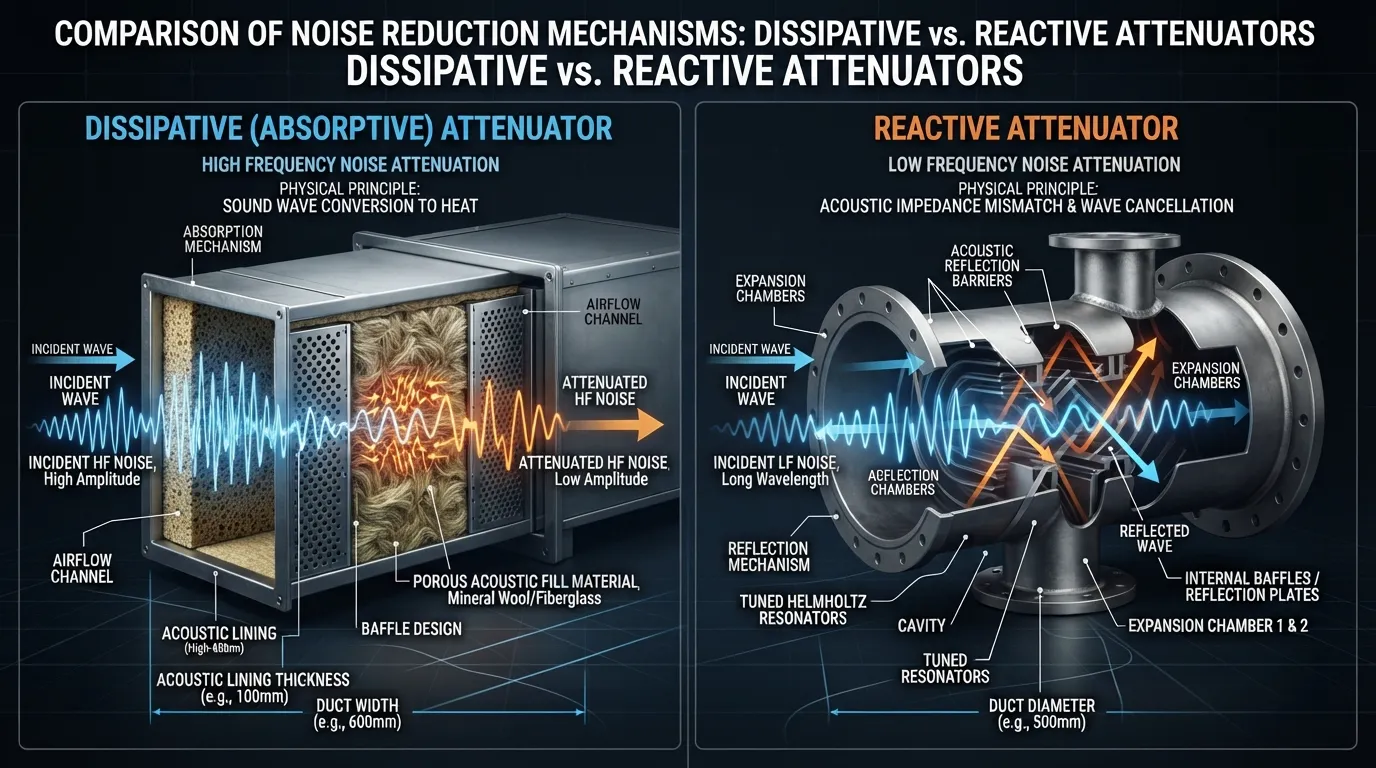 Sound attenuators are categorized based on their underlying acoustic working principles, allowing mechanical engineers to match specific equipment designs to the unique noise profiles of commercial and industrial HVAC installations. Selecting the correct mechanism ensures optimal decibel reduction across targeted frequency bands.
Absorptive Dissipative Attenuators
Absorptive or dissipative attenuators are the most widely specified units in standard commercial ventilation systems. They utilize internal acoustic media—such as acoustic-grade fiberglass or mineral wool—protected by perforated metal facings to trap sound waves.
- Frequency Range: Highly effective at dampening mid-to-high frequency airborne noises like fan blade rotation and high-velocity turbulence.
- Design Trade-Off: Offers high acoustic performance but introduces moderate static pressure drop and requires packed media that may need protective liners for cleanroom environments.
Reactive Attenuators
Reactive attenuators rely on acoustic reflection, expansion chambers, and internal baffle geometry rather than fibrous padding. They bounce sound waves back toward the source to achieve cancellation without relying on porous absorption materials.
- Frequency Range: Specially engineered to target troublesome low-frequency rumbles and tones generated by large centrifugal or axial fans.
- Design Trade-Off: Clean and maintenance-friendly since they lack fibrous packing, but they have a narrower frequency band of effectiveness compared to absorptive models.
Combination Hybrid Attenuators
Combination or hybrid attenuators merge both absorptive and reactive technologies into a single housing to deliver comprehensive, broad-spectrum acoustic control. They feature tuned chambers alongside fibrous baffles.
- Frequency Range: Exceptional performance across a wide broadband spectrum, simultaneously suppressing low-frequency hums and high-frequency hisses.
- Design Trade-Off: Typically larger in physical footprint and heavier, requiring robust structural support hangers within the duct network.
Diffuser Depressive Attenuators
Diffuser or depressive attenuators utilize aerodynamic expansion shapes to stabilize erratic airflow right after high-pressure discharge points. They treat the root cause of noise by smoothing out pressure turbulence.
- Frequency Range: Targets broad-spectrum aerodynamic whistling and roaring caused by rapid pressure changes and flow separation.
- Design Trade-Off: Excellent at controlling air regeneration noise, though they require careful layout planning to fit within tight mechanical room constraints.
Active Attenuators
Active attenuators represent the cutting edge of HVAC acoustics, combining traditional ductwork layouts with digital signal processing and electro-acoustic technology. They synthesize counter-noise on the fly.
- Frequency Range: Unmatched precision in neutralizing ultra-low frequency pulsations where passive silencers become too bulky or ineffective.
- Design Trade-Off: Higher initial capital expenditure and electrical power requirements due to onboard sensors, controllers, and speakers.
Types of Sound Attenuators by Construction & Lining Material
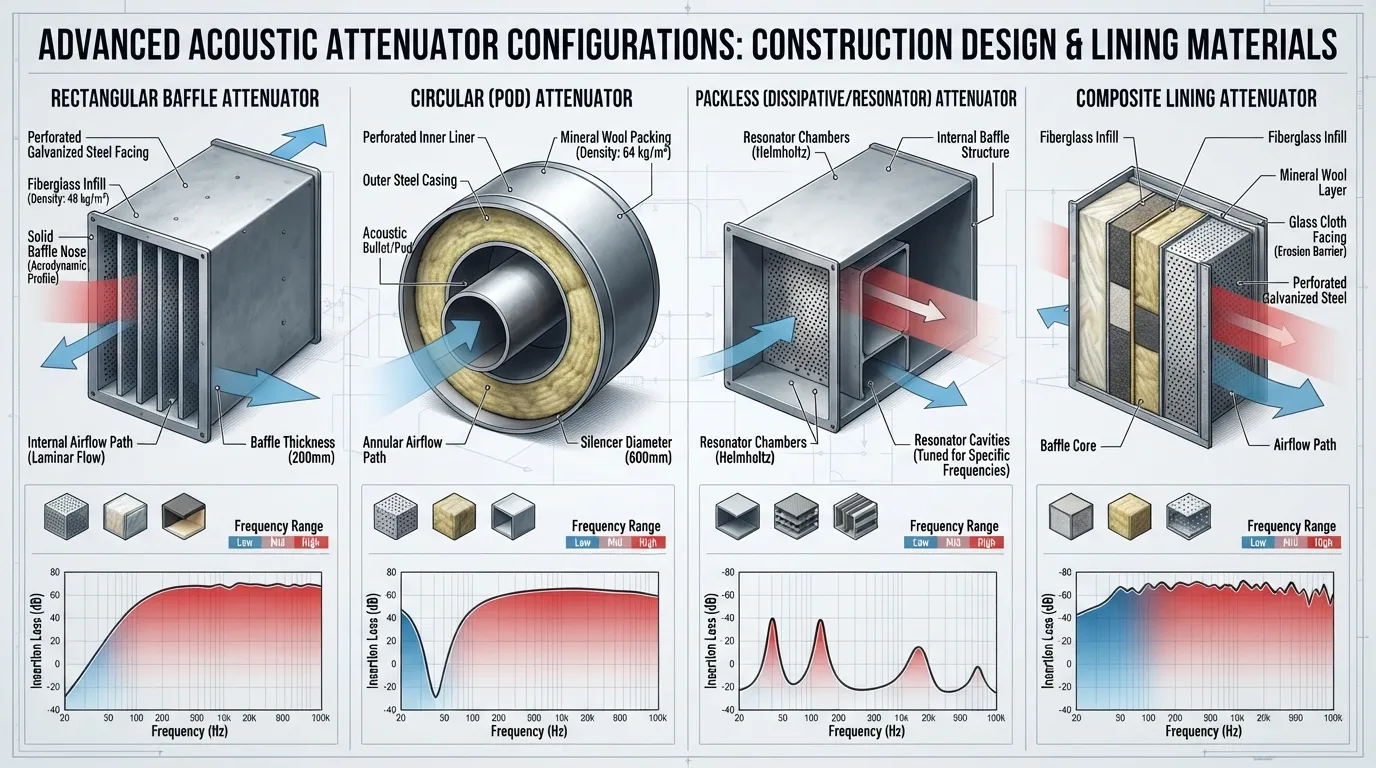 Selecting the correct construction and lining material is critical for matching sound attenuators to strict environmental hygiene, indoor air quality, and cleanroom standards. Different interior configurations dictate how well a silencer resists moisture, particulate shedding, and microbial growth.
Standard Packed Dissipative Lining
Standard packed attenuators feature exposed acoustic-grade fiberglass or mineral wool directly behind perforated metal facings. This traditional construction delivers maximum broadband sound absorption for standard commercial office buildings, retail spaces, and general industrial facilities.
- Air Quality Consideration: Suitable for standard HVAC zones where airstreams do not demand specialized particulate filtration beyond regular air handling unit filters.
- Maintenance Profile: Requires periodic inspection in high-moisture environments to prevent potential material degradation over decades of continuous operation.
Film-Lined Mylar Bagged Hospitals & Cleanrooms
Film-lined attenuators encase the internal fibrous packing within thin, impermeable protective membranes—typically Tedlar, Mylar, or sealed polyethylene bags—before securing them behind perforated metal. This barrier prevents airborne glass fibers and moisture from entering the airstream.
- Healthcare Compliance: Widely specified for hospitals, surgical suites, and pharmaceutical manufacturing to satisfy stringent cleanroom cleanliness standards.
- Moisture Resistance: Effectively stops humidity and water vapor from saturating the internal acoustic media during high-humidity operational cycles.
Packless No-Media Attenuators Zero-Particulate Applications
Packless or no-media attenuators eliminate fibrous sound-absorbing materials entirely, relying strictly on reactive geometry, resonant chambers, and tuned internal baffles to quiet the ductwork. Because there is no insulation inside, they eliminate the risk of media erosion entirely.
- Zero Particulate Shedding: Ideal for microelectronics fabrication cleanrooms, high-purity laboratories, and critical containment facilities.
- Sanitation Advantage: Easily washed down and sterilized with chemical agents without damaging internal acoustic components.
Mold-Resistant & Fiber-Free Options Practical Expert Insight
Advanced fiber-free options utilize specialized open-cell metal foams, sintered porous metals, or hydrophobic polymer matrix cores that inherently resist microbial growth. These materials solve long-term operational challenges in humid climates where traditional organic binders might degrade.
- Microbial Prevention: Eliminates organic nutrient sources required by mold and bacteria, protecting indoor air quality against bio-contamination.
- Expert Recommendation: Highly advised for tropical environments or natatoriums (indoor swimming pools) where persistent moisture accelerates organic media decay.
Types of Sound Attenuators by Shape & Geometry
The physical geometry and shape of a sound attenuator must match the architectural layout of the ventilation ductwork and available mechanical room space. Different configurations optimize airflow dynamics, fit seamlessly into tight ceiling plenums, or solve unique acoustic transmission problems.
Rectangular Attenuators Standard Lengths: 3, 5, 7, 9 ft
Rectangular attenuators are the most common modular units used in commercial duct networks, featuring parallel internal splitters that divide the airflow channel. They are manufactured in standard modular lengths of 3, 5, 7, and 9 feet to provide incremental levels of acoustic insertion loss.
- System Integration: Easily connects to standard rectangular sheet metal ductwork leaving large central air handling units.
- Custom Sizing: Splitter thickness and air passage widths can be adjusted during manufacturing to balance noise reduction with acceptable static pressure drops.
Circular Cylindrical Attenuators Bullet-Shaped Core
Circular or cylindrical attenuators are designed specifically for round spiral duct systems, commonly found directly downstream of inline fans or packaged air conditioning units. Many models incorporate a central bullet-shaped acoustic pod that streamlines airflow.
- Aerodynamic Efficiency: The aerodynamic center body reduces pressure loss and eliminates turbulent wakes compared to blunt rectangular splitter entries.
- Structural Strength: Naturally rigid tubular casing construction handles high-pressure duct systems without requiring external structural reinforcement ribs.
Elbow Bend Attenuators Space-Saving Design
Elbow silencers are engineered to replace standard 90-degree or 45-degree duct turns while providing built-in sound attenuation. They solve severe spatial constraints in mechanical shafts where straight-run duct paths are unavailable.
- Spatial Footprint: Eliminates the need for separate straight silencers immediately following a directional change, saving valuable ceiling plenum height.
- Acoustic Benefit: Naturally capitalizes on the directional change to scatter high-frequency noise components against internal acoustic splitters.
Cross-Talk Attenuators Speech Privacy Office Hotel Use
Cross-talk silencers are specialized low-profile units installed between adjacent private rooms, executive offices, conference centers, or hotel suites to prevent confidential conversations from traveling through shared transfer ducts.
- Acoustic Isolation: Features convoluted or zigzag internal baffling that disrupts voice frequencies while permitting necessary passive return air equalization.
- Privacy Protection: Ensures high speech privacy ratings without requiring motorized dampers or complex active balancing systems.
Air-Relief Silencers Specialty Gap Fill
Air-relief silencers are compact, specialized units integrated into doors, walls, or partition transfers to manage airflow and sound transmission simultaneously in specialized containment or broadcasting zones.
- Pressure Equalization: Allows balanced pressure transfer between sealed rooms without compromising acoustic isolation boundaries.
- Compact Deployment: Ideal for recording studios, server rooms, and medical testing booths requiring strict environmental control.
Comparison Table Which Sound Attenuator Type Should You Choose?
Choosing the correct sound attenuator requires balancing acoustic insertion loss requirements, allowable static pressure drops, spatial limitations, and project budgets. The following comparative breakdown evaluates each primary attenuator type to guide optimal selection for commercial and industrial mechanical systems.
Quick Comparison Table
Advanced Selection Factors & Performance Metrics
 Selecting and sizing a sound attenuator requires moving past basic catalog data to evaluate complex aerodynamic and acoustic interactions within the ductwork. Mastering advanced performance metrics ensures that mechanical designs achieve desired interior noise criteria without unexpected pressure penalties or acoustic failures.
Dynamic Insertion Loss DIL vs. Static Insertion Loss What’s the Real Difference
Laboratory testing protocols—governed by standards such as the ASTM E477 standard—measure static insertion loss under ideal, undisturbed airflow conditions. However, real-world systems experience turbulent air profiles.
- Static Loss Limitations: Static ratings assume uniform air distribution across the silencer face, which rarely occurs immediately downstream of fans or elbows.
- Dynamic Realities: Dynamic Insertion Loss (DIL) accounts for actual air velocity and flow profiles, providing a realistic prediction of how the silencer will perform installed in the field.
Self Noise SN The Sound Attenuators Create Themselves
Paradoxically, sound attenuators can actually become noise generators if air velocity through the device exceeds recommended design limits. As high-speed air rushes past perforated metal facings and internal splitters, it generates aerodynamic self-noise.
- Turbulence Interaction: Friction between the moving air stream and internal baffles creates broadband self-noise that can mask the insertion loss benefits.
- Engineering Balance: Sizing duct cross-sections to maintain face velocities below manufacturer-recommended thresholds prevents self-noise interference.
System Effect Why Real-World Pressure Drop Can Double or Triple Practical First-Hand Insight
Catalog pressure drop numbers typically reflect straight, unobstructed laboratory airflow entering and leaving the silencer. In actual mechanical rooms, poor duct connections create severe system effects.
- Non-Uniform Flow: Placing an attenuator directly downstream of an axial fan or tight elbow causes skewed airflow, spiking the static pressure loss.
- Design Mitigation: Providing straight duct run requirements—typically 3 to 5 duct diameters upstream and downstream—allows airflow to stabilize before entering the silencer.
Break-Out Noise & High Transmission Loss HTL Casings Practical Insight
High-velocity noise inside a duct can easily penetrate standard sheet metal walls, radiating directly into adjacent mechanical rooms or occupied ceiling spaces via break-out noise.
- Casing Integrity: Standard single-wall casings allow sound to escape through the housing walls, bypassing downstream attenuation entirely.
- HTL Specification: Upgrading to High Transmission Loss (HTL) double-walled casings with heavier exterior gauges or mass-loaded dampening barriers locks the noise inside the ductwork.
Low-Frequency Physics Why a 63 Hz Wave Needs an 18-Foot-Long Attenuator Unique Technical Depth
Controlling low-frequency sound is one of the greatest engineering challenges in HVAC acoustics due to fundamental wave physics. Low-frequency tones have exceptionally long wavelengths.
- Wavelength Scale: A 63 Hz sound wave has a wavelength of roughly 18 feet, meaning standard 3-foot silencers pass these low tones almost completely unaffected.
- Physical Requirement: Achieving meaningful low-frequency insertion loss requires extended silencer lengths, reactive tuning chambers, or active noise control systems.
Regenerated Noise & Airflow Turbulence
Regenerated noise occurs when sharp pressure eddies collide with internal baffle edges, creating a persistent roaring sound. Designers must balance acoustic attenuation against maximum allowable pressure drops to keep air velocities within quiet operating parameters.
- Velocity Limits: Keeping open-face velocities within standard engineering limits prevents aerodynamic whistling and rumble regeneration.
- Aerodynamic Transitions: Utilizing tapered splitter nosecones helps split incoming air cleanly, minimizing turbulence generation.
Maintenance & Accessibility Considerations
Long-term acoustic performance depends heavily on the physical longevity of internal materials and accessibility for periodic inspection. Specifying removable splitters or inspection access doors ensures that lint, dust, or moisture accumulation can be managed without duct demolition.
- Inspection Access: Placing access panels directly upstream and downstream of major attenuators allows facilities teams to check for media erosion or moisture build-up.
- Filtration Protection: Ensuring upstream air filters are rigorously maintained prevents particulate loading from degrading absorptive media over time.
For Contractors vs. For Consulting Engineers Practical Tips
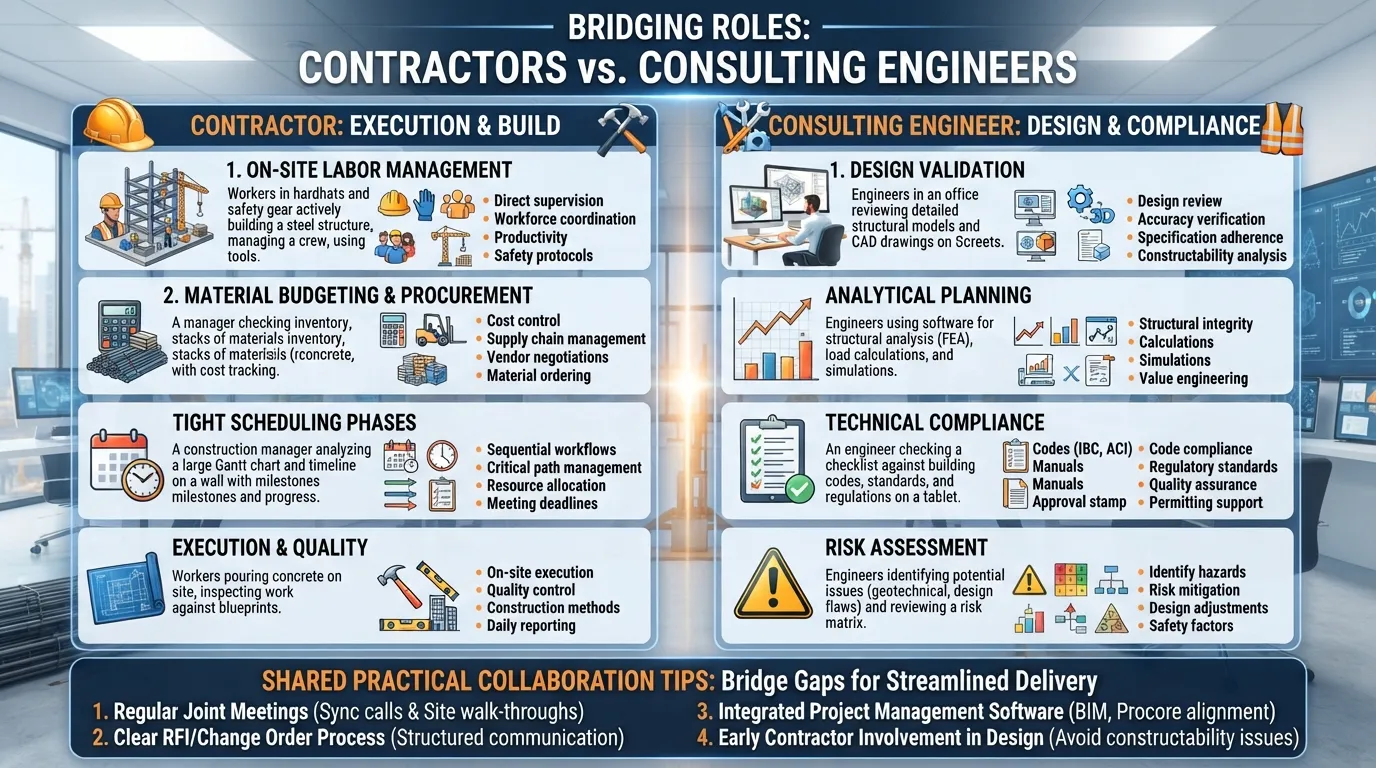 Successful HVAC noise mitigation depends on clear coordination between mechanical contractors installing the equipment and consulting engineers designing the acoustic specifications. Aligning installation realities with design intent prevents costly on-site delays, performance failures, and schedule revisions.
Contractor Checklist: Don’t Cut Attenuator Length Without Checking the Design Team
Field modifications to sound attenuators can completely compromise acoustic performance, turning an expensive silencer into an ineffective piece of straight ductwork. Contractors must prioritize schedule integrity and acoustic compliance during installation.
- Length Integrity: Never trim or shorten a sound attenuator on-site to fit tight space constraints without consulting the mechanical engineer; insertion loss is directly proportional to length.
- Hanger Support: Ensure silencers are independently supported by structural hangers rather than relying on adjoining sheet metal ductwork to bear their substantial weight.
- Sealing & Gasketing: Apply heavy-duty acoustic sealants and proper gasketing at all flanged connections to prevent air leakage and pressure loss.
Engineer Checklist: Adjust DIL Values If Length Changes on the Schedule
Value engineering change orders or spatial clashes frequently force changes to equipment schedules, requiring careful recalculations to maintain interior noise criteria. Design engineers must verify acoustic impacts before approving dimensional swaps.
- Recalculate DIL: If a 7-foot attenuator is swapped for a 5-foot model due to space constraints, re-evaluate the Dynamic Insertion Loss across all octave bands to ensure NC levels are not exceeded.
- Verify Pressure Drop: Check that increased face velocities resulting from shortened silencer configurations do not push total system static pressure beyond fan design limits.
- Specify HTL Clearances: Clearly indicate on drawings where High Transmission Loss casings are required to prevent break-out noise in sensitive architectural zones.
When to Involve an Acoustical Consultant
While standard commercial projects can rely on manufacturer selection software, complex or high-stakes environments demand specialized third-party acoustic expertise. Bringing in a consultant early prevents expensive retrofits after construction completion.
- Sensitive Environments: Engage acousticians early for recording studios, performing arts centers, hospitals, and luxury high-rises with strict noise criteria ratings.
- Vibration and Structure-Borne Noise: Consult specialists when equipment rooms sit directly above noise-sensitive spaces, requiring combined floating floors and advanced silencers.
- Troubleshooting Post-Construction: Bring in certified acoustic engineers equipped with sound-level meters to diagnose field performance discrepancies if a completed installation fails noise criteria testing.
How Much Do HVAC Sound Attenuators Cost?
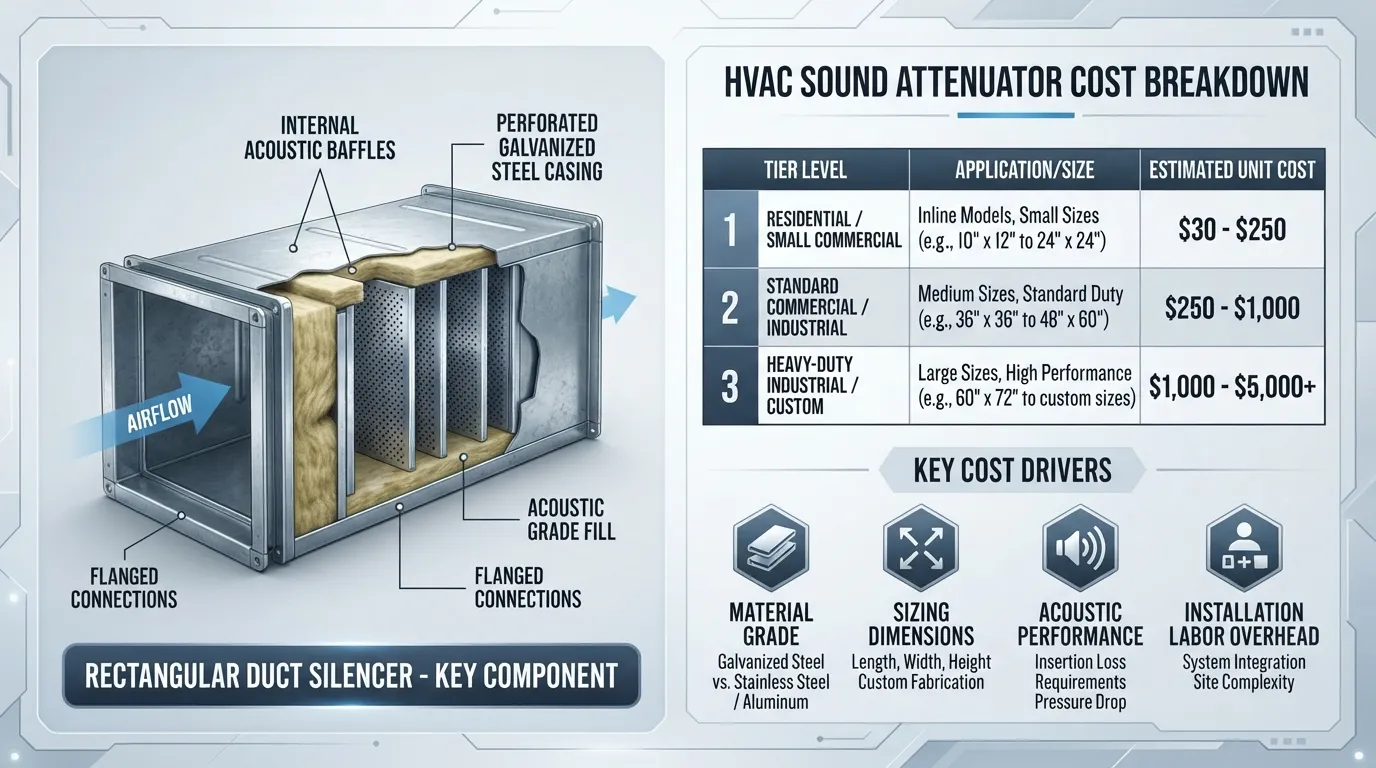 Understanding the financial investment required for HVAC sound attenuators is essential for accurate mechanical budgeting and project estimation. Because attenuators are custom-configured engineered products rather than off-the-shelf commodities, pricing varies widely based on several mechanical and acoustic parameters.
Factors That Affect Sound Attenuator Pricing Size Type Material Custom vs Standard
The final procurement cost of a duct silencer depends heavily on physical dimensions, performance requirements, and specialized manufacturing options. Evaluating these cost drivers helps project managers optimize their equipment budgets.
- Physical Dimensions: Larger cross-sectional areas and extended lengths (such as 7-foot or 9-foot modular units) require significantly more raw sheet metal and internal acoustic media.
- Construction Materials: Upgrading from standard galvanized steel to marine-grade aluminum, 304/316 stainless steel, or specialized acoustic fill increases material costs.
- Specialized Linings: Cleanroom-grade Mylar wrapping, Tedlar films, or packless reactive construction add manufacturing steps that raise the unit price.
Custom vs. Off-the-Shelf Attenuators: Cost Trade-Off
While standard rectangular and circular models are mass-produced in typical nominal sizes and offer lower price points, unique architectural constraints often require custom fabrication.
- Standard Modular Units: Readily available from major manufacturers with predictable lead times and lower unit costs for standard commercial applications.
- Custom Engineered Units: Designed for unusual duct geometries, extreme high-pressure drops, or severe low-frequency noise issues, carrying higher fabrication expenses and longer delivery windows.
Cost vs. Acoustic Performance Balance
Value engineering exercises frequently tempt project teams to downgrade attenuator specifications to reduce initial capital expenditure. However, compromising on insertion loss to save money can lead to expensive post-construction remediation.
- Risk of Undersizing: Choosing a cheaper, shorter silencer that fails to meet required Noise Criteria (NC) levels can result in costly retrofits, silencer replacements, or tenant dissatisfaction.
- Long-Term Value: Investing in the correct attenuator type and casing class during initial installation guarantees regulatory compliance and acoustic comfort without secondary expenses.
Other Ways to Reduce HVAC Noise Beyond Attenuators
While sound attenuators are critical components for silencing ductborne noise, comprehensive acoustic design requires a multi-layered approach. Combining duct silencers with vibration isolation, strategic equipment placement, and internal duct treatments ensures optimal quietness throughout a building.
Duct Lining & Insulation
Applying acoustic thermal insulation or fiberglass duct liner to the interior of sheet metal ductwork provides distributed high-frequency sound absorption along entire runs. This treatment dampens breakout noise and reduces fan rumble before it reaches room diffusers.
- Broadband Absorption: Lines continuous duct runs to soak up high-frequency whistling and turbulent air friction sounds.
- Thermal Dual-Duty: Provides essential thermal insulation to prevent condensation and maintain conditioned air temperatures.
Vibration Isolation for Equipment
Mechanical equipment like chillers, cooling towers, and air handling units generate massive mechanical vibrations that travel through structural building frames. Installing spring isolators, rubber pads, and flexible duct connectors stops vibrations before they convert into audible structure-borne noise.
- Inertia Bases: Heavy concrete equipment inertia bases stabilize heavy compressors and fans, lowering operational vibration amplitudes.
- Flexible Connections: Flexible canvas or rubber duct connections isolate fan vibration from rigid sheet metal ductwork networks.
Proper Equipment Placement & Duct Layout
Thoughtful architectural planning of mechanical rooms keeps noisy equipment away from noise-sensitive spaces like boardrooms, bedrooms, and operating theaters. Strategic routing minimizes abrupt turns and high-velocity restrictions.
- Buffer Zones: Use non-sensitive utility areas, storage rooms, or corridors as acoustic buffer zones around primary mechanical equipment spaces.
- Smooth Transitions: Design gradual duct transitions and wide radius elbows to prevent flow separation and aerodynamic noise generation.
Combining Multiple Noise Control Strategies
Achieving strict acoustic criteria in luxury hotels, recording studios, or hospitals requires integrating sound attenuators with floating floors, acoustic drywall partitions, and silencers simultaneously. A comprehensive strategy covers airborne, ductborne, and structure-borne noise pathways concurrently.
- Holistic Engineering: Coordinates equipment selection, duct silencing, and architectural room acoustics during the early schematic design phase.
- Guaranteed Compliance: Eliminates acoustic flanking paths to ensure the completed installation passes final third-party sound testing without expensive retrofits.
Frequently Asked Questions
Find direct answers to the most common questions regarding HVAC sound attenuator selection, performance mechanics, cost factors, and potential system trade-offs to guide your mechanical engineering decisions.
What are the different types of sound attenuators?
Sound attenuators are categorized by their noise-reduction mechanism, construction materials, and physical shape. The primary mechanism types include absorptive (dissipative), reactive, combination (hybrid), diffuser (depressive), and active attenuators, alongside specialized configurations like rectangular, circular, elbow, and cross-talk silencers.
What is a sound attenuator for HVAC?
A sound attenuator—also commonly called a duct silencer or muffler—is an engineered ventilation control device installed within HVAC ductwork. Its primary purpose is to absorb, reflect, or cancel airborne and ductborne fan noise before it reaches occupied rooms.
Do attenuators reduce noise?
Yes, attenuators significantly reduce noise by lowering decibel levels across targeted frequency bands. They utilize specialized internal media, expansion chambers, or electronic anti-phase cancellation to dissipate acoustic energy generated by fans and airflow turbulence.
What are the disadvantages of using a sound attenuator?
The primary drawbacks of using sound attenuators include introducing a static pressure drop that requires increased fan energy, adding physical weight that demands structural duct support, and taking up valuable ceiling plenum space.
Which is the best type of sound attenuator?
There is no single “best” attenuator, as the ideal choice depends entirely on project requirements. Absorptive units are best for general mid-to-high frequency commercial noise, reactive units excel at low-frequency fan rumble, and film-lined models are required for cleanrooms and hospitals.
How do I choose the right sound attenuator?
Choosing the right attenuator requires evaluating peak noise frequency bands, required Dynamic Insertion Loss (DIL), allowable static pressure drop, spatial limitations in the ceiling plenum, and environmental hygiene standards such as cleanroom or hospital requirements.
How much does a sound attenuator cost?
Sound attenuator costs vary widely based on physical dimensions, modular lengths, construction materials (such as stainless steel upgrades), and whether the unit is an off-the-shelf standard model or a custom-engineered fabrication for specialized low-frequency or cleanroom applications.
Conclusion & Key Takeaways
Mastering HVAC acoustic design requires a thorough understanding of sound attenuator types, working mechanisms, and performance metrics. Selecting the correct silencer ensures that mechanical systems deliver exceptional indoor air comfort without compromising airflow efficiency or budgetary constraints.
Recap: Choosing the Right Attenuator for Your Application
Selecting the optimal sound attenuator is a balancing act between acoustic insertion loss, allowable pressure drop, physical space limitations, and environmental hygiene requirements. Keeping these core principles in mind guarantees long-term operational success.
- Match the Mechanism: Use absorptive units for high-frequency fan hiss, reactive units for low-frequency rumble, and hybrids for broad-spectrum control.
- Prioritize Hygiene: Specify film-lined or packless attenuators for hospitals, cleanrooms, and moisture-prone facilities to prevent media contamination.
- Account for System Dynamics: Always factor in Dynamic Insertion Loss, potential system effects, and self-noise limitations during the engineering design phase.

Oscar Vance | Master Plumber & Drainage Expert
Meet Oscar Vance, a licensed master plumber sharing practical solutions on residential repairs, preventive maintenance, and thoughtful home upkeep.