Top 5 Primary Uses of Glycol in HVAC Systems
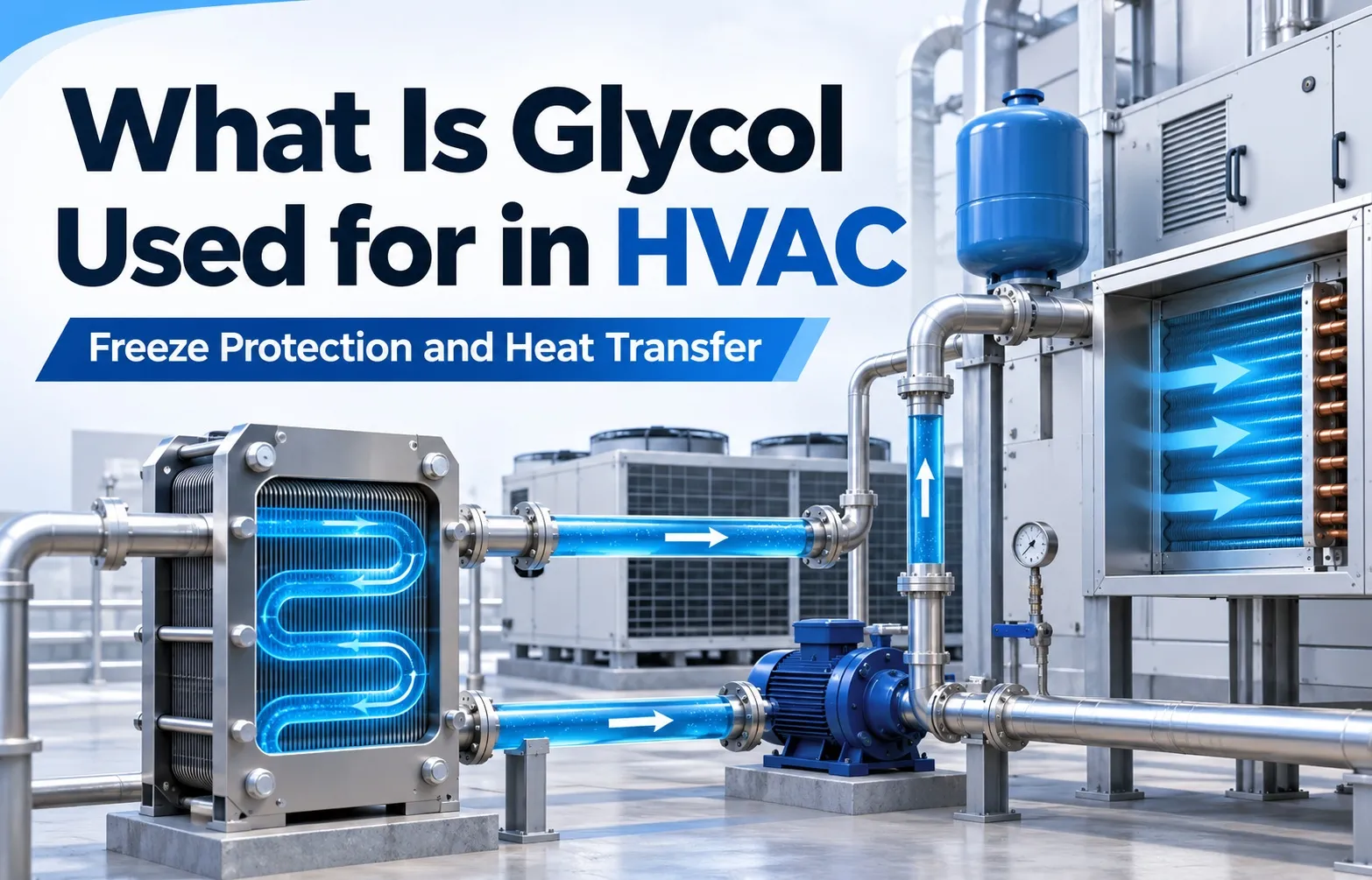 HVAC engineers and facility managers rely on glycol-water solutions to handle extreme thermal loads across diverse commercial and residential applications. Understanding these core uses ensures proper fluid selection and long-term system integrity.
Freeze and Burst Protection in Cold Climates
Water expands significantly when it freezes, which can rupture copper tubing, cast-iron boilers, and chiller barrels. Adding glycol suppresses the fluid freezing point, converting expanding ice into a pumpable slush or preventing freezing entirely during deep winter freezes.
- Protects commercial rooftop units and unconditioned mechanical rooms.
- Safeguards secondary piping loops exposed to ambient outdoor air.
- Eliminates catastrophic repair costs associated with winter pipe failures.
Chilled Water Systems and Air Handlers
Central air conditioning systems frequently circulate chilled water through air handling units (AHUs) and fan coil units. Glycol prevents cooling coils from accidentally freezing during low-ambient economizer operation or sudden load drops.
- Maintains continuous heat transfer efficiency under low outdoor temperatures.
- Prevents ice buildup from restricting airflow across evaporator coils.
- Ensures stable temperature control in critical data centers and commercial buildings.
Geothermal Heat Pumps and Solar Thermal Loops
Ground-source heat pumps and rooftop solar thermal collectors experience extreme temperature fluctuations. Earth loops can drop below freezing during heavy winter heating cycles, while solar panels can reach stagnation temperatures in summer.
- Protects subterranean polyethylene earth loops from freezing surrounding soil and cracking.
- Withstands high stagnation heat in solar thermal panels without boiling off or degrading prematurely.
- Maintains balanced fluid viscosity for optimal circulator pump performance.
Hydronic Radiant Heating and Snowmelt Systems
Hydronic radiant floor heating and outdoor concrete snowmelt systems rely on continuous fluid circulation. Because snowmelt systems operate directly beneath driveways and walkways in freezing weather, robust freeze protection is mandatory.
- Keeps fluid moving freely through exterior concrete slabs during blizzards.
- Provides reliable residential floor heating without risk of freeze-ups in perimeter zones.
- Reduces thermal shock to boilers when starting up in sub-zero ambient conditions.
Internal Corrosion, Scale, and Algae Inhibition
Raw water is highly corrosive to closed-loop metal components and promotes biological growth. Commercial HVAC glycols come pre-mixed with specialized chemical packages to protect the entire plumbing infrastructure.
- Forms a microscopic protective film over copper, steel, brass, and aluminum surfaces.
- Neutralizes organic acids to prevent premature pinhole leaks in piping.
- Lubricates mechanical pump seals and reduces friction head loss across valves.
Propylene Glycol vs. Ethylene Glycol: Which One Does Your System Need?
Selecting between propylene glycol and ethylene glycol depends primarily on local plumbing codes, human health safety, and system thermal load requirements. While both fluids prevent freezing, their toxicity profiles and heat transfer efficiencies differ significantly.
Propylene Glycol (Non-Toxic & Food-Grade Standard)
Propylene glycol is a non-toxic, biodegradable fluid classified by the FDA as Generally Recognized as Safe (GRAS). It is the mandatory choice for any HVAC system where accidental leakage could result in potable water cross-contamination or human exposure.
- Approved Environments: Residential homes, hospitals, schools, food processing plants, and pharmaceutical facilities.
- Plumbing Code Compliance: Meets strict ASHRAE standards and local building codes for single-wall heat exchangers connected to domestic water heaters.
- Thermal Trade-Off: Exhibits slightly higher fluid viscosity and lower thermal conductivity than ethylene glycol, requiring marginally higher pumping power at sub-zero temperatures.
Ethylene Glycol (High-Efficiency Industrial Grade)
Ethylene glycol is an industrial-grade heat transfer fluid prized for its superior thermal conductivity and low pumping resistance. However, because it is acutely toxic if ingested by humans or animals, its use is strictly regulated.
- Approved Environments: Isolated commercial chillers, industrial manufacturing plants, district cooling loops, and outdoor snowmelt systems with zero domestic water contact.
- Superior Thermal Performance: Transfers heat more efficiently and flows more easily at extreme low temperatures than propylene glycol.
- Containment & Disposal Rules: Requires backflow preventers, double-wall heat exchangers where applicable, and hazardous waste disposal protocols during system flushes.
Side-by-Side Comparison Matrix: Propylene vs. Ethylene Glycol
Always choose inhibited glycol formulations engineered specifically for HVAC systems rather than raw base glycols, which quickly oxidize and corrode metal piping.
Glycol Concentration Ratios & Freeze Protection Chart
Determining how much glycol to add to your heating or cooling system is critical for preventing pipe ruptures without sacrificing thermal performance. Selecting the correct glycol concentration ratio requires balancing local winter ambient lows against system flow requirements.
Glycol-to-Water Freeze & Burst Protection Table
Maintaining the proper mix ensures that your fluid protects against both freezing (crystallization) and bursting (solid ice expansion). When mixing your system, always use distilled or deionized water to prevent hard water minerals from prematurely consuming chemical corrosion inhibitors.
For deep technical insights into fluid thermodynamic properties and heat transfer fluid standards, refer to documentation provided via U.S. Department of Energy research archives.
Why You Must Never Use 100% Pure Glycol
A common misconception among DIY maintainers is that pouring pure, undiluted glycol into an HVAC system provides maximum protection. In reality, pure ethylene or propylene glycol freezes at a much higher temperature than a properly proportioned water mixture (pure propylene glycol freezes at roughly +9°F).
- Severe Viscosity Penalties: Undiluted glycol becomes thick and syrupy, drastically reducing pump flow rates and causing motor strain.
- Thermal Transfer Breakdown: Pure glycol’s heat capacity is less than half that of water, crippling your system’s ability to absorb or reject heat.
- Optimal Concentration Ceiling: Never exceed a 60% glycol concentration ratio; higher mixtures degrade thermodynamic performance and accelerate component wear.
The Hidden Engineering Trade-Offs of Using Glycol
While adding glycol is essential for freeze protection, MEP engineers understand that it introduces distinct thermodynamic and hydraulic penalties. Transitioning a closed-loop system from pure water to a glycol-water mixture alters system performance, requiring careful adjustments during the design and balancing phases.
Reduced Heat Transfer Capacity (Specific Heat Penalty)
Water has an exceptionally high specific heat capacity, making it the benchmark fluid for carrying thermal energy. Glycol, by contrast, holds significantly less heat per gallon, meaning your system must circulate more volume to deliver the exact same heating or cooling capacity.
- Requires 5% to 15% higher flow rate (GPM) adjustments to compensate for reduced thermal absorption.
- Demands larger coil surface areas or increased heat exchanger sizing in commercial air handlers.
- Can lead to temperature control lag if hydronic loop flow rates are not re-balanced after adding glycol.
Increased Viscosity and Pumping Energy Costs
Glycol solutions are inherently thicker and more viscous than pure water. This increased fluid viscosity elevates internal friction throughout the piping network, directly impacting pump performance and operating expenses.
- Causes higher pump head loss and increased pressure drop across valves, fittings, and coils.
- Forces circulator pumps to work harder, consuming more electrical energy to maintain required flow.
- Becomes particularly pronounced during cold-weather startups when thick fluid resistance spikes.
Expansion Tank Sizing Adjustments
Glycol mixtures possess a higher thermal expansion coefficient than plain water, meaning they expand more dramatically when heated from ambient temperatures to operating conditions. Failing to account for this can lead to frequent maintenance issues.
- Requires a larger diaphragm expansion tank capacity to accommodate the increased fluid volume swing.
- Prevents pressure relief valves from prematurely opening (“weeping”) due to thermal over-pressurization.
- Protects piping joints and mechanical seals from continuous pressure cycling and stress.
Field Maintenance, Testing & Critical Warnings
Maintaining a closed-loop HVAC system requires proactive field testing and strict adherence to fluid management protocols. Ignoring routine maintenance leads to severe corrosion, acid breakdown, and catastrophic component failures.
How to Test Glycol Concentration with a Refractometer
Verifying your system’s freeze protection requires precise field tools rather than guesswork. Simple floating-ball hydrometers are notoriously inaccurate when measuring glycol because fluid temperature fluctuations drastically skew density readings.
- Use an optical Brix refractometer with a specialized propylene or ethylene glycol temperature-compensated scale.
- Place a single drop of sampled loop fluid onto the prism glass and close the daylight plate.
- Look through the eyepiece toward a light source to read the exact freeze point intersection line instantly.
Monitoring pH Levels and Inhibitor Depletion
Over time, exposure to oxygen, heat, and metal catalysts causes glycol to oxidize and degrade into organic acids. This process, known as glycol acidification, turns the fluid corrosive and strips away protective chemical buffers.
- Test fluid pH regularly using high-precision pH test strips or a digital meter, maintaining a healthy target range between 8.5 and 10.0.
- Monitor reserve alkalinity to detect inhibitor depletion before corrosion compromises pipe walls.
- Flush and recharge the system entirely when pH drops below 7.0 or when inhibitor packages can no longer be replenished.
Warning: Never Use Automotive Antifreeze in HVAC Systems
A fatal DIY mistake is substituting commercial HVAC glycol with cheap automotive engine coolant. Car antifreezes are chemically engineered for internal combustion engines and contain aggressive additive packages that destroy closed-loop heating systems.
- Silicates, phosphates, and borates present in automotive coolants drop out of solution, gelling up and fouling heat exchangers.
- Abrasive additives grind down ceramic and carbon mechanical pump seals, causing rapid, expensive leaks.
- Automotive inhibitors deplete rapidly in closed hydronic loops, accelerating severe localized pitting and pinhole leaks.
Frequently Asked Questions About Glycol in HVAC
Should I put glycol in my home heating system?
You only need glycol in a residential hydronic boiler system if piping runs through unconditioned spaces like attics, crawlspaces, or garages, or if the property sits vacant during winter. Otherwise, pure water transfers heat more efficiently and avoids unnecessary pumping penalties.
- When to Add Glycol: Vacation homes, snowmelt driveways, and exposed exterior hydronic loops.
- When to Stick with Water: Fully conditioned living spaces with continuous winter occupancy and backup power.
How long does glycol last in an HVAC system?
High-quality inhibited commercial HVAC glycol typically achieves a fluid lifespan of 5 to 10 years, though industrial-grade formulations can last up to 15 years. Longevity depends heavily on operating temperatures, water quality used during initial mixing, and annual chemical inhibitor testing.
- Annual Testing Required: Check freeze point concentration and pH levels every heating season.
- Signs of Replacement: Dark discoloration, foul odor, or pH dropping below 7.5 indicate depleted inhibitors.
Does glycol build more pressure than water when heated?
Yes, glycol-water solutions have a higher coefficient of thermal expansion than plain water, meaning the fluid expands more significantly as system temperatures rise. Closed-loop systems require a properly sized diaphragm expansion tank to absorb this extra volume and prevent relief valve discharges.
- System Sizing Rule: Increase expansion tank volume by 10% to 20% when converting from water to a 50% glycol mix.
- Pressure Protection: Prevents nuisance pressure spikes and protects mechanical pump seals from over-pressurization.
Do all heat pumps need glycol?
No, standard split air-source heat pumps circulate chemical refrigerant between indoor and outdoor coils and never use glycol. Only hydronic systems—specifically outdoor air-to-water monobloc heat pumps and ground-source geothermal heat pumps—require glycol to protect water loops from freezing.
- Air-to-Water Monobloc Units: Require glycol because water lines run directly outdoors to the exterior heat exchanger.
- Geothermal Loops: Use glycol mixtures to prevent subterranean earth loops from freezing surrounding soil.
Is HVAC glycol hazardous to handle?
Hazard levels depend entirely on the chemical formulation specified on the product Safety Data Sheet (SDS). Propylene glycol is non-toxic and safe to handle with standard nitrile gloves, whereas ethylene glycol is acutely toxic if ingested and requires strict containment and disposal protocols.
- Propylene Glycol Safety: Non-toxic and biodegradable; rinse skin or eyes with clean water upon contact.
- Ethylene Glycol Precautions: Wear protective eyewear and gloves, prevent pet or wildlife access to spills, and dispose of used fluid as regulated waste.

Oscar Vance | Master Plumber & Drainage Expert
Meet Oscar Vance, a licensed master plumber sharing practical solutions on residential repairs, preventive maintenance, and thoughtful home upkeep.