How Long Does It Take to Become an HVAC Technician?
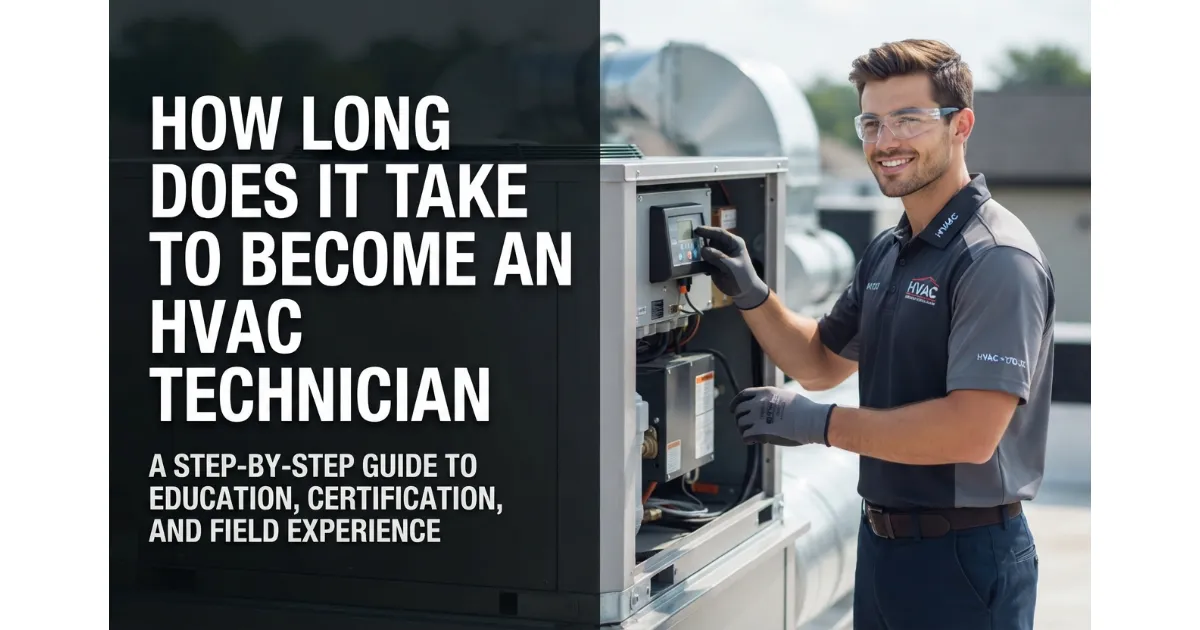 Becoming an HVAC technician typically takes anywhere from 6 months to 5 years, depending on the educational pathway and career depth you choose. While accelerated training gets you into entry-level roles quickly, comprehensive programs and field training ensure complete industry proficiency.
- Certificate Programs (6 months to 1 year): Designed for rapid career entry, these programs cover basic heating, ventilation, air conditioning, and refrigeration principles through technical schools or community colleges.
- Associate Degrees (2 years): Comprehensive programs that blend advanced technical theory with hands-on lab training for broader career opportunities and higher starting positions.
- Apprenticeships (3 to 5 years): Paid, hands-on training models where you work alongside seasoned professionals while completing required classroom instructional hours.
- State Licensing Requirements: Timelines are often shaped by regional regulations, which frequently mandate specific verified work hours, background checks, and EPA Section 608 certification before independent operation.
What Does HVAC Technician Actually Mean? Terminology Clarity
The term “HVAC technician” is a broad title that spans multiple career tiers, each representing distinct skill levels, responsibilities, and legal authorities. Understanding this hierarchy helps you map out your professional growth and earnings potential from day one.
Entry-Level Technician vs Journeyman vs Master Technician
Career progression in the heating, ventilation, air conditioning, and refrigeration industry is strictly structured around verified field experience, testing, and independent competence. Moving up the ladder shifts your focus from basic installations to complex diagnostics and system engineering.
- Entry-Level Technician: Works under direct supervision, focusing on preventative maintenance, basic filter replacements, and assisting senior techs on major installs.
- Journeyman HVAC Technician: Licensed professionals certified to install, diagnose, and repair residential and commercial systems independently without daily oversight.
- Master HVAC Technician: The highest operational tier, typically managing complex system design, troubleshooting difficult commercial failures, and mentoring junior staff.
Which Title Requires How Much Experience
Each milestone in the HVAC career ladder requires a specific combination of classroom hours, documented field experience, and state or national board examinations.
4 Main Paths to Becoming an HVAC Technician
Choosing the right educational route is the most critical decision in your HVAC career journey. Each path offers a different balance of upfront time, financial investment, and practical field experience to match your personal goals.
Certificate Programs 6–12 Months
Certificate programs at trade schools focus exclusively on core technical skills to fast-track your entry into the workforce. You learn essential electrical theory, refrigeration cycles, and heating fundamentals without general education requirements.
- Pros: Quick completion time, lower tuition costs, and immediate job readiness.
- Cons: Lacks deep management or advanced system design instruction.
- Best For: Career changers looking to enter the field as quickly as possible.
Diploma Programs 9–15 Months
Diploma options expand slightly on certificate structures by including more comprehensive hands-on lab hours and diagnostic training. They bridge the gap between quick tech school courses and full college degrees.
- Pros: Greater practical exposure and higher employer recognition for entry roles.
- Cons: Slightly higher financial investment than short-term certificates.
- Best For: Students wanting structured lab practice before starting work.
Associate Degree Programs 18–24 Months
Community colleges and technical institutes offer associate degrees that combine rigorous HVAC curriculum with general education credits. This path builds a foundation for long-term career advancement into commercial management.
- Pros: Equips you with broader technical knowledge and credits toward future engineering paths.
- Cons: Takes up to two years and incurs higher overall education expenses.
- Best For: Individuals targeting commercial or industrial sectors and leadership roles.
Apprenticeships 3–5 Years Paid Learning
Apprenticeships combine paid on-the-job training under master technicians with mandatory evening classroom instruction. Sponsored by unions or contractor associations, you earn a salary while earning your credentials.
- Pros: Zero tuition debt, continuous earning while learning, and deep real-world mentorship.
- Cons: Highly competitive entry process and multi-year commitment.
- Best For: Cost-conscious learners who learn best through direct, hands-on field experience.
Comparison Table Path Duration Cost Level Best For
Step by Step Timeline From Zero to First Job
Embarking on an HVAC career follows a structured roadmap that transitions you from a beginner to a confident, certified professional in the field. Understanding each sequential milestone helps you plan your training timeline and entry strategy effectively [00:02:39].
Step 1 — GED or High School Diploma
A high school diploma or GED serves as the foundational prerequisite for entering trade schools and apprenticeship programs. Basic proficiency in math and science ensures you can easily grasp electrical calculations and thermodynamics.
- Requirement Check: Most accredited technical institutes require proof of secondary education prior to enrollment.
- Skill Focus: Brush up on basic algebra and geometry to prepare for sizing calculations and airflow measurements.
Step 2 — Enroll in Training Program
Enroll in a certificate, diploma, or accelerated technical program to learn the fundamentals of refrigeration cycles and electrical schematics [00:00:05]. Programs can range from intensive multi-month courses to structured year-long trade school schedules [00:00:11].
- Classroom & Lab Work: Combine theoretical study with hands-on bench practice on real heating and cooling units [00:01:26].
- Program Flexibility: Choose between full-time daytime classes or flexible evening schedules if you are balancing another job [00:00:16].
Step 3 — Pass EPA Section 608 Exam
Obtaining your mandatory EPA Section 608 Universal Certification is legally required before you can legally handle refrigerants [00:02:01]. This step relies on dedicated study guides and passing a standardized proctored exam [00:01:38].
- Legal Mandate: Working with regulated refrigerants without this certification violates federal law [00:02:01].
- Quick Turnaround: The examination process is independent of degree length and can be completed quickly with focused preparation [00:01:34].
Step 4 — Enter Apprenticeship or Entry-Level Job
Secure an entry-level position or formal apprenticeship to transition from simulated lab environments to active field service [00:01:01]. Working under senior technicians lets you apply theoretical knowledge directly to real-world customer systems.
- Field Shadowing: Spend your initial weeks observing master technicians troubleshoot complex electrical and mechanical failures [00:00:53].
- Company Training: Many contractor-led programs combine paid field tasks with ongoing shop-floor instruction [00:01:26].
Step 5 — Gain On-the-Job Comfort First 6–12 Months
Building true field competence typically requires several months of combined shadowing, classroom instruction, and routine maintenance work [00:01:01]. This period builds the confidence needed to interact with homeowners independently [00:01:12].
- Routine Service: Start with preventative maintenance, filter checks, and minor diagnostic calls to build familiarity.
- Exuding Competence: Consistent exposure to diverse repair scenarios transforms a novice trainee into an independent service technician [00:01:12].
EPA Section 608 Certification & Other Required Certifications
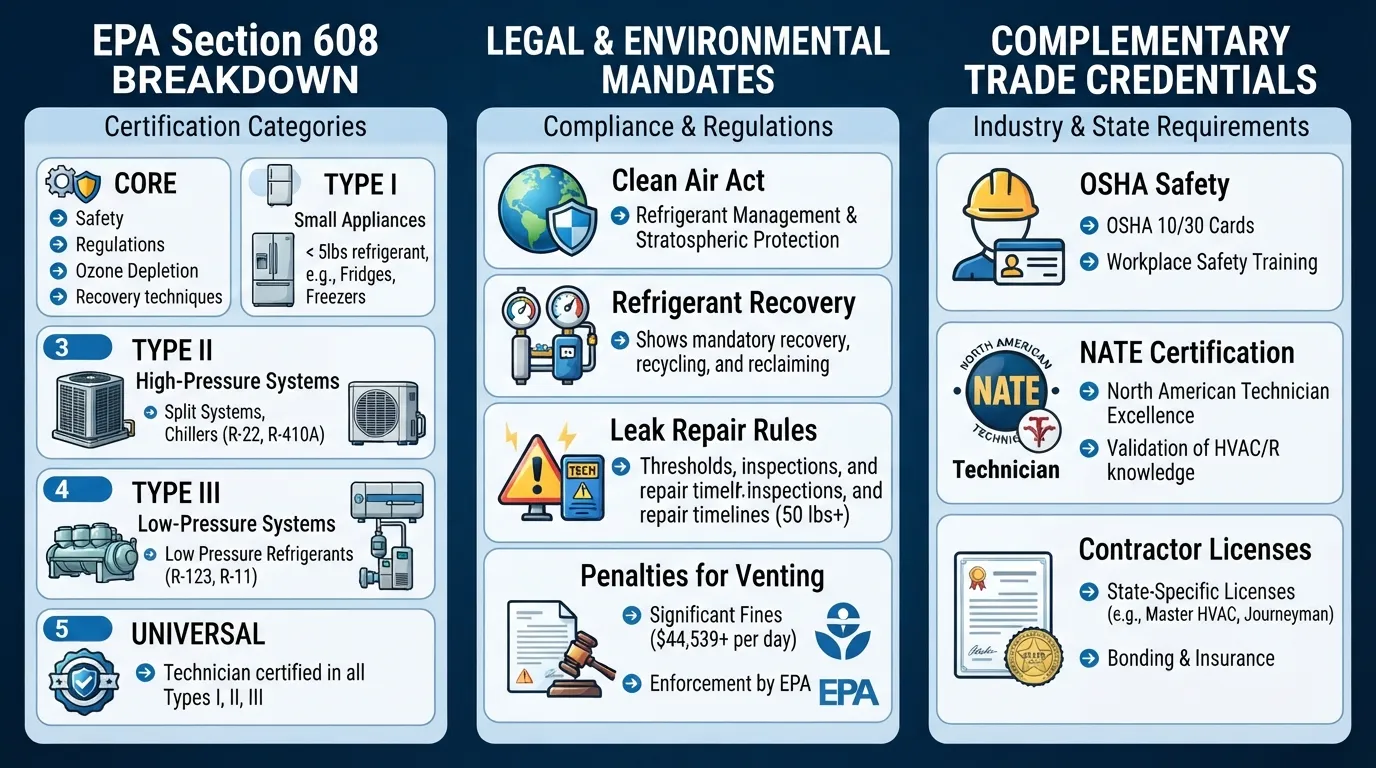 Securing professional credentials is non-negotiable for anyone entering the heating, ventilation, and air conditioning field. Among these, the EPA Section 608 Technician Certification is a mandatory federal requirement under the Clean Air Act for anyone who maintains, services, repairs, or disposes of equipment containing regulated refrigerants.
What Is EPA Section 608 Certification? Types I, II, III, Universal
The EPA Section 608 program splits credentials into four distinct categories based on the scale and pressure of the equipment you service. Passing the core exam along with all three equipment sections grants you Universal status, maximizing your employability across residential and commercial sectors.
- Type I: Focuses on servicing small appliances containing five pounds or less of refrigerant, such as household refrigerators and window AC units.
- Type II: Covers high-pressure and very high-pressure appliances, including residential split systems and commercial rooftop package units.
- Type III: Regulates low-pressure appliances, specifically large industrial and commercial chillers.
- Universal Certification: Combines Type I, Type II, and Type III designations, allowing technicians to work on all stationary refrigeration and cooling equipment without restriction.
How Long Does It Take to Prepare and Pass? 1–4 Weeks
Preparing for the EPA Section 608 exam is a relatively fast process compared to a full degree program, typically taking anywhere from 1 to 4 weeks of dedicated study. Because it is a standalone certification test rather than a semester-long course, you can schedule and pass it as soon as you master the study materials.
- Focused Study Guides: Most candidates spend a few weeks reviewing environmental regulations, recovery techniques, and safety protocols.
- Proctored Testing: Exams are administered by approved organizations through in-person or authorized remote proctoring options. Once passed, your credential remains permanently valid and never expires.
NATE Certification Optional But Valuable
North American Technician Excellence (NATE) certification is an independent, industry-recognized validation of professional knowledge. While not legally mandated by the federal government like EPA 608, earning NATE credentials proves elite competency to employers and clients.
- Specialized Tracks: Technicians can pursue certifications in specific installation or service areas, such as gas heating, air distribution, or heat pumps.
- Career Advancement: Holding NATE certification frequently leads to higher pay scales, preferred job assignments, and enhanced credibility in residential and commercial markets.
State Licensing Requirements What Varies by Location
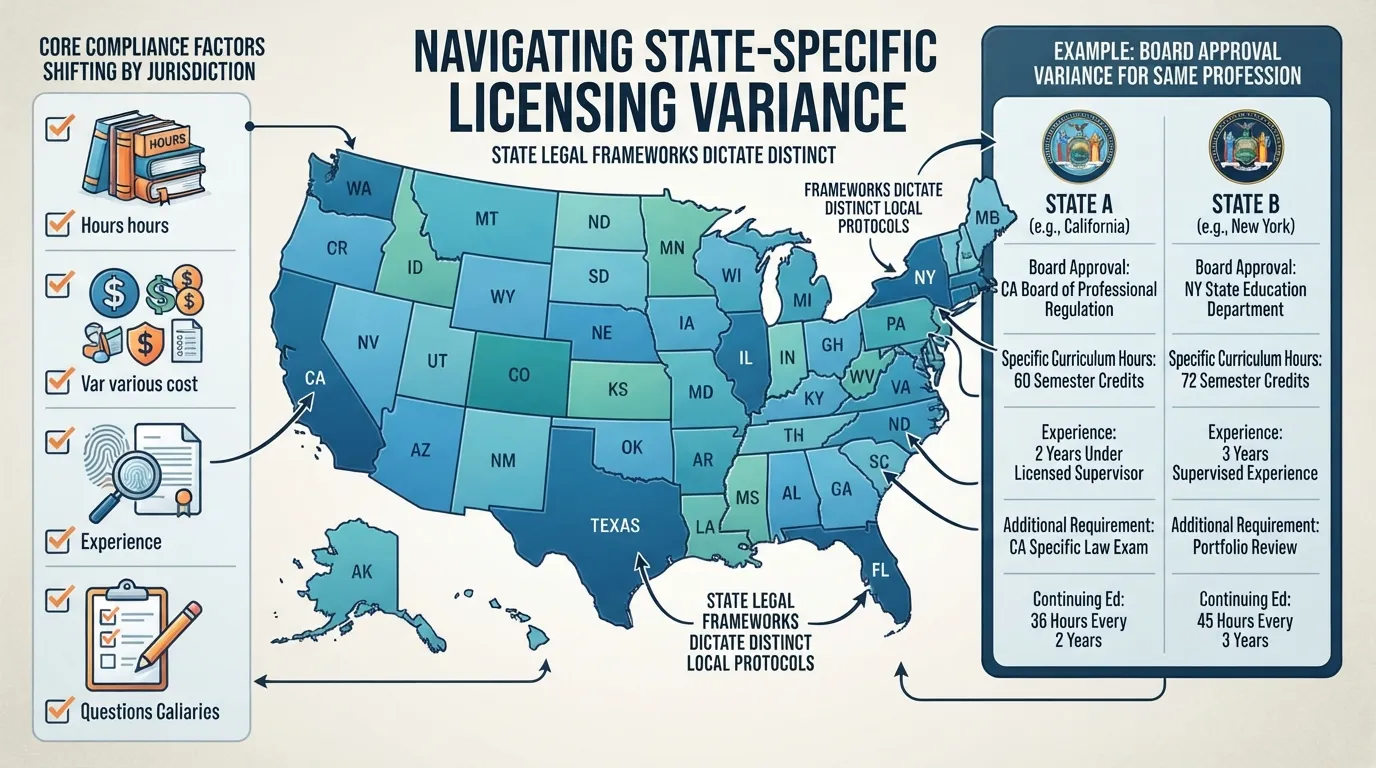 While federal EPA regulations apply nationwide, legal requirements for working as an HVAC technician change dramatically depending on the state, county, or municipality where you practice. Understanding these geographical differences prevents costly regulatory penalties and career delays.
States That Require 2–6 Years of Combined Experience
Many states mandate formal licensure at the technician, journeyman, or contractor level before you can perform unsupervised service work. These jurisdictions enforce strict verification of combined classroom hours and hands-on field experience.
- California: Requires at least 4 years of verifiable journeyman-level experience and a C-20 contractor license if operating independently on projects over $500.
- Texas & Kentucky: State boards require targeted apprenticeship milestones, ranging from 2 to 4 years of verified work history under licensed master mechanics, plus state board examinations.
- Strict Verification: States like Delaware and Alabama enforce structured paths moving from registered apprentice to licensed technician and master contractor.
States With No Statewide License Local County Rules
Several states do not issue a blanket statewide HVAC license, which often creates confusion for new technicians. Instead, regulatory authority is delegated down to municipal, city, or county boards.
- Decentralized Regulation: States like Colorado, Missouri, and Pennsylvania lack a single statewide technician license but require local competency cards.
- Municipality Mandates: You may need to pass specific municipal exams or register your credentials directly with city and county building departments depending on your work location.
- Cross-Border Compliance: If you work across city lines, you might need multiple local permits even if you operate within the same general geographic region.
How to Check Your State’s Exact Requirement
Because trade regulations are constantly updated by local administrative boards, you must verify requirements before committing to a long-term career plan in a specific area.
- Department of Labor & Licensing: Check your state’s official government portal under the division of professional regulation or contractor boards.
- Local Building Authority: Contact your county or city clerk’s office to find out if local mechanical permits, bonds, or local competency exams are mandatory.
- Union & Trade Associations: Local union halls or contractor alliances can provide exact breakdowns of regional hours and testing prerequisites.
How Much Does It Cost to Become an HVAC Technician?
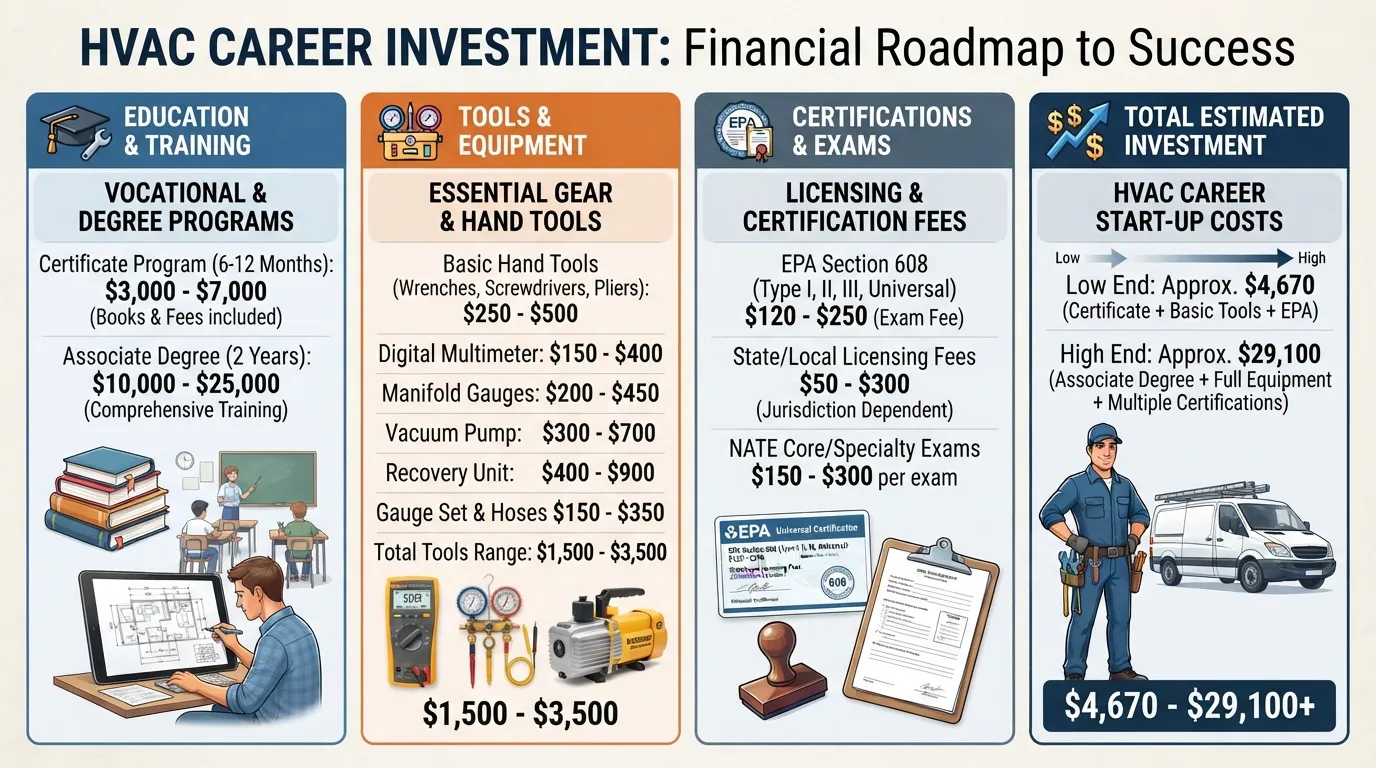 Entering the heating, ventilation, and air conditioning field requires a clear financial plan covering tuition, professional instruments, and testing fees. Understanding these expenses upfront helps you evaluate your return on investment and choose the most cost-effective training pathway.
Cost of Certificate vs Diploma vs Associate Degree Programs
Tuition expenses vary widely based on the institution type and credential length, ranging from affordable community college tracks to comprehensive private technical institutes.
- Certificate Programs ($1,200 to $15,000): Fast-track vocational programs provide targeted instruction. Public community colleges sit at the lower end, while private trade schools charge higher rates for specialized lab equipment.
- Diploma Programs ($5,000 to $18,000): Mid-length programs balance extended practical labs with moderate tuition investments before financial aid.
- Associate Degrees ($10,000 to $35,000): Comprehensive two-year public and private college degrees carry higher total tuition costs but build a strong foundation for future management roles.
Apprenticeship Cost Paid vs Unpaid Models
Formal apprenticeships flip traditional education finance on its head by allowing you to earn wages while acquiring technical skills.
- Zero Tuition Debt: Union and contractor-sponsored programs generally require minimal administrative fees ($500 to $2,000 total) while providing full-time paid work experience.
- Immediate Earnings: Apprentices receive incremental hourly pay increases as they complete required on-the-job milestones and classroom instruction hours.
Hidden Costs Tools Exam Fees Licensing Fees
Beyond classroom tuition, prospective technicians must budget for essential professional gear and mandatory regulatory credentials to get started.
- Tool Investments ($1,000 to $3,000): Basic hand tools, multimeters, gauges, and safety equipment are necessary for field service work. Many employers or schools provide starter tool kits or tool-purchase programs.
- Certification & Licensing Fees ($50 to $250): Proctored EPA Section 608 testing and state licensing applications add minor out-of-pocket expenses that are essential for legal compliance.
Is HVAC Hard to Learn? Difficulty Cluster PAA Capture
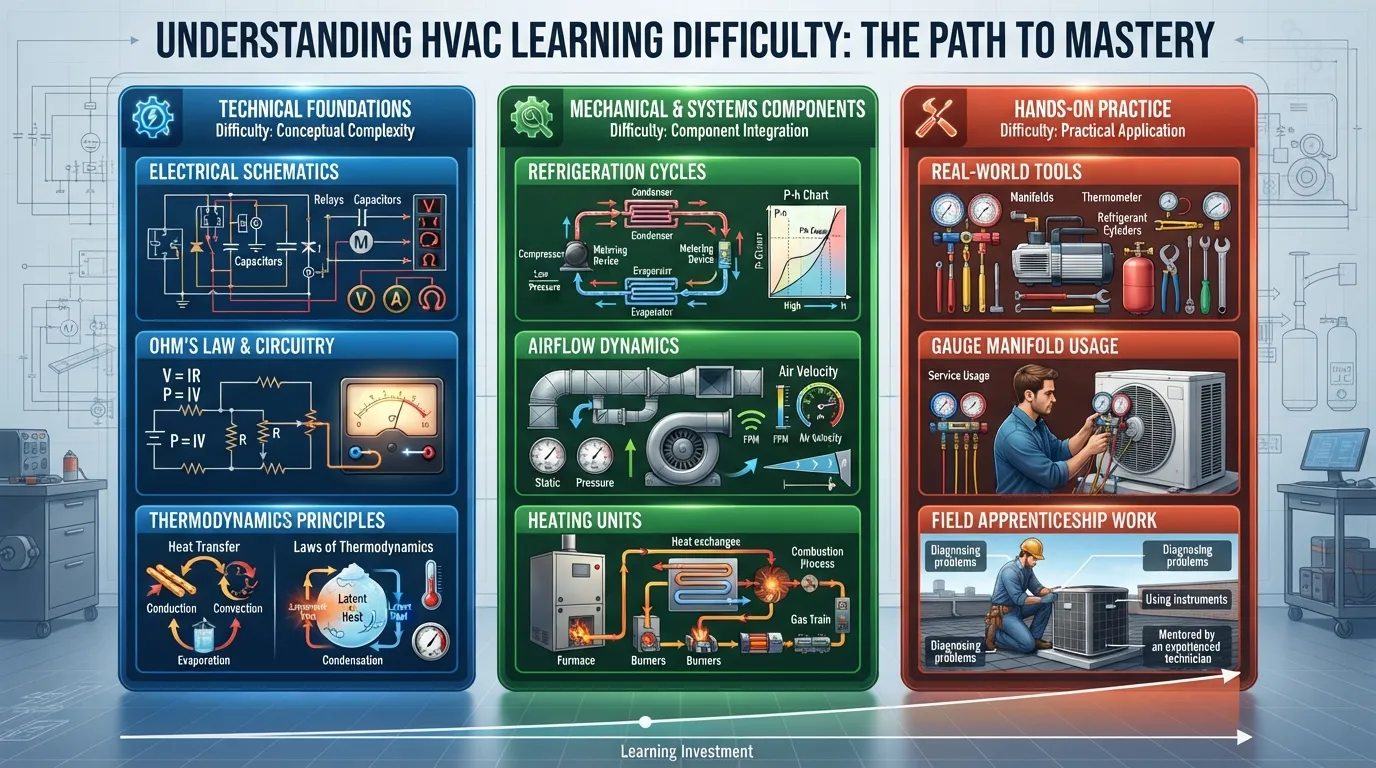 Evaluating the technical difficulty of heating, ventilation, and air conditioning helps prospective students prepare for the intellectual and physical demands of the trade. While the field requires mastering electrical, mechanical, and thermodynamic principles, dedicated study and hands-on practice make it highly accessible.
Is HVAC a Lot of Math?
HVAC work involves moderate mathematical calculations, but it rarely requires advanced calculus or complex theoretical equations. Instead, calculations focus on applied geometry, algebra, and basic arithmetic used in daily field operations.
- Manual J Load Calculations: Determining total heat gain and heat loss for residential buildings using square footage, insulation values, and window ratios.
- Airflow Sizing: Computing duct dimensions and CFM (Cubic Feet per Minute) rates to ensure balanced airflow across rooms.
- Electrical Formulas: Applying Ohm’s Law (Voltage equals Current multiplied by Resistance, or $V = I \times R$) to diagnose electrical faults and motor loads.
Is HVAC Harder Than Becoming an Electrician?
Comparing HVAC difficulty to electrical work depends entirely on your personal strengths, as both trades demand rigorous safety standards and strict adherence to local building codes.
- HVAC Complexity: Requires multi-disciplinary knowledge spanning electrical circuits, plumbing, gas piping, refrigeration thermodynamics, and mechanical airflow.
- Electrical Complexity: Focuses heavily on complex high-voltage power distribution, circuit design, and national electrical code compliance, often with less mechanical hardware overhead.
- Overall Takeaway: Neither trade is universally harder; HVAC involves wider cross-disciplinary mechanics, while electrical work demands deeper focus on complex circuitry.
Is HVAC One of the Hardest Trades to Get Into?
HVAC is widely considered one of the most accessible and welcoming skilled trades for career changers and recent graduates due to flexible training pathways.
- Low Barriers to Entry: Short-term certificate programs and paid apprenticeships offer immediate on-ramps without requiring a four-year university degree.
- High Industry Demand: Ongoing labor shortages mean contractor associations and local unions actively recruit and train motivated candidates.
- Structured Advancement: Clear regulatory milestones, like the EPA Section 608 exam, provide a transparent path from novice status to licensed professional.
Who Struggles Most And Who Picks It Up Fast?
Success in the HVAC industry depends on a blend of diagnostic patience, physical stamina, and practical problem-solving capabilities.
- Who Struggles Most: Individuals who dislike physical outdoor work in tight spaces, struggle with troubleshooting abstract electrical diagrams, or prefer purely administrative office tasks.
- Who Picks It Up Fast: Hands-on learners with strong mechanical aptitude, logical troubleshooting habits, and good spatial reasoning excel quickly in both lab and field settings.
HVAC Technician Salary vs Time Invested ROI Section
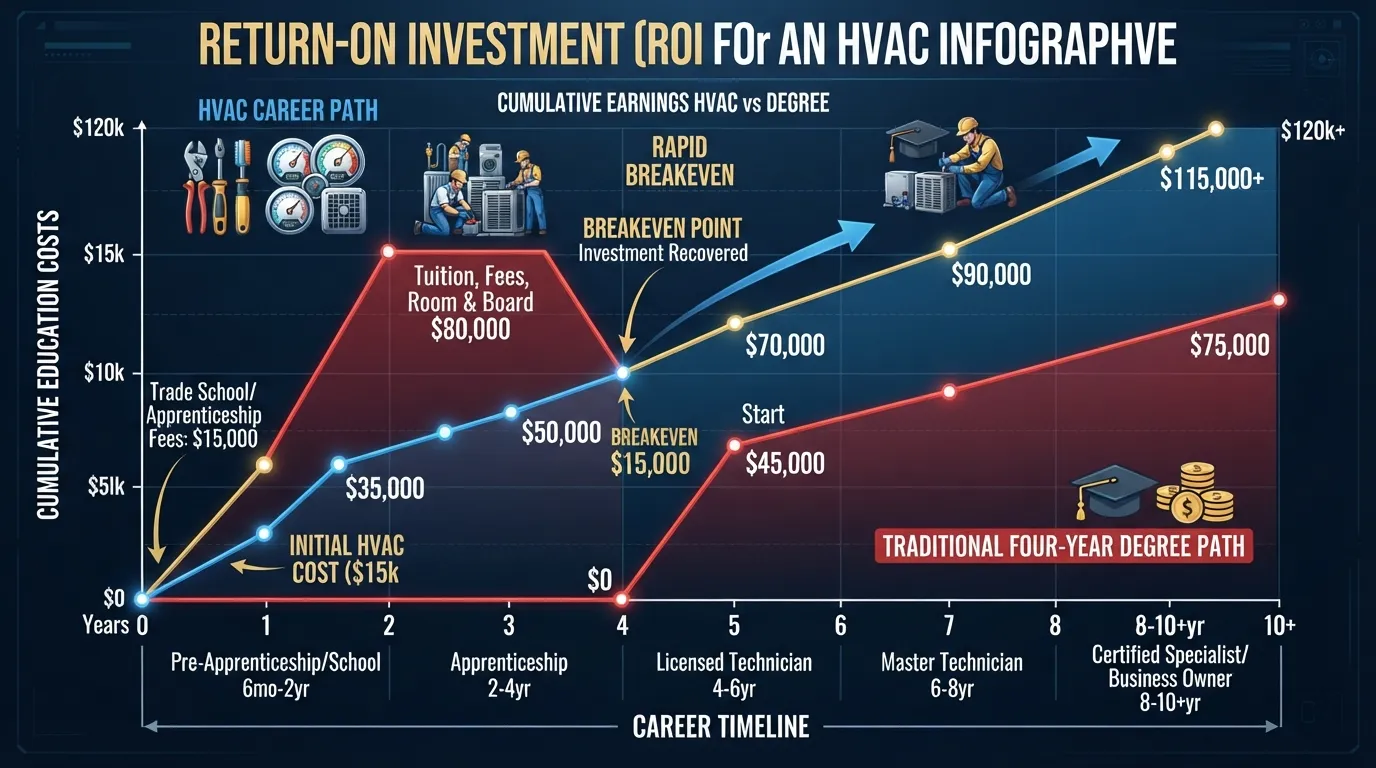 Evaluating the financial return on investment (ROI) for an HVAC career reveals a lucrative path where earning potential scales rapidly with experience, specialized certifications, and field independence. Understanding expected pay at each career stage helps set realistic financial expectations.
Entry-Level Salary After Certificate Diploma
Entry-level technicians and fresh apprentices typically start earning between $18.50 and $22.00 per hour, translating to an annual starting wage of roughly $38,000 to $45,000. Even during initial training phases, paid apprenticeships ensure you receive an income while acquiring real-world skills.
- Immediate Earning: Unlike traditional four-year degrees that accumulate substantial student debt before generating income, HVAC training lets you earn from day one.
- Foundational Growth: Base pay climbs steadily within the first 12 to 24 months as you transition from basic preventative maintenance to independent service calls.
Journeyman Salary 3–5 Years Experience
Once you achieve journeyman status with 3 to 5 years of verified field experience, your earning potential increases significantly, with national median wages reaching $58,000 to $68,000 annually.
- Hourly Wage Growth: Experienced journeymen often command $28.00 to $35.00 per hour depending on geographic market demands.
- Overtime Opportunities: Peak cooling and heating seasons bring lucrative overtime pay, significantly boosting annual take-home compensation during extreme weather months.
Can HVAC Technicians Really Make $100K+? Realistic Path Explained
Yes, earning $100,000 or more per year as an HVAC professional is entirely achievable, though it requires specific strategic career choices beyond standard residential service work.
- Commercial & Industrial Specialization: Transitioning to large-scale commercial chillers, industrial refrigeration, or building automation systems unlocks top-tier hourly rates and specialized contract bonuses.
- Advanced Certifications: Acquiring NATE master credentials, specialized EPA endorsements, and electrical licenses makes you indispensable for complex corporate projects.
- Entrepreneurship & Contracting: Launching your own independent HVAC contracting business offers the highest earning ceiling, allowing successful owners to scale well past six figures.
How Long to Become a Master HVAC Technician?
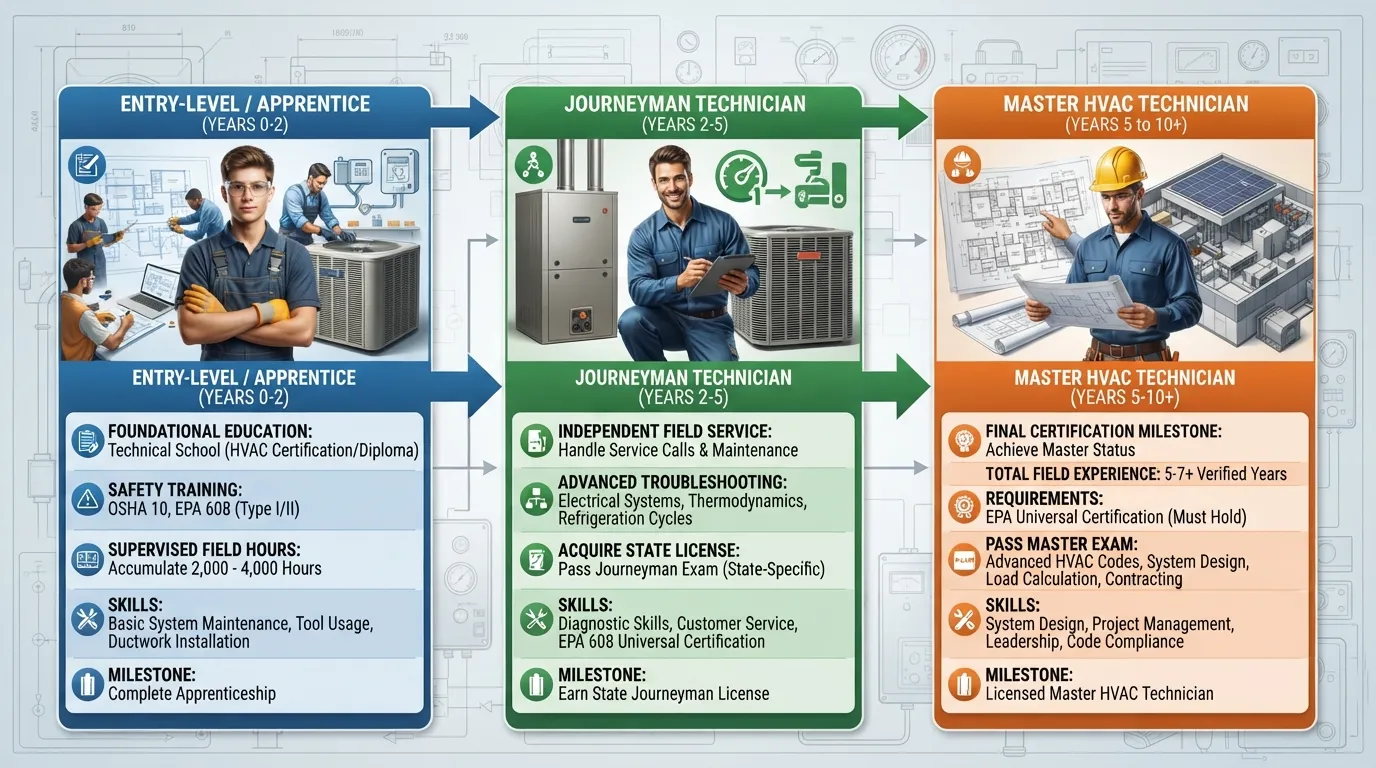 Reaching the pinnacle of the heating, ventilation, and air conditioning profession as a master technician represents the ultimate career milestone. This advanced role combines elite technical troubleshooting with leadership responsibilities and regulatory compliance.
Timeline From Entry-Level Journeyman Master Typically 5–10 Years Total
Progression to the master level requires sustained, documented field experience and deep mechanical mastery across diverse system architectures. Building this level of expertise cannot be rushed through classroom theory alone.
- Years 1 to 2: Complete formal foundational training, secure your EPA Section 608 certification, and transition from an entry-level trainee to a competent service helper.
- Years 3 to 5: Work independently as a journeyman technician, handling complex diagnostic calls, residential installations, and standard commercial repairs.
- Years 6 to 10+: Supervise junior staff, manage large commercial retrofit projects, and accumulate the advanced field hours necessary to qualify for state master licensing exams.
Additional Exams Requirements for Master License
Qualifying for a master HVAC license involves much more than simply logging years on the job; it requires rigorous testing and administrative approvals from state or municipal boards.
- Master Board Examinations: Passing comprehensive state or contractor licensing tests that cover advanced electrical theory, advanced thermodynamics, and local building code compliance.
- Proof of Verified Hours: Submitting notarized employment records proving 5 to 10 years of combined journeyman-level experience under a licensed contractor.
- Bonding and Insurance: Securing professional liability insurance and surety bonds if you intend to use your master license to open an independent contracting business.
Tips to Speed Up Your HVAC Career E-E-A-T Section
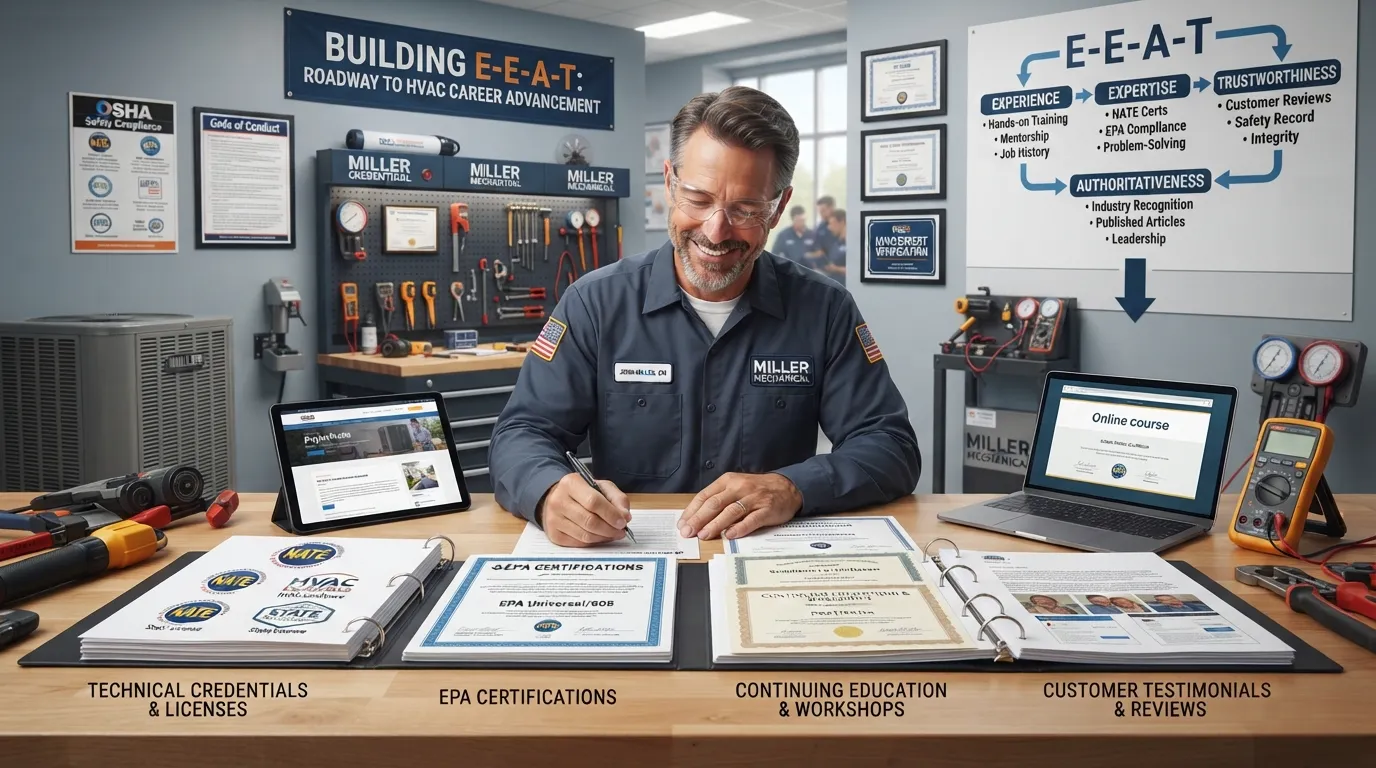 Accelerating your timeline from a novice trainee to an independent, high-earning professional requires strategic planning and proactive career management. Leveraging industry connections, specialized training, and prior skills can shave months or even years off your progression.
Choosing a Program With Job Placement Support
Selecting a trade school or technical institute that maintains active industry partnerships can drastically shorten your post-graduation job hunt. Quality programs often feature direct employer pipelines that transition students straight into local contractor networks.
- Employer Partnerships: Look for institutions that host career fairs, on-campus contractor interviews, and guaranteed externship placements.
- Alumni Networks: Connecting with graduates working in the field provides direct referrals to open apprentice positions and entry-level service roles.
Getting Hands-On Practice Before Your First Job Home Projects Internships
Practical confidence in the field comes from physical muscle memory and tool familiarity rather than textbook theory alone. Gaining extra hands-on exposure before your first official day on the job gives you a major advantage.
- Independent Labs: Spend extra time outside of regular class hours practicing wiring, brazing copper lines, and diagnosing training units.
- Shadowing Opportunities: Reach out to local independent contractors to ask about shadowing opportunities or unpaid ride-alongs during weekends to observe real customer service calls.
How Prior Experience Electrical Plumbing Cuts Down Your Timeline
If you possess a background in residential construction, plumbing, automotive repair, or general electrical wiring, you can often fast-track your HVAC education and licensing timeline.
- Transferable Skills: Existing knowledge of Ohm’s Law, hand tool safety, and pipe fitting eliminates the learning curve for foundational technical modules.
- Credit Approvals: Some state licensing boards and apprenticeship programs grant partial credit or reduced required instructional hours if you can document related trade experience.
Frequently Asked Questions FAQ Schema Target
Addressing common questions about training timelines, industry rules, and long-term career outlook helps clarify final doubts for prospective students entering the heating, ventilation, and air conditioning sector.
How Fast Can You Become an HVAC Technician?
You can enter the workforce in as little as 6 months to 1 year through an accelerated certificate program or by securing an entry-level position as a helper while studying for your EPA certification.
- Fastest Entry: 6 to 12 months for basic trade certificates and EPA credentials.
- Full Proficiency: 3 to 5 years of field experience is typically required to become a fully independent journeyman technician.
How Long Are HVAC Classes Per Day?
Class schedules vary widely depending on whether you choose a full-time institute, a community college, or a part-time evening training program.
- Full-Time Programs: Typically run 4 to 6 hours per day, 5 days a week, combining morning classroom theory with afternoon practical lab sessions.
- Part-Time & Evening Tracks: Often structured as 2 to 3 hour evening classes or weekend sessions to accommodate students maintaining daytime employment.
What Is the $5,000 Rule for HVAC?
The $5,000 rule is a common industry guideline used by homeowners and technicians to decide whether to repair or replace an aging heating or cooling system.
- Calculation: Multiply the age of the HVAC unit in years by the estimated cost of the current repair.
- Decision Metric: If the resulting total exceeds $5,000, investing that money toward a brand-new, energy-efficient system is usually more cost-effective than fixing the old unit.
Is HVAC an Easy Trade to Get Into?
Yes, HVAC is considered one of the most accessible and welcoming skilled trades due to the wide availability of certificate programs, trade schools, and paid apprentice openings.
- Low Initial Barriers: No college degree is required to start training, and federal EPA certification can be achieved quickly.
- High Employer Demand: Ongoing industry labor shortages mean employers are eager to hire and train motivated newcomers.
Is HVAC a Job That Will Still Exist by 2030?
HVAC is an exceptionally future-proof, automation-proof trade that will remain in high demand well beyond 2030 due to the physical nature of climate control work.
- Physical Service Need: Robots and AI cannot physically travel to residential or commercial buildings to repair broken compressors, run new ductwork, or braze refrigerant lines.
- Energy Efficiency Growth: Increasing regulatory focus on green energy, smart thermostats, and eco-friendly refrigerants ensures growing long-term demand for skilled technicians.
Conclusion Which Path Should You Choose?
Choosing the ideal pathway into the heating, ventilation, and air conditioning industry depends entirely on your personal timeline, financial situation, and long-term career aspirations. Weighing your options carefully ensures you select a route that aligns with your goals.
Fastest Route Recap
If your primary objective is to enter the workforce and start earning an income as quickly as possible, short-term educational strategies offer the most direct timeline.
- Certificate Programs & EPA 608: Completing a 6-to-12 month trade school certificate paired with your mandatory EPA Section 608 certification gets you job-ready in under a year.
- Entry-Level Helper Roles: Applying directly as a contractor’s assistant lets you bypass extended classroom time, learning essential skills directly on the job.
Most Career-Secure Route Recap
If you prefer a debt-free education or are targeting advanced commercial management roles, structured long-term pathways provide maximum stability and growth.
- Paid Apprenticeships: Combining 3 to 5 years of paid on-the-job training with classroom instruction delivers zero tuition debt and deep professional competence.
- Associate Degrees: Investing 18 to 24 months in a comprehensive community college program builds a strong foundation for future commercial specialization and master-level licensing.

Oscar Vance | Master Plumber & Drainage Expert
Meet Oscar Vance, a licensed master plumber sharing practical solutions on residential repairs, preventive maintenance, and thoughtful home upkeep.