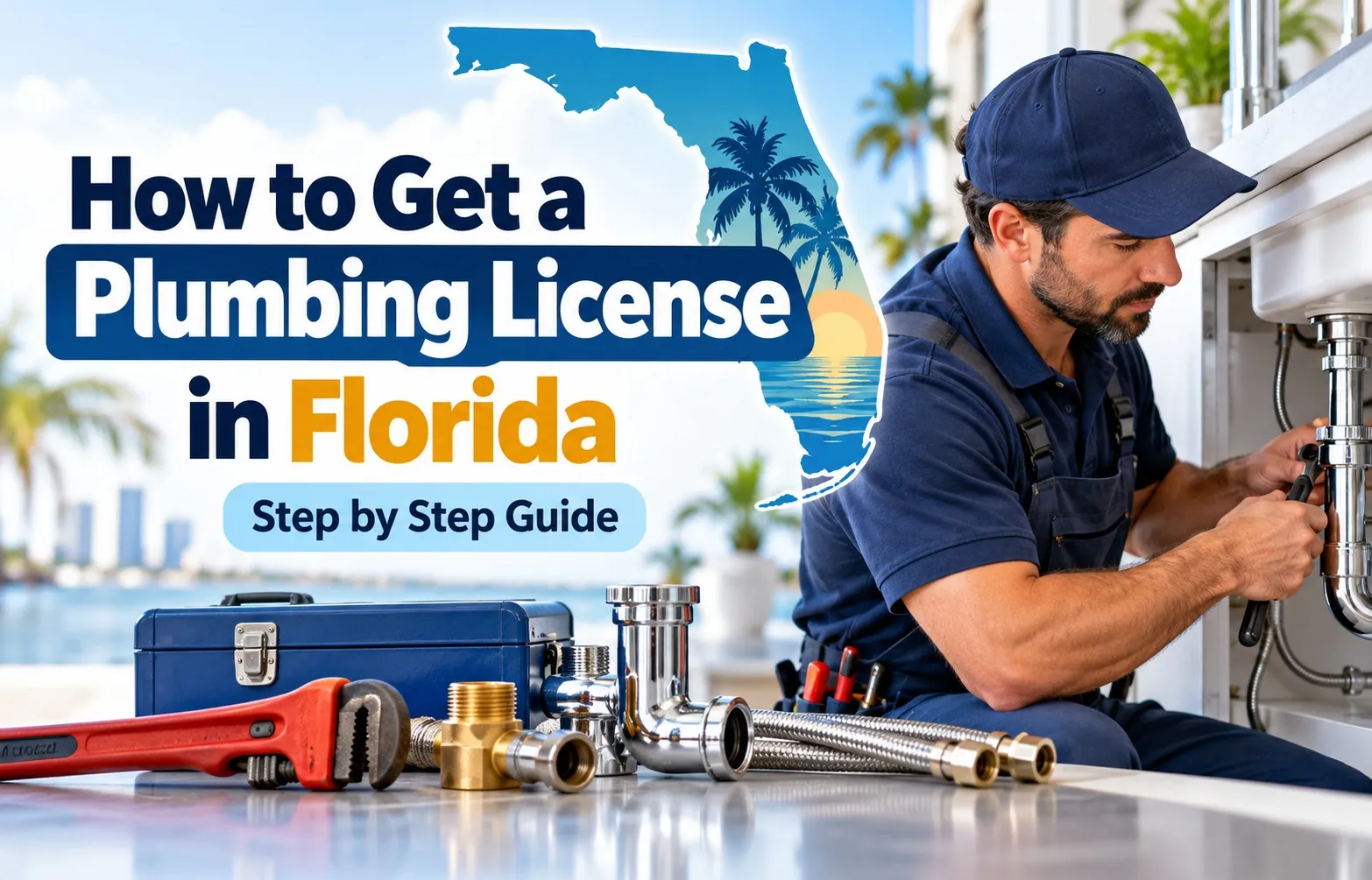
 Florida Plumbing License Overview: Certified vs. Registered Contractors
Choosing the correct credential is the vital first step to legally operating in the construction industry. The Florida Department of Business and Professional Regulation (DBPR) and its division, the Construction Industry Licensing Board (CILB), oversee all contractor licensing structures across the state.
Aspiring plumbing professionals must decide between a statewide credential or a local authorization before submitting any documentation. Making the wrong choice early on can heavily restrict your commercial reach, geographic bidding capabilities, and long-term business growth.
What is a Certified Plumbing Contractor? (Statewide Scope)
A certified plumbing contractor license grants you the legal authority to contract and perform plumbing work anywhere within the state of Florida without geographic limitation. Governed directly by the state through the DBPR and CILB, this elite credential requires passing the official state-administered examinations.
Opting for a statewide certified license unlocks massive operational advantages for ambitious contractors and business owners:
- Unlimited Geographic Scope: Execute residential, commercial, and industrial plumbing projects across all 67 Florida counties without buying local municipal permits.
- Statewide Recognition: Build a scalable enterprise brand that transcends local county lines, allowing seamless expansion into booming metropolitan markets like Miami, Orlando, and Tampa.
- Direct State Accountability: Deal exclusively with state-level boards for renewals and compliance rather than juggling separate local regulatory agencies.
What is a Registered Plumbing Contractor? (Local Jurisdiction Scope)
A registered plumbing contractor license restricts your legal operations strictly to specific local jurisdictions, such as individual cities or counties where you hold a local certificate of competency. Unlike statewide credentials, registered licenses do not require passing the state trade exam but depend entirely on local municipal testing.
While local registration provides a viable entry point for localized service operations, it carries distinct geographic and administrative constraints:
- Localized Boundaries: You are legally forbidden from performing plumbing contracting outside the precise municipal or county boundaries specified on your local certificate.
- Multiple Local Registrations: Expanding your business into a neighboring county requires separate local competency applications, local fees, and local board approvals.
- Dependency Risk: If your local county certificate lapses or expires, your entire operational status becomes compromised under state oversight frameworks.
Quick Eligibility Checklist: Are You Ready to Apply?
Before launching your licensing application through the state or local portals, you must clear fundamental prerequisite benchmarks. Meeting these statutory criteria ensures your application bypasses initial administrative rejections by board review panels.
Review this fast-action compliance checklist to gauge your immediate readiness:
- Age Requirement: You must be at least 18 years old at the time of application submission.
- Experience Verification: You must possess a verified background of hands-on industry work or an approved combination of education and experience.
- Financial Standing: You must be prepared to submit a personal credit report meeting financial stability thresholds.
- Background Clearance: You must successfully pass a criminal background check via fingerprint submission.
Step 1: Meeting Experience, Age, and Education Requirements
Meeting the rigid experience benchmarks set by the Construction Industry Licensing Board (CILB) is the most critical hurdle for plumbing applicants. You must document a precise combination of hands-on field hours, supervisory leadership, or academic equivalents before the state will approve your licensing application.
Applicants must also verify they meet the baseline age requirement of 18 years old and prepare comprehensive documentation for CILB experience verification. Navigating these prerequisites correctly prevents costly application rejections right from the start.
The 4-Year Experience Rule Broken Down (2,000 Hours Per Year)
To qualify for a certified plumbing license in Florida, you must accumulate a minimum of four years of comprehensive industry experience. The state strictly quantifies this requirement using hourly milestones, demanding a total of 8,000 documented hours of active trade practice.
Each qualifying year must reflect practical plumbing installation, maintenance, and repair work performed under a licensed contractor. To satisfy the board audit successfully, ensure your records match these core parameters:
- Annual Milestone: A minimum of 2,000 verified working hours per calendar year.
- Total Accumulation: Exactly 8,000 total hours across your active career timeline.
- Employment Validation: W-2 forms, payroll records, and formal contractor reference sign-offs required for CILB experience verification.
The Mandatory 1-Year Foreman and Supervisory Role Requirement
Merely completing four years of basic pipe installation is insufficient for state approval; you must prove advanced leadership capability. At least one full year of your required experience must be spent acting in a supervisory or foreman capacity on active job sites.
This strict mandate ensures that licensed contractors possess the administrative and field management skills required to run a safe, code-compliant business. Your documentation must clearly highlight your leadership background:
- Supervisory Oversight: Directing junior workers, managing material logistics, and coordinating rough-in schedules.
- Code Responsibility: Overseeing work to guarantee strict adherence to the Florida Building Code.
- Detailed References: Written attestations from licensed contractors explicitly confirming your title and duties as a foreman.
Substituting Experience: Using College Construction Credits and Military Service
If you lack the full four years of traditional field work, Florida law permits strategic substitutions through higher education or military service. You can replace up to three years of practical work requirements with accredited academic or technical credentials.
Leveraging formal education or specialized military backgrounds accelerates your timeline to licensure without bypassing core technical competency. Review the acceptable substitution avenues recognized by the state:
- Construction Degrees: Associate or bachelor’s degrees in building construction, civil engineering, or mechanical engineering substitute for up to three years of experience.
- Military Experience: Technical plumbing, utility management, or construction engineering service in the U.S. Armed Forces counts directly toward your qualifying hours.
- The Mandatory Floor: Regardless of educational or military credits, every applicant must still complete at least one year of hands-on field experience under a certified contractor.
Step 2: Conquering the Two-Part Licensing Exams
Passing the official state examinations requires mastering two entirely different test formats handled by separate testing agencies. Candidates must clear both the computer-based business assessment and the rigorous paper-based technical trade test to qualify for licensure.
Understanding the strict delivery formats, testing environments, and scoring parameters prevents costly retake delays. Preparation must be tailored specifically to the unique demands of each individual test.
Part 1: The Business and Financial Management Exam (Pearson VUE CBT Format)
The Business and Financial Management exam is a computer-based test (CBT) administered digitally through Pearson VUE facilities across the state. This module evaluates your capability to manage a legal construction business, handle contracts, and execute Florida-specific labor and tax laws.
Candidates must navigate a high volume of multi-choice questions under strict time constraints. Focus your preparation on these core operational domains:
- Exam Delivery: Conducted entirely on computers at authorized Pearson VUE testing centers with instant preliminary score reporting.
- Core Topics: Business organization, financial accounting, lien laws, estimating, workers’ compensation regulations, and safety standards (OSHA).
- Resource Materials: Open-book format allowing approved state contractor reference manuals and code books during the digital session.
Part 2: The Plumbing General Trade Knowledge Exam & The 5 Isometric Drawings
The Plumbing General Trade Knowledge exam is a specialized, paper-and-pencil technical test administered by Professional Testing Inc. (PTI). Beyond code multiple-choice questions, the most notorious hurdle in this exam is hand-drafting five complex isometric drawings under timed conditions.
Mastering plumbing blueprints and orthographic-to-isometric conversions is non-negotiable for passing this portion. Review the critical structural elements of this trade exam:
- Testing Medium: Traditional paper-and-pencil format requiring physical drawing tools, scale rulers, and code lookups at designated testing sites.
- The 5 Isometric Drawings: Candidates must accurately translate floor plans into three-dimensional isometric layouts featuring correct stack sizing, vent configurations, and fixture placements.
- Technical Depth: Extensive code navigation covering the Florida Building Code, sanitary drainage systems, water supply distribution, and gas piping.
Understanding the 70% Passing Score Threshold and Open-Book Rules
Both parts of the Florida plumbing licensure examination enforce an unyielding passing grade threshold of 70% or higher. Scoring anything below this percentage on either module requires a complete retake of the failed section.
Because these exams are open-book, success relies less on rote memorization and more on lightning-fast tabbing and indexing. Implement these exam-day tactics to protect your score:
- Passing Benchmark: You must achieve a minimum scaled score of 70% on both the Pearson VUE business module and the PTI trade module.
- Book Tabbing Discipline: Pre-tab your approved reference books with permanent, color-coded tabs to locate code articles instantly during the clock.
- Time Management: Practice pacing yourself under exam simulations to ensure you complete all isometric drawing layouts without running out of time.
Step 3: Financial Stability and Navigating the FICO Score Requirement
Meeting the financial stability and responsibility guidelines enforced by the Construction Industry Licensing Board (CILB) requires submitting a clean consumer credit report and meeting strict credit score thresholds. Failing to satisfy these financial parameters will result in immediate application rejection by the state review panel.
Applicants must carefully evaluate their personal credit histories long before filing paperwork with the Florida Department of Business and Professional Regulation (DBPR). Understanding how the board evaluates financial stability ensures you can proactively resolve any reporting flags or credit deficiencies.
The 660 FICO Score Threshold Explained
The state of Florida mandates a minimum FICO-derived credit score of 660 to satisfy financial stability requirements for contractor applicants. This score must be pulled from a certified consumer credit report that also confirms the complete absence of unsatisfied judgments, open liens, or unresolved bankruptcies.
A high credit score alone does not guarantee approval if public records reveal unpaid debts or active legal judgments. Review the critical components of the board’s financial screening process:
- The Magic Number: A FICO score of 660 or higher from a qualified consumer reporting agency that checks local, state, and federal databases.
- Clean Report Mandate: The credit report must show zero active or unsatisfied judgments, tax liens, or unpaid vendor claims against you or any previously qualified business entity.
- Separate Criteria: Financial stability (the score) and financial responsibility (the clean record) are evaluated as two distinct legal grounds by the CILB.
What to Do If Your Credit Score is Below 660: The 14-Hour Financial Responsibility Course Workaround
If your consumer credit report reflects a FICO score below the standard 660 baseline, you can legally bypass this deficiency by completing a board-approved educational program. The Construction Industry Licensing Board explicitly accepts a 14-hour financial responsibility course as an approved alternative to fulfill financial stability rules.
While third-party vendors sometimes market a private surety bond or letter of credit for sub-660 applicants, completing this mandatory course is the official statutory pathway recognized under Florida administrative code. Leverage these strategic steps if your score falls short:
- Authorized Education: Enroll exclusively in a 14-hour financial responsibility course approved by the CILB through certified construction schools.
- Certificate Submission: Retain your official course completion certificate, provider number, and attendance dates to submit directly alongside your licensing paperwork.
- Ongoing Compliance: Keep in mind that completing the course solves the sub-660 stability requirement, but it does not excuse or erase any active judgments or tax liens on your credit report.
Proving Financial Responsibility to the CILB
Submitting your financial documents correctly to the DBPR requires obtaining a comprehensive consumer credit report that meets strict statutory definitions. Standard consumer-facing credit monitoring apps or basic credit summaries will be instantly rejected if they lack the required public records search parameters.
To ensure your financial proof satisfies state auditors on the first submission, structure your documentation package carefully:
- Comprehensive Credit Report: Secure a report that pulls data from multiple bureaus and includes a certified public records statement covering local, state, and federal levels.
- Discharge Documentation: If past bankruptcies, judgments, or liens appear on your record, attach certified court documentation proving they have been fully satisfied or legally discharged.
- Corporate Entity Separation: Ensure that any business entity you intend to qualify also meets its independent reporting and financial compliance standards under state oversight guidelines.
Step 4: Background Checks, Fingerprinting, and Insurance Mandates
Activating your official Florida plumbing contractor license requires clearing mandatory state background screenings and establishing strict financial protection policies. The Construction Industry Licensing Board (CILB) requires every applicant to verify their personal record and prove financial security through comprehensive insurance coverages.
Failing to secure the exact insurance minimums or missing fingerprinting deadlines will stall your license issuance indefinitely. Ensuring these compliance benchmarks are met protects your business from major legal liabilities right from day one.
Submitting Criminal Background Checks via FDLE Livescan
Every applicant must complete a comprehensive criminal background check processed through the Florida Department of Law Enforcement (FDLE) using approved Livescan fingerprinting vendors. This mandatory screening allows the state to review your state and national criminal history records before final board approval.
Using authorized Livescan service providers ensures your electronic fingerprints are transmitted securely and instantly directly to the Department of Business and Professional Regulation (DBPR). Follow these essential steps to clear your background check smoothly:
- Approved Vendors: Schedule your fingerprinting appointment through an FDLE-approved Livescan service provider using the correct DBPR agency ORI number.
- Required Identification: Bring a valid, government-issued photo ID (such as a driver’s license or passport) to your scanning appointment.
- Receipt Tracking: Retain your transaction control number (TCN) receipt to verify submission status and track your background check clearance with the state.
Mandatory General Liability Insurance Minimums ($100k Public Liability / $25k Property Damage)
Certified plumbing contractors in Florida must maintain active general liability insurance coverage with strict statutory minimums before the state activates their license. The CILB specifically requires public liability coverage of at least $100,000 and property damage coverage of $25,000 per incident.
Your insurance carrier must submit proof of this coverage directly to the DBPR using official state certificate forms. Review these vital insurance requirements to maintain active status:
- Public Liability Minimum: Active policy limits providing a minimum of $100,000 for public liability protection.
- Property Damage Minimum: Active policy limits providing at least $25,000 for property damage protection.
- Certificate of Insurance: Ensure your insurance agency lists the Department of Business and Professional Regulation as the official certificate holder to prevent processing delays.
Workers’ Compensation Insurance Rules and Official Exemptions
Florida law strictly mandates that plumbing contractors carry active workers’ compensation insurance for all company employees or secure a legal exemption if eligible. Operating without proper workers’ compensation coverage or an official state-approved exemption results in heavy fines and immediate license suspension.
If your business operates as a sole proprietorship or a corporation with minimal officers and zero non-exempt employees, you may qualify for a formal exemption. Keep these core workers’ compensation guidelines in mind:
- Mandatory Coverage: Required for businesses employing full-time or part-time staff under standard Florida statutory guidelines.
- Corporate Officers: Officers of a corporation can elect to be exempt from workers’ compensation coverage by filing the appropriate state notice.
- Proof of Exemption: Submit approved exemption certificates or proof of active carrier coverage to the DBPR within 30 days of initial license board approval.
Step 5: Submitting Your Application and Maintaining Your License
Submitting your completed paperwork correctly through state platforms finishes the initial application journey while setting the stage for long-term business compliance. Managing your credentials proactively ensures your plumbing enterprise remains legally authorized to operate across Florida without operational interruptions.
Mastering both the initial digital portal submission and ongoing renewal obligations protects your livelihood and prevents expensive state fines or accidental license lapses.
How to File Your Application Through the DBPR Online Licensing Portal
Submitting your licensing packet efficiently requires navigating the official Florida DBPR Licensing Portal to complete your digital forms. Creating an official user account ensures your documents attach seamlessly to your candidate file.
Ensure every required document is digitized and ready for upload before beginning your final submission to avoid timeout errors:
- Digital Forms: Fill out the official CILB application form completely, double-checking all corporate or individual classification fields.
- Attachment Uploads: Attach your credit reports, examination score sheets, fingerprint TCN receipts, and insurance certificates directly to your portal profile.
- Fee Remittance: Pay all required state application and licensing fees securely online using a business credit card or electronic check.
License Renewal Deadlines: Every Two Years by August 31
Maintaining active legal status as a certified plumbing contractor requires renewing your license every two years before strict statutory deadlines. State regulations dictate that certified contractor licenses must be renewed by August 31 of even-numbered years.
Failing to renew on time triggers late penalties and prohibits you from legally performing contract work until the board reinstates your credential:
- Biennial Cycle: State-certified licenses expire on August 31 of every even-numbered calendar year.
- Renewal Notices: Watch your online DBPR account portal for digital renewal notices sent out weeks ahead of the expiration window.
- Active Status: Ensure your general liability and workers’ compensation policies remain fully active during renewal processing to prevent automatic flags.
Fulfilling the 14-Hour Continuing Education (CE) Requirement
Florida law mandates that plumbing contractors complete 14 hours of DBPR-approved continuing education during every two-year licensing cycle to qualify for renewal. These courses keep you updated on evolving safety standards, code amendments, and business practices.
Completing your hours through an authorized provider guarantees that your credits report directly to the state board system:
- Total Hours: A mandatory minimum of 14 continuing education hours must be completed prior to your renewal window closing.
- Core Curriculum: Required credit distributions typically include advanced building code updates, workplace safety, workers’ compensation regulations, and business laws.
- Provider Reporting: Choose a certified provider that automatically uploads your completed credit certificates directly to the DBPR database on your behalf.
Frequently Asked Questions & Legal Gray Areas
Navigating Florida construction law requires understanding the strict boundaries enforced by the Department of Business and Professional Regulation (DBPR). Misinterpreting statutory exceptions for minor home repairs can lead to severe legal and financial penalties for property owners and workers alike.
Reviewing these high-intent compliance answers clarifies how state statutes handle handymen, general contractors, cross-state licenses, and illicit contracting violations.
Can a Handyman Replace a Toilet or Fix Pipes in Florida Without a License?
Unlicensed handymen cannot legally replace toilets, repair drain lines, or fix pressurized water supply pipes in Florida. State statutes classify these tasks as regulated plumbing work requiring active state or local licensure.
Property owners often assume minor home repairs are exempt from licensing laws, but plumbing systems carry high health and structural risks. Keep these regulatory limits in mind:
- Toilet Replacements: Swapping a toilet involves reconnecting water supply lines and sanitary drain connections, which legally demands a licensed plumbing contractor.
- Minor Exceptions: Legally permitted handyman tasks are generally restricted to non-structural cosmetic maintenance, painting, or fixing cabinet hardware.
- Liability Risks: Hiring an unlicensed handyman for plumbing work invalidates insurance coverage and exposes property owners to statutory fines.
What Are the Penalties for Unlicensed Contracting in Florida?
Unlicensed contracting is treated as a criminal offense under Florida law, carrying severe statutory punishments that escalate quickly with repeat violations. The state actively prosecutes individuals caught performing regulated trade work without proper credentials.
Enforcement actions protect consumers but impose heavy personal and financial consequences on offenders:
- Misdemeanor Charges: A first-time violation is typically prosecuted as a first-degree misdemeanor, carrying probation, mandatory court appearances, and fines up to $5,000.
- Felony Escalation: Subsequent violations or performing unauthorized contracting during a declared state of emergency are automatically elevated to a third-degree felony.
- Enforceability Loss: Unlicensed contracts are legally void and unenforceable in court, meaning contractors cannot sue clients to recover unpaid project invoices.
Can General Contractors Perform Plumbing Work on Residential/Commercial Sites?
General contractors (GCs) cannot directly perform specialized plumbing installations on residential or commercial projects unless they hold an independent, active plumbing contractor license. GCs must legally subcontract this specialized work out to qualified professionals.
While general contractors manage overall project coordination, trade-specific scopes require strict separation under Florida construction regulations:
- Subcontractor Mandate: GCs must hire state-certified or locally registered plumbing subcontractors to execute sanitary drainage, supply, and gas lines.
- Permit Pulling: Municipal building permits for plumbing work must be pulled by the licensed plumbing contractor of record rather than the general contractor.
- Supervisory Boundaries: General oversight does not grant legal authorization to perform hands-on plumbing repairs or alterations.
Is There Reciprocity to Transfer an Out-of-State Plumbing License to Florida?
Florida does not offer direct, automatic license reciprocity for plumbing contractors moving from other states. Every applicant seeking a certified statewide credential must satisfy Florida’s independent statutory evaluation criteria.
Out-of-state contractors cannot simply swap their current credentials; they must navigate the formal board application pipeline:
- Examination Mandate: Transferring contractors must still successfully pass both the Pearson VUE business exam and the PTI trade knowledge exam, including isometric drawing evaluations.
- Experience Verification: Applicants must provide documented proof of four years of qualifying experience that matches CILB audit standards.
- Background Compliance: Fingerprint background checks, credit evaluations, and financial responsibility standards apply universally to all incoming candidates.

Oscar Vance | Master Plumber & Drainage Expert
Meet Oscar Vance, a licensed master plumber sharing practical solutions on residential repairs, preventive maintenance, and thoughtful home upkeep.