What Does CFM Stand For in HVAC?
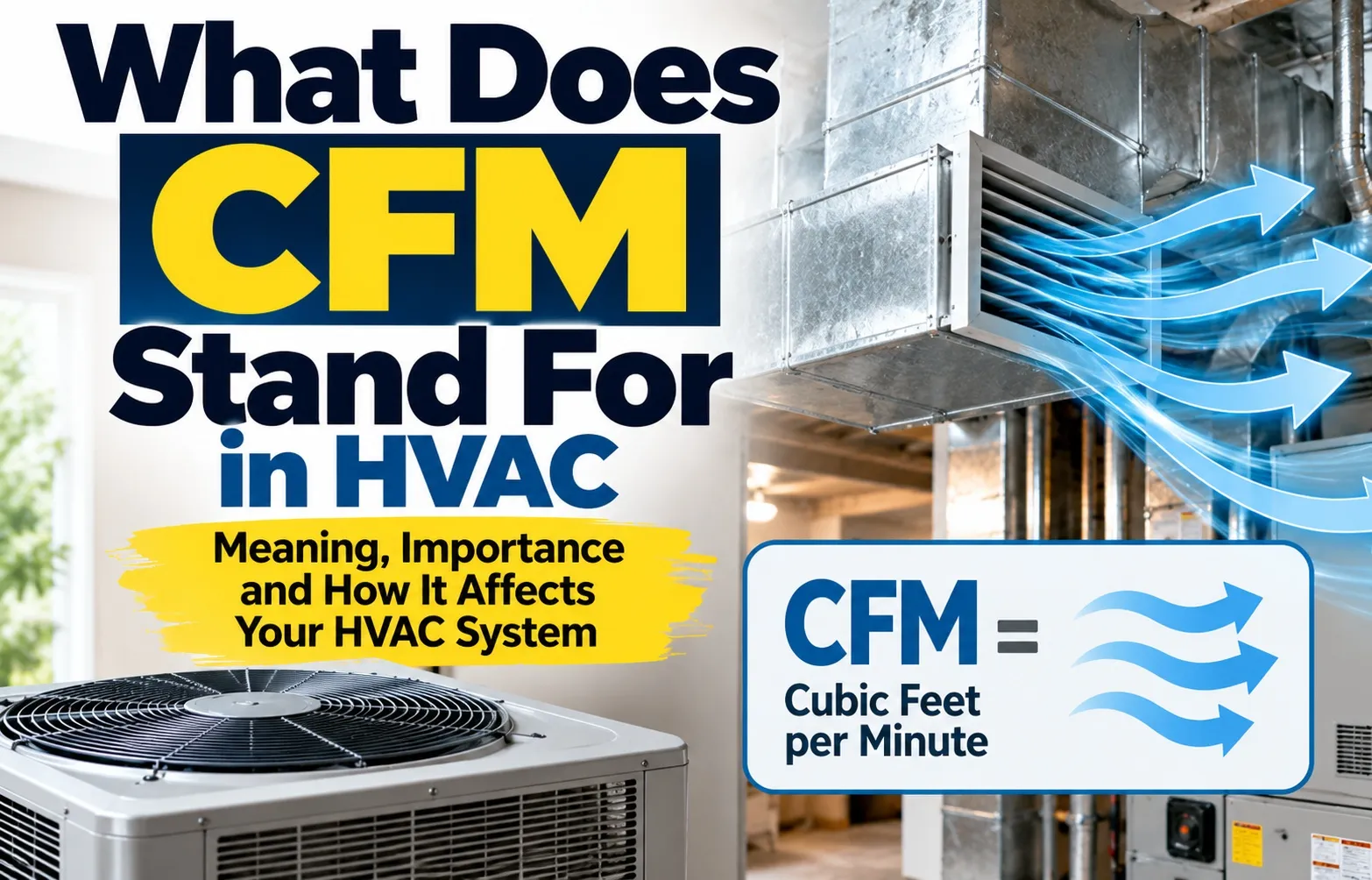 In heating, ventilation, and air conditioning (HVAC), CFM stands for Cubic Feet per Minute. It is the fundamental metric used to measure airflow volume, representing exact quantity of air an HVAC system moves through ductwork or a living space every 60 seconds.
Understanding CFM is crucial for maintaining home comfort, equipment longevity, and overall energy efficiency:
- Airflow Volume: Measures the literal volume of air transported by the blower fan rate over time.
- System Performance: Proper CFM ensures consistent temperature distribution throughout every room.
- Energy Costs: Balanced airflow prevents the system from running unnecessarily long cycles, protecting overall HVAC system efficiency.
Defining Cubic Feet per Minute (CFM)
A single cubic foot of air can be visualized as a three-dimensional box measuring one foot wide, one foot long, and one foot high. One CFM equals one of these imaginary boxes of air moving past a fixed point in your duct network in exactly one minute.
When an air conditioner or furnace operates, the indoor blower fan pulls return air from the home, passes it over heating or cooling coils, and pushes conditioned air back out through supply vents. The total CFM rating determines how quickly and effectively this continuous air exchange occurs throughout the structure.
What Does Airflow Volume Actually Represent in Your Home?
Airflow volume represents the carrying capacity of your HVAC system to deliver heating or cooling BTU (British Thermal Units) to your living quarters. If the CFM rate is too low, the system cannot distribute thermal energy effectively, leading to hot or cold spots and potentially freezing the evaporator coil.
Conversely, if the CFM rate is overly high for your ductwork capacity, it creates excessive air noise, increases static pressure, and fails to properly dehumidify the home during cooling cycles. According to official ventilation performance guidelines outlined in the Carrier Airflow and CFM Resource Guide, maintaining precise cubic feet per minute calculations directly correlates with indoor thermal stability and equipment operational lifespan.
Key factors influenced by home airflow volume include:
- Humidity Management: Proper airflow ensures moisture is drawn out of the air effectively during cooling.
- Indoor Air Quality: Consistent circulation forces air through filtration systems, removing dust, pollen, and airborne debris.
- Static Pressure Balance: Aligns the blower fan output with duct dimensions to prevent motor strain and premature mechanical failure.
Why CFM Matters for Comfort Energy Bills and System Longevity
Understanding CFM transitions your knowledge from basic definitions to practical real-world savings and comfort. Proper airflow is the single most critical variable determining whether your heating and air conditioning system runs efficiently or fails prematurely.
When an HVAC system operates at its ideal CFM rating, it delivers uniform temperatures, maintains healthy indoor air quality (IAQ), and keeps monthly energy bills low by maximizing system efficiency.
Temperature Balance and Elimination of Hot Cold Spots
Inconsistent airflow directly degrades your home’s thermal comfort. When ductwork or blower fans fail to deliver targeted CFM rates, distant bedrooms or second-floor areas suffer from persistent hot or cold spots.
Proper airflow distribution ensures that conditioned air spreads evenly across every square foot of living space:
- Equalized Pressure: Correct CFM balances supply and return airflow, eliminating room-to-room temperature variations.
- Preventing HVAC Short-Cycling: Adequate airflow prevents air from stagnating near the thermostat, stopping rapid turning on and off of the compressor.
- Consistent Circulation: Continuous air movement prevents thermal stratification, where heat rises to the ceiling while cold air stays trapped near the floor.
Humidity Removal and Latent Cooling Capacity
Air conditioning systems do more than cool the air; they remove excess moisture through latent cooling capacity. The volume and speed of air moving across the evaporator coil determine how effectively your system controls relative humidity.
If CFM is too high, air passes across the cold evaporator coil too quickly, preventing water vapor from condensing and leaving your home feeling warm and sticky despite a low thermostat reading. Conversely, extremely low airflow causes moisture to freeze on the coil surface, leading to severe operational failures.
Managing airflow for optimal dehumidification yields critical benefits:
- Preventing Evaporator Coil Freezing: Balanced airflow supplies enough heat energy to keep condensate water liquid, preventing ice formation.
- Optimal Relative Humidity: Keeping indoor humidity between 30% and 50% lowers perceived temperatures, letting you set the thermostat higher without sacrificing comfort.
- Improved Indoor Air Quality (IAQ): Controlling moisture limits mold growth, dust mites, and airborne allergens within duct networks.
System Lifespan vs. Motor Strain (Static Pressure Impact)
Every duct system creates resistance to airflow, known as static pressure. When filters are clogged or ductwork is undersized, static pressure spikes, drastically restricting system CFM and forcing the blower motor to work significantly harder.
High static pressure directly impacts utility bills and equipment longevity. Forcing a motor to push air against severe restriction decreases your system’s Energy Efficiency Ratio (EER) and accelerates mechanical wear.
The primary mechanical risks associated with improper airflow include:
- Blower Motor Overheating: Restricted CFM starves ECM and PSC blower motors of cooling airflow, causing thermal overload and premature motor failure.
- Compressor Strain: Refrigerant fails to absorb heat properly during low airflow conditions, allowing liquid refrigerant to flood back and destroy the compressor.
- Excess Energy Consumption: Strained motors draw higher amperage, causing sharp spikes in monthly utility expenses.
How to Calculate CFM: Sizing Rules of Thumb & Formulas
Calculating the correct Cubic Feet per Minute (CFM) for your heating and air conditioning system requires evaluating cooling tonnage, room volume, or duct velocity. Using reliable industry formulas and a standard CFM chart prevents equipment strain and ensures balanced thermal distribution across every room in your home.
The Tonnage Rule of Thumb: 400 CFM Per Ton of Cooling
The standard rule of thumb across the HVAC industry requires approximately 400 CFM of airflow per ton of cooling capacity. This benchmark ensures that standard air conditioners and heat pumps move enough air volume to efficiently absorb and remove indoor heat without freezing the evaporator coils.
Key considerations for this baseline rule include:
- Cooling Tonnage: One ton of cooling equals 12,000 BTUs (British Thermal Units) per hour of heat removal.
- Climate Adjustments: Drier climates can push up to 450 CFM per ton, while humid regions often drop to 350 CFM per ton to enhance latent moisture removal.
- System Matching: Blower fan speeds must be configured precisely to match the outdoor compressor tonnage rating.
Residential CFM Sizing Quick Reference Table (1.5 Tons to 5 Tons)
A quick-reference CFM chart helps homeowners and technicians rapidly match system tonnage ratings and estimated home square footage to target airflow requirements.
How to Calculate CFM by Room Volume & Air Changes per Hour (ACH)
To determine the required airflow for an individual room or enclosed space, you can use the Air Changes per Hour (ACH) calculation formula. This method measures how many times the total air volume of a space should be completely refreshed every hour.
Follow these calculation steps to find room-specific CFM requirements:
- Calculate Room Volume: Multiply floor area (square feet) by the ceiling height (feet).
- Apply ACH Factor: Multiply total volume by recommended Air Changes per Hour (typically 4 to 6 for living spaces).
- Convert to Minutes: Divide the hourly total by 60 minutes to establish the final required CFM.
Calculating CFM using Air Velocity
When measuring physical airflow directly at a supply register using an anemometer, professionals rely on the air velocity calculation formula. This equation multiplies duct cross-sectional area by air speed measured in Feet per Minute (FPM).
Practical measurement steps include:
- Measure Area: Determine the cross-sectional area of the duct or grille opening in square feet.
- Determine Velocity: Use an airflow meter to record air speed in Feet per Minute (FPM).
- Compute Output: Multiply area by velocity to get the exact CFM output.
Low CFM vs. High CFM: Symptoms Causes and DIY Fixes
Imbalanced airflow can quickly reduce your home’s thermal comfort and strain heating and cooling equipment. Recognizing the warning signs of incorrect CFM helps homeowners diagnose performance issues early and implement practical DIY fixes before calling an HVAC professional.
Whether your system suffers from insufficient air movement or excessive blower velocity, identifying the root cause protects major components from severe mechanical wear.
Symptoms of Low CFM (And Why It Freezes Your AC Coils)
Low CFM occurs when air volume moving through the air handler drops below design specifications. When airflow drops, the cooling coil cannot absorb enough ambient heat, causing operating temperatures to fall below freezing.
Common low airflow symptoms include:
- Frozen Evaporator Coil: Trapped cold air causes moisture on the cooling coils to turn to solid ice, completely blocking airflow through the system.
- Weak Vent Discharge: Very little air exits supply grilles, leading to hot and cold spots across distant rooms.
- System Overheating: Furnaces trip high-limit safety switches and shut down repeatedly due to trapped heat around the heat exchanger.
- Compressor Slugging: Liquid refrigerant fails to boil off into a gas, returning directly to the compressor and causing major mechanical damage.
Symptoms of Excessively High CFM (Drafts Noise and Unremoved Moisture)
Excessively high CFM happens when a blower fan runs too fast or pushes air through undersized ductwork. While powerful airflow might seem beneficial, moving air too fast severely degrades comfort and indoor moisture control.
Telltale signs of excessively high airflow include:
- High Indoor Humidity: Air rushes across the evaporator coil too quickly for condensation to form, leaving high relative humidity levels inside the home.
- Excessive Vent Noise: Loud whistling, rattling, or rushing air sounds coming from supply grilles and return vents.
- Uncomfortable Air Drafts: High air velocity creates persistent drafts that make living spaces feel cool during heating cycles or uncomfortable in summer.
- Increased Dust Circulation: High air velocity pulls dust and debris out of duct seams and blows it throughout living spaces.
Top Causes of Reduced Airflow: Dirty Filters Leaky Ducts and Closed Vents
Most low airflow problems stem from routine maintenance oversights or simple airflow restrictions rather than major equipment failures. Addressing these primary culprits restores proper CFM and lowers utility bills.
Primary causes of restricted airflow and their immediate solutions include:
- Dirty Air Filter Restriction: Clogged air filters act as major barriers, spiking static pressure and starving the blower fan. Inspect filters monthly and replace them whenever dust accumulates.
- Closed or Blocked Vents: Closing supply registers to unused rooms increases friction loss and restricts system CFM. Keep at least 80% of interior vents fully open and unblocked by furniture or drapes.
- Duct Leakage: Disconnected, crushed, or unsealed duct joints allow conditioned air to escape into attics or crawl spaces before reaching living areas. Seal visible joint gaps with mastic sealant or foil tape.
- Incorrect Blower Motor Speed Settings: Improper tap settings on multi-speed ECM or PSC blower motors can cause improper airflow. Verify that motor speeds match your system’s rated tonnage.
Answering Frequently Asked Airflow Questions
Homeowners and property managers frequently encounter complex airflow questions when troubleshooting or upgrading heating and cooling systems. Direct answers to high-volume “People Also Ask” queries help clarify technical sizing rules and performance standards.
Addressing these common long-tail inquiries bridges the gap between residential confusion and professional HVAC standards.
What does an airflow rate of 8,000 CFM mean?
An airflow rate of 8,000 CFM represents massive air movement, equivalent to moving 8,000 cubic feet of air every single minute. This volume level belongs exclusively to commercial, industrial, or large multi-zone building HVAC systems.
Contextual differences between residential and high-volume systems include:
- Commercial Scale: While standard residential homes require 1,000 to 2,000 CFM, an 8,000 CFM system typically conditions large office spaces, retail complexes, or industrial warehouses.
- Large Air Handling Units (AHUs): Such high volumes require heavy-duty commercial rooftop units, multi-stage fans, and heavy structural ductwork to manage extreme static pressure.
What is the acceptable CFM for a 2.5-ton air conditioner?
The acceptable CFM for a 2.5-ton air conditioner is approximately 1,000 CFM. This figure is calculated using the standard industry rule of thumb requiring 400 CFM of airflow per ton of cooling capacity.
Key factors governing 2.5-ton system airflow include:
- Mathematical Breakdown: 2.5 tons multiplied by 400 CFM equals exactly 1,000 CFM of required blower volume.
- Tolerances: Minor adjustments between 900 and 1,000 CFM are acceptable depending on local humidity levels and duct design restrictions.
How many CFM do I need for a 2,000-square-foot house?
A typical 2,000-square-foot residential home generally requires between 1,000 and 1,600 CFM of total airflow, depending on ceiling heights, insulation values, and climate zone requirements.
Variables influencing this square footage requirement include:
- System Tonnage Sizing: A 2,000 sq. ft. home often uses a 3.5-ton to 4-ton cooling system, yielding a target range of 1,400 to 1,600 CFM.
- Thermal Load: Homes with vaulted ceilings or large south-facing windows require higher CFM delivery to maintain comfortable interior temperatures.
Is it better to oversize or undersize an AC unit?
Neither oversizing nor undersizing an air conditioner is recommended, but oversizing introduces severe airflow and humidity control problems that damage comfort. An oversized unit moves too much air too quickly without extracting adequate moisture.
The major drawbacks of improper system sizing include:
- Oversized System Issues: Short-cycling occurs when the unit cools the house too fast and shuts off, leaving high indoor humidity, clammy air, and uneven temperatures.
- Undersized System Issues: The system runs continuously without reaching the thermostat setpoint, driving up utility bills and accelerating mechanical wear.
What is the difference between CFM and Static Pressure?
CFM measures the actual volume of air moving through your system, whereas static pressure measures the resistance or friction that air encounters as it pushes through ductwork, filters, and grilles.
Understanding how these two metrics interact is critical:
- Inverse Relationship: As static pressure increases due to clogs or poor design, actual system CFM drops drastically.
- Measurement Units: CFM is measured in cubic feet per minute, while static pressure is measured in inches of water column (in. w.c.).
What is CMH in HVAC and how does it convert to CFM?
CMH stands for Cubic Meters per Hour, a metric measurement of airflow volume commonly used outside the United States. It measures how many cubic meters of air move through a system every hour.
Converting CMH to CFM requires a simple mathematical formula:
- Conversion Ratio: One cubic meter equals approximately 35.3147 cubic feet, and one hour equals 60 minutes.
- Calculation Formula: Divide the CMH value by 35.3147, or multiply CMH by 0.5886 to find the exact equivalent CFM.

Oscar Vance | Master Plumber & Drainage Expert
Meet Oscar Vance, a licensed master plumber sharing practical solutions on residential repairs, preventive maintenance, and thoughtful home upkeep.