The New York Plumbing License System
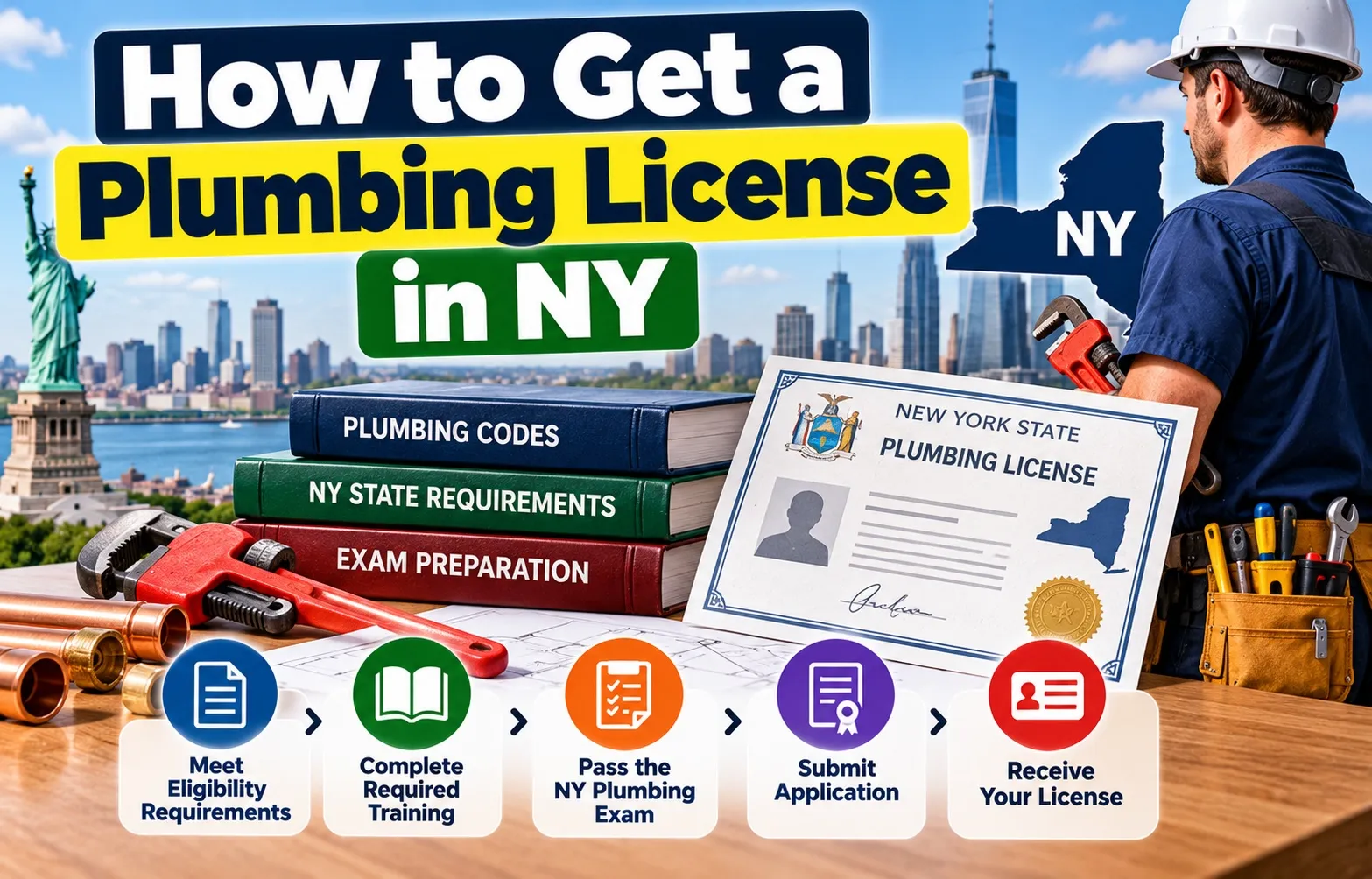 New York State does not issue a single, statewide plumbing license. Plumbing licenses and trade certifications are regulated entirely at the municipal level by local city clerks, town boards, or county building departments. To work legally as a plumber in New York, you must obtain a license directly from the specific local jurisdiction where you plan to perform trade work.
Does New York State Have a Statewide Plumbing License?
No, New York State leaves all trade licensing authority to local municipalities. This local regulatory model means that a license issued in one city or town generally does not grant reciprocity in another.
- Municipal Authority: Each city or county sets its own standards for trade certification, experience verification, and exam passing scores.
- NYC Division: The five boroughs of New York City operate under a separate regulatory framework administered by the NYC Department of Buildings Official Portal.
- Upstate & Long Island Jurisdictions: Regions outside NYC, including Westchester County, Nassau County, Buffalo, and Rochester, require separate registration with their local municipal licensing boards or local city clerk offices.
NYC vs. Upstate NY: Key Licensing Differences at a Glance
The path to becoming a licensed plumber varies significantly depending on whether you operate within New York City or in Upstate and Suburban New York. Understanding these regional differences ensures full regulatory compliance before beginning work.
From Apprentice to Master Plumber
Advancing in the New York plumbing industry follows a strict, chronological progression based on documented work hours, technical training, and direct supervision. Each tier unlocks higher responsibility, improved pay scales, and expanded legal working parameters.
Tier 1: Plumbing Apprentice Trainee (Getting Started)
The apprentice stage is the entry point where trainees learn trade fundamentals while working under the direct supervision of a licensed Master Plumber. Apprentices gain hands-on field exposure alongside mandatory classroom instruction.
- Training Pathways: You can enter via a union apprenticeship (such as Plumbers Local 1 in NYC) or a non-union apprenticeship registered with the NYS Department of Labor.
- Core Responsibilities: Assembling basic piping systems, maintaining site safety, interpreting blueprints, and assisting senior plumbers.
- Documentation Requirement: Maintain accurate employer records and pay stubs to ensure all worked hours qualify toward future licensing thresholds.
Tier 2: Registered Journeyman Plumber (5-Year Threshold)
After acquiring five years of full-time trade experience under a licensed professional, a plumber becomes eligible for Journeyman Plumber Registration. This credential certifies your ability to perform complex installation and repair work independently.
- Experience Benchmark: Requires a minimum of 5 years (or 8,750+ hours) of verifiable trade experience, including formal W-2 experience proof from licensed employers.
- Work Standards: Registered Journeymen can perform installations, system modifications, and routine maintenance without constant direct supervision.
- Permit Limitations: Journeymen cannot pull building permits or independently operate a plumbing contracting company in New York.
Tier 3: Licensed Master Plumber (7-Year Threshold & Business Rights)
The Master Plumber License represents the highest professional tier in New York. Achieving this rank grants full legal authority to run a business, pull construction permits, and supervise crews of apprentices and journeymen.
- Qualifications: Candidates need at least 7 years of total plumbing experience within the prior 10 years (including at least 2 years as a registered NYC Journeyman) or a relevant engineering degree plus 5 years of practical experience.
- Examination Process: Candidates must pass a comprehensive written examination followed by a rigorous practical hands-on evaluation.
- Business Rights: Allows you to establish a licensed contracting company, register an official seal, sign off on completed jobs, and obtain local building permits.
How to Get a NYC Plumbing License: Step-by-Step DOB NOW Process
Securing a Master Plumber license in New York City requires navigating the digital NYC Department of Buildings platform. Meeting rigorous experience thresholds and passing two distinct testing phases are mandatory for full licensing approval.
Step 1: Fulfill Experience & Education Eligibility Requirements
Candidates must accumulate at least 7 years of full-time general experience within the prior 10 years under a licensed professional. Alternatively, a qualifying engineering degree plus 5 years of practical experience satisfies the mandate.
- Journeyman Milestone: You must include at least 2 years of certified work experience as a registered NYC Journeyman Plumber.
- Documentation Check: Compile comprehensive tax documents, W-2 forms, and employer affidavits verifying every single hour of required field work.
Step 2: Submit Application via DOB NOW Licensing Portal
Applicants must register an account on the DOB NOW: Licensing Portal to submit background documentation and pay initial processing fees. The application submission requires careful uploading of all work history verification forms.
- Portal Processing: Pay the initial application and review fees online securely through the portal dashboard.
- Application Review: The Department of Buildings reviews your submitted credentials before granting authorization to schedule the official examinations.
Step 3: Pass the Written Multiple-Choice Exam
Candidates must pass a comprehensive written examination covering the NYC Plumbing Code, Fuel Gas Code, and OSHA safety standards. Reviewing the official candidate guide helps applicants master code references before test day.
- Exam Fees: The computer-based test requires paying a $585 written exam fee upon scheduling.
- Prerequisite Status: Passing this theoretical test is mandatory before moving forward to the practical bench testing phase.
Step 4: Pass the Hands-On Practical Exam (Within 24 Months)
Candidates who pass the written test must clear the hands-on practical exam at an approved practical testing center within a strict 24-month deadline. This rigorous test evaluates real-world piping installation, joint sealing, and pressure-testing skills.
- Practical Cost: The bench evaluation requires paying a $530 practical exam fee prior to test administration.
- Strict Expiration: Failing to complete the practical portion within the 24-month deadline voids your written exam score, requiring a complete restart.
Step 5: Complete Background Check Character References & Seal Issuance
Final license issuance requires clearing an extensive background investigation and submitting notarized character reference letters. The Department of Buildings reviews your criminal history, fingerprinting records, and financial standing.
- Character Affidavits: Provide signed character affidavits from established industry professionals or previous licensed employers.
- Seal Issuance: Upon final background investigation clearance, you receive your official Master Plumber seal and license card, authorizing full business operations in NYC.
Licensing Outside NYC (Upstate Long Island & Westchester)
Plumbing licensing rules vary significantly across New York State once you step outside New York City. Because there is no statewide plumbing license, each county, city, or local municipality enforces its own local city ordinances, board examinations, and experience requirements.
Westchester County Plumbing Licensing (Consumer Protection Board)
Westchester County operates a centralized countywide plumbing licensing program managed by the Westchester County Department of Consumer Protection. This system streamlines licensing across most towns and villages within the county borders.
- Licensing Tiers: Issues both Journeyman and Master Plumber licenses valid across county jurisdictions.
- Exam Requirements: Applicants must verify at least 5 years of field experience before taking the county’s written trade examination.
- Business Compliance: Operating a plumbing business requires registering general liability insurance and workers’ compensation coverage directly with the county board.
Long Island Licensing (Nassau & Suffolk County Rules)
Long Island does not have a single unified licensing system for Nassau and Suffolk counties. Instead, licensing authority is held by individual townships and cities, requiring plumbers to secure multiple licenses if working across town boundaries.
- Township Specifics: Towns such as Hempstead, Oyster Bay, Huntington, and Islip maintain separate licensing boards and application procedures.
- Reciprocal Agreements: Select neighboring towns offer reciprocal agreements, allowing licensed Master Plumbers to extend credentials without re-taking written exams.
- Local Registration: Always check with the local city or town clerk before starting a job to ensure local registration and permit filing requirements are met.
Upstate New York Cities (Buffalo Rochester Albany & Troy)
Major cities across Upstate New York enforce local city ordinances administered through a dedicated local Examining Board of Plumbers or the local city clerk office.
- Buffalo & Rochester: Require candidates to prove 4 to 5 years of verifiable trade work under a licensed master before sitting for the municipal exam.
- Troy & Albany: The City of Troy requires 5 years of continuous, full-time employment verified by employer tax forms, followed by formal application to the Troy City Clerk.
- Board Review: Local examining boards meet periodically to review background references, approve exam candidates, and issue municipal licenses.
Documents & Exam Prep Strategy
Successfully navigating the New York plumbing licensing process requires flawless administrative paperwork and rigorous preparation for both written and hands-on testing phases. Meeting these high standards prevents costly application rejections and positions you to pass on your first attempt.
How to Properly Document W-2 Hours & Master Plumber Sign-Offs
Securing official sign-offs from a licensed Master Plumber requires meticulous record-keeping, as the NYC Department of Buildings rejects thousands of applications annually due to incomplete employment history. Consistently maintaining verified W-2 tax forms alongside signed affidavits is non-negotiable for proving your exact practical hours.
- W-2 Tax Form Verification: Always retain certified federal and state W-2 tax transcripts proving employment continuity directly under a licensed plumbing contractor.
- Affidavits of Experience: Have supervising Master Plumbers complete and notarize official Department of Buildings experience affidavits detailing your exact dates of employment and specific task breakdowns.
- Avoid Common Rejection Pitfalls: Ensure overlapping employment dates or missing employer signatures are accounted for with supporting payroll records or union logs before initial application submission.
Practical Tips for Cracking the NYC Practical Plumbing Exam
Passing the hands-on practical exam demands familiarity with physical testing rigs, strict code adherence, and precise measurements under tight time constraints. Candidates must master rigorous safety benchmarks and joint installation techniques governed by local standards.
- Code Compliance Mastery: Study the explicit requirements outlined in the NYC Plumbing Code, NYC Fuel Gas Code, and relevant ASME standards to ensure flawless technical execution during testing.
- Bench Training & Rig Practice: Practice pipe threading, copper joining, and pressure testing on standardized test rigs to build muscle memory and speed under pressure.
- Time Management: Allocate your testing hours efficiently across blueprint interpretation, layout assembly, and final joint testing to complete every station before the buzzer.
Military Experience & Trade School Credit Conversions
Aspiring plumbers with military engineering backgrounds or accredited vocational school diplomas can often convert structured training hours directly toward their state licensing thresholds. Understanding how trade school credits translate accelerates your timeline toward journeyman and master status.
- Vocational Credit Hours: Accredited trade school programs often allow a direct trade school hours conversion, shaving up to two years off required field apprenticeship requirements.
- Military Utility & Construction Experience: Service members with plumbing, piping, or utilities ratings can submit official Joint Services Transcripts (JST) to evaluate credit equivalencies with municipal boards.
- Supplemental Field Hours: Note that classroom hours only cover a portion of the mandate; candidates must still fulfill remaining practical field experience thresholds under licensed supervision.
Insurance Surety Bonds & Starting a Business
Passing the exams and earning your Master Plumber license is only the first phase. Before you can legally pull permits, sign off on jobs, or operate a contracting business in New York, you must fulfill specific legal, insurance, and corporate registration mandates.
Required General Liability Insurance & $100,000 Surety Bonds
Operating as a licensed Master Plumber in New York requires maintaining active insurance policies and financial guarantees to protect the public and property against damages during construction.
- $100,000 Surety Bond: You must file a $100,000 surety bond with the local licensing authority (such as the NYC Department of Buildings) to guarantee code compliance and financial accountability.
- General Liability Insurance: Active Master Plumbers must carry comprehensive General Liability Insurance—typically requiring at least $1,000,000 to $2,000,000 per occurrence depending on municipal standards.
- Workers’ Compensation & Disability Coverage: If you hire employees, apprentices, or journeymen, you must maintain mandatory Workers’ Compensation and Disability Insurance under New York State law.
Registering Your Master Plumber Business & Official Seal
To contract work legally, your plumbing license must be tied to an approved business entity and an official corporate seal registered with your municipal licensing board.
- Entity Formation: Establish your corporate structure by filing for an LLC formation or Corporation through the New York Department of State.
- Master Plumber Seal: Order your customized, official Master Plumber Seal following strict municipal design specs, and submit a physical seal impression to the licensing department for authorization.
- DOB Business Authorization: Register your corporate entity and primary place of business directly with the building department to tie your license number to job permit applications.
NYC Vehicle Lettering & License Plate Compliance Laws
In New York City and various surrounding municipalities, commercial plumbing vehicles are strictly regulated to prevent unlicensed contracting and ensure public accountability.
- Vehicle Lettering Requirements: All commercial trucks and vans operated by a licensed Master Plumber must display the company name, business address, and Master Plumber license number prominently on both sides in legible lettering at least 3 inches high.
- DOB Plate Registration: In NYC, all commercial vehicles used for plumbing contracting must be formally registered with the Department of Buildings and display specialized commercial license plates.
- Compliance Enforcement: Operating an unlettered or unregistered vehicle on job sites can result in hefty municipal fines, permit suspensions, or disciplinary hearings before the licensing board.
Salary Insights & Career ROI: Is a NY Plumbing License Worth It?
Investing five to seven years in acquiring a New York plumbing license offers substantial financial returns and long-term job security. Understanding the income trajectory across career stages and trade specializations helps clarify the overall return on investment for trade professionals.
Average Plumber Salaries in New York (Apprentice vs. Master)
Earning potential increases significantly with each credential milestone, moving from entry-level trainee stipends to lucrative business ownership revenues.
- Apprentice Level: Starting hourly wage ranges from $18 to $28 per hour, yielding an initial annual income of approximately $37,000 to $58,000 while gaining required field hours.
- Journeyman Pay Scale: Licensed Journeymen earn between $35 and $55 per hour, bringing annual earnings to $72,000–$115,000 depending on location and overtime.
- Master Plumber Revenue: Independent Master Plumbers running licensed contracting firms can generate $120,000 to well over $250,000 annually, driven by commercial permits and specialized emergency services.
Union vs. Non-Union Earning Potential in NY
Compensation structures differ notably between organized labor unions and independent open-shop contractors, particularly in the New York City metropolitan market.
- Local 1 Union Wages: Members of Plumbers Local 1 in NYC benefit from collectively bargained rate cards that deliver among the highest total compensation packages nationwide.
- Open-Shop Flexibility: Non-union plumbers often experience faster initial hiring processes and flexible project incentives, though overall hourly packages remain slightly lower than union benchmarks.
Plumbing vs. HVAC: Which Trade Pays Better in New York?
Both plumbing and HVAC offer strong trade career growth across New York, but key differences in licensing barriers and emergency demand shape their earning limits.
- Licensing Premium: Plumbing generally commands higher hourly rates for Master level practitioners due to stricter municipal licensing barriers and health code regulations compared to residential HVAC work.
- Emergency Service Rates: Master Plumbers in urban areas frequently charge premium emergency fees for main line back-ups, boiler failures, and gas line repairs.
- Dual-Credential Advantage: Technicians who secure both plumbing and HVAC trade certifications maximize year-round service demand and position themselves for high-paying facility management roles.
Frequently Asked Questions
Here are concise, direct answers to the most common questions regarding plumbing licensing, training timelines, and regulations in New York.
How long does it take to get a plumbing license in NY?
It takes between 5 to 7 years to get a plumbing license in New York, depending on the tier and local jurisdiction:
- Registered Journeyman Plumber: Requires a minimum of 5 years (8,750+ hours) of full-time documented work under a licensed Master Plumber.
- Licensed Master Plumber: Requires at least 7 years of total trade experience (or 5 years if holding a relevant engineering degree), followed by passing both written and practical exams.
Is 35 (or older) too late to become a plumber in New York?
No, 35 or older is not too late to become a plumber in New York. Adult apprenticeships are common, and trade unions (like Plumbers Local 1) and non-union contractors accept applicants of any age, provided they meet physical capability standards, possess a high school diploma or GED, and are legally eligible to work in the U.S.
Do you need a license to perform basic plumbing repairs in NY?
You do not need a plumbing license to perform minor maintenance or simple handyman-level repairs on existing fixtures. However, any project involving structural piping, gas line work, drainage line modifications, or system installations requires a permit pulled by a licensed Master Plumber under local building codes.
Can you get a plumbing license online in New York?
No, you cannot get a plumbing license online in New York. While you can complete preliminary trade courses or exam prep online, state and local regulations require in-person, hands-on field experience (5 to 7 years) and proctored physical examinations before issuing a license.
What plumbing work can be done without a license in NY?
Under the handyman exemption and local building codes, non-licensed individuals can perform minor repairs that do not alter the underlying system piping, including:
- Replacing faucet washers, aerators, or showerheads.
- Clearing minor drain clogs with hand snakes or plungers.
- Replacing toilet flappers, fill valves, or wax rings.
- Connecting exposed appliance supply lines (e.g., washing machines, dishwashers).

Oscar Vance | Master Plumber & Drainage Expert
Meet Oscar Vance, a licensed master plumber sharing practical solutions on residential repairs, preventive maintenance, and thoughtful home upkeep.