Is Operating an HVAC UV Light System Costly?
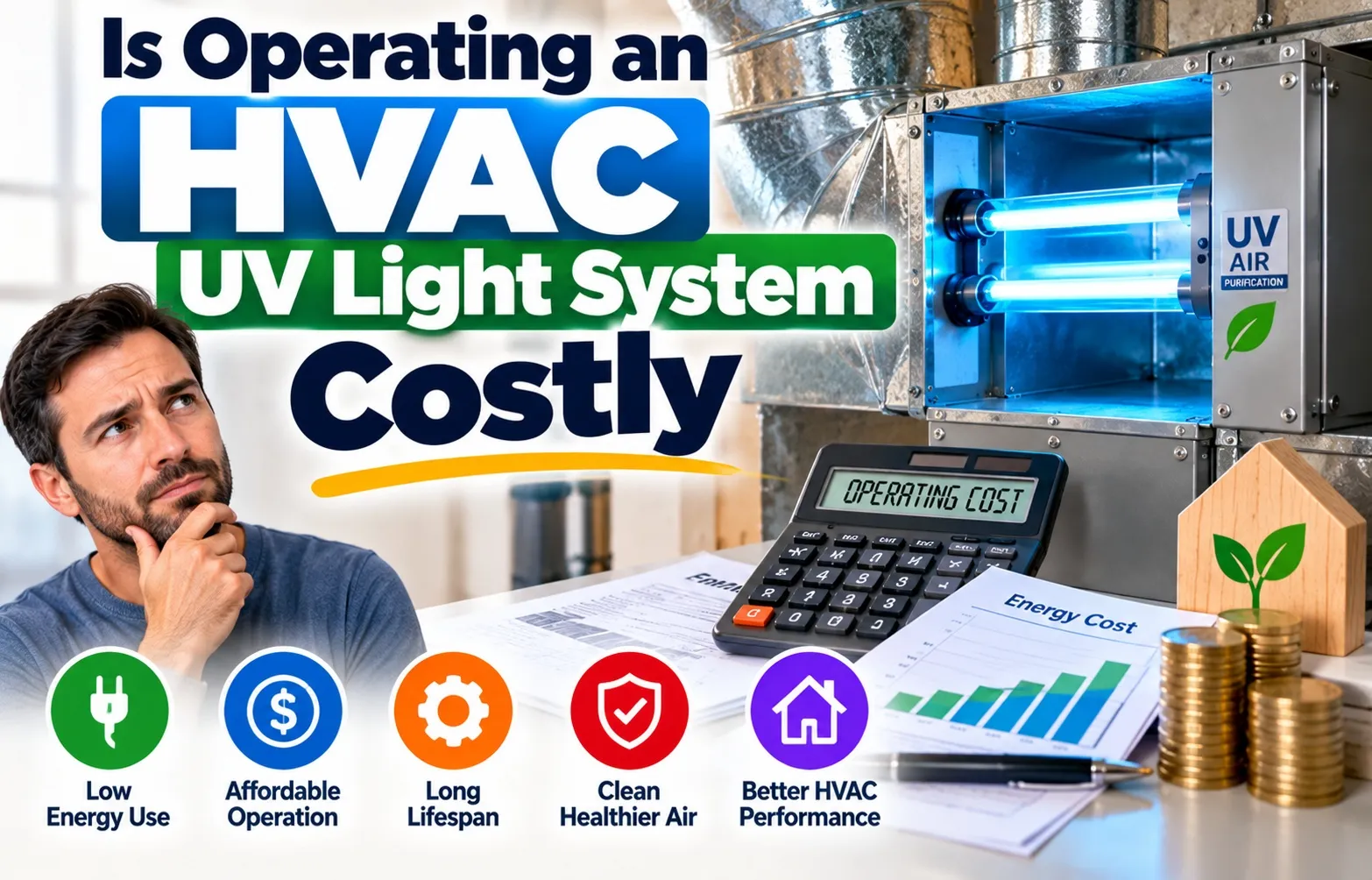 Operating an HVAC UV light system is not costly, adding only $1.50 to $4.00 per month to your electric bill under continuous 24/7 operation. While running the system consumes minimal energy, ongoing expenses primarily depend on annual replacement bulbs and the initial equipment selection.
The Reality of HVAC UV Light Running Expenses
Running a UV light system continuously requires very little electrical power because residential units use low-wattage bulbs. The overall financial commitment breaks down into three key areas:
- Electricity Costs: Standard residential UV lamps draw between 15W and 36W, which translates to roughly $18 to $48 per year on your power bill depending on local energy rates.
- Bulb Replacements: UV-C lamps lose germicidal effectiveness over time and require replacement every 9 to 12 months, costing between $30 and $100 per bulb.
- Upfront Installation: Initial equipment and professional installation range from $250 to $1,200 depending on system type.
Because the light operates at a constant low wattage, it does not create significant power spikes or disrupt household energy efficiency.
Breaking Down the Monthly Electricity Usage
An HVAC UV light draws between 15 and 50 watts of continuous electrical power, resulting in a minimal monthly energy consumption of roughly 11 to 36 kilowatt-hours (kWh). Because germicidal lamps operate at low wattages comparable to standard household bulbs, they do not cause sudden surges in your utility bills.
How Much Power Does an HVAC UV Lamp Actually Draw?
The energy draw of an ultraviolet system depends entirely on its lamp size, bulb count, and physical installation style. Understanding power specifications helps you determine exact utility impacts:
- Single-Bulb Coil Lights: Standard coil-sterilization lamps typically operate at 15W to 24W, consuming around 11 kWh to 17 kWh per month.
- Dual-Bulb or High-Output Systems: Larger whole-house in-duct systems use 36W to 50W setups, drawing roughly 26 kWh to 36 kWh per month.
- Standard Household Comparison: Running a typical 18W UV lamp continuously uses less energy than a single standard 60-watt incandescent light bulb left on for just 8 hours a day.
Because the electrical load is constant and relatively light, standard residential wiring handles UV installations without requiring specialized circuit upgrades.
The Math: Step-by-Step Monthly Energy Calculation Formula
Calculating the exact power consumption of your UV light requires converting bulb wattage to kilowatt-hours and multiplying by your local electricity rate.
Use this plug-and-play energy calculation formula:
Monthly Cost = [(Wattage × 24 hours × 30 days) ÷ 1,000] × Local Electricity Rate per kWh
Here is how the math breaks down for a standard 18-watt UV light at an average rate of $0.16 per kWh:
- Calculate Daily Watt-Hours: 18 Watts × 24 Hours = 432 Watt-hours per day.
- Convert to Monthly Kilowatt-Hours: (432 Watt-hours × 30 Days) ÷ 1,000 = 12.96 kWh per month.
- Apply Local Energy Rate: 12.96 kWh × $0.16 per kWh = $2.07 per month.
Adjusting the formula with your exact utility provider’s kWh rate gives you a precise dollar figure for your monthly electric bill.
Continuous (24/7) Operation vs. Intermittent Fan Cycling
Operating a UV light in continuous run mode is recommended by most manufacturers to maintain proper germicidal efficacy and prolong bulb lifespan.
- Continuous Run Mode (24/7): Keeps the lamp illuminated at all times to continuously sterilize the cooling coil and prevent mold spore colonization during idle HVAC cycles.
- Intermittent Fan Cycling: Wiring the light to a blower fan interlock switch turns the lamp on only when airflow is active, slightly reducing power usage.
- Bulb Longevity Impact: Frequent power cycling wears out UV lamp filaments quickly, reducing overall bulb lifespan faster than continuous low-wattage operation.
Keeping the system powered continuously ensures maximum air quality protection while keeping electricity costs under a few dollars per month.
The True Ongoing Expense: UV-C Bulb Replacement & Maintenance
While the monthly electricity cost of running an HVAC UV light remains under a few dollars, maintenance represents the primary ongoing expense for homeowners. Understanding replacement intervals and bulb costs prevents unexpected service surprises.
Why UV Bulbs Must Be Replaced Annually (The Output Decay Factor)
A common misconception among homeowners is that a UV lamp functions effectively as long as it continues glowing. However, germicidal UV-C output experiences steady degradation over time even while visible illumination persists.
- The 9,000-Hour Lifespan: Standard UV-C bulbs are engineered for approximately 9,000 hours of continuous operation, which translates to roughly 12 months of constant use.
- The Visible Blue Light Illusion: The blue glow emitted by the fixture is just visible light; it does not indicate that germicidal radiation is actively destroying mold or bacteria.
- Loss of Sterilization Efficacy: After one year, ultraviolet output drops below the threshold needed to sanitize evaporator coils effectively.
To explore comprehensive cost analyses regarding ongoing operation and replacement trends, refer to the Filterbuy HVAC UV Light Electricity Cost Guide.
Replacement Bulb Price Comparison: Single vs. Dual Lamps
Purchasing replacement bulbs involves varying price points depending on your system configuration and lamp wattage. Knowing replacement expenses helps budget annual maintenance accurately:
- Single Replacement Bulbs: Basic replacement lamps for single-bulb coil units generally cost between $30 and $70 per bulb.
- Dual-Bulb System Replacements: Advanced or dual-lamp whole-house systems require two replacement bulbs, ranging from $70 to $150 total per cycle.
- Specialized High-Output Lamps: Proprietary OEM brand bulbs designed for specific manufacturer housings can cost upwards of $100 to $120 each.
Buying generic or universal replacement bulbs matching your socket and pin configuration can significantly lower annual maintenance costs.
DIY Replacement vs. Hiring an HVAC Technician
Swapping out an expired UV lamp can be handled independently or delegated to a professional service technician, directly impacting total maintenance overhead.
- DIY Replacement Approach: Involves turning off system power, unscrewing the housing, sliding out the old bulb, and plugging in a new compatible lamp in under 15 minutes.
- Contractor Service Fees: Hiring an HVAC technician for annual bulb replacement typically adds $100 to $250 in labor fees on top of the retail bulb cost.
- Safety Precautions: Always wear gloves and safety glasses during DIY swaps to avoid touching the glass quartz sleeve or exposing eyes to stray UV radiation.
Performing bulb replacements yourself is straightforward and eliminates unnecessary contractor service fees while keeping your system operating at peak sanitization capacity.
Coil-Sanitizing vs. Air Sterilization: Cost & Wattage Differences
Understanding the distinction between coil-sterilization lights and in-duct whole-house UV air purifiers is critical to evaluating operating costs. System design, wattage draw, and bulb counts directly determine both your monthly power bill and long-term replacement expenses.
Coil-Sterilization Lights: Low Wattage, Targeted Protection
Coil-sterilization units are installed directly inside the air handler above or below the indoor cooling coil. These targeted systems focus on preventing biological growth on wet surfaces rather than purifying moving air.
- Minimal Wattage Draw: Most coil-mounted lights operate at 15 to 24 watts, adding less than $2.50 per month to your electric bill.
- Single-Bulb Efficiency: Because they focus strictly on stationary surfaces, single-bulb configurations provide sufficient UV-C intensity without drawing excess power.
- Budget-Friendly Replacement: Replacing a single coil lamp annually requires an investment of $30 to $70, making it the most cost-effective option for homeowners.
Targeting the evaporator coil addresses the root cause of HVAC mold and odor without introducing complex power demands or restricting airflow static pressure.
In-Duct Whole-House UV Systems: Higher Wattage & Multi-Bulb Costs
In-duct whole-house systems are mounted directly inside the supply or return ductwork to sanitize fast-moving air as it circulates through your home. These advanced units often incorporate Photocatalytic Oxidation (PCO) technology or secondary oxidizers.
- Higher Power Requirements: Purifying moving air in milliseconds requires high-output lamps drawing 36 to 70+ watts, costing $4.00 to $8.00 per month in electricity.
- Multi-Bulb Configurations: Many in-duct systems utilize dual bulbs or combination UV/PCO cells, increasing annual replacement expenses to $80–$180.
- Airflow Considerations: Larger physical fixtures placed in air ducts must be sized correctly by a professional to ensure static pressure remains within design specifications.
While whole-house air purifiers require higher operational and maintenance budgets, they treat airborne pathogens and odors across your entire living space.
Popular Models Compared: Blue-Tube UV, Carrier, and Honeywell
Comparing mainstream HVAC germicidal models highlights clear variations in power consumption, bulb pricing, and feature sets across top manufacturers.
Selecting the right brand depends on whether your priority is basic coil protection to preserve cooling efficiency or comprehensive duct-based air purification.
The ROI Equation: Do UV Lights Save Money on HVAC Bills?
Operating an HVAC UV light system can actually generate a net positive return on investment by preserving heat transfer efficiency and lowering seasonal cooling expenses. The modest electricity cost of $2 to $4 per month is frequently offset by preventing efficiency loss and avoiding premature repair expenses.
Preventing Bio-Film Buildup on Evaporator Coils
Indoor cooling coils operate in a dark, humid environment that acts as a breeding ground for mold spores, fungi, and bacterial bio-film. Over time, an microscopic layer of organic matter forms across the delicate aluminum fins.
- Restricted Airflow: Bio-film accumulation acts as physical insulation, narrowing passages between fins and forcing the blower fan to work harder.
- Continuous Sterilization: UV-C light disrupts microbial DNA, preventing bio-film from forming and keeping coil surfaces biologically clean.
- System Longevity: Preventing organic accumulation protects copper tubing and aluminum fins from premature corrosion, extending your HVAC system lifespan.
Maintaining clean coils ensures consistent airflow without putting extra stress on your system’s blower motor or compressor.
Maintaining Energy Efficiency & Heat Transfer Rates
Even a microscopic layer of bio-film on your evaporator coil can reduce thermal conductivity significantly. When coils are insulated by organic build-up, heat transfer efficiency drops rapidly, forcing the cooling system to run longer cycles.
- Efficiency Loss Prevention: A dirty coil can reduce cooling efficiency by 10% to 15%, causing a corresponding spike in monthly power usage during summer months.
- Energy Savings Offset: On a $200 monthly summer electric bill, a 10% efficiency loss costs an extra $20 per month—far exceeding the $2 to $3 required to run the UV light.
- Consistent Performance: Keeping coil surfaces clean maintains maximum refrigerant heat absorption, ensuring your home reaches desired thermostat settings faster.
The energy saved by preserving heat transfer efficiency consistently offsets the minor electrical power required to operate a germicidal UV lamp.
Avoiding Unscheduled $300+ AC Coil Cleanings
Preventing microbial build-up eliminates the need for frequent manual chemical cleanings, saving substantial money on routine HVAC maintenance.
- High Professional Cleaning Costs: Having an HVAC technician perform a deep chemical wash on a heavily fouled indoor coil typically costs $300 to $600.
- Preventive Maintenance Savings: Continuous UV light exposure keeps coils clean, reducing manual maintenance needs to basic visual inspections during regular tune-ups.
- Reduced Emergency Calls: Preventing organic growth stops drain pan blockages and condensate line backups caused by slime mold buildup.
Investing in continuous UV coil protection protects your household budget from unexpected mechanical service bills and professional cleaning fees.
Frequently Asked Questions About HVAC UV Light Costs
Here are direct answers to the most common questions regarding the cost, operation, and maintenance of HVAC UV light systems.
Can I turn off my HVAC UV light in the winter to save money?
You can turn off your HVAC UV light during the winter, but it is generally not recommended if your primary goal is air purification or maintaining clean coils during heating cycles. Turning the system off during winter months saves only $3 to $8 total in seasonal electricity costs while leaving your system unprotected against dust mites, bacteria, and indoor air pollutants that thrive in heated homes. Additionally, frequent power cycling can wear out UV bulb filaments faster than continuous operation.
How do I know if my HVAC UV light bulb needs to be replaced?
You can determine if your HVAC UV light bulb needs replacement by checking the operating duration, looking at sight glass indicators, or monitoring system alerts:
- Operating Time (12-Month Rule): If the bulb has been powered continuously for 9,000 hours (roughly 12 months), it must be replaced even if it still emits a blue glow.
- Sight Glass Indicator: Most HVAC UV light installations include a safe external sight glass or view port on the ductwork that lets you confirm if the bulb is lit without opening the unit or exposing yourself to harmful rays.
- Indicator Lights & Alarms: Modern ballast units feature LED indicator lights or audible beeps that alert you when the lamp’s transformer detects bulb failure or expired service life.
Will an HVAC UV light increase my monthly electric bill significantly?
No, an HVAC UV light will not increase your monthly electric bill significantly. Because most residential systems use low-wattage bulbs between 15W and 36W, operating the light continuously 24/7 typically adds only $1.50 to $4.00 per month to your overall utility bill depending on local electricity rates. This minor electricity cost is often offset by the energy saved when clean evaporator coils operate at peak efficiency.
Are HVAC UV lights worth the money according to HVAC technicians?
According to the consensus among experienced HVAC technicians, UV lights are worth the money specifically for homeowners dealing with high humidity, recurring coil mold, unpleasant odors, or severe respiratory allergies. Technicians emphasize that while coil-sterilization UV lights excel at preventing organic bio-film buildup and keeping air handlers clean, they should be viewed as an addition to—rather than a replacement for—quality air filters and regular preventative maintenance.

Oscar Vance | Master Plumber & Drainage Expert
Meet Oscar Vance, a licensed master plumber sharing practical solutions on residential repairs, preventive maintenance, and thoughtful home upkeep.