How Many Bundles of Roofing Shingles Do You Need?
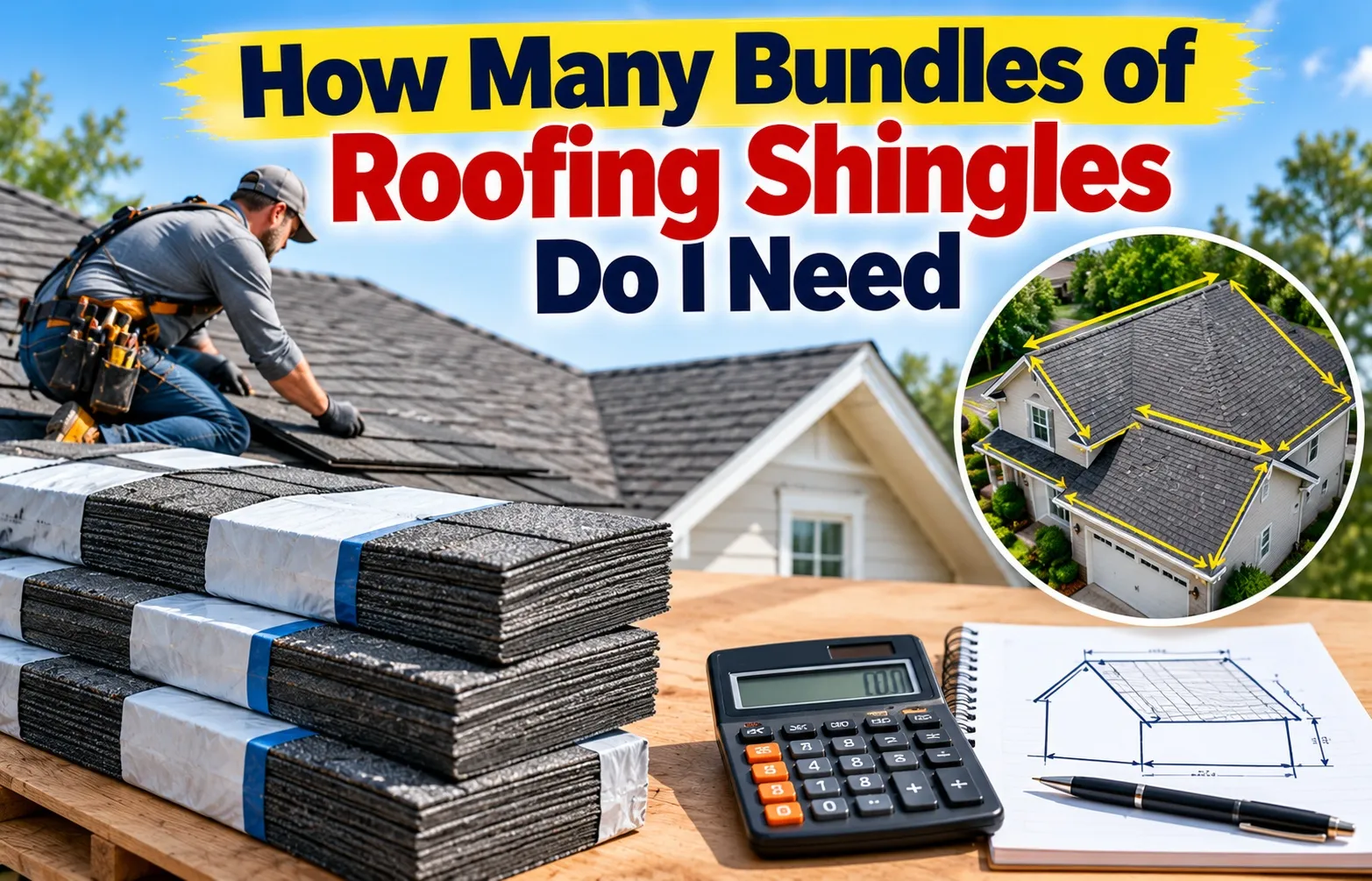 To determine how many bundles of roofing shingles you need, calculate your total roof area, divide it by 100 to find your roofing squares, and multiply by 3. Finally, add a waste factor of 10% to 15% to cover cuts, starter strips, and ridge caps.
The Standard Shingle Formula (At a Glance)
Roofing materials are measured in “squares,” where one roofing square equals 100 square feet. Standard asphalt 3-tab and architectural shingles require 3 bundles per square, meaning each bundle covers approximately 33.3 square feet.
- Step 1: Total Roof Area (sq ft) ÷ 100 = Total Roofing Squares
- Step 2: Total Roofing Squares × 3 = Base Bundles Needed
- Step 3: Base Bundles × 1.10 (10% waste for simple roofs) or 1.15 (15% waste for complex roofs) = Final Bundles Required
Step-by-Step: How to Calculate Shingle Bundles for Any Roof
Calculating the exact number of shingle bundles for your roofing project requires an accurate mathematical breakdown. By measuring your roof plane, accounting for slope geometry, converting measurements into standard roofing squares, and factoring in cutting waste, you can eliminate guesswork and avoid material shortages.
Step 1: Calculate the Roof Footprint Area (Length × Width)
Your calculation begins with measuring the base footprint of each roof plane rather than just the square footage of your home’s foundation. Measure the length and width of each individual roof section from the ground or architectural blueprints.
- Multiply the length by the width of each rectangular roof plane to find its base square footage.
- Add the square footage of all individual planes together to get your total roof footprint area.
- If your roof features complex angles, break it down into smaller geometric shapes before combining the totals.
Step 2: Account for Roof Pitch & Slope Multipliers
Flat ground measurements fail to reflect your roof’s actual surface area because steeper slopes stretch the physical dimensions. You must multiply your footprint area by a specific pitch multiplier determined by your roof’s rise-over-run ratio.
- Low Slope (4/12 pitch): Multiplier of approximately 1.054.
- Standard Slope (6/12 pitch): Multiplier of approximately 1.118.
- Steep Slope (8/12 or higher): Multiplier of 1.200 or greater, significantly increasing true surface area.
Step 3: Convert Surface Area into Roofing Squares
The roofing industry measures materials in units called “squares” rather than individual square feet to simplify large-scale calculations. One standard roofing square is equal to exactly 100 square feet of actual surface area.
- Divide your final adjusted surface area by 100 to determine your total number of roofing squares.
- For example, if your adjusted surface area is 1,677 square feet, dividing by 100 yields 16.77 roofing squares.
- Maintain decimal precision during this step before calculating your final bundle counts.
Step 4: Multiply by Bundles per Square & Add Waste Factor
Standard asphalt shingles—including both 3-tab and architectural shingles—are packaged so that 3 bundles cover exactly 1 roofing square, meaning each individual bundle covers approximately 33.3 square feet. You must also add a waste factor to account for field cuts, starter strips, and ridge trimming.
- Multiply your total roofing squares by 3 to find your base bundle requirement.
- Add 10% to 15% extra material for standard gable roofs to cover cutting waste.
- Increase your waste factor to 20% for complex roofs featuring multiple valleys, dormers, and hip joints.
Real-World Calculation Example: Consider a home with a 1,500 square foot footprint and a standard 6/12 pitch:
- Surface Area: 1,500 sq ft × 1.118 (6/12 pitch multiplier) = 1,677 sq ft of actual surface area.
- Roof Squares: 1,677 sq ft ÷ 100 = 16.77 roofing squares.
- Base Bundles: 16.77 squares × 3 bundles = 50.31 base bundles.
- Waste & Rounding: 50.31 × 1.15 (15% waste factor) = 57.85 bundles, rounded up to 58 total bundles.
Beyond Field Shingles: Calculating Starter Strips, Hips, and Ridge Caps
Calculating field shingles only accounts for the main flat surfaces of your roof. To avoid running out of materials mid-project, you must calculate starter strips for the perimeter and specialized cap shingles for all hips and ridges separately.
How Many Bundles for Starter Strips? (Linear Feet Math)
Starter strip shingles form the initial layer along your roof’s bottom edges (eaves) and side edges (rakes) to prevent wind uplift and water infiltration. Unlike field shingles measured in square feet, starter strips are purchased based on total linear feet.
- Measure the total length of all eaves and rakes along the roof perimeter in linear feet.
- Divide the total linear footage by the coverage length provided on the manufacturer’s bundle package (typically 100 to 120 linear feet per bundle).
- Round up to the next whole bundle to ensure complete seam coverage along every edge.
Estimating Hip and Ridge Cap Bundles
Hip and ridge caps seal the intersecting peak joints of your roof. Professional contractors often use specialized high-profile ridge cap bundles or cut standard 3-tab shingles into three individual cap pieces to cover these high-wind zones.
- Measure the linear footage of all horizontal ridges and sloped hip lines.
- If using pre-cut specialty ridge caps, one bundle typically covers 20 to 35 linear feet depending on the brand and exposure.
- If cutting standard 3-tab shingles, one 3-tab bundle yields approximately 35 linear feet of cap coverage (each shingle yields 3 cap pieces covering roughly 5 inches of exposed length).
Roof Complexity & Waste Factor Rules (10% vs. 15% vs. 20%)
Applying a blanket waste percentage across every roof leads to material shortages on complex designs. The architectural features of your roof dictate whether you should add 10%, 15%, or 20% to your overall material order.
- 10% Waste Factor: Use for simple gable roofs with two flat planes and minimal angled cuts.
- 15% Waste Factor: Use for standard hip roofs, roofs with basic valleys, or projects with attached garages.
- 20% Waste Factor: Mandatory for complex roof facets featuring multiple dormers, sidewalls, skylights, and intersecting valleys where diagonal cutting creates significant material loss.
Shingle Bundle Costs and Budgeting (2026 Price Guide)
Budgeting for a roofing project involves understanding both raw material costs and labor expenses. Standard asphalt shingle pricing varies depending on shingle design, durability tier, and regional labor rates, making clear cost estimations essential before hiring contractors or ordering supplies.
Average Price per Bundle of Shingles
Asphalt shingles typically cost between $30 and $45 per bundle for basic to mid-range options, though premium architectural and luxury designer shingles can reach $60 to $90+ per bundle. Because three bundles cover one square (100 square feet), raw field material costs range from $90 to $135 per square before adding starter strips, ridge caps, underlayment, and waste factors. For detailed packaging dimensions, weight limits, and coverage specs, refer to the IKO Roofing Specification Guide.
- 3-Tab Shingles: $30 to $38 per bundle ($90 to $114 per square). Most budget-friendly option with a 20- to 25-year lifespan.
- 30-Year Architectural Shingles: $35 to $50 per bundle ($105 to $150 per square). Dimensional design offering higher wind resistance and extended durability.
- Luxury / Specialty Shingles: $60 to $90+ per bundle ($180 to $270+ per square). Heavyweight laminated materials mimicking natural slate or wood shake.
Total Material Cost vs. Contractor Installation Costs
Labor typically accounts for 60% to 70% of the total cost of a roof replacement, while materials represent the remaining 30% to 40%. Replacing the roof on a standard 1,200 square foot home (requiring roughly 14 to 16 squares after accounting for pitch and waste) illustrates how labor drives the total invoice.
Seasonal Savings: What is the Cheapest Month for Roofing?
The most affordable time to schedule a roof replacement is during the off-peak roofing season, typically late winter through early spring (January through March in most northern climates). Demand drops significantly during cold weather, leading contractors to offer discounted labor rates or seasonal promotions to keep installation crews active.
- Peak Season (Late Summer to Autumn): Highest demand, premium contractor pricing, and tighter scheduling availability.
- Off-Peak Season (Late Winter to Early Spring): Lower labor rates, faster project start dates, and greater contractor negotiation room.
- Temperature Consideration: Ensure temperatures remain above freezing (or above manufacturer recommendations) during installation so self-sealing adhesive strips bond properly.
How to Calculate Shingles for Sheds and Small Outbuildings
Calculating shingles for smaller structures like storage sheds or outbuildings requires accounting for different footprint dimensions and unique architectural profiles. Because smaller roofs have less forgiveness for measurement errors, understanding square footage conversions and minimum bundle purchases prevents costly material shortages.
How Many Bundles for a 10×10 or 12×12 Shed?
Standard outbuildings like a 10×10 or 12×12 shed have relatively small surface areas, but material calculations must always factor in overhangs, rake edges, and waste. A standard gable roof on a 10×10 shed yields about 100 square feet of footprint area before accounting for slope.
- 10×10 Shed (Gable Roof): Typically requires 4 to 5 bundles of standard shingles, including a 10% waste factor and separate ridge cap materials.
- 12×12 Shed (Gable Roof): Encompasses roughly 144 square feet of footprint base, requiring approximately 5 to 6 bundles of field shingles.
- Minimum Purchase Rule: Home improvement stores sell shingles by the individual bundle, meaning any fractional calculations must always be rounded up to the next full integer.
Calculating Shingles for a Gambrel (Barn-Style) Roof
Gambrel or barn-style roofs feature dual-pitched slopes on each side, combining a steep lower slope with a shallower upper slope. To accurately calculate shingle bundles for a Gambrel shed, you must measure and calculate the upper and lower roof planes separately.
- Measure the length and width of the upper shallow slope planes and convert to square footage.
- Measure the length and width of the steeper lower slope planes independently to account for the sharper pitch multiplier.
- Combine both surface areas to find the true total square footage, convert to roofing squares, multiply by 3 bundles per square, and add a 15% waste factor for complex transition ridges.
Frequently Asked Questions About Roofing Shingle Bundles
Common questions regarding shingle bundles, packaging counts, material coverage, project costs, and brand durability help homeowners finalize accurate material orders and plan successful roof installations.
How many shingles are in a single bundle?
A single bundle of asphalt shingles typically contains between 15 and 29 individual shingles, depending on the shingle weight, thickness, and manufacturer specifications. Standard 3-tab bundles usually contain 26 to 29 shingles, whereas heavier architectural laminated shingles contain fewer pieces (around 16 to 22 per bundle) because of their thicker dual-layer design.
- Standard 3-tab shingle bundles usually consist of 26 to 29 individual pieces.
- Architectural laminated shingle bundles contain 16 to 22 thicker pieces due to multi-ply construction.
- Bundle weight generally ranges from 60 to 80 pounds across standard residential asphalt products.
How much area does 3 bundles of shingles cover?
Three bundles of standard asphalt shingles cover exactly one roofing square, which equals 100 square feet of actual flat surface area. Because one bundle covers approximately 33.3 square feet, multiplying your total roofing squares by 3 provides your base material requirement before factoring in waste.
- Each individual bundle covers roughly 33.3 square feet of roof surface.
- Three bundles combined equal one roofing square (100 square feet).
- Additional bundles must always be added to account for rake cuts, starter strips, and valley waste.
What is the most expensive part of replacing a roof?
Labor and installation fees represent the most expensive component of replacing a roof, typically accounting for 60% to 70% of total contractor project costs. Professional roof removal, old material disposal, structural decking repairs, and skilled crew labor outweigh raw material manufacturing costs.
- Labor costs cover professional tear-off, disposal fees, safety setup, and expert installation.
- Complex roof geometry increases labor hours significantly compared to simple gable designs.
- Unforeseen plywood decking replacement due to rot or water damage adds unexpected costs.
How long does a 30-year shingle roof really last in practice?
In real-world conditions, a standard 30-year architectural shingle roof typically lasts between 20 and 25 years rather than the full 30 years. Attic ventilation quality, regional climate extremes, severe storm exposure, and proper installation practices heavily dictate long-term durability.
- Real-world performance averages 20 to 25 years for standard architectural shingle systems.
- Inadequate attic ventilation traps excessive heat and moisture, prematurely aging shingle asphalt.
- Severe weather events, high winds, and heavy hail can shorten service life regardless of shingle rating.
Which brand of shingles is considered the best quality?
Leading roofing manufacturers recognized for exceptional quality, warranty protection, and product durability include GAF, Owens Corning, and CertainTeed. IKO also maintains a strong reputation for offering reliable dimensional performance and robust color selections.
- GAF: Renowned for industry-leading warranties and widespread contractor certification networks.
- Owens Corning: Highly rated for patented wind-resistance technologies and vibrant granule colors.
- CertainTeed: Recognized for premium heavy-weight architectural products and strict quality standards.

Oscar Vance | Master Plumber & Drainage Expert
Meet Oscar Vance, a licensed master plumber sharing practical solutions on residential repairs, preventive maintenance, and thoughtful home upkeep.