How Many Shingles Are in a Bundle?
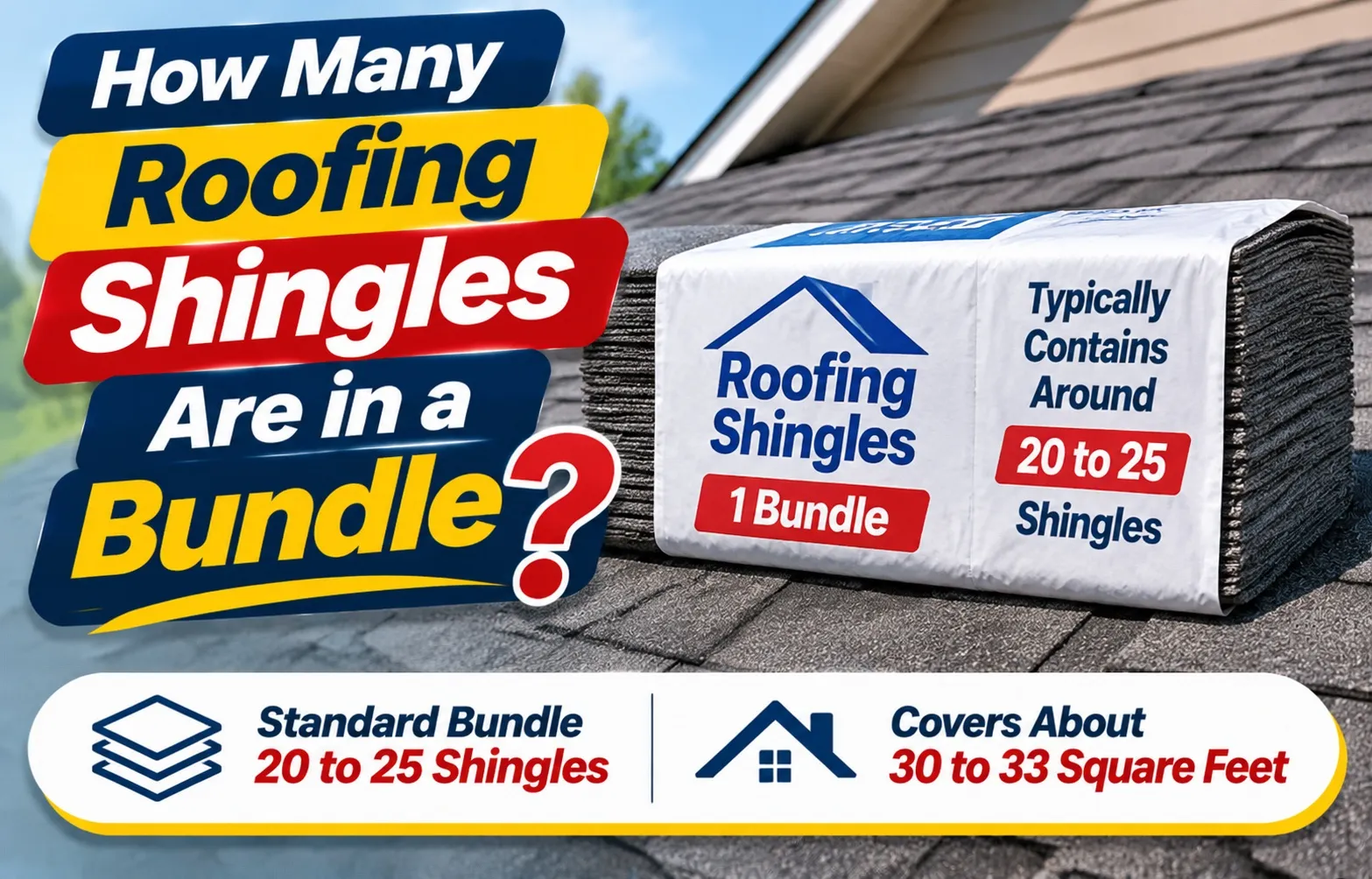 A standard bundle of roofing shingles contains anywhere from 10 to 29 individual pieces, depending entirely on the manufacturing style, weight, and grade of the material. Accurately knowing this quantity is essential when planning material purchases for roof replacements or repairs to avoid shortages or excess waste.
Most residential projects rely on standard asphalt or architectural materials, which come packed in precise counts per bundle to facilitate easy handling and lifting onto roof decks. Understanding these baseline numbers ensures precise estimation before ordering supplies from a distributor.
Quick Snapshot: Shingles Per Bundle by Type
Different roofing products feature vastly different piece counts per bundle because heavier, multi-layered designs take up significantly more physical volume and weight than traditional single-layer options.
- 3-Tab Asphalt Shingles: 26 to 29 shingles per bundle. These traditional, flat shingles are lighter and require more individual pieces to cover a designated area.
- Architectural / Dimensional Shingles: 20 to 22 shingles per bundle. Featuring a thicker, laminated dual-layer build, they provide enhanced wind resistance and a dimensional look with fewer pieces per bundle.
- Luxury / Designer Shingles: 10 to 16 shingles per bundle. These heavy, premium-grade products mimic slate or shake and pack fewer pieces due to their substantial thickness and specialized profile.
Standard Coverage Area Per Bundle
While piece counts vary widely across different styles, nearly all standard residential roofing bundles are engineered to cover approximately 33.3 square feet of roof surface when installed correctly with proper exposure.
- The Three-Bundle Rule: It typically takes 3 standard bundles of 3-tab or architectural shingles to cover one roofing square, which equals 100 square feet of roof area.
- Heavy Materials Adjustment: Luxury, high-profile designer shingles often require 4 to 5 bundles per roofing square due to their specialized weight, overlapping construction, and thicker profile.
- Precise Square Foot Conversion: Dividing your total roof square footage by 33.3 gives you the exact number of bundles required before factoring in waste allowances.
Breakdown of Shingle Types & Bundle Counts
Understanding the exact relationship between shingle types, piece counts, and bundle weights is critical for accurate project planning. Because manufacturing styles vary significantly from traditional flat designs to multi-layered architectural profiles, each category handles differently on the job site and requires distinct structural load considerations.
Evaluating these differences prevents costly miscalculations and ensures that installers load the roof deck safely without exceeding weight limits. The following breakdowns detail what to expect from each major shingle category.
3-Tab Asphalt Shingles Breakdown
Traditional 3-tab asphalt shingles represent the most economical and lightweight option available for residential roofing. Their single-layer fiberglass construction keeps overall bundle weight manageable, typically ranging between 60 to 70 pounds per bundle.
- Piece Count: Contains 26 to 29 individual pieces per bundle, which means more manual placement during installation.
- Bundle Coverage: Delivers approximately 33.3 square feet of coverage, fitting neatly into the standard 3-bundles-per-square calculation.
- Handling & Transport: Their lighter weight makes them easier to hoist onto roof decks, though they offer lower wind resistance compared to multi-layered alternatives.
Architectural Dimensional Shingles Breakdown
Architectural or dimensional shingles feature a dual-layer laminated construction that creates a rugged, textured appearance similar to wood shakes. This extra layer increases both durability and overall bundle weight, usually averaging 75 to 85 pounds per bundle.
- Piece Count: Contains 20 to 22 individual pieces per bundle due to the thicker, heavier composition of each shingle tab.
- Bundle Coverage: Maintains the standard 33.3 square feet of coverage per bundle despite having fewer physical pieces than 3-tab variants.
- Structural Considerations: The increased bundle weight requires careful staging on the roof deck to distribute loads evenly across rafters without causing structural sagging.
Luxury & Designer Shingles Breakdown
Luxury and designer shingles are premium, ultra-thick products engineered to replicate high-end materials like natural slate or heavy-cut cedar shakes. They feature complex multi-layer designs and specialized manufacturing processes.
- Piece Count: Packed with only 10 to 16 individual pieces per bundle because of their massive physical thickness and larger dimensions.
- Bundle Coverage: Often deviates from the standard 33.3 square feet, frequently requiring 4 to 5 bundles to cover a single roofing square due to heavy overlapping and dense material composition.
- Weight Management: These heavy bundles place a significant load on transport vehicles and roof structures, demanding professional evaluation of existing framing before installation begins.
How to Calculate Bundles and Squares for Your Roof
Accurately determining material requirements prevents costly project delays and eliminates excess leftover supplies. While many competitors offer vague estimates, applying a precise mathematical framework ensures you purchase the exact number of roofing bundles needed for your specific roof layout.
Mastering the conversion from total square footage to roofing squares and final bundle counts removes guesswork from the purchasing process. Follow this straightforward methodology to calculate your materials with professional accuracy.
What is a Roofing Square?
In the roofing industry, materials and measurements are rarely calculated using single square feet. Instead, contractors rely on a standardized unit of measurement known as a roofing square.
- Definition: One roofing square is equal to exactly 100 square feet of roof surface area.
- Industry Standard: All shingle coverage ratings, manufacturer specifications, and material estimates are calculated using squares rather than raw square footage.
- Conversion Principle: If a roof measures 2,000 total square feet, you divide by 100 to find that the project requires 20 roofing squares.
The Step-by-Step Calculation Formula
Calculating your total bundle count requires a sequential formula that translates raw dimensions into standardized squares and package quantities. This simple mathematical workflow guides your purchasing decisions.
- Step 1 – Measure Footprint Area: Calculate the total square footage of your roof surface by multiplying length by width for each roof plane, then sum them together.
- Step 2 – Convert to Squares: Divide your total roof square footage by 100 to determine how many roofing squares your project spans.
- Step 3 – Multiply by Three: Multiply the total number of roofing squares by 3, since standard asphalt and architectural shingles require 3 bundles per square.
Why You Must Add a 10% to 15% Waste Factor
Calculating the raw mathematical bundle count without accounting for material waste will leave your roof unfinished. Cutting shingles to fit complex roof features inevitably creates off-cuts and scrap material.
- Valleys and Rakes: Sloped intersections, gables, and valleys require diagonal cuts that generate unusable scrap pieces.
- Hip and Ridge Caps: Capping ridges and hips often involves cutting standard field shingles into specialized pieces, increasing material consumption.
- Standard Allowance: Add a 10% waste factor for straightforward gable roofs, and increase to 15% for complex roofs featuring multiple gables, dormers, and valleys.
How Many Bundles for Common House Sizes?
Applying mathematical formulas to abstract square footage can be challenging when planning an actual home improvement project. Homeowners frequently search for exact bundle quantities tailored to common house footprints to streamline budgeting and material pickups.
Translating standard house dimensions into finished bundle counts—while factoring in roof pitch multipliers and essential waste allowances—takes the guesswork out of ordering supplies. Review these practical scenarios to match your specific home size.
How Many Bundles for a 1,000 to 1,200 Sq. Ft. House?
A home with a 1,200 square foot footprint does not necessarily require exactly 1,200 square feet of shingles, because roof pitch and overhangs expand the total sloped surface area.
- Adjusted Surface Area: A standard moderate-slope roof over a 1,200 sq. ft. base typically expands to roughly 1,400 to 1,500 square feet of actual shingle coverage area.
- Roofing Squares Needed: This translates to approximately 14 to 15 roofing squares.
- Total Bundles Required: Multiplying by 3 yields 42 to 45 base bundles, which rises to 48 or 50 bundles once a standard 10% to 15% waste factor is added.
How Many Bundles for a 1,500 Sq. Ft. House?
Medium-sized suburban homes often feature complex roof lines with multiple gables or valleys, which directly impacts the total amount of materials ordered from the distributor.
- Adjusted Surface Area: Accounting for roof pitch multipliers, a 1,500 sq. ft. home footprint usually generates around 1,750 to 1,850 square feet of sloping roof deck.
- Roofing Squares Needed: The project requires between 17.5 and 18.5 roofing squares of material.
- Total Bundles Required: Expect to purchase 53 to 56 base bundles, totaling roughly 60 to 64 bundles after accounting for ridge caps and cutting waste.
How Many Bundles for a 2,000 Sq. Ft. House?
Larger residential structures demand careful pallet planning to ensure heavy shingle loads are distributed efficiently across delivery trucks and roof staging zones.
- Adjusted Surface Area: A 2,000 sq. ft. home footprint easily expands to 2,300 to 2,400 square feet of total inclined roofing surface.
- Roofing Squares Needed: This scale demands approximately 23 to 24 roofing squares of coverage.
- Total Bundles Required: Base calculations start at 69 to 72 bundles, expanding to roughly 78 to 83 bundles once waste and hip-and-ridge requirements are factored in.
Pro Tips & Cost Considerations for Buying Roofing Materials
Successfully managing a roofing project requires looking beyond basic bundle counts to understand pallet quantities, pricing variables, and professional staging strategies. Proper planning ensures you stay within budget while securing enough material to finish the job without emergency distributor runs.
Leveraging industry standards and manufacturer tools helps eliminate costly mistakes during material procurement. Review these essential tips and cost breakdowns to optimize your purchasing process.
How Many Bundles Come on a Standard Pallet?
When purchasing materials in bulk for a full roof replacement, shingles are delivered on pallets rather than individual bundles. Understanding pallet configurations helps coordinate delivery drop-offs and crane hoisting.
- Standard Pallet Load: Most manufacturers pack between 30 and 42 bundles of shingles on a single pallet, depending on whether the product is light 3-tab or heavy architectural.
- Roofing Squares Per Pallet: A standard pallet usually yields about 10 to 14 roofing squares of coverage.
- Total Pallet Weight: A full pallet of architectural shingles weighs between 2,200 and 3,000 pounds, requiring a stable delivery surface and professional offloading equipment.
Average Cost Per Bundle of Shingles
Budgeting for a roofing project depends heavily on material pricing per bundle, which fluctuates based on shingle grade, local market demand, and brand selection.
- 3-Tab Shingle Pricing: Standard 3-tab bundles typically range from $30 to $45 each, offering the most budget-friendly option for simple roofs.
- Architectural Shingle Pricing: Dimensional bundles usually cost between $40 and $60 each, providing a durable, high-value upgrade favored by most homeowners.
- Luxury & Designer Pricing: Premium or designer bundles can range from $75 to $125+ per bundle due to their specialized multi-layer construction and enhanced aesthetic appeal. For more detailed calculation frameworks, consult official guidelines such as the GAF shingle estimation resource.
Pro Contractor Tips to Avoid Buying Too Few Materials
Experienced contractors follow strict protocols when ordering materials to account for structural quirks, weather shifts, and unexpected cuts during installation.
- Never Cut Corners on Pitch Multipliers: Always use a roof pitch factor chart rather than flat floor dimensions, as steep slopes significantly increase actual surface area.
- Order Extra Starter Strips and Hip Caps: Field shingles cannot always be repurposed cleanly for ridges and eaves; make sure to purchase dedicated accessory bundles.
- Proper Material Staging: Distribute heavy shingle bundles evenly across structural roof trusses during loading to prevent localized sagging or structural strain before installation.

Oscar Vance | Master Plumber & Drainage Expert
Meet Oscar Vance, a licensed master plumber sharing practical solutions on residential repairs, preventive maintenance, and thoughtful home upkeep.