Can a 200 Amp Panel Handle an EV Charger?
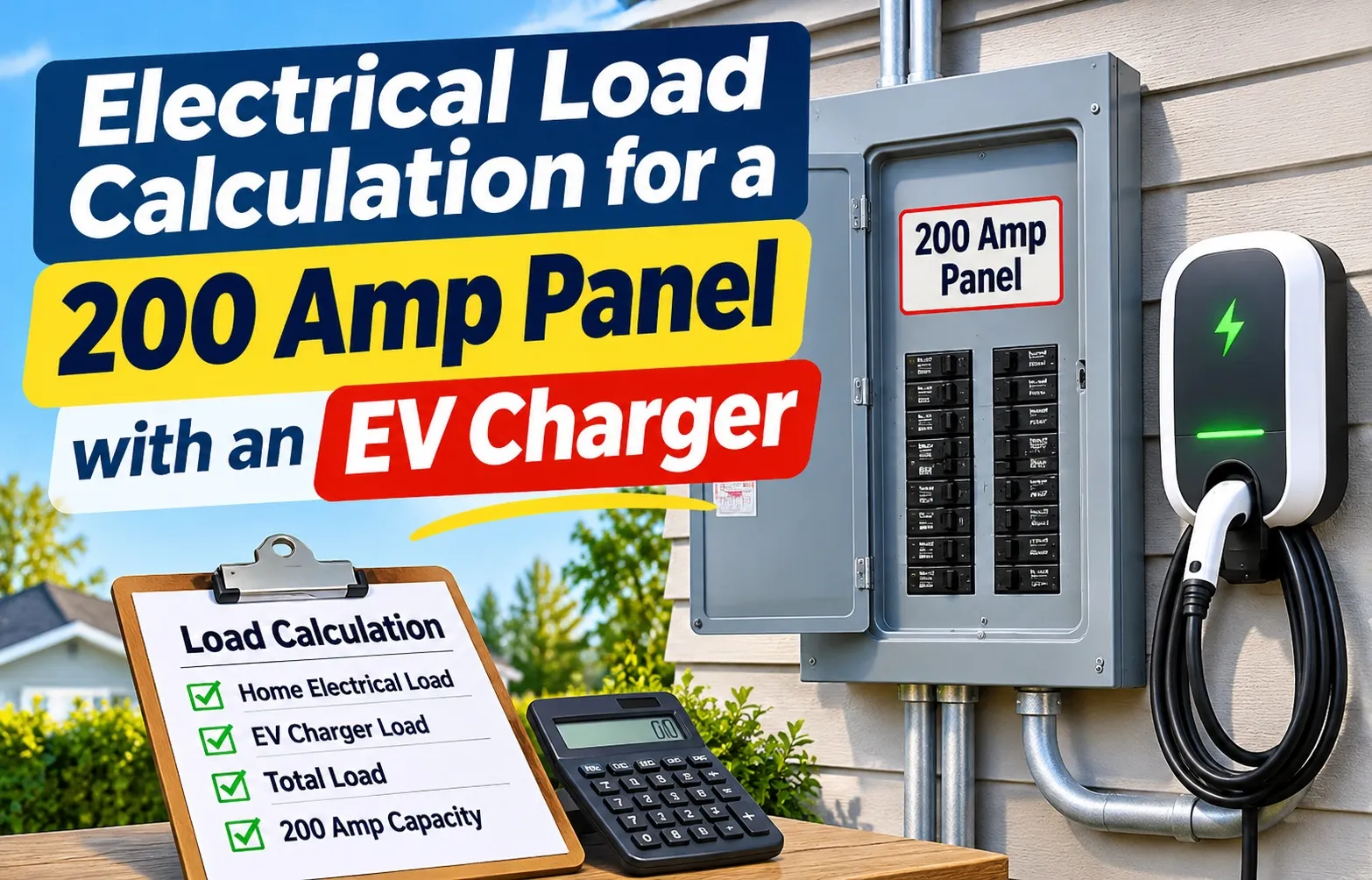 A standard 200-amp electrical panel provides plenty of power to support a Level 2 EV charger in approximately 85% of modern homes. With a overall main service threshold capable of delivering 48,000 volt-amperes (VA), most single-family residences maintain enough spare capacity to accommodate a dedicated 40-amp or 50-amp branch circuit without triggering a panel upgrade.
Determining whether your setup has enough headroom requires looking past the 200-amp main breaker label. You must calculate your home’s existing baseload under National Electrical Code (NEC) Article 220 rules to verify that peak household usage plus continuous charging stays within safe thermal limits.
Can a 200A Panel Handle an EV Charger?
Yes, a 200-amp service panel easily supports a Level 2 EV charger for the vast majority of single-family homes. Average peak household demand for a 2,000 to 3,000 square foot home usually ranges between 80 amps and 130 amps, leaving 30 to 70 amps of available panel capacity for dedicated vehicle charging.
However, specific high-draw electrical loads can quickly consume your panel’s safety margin. Homes with multiple heavy-draw electrical appliances require a load calculation before adding a charger:
- Electric tankless water heaters: These appliances draw massive instantaneous current (often 80 to 120 amps across multiple double-pole breakers), severely limiting spare panel capacity.
- All-electric resistance heating: Legacy electric baseboard heaters draw continuous current during winter months, reducing thermal headroom.
- Multiple central heat pumps or air conditioners: High compressor starting amps (locked rotor amps) demand conservative baseline sizing.
- Luxury amenities: Dedicated subpanels powering hot tubs, saunas, or heated swimming pools take up substantial service capacity.
Understanding Your Home’s True Capacity (48,000 VA vs. 160A Continuous Rule)
A 200-amp main service breaker operating at standard 240-volt single-phase power delivers a total panel capacity of 48,000 volt-amperes (200 amps × 240 volts = 48,000 VA). However, standard electrical safety rules prevent operating a main panel at 100% capacity for extended periods.
Because an Electric Vehicle Supply Equipment (EVSE) system draws maximum current continuously for hours, it falls under the NEC continuous load rule (operating for 3 hours or more). This introduces two critical math thresholds for your load calculation:
- The 80% Continuous Safety Limit: The NEC restricts continuous loads on any main breaker or branch circuit to 80% of its maximum rating. For a 200A service, maximum continuous operation equals 160 amps, or 38,400 VA.
- The 125% Continuous Duty Multiplier: When adding an EV charger to a panel calculation, its nameplate amperage rating must be multiplied by 1.25. A 48-amp continuous charger (11,520 VA) requires a 60-amp circuit breaker, accounting for 60 amps of total calculated load.
Balancing non-continuous appliance loads with continuous EVSE draw according to NEC Article 220 ensures your electrical panel operates safely without nuisance trips or thermal degradation over long charging sessions.
Why Most Homeowners Fail Their Panel Check (And How to Fix It)
Homeowners often panic when a standard electrical load calculation suggests their 200-amp service cannot support an EV charger, frequently leading to unnecessary quotes for a costly service panel upgrade. Traditional code formulas use ultra-conservative estimates that rarely reflect actual household energy consumption patterns.
The Problem With Overly Conservative Load Math
The standard compliance method mandated during an electrical code inspection assumes every major appliance operates at maximum capacity simultaneously. This worst-case scenario model creates artificial capacity bottlenecks for modern single-family homes.
- The Simultaneous Peak Fallback: Code calculations treat electric ranges, dryers, and HVAC systems as if they run at 100% draw concurrently around the clock.
- The Continuous Duty Multiplier Effect: Factoring in an EV charger requires applying a continuous duty multiplier that artificially inflates projected branch circuit loads.
- Ignored Energy Efficiency: Modern inverter-driven heat pumps and Energy Star appliances draw significantly less operating current than legacy equipment factored into baseline formulas.
When Do You Actually Need a Service Upgrade?
A service panel upgrade is genuinely required only when physical infrastructure limitations or true peak household demand exceed safety boundaries. If your baseline audit confirms genuine physical overloads, bypassing safety code requirements is not an option.
- Physical Bus Bar Damage: Visible signs of overheating, melted insulation, or scorched main breaker terminals indicate failing, degraded hardware.
- Excessive Peak Household Demand: Real-world monitoring reveals sustained home usage regularly pushing past the 160-amp continuous safety threshold.
- Multiple High-Draw Additions: Combining a heavy EVSE load with a tankless water heater, hot tub, and auxiliary ADU subpanel completely overwhelms standard 200A capacity limits.
Step-by-Step NEC Standard Method Calculation (Article 220)
Performing a formal electrical load calculation using the National Electrical Code (NEC) Standard Method under Article 220 provides the exact mathematical framework required by city permit offices and electrical inspectors. This method evaluates continuous and non-continuous household branch circuits to determine your 200-amp service capacity.
To view official codes, safety standards, and regional enforcement frameworks, consult the National Fire Protection Association (NFPA) NEC guidelines.
Step 1 – General Lighting and General-Use Receptacles
The standard calculation begins by establishing a baseline volt-ampere load for general indoor lighting and plug receptacles based on living area dimensions.
- Square Footage Multiplier: Multiply your home’s total habitable square footage (excluding unfinished basements, open porches, and unheated garages) by the standard 3 VA per square foot unit load.
- Initial Baseline Total: A 2,500 square foot home yields a 7,500 VA initial general lighting load (2,500 sq ft × 3 VA/sq ft).
- General Lighting Demand Factors: Apply NEC Table 220.42 demand factors to account for non-simultaneous lighting use: the first 3,000 VA is calculated at 100%, while the remaining balance is calculated at 35%.
Step 2 – Small Appliance and Laundry Circuits
The code mandates dedicated additions for kitchen countertop outlets and dedicated laundry branch circuits to cover portable high-draw appliances.
- Small Appliance Circuits: Include a minimum of two 20-amp small appliance kitchen branch circuits rated at 1,500 VA each (3,000 VA total).
- Laundry Branch Circuit: Include at least one 20-amp dedicated laundry circuit rated at 1,500 VA.
- Combined Baselines: Adding small appliance and laundry circuits (4,500 VA total) to your general lighting total creates the preliminary general load before applying overall demand factors.
Step 3 – Fixed Appliances (Ranges, Dryers, Water Heaters)
Permanently connected or fastened-in-place appliances must be tallied at their nameplate rating.
- Electric Clothes Dryer: Counted at a minimum rating of 5,000 VA (or the actual nameplate rating, whichever is higher).
- Electric Cooking Equipment: Calculated using nameplate ratings or demand factors outlined in NEC Table 220.55 for household ranges.
- Fixed Appliance Demand Factor: Per NEC 220.53, if four or more fixed appliances (such as a dishwasher, garbage disposal, microwave, and electric water heater) are installed, a 75% demand factor can be applied to their combined load.
Step 4 – HVAC Loads (Heating vs. Cooling Rule)
Heating and air conditioning systems represent significant peak draws, but they rarely operate simultaneously at full capacity.
- The Non-Coincident Load Rule: Per NEC 220.60, compare the total heating load against the total cooling load and include only the larger of the two loads in your final total.
- Air Conditioning Calculation: Calculate central AC units at 100% of their nameplate motor compressor load.
- Electric Heating Calculation: Calculate heat pump auxiliary heat strips or central electric furnace resistance heat at 100% of total nameplate rating.
Step 5 – Adding the EV Charger (NEC 220.57 & the 125% Rule)
Electric Vehicle Supply Equipment (EVSE) demands dedicated evaluation to ensure continuous charging sessions do not overload your panel bus bars.
- NEC 220.57 EVSE Load Standard: Under NEC 220.57, calculate the EV charger load at its actual nameplate rating (or 7,200 VA minimum, whichever is larger).
- Branch Circuit Sizing (The 125% Rule): Because vehicle charging is a continuous load running over 3 hours, branch circuit conductors and circuit breakers must be sized at 125% of the continuous draw.
- Standard Amperage Breakdown: A 32-amp charger (7,680 VA continuous draw) requires a 40-amp circuit breaker. A 48-amp charger (11,520 VA continuous draw) requires a 60-amp circuit breaker.
The Secret Weapon: NEC Optional Calculation Method (NEC 220.82)
The NEC 220.82 optional calculation method provides a legal, code-compliant alternative for single-family dwellings that fail the conservative standard calculation. By using realistic demand factors for modern household energy usage, this method frequently proves a 200-amp panel can safely handle a Level 2 EV charger without requiring an expensive service upgrade.
How the Optional Method Differs from Standard Calculations
Unlike the Standard Method, which divides loads across multiple code tables, NEC 220.82 simplifies general household loads into a single combined baseline and applies a aggressive demand factor tier:
- Unified Baseline Load: You sum the square footage load (3 VA/sq ft), small appliance circuits (3,000 VA), laundry circuit (1,500 VA), and all nameplate ratings for heavy appliance loads (dryer, range, water heater, dishwasher).
- First 10 kVA Tier: The first 10,000 VA (10 kVA) of the combined general load is calculated at 100%.
- The 40% Remainder Rule: All remaining general load over 10,000 VA is calculated at just 40%, drastically reducing the total calculated volt-amperes.
- HVAC & EV Charger Integration: The largest HVAC load (heating or cooling) is added separately at 100%, while the EV charger is added at 100% of its continuous rating (or 125% depending on local inspector enforcement).
Who Qualifies to Use NEC 220.82?
The optional calculation method cannot be applied universally to every structure, but it is explicitly designed for typical residential installations:
- Single-Family Dwellings: Applies to individual single-family homes, townhomes, or individual dwelling units of multi-family buildings served by a single feeder or service panel.
- Existing Service Capacity: The service panel or feeder must have a minimum total capacity rating of 100 amps or greater, making 200-amp panels fully eligible.
- Complete Load Scope: The calculation must encompass all major connected electrical loads of the entire dwelling unit under a single overall evaluation.
Real-World Example Worksheet: 2,500 Sq. Ft. Home Calculation
Walking through a practical continuous load calculation worksheet demonstrates exactly how baseline household usage interacts with modern vehicle charging requirements. Testing real-world numbers removes guesswork and proves whether your 200-amp service maintains sufficient remaining panel headroom.
Baseline House Specs & Existing Appliance Profile
Consider a standard suburban single-family home utilizing a standard 200-amp service entry panel. Before introducing any electric vehicle supply equipment, the home operates a typical mix of standard electric and gas-assisted appliances.
- Habitable Living Space: Exactly 2,500 square feet of finished indoor area.
- Kitchen & Laundry Setup: Two standard 20-amp small appliance circuits and one dedicated 20-amp laundry branch circuit.
- Major Household Appliances: An electric clothes dryer (5,000 VA), an electric range (8,000 VA), an electric water heater (4,500 VA), and a central air conditioning unit (6,000 VA).
Step-by-Step Volt-Ampere Breakdown Table
Applying NEC standard calculation rules to our benchmark home generates a comprehensive numerical profile of total connected volt-amperes (VA) prior to adding an EV charger.
Final Verdict: Is There Room for a 48A or 32A EV Charger?
Evaluating our sample worksheet against a 200-amp panel’s absolute 38,400 VA continuous safety limit (160 amps continuous threshold) reveals precise capacity margins for vehicle charging integration.
- Calculating Available Headroom: Subtracting our 28,575 VA baseline load from the 38,400 VA continuous safety threshold leaves 9,825 VA of remaining panel headroom (~40.9 amps of continuous capacity).
- Installing a 32A EV Charger: A 32-amp charger requires a 40-amp breaker and pulls 7,680 VA continuously. This fits safely within our remaining 9,825 VA headroom, passing code inspection without issues.
- Installing a 48A EV Charger: A 48-amp charger requires a 60-amp breaker and pulls 11,520 VA continuously. Because 11,520 VA exceeds our 9,825 VA remaining headroom, a 48A charger would fail standard code calculations on this specific home profile.
Smart Workarounds If Your Panel is Near Capacity
Failing an electrical load calculation does not automatically mean you must spend thousands of dollars on a panel upgrade. Modern electrical codes and smart charging hardware offer engineered workarounds that allow high-power Level 2 charging while completely protecting your 200-amp panel from overload conditions.
These code-compliant solutions optimize energy distribution dynamically or cap peak draw, allowing homeowners to pass building permit inspections without replacing existing electrical infrastructure.
Dynamic Load Management & EVEMS (Smart Chargers)
Electric Vehicle Energy Management Systems (EVEMS) serve as intelligent gatekeepers for your home’s electrical distribution system. Under NEC Article 625, an approved EVEMS allows an EV charger to be legally excluded from standard panel load calculations because the system prevents the panel from ever exceeding its rated capacity.
- Current Transformer (CT) Clamp Monitoring: Hardware like the Wallbox Pulsar Plus with Power Meter or Emporia Vue installs CT clamps around your main service entrance conductors to measure real-time household electrical demand 24/7.
- Real-Time Automatic Throttling: When high-draw appliances like electric ovens, clothes dryers, or heat pumps turn on simultaneously, the EVEMS automatically dials down the charger’s output in real time to protect the main breaker.
- Instantaneous Recovery: As soon as household appliance usage drops, the smart load-sharing device safely ramps charging speed back up to maximum available levels without user intervention.
Amperage Throttling (Stepping Down from 48A to 32A or 24A)
Another immediate, zero-cost engineering workaround is software or dip-switch amperage throttling, which reduces the charger’s continuous draw to match your panel’s exact available headroom.
- Dramatically Lower Circuit Requirements: Lowering your charger target from a 48-amp continuous draw (60-amp breaker / 11,520 VA) down to 32 amps (40-amp breaker / 7,680 VA) or 24 amps (30-amp breaker / 5,760 VA) cuts panel demand by up to 50%.
- Minimal Impact on Overnight Charging: A 32-amp charger still adds roughly 25 to 30 miles of range per hour, which easily replenishes a standard daily commute in 3 to 4 hours overnight while keeping your panel within safe operating parameters.
- Hardcoded DIP Switch Capping: Most modern Level 2 chargers feature physical DIP switches inside the unit that permanently restrict maximum draw, satisfying inspector requirements for a smaller continuous load designation.
People Also Ask (PAA) Quick-Fire FAQ
Here are direct answers to the most common questions homeowners ask when determining their electrical panel capacity for an EV charger installation.
How do I calculate total load on a 200 amp panel?
Calculating the total load on a 200-amp service panel involves summing your household branch circuit demand using National Electrical Code (NEC) Article 220 guidelines:
- Square Footage Baseline: Multiply your home’s total living area by 3 VA per square foot for general lighting and receptacles.
- Small Appliance & Laundry: Add 3,000 VA for two small appliance kitchen circuits and 1,500 VA for a dedicated laundry circuit.
- Fixed Appliances & HVAC: Add the nameplate ratings for electric water heaters, dryers, ranges, and the larger of your heating or cooling load.
- Apply Code Demand Factors: Apply standard NEC demand factors (or the NEC 220.82 optional calculation method) to establish your baseline continuous household demand before adding an EVSE branch circuit.
What is the 80% rule for electrical panels?
The 80% rule is a foundational safety requirement in the National Electrical Code (NEC 210.20 and 215.3) designed to prevent thermal buildup and main breaker tripping during extended operation:
- Continuous Load Threshold: Any electrical load running continuously for 3 hours or more—such as an EV charger or electric space heater—must not exceed 80% of the circuit breaker’s rated capacity.
- Panel Safety Limit: For a 200-amp service panel delivering 48,000 volt-amperes (VA), maximum continuous operating capacity is strictly capped at 160 amps (38,400 VA).
- Branch Circuit Sizing: Conversely, when sizing a circuit breaker for continuous loads, you must apply a 125% multiplier to the appliance’s continuous draw (e.g., a 48A continuous EV load requires a 60A breaker).
Can I install a 48A EV charger on a 200A service with an electric dryer and range?
In most single-family homes, yes—you can safely run a 48A EV charger on a 200A service alongside an electric dryer and range, provided your home does not also utilize high-draw electric tankless water heaters or extensive electric resistance heating.
- Breaker & Load Requirements: A 48A continuous charger requires a dedicated 60-amp breaker and adds 11,520 VA of calculated continuous load to your main service panel.
- Capacity Headroom Check: A 2,500 sq. ft. home with a standard heat pump, electric dryer, and electric range typically maintains a baseline calculated load of roughly 28,000 VA to 30,000 VA. Adding a 48A charger (11,520 VA) under the NEC 220.82 optional calculation method easily fits within the 38,400 VA continuous safety ceiling.
- When Headroom is Tight: If heavy concurrent loads push your math beyond 160 amps, installing a smart EVSE dynamic load management system allows safe operation without needing a main panel upgrade.

Oscar Vance | Master Plumber & Drainage Expert
Meet Oscar Vance, a licensed master plumber sharing practical solutions on residential repairs, preventive maintenance, and thoughtful home upkeep.