Does Homeowners Insurance Cover Electrical Panel Replacement?
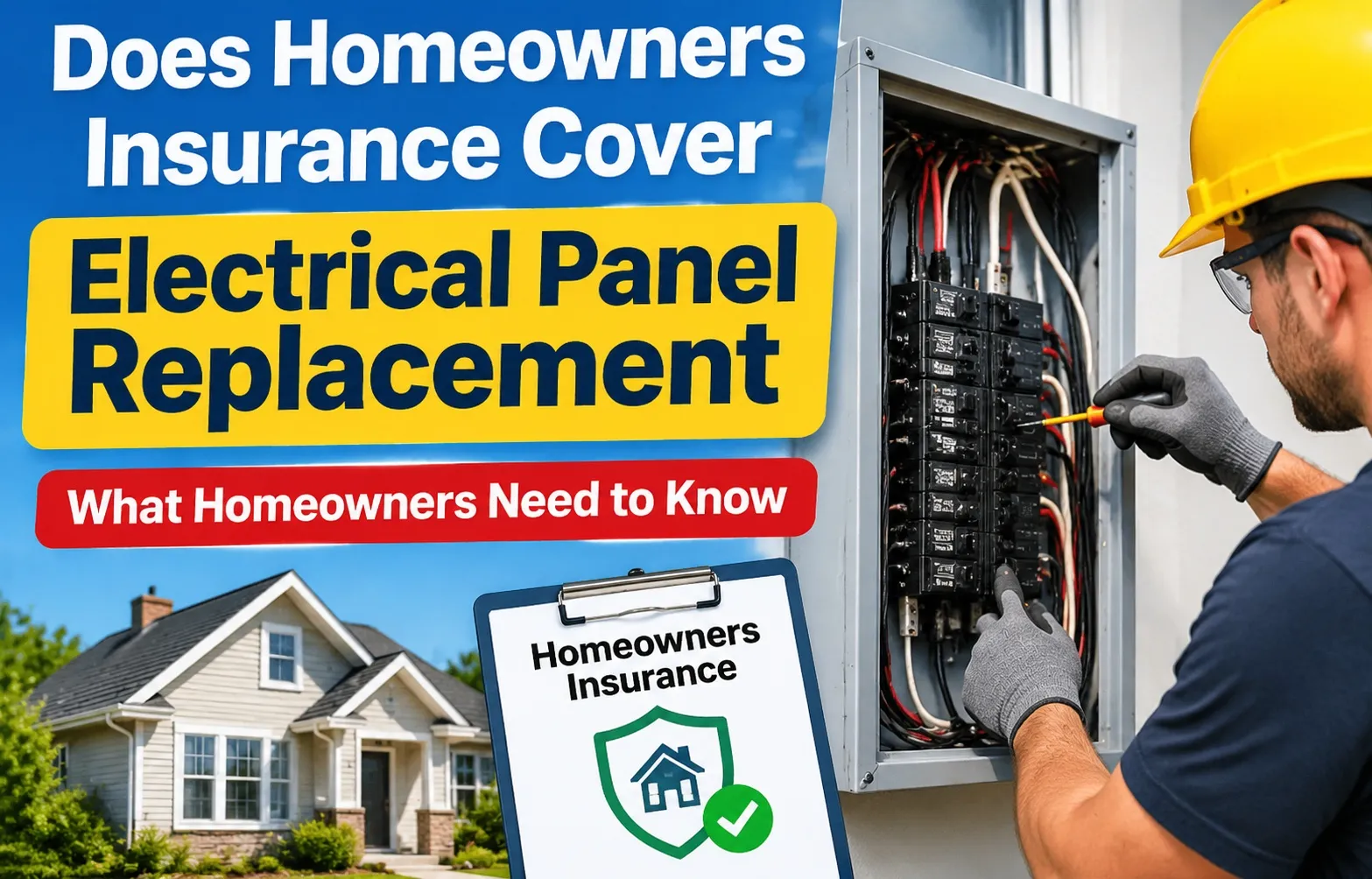 No, standard homeowners insurance does not cover electrical panel replacement caused by normal wear and tear, age, or routine capacity upgrades. However, Dwelling Coverage (Coverage A) will pay to repair or replace your main breaker box—minus your deductible—if a sudden, covered peril like a lightning strike, fire, or external power surge destroys it.
Understanding how your policy classifies electrical damage saves you from filing claims that net zero payout while risking a rate increase. Insurers separate sudden external disasters from expected homeowner maintenance:
- Covered Losses: Sudden and accidental physical damage triggered by named or open perils, such as electrical fires, falling tree limbs, or utility surge events.
- Optional Rider Coverage: Internal mechanical arcing or breaker burnout may qualify if you carry an Equipment Breakdown endorsement.
- Out-of-Pocket Costs: Rust, outdated 60-amp or 100-amp service upgrades, and insurer-mandated replacements of hazardous brands like Federal Pacific or Zinsco fall entirely on the homeowner.
When Does Homeowners Insurance Pay for a New Electrical Panel?
Homeowners insurance pays for an electrical panel replacement when sudden, accidental physical damage stems from a covered peril—or when your policy includes specific Equipment Breakdown or Ordinance or Law endorsements. Under a standard HO-3 policy, Dwelling Coverage (Coverage A) insures your home’s permanent electrical infrastructure on an “open perils” basis, meaning every sudden external cause is covered unless specifically excluded.
Depending on your policy valuation method, your payout will be calculated using either Actual Cash Value (ACV), which deducts depreciation for the panel’s age, or Replacement Cost Value (RCV), which reimburses the full cost of installing a comparable modern unit.
Sudden and Accidental Covered Perils (Fire, Lightning, & Storm Damage)
Your insurer covers a full panel replacement if a discrete, unpredictable event—such as a direct lightning strike, an electrical fire, or a storm-downed tree limb—physically destroys the breaker box or exterior meter base. Because standard HO-3 policies protect against sudden disasters rather than gradual deterioration, adjusters look for clear forensic evidence tying the electrical failure to an external trigger.
- Lightning Strikes and External Power Surges: When lightning strikes near your home or a utility transformer blows, the resulting voltage spike can melt busbars and weld breakers shut. Most insurers cover surge damage caused by lightning, though some carriers exclude utility-generated surges unless you add a specific power surge rider.
- Electrical Fires and Smoke Damage: If an accidental short circuit sparks a fire inside the enclosure and chars the cabinet, Dwelling Coverage pays to replace the ruined panel and damaged branch wiring.
- Falling Objects and Windstorm Impact: If severe winds snap a tree branch that rips the service mast, weatherhead, and exterior breaker panel off your siding, the structural and electrical repairs qualify under your storm coverage.
- Sudden Water Intrusion from a Covered Roof Leak: If hail or wind tears open your roof and rainwater pours directly into an interior subpanel, the resulting short-circuit damage is covered—unlike slow leaks from worn flashing.
Equipment Breakdown Coverage (The Secret Rider for Internal Failure)
An optional Equipment Breakdown Coverage endorsement—typically costing $25 to $50 per year—extends your policy to cover sudden internal electrical arcing, mechanical failure, and short circuits that occur without an outside storm or fire. Standard policies exclude internal electrical burnout, making this low-cost add-on the primary way homeowners get insurance to pay when a panel suddenly fails on a clear, sunny day.
- What It Covers: Sudden electrical arcing, fried main lugs, catastrophic busbar failure, and power surges originating inside your home’s electrical system.
- Typical Policy Terms: Most Equipment Breakdown riders carry a separate, lower deductible (often $500) rather than your standard $1,500 or $2,500 all-peril deductible, and offer $50,000 to $100,000 in coverage limits.
- The Pre-Existing Exclusion: Even with this rider, insurers will deny claims if an electrician finds that the panel failed due to decades of rust, water corrosion, or unpermitted DIY modifications.
Ordinance or Law Coverage (Paying for Mandatory 2026 NEC Code Upgrades)
Ordinance or Law coverage pays the extra labor and material costs required to bring a damaged electrical panel up to current 2026 National Electric Code (NEC) standards after a covered loss. Without this endorsement, standard Dwelling Coverage only pays to replace your damaged equipment with “like kind and quality,” leaving you stuck with mandatory municipal upgrade bills.
- Why Standard Payouts Fall Short: If lightning destroys an older 1980s breaker box, local building inspectors will not allow an electrician to install an identical outdated unit; the replacement must meet strict 2026 NEC safety mandates.
- Expensive Code Requirements Covered: Ordinance or Law riders reimburse the cost of installing required Arc-Fault Circuit Interrupter (AFCI) and Ground-Fault Circuit Interrupter (GFCI) breakers, whole-home surge protective devices (SPDs), exterior emergency disconnects, and upgraded copper grounding electrode systems.
- Recommended Coverage Limits: Basic HO-3 policies often include only 10% of your Coverage A limit for building codes, which can easily be exhausted if a fire requires rewiring; increasing this endorsement to 25% protects against steep electrical compliance costs.
What Electrical Panel Issues Are Excluded by Homeowners Insurance?
Homeowners insurance policies are strictly designed to cover sudden, accidental property damage from covered perils like fires or severe storms, rather than predictable deterioration or elective modernizations. Filing claims for excluded electrical panel issues will not result in payout reimbursement and can negatively stain your Comprehensive Loss Underwriting Exchange (CLUE) report, potentially driving up your future insurance premiums.
Understanding the exact boundaries between insurable damage and homeowner responsibility ensures you protect your financial standing and avoid unnecessary claim denials.
Normal Wear and Tear, Rust, and Aging Breakers
Insurance policies explicitly exclude routine home maintenance and degradation caused by age, meaning worn-out electrical components are entirely the homeowner’s financial obligation. Because standard service panel lifespans span 25 to 40 years, insurers view component aging as an expected part of property upkeep rather than an insurable accident.
- Service Panel Lifespan: Panels exceeding 30 years naturally experience component fatigue, brittle wire insulation, and failing spring mechanisms inside breakers.
- Busbar Corrosion: Moisture intrusion from worn exterior weatherheads or aging seals causes gradual busbar corrosion, which is classified as long-term neglect rather than sudden storm damage.
- Loose Connections: Normal thermal expansion and contraction over decades cause busbar screws and terminal connections to loosen, requiring routine preventative tightening.
Amperage & Capacity Upgrades (100-Amp to 200-Amp Service)
Elective power upgrades designed to support modern household lifestyle demands are classified as voluntary home improvements and are never covered by insurance. Transitioning from an outdated 100-amp to a 200-amp service is a lifestyle choice rather than a restoration following a covered peril.
- EV Charger Electrical Upgrade: Installing dedicated circuits for electric vehicle charging stations represents a voluntary electrical expansion of your home’s capacity.
- Modern HVAC & Heat Pumps: Upgrading electrical panels to handle heavy-draw HVAC systems, tankless water heaters, or solar panel arrays falls entirely under out-of-pocket renovation expenses.
- Capacity Deficits: Simply running out of circuit breaker slots due to purchasing new appliances or electronics does not constitute property damage or an insurance loss event.
Pre-Existing Faulty Wiring and DIY Code Violations
Insurance companies deny claims resulting from unpermitted electrical modifications, substandard workmanship, or known pre-existing code violations. If an electrical fire or failure traces back to amateur DIY wiring or outdated hazardous systems that were previously unaddressed, the insurer will hold the property owner liable.
- Unpermitted Work: Electrical alterations completed without local municipal permits or professional electrician oversight violate standard policy clauses regarding property safety.
- Ignored Hazards: Continuing to use panels with documented overheating issues, flickering lights, or tripping breakers without remediation constitutes contributory negligence.
- Substandard Materials: Using non-compliant wires, mismatched breakers, or unauthorized double-tapping voids coverage for any subsequent electrical damage.
Which Electrical Panels Will Insurance Companies Not Cover?
Insurance carriers across the United States maintain strict underwriting guidelines that automatically blacklist outdated, recalled, or fire-prone electrical panels during property inspections. Discovering one of these legacy panels typically triggers an immediate policy non-renewal notice or a mandatory replacement ultimatum before coverage can be bound or renewed.
Navigating these high-risk classifications requires understanding which specific hardware models underwriters flag, how to manage non-renewal notices within strict grace periods, and how to secure coverage in volatile regional markets.
The 4 High-Risk Panels Insurers Flag (FPE, Zinsco, Challenger, & Pushmatic)
Underwriters routinely reject specific legacy electrical panels because decades of field data link them to catastrophic thermal failures, arcing, and unprevented circuit overloads. Insurers rely on independent safety research and advisories from organizations like the U.S. Consumer Product Safety Commission (CPSC) to maintain strict blacklists of hazardous hardware.
- Federal Pacific Electric (FPE) Stab-Lok: FPE Stab-Lok breakers feature an internal mechanical defect that causes them to fail to trip during an overload or short circuit, allowing electrical current to continuously heat wires and trigger structural fires.
- Zinsco (and Sylvania): Zinsco panels utilize aluminum busbars that are prone to oxidation, severe arcing, and melting, which can cause circuit breakers to fuse permanently to the busbar and render safety cutoffs useless.
- Challenger Electrical Panels: Challenger panels face widespread underwriting flags due to overheating busbars, loose breaker connections, and a high incidence of thermal tripping failures that have prompted massive property insurance exclusions.
- Bulldog Pushmatic & Legacy Systems: Pushmatic panels utilize heavy mechanical push-button breakers that frequently seize up with age, alongside vintage 60-amp fuse boxes and obsolete knob-and-tube wiring incapable of handling modern electrical loads.
How to Handle an Insurance Non-Renewal Notice (30-to-60-Day Grace Periods)
Receiving an insurance cancellation or non-renewal notice due to an outdated electrical panel typically grants a 30-to-60-day grace period to resolve the hazard before coverage terminates. Acting swiftly by hiring a certified electrician and submitting an official proof packet prevents your home from sliding onto involuntary state-run pools.
- Schedule an Immediate Inspection: Contact a licensed, insured electrician the moment a notice arrives to evaluate the panel and perform a complete service upgrade to a modern 200-amp system.
- Pull Local Municipal Permits: Ensure your contractor pulls all mandatory city or county building permits; insurance underwriters will instantly reject unpermitted or DIY electrical work.
- Compile the Proof Packet: Submit a comprehensive compliance package to your carrier featuring the paid electrician invoice, closed municipal permit sign-off, and clear high-resolution photos of the new panel.
Navigating High-Risk Markets Like California (FAIR Plan & Carrier Strictness)
Homeowners in high-risk regional markets like California face unprecedented insurance non-renewal crises driven by both wildfire exposure and strict carrier underwriting audits. Property insurers operating in these areas enforce zero-tolerance rules on outdated electrical systems, leaving many residents scrambling to find temporary or fallback coverage structures.
- California FAIR Plan Bridge: When admitted carriers issue non-renewals over panel age or wildfire risk, homeowners frequently rely on the California FAIR Plan as a temporary safety-net fire policy while securing supplemental liability wrap-around policies.
- Underwriting Scrutiny Audits: Modern carriers deploy aerial drone photography, high-resolution property data analytics, and mandatory four-point inspection photos to catch aging exterior weatherheads and blacklisted panels automatically.
- Proactive Remediation Investment: Replacing a high-risk panel preemptively before selling a home or facing policy renewal eliminates administrative delays and protects your Comprehensive Loss Underwriting Exchange (CLUE) history from damaging cancellation flags.
How Much Does It Cost to Replace an Electrical Panel in 2026?
A complete electrical panel replacement in 2026 typically ranges from $1,500 to $4,500, depending heavily on whether you are doing a direct like-for-like swap or scaling up capacity for modern home electrification. Mastering these pricing tiers and evaluating the financial reality of insurance deductibles ensures you make cost-effective decisions without risking unnecessary policy rate hikes.
Reviewing detailed cost projections and applying smart financial frameworks helps homeowners budget accurately and avoid common pitfalls when upgrading outdated infrastructure.
2026 Cost Breakdown by Amperage (100A vs. 200A vs. 400A)
Electrical upgrade costs scale according to your home’s total power requirements, local permit fees, and the condition of auxiliary components like the meter socket and service mast. Upgrading to a modern 200-amp system represents the national standard for supporting electric vehicle chargers, heat pumps, and modern kitchen appliances safely.
The “Deductible Math” Rule: When NOT to File an Insurance Claim
Filing an insurance claim for electrical panel damage only makes financial sense when repair expenses vastly exceed your policy deductible and long-term premium surcharges. If an unexpected power surge causes $2,200 in subpanel damage against a $1,500 deductible, filing a claim yields a net reimbursement of just $700 while triggering multi-year financial penalties.
- Net Payout Deficit: Subtracting your insurance deductible from minor electrical repair bills often leaves a minimal payout that fails to justify initiating a formal claim.
- Loss of Claims-Free Discounts: Submitting a claim instantly forfeits your valuable multi-year claims-free discounts, which frequently save homeowners hundreds of dollars annually on overall premiums.
- Policy Surcharge Impact: A recorded property claim remains active on your Comprehensive Loss Underwriting Exchange (CLUE) report for 5 to 7 years, driving up rates across all future insurance renewals.
- Reserving Claims for Catastrophes: Save formal insurance claims exclusively for catastrophic, high-cost electrical emergencies—such as major structural fires—where restoration expenses run into tens of thousands of dollars.
How to File an Electrical Panel Claim (And What NOT to Say to Your Adjuster)
Navigating an insurance claim for electrical panel damage requires precise communication and rigorous documentation to prove the loss qualifies as sudden and accidental. Insurance adjusters evaluate claims strictly through the lens of policy exclusions, meaning careless phrasing can instantly convert a valid payout into an automatic denial.
Mastering what to say—and what strictly to avoid—protects your financial recovery and ensures your claim accurately reflects an insurable peril.
3 Phrases That Trigger Automatic Claim Denials
Home insurance policies explicitly cover sudden, accidental property damage while denying long-term wear and tear or deferred maintenance. Using casual, self-incriminating language during your initial statement provides adjusters with immediate legal justification to deny coverage.
- “My old panel finally wore out”: Avoid implying age-related degradation. Instead, report the specific factual event: “A sudden power surge or severe electrical arc event caused catastrophic component failure.”
- “It’s been tripping for months”: Admitting to chronic tripping signals pre-existing neglect. Instead, state clearly: “The circuit breaker catastrophically failed and locked up during yesterday’s severe storm.”
- “I tried fixing a loose wire myself”: Mentioning unauthorized DIY work voids policies instantly. Instead, rely solely on professional assessments: “A certified electrical contractor documented sudden mechanical failure following external grid fluctuations.”
Step-by-Step Documentation Checklist Before Calling Your Insurer
Assembling a comprehensive evidentiary packet before opening a claim prevents insurance carriers from misclassifying your electrical emergency as routine home maintenance. Professional diagnostic proof and detailed visual records establish undeniable credibility with your adjuster.
- Hire a Licensed Electrician First: Never file a claim blindly; bring in a qualified, insured electrician to safely inspect the panel and identify the exact mechanical failure point.
- Secure a Written Diagnostic Report: Obtain a formal, signed technician statement explicitly pinpointing a sudden external cause, such as an utility transformer surge, lightning strike, or internal arc flash.
- Photograph Comprehensive Evidence: Take high-resolution photos of charred breaker switches, melted busbars, soot residue on the drywall, and any fried downstream appliances like refrigerators or HVAC boards.
- Review Your Declarations Page: Examine your policy terms for specialized endorsements, such as Equipment Breakdown coverage or Ordinance and Law riders, which can expand your reimbursement scope.
How to Pay for an Electrical Panel Replacement When Insurance Says No
When homeowners insurance denies coverage for an aging, obsolete, or worn-out electrical panel, financing the replacement out of pocket requires exploring alternative risk-protection plans and government-backed funding mechanisms. Navigating these options prevents unexpected budget strain while ensuring your electrical infrastructure meets modern safety codes and supports electrification upgrades.
Understanding how home warranties differ from traditional insurance and leveraging current 2026 rebate structures can significantly reduce your out-of-pocket expenses.
Homeowners Insurance vs. Home Warranty Plans
While homeowners insurance is strictly built for sudden, catastrophic storm or fire damage, specialized home warranty plans are designed to cover mechanical breakdowns caused by normal wear and tear. A standard home warranty—typically costing $500 to $700 annually with a $75 to $125 service call fee—frequently covers aging electrical panel failures up to specific policy coverage caps, whereas standard hazard insurance excludes them entirely.
2026 Tax Credits, State Rebates, & Utility Incentives (Important Rule Change)
Federal tax incentives underwent a major shift: the federal 25C Energy Efficient Home Improvement Credit for standalone electrical panel upgrades officially expired on December 31, 2025. Consequently, 2026 installations must instead leverage state-administered Inflation Reduction Act (IRA) HOMES and HEAR rebates (High-Efficiency Electric Home Rebate Act)—which provide substantial subsidies for electrical service upgrades for income-eligible households—alongside local utility company panel-upgrade rebates and electrician financing.
- 25C Tax Credit Expiration: Homeowners can no longer claim federal tax credits for standalone electrical panel replacements filed after December 31, 2025, shifting financial relief to state and local programs.
- IRA HEAR Rebates: State-administered High-Efficiency Electric Home Rebate Act programs offer point-of-sale discounts covering heavy-up costs for qualifying low-to-moderate-income families.
- Utility Company Incentives: Regional electric co-ops and municipal utilities provide direct rebates for upgrading obsolete panels to support heat pumps, EV chargers, or solar readiness.
- Electrician Financing: Licensed contractors offer flexible monthly payment plans and low-interest financing options to break down upgrade costs into manageable installments.
Frequently Asked Questions About Electrical Panels & Home Insurance
Navigating insurance claims, coverage exclusions, and underwriting mandates for residential electrical systems often raises specific technical questions for property owners. Reviewing direct, expert answers to these common inquiries clarifies how policies handle electrical hazards.
Understanding these rules ensures you can protect your property and avoid costly coverage surprises.
Will homeowners insurance cover a power surge that fries my electrical panel?
Yes, standard homeowners insurance policies typically cover electrical panel damage caused by a sudden, accidental power surge from a lightning strike or utility grid failure, provided you have adequate dwelling coverage and your deductible is met. However, securing payout reimbursement requires professional diagnostic proof from a licensed electrician establishing the exact cause of loss.
Does homeowners insurance cover electrical wiring issues inside the walls?
Homeowners insurance covers branch circuit wiring issues inside walls only if they result from a sudden, accidental covered peril like a localized fire or acute physical trauma. Damage caused by aging, deteriorated insulation, faulty amateur installation, or long-term wear and tear is classified as routine maintenance and is strictly excluded.
Can my insurance company cancel my policy over a 100-amp electrical panel?
Generally, insurers will not cancel a policy solely for having a standard, functional 100-amp electrical panel if it complies with local building codes and operates safely. However, underwriters may issue 30-to-60-day non-renewal notices if the 100-amp service utilizes a blacklisted hazard panel like Federal Pacific or Zinsco, or if total electrical demand exceeds safe load capacities.
Does upgrading to a 200-amp electrical panel lower homeowners insurance rates?
Upgrading to a modern 200-amp electrical panel does not automatically trigger a direct insurance discount, but it permanently eliminates non-renewal threats and coverage drops caused by hazardous legacy systems. Additionally, removing outdated panels significantly lowers your structural fire risk, helping you avoid severe policy surcharges and maintain access to competitive carrier pricing.

Oscar Vance | Master Plumber & Drainage Expert
Meet Oscar Vance, a licensed master plumber sharing practical solutions on residential repairs, preventive maintenance, and thoughtful home upkeep.