Cost to Replace a Federal Pacific Electrical Panel
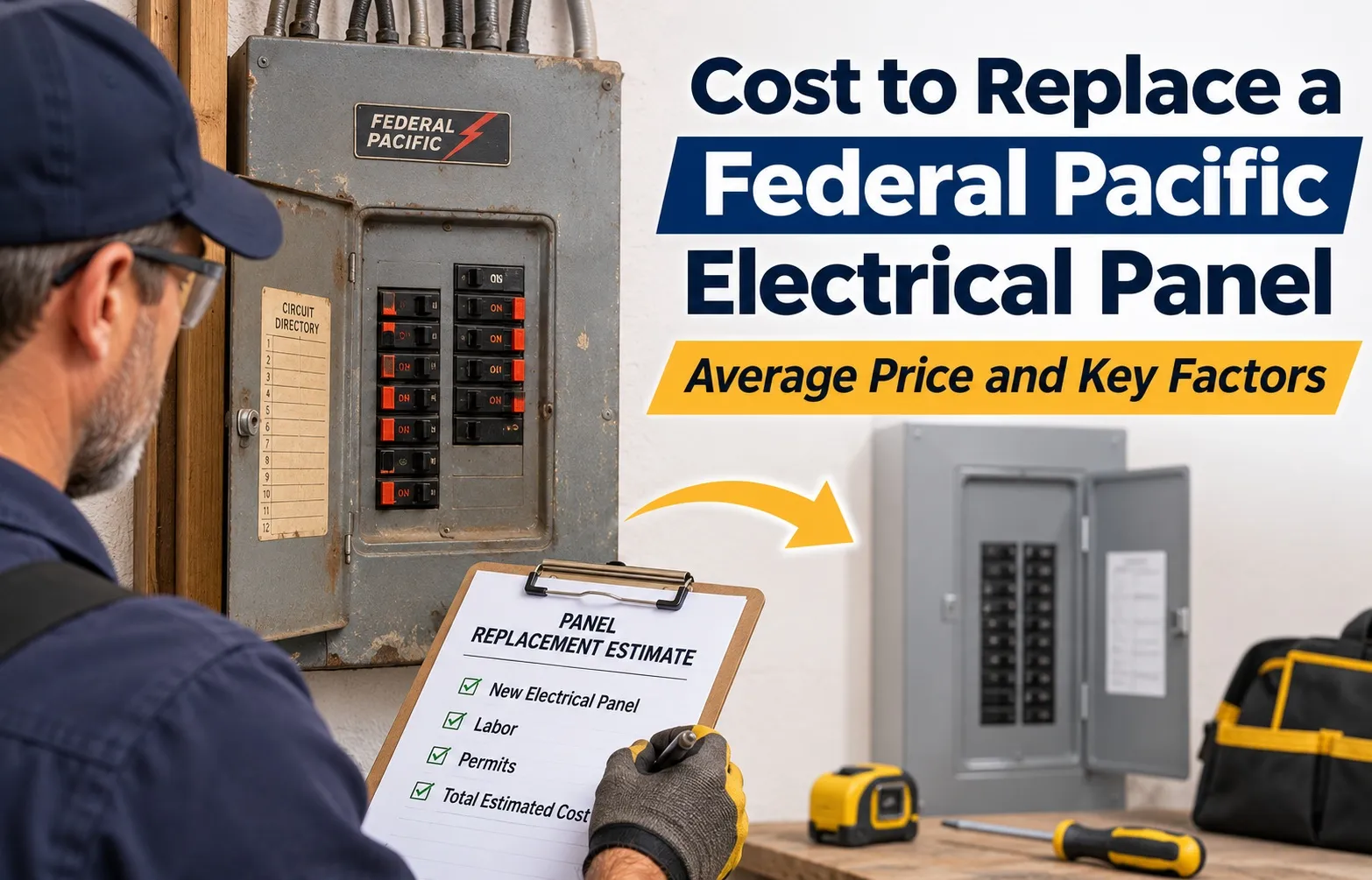 Replacing a Federal Pacific Electric (FPE) electrical panel costs between $1,500 and $4,000 for a standard like-for-like service swap. Complete system overhauls that require upgrading to 200-amp service, relocating the panel, or meeting strict local building codes in major metropolitan areas typically range from $5,000 to $10,000+.
Federal Pacific Electrical Panel Replacement
The total cost to replace a Federal Pacific electrical panel depends heavily on your home’s current electrical capacity, local electrician labor rates, and mandatory municipal permit requirements. FPE panels—specifically those fitted with Stab-Lok circuit breakers—present documented safety hazards, making direct replacement a high priority for homeowners, home buyers, and insurance carriers alike.
Most residential projects fall into three primary pricing tiers based on the scope of work required:
- Basic Amperage Swaps ($1,500 – $3,500): Involves replacing an existing 100-amp or 125-amp FPE panel with a modern breaker box in the exact same location without modifying the main utility feed line.
- Service Upgrades ($3,500 – $6,500): Combines the panel replacement with an upgrade from 100-amp to 200-amp service, requiring new meter enclosure hardware, heavier grounding conductors, and utility coordination.
- Complex & Metro Upgrades ($6,500 – $10,000+): Applies to projects requiring panel relocation, extensive drywall cutting/repair, exterior emergency disconnect switches, and complete Arc-Fault Circuit Interrupter (AFCI) circuit retrofits.
Itemized Cost Breakdown & Key Pricing Drivers
Replacing a Federal Pacific Electric (FPE) panel involves several line-item expenses beyond the physical breaker box itself. Understanding how electrician labor, municipal permits, utility charges, and hardware specifications combine ensures you can accurately evaluate contractor estimates without facing surprise fees.
Labor Costs & Electrician Hourly Rates
Labor accounts for 50% to 70% of the total cost to replace a Federal Pacific electrical panel. Licensed electricians typically charge a licensed electrician hourly rate of $75 to $150 per hour, depending on local demand and master electrician credentials.
A standard panel replacement takes between 8 to 12 hours of total labor. The key labor components included in an electrician’s quote are:
- Old Panel Removal ($200 – $400): Safely disconnecting existing branch circuits, unmounting the FPE Stab-Lok enclosure, and disposing of hazardous components.
- New Enclosure Installation ($800 – $1,800): Mounting the modern panel enclosure, installing main breakers, fitting individual circuit breakers, and landing neutral and grounding wires.
- Circuit Labeling & Testing ($150 – $350): Tracing unlabeled circuits throughout the home, testing voltage stability across all terminals, and balancing breaker loads.
Permits, Utility Fees, and Municipal Inspections
Working on main service equipment requires coordination with local building departments and power companies. Replacing a dangerous FPE panel cannot be performed legally as an unpermitted job.
Essential administrative and utility line items include:
- Electrical Permit Fee ($100 – $400): Issued by your city or county building department to authorize structural electrical modifications.
- Utility Disconnect and Reconnect Fee ($100 – $300): Paid to your electric utility provider to disconnect power at the service drop line during installation and restore main service post-inspection.
- Municipal Inspection Sign-Off ($50 – $150): A mandatory visit by a municipal electrical inspector to verify code compliance before power restoration.
Amperage Upgrades: Moving from 100-Amp to 200-Amp Service
Many older homes equipped with Federal Pacific panels run on outdated 100-amp service capacity. Upgrading to a modern 200-amp system—commonly known as a heavy-up service cost—increases total project fees to $3,500 to $6,500.
A complete service amperage upgrade requires replacing critical outdoor infrastructure:
- Service Drop Line & Weatherhead ($500 – $1,200): Upgrading heavy-gauge overhead or underground service entrance conductors leading from the utility pole to the house.
- Meter Main Replacement ($400 – $900): Installing an updated outdoor meter socket enclosure capable of handling higher amperage loads.
- AFCI Circuit Breakers ($40 – $60 per breaker): Modern building codes require replacing standard thermal breakers with Arc-Fault Circuit Interrupters on living space branch circuits, adding $400 to $800 to raw material costs.
Geographic Price Variations: Metro vs. Suburban Costs
Geographic location impacts both labor rates and mandatory code requirements. Local building codes dictates how complex a panel swap becomes when pulling permits.
Regional pricing patterns generally break down as follows:
- High-Cost Metro & Coastal Regions (e.g., California, New York, Pacific Northwest): Total replacement costs range from $4,500 to $9,000+ due to higher hourly rates ($125 – $200/hr) and strict municipal codes mandating exterior emergency disconnects and arc-fault retrofits.
- Midwest & Suburban Markets (e.g., Texas, Ohio, Florida): Standard replacement costs range from $2,000 to $4,500, reflecting lower baseline labor costs ($75 – $110/hr) and streamlined permitting protocols.
- Rural Areas: Costs range between $1,800 and $3,500, though long-distance travel surcharges from utility companies or electrical contractors can add nominal fees.
Why Federal Pacific Panels Are Hazardous (The Science & Risk)
Federal Pacific Electric (FPE) panels manufactured between the 1950s and 1980s represent a severe structural defect rather than standard mechanical wear. Unlike operational circuit breakers that function as reliable automated shutoff valves, FPE panels pose a direct electrical fire hazard due to fundamentally flawed breaker mechanisms and internal busbar construction.
The Defect Behind Stab-Lok Circuit Breakers
The core safety hazard of FPE panels stems from their proprietary Stab-Lok circuit breakers. In a properly functioning electrical system, a thermal-magnetic breaker trips automatically to stop the flow of electricity whenever a wire draws excess current or experiences a short circuit.
FPE Stab-Lok breakers suffer from a severe mechanical failure mode known as double-pole breaker jamming. Key physical mechanisms causing breaker failure include:
- Internal Mechanical Binding: The internal spring-loaded tripping mechanisms jam within their plastic enclosures, causing the toggle switch to remain in the “ON” position despite active electrical overloads.
- Double-Pole Calibration Failure: When one pole of a 240-volt double-pole breaker experiences an overload, internal mechanical interference frequently prevents either pole from tripping, sending raw current through overheating wall conductors.
- False Trip Indications: Breakers can appear fully operational from the exterior control panel while their internal contacts remain fused together.
Empirical Failure Rates: The Aronstein Findings
The safety risks associated with FPE hardware are backed by decades of rigorous laboratory testing. Independent engineering investigations led by electrical failure expert Dr. Jesse Aronstein—alongside extensive testing by the Consumer Product Safety Commission (CPSC) historical research data—revealed alarming structural failure rates across installed Stab-Lok breakers.
Field data and testing benchmarks demonstrate severe non-compliance with standard Underwriters Laboratories (UL) safety criteria:
- Double-Pole Breaker Failure Rates: Independent testing confirmed that approximately 51% of double-pole FPE Stab-Lok breakers failed to trip under standard overload conditions, with certain test batches exhibiting failure rates as high as 85%.
- Single-Pole Breaker Failure Rates: Up to 39% of single-pole Stab-Lok breakers tested failed to trip during sustained overcurrent loads, continuing to energized circuits unchecked.
- No-Trip Conditions: In multiple test instances, Stab-Lok breakers failed to trip at any current level, allowing electricity to flow continuously until external conductors melted or caught fire.
Fire Hazards, Busbar Melting, and Overload Hazards
Beyond internal breaker jamming, the physical connection between the breaker and the main distribution busbar inside the panel enclosure creates an ongoing fire hazard. The Stab-Lok connection relies on a spring-clip mechanism that plugs directly into slots along the main electrical busbar.
This design defect triggers a dangerous thermal chain reaction over time:
- Busbar Arcing & Corrosion: Loose mechanical tolerances between the breaker stab and the busbar generate microscopic electrical arcing, pitting the metal surfaces and increasing electrical resistance.
- Thermal Runway & Melting: High electrical resistance creates extreme localized heat, causing the copper or aluminum busbar to melt and fuse directly to the breaker casing.
- Uncontrolled Electrical Fires: Because jammed breakers fail to shut off power during a thermal overload, wall wiring heat reaches temperatures exceeding 1,000°F, igniting surrounding wood framing, drywall paper, and insulation within the home.
Home Insurance Non-Renewals & Real Estate Transactions
A Federal Pacific Electric (FPE) panel impacts more than household safety—it presents immediate risk to real estate closings and policy eligibility. Insurance carriers routinely flag FPE boxes as uninsurable electrical panels, forcing homeowners, buyers, and sellers to address replacements to maintain property coverage or execute real estate transfers.
Why Insurance Companies Flag & Reject FPE Panels
Homeowners insurance cancellation notices and policy rejections frequently stem from FPE panel installations. Insurance underwriters assess property risk based on loss probability data; because Stab-Lok breakers exhibit documented failure rates in laboratory testing, carriers view these boxes as high-probability fire hazards rather than typical household equipment.
When an insurer discovers an active Federal Pacific panel, the policy response follows specific administrative protocols:
- Immediate Policy Cancellation or Non-Renewal: Existing policyholders receive a formal 30-to-60-day notice requiring complete panel replacement by a licensed contractor to prevent coverage termination.
- New Policy Binding Denials: Buyers applying for coverage on older homes are outright denied binding until an electrician replaces the uninsurable electrical panel and submits permit documentation.
- Conditional Binding & Temporary Extensions: Underwriters may grant a 30-day conditional binder if the policyholder submits a signed electrician contract, paid permit receipt, and scheduled installation date.
4-Point Inspection Failures: What Buyers and Sellers Must Know
In standard real estate transactions involving homes over 20 years old, insurance companies require a specialized 4-point inspection report focusing on the roof, plumbing, HVAC, and electrical systems. Inspectors remove the main panel cover, photographing internal manufacturer labels and breaker types.
A real estate home inspection flag triggered by an FPE panel creates specific transactional bottlenecks:
- Automatic Underwriting Flags: Highlighting “Federal Pacific” or “Stab-Lok” on the 4-point report alerts underwriting software, generating a mandatory repair requirement prior to final policy authorization.
- Lender Financing Holds: Mortgage lenders require active hazard insurance to fund loans. An insurance decline due to an uninsurable electrical panel halts mortgage processing.
- Closing Schedule Delays: Waiting for municipal permits, electrician scheduling, and re-inspection sign-offs can delay property closing by 2 to 4 weeks.
How to Negotiate Panel Replacement in Escrow (Buyer vs. Seller Credits)
Navigating an FPE panel finding during property purchase negotiations requires clear contract structuring to satisfy lender deadlines and insurance guidelines. Buyers and sellers typically settle panel replacement obligations through one of two escrow methods:
- Seller Replacement Before Closing: The seller hires a licensed electrician to complete the panel replacement prior to closing. The seller provides paid invoices, city permit sign-offs, and an updated 4-point inspection report to clear underwriting requirements before funding.
- Seller Escrow Credit / Concession: The seller grants an escrow credit or seller concession covering the quote cost (typically $2,000 to $4,500). If the buyer’s lender permits, funds are held in escrow at closing and released to the electrician upon completion post-sale.
- Price Reduction Adjustment: The purchase price is reduced by the estimated replacement cost. The buyer assumes replacement responsibility immediately after closing using a conditional insurance binder.
Debunking Quick-Fix Myths (Retrofits vs. Replacement)
Homeowners seeking to save money often look for alternative solutions to expensive electrical overhauls. However, attempting to fix a Federal Pacific Electric (FPE) system piecemeal using aftermarket components or partial retrofits fails to resolve the underlying fire hazards and leaves properties uninsurable.
Can You Just Replace Individual FPE Breakers?
Swapping out old breaker switches for new or refurbished Stab-Lok replacement breakers does not fix the fundamental safety hazards of an FPE electrical system. Simply replacing individual units fails to secure your home for several reasons:
- Flawed Busbar Architecture: The primary defect involves both the internal breaker mechanics and the panel’s physical busbar design. Original copper-to-aluminum busbars degrade and arc, meaning even a brand-new breaker attached to a damaged busbar slot can fail or melt.
- Refurbished & Counterfeit Risks: Replacement units sold on secondary marketplaces like eBay or Amazon are often salvaged original FPE breakers that carry the exact same factory failure rates, or untested third-party knockoffs.
- Unmitigated Fire Risks: Installing new breakers into an aging, heat-damaged FPE enclosure does not restore structural safety or prevent ongoing arcing across degraded electrical contacts.
The Truth About Aftermarket Breakers & Retrofit Kits
Some hardware suppliers market brand-new, UL-classified aftermarket FPE breakers and panel interior retrofit kits as quick remedies. While these products claim full compatibility, they introduce critical practical and financial drawbacks:
- High Component Costs: Individual aftermarket Stab-Lok breakers cost significantly more than modern standard breakers—often ranging from $40 to $150 per breaker. Replacing an entire panel’s worth of breakers piecemeal can cost up to $1,000 in hardware alone without upgrading the panel enclosure itself.
- Partial Retrofit Limitations: Interior retrofit kits—which replace the internal busbar assembly while keeping the old metal outer box—require extensive custom wiring labor. The labor cost to install a retrofit kit frequently matches or exceeds the cost of a clean, modern panel replacement.
- Persistent Mechanical Stress: Proprietary stab-connection designs remain prone to loosening and overheating over time, regardless of whether the breaker casing is newly manufactured.
Why Quick Fixes Fail Code Compliance and Insurance Reviews
Relying on partial repairs or aftermarket component swaps creates severe administrative and legal complications when a property undergoes inspection or insurance underwriting:
- Insurance Audit Rejections: Home insurance underwriters and 4-point inspectors look specifically for the physical manufacturer casing and model series. If the outer panel shell displays “Federal Pacific Electric” or “Stab-Lok,” insurance auditors reject the policy regardless of what individual breakers are installed inside.
- Failure to Meet NEC Code Compliance: Modern National Electrical Code (NEC) standards require whole-home Arc-Fault Circuit Interrupters (AFCI), Ground-Fault Circuit Interrupters (GFCI), and proper grounding busbar configurations. Patching an older FPE box with replacement breakers fails to meet current building safety codes.
- Permit Inspection Holds: Municipal electrical inspectors will not sign off on partial FPE upgrades. Pulling a permit for panel work mandates a total system replacement using modern, code-compliant equipment from manufacturers such as Eaton, Square D, Siemens, or Leviton.
Hidden Upgrade Costs Triggered by Panel Swaps
Replacing an obsolete Federal Pacific panel involves more than unmounting the old cabinet and wiring a modern box. Under current National Electrical Code standards, pulling a municipal permit for a main service swap automatically activates mandatory modern safety requirements. These mandatory secondary upgrades can add $1,000 to $3,500+ in extra parts, specialized labor, and cosmetic repairs to your total project invoice.
Mandatory AFCI & GFCI Breaker Upgrades
Modern electrical standards require extensive protection against electrical arcing and ground faults on residential branch circuits. When an electrician replaces a main service panel, local building inspectors mandate updating older standard breakers to specialized protective devices.
The cost impact of updating branch circuit protection includes:
- AFCI Breakers ($40 – $60 per breaker): Arc-Fault Circuit Interrupters detect micro-arcing in wall wiring before fires ignite. Installing dual-function AFCI units across 15 to 25 branch circuits adds $600 to $1,500 in material costs compared to traditional $10 thermal-magnetic breakers.
- GFCI Breakers ($50 – $90 per breaker): Ground-Fault Circuit Interrupters are required for circuits serving wet areas like kitchens, bathrooms, basements, and outdoor receptacles.
- Dual-Function AFCI/GFCI Breakers ($60 – $100 per breaker): Combines arc-fault and ground-fault protection into a single unit, mandatory on multi-use branch lines in modern homes.
Grounding Rods and Water Pipe Bonding Requirements
A primary failure point in older electrical systems is an undersized or missing grounding system. Modern codes enforce strict grounding electrode conductor installation to divert lightning strikes and sudden utility power surges safely into the earth.
Electricians must install several dedicated grounding components during a panel swap:
- Dual Copper Grounding Rods ($200 – $450): Driving two 8-foot copper-bonded grounding rods into the earth outside the home, spaced at least 6 feet apart, and connecting them to the main panel with heavy-gauge bare copper wire.
- Interior Water Pipe & Gas Line Bonding ($150 – $350): Clamping continuous grounding electrode conductors to metal water main pipes within 5 feet of point-of-entry and bonding household gas piping to the grounding system.
- Intersystem Bonding Termination ($75 – $150): Mounting an exterior grounding block to accommodate ground connections for telecommunications, internet, and cable service lines.
Exterior Emergency Disconnect Switches (NEC 230.85)
Under NEC 2020, NEC 2023, and NEC 2026 mandates (Article 230.85), all one- and two-family dwelling service replacements require an emergency disconnect switch installed in a readily accessible outdoor location. This requirement allows firefighters and emergency responders to shut off power to the entire home from the exterior without entering a burning structure.
Meeting this specific code mandate adds distinct labor and equipment fees:
- Meter Combination / Disconnect Enclosure ($300 – $800): Replacing the standard outdoor meter socket with a combined meter main enclosure equipped with an exterior main breaker shutoff.
- 4-Wire Feeder Upgrades ($400 – $1,200): Converting the main feeder line between the new exterior disconnect and the interior panel into a 4-wire system (separating neutral and ground conductors) to comply with service equipment safety rules.
- Field-Applied Code Markings ($25 – $50): Adding high-visibility, weatherproof red-and-white warning labels marked “EMERGENCY DISCONNECT, SERVICE DISCONNECT” near the outdoor meter enclosure.
Panel Relocation and Drywall Repair Expenses
Older FPE panels were frequently installed in locations that violate modern safety clear-space rules—such as inside clothes closets, directly over stairwells, or in tight bathroom spaces. If your current panel location violates physical clearance codes, local inspectors will force a panel relocation.
Secondary construction costs resulting from a forced panel relocation include:
- Branch Circuit Junction Boxes & Wire Extension ($500 – $1,500): Converting the existing panel cavity into a master junction box and extending existing wall wiring to the new panel location.
- Drywall Cutting, Patching, and Painting ($300 – $900): Repairing wall openings left behind after removing old panel enclosures and running new conduit lines through finished living space.
- Weatherproof Exterior/Garage Mounting ($400 – $800): Installing a NEMA 3R rain-tight enclosure if the new panel must be relocated to an exterior wall or unconditioned garage.
Step-by-Step Homeowner Action Plan
Replacing a Federal Pacific panel requires methodical planning to prevent safety missteps and budget overruns. Following a structured action plan ensures you accurately verify panel hazards, obtain transparent contractor estimates, and satisfy all municipal permitting requirements.
Step 1: Confirming Your FPE Panel Identification
Before contacting electrical contractors, verify whether your existing breaker box is a Federal Pacific Electric panel. Safe panel identification requires checking external and internal enclosure markings without opening energized interior covers.
Use this physical inspection checklist to confirm panel details:
- Manufacturer Logo & Nameplate: Check the metal door exterior or inside cover label for “Federal Pacific Electric Company,” “FPE,” or “Federal Noark.”
- Stab-Lok Brand Marking: Look for the trademarked “Stab-Lok” label printed on the main circuit directory, side casing, or individual breaker bodies.
- Distinctive Orange Handle Switches: FPE Stab-Lok breakers are widely recognized by their bright orange or red-tipped toggle switches, often featuring stamped white amperage numbers.
- Canadian Variants (Federal Pioneer): Homes built in Canada during the same era may feature “Federal Pioneer” panels, which use the identical Stab-Lok breaker mechanism and require total replacement.
Step 2: How to Get Comparable Quotes from Licensed Electricians
Never hire an unlicenced handyman for a main electrical service swap. Always work with an insured, licensed electrical contractor who pulls municipal permits and carries master electrician credentials.
Follow these essential steps when gathering contractor proposals:
- Request Three Detailed Quotes: Obtain itemized estimates from three independent, licensed contractors to compare local labor rates and material specs.
- Verify Licensing & Insurance: Confirm state master electrician license numbers, active general liability insurance, and current workers’ compensation coverage before signing a contract.
- Review the Electrical Estimate Checklist: Ensure each bid explicitly details permit acquisition, panel enclosure size (e.g., 200A 40-space panel), AFCI breaker counts, utility disconnect coordination, and drywall patching.
Step 3: Coordinating Utilities and Municipal Permit Sign-Offs
Replacing main service equipment requires synchronized scheduling between your electrical contractor, local building department inspectors, and electric utility provider.
The final installation and approval process follows three core phases:
- Permit Acquisition & Scheduling: Your licensed electrician files engineering plans with the local building department to issue an official electrical permit, then schedules a temporary service disconnect window with your power company.
- Installation & Utility Reconnect: The electrician replaces the panel cabinet, wires individual branch circuits, and installs grounding rods. A municipal inspector conducts a field evaluation to authorize the utility company to re-energize the main line.
- Final Inspection Sign-Off: The city electrical inspector issues a formal final inspection sign-off document. Keep a copy of this permit completion certificate for your records to submit to your home insurance carrier.
People Also Ask (PAA) & Frequently Asked Questions
Homeowners, buyers, and sellers frequently have immediate questions regarding the safety, insurance status, and real estate impact of older breaker boxes. Below are direct answers to common queries regarding Federal Pacific Electric panels and aging residential electrical infrastructure.
Can I sell a house with a Federal Pacific electrical panel?
Yes, you can sell a house with an FPE panel, but it often complicates real estate transactions. Buyers’ home inspectors will flag the panel on 4-point inspection reports, causing mortgage lenders and insurance companies to deny coverage. Sellers typically must offer an escrow credit or replace the panel prior to closing.
Should a 50-year-old electrical panel be replaced regardless of brand?
Yes, a 50-year-old electrical panel should generally be replaced regardless of brand. Electrical panels have an operational lifespan of 25 to 40 years. Aging enclosures suffer from internal mechanical wear, busbar corrosion, outdated safety features, and insufficient amperage to safely support modern household power demands and electrical codes.
How long does an electrical panel replacement take?
A standard electrical panel replacement takes between 8 and 12 hours to complete, usually finished within a single workday. Power is typically shut off for 4 to 8 hours while the licensed contractor swaps the enclosure, wires branch circuits, and coordinates with municipal inspectors for utility re-energization.
What other electrical panel brands are considered uninsurable?
Besides Federal Pacific Electric (Stab-Lok), insurance companies frequently blackball Zinsco (GTE-Sylvania), Sylvania, and Challenger electrical panels. These legacy brands are widely classified as uninsurable panel brands due to documented design flaws, breaker jamming issues, busbar overheating hazards, and elevated electrical fire risks.

Oscar Vance | Master Plumber & Drainage Expert
Meet Oscar Vance, a licensed master plumber sharing practical solutions on residential repairs, preventive maintenance, and thoughtful home upkeep.