Roofing Cost Per Square Foot: 2026 National Pricing Benchmarks
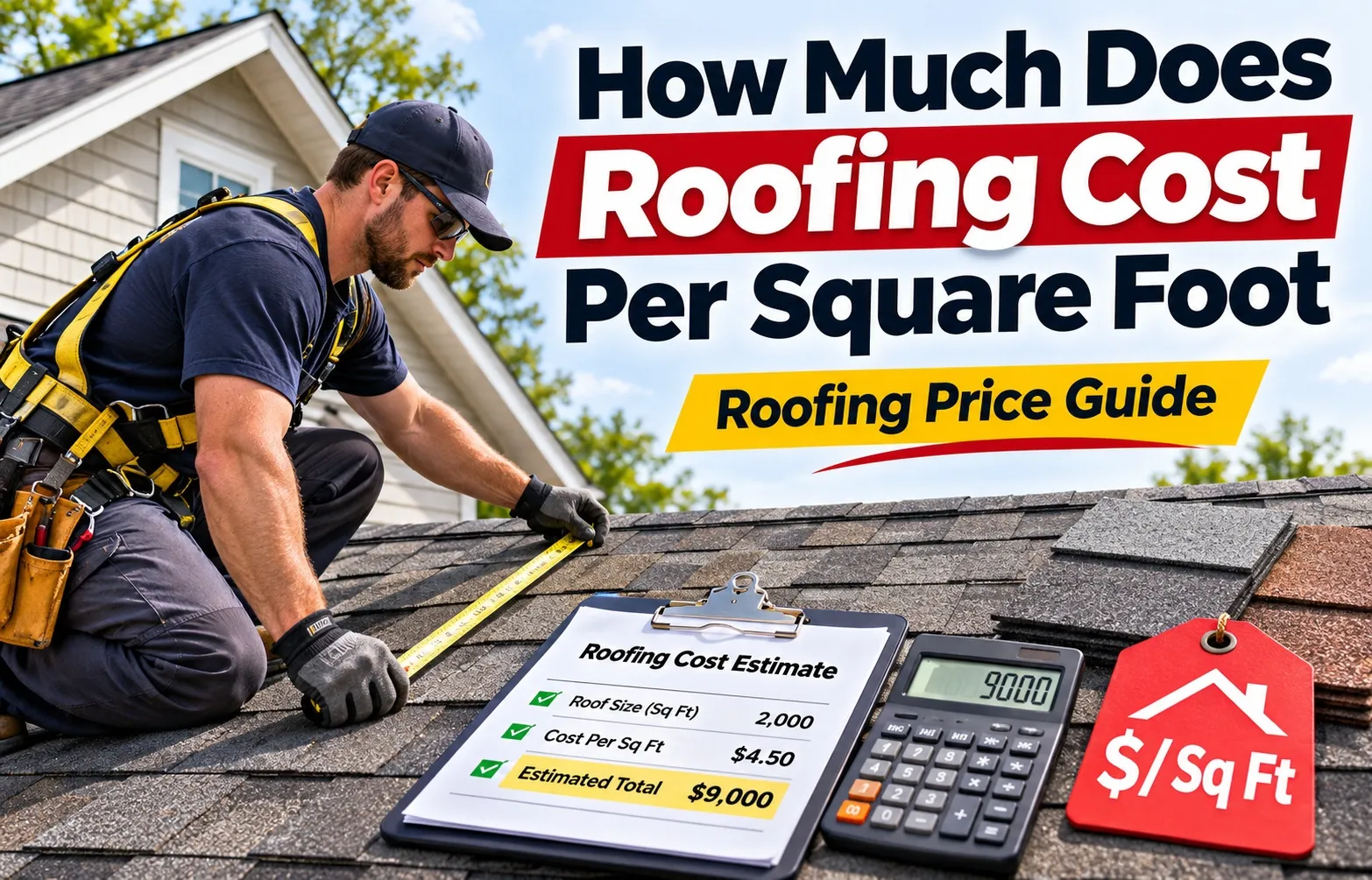 Installing a replacement roof costs between $4.00 and $11.00 per square foot installed for standard residential projects in 2026. Premium materials like standing seam metal, clay tile, or natural slate push installation rates from $12.00 to $30.00+ per square foot. Total project budgets for average single-family homes range from $9,000 to $26,000 depending on home size, material selection, and local labor pricing.
Average Cost per Square Foot (Installed)
National average prices for complete roof replacement break down into three primary budget tiers based on material durability and installation complexity:
- Standard Architectural Shingles: $4.50 – $8.00 per square foot (Installed material + labor)
- Mid-Range Metal & Tile: $8.00 – $18.00 per square foot (Installed material + labor)
- High-End Slate & Premium Systems: $15.00 – $30.00+ per square foot (Installed material + labor)
Labor typically accounts for 50% to 60% of the overall invoice, while raw materials, dump fees, and structural permits make up the remaining balance.
Understanding the “Roofing Square” Unit Metric ($400 – $1,100/Square)
Contractors measure, quote, and order materials using a trade unit called a roofing square, which equals exactly 100 square feet of roof surface area. Converting cost per square foot into cost per square allows home owners to accurately parse professional line-item estimates.
- 1 Roofing Square: 100 sq. ft. of roof surface
- Average Shingle Cost per Square: $450 – $800 installed
- Average Metal Cost per Square: $800 – $1,800 installed
- Average Slate Cost per Square: $1,500 – $3,000+ installed
A standard 2,000-square-foot roof surface contains 20 roofing squares. Professional estimates factor in a 10% to 15% material waste allowance on top of base square footage to account for rake cuts, hips, and valleys.
Roof Replacement Cost Breakdown by Material
Material selection serves as the single largest variable governing your total roof replacement budget. Raw material expenses range from $1.20 to $14.00 per square foot, while specialized installation labor scales based on weight, pitch complexity, and attachment methods. Evaluating upfront installation pricing alongside projected lifespan ensures long-term return on investment (ROI).
Budget & Entry Level: 3-Tab vs. Architectural Shingles
Asphalt products remain the most common residential roofing choice due to lower initial capital expenditure and widespread installer availability. Choosing between basic flat shingles and dimensional products impacts structural wind ratings and curb appeal.
- 3-Tab Shingles ($3.50 – $5.50/sq. ft. installed): Standard single-layer asphalt cutouts designed for basic weather protection. Material runs $1.20 to $2.00 per square foot, with labor adding $2.30 to $3.50. Rated for 60 mph wind resistance with a 15-to-20-year operational life.
- Laminated Architectural Shingles ($5.00 – $8.50/sq. ft. installed): Multi-layer dimensional asphalt featuring enhanced thickness and shadow lines. Material costs $2.00 to $3.50 per square foot, plus $3.00 to $5.00 in installation labor. Offers 110–130 mph wind resistance and lasts 25 to 30 years.
While 3-tab shingles offer the lowest entry price, architectural shingles deliver higher long-term ROI due to superior tear resistance, extended warranty coverage, and higher home resale valuation.
Mid-Tier & Modern Solutions: Standing Seam Metal & Synthetic Shingles
Mid-range roofing materials prioritize longevity, energy performance, and modern design aesthetics. These systems command higher labor installation fees due to specialized cutting, seaming, and fastening requirements.
- Ribbed Corrugated Metal ($6.50 – $11.00/sq. ft. installed): Exposed-fastener metal panels costing $3.00 to $5.00 per square foot for materials and $3.50 to $6.00 for labor. Requires screw gasket inspections every 10 to 15 years.
- Standing Seam Metal ($11.00 – $19.00/sq. ft. installed): Concealed-fastener steel or aluminum panels with interlocking thermal seams. Material costs $5.00 to $9.00 per square foot, with labor adding $6.00 to $10.00 due to precise hand-seaming demands. Lasts 50 to 70+ years with minimal maintenance.
- Synthetic Composite Shingles ($9.50 – $16.00/sq. ft. installed): Engineered polymer panels mimicking cedar shake or slate. Material pricing averages $4.50 to $8.00 per square foot, combined with $5.00 to $8.00 installation labor. Lightweight composition eliminates the need for structural roof reinforcement.
Standing seam metal reflects radiant solar heat, reducing summer cooling bills by up to 25% while outlasting standard asphalt by double its functional lifespan.
Premium & Luxury Options: Concrete, Clay Tile, and Natural Slate
Heavyweight luxury roofing provides unmatched architectural distinction and extreme storm resilience. Installation requires reinforced roof framing and specialized masons certified to work with high-density stone and fired clay products.
- Concrete Tile ($10.00 – $16.00/sq. ft. installed): Molded cement panels offering Class A fire resistance. Materials cost $4.50 to $7.00 per square foot, while labor adds $5.50 to $9.00. Requires structural truss inspection before installation.
- Clay Tile ($13.00 – $22.00/sq. ft. installed): Traditional kiln-fired Mediterranean and Spanish tiles. Material expenses range from $6.00 to $10.00 per square foot, with labor costs reaching $7.00 to $12.00 due to fragile handling requirements.
- Natural Slate ($16.00 – $32.00+ /sq. ft. installed): Authentic quarried stone slate representing the highest tier of durability. Slabs cost $7.00 to $14.00 per square foot, with specialized artisan labor adding $9.00 to $18.00+. Operational lifespan routinely exceeds 100 years.
Luxury materials weigh between 800 and 1,500 pounds per roofing square. Upgrading from asphalt to tile or slate often requires structural decking retrofits costing $1.50 to $3.00 per square foot in supplemental carpentry.
Low-Slope Options: EPDM & TPO Membranes for Flat Roofs
Residential additions, modern flat roofs, and low-slope porches (pitches below 2/12) cannot shed water using overlapping shingles. They require continuous single-ply synthetic rubber or thermoplastic membranes to prevent standing water intrusion.
- EPDM Membrane ($5.00 – $8.50/sq. ft. installed): Ethylene Propylene Diene Monomer synthetic black rubber. Roll material costs $2.00 to $3.50 per square foot, with fully-adhered labor adding $3.00 to $5.00. Ideal for cold climates due to high heat absorption.
- TPO/EPDM Flat Roof Membrane ($5.50 – $9.50/sq. ft. installed): Thermoplastic Polyolefin single-ply white membrane featuring heat-welded seams. Material runs $2.50 to $4.00 per square foot, plus $3.00 to $5.50 for hot-air seam welding labor. Highly reflective surface resists UV degradation and punctures.
Single-ply membrane systems carry a 20-to-30-year operational life when properly flashed around scuppers, parapet walls, and roof drainage penetrations.
The Floor Plan vs. True Roof Area: Pitch Multipliers & Measurement Math
Homeowners often make the costly mistake of calculating roof replacement budgets using their home’s ground footprint square footage instead of total roof surface area. Because roofs slant upward at varying angles, a 2,000-square-foot foundation requires significantly more material to cover the actual three-dimensional surface area.
Ground Footprint vs. Pitch-Adjusted Surface Area
Your home’s square footage on a real estate listing only measures the climate-controlled indoor floor plan. It completely ignores exterior wall thickness, roof overhangs, eaves, and the steepness of the slope overhead.
- Footprint Measurement: Represents the 2D perimeter of ground-level exterior walls.
- Surface Area Measurement: Represents the actual 3D sloped area requiring shingles, underlayment, and metal flashings.
- The Variance Gap: A standard 2,000 sq. ft. ranch house routinely translates to 2,200 to 2,600 square feet of actual roof surface.
Failing to account for this difference results in severe under-bidding when ordering materials, leading to project delays and unexpected budget overruns.
Roof Pitch & Slope Multiplier Table (Low, Standard, Steep, Severe)
Roof pitch is expressed as a ratio comparing vertical rise to horizontal run, such as 4/12 or 8/12. Contractors apply a specific pitch multiplier to the ground footprint square footage to calculate true surface area before adding material waste.
To determine your roof size, multiply your home’s total ground footprint square footage by the decimal pitch multiplier corresponding to your roof’s steepness grade.
Accounting for Overhangs, Eaves, and Waste Factors (10% to 20%)
Accurately sizing a roof replacement requires accounting for structural overhangs, eaves, gables, and material cutting waste. Standard contractor estimating formulas add an explicit waste factor percentage to cover hip, valley, and rake cuts.
- Eaves and Overhangs: Roof extensions past exterior walls add 1 to 3 feet of surface framing on all sides.
- Standard Waste Factor (10%): Applied to simple gable roofs with minimal cuts or angles.
- Complex Waste Factor (15% – 20%): Applied to hip roofs, dormers, multiple valleys, and intricate architectural intersections where shingle trimming increases off-cut scraps.
Multiplying your pitch-adjusted surface area by a 1.10 to 1.15 waste factor ensures your contractor orders enough physical bundles to complete the installation without running short.
Itemized Labor Breakdown & Hidden Fee Audit
Understanding contractor estimates requires examining how roofing expenses are distributed across labor, removal, and structural components. Labor consistently represents the single most expensive component of replacing a roof, accounting for 50% to 60% of total project invoices due to the specialized trade skills required for safe, weather-tight installation.
Labor & Installation Rate Factors (50% – 60% of Total Quote)
Professional roofing crews charge based on project complexity, crew size, and regional economic variables. Labor rates scale upward when working on steep slopes or multi-story structures requiring specialized fall-protection scaffolding.
- Regional Labor Variances: Local labor costs vary significantly based on state cost-of-living indexes, local building code requirements, and post-storm contractor demand surges.
- Crew Productivity & Timeframe: A standard residential installation requires a 3-to-5-person crew working 1 to 3 days to strip, protect, and install a complete system.
- Safety & Compliance Overhead: Professional labor quotes incorporate workers’ compensation insurance, general liability policies, and OSHA safety compliance gear.
Attempting to cut corners by hiring unlicensed labor often voids manufacturer material warranties and exposes homeowners to liability for workplace injuries.
Tear-off and Dumpster Disposal Costs ($1.00 – $2.40/Sq Ft Per Layer)
Before installing new materials, contractors must strip old roofing down to the bare wooden decking. Tear-off labor and debris disposal fees add a distinct line-item charge to every project.
- Single-Layer Tear-Off: Stripping and hauling away one existing layer of asphalt shingles costs $1.00 to $1.60 per square foot.
- Double-Layer Stripping: Removing multiple layers doubles labor effort and waste volume, pushing removal costs to $1.80 to $2.40+ per square foot.
- Dumpster & Landfill Fees: Roll-off container rentals and local environmental dumping fees account for $400 to $900 of the total disposal expense per job.
While building codes sometimes permit laying new shingles directly over one existing layer, full tear-offs are recommended to inspect the underlying decking for hidden moisture rot.
Structural Repairs: Plywood Decking (CDX) & Fascia Board Replacement
Water infiltration often rots underlying roof decking long before surface shingles show visible failure. Contractors cannot assess wood damage until the old roofing materials are completely stripped away.
- CDX Plywood Sheathing Replacement: Replacing rotted 4×8 plywood or OSB decking boards costs $60 to $100 per sheet, covering both materials and carpentry labor.
- Fascia Board Repair: Damaged wooden trim boards along the roof perimeter cost $15 to $25 per linear foot to replace and paint.
- Rafter Tail Inspection: Severely compromised structural rafters require sistering or reinforcement to ensure structural load capacity.
Reputable roofing contracts include a per-sheet replacement rider so homeowners know upfront how much extra to budget if hidden deck rot is discovered.
Essential Flashing, Underlayment, and Ice & Water Shield Requirements
Waterproofing protection relies heavily on components hidden beneath the visible outer layer. High-performance underlayments and flashing details prevent leaks around vulnerable roof intersections.
- Synthetic Underlayment: Heavy-duty woven moisture barriers replace traditional felt paper, costing $0.25 to $0.50 per square foot installed.
- Ice & Water Shield: Self-adhering polymer modified bitumen membranes installed along eaves, valleys, and penetrations cost $0.75 to $1.75 per square foot.
- Chimney & Step Flashing: Custom metal step flashing and counter-flashing around chimneys, skylights, and vent pipes add $300 to $1,200 per complex architectural detail.
Skipping premium underlayment or reusing old, bent metal flashing to save money drastically increases the risk of premature interior water damage during wind-driven rainstorms.
Financial Strategies, Tax Credits & Contractor Pricing Cycles
Replacing a roof represents a substantial capital investment, but smart financial planning can significantly offset upfront costs. Understanding tax incentives, seasonal pricing drops, and specialized financing programs allows homeowners to secure quality installations while protecting their household budget.
Is a New Roof Tax Deductible in 2026? (Capital Improvements vs. Energy Efficiency Credits)
Standard roof replacements on primary residences are not directly tax-deductible in the year of installation, but they qualify as capital improvements that increase your home’s cost basis. This adjustment reduces taxable capital gains when you eventually sell the property.
- Capital Improvement Basis: Save all contractor receipts, permits, and line-item invoices to add the full installation expense to your home’s adjusted cost basis.
- Energy Efficiency Tax Credits: Installing qualifying solar-reflective metal roofing or cool-roof asphalt shingles with high solar reflectance values may qualify for federal energy credits. Review the official Energy Star Tax Credit Guidelines to verify eligible materials and maximum credit caps before purchasing.
- Rental Property Deductions: Landlords and residential property investors can depreciate the cost of a full roof replacement over 27.5 years under standard tax schedules.
Consult a certified tax professional to determine how specific roofing upgrades apply to your individual tax filing status.
Off-Peak Bargains: What is the Cheapest Month to Buy a Roof?
Roofing contractors experience heavy seasonal demand swings, leading to fluctuating labor rates and scheduling availability throughout the calendar year.
- Cheapest Months (Late Winter / Early Spring): January, February, and March offer the lowest installation rates. Contractors drop labor fees by 5% to 15% to maintain crew schedules during slow winter months.
- Peak Pricing Months (Late Summer / Autumn): August through November represents peak season. High homeowner demand and storm-chasing volume drive quotes to maximum rate caps.
- Weather Constraints: Asphalt shingles require temperatures above 40°F (4°C) for thermal seal strips to activate properly, making unseasonably mild winter days optimal for discounted installations.
Booking your roof replacement during off-peak seasonal lulls gives you stronger leverage to negotiate material upgrades or labor discounts.
Financing Options: HELOCs, Contractor Plans, Insurance Claims, and USDA Grants
When paying cash upfront is not feasible, multiple financing pathways exist to fund urgent roof repairs or complete system replacements without depleting emergency savings.
- Home Equity Lines of Credit (HELOC): Offers lower interest rates backed by your home’s equity, making it ideal for large-scale structural renovations.
- Contractor In-House Financing: Many certified roofers offer 0% APR promotional financing for 12 to 24 months, though deferred interest terms apply if not paid within the intro period.
- Roof Insurance Claims: Storm damage from hail, falling trees, or severe wind is covered by standard homeowners policies minus your deductible. Normal wear-and-tear is excluded.
- USDA Section 504 Home Repair Program: Very-low-income rural homeowners aged 62 and older may qualify for direct grants up to $10,000 or low-interest loans up to $40,000 to remove health and safety hazards.
Compare interest rates, loan origination fees, and repayment timelines across at least three financial institutions before signing a financing agreement.
Frequently Asked Questions & Replacement Decision Guide
Deciding whether to repair localized damage or invest in a full roof replacement requires evaluating the age of your system, the extent of structural wear, and local building code limits. Addressing these critical decision factors ensures you choose the most cost-effective solution for your property.
Should You Replace a 20-Year-Old Roof or Repair It?
A 20-year-old asphalt shingle roof has generally reached the end of its intended operational lifespan. While minor leaks on newer roofs can be patched for $300 to $900, attempting spot repairs on aging shingles often leads to recurring leaks and compromised protection.
- Widespread Granule Loss: Heavy accumulation of loose shingle granules in your gutters indicates that the asphalt coating is deteriorating, leaving the underlying fiberglass backing exposed to UV degradation.
- Curling or Missing Shingles: Shingles that are cupping, clawing, or blown away during storms lose their seal, allowing water to seep underneath and cause deck rot.
- System Age Limit: Standard 3-tab shingles last 15 to 20 years. Once a roof reaches this milestone, repairing individual spots becomes a temporary band-aid rather than a long-term fix.
If visible damage covers more than 30% of your total roof surface, opting for a complete replacement offers better long-term value and full manufacturer warranty coverage.
Can You Install New Shingles Over an Existing Layer (Layover)?
Installing a new layer of architectural shingles directly over an existing layer—known as a layover or overlay—can save $1.00 to $1.60 per square foot in tear-off and disposal costs. However, this shortcut carries several long-term drawbacks.
- Building Codes (2-Layer Limit): Most municipal residential building codes permit a maximum of two layers of asphalt roofing. If your home already has two layers installed, a full tear-off is legally required.
- Hidden Decking Rot: Overlaying new shingles traps moisture and prevents contractors from inspecting the wooden decking below for rotted sheathing or structural sagging.
- Reduced Lifespan & Warranty: Heat retention between the two layers accelerates shingle deterioration, often shortening the new layer’s functional life by 20% and voiding manufacturer warranties.
While a layover cuts initial labor expenses, a complete tear-off is recommended to ensure your structural decking is solid and properly protected with new underlayment.
How Long Does a Full Roof Replacement Take?
A standard single-family residential roof replacement typically takes 1 to 3 days from initial tear-off to final magnetic clean-up, depending on home size, roof slope, and crew size.
- Standard Single-Story Home (1 to 2 Days): Simple gable roofs using standard architectural shingles are routinely completed in a single day by a 5-person crew.
- Steep or Complex Roofs (2 to 4 Days): Multi-story structures, high-pitch angles, or designs with multiple dormers, chimneys, and valleys require extra safety setup and meticulous flashing installation.
- Heavyweight & Specialty Materials (1 to 2 Weeks): Specialty materials such as standing seam metal, clay tile, or natural slate demand precise hand-seaming and masonry work, extending project timelines.
Weather conditions like heavy rain, high winds, or freezing temperatures will pause installation progress to keep the structure safely dry throughout construction.

Oscar Vance | Master Plumber & Drainage Expert
Meet Oscar Vance, a licensed master plumber sharing practical solutions on residential repairs, preventive maintenance, and thoughtful home upkeep.