The Roofing Labor Dilemma
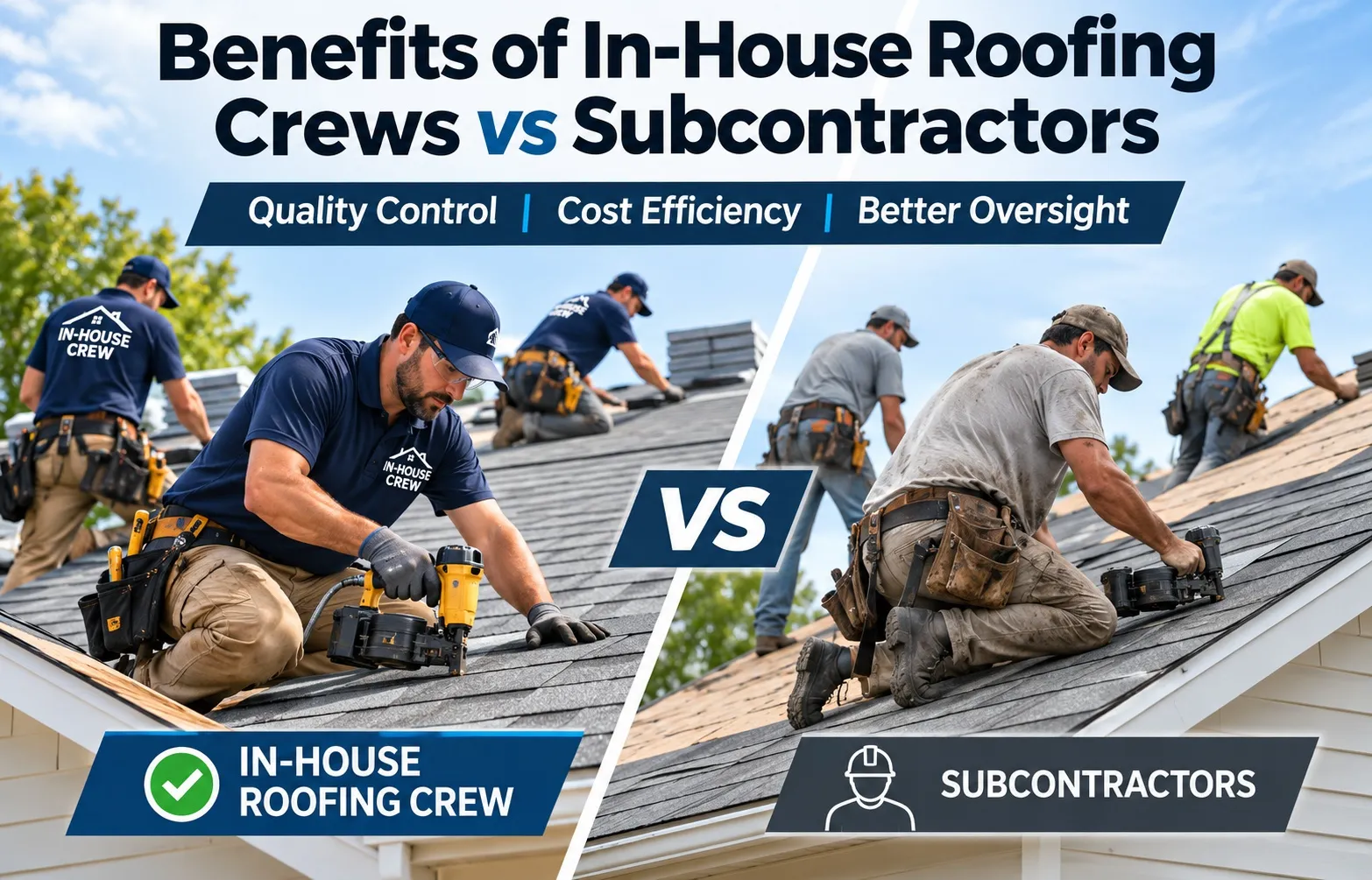 Scaling a roofing business hinges on one critical operational decision: choosing between an in-house labor model and independent subcontractors. Striking the right balance directly determines profit margins, project timelines, and long-term brand reputation in a competitive local market.
Why Labor Structure Makes or Breaks a Roofing Company
Roofing business owners and project managers frequently discover that labor is their single largest operational variable. A poorly structured workforce leads to scheduling bottlenecks, inconsistent installation quality, and inflated overhead expenses that silently erode profitability.
- Quality Consistency: Direct oversight ensures that every shingle, underlayment, and flashing detail aligns with exact company standards.
- Financial Predictability: Balancing fixed payroll obligations against variable project payouts dictates how safely a company can weather slow seasons.
- Brand Protection: Because homeowners hold the primary brand accountable, labor execution directly dictates word-of-mouth referrals and online reviews.
W-2 Employees vs. 1099 Subcontractors: A Quick Baseline Definition
Understanding the fundamental legal and operational differences between W-2 workers and 1099 independent contractors forms the foundation of modern roofing management. Each classification carries distinct responsibilities regarding taxes, supervision, and daily scheduling.
- W-2 In-House Crews: Workers directly employed by your roofing company, requiring payroll tax withholding, workers’ compensation insurance, and direct supervision by your project managers.
- 1099 Subcontractors: Independent business entities or operators hired on a per-project or per-square basis, responsible for their own taxes, insurance, and specialized tools.
- Core Trade Impact: Deciding between these structures dictates your capacity to handle massive storm surges versus maintaining year-round control over high-end retail replacements.
Roofing Subcontractors (1099): Flexibility, Scale, and Risk
Partnering with 1099 independent contractors gives roofing companies the agility to rapidly expand production and control overhead during unpredictable market swings. Balancing this model requires understanding both its powerful financial advantages and its inherent operational risks.
Peak Season Scalability: Handling Massive Storm Surges Without Burning Out
Severe weather events and peak storm seasons create sudden surges in roofing demand that would quickly overwhelm any fixed in-house crew. Utilizing independent specialists and subcontractor networks allows companies to scale up operations overnight without overextending internal resources.
- Rapid Production Capacity: Instantly deploy multiple sub-crews to tackle large volumes of insurance restoration and storm damage repairs simultaneously.
- Surge Absorption: Absorb unexpected spikes in local market demand without forcing your core team into burnout or sacrificing project turnaround times.
- Geographic Expansion: Take on projects outside your immediate service radius by partnering with reliable local subcontractors in neighboring territories.
Lean Financials: Eliminating Full-Time Overhead and Year-Round Maintenance
Operating with a 1099 labor model shifts financial risk away from the business owner by replacing fixed base wages with flexible project-based expenses. This lean approach protects cash reserves when market conditions turn slow or unpredictable.
- Flat-Rate Square Payouts: Pay independent crews agreed-upon rates per square or per completed project, turning variable labor costs directly into predictable profit margins.
- Zero Payroll Tax Burden: Eliminate the responsibility of withholding payroll taxes, matching FICA, or funding employee benefits and paid time off.
- Reduced Equipment and Maintenance Costs: Subcontractors typically supply their own specialized roofing tools, nail guns, and vehicles, saving your business from heavy capital expenditures.
The Downside: Variable Quality Control and Scheduling Conflicts
While the financial and scaling benefits are significant, relying heavily on subcontractors introduces substantial operational vulnerability. Without direct, constant oversight, quality inconsistencies and reliability issues can quickly threaten your company’s reputation.
- Inconsistent Craftsmanship: Independent crews may cut corners to finish jobs faster and maximize their daily square output, resulting in installation flaws.
- Scheduling Reliability Risks: Subcontractors juggle multiple general contractors simultaneously, increasing the likelihood of delayed starts, no-shows, or abandoned jobs during peak periods.
- Communication Breakdowns: Disconnects between your project managers and subcontractor crews can lead to mismanaged details, customer friction, and costly warranty call-backs.
Head-to-Head Comparison Matrix: Cost, Control, and Risk
Choosing between an in-house W-2 crew and a 1099 subcontractor network is not a choice between right and wrong; it is a strategic trade-off between fixed control and variable scalability. Reviewing these models side-by-side clarifies how each structure impacts your daily operations and bottom-line profit margins.
Side-by-Side Evaluation: Financial Burden vs. Operational Flexibility
Evaluating financial burden, quality oversight, and compliance obligations side-by-side helps roofing business owners align their labor strategy with long-term growth goals and risk tolerance.
The Legal, Tax, and Compliance Deep Dive
Navigating the legal and regulatory landscape of roofing labor requires strict adherence to federal and state standards. Overlooking worker classification laws or general liability exposure can result in devastating IRS audits, expensive Department of Labor fines, and severe legal liabilities.
IRS and Department of Labor: Avoiding Subcontractor Misclassification Audits
Regulators scrutinize the construction and roofing sectors heavily for worker misclassification, where companies improperly label W-2 employees as 1099 independent contractors to avoid payroll taxes and insurance costs. To prevent costly penalties, roofing businesses must prove behavioral control, financial control, and structural independence.
- Behavioral Control Tests: Subcontractors must maintain autonomy over their work methods, hours, and equipment without direct micro-management from your company supervisors.
- Financial Independence: Independent crews should invest in their own tools, set their own pricing structures, and offer their services to multiple general contractors concurrently.
- Regulatory Compliance Resources: Reviewing official federal guidelines helps ensure your operational agreements stay compliant. You can reference the IRS Independent Contractor Guidelines to evaluate proper worker classification.
Indemnification Clauses, Lien Waivers, and Protecting Your General Liability
Protecting your roofing business from third-party injury claims and mechanic’s liens requires ironclad contractual safeguards. Failing to secure proper legal documentation leaves your company exposed to catastrophic financial damages if a subcontractor accident or payment dispute occurs on site.
- Comprehensive Indemnification Agreements: Contracts must require subcontractors to indemnify and hold your company harmless against any workplace injuries, property damage, or safety violations.
- Mandatory Certificate of Insurance: Never let a sub-crew on a roof without verifying active general liability and workers’ compensation policies naming your business as an additional insured.
- Unconditional Lien Waivers: Secure signed lien waivers upon every progress payment and final disbursement to prevent unpaid suppliers or crew members from filing mechanic’s liens against the homeowner’s property.
The Ultimate Solution: Running a Profitable Hybrid Model
Successful roofing contractors quickly realize that choosing between 100 percent in-house crews and full subcontractor reliance is a false dichotomy. The most profitable roofing businesses deploy a strategic hybrid model that combines the stability of core employees with the agility of vetted subcontractor networks.
Core In-House Leadership Plus Vetted Subcontractor Surge Capacity
Building a resilient workforce structure relies on establishing a permanent internal core while maintaining scalable external partnerships. This balance preserves high workmanship standards while protecting the business from seasonal market volatility.
- Core In-House Team: Maintain a dedicated crew of full-time project managers, quality control supervisors, and skilled repair technicians to handle warranty calls, retail replacements, and day-to-day operations.
- Vetted Subcontractor Network: Cultivate trusted relationships with independent 1099 crews who undergo rigorous safety and quality screening before stepping onto any job site.
- Surge Capacity Deployment: Activate your subcontractor network instantly during heavy storm seasons or market spikes to maximize volume without increasing year-round overhead.
How Top-Tier Roofing Companies Balance Both Models for Maximum Profitability
Optimizing profit margins requires matching the right labor model to the exact scope of each project. Top-performing roofing companies route high-end residential jobs and insurance restoration details through internal teams, while utilizing sub-crews for high-volume production.
- Strategic Project Allocation: Assign complex architectural installations and warranty-sensitive replacements to your W-2 team to safeguard your manufacturer certifications and brand reputation.
- Overhead Optimization: Protect winter profit margins by scaling down external labor expenses during slow periods instead of carrying an oversized full-time payroll.
- Sustainable Business Growth: Scale your revenue ceiling significantly higher by leveraging independent labor capacity without taking on the crushing financial burdens of a massive permanent workforce.
Frequently Asked Questions
Addressing common questions regarding roofing labor models helps clarify operational uncertainties and captures direct search queries from Google AI Overviews and People Also Ask boxes.
Do most roofing companies use subcontractors?
Yes, a significant percentage of residential and commercial roofing companies rely heavily on 1099 independent labor or a hybrid model. While some large enterprises maintain exclusive in-house crews, roofing sub-contracting allows most contractors to scale rapidly during storm seasons, absorb labor fluctuations, and manage overhead costs effectively.
How do warranties differ between in-house crews and subcontractors?
Workmanship warranties depend entirely on the contractor’s accountability, whereas manufacturer system warranties rely on strict installation compliance. In-house crews trained directly under brand standards reduce the risk of installation errors that can void 50-year manufacturer warranties. Conversely, when using subcontractors, roofing companies must enforce rigorous oversight to ensure independent labor adheres to exact manufacturer specifications.
What are the primary legal risks of hiring 1099 roofing subs?
Hiring independent labor carries distinct legal exposures, most notably worker misclassification audits by the IRS and Department of Labor. If independent contractors are micro-managed like regular employees, businesses face severe back taxes and penalties. Additionally, failing to secure valid certificates of insurance and unconditional lien waivers exposes roofing companies to third-party liability and mechanic’s liens.

Oscar Vance | Master Plumber & Drainage Expert
Meet Oscar Vance, a licensed master plumber sharing practical solutions on residential repairs, preventive maintenance, and thoughtful home upkeep.