What Is an Electrical Whip?
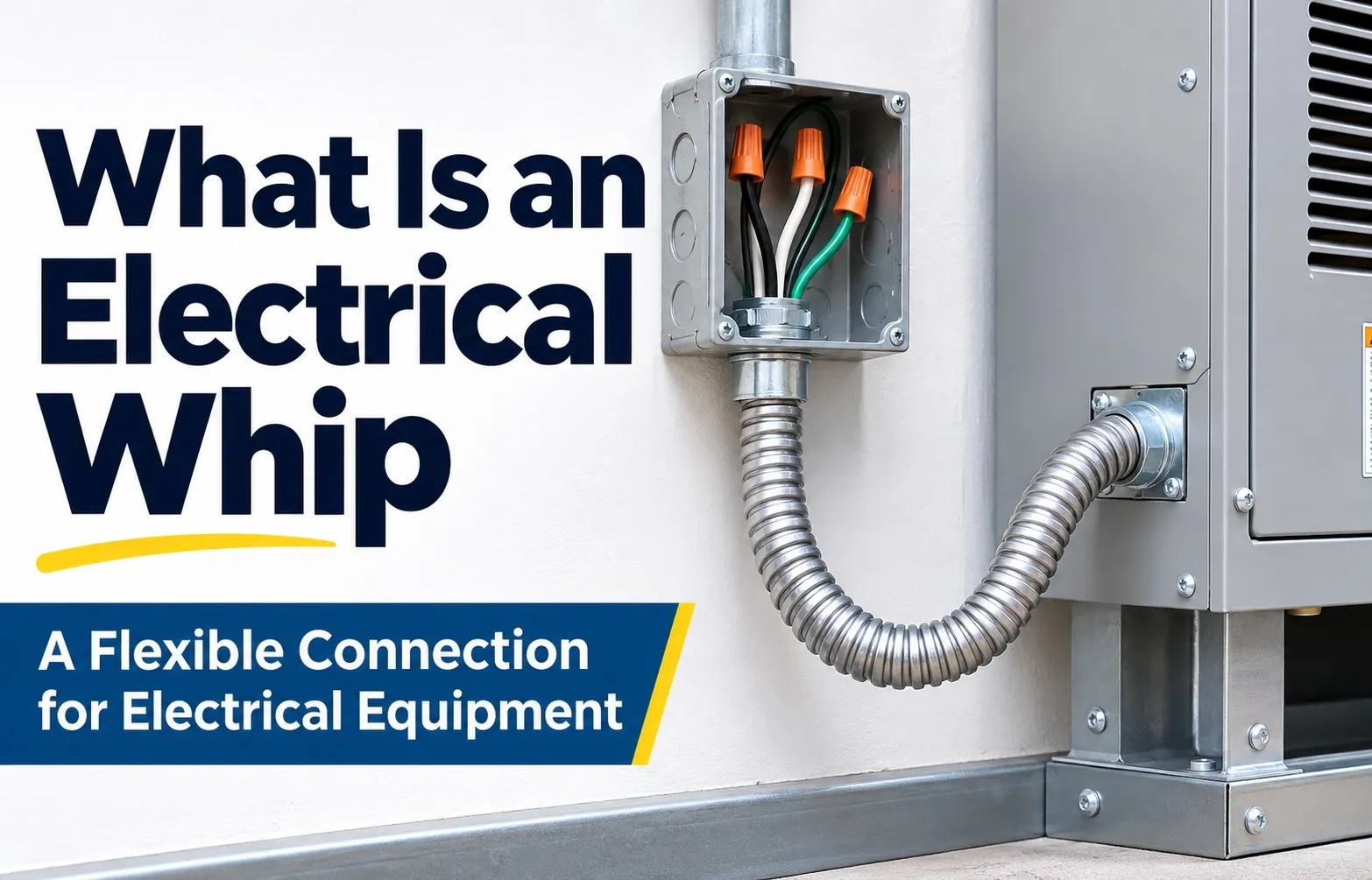 An electrical whip (also called a power whip) is a short, pre-assembled length of flexible conduit containing insulated conductors and end connectors used to link a power source or disconnect box to equipment, fixtures, or modular units. Its core purpose is delivering safe, adaptable power where rigid wiring is impractical.
On job sites, technicians also use the term for extra slack cable left in a wall cavity during rough-in framing so fixtures can be placed later. Using a whip speeds up installation while keeping critical equipment connections serviceable.
- Vibration isolation: Flexible conduit absorbs motor and compressor vibration on outdoor air conditioners and heat pumps so wire terminations do not loosen over time.
- Weather and mechanical protection: Liquid-tight and metallic conduit assemblies shield insulated conductors from moisture, sunlight, and accidental knocks near equipment pads.
- Tight-space routing: Pre-fitted straight or 90-degree connectors make short runs from a disconnect box or junction box into equipment enclosures faster and cleaner.
Safety Disclaimer: Electrical wiring carries serious shock, arc-flash, and fire hazards. Always shut off power at the main breaker, verify circuits are de-energized with a rated tester, match equipment nameplates, and follow the National Electrical Code (NEC), local amendments, and a licensed electrician’s guidance before starting any work.
Common Uses of Electrical Whips Across Industries and Projects
Electrical whips serve different jobs depending on where power enters a system, ranging from outdoor HVAC condensers and spa pumps to ceiling luminaires, modular office cubicles, and pre-drywall framing. Matching the whip style to the environment keeps connections protected, serviceable, and aligned with job-site needs.
HVAC Whips: Connecting Outdoor Condensers and Heat Pumps
An electrical whip in HVAC is a short, flexible conduit assembly that connects an outdoor air conditioner or heat pump to a nearby disconnect box. Building power feeds the disconnect box first, and the whip bridges the final short span into the equipment service panel.
Because outdoor compressors vibrate and sit exposed to sun, rain, and lawn trimmers, a flexible whip prevents rigid conduit stress and protects internal conductors. This separation also lets a technician shut off local power at the disconnect box during routine servicing.
- Disconnect-to-unit bridge: Links the local service disconnect box directly to the condenser or heat pump cabinet.
- Movement and service access: Handles minor cabinet shifting and lets installers swing panels open without pulling wire terminations taut.
Pool, Spa, and Wet-Location Equipment Whips
Pool and spa gear operates in constant splash zones, humidity, and outdoor weather, making damp/wet-location protection essential on short equipment runs. Whips link pumps, heaters, blowers, and control panels to nearby disconnects or subpanels while shielding conductors from moisture.
- Moisture resistance: Sealed fittings and moisture-rated conduit assemblies help keep water out of terminal compartments.
- Equipment maintenance: Flexible routing makes servicing pumps and heaters simpler in cramped equipment pads.
Lighting Fixture Whips and Modular Office Power Infeeds
In commercial ceilings and workspaces, whips speed up final connections without hardwiring every piece from scratch. A lighting fixture whip links a junction box above a drop ceiling to an individual luminaire, while a base power infeed or base feed module brings building power into modular cubicles or office furniture workstations.
- Drop-ceiling luminaires: Connects recessed or suspended light fixtures cleanly to above-ceiling branch circuits.
- Workstation power distribution: Routes power from a floor or wall junction into a modular cubicle spine or base feed module.
Rough-In Whips in Framing and Wall Cavities
During wall rough-in before drywall goes up, electricians often leave extra slack cable coiled or looped inside a wall cavity, calling that spare length a whip. Having extra cable gives installers room to position sconces, outlets, or fixtures accurately after finishing work is complete.
- Post-drywall flexibility: Prevents short-wire headaches when final fixture locations shift slightly during trim-out.
- Clean termination slack: Provides enough conductor length to land cleanly inside electrical boxes without stretching sheathing.
Types, Sizes, Connectors, and 4-Wire Configurations
Selecting the right electrical whip means matching the conduit material, trade size, wire gauge, connector style, and conductor count to the load and environment. Understanding how these hardware parts pair together prevents voltage drop, overheating, and fitment issues on site.
Conduit Materials: Liquid-Tight vs. Flexible Metal Conduit
Liquid-tight non-metallic conduit (LFNC / PVC) uses a flexible plastic or polymer jacket designed to seal out moisture, oil, and outdoor weather. Flexible metal conduit (FMC) uses a spiraled metal strip that bends easily in tight spaces and suits indoor dry or protected locations.
- Liquid-tight non-metallic conduit (LFNC / PVC): Ideal for wet or outdoor spots like AC pads and spa equipment where water resistance matters.
- Flexible metal conduit (FMC): Suited for dry indoor spaces, commercial ceilings, and equipment enclosures needing rugged metal shielding.
Lengths, Trade Sizes, and Wire Gauges (4 ft, 6 ft, 8 ft, and AWG)
Pre-assembled whips commonly come in 4-foot, 6-foot, and 8-foot lengths with 1/2-inch or 3/4-inch trade-size conduit. Inside, wire gauges such as 8 AWG, 10 AWG, 12 AWG, 14 AWG, or 18 AWG carry the circuit load based on equipment amperage and rating.
- Lengths (4-foot, 6-foot, 8-foot): Choose a length that reaches cleanly from the source to the terminal box without dragging or pulling tight.
- Trade sizes (1/2-inch, 3/4-inch): Larger 3/4-inch conduit gives extra room for heavier conductors or multi-wire pulls.
- Wire gauges (8 AWG to 18 AWG): Lower AWG numbers mean thicker wire for higher current loads, while higher AWG numbers mean thinner wire for lighter loads.
Straight vs. 90-Degree Connectors and Plugged Whips
An electrical whip connector secures the conduit into a knockout using a straight fitting for direct entry or a 90-degree fitting when clearance against a wall or cabinet is tight. Some assemblies also ship as an electrical whip with plug or modular connector for rapid hookup without hardwiring every end.
- Straight fitting: Best when the conduit enters perpendicular to the box wall with plenty of front clearance.
- 90-degree fitting: Helps hug walls, pads, or equipment sides cleanly in cramped spots.
- Electrical whip with plug: Speeds up installation on modular furniture or portable equipment where plug-in convenience is desired.
3-Wire vs. 4-Wire Electrical Whips Explained
A 4-wire electrical whip typically includes two hot conductors, one neutral conductor, and one ground conductor, whereas a 3-wire assembly may use two hots and a ground or one hot, neutral, and ground depending on the circuit. Always match the conductor count and color coding to the equipment nameplate and circuit design.
- Hot and neutral conductors: Carry alternating current between the power source and the connected load or control circuit.
- Ground conductor: Provides a fault path to help trip breakers quickly if a live wire contacts metal housing.
How Long Can an Electrical Whip Be?
There is no single universal whip length for every job because allowable length depends on the application, conduit type, and local electrical rules. Most off-the-shelf pre-assembled whips measure 4 ft, 6 ft, or 8 ft, while specific fixture whip length limits and code rules govern longer or specialized runs.
Standard Pre-Assembled Lengths vs. Job-Site Needs
Retail and supply-house whips are sold in 4 ft, 6 ft, and 8 ft lengths because short runs protect flexible conduit and keep wiring neat near equipment. Picking a whip length that fits the exact distance between the disconnect box, junction box, or equipment knockout avoids messy loops or tight pulls.
- Short equipment runs (4 ft to 6 ft): Commonly used between an outdoor AC or heat pump disconnect box and the unit cabinet where a short, direct path works best.
- Extended or offset runs (up to 8 ft): Used when a disconnect box sits slightly farther from the equipment knockout or needs a gentle sweep around trim or piping.
- Fixture whip length limits: Luminaire whips used for drop-ceiling or recessed lights follow specific code length restrictions and support rules rather than open-ended slack.
Physical Protection, Slack, and Code Rules to Check
Leaving extra slack inside a whip can create loops that catch on yard tools, rub against sharp edges, or kink the conduit jacket. Too little slack puts strain relief under tension and pulls conductors loose inside connectors.
Always confirm UL Listed assemblies, verify equipment nameplate requirements, and check National Electrical Code (NEC) standards along with local amendments before finalizing whip length.
- Controlled slack: Keep just enough slack for gentle bending and equipment servicing without long hanging loops.
- Proper strain relief: Secure fittings tightly so weight or vibration never pulls directly on wire terminals.
- Code and nameplate check: Confirm NEC compliance and match equipment nameplate ratings before installation.
Common Installation Mistakes and Practical E-E-A-T Tips
Small wiring shortcuts can cause premature conduit failure, equipment damage, or failed electrical inspections. Watching out for common pitfalls around conduit handling, ratings, and disconnect box placement keeps your installation safe and clean from day one.
Mistakes That Damage Whips or Fail Inspection
Improper fitting installation and mismatched materials are frequent causes of nuisance trips, moisture entry, and failed inspections. Always separate whip electrical specifications from general HVAC sizing or replacement rules such as equipment tonnage or the “$5,000 HVAC rule.”
- Kinking conduit or crushing jackets: Sharp bends or stepping on liquid-tight conduit can crease the outer wall, weaken protection, and stress internal conductors.
- Indoor vs. outdoor rating mismatches: Using indoor-only conduit or non-weather-resistant fittings in sun, rain, or damp zones leads to early cracking and moisture intrusion.
- Loose connector torque/locknut or wrong fittings: Under-tightened locknuts or mismatched connectors allow vibration to loosen ground bonds and leave knockouts unsealed.
- Confusing HVAC sizing vs. whip specs: Tonnage and general HVAC buying rules guide system capacity, whereas whip selection depends on amperage rating, conductor gauge, and physical routing.
Quick Pre-Buy & Pre-Install Checklist
Running through a short verification list before buying or mounting a whip prevents costly rework and supports smooth inspection compliance. Check the equipment nameplate and local rules first so every part matches the circuit.
- Verify amperage rating and wire gauge: Match the whip’s conductors and breaker/circuit rating to the equipment nameplate.
- Confirm environment and rating: Check indoor vs. outdoor rating and moisture exposure before selecting conduit and connectors.
- Check disconnect box placement: Confirm disconnect box placement gives safe clearance, easy shutoff access, and a clean path to the unit.
- Tighten connectors and inspect routing: Verify connector torque/locknut snugness, smooth bend radii, and full inspection compliance before restoring power.
Frequently Asked Questions
Quick answers to common questions about electrical whips, disconnect boxes, outdoor ratings, pre-stripped conductors, and related HVAC search topics help clear up confusion before you buy or install parts.
What Is the Difference Between a Disconnect Box and an Electrical Whip?
A disconnect box is a wall- or pad-mounted switch enclosure that lets you shut off local power to equipment for safe servicing. An electrical whip is the short, flexible conduit assembly with conductors that connects the power source or disconnect box to the equipment.
- Disconnect box: Provides a local power shutoff point near equipment such as an outdoor air conditioner or heat pump.
- Electrical whip: Carries the conductors between the disconnect box and the equipment cabinet with built-in flexibility.
Can You Use an Electrical Whip Indoors and Outdoors?
Yes, provided the specific assembly is outdoor rated for the conditions it faces. Liquid-tight conduit assemblies suit outdoor or wet locations, while dry indoor areas can often use standard flexible conduit or lighting whips.
- Outdoor rated setups: Use moisture- and sunlight-resistant conduit and sealed fittings around condensers, pools, and spas.
- Indoor setups: Match conduit and fittings to dry, damp, or ceiling environments as required by code.
Do Electrical Whips Come With a Plug or Pre-Stripped Wires?
Many electrical whips come with pre-stripped conductors ready for terminal or wire-connector hookups, while others ship as a plug whip or modular connector assembly. Check the product listing and equipment terminals to confirm which termination style you need.
- Pre-stripped conductors: Common on equipment and fixture whips wired directly into terminal blocks, disconnects, or junction boxes.
- Plug whip assemblies: Common on modular office furniture, workstations, or equipment designed for plug-in connections.
Why Do HVAC Searches Mention the $5,000 Rule or AC Sizing?
Those terms come from broader HVAC replacement and cooling-load topics rather than electrical whip specifications. HVAC replacement cost rules compare repair versus replacement budgets, and AC tonnage measures cooling capacity rather than electrical whip size.
- HVAC replacement cost rules: Focus on repair estimates versus full system replacement budgets, not conduit or wire sizing.
- AC tonnage: Reflects thermal cooling capacity, whereas whip selection depends on electrical load, voltage, and routing.

Home Improvement Researchers & Guides Editors
Meet the Nest Team, a collective of dedicated researchers, home improvement enthusiasts, and industry writers sharing practical guides, thorough category research, and trusted solutions for residential repairs and thoughtful home upkeep.