What is a Return Register in HVAC/AC?
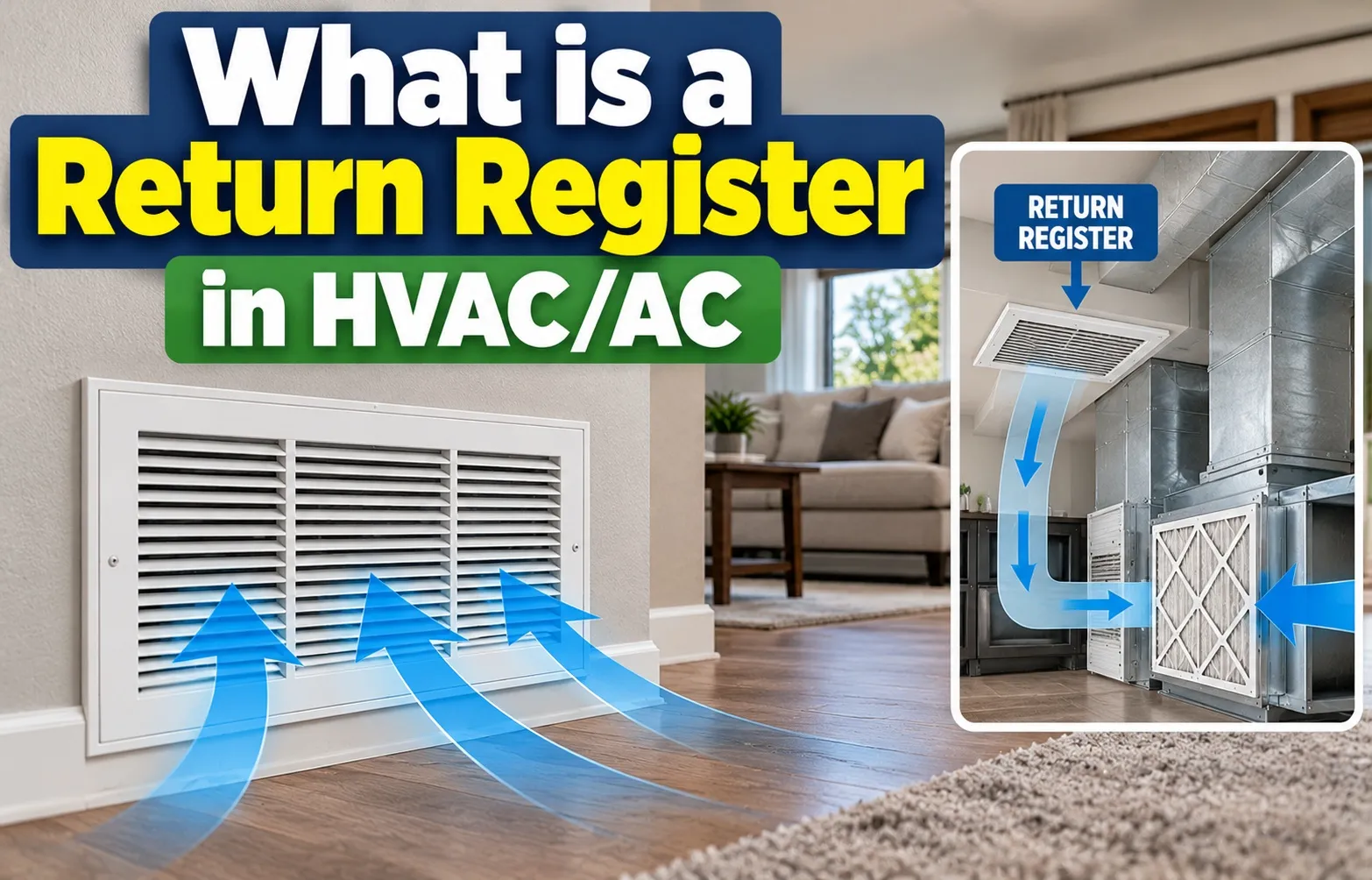 A return register is an essential HVAC wall, floor, or ceiling vent cover that pulls unconditioned room air out of your living space and sends it back through ductwork to your air conditioner or furnace. It acts as the intake entry point, completing the HVAC closed-loop air cycle so indoor air can be filtered, re-cooled, or re-heated efficiently.
What is a Return Register?
A return register—often referred to as a return air grille—is the suction vent in your home climate control system. Unlike supply vents that blow conditioned air into your rooms, a return register continuously draws air out of your living spaces to maintain proper air volume and balance.
Here is what defines a return register in your home:
- Inward Airflow Direction: It creates gentle suction to pull room-temperature air back into the return ductwork.
- Fixed Louver Structure: Most return registers feature stationary open grates without directional control levers.
- Integrated Air Filter Housing: Many return registers contain an internal slot designed to hold a removable air filter.
Why Your HVAC System Cannot Function Without It
Your heating and cooling equipment functions as a sealed, continuous loop. For every cubic foot of cold or warm air your supply vents push into a room, your system must pull an equal amount of air back out through the return registers to maintain balanced atmospheric pressure.
Without properly functioning return air registers, your HVAC system experiences major performance issues:
- Air Pressure Imbalances: Rooms become over-pressurized or under-pressurized, causing doors to slam or air to leak through window cracks.
- Severe Strain on Equipment: The furnace blower motor works harder to pull air, leading to higher electricity bills and premature motor failure.
- Poor Indoor Air Quality: Stagnant indoor air fails to circulate through your central air filter, allowing dust, pet dander, and allergens to accumulate.
How an HVAC Return Register Works (The Science of Airflow)
An HVAC return register powers the continuous movement of air by creating controlled negative pressure that draws indoor air back into the system. This thermal cycle ensures that every room maintains balanced pressure while old air is constantly recycled through the central conditioning equipment.
The Closed-Loop Air Cycle Explained
Heating and cooling systems rely on a closed-loop air cycle where supply vents push air into rooms and return registers pull an equal volume back out. This perpetual loop prevents house pressure from destabilizing and keeps conditioned temperatures uniform across your home.
Core components driving this closed-loop cycle include:
- Static Pressure: The pressure differential created between supply and return ducts that keeps air moving seamlessly.
- Negative Pressure: A slight vacuum effect at the return intake that gently pulls room air toward the grille.
- Room Air Recycling: Continuous collection of stagnant indoor air to be re-filtered and re-heated or re-cooled.
How Air Travels Through the Return Register
Air movement begins the moment your furnace or air conditioner blower motor turns on, creating a powerful suction force throughout the duct network. Understanding this journey clarifies why return vents must remain unobstructed at all times.
- Intake Suction: The blower motor pulls indoor air inward through the open grates of the return register.
- Duct Transmission: Air travels through the return duct system, moving away from individual living spaces toward the main air handler.
- Conditioning Cycle: The air passes through the central air filter and heat exchanger or evaporator coil before being redistributed.
The Crucial Role of Air Filters Behind the Register Grate
Air filtration is a primary defense mechanism built into return registers or central filter slots to protect your HVAC equipment and indoor air quality. Without effective filtration, airborne debris quickly damages sensitive mechanical components.
Key benefits of filtration at the return intake include:
- Dust Accumulation Prevention: Traps airborne particles before they can settle inside ductwork or coat the blower fan.
- Pet Hair and Dander Control: Captures heavy floating pet fibers that routinely clog mechanical coils.
- Protected Equipment Longevity: Prevents premature wear on high-efficiency blower motors by ensuring clean airflow.
Return Register vs. Supply Vent vs. Grille (Clearing the Confusion)
Homeowners often mistake supply vents, return vents, grilles, and registers for one another because they look similar on walls and ceilings. Distinguishing between these components is critical when troubleshooting home airflow issues or balancing your system’s output.
Key Differences: Return Register vs. Supply Vent
Supply vents and return registers work in opposite directions to maintain continuous airflow in your home. For a complete technical breakdown of system airflow components, you can refer to the Trane HVAC Educational Guide.
Grille vs. Register vs. Diffuser: What’s the Real Difference?
While people use these terms interchangeably, HVAC professionals categorize vent covers based on their mechanical controls and airflow diffusion design.
- Grille: A basic wall or ceiling cover with fixed slats that allows unrestricted air to pass into or out of a duct.
- Register: A grille cover equipped with built-in adjustable dampers or louvers to control or direct airflow volume.
- Diffuser: A specialized ceiling vent cover designed to disperse outgoing supply air evenly in multiple directions across a room.
How to Identify Return Vents in Your Home (The Paper Test Method)
You can quickly identify return registers without specialized HVAC diagnostic tools by performing a simple, non-invasive suction test using a single sheet of paper.
- Turn on your central air conditioner or furnace at the thermostat so the blower motor runs.
- Hold a standard sheet of paper lightly against the face of the metal or plastic vent grate.
- Observe the paper: if suction holds it flat against the grate, it is a return register; if air blows the paper away, it is a supply vent.
Ideal Placement Sizing and Quantity Guidelines
Proper sizing and strategic placement of return registers ensure balanced air movement throughout every room in your house. Incorrect vent counts or poor placement disrupt pressure dynamics, leading to uneven room temperatures and severe system strain.
Where Should Return Vents Be Located in a Home? (High vs. Low Wall Placement)
Return registers are positioned strategically on walls, ceilings, or floors based on thermodynamic airflow behavior. Cold air naturally sinks toward the floor while warm air rises toward the ceiling, directly influencing ideal vent heights.
- High Wall Placement: Essential in warmer climates where air conditioning is primarily used, as upper vents draw out warm air collecting near ceilings.
- Low Wall Placement: Ideal in cold climates with heavy heating usage to capture cold air pooling along floorboards.
- Central Return Strategy: Common in older homes, utilizing one large centrally placed return grille in a hallway or main living area.
How Many Return Vents Does a House Need? (By Square Footage & Tonnage)
The total number of return vents depends on your home’s total square footage and system cooling capacity measured in tons. As a baseline HVAC standard, a system requires roughly 200 square inches of return grate area per ton of cooling capacity.
Sizing requirements for standard home footprints include:
- 1,200 to 1,500 Sq. Ft. (2.5 Tons): Requires at least 1 large central return or 2 to 3 dedicated returns across main areas.
- 2,000 Sq. Ft. House (3 to 3.5 Tons): Typically requires 1 large central return paired with 3 to 4 dedicated returns in bedrooms.
- 2,500+ Sq. Ft. Multi-Story (4+ Tons): Requires dedicated return ducts on every level, ideally with at least one return per enclosed bedroom.
Should Every Bedroom Have Its Own Return Vent?
Yes, modern building codes and energy-efficiency standards strongly recommend a dedicated return vent in every closed bedroom. When bedroom doors close at night without a dedicated return, supply vents continue pushing air in, building up high pressure.
This room pressure spike forces conditioned air out through window seams and forces the central furnace or air conditioner blower motor to work under dangerous static backpressure.
What to Do If Your Bedroom Lacks a Return Vent (Transfer Grilles & Door Undercuts)
Retrofitting brand-new return ductwork through finished walls can be expensive, but several passive pressure-relief solutions restore airflow without complete duct overhaul.
- Door Undercuts: Trimming 1 to 1.5 inches off the bottom of interior bedroom doors allows room air to pass back out into hallway central returns.
- Transfer Grilles: Installing a dual-sided wall grille through the drywall above the door frame creates a passive airflow bridge into the hallway.
- Jump Ducts: Connecting a short piece of flexible ducting through the attic space above two adjacent rooms relieves localized pressure buildup instantly.
Why You Should NEVER Close or Block Return Vents
Many homeowners mistakenly believe that blocking or sealing off return registers helps cool or heat specific rooms faster. In reality, restricting return airflow creates a dangerous pressure imbalance that damages heating and cooling equipment, reduces efficiency, and spikes utility costs.
The Myth: Closing Return Vents to Save Energy
A common misconception is that covering return grilles with rugs, furniture, or DIY covers forces air elsewhere to save energy. Unlike supply vents, return registers feature no adjustable dampers because your HVAC system requires a constant, uninterrupted volume of circulating air to operate correctly.
Key misconceptions about return air restriction include:
- The “Unused Room” Fallacy: Closing a return in a spare room does not reduce your energy consumption; it simply starves your system of required air volume.
- The Pressure Myth: Blocking intakes does not boost airflow elsewhere; it only disrupts the balanced pressure dynamics required for efficient climate control.
- The Damper Misunderstanding: People often assume return grilles can be adjusted just like supply vents, failing to realize return ducts lack internal louvers for a reason.
What Happens When Return Vents Are Blocked or Restricted?
When an airflow obstruction chokes off your return system, the blower motor continues trying to pull air from a restricted space. This creates an immediate vacuum effect that severely harms internal mechanical components.
Major system failures caused by restricted return air include:
- Frozen AC Evaporator Coil: Starved of warm air passing across it, the indoor coil drops below freezing, turning condensation into solid ice blocks.
- Heat Exchanger Cracking: In heating mode, restricted airflow traps heat inside the furnace combustion chamber, eventually fracturing the metal heat exchanger and risking dangerous carbon monoxide leaks.
- Severe System Inefficiency: Restricted airflow forces your entire setup to run longer cycles to reach target temperatures, wearing out parts prematurely.
Static Pressure Motor Strain and Soaring Energy Bills
Blocking return vents triggers a dramatic static pressure spike inside your duct network. As the blower motor struggles against a suffocating vacuum, electrical resistance skyrockets, causing excessive component wear.
The financial and mechanical toll of high static pressure includes:
- Furnace Strain: The blower motor must work twice as hard to pull air through narrow gaps, leading to motor burnout.
- High Energy Bills: Overworked blowers draw significantly more electricity, erasing any perceived savings from trying to manage room temperatures manually.
- Whistling and Duct Noise: Extreme pressure differentials force air through tiny cracks and gaps, producing loud whistling noises and rattling ductwork.
DIY Maintenance & Troubleshooting Guide
Routine upkeep of your return registers prevents common issues like whistling noises, dust accumulation, and weak airflow. Performing basic maintenance yourself keeps your heating and cooling system running quietly and efficiently without costly service calls.
Why Is My Return Vent Whistling or Rattling? (And How to Fix It)
Unusual sounds coming from your return air vents are usually caused by restricted airflow or loose hardware vibrating against the wall or ceiling framing. Identifying the root cause lets you resolve the issue quickly.
Common causes and fixes for noisy return vents include:
- Whistling Vent Noise: Caused by a clogged air filter or an undersized grille opening that forces air through narrow gaps at high speed. Replace your filter or upgrade to a higher-flow register cover.
- Loose Grate Vibration: Caused by loose mounting screws vibrating against drywall. Simply tighten the screws securing the register cover in place.
- Blocked Intake Restrictions: Furniture, rugs, or heavy drapes blocking the grille create turbulent air intake sounds. Clear the area around the vent.
How to Clean a Return Air Register Safely
Dust, pet hair, and lint naturally accumulate on return grilles over time due to constant suction. Cleaning your register covers regularly preserves indoor air quality and prevents debris from falling into your ductwork.
- Turn Off the HVAC System: Power down your furnace or air conditioner at the thermostat to stop the blower motor while cleaning.
- Remove the Grille Cover: Unscrew the mounting fasteners and gently pull the register cover away from the wall or ceiling.
- Vacuum and Wipe: Use a vacuum attachment to clear loose dust from the grilles, then wipe down the slats using a damp microfiber cloth.
- Perform Filter Replacement: If your filter is housed behind the grille, discard the old dirty media and insert a fresh replacement filter.
How to Replace an Old Return Register Cover
Over time, metal or plastic return register covers can rust, warp, or crack, diminishing your home’s appearance. Replacing an outdated cover is a straightforward DIY project.
- Measure the Duct Opening: Measure the exact interior width and height of the duct opening (not the outer frame of the old register).
- Purchase Correct Register Sizing Replacement: Buy a replacement grille that matches your exact duct dimensions to ensure a secure, airtight fit.
- Install the New Cover: Align the new grille over the opening and secure it firmly using the provided mounting screws, taking care not to over-tighten and crack the frame.
Frequently Asked Questions About Return Registers
Here are concise answers to common questions homeowners ask about HVAC return registers, vent locations, and system modifications.
Can I add a return vent to existing ductwork?
Yes, you can add a return vent to existing ductwork by tapping into your current return trunk line or installing a jump duct to balance room pressure. Retrofitting ductwork requires proper sizing calculations to ensure the blower motor can handle the modified airflow without creating static pressure issues.
Considerations before retrofitting ductwork include:
- Return Trunk Access: Adding a return is easiest when ductwork is accessible through an unfinished basement, attic, or crawlspace.
- HVAC Technician Installation: A certified professional should perform a load calculation to ensure the added vent improves overall circulation.
- Alternative Solutions: Installing transfer grilles or jump ducts can often solve airflow issues without cutting into main return trunks.
How expensive is it to add a return vent to a room?
The total ductwork modification cost to add a return vent generally ranges between $300 and $1,200 per vent, depending on duct accessibility and labor complexity. Easy attic access keeps installation costs on the lower end, while running new duct lines through finished walls increases labor expenses.
Factors influencing the final installation cost include:
- Duct Material: Flexible ductwork is less expensive to install than rigid sheet metal ducts.
- Accessibility: Open attics or basements require significantly less labor than multi-story homes with sealed drywall.
- Drywall Repairs: Cutting into finished walls or ceilings may require additional patch and paint work after installation.
Should return vents be on the floor or wall?
Return vents can be installed on floors, walls, or ceilings depending on your home’s layout, climate zone, and duct design. Wall and ceiling placements are generally preferred because they remain free from furniture obstructions and collect rising warm air effectively during cooling season.
Comparing placement choices:
- Floor Return Vents: Common in single-story homes with crawlspaces or basements, but easily blocked by rugs or heavy furniture.
- High Wall Vents: Ideal for warm climates to draw out trapped heat gathering near ceilings during summer cooling.
- Low Wall Vents: Effective in cold climates to pull cold floor air back into the furnace during winter heating.
Is a return air register the same as an air intake?
Yes, an HVAC return air register is commonly referred to as an air intake vent. Both terms describe the entry point where indoor room air is pulled into the return ductwork to be filtered, cooled, or heated by your central system.
Key similarities include:
- Inward Suction: Both draw room-temperature air back toward the blower motor rather than pushing air out.
- Filtration Point: Both frequently house central air filters to trap airborne dust and allergens before air reaches the main unit.
- Continuous Circulation: Both serve as the vital starting point for the continuous home heating and cooling cycle.

Oscar Vance | Master Plumber & Drainage Expert
Meet Oscar Vance, a licensed master plumber sharing practical solutions on residential repairs, preventive maintenance, and thoughtful home upkeep.