What Is a Ball Valve in Plumbing? (Definition & Mechanics)
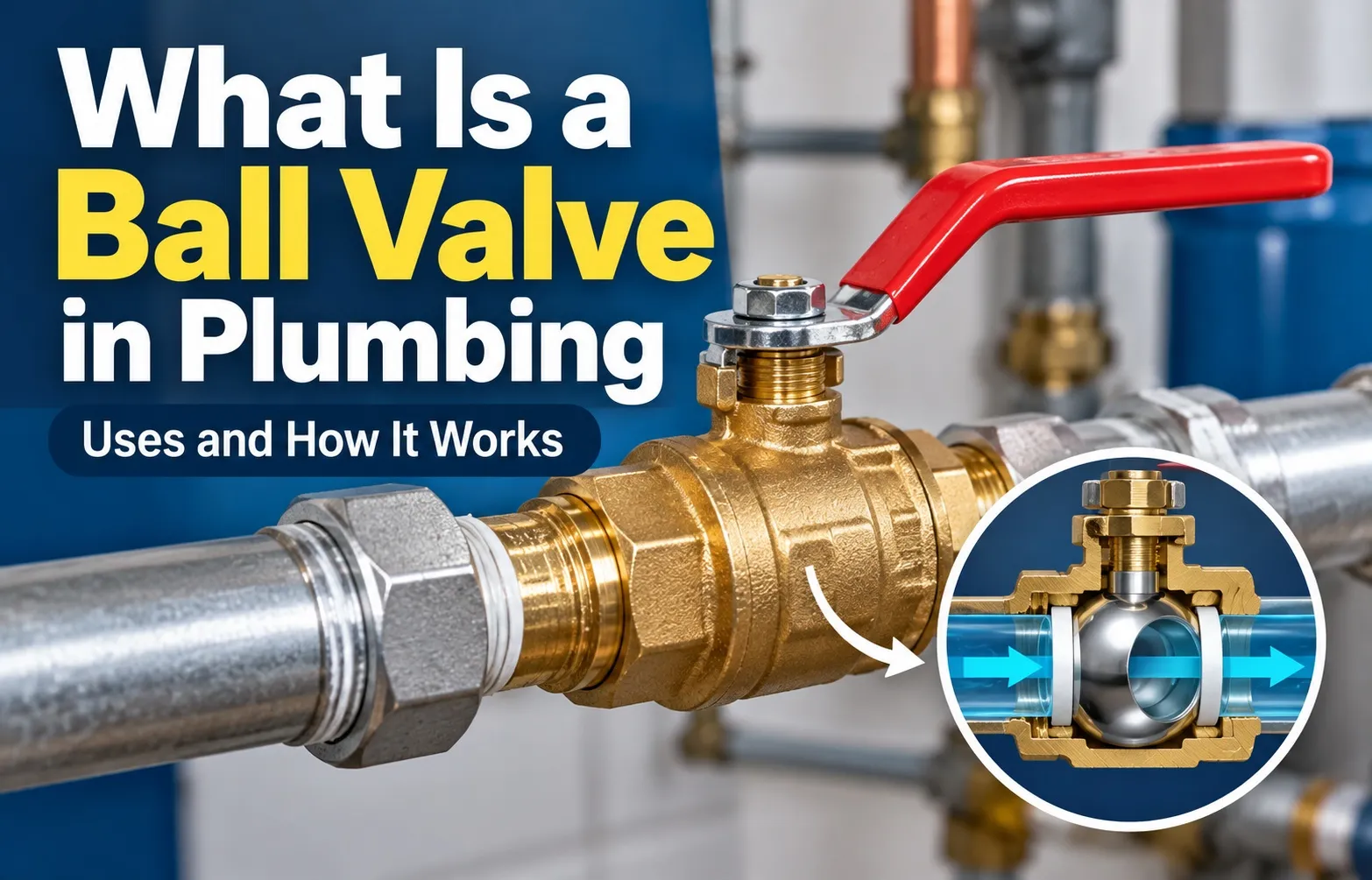 A ball valve is a reliable quarter-turn shut-off valve that uses a hollow, perforated metal or plastic sphere to control the flow of water, gas, or oil through a plumbing pipe. When the handle turns 90 degrees, the hole in the ball aligns with the pipe direction to allow full flow, or rotates perpendicular to stop water movement completely.
The Quarter-Turn Mechanism Explained
The core mechanism of a ball valve relies on a simple 90-degree handle rotation to regulate fluid movement inside residential and commercial piping systems.
Operating a ball valve requires only a short quarter-turn lever action to switch between open and closed states:
- Parallel Position (Open): When the handle lines up straight with the pipe, the perforated metal ball lines up with the fluid path to permit full water flow.
- Perpendicular Position (Closed): When the handle forms a 90-degree angle to the pipe, the solid wall of the internal hollow sphere completely blocks water passage.
Key Functions of a Ball Valve in Modern Plumbing
In modern water distribution setups, ball valves serve critical water flow control functions across supply lines and fixtures due to their tight seal and long-term durability.
Plumbers specify ball valves for key applications throughout residential properties:
- Main Water Shut-Off Valve: Placed where the main supply line enters a home to shut down water completely during severe leaks or system maintenance.
- Appliance Isolation Valves: Installed near water heaters, boilers, and washing machines to allow quick servicing without turning off water to the entire household.
- Fixture Control: Utilized in high-pressure supply lines feeding outdoor spigots, water tanks, and manifold branch lines for reliable shut-off capability.
Anatomy & Internal Working Mechanism of a Ball Valve
Understanding how a ball valve operates requires a close look at its internal geometry and mechanical components. These assemblies are engineered to provide rapid, reliable flow control with minimal resistance.
Step-by-Step: How a Ball Valve Controls Flow
A ball valve regulates water movement through a precision-engineered internal sphere that rotates via an external lever. When operated, the internal hollow sphere pivots smoothly between open and closed alignments, establishing or cutting off the water flow path instantly.
The mechanical sequence during operation involves specific physical movements:
- Initial Rotation: Turning the handle initiates a 90-degree pivot of the internal metal sphere housed inside the valve body.
- Flow Path Alignment: As the sphere rotates, its central hole aligns directly with the pipe interior, allowing media to stream through without obstruction.
- Complete Sealing: Rotating the handle back shifts the solid wall of the sphere across the aperture, terminating fluid movement entirely.
Core Internal Parts (Stem, Ball, Seats, and Seals)
The robust internal design of a ball valve relies on several precision mechanical components working in unison. Essential parts like the valve stem, valve seat, and PTFE rubber seals ensure smooth operation and complete leak prevention under household water pressure.
Each internal component fulfills a specific structural role:
- Valve Stem: The vertical shaft connecting the external handle to the internal ball, transmitting rotational torque securely.
- Perforated Ball: The central spherical core featuring a bored hole matching the internal diameter of the plumbing line.
- Valve Seat & PTFE Rubber Seals: High-performance ring supports that encase the ball, preventing fluid bypass and guaranteeing leak prevention.
How to Tell If a Ball Valve Is Open or Closed (Visual Check Guide)
Verifying the operational status of a plumbing valve takes only a quick visual inspection of the external handle. By observing whether the lever rests in a parallel open handle position or perpendicular closed handle position, you can instantly determine water flow status.
Interpreting handle orientation is straightforward:
- Parallel Open Handle: When the handle lines up straight alongside the axis of the pipe, the valve is fully open and water flows freely.
- Perpendicular Closed Handle: When the handle sits across the pipe at a 90-degree angle, the internal ball blocks the line and shuts off water.
Ball Valves vs. Gate Valves (Which Is Better for Your Main Line?)
Choosing between a ball valve and a gate valve comes down to mechanical efficiency, seal longevity, and ease of operation. While older homes often feature gate valves, modern plumbing standards overwhelmingly favor ball valves for main supply lines.
Speed, Durability, and Reliability Comparison
Ball valves provide superior speed and operational reliability compared to traditional multi-turn valves. A simple quarter-turn fully opens or closes a ball valve, whereas a gate valve requires multiple complete turns of a wheel handle to raise or lower an internal gate.
Key performance differences include:
- Operation Speed: Ball valves shut off water instantly with a 90-degree handle flip, while gate valves take several seconds of turning to close.
- Wear Resistance: Synthetic seals inside ball valves remain fluid-tight over decades, whereas gate mechanisms degrade faster under continuous water pressure.
- Visual Verification: The handle position on a ball valve gives an immediate visual signal of whether the valve is open or closed, unlike a wheel-style gate valve handle.
Why Gate Valves Leak and Stick Over Time
Gate valves are prone to mechanical failure because their internal components remain constantly exposed to mineral deposits in the water supply. Over years of disuse, hard water minerals lead to valve corrosion and calcification around the internal wedge and screw threads.
Common issues with aging gate valves include:
- Stuck Handles: Mineral buildup inside the bonnet binds the threaded stem, making the wheel handle impossible to turn without breaking.
- Incomplete Shut-Off: Sediment accumulation at the bottom channel prevents the gate from seating fully, allowing water to trickle through even when closed.
- Stem Packing Leaks: Repeated friction on the packing nut wears down internal washers, leading to slow leaks along the valve stem.
Main Line Shut-Off Choice: Ball Valve or Gate Valve?
A full port valve design makes the ball valve the optimal choice for a residential main line shut off. Because a full port ball valve features an internal opening identical to the pipe diameter, it creates zero flow restriction and delivers maximum water pressure throughout the property.
Engineers and professional plumbers recommend ball valves for main line applications due to their high pressure tolerances and strict adherence to modern Wikipedia’s Ball Valve Technical Documentation standards.
Comparative Table: Ball Valve vs. Gate Valve at a Glance
Key Types, Configurations, and Material Options
Selecting the correct ball valve configuration and body material is crucial for long-term plumbing system efficiency. Internal port dimensions, structural metals, and flow pathways determine how well a valve withstands internal water pressure, chemical exposure, and operational demands.
Full Port vs. Standard Port Ball Valves (Pressure Loss Explained)
Port sizing directly impacts fluid velocity and friction loss throughout your piping system. Choosing between a full port and a standard port design dictates whether your fixtures maintain steady water volume or experience noticeable pressure drop.
The structural differences define their performance characteristics:
- Full Port Ball Valve: Features an oversized internal sphere with a flow hole matching the exact inner diameter of the connected pipe. Because fluid passes through without restriction, full port models eliminate pressure drop, making them mandatory for main supply lines.
- Standard Port (Reduced Port) Ball Valve: Contains a smaller ball housing with a bore size one pipe size smaller than the connected pipe line. Water must narrow as it passes through the valve body, causing minor friction loss and reduced flow velocity.
Material Guide: Brass, Bronze, Stainless Steel, PVC, and CPVC
Matching the valve body material to your specific plumbing application prevents premature valve degradation, corrosion, and structural leaks under varied temperature conditions.
Common piping materials offer distinct structural advantages:
- Brass Ball Valve: The industry standard for indoor residential water supply systems, offering high mechanical durability, excellent corrosion resistance, and high-pressure tolerance.
- Bronze Ball Valve: Superior for heavy-duty applications and aggressive water conditions due to its enhanced resistance to dezincification and saltwater pitting.
- Stainless Steel Ball Valve: Engineered for extreme temperatures, high pressure, and commercial applications where chemical resistance and sanitary conditions are paramount.
- PVC Ball Valve: Lightweight, economical plastic options ideal for outdoor irrigation, cold water lines, and residential pool systems, though limited to low-pressure environments.
- CPVC Ball Valve: Designed to handle higher temperatures than standard PVC, making it suitable for residential hot water distribution systems and indoor plastic piping grids.
2-Way vs. 3-Way Ball Valves (Diverting vs. Shut-Off)
Internal porting configurations determine whether a valve acts as a simple cut-off device or as an active fluid directional manager within a complex plumbing network.
Flow path configurations suit different system operations:
- 2-Way Ball Valve: Features one inlet port and one outlet port, functioning as a straightforward inline on/off water tank ball valve or primary shut-off control.
- 3-Way Ball Valve: Incorporates three ports configured in an L-port or T-port design, enabling the operator to divert flow between two distinct lines or mix fluid streams from separate supply inputs.
Common Ball Valve Failures, Troubleshooting & Replacement Costs
Although ball valves are among the most durable components in a plumbing system, they can still experience wear, mineral buildup, or mechanical jams over years of service. Knowing how to identify early warning signs, safely unstick a frozen handle, and understand replacement costs prevents costly water damage.
What Happens When a Ball Valve Fails? (Signs of Wear & Leaks)
Ball valve failure typically manifests as a leaky stem packing nut, internal fluid bypass when closed, or a completely seized lever handle. These issues usually stem from hardened mineral deposits or degraded internal seals under high water pressure.
Common signs of ball valve failure include:
- Stem Leaks: Water seeps around the handle stem when opened or closed, indicating that the internal packing nut or O-rings have worn down.
- Incomplete Shut-Off: Water continues to trickle past the valve even when the handle is turned completely perpendicular, signaling scratched internal balls or damaged PTFE seats.
- Stiff or Frozen Handles: Hard water minerals and calcification lock the moving parts in place, preventing the lever from rotating smoothly.
How to Safely Unstick a Frozen or Stuck Ball Valve
Forcing a seized handle with excessive leverage or a pipe wrench often snaps the valve stem or cracks the copper pipe. Instead, proper troubleshooting requires gentle loosening techniques and chemical penetrants to dissolve mineral buildup safely.
Steps to safely free a stuck ball valve include:
- Relieve Pressure: Turn off the main water supply further upstream if possible to relieve heavy line pressure against the valve.
- Apply Penetrating Oil: Spray a plumbing-safe penetrating lubricant around the valve stem and packing nut area, allowing it to sit for 15 to 30 minutes.
- Gentle Leverage: Tap lightly on the handle with a rubber mallet or use an adjustable wrench with controlled, minimal force—never jerk or yank the handle aggressively.
- Tighten Packing Nut Slightly: If the nut is loose, gently snugging it can break loose minor corrosion around the stem threads.
Ball Valve Replacement Costs (DIY Parts vs. Professional Plumber Fees)
When a ball valve fails completely, a DIY plumbing replacement is a cost-effective option for experienced homeowners, while hiring a licensed professional ensures safety on critical main supply lines.
Cost expectations vary significantly depending on whether you complete the job yourself or hire a licensed plumber:
- DIY Replacement Costs: Purchasing a high-quality replacement valve price ranges between $10 and $35 for standard brass or PVC fittings, plus basic tools and solder or push-fit connectors.
- Professional Plumber Fees: Hiring a licensed contractor typically incurs plumber labor costs ranging from $150 to $350, depending on accessibility, pipe material (copper, PEX, or galvanized steel), and emergency service rates.
Quick FAQ: Answers to Top Plumbing Ball Valve Questions
Here are direct answers to the most frequently asked questions about selecting, operating, and locating ball valves in residential plumbing systems.
Does a ball valve shut off water completely?
Yes, a ball valve provides a complete, watertight seal to cut off water flow entirely when fully closed. The precision-engineered internal sphere presses tightly against synthetic PTFE seats, preventing even minor leaks under high household water pressure.
Key shut-off features include:
- 100% Flow Barrier: Solid metallic or plastic walls block the pipe channel completely when turned to the perpendicular position.
- High-Pressure Seal: Fluid pressure pushes the ball slightly into the downstream seat, creating an even tighter emergency shut-off valve seal.
Can a ball valve be left partially open?
While a ball valve can physically be left partially open, it is not recommended for controlling or throttling flow over extended periods. Using a ball valve to throttle flow exposes the exposed edges of the PTFE seals to high-velocity water, leading to premature wear and persistent internal leaks.
Consequences of leaving a ball valve partially open include:
- Seal Degradation: Continuous water turbulence erodes the synthetic seats around the internal sphere.
- Vibration and Noise: High water velocity through a restricted port creates noisy pipe vibrations and cavitation within the valve body.
What is another name for a ball valve?
A ball valve is commonly referred to as a quarter-turn valve because it requires only a 90-degree handle rotation to operate fully. Depending on its installation location, plumbers also call it an inline shut-off valve, main water shut off, or lever valve.
Common alternative terms include:
- Quarter-Turn Valve: Named for its quick 90-degree mechanical movement.
- Full-Port Lever Valve: Referring to models with unrestricted internal diameters and flat handle designs.
- Isolation Valve: Used when installed adjacent to specific fixtures like water heaters or washing machines.
What to do if you can’t find your main water shut-off valve?
If you cannot locate your main ball valve during a plumbing emergency, systematically check primary entry points where municipal lines enter the property. If an interior valve is missing or seized, locate the outdoor curb box or main water meter box near the street boundary.
Follow these steps to locate your emergency shut-off point:
- Inspect Foundation Entry Points: Check basement walls, crawlspaces, or utility closets near the front exterior wall where the main line enters the home.
- Locate the Water Meter Box: Look outdoors near the street or sidewalk boundary for an underground meter pit housing the primary curb valve.
- Use a Meter Key: Use a specialized pentagon meter key or curb wrench to shut off the main water valve located before the meter box if necessary.

Oscar Vance | Master Plumber & Drainage Expert
Meet Oscar Vance, a licensed master plumber sharing practical solutions on residential repairs, preventive maintenance, and thoughtful home upkeep.