Why Standard General Liability Fails on Roofing and Demolition Sites
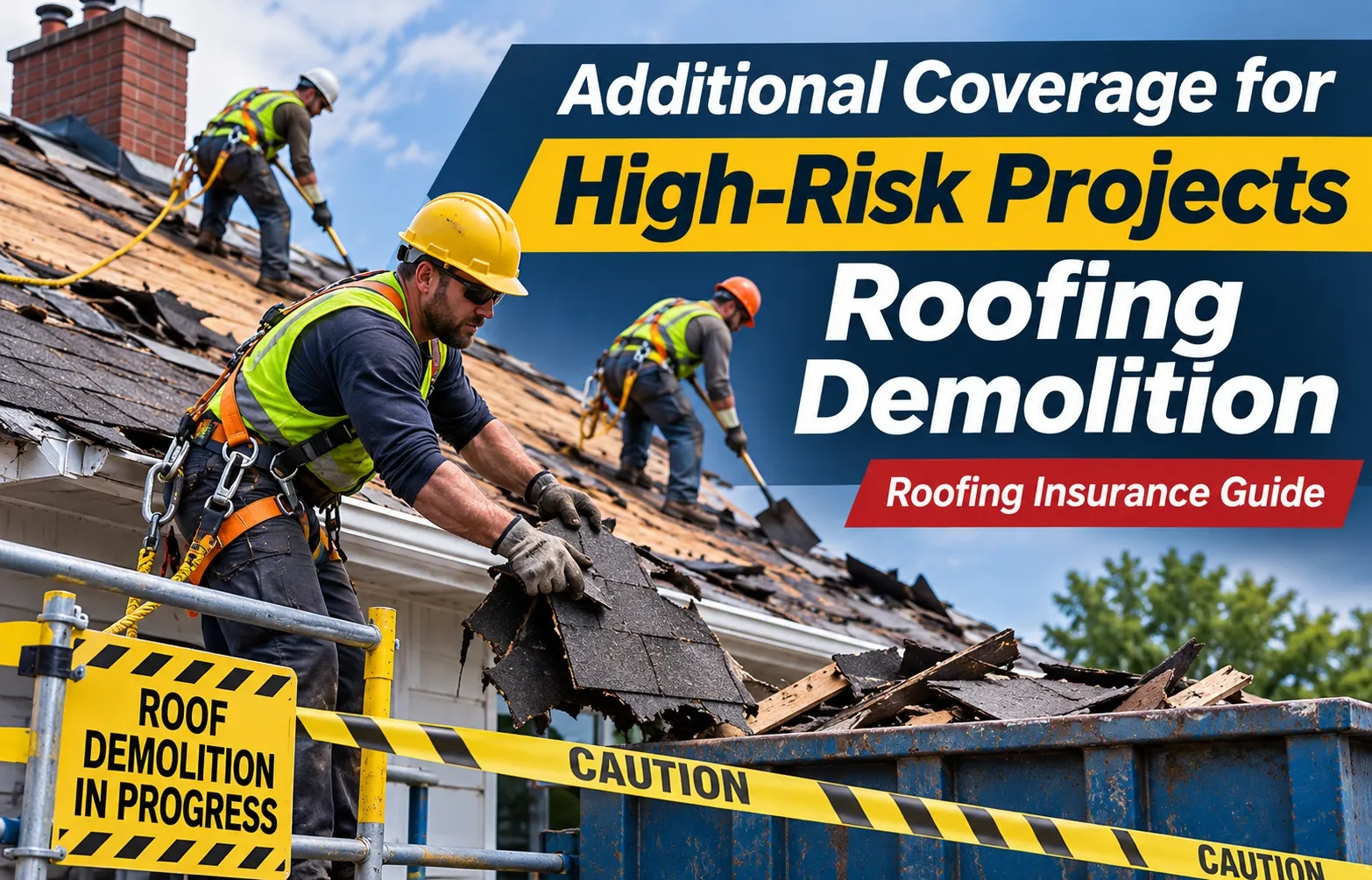 Holding an active ACORD 25 Certificate of Insurance (COI) does not guarantee protection when structural roof tear-offs and active demolition intersect. Standard admitted Commercial General Liability (CGL) policies rely on restrictive ISO form exclusions and surplus lines endorsements that quietly strip away coverage for collapse, vertical height, weather intrusion, and third-party subcontractor injuries.
When a claim occurs on a complex commercial job site, insurance carriers audit the underlying policy endorsements rather than the one-page certificate. Understanding where standard trade policies fail prevents catastrophic out-of-pocket losses and contract defaults.
XCU Exclusions (Explosion, Collapse, and Underground Hazards)
XCU coverage protects contractors against property damage caused by explosions, structural collapse, and underground utility strikes during heavy site work. Standard admitted policies routinely attach XCU exclusion endorsements to roofing and wrecking classifications because heavy equipment vibrations and structural load shifts create severe loss severity.
- Collapse Hazard Triggers: Staging heavy pallets of tear-off debris, gravel ballast, or HVAC units on weakened roof trusses can cause sudden structural failure that carriers deny without explicit collapse coverage.
- Underground & Adjacent Structure Risks: Crane outriggers, hydraulic excavators, and falling masonry frequently rupture buried utility lines or crack neighboring foundations during exterior perimeter demolition.
Height and Story Caps (The 3-Story Commercial Wall)
Most standard roofing and light-demolition policies enforce a strict height limitation endorsement capping operations at three stories or 30 to 35 feet above grade. Stepping onto a four-story commercial warehouse, hospital, or mid-rise apartment roof without removing this restriction voids liability coverage across the entire job site—even if an accident happens on the ground floor.
- Measurement Rules: Underwriters measure total building height from ground level to the highest roof peak, meaning a three-story building with a mechanical penthouse or steep parapet often violates a 35-foot policy cap.
- Surplus Lines Solution: High-risk commercial contractors must secure unrestricted height endorsements or tiered height schedules through Excess & Surplus (E&S) carriers prior to mobilization.
Conditional Open Roof and Water Intrusion Exclusions
Water damage claims during commercial tear-offs represent the single highest frequency loss in roofing demolition, prompting insurers to attach conditional open roof endorsements such as form FSIC CG 08 00. Rather than offering blanket rain protection, these restrictive endorsements impose strict operational warranties that void coverage if field crews miss a single procedural step.
- Unattended Time Limits: Many surplus policies void interior water damage coverage if an exposed roof deck is left untarped or unattended for more than four consecutive hours.
- Mandatory Weather Monitoring: Carriers routinely require documented proof that site supervisors checked local National Weather Service forecasts before initiating tear-offs and maintained emergency tarping materials on the roof deck at all times.
Hot Work and Torch-Down Fire-Watch Clauses
Applying modified bitumen membranes, heat-welding TPO seams, or using oxy-acetylene torches to cut structural steel roof decking triggers strict hot work warranty conditions. A single smoldering ember trapped inside wood decking or insulation can ignite hours after crews leave the site, resulting in total-loss fire claims.
- Mandatory Fire-Watch Logs: Most E&S roofing and demolition policies mandate an uninterrupted 30-to-60-minute post-work fire watch using infrared thermometers and signed inspection logs.
- Equipment & Clearance Rules: Policies require fully charged ABC fire extinguishers within 10 to 20 feet of active torches and strictly prohibit open-flame work near combustible cant strips or penetrations without non-combustible shields.
Essential Add-On Policies for High-Risk Roofing and Demolition
Closing the coverage gaps on high-risk roofing and demolition jobs requires pairing your primary General Liability policy with specialized standalone policies and contractual endorsements. These targeted layers protect against hazardous material releases, high-limit contract mandates, heavy equipment losses, and third-party indemnity demands.
1. Contractors Pollution Liability (CPL)
Contractors Pollution Liability (CPL) covers bodily injury, property damage, cleanup costs, and regulatory fines caused by pollutants released or disturbed during contracting operations. Standard General Liability policies rely on a Total Pollution Exclusion that strips away coverage for hazardous substances—even when a contractor did not intentionally introduce the contaminant.
- Asbestos and Lead Exposure: Disturbing older roofing mastics, tar flashing, cementitious panels, or lead-based coatings during tear-offs and asbestos abatement frequently triggers costly remediation mandates.
- Silica Dust and Runoff: Cutting concrete roof decks or masonry parapet walls generates respirable crystalline silica and contaminated stormwater runoff that can migrate onto neighboring parcels.
2. Commercial Umbrella and Excess Liability (Per-Project Aggregates)
Commercial Umbrella and standalone excess policies raise your liability limits above primary General Liability, Commercial Auto, and Employers Liability policies. Commercial general contractors and property owners regularly demand $2 million, $5 million, or $10 million in total limits before awarding high-hazard roofing or demolition subcontracts.
- Per-Project Aggregate Protection: Adding a per-project aggregate endorsement prevents claims on one commercial tear-off from exhausting your policy aggregate before work begins on a second project.
- Stacked Excess Layers: High-limit commercial contracts often require combining a primary umbrella policy with upper-tier excess layers to satisfy strict owner indemnity thresholds.
3. Inland Marine and Contractors Equipment Floaters
A Contractors Equipment Floater under an Inland Marine policy insures mobile machinery, job-site tools, and specialized equipment that move between locations or sit on active projects. Standard commercial property policies typically cover assets only at scheduled premises and fail to protect high-value gear during transport or job-site staging.
- Heavy Machinery and Lifts: Protects skid steers, mini-excavators, boom lifts, telehandlers, hoists, and cranes used for roof tear-offs, material lifts, and structural demolition.
- Owned, Leased, and Rented Gear: Covers both owned machinery and short-term rentals or leased equipment where contracts hold the contractor responsible for physical loss or damage.
4. Builder’s Risk vs. Installation Floaters (Teardown vs. Rebuild)
A Builder’s Risk Course of Construction policy protects buildings and structures under active construction, renovation, or reconstruction against specified perils such as fire, windstorm, hail, and theft. Pure demolition projects with no rebuild or renovation component generally do not qualify for Builder’s Risk because there is no completed or restored structure being built.
- Reroofing and Remodeling Projects: When a project involves full roof replacement, structural deck rebuilding, or commercial remodeling, an existing-structure or renovation endorsement may be needed to cover the broader project scope.
- Installation Floater for Materials: An Installation Floater specifically covers roofing membranes, insulation, metal decking, and fixtures staged on-site or in transit awaiting installation.
5. Mandatory Contractual Risk-Transfer Endorsements
Commercial contracts routinely require specific endorsements that transfer risk cleanly between project owners, general contractors, and trade subcontractors. Relying on blanket assumptions rather than exact policy wording can leave a contractor in breach of contract after a loss.
- Additional Insured (CG 20 10 and CG 20 37): Endorsement CG 20 10 extends additional insured protection to the project owner or general contractor for ongoing operations, while CG 20 37 extends coverage to completed operations after the project wraps.
- Waiver of Subrogation: Prevents your insurer from pursuing recovery against the upstream party or subcontractor after paying a covered claim when required by the project contract.
- Primary and Non-Contributory Wording: Ensures your policy responds first and exhausts its applicable limits before an upstream general contractor’s policy is called upon to contribute.
Passing Underwriting and the Demolition Supplemental Application
Securing bindable quotes from non-admitted carriers in the Excess & Surplus (E&S) market requires completing a specialized demolition contractor supplemental application alongside standard ACORD forms. Underwriters use this questionnaire to separate routine interior strip-outs and commercial roof tear-offs from high-severity structural wrecking exposures.
Incomplete or vague answers on a supplemental form routinely trigger automatic declinations or punitive minimum premiums. Preparing exact operational metrics and documented safety programs before submission demonstrates disciplined risk control and secures far broader policy terms.
What Underwriters Scrutinize on a High-Risk Supplemental Application
E&S construction underwriters evaluate five core underwriting guidelines before releasing terms for combined roofing and demolition risks. Submitting verifiable percentages and documented field controls prevents unnecessary exclusions from being attached at binding.
- Interior Soft Strip-Out vs. Structural Demolition Ratio: Carriers require an exact revenue split between non-load-bearing interior soft strip-out work and exterior or structural demolition involving load-bearing walls, steel trusses, and roof decks.
- Maximum Building Height and Story Count: Applications must specify both your average working height and your single tallest structure over the past five years, as exceeding three stories shifts the account into high-hazard excess tiers.
- Proximity to Adjacent Structures: Underwriters evaluate zero-lot-line urban jobs, party walls, and neighboring occupied buildings where falling debris or structural vibration could cause severe third-party property damage.
- Subcontractor Cost Ratio and Warranty Caps: Most E&S programs cap subcontracted demolition at 25 percent of total annual receipts and enforce a strict subcontractor warranty endorsement requiring equal limits and Additional Insured status from every sub.
- Five-Year Currently Valued Loss Runs and Safety Plans: Carriers demand five years of hard-copy loss runs alongside written fall-protection, silica control, and engineering survey protocols aligned with OSHA Demolition Safety Standards.
Prohibited Operations and Specialty Carve-Outs
Standard high-risk roofing and demolition packages automatically exclude extreme wrecking methods unless the contractor negotiates specialized manuscript endorsements. Performing any prohibited operation without prior carrier approval voids coverage across the entire job site.
- Implosions, Blasting, and Wrecking Balls: Explosive demolition and swinging-ball wrecking are universally excluded from standard E&S contractor forms and require dedicated heavy-wrecking specialty markets.
- Underground Storage Tanks (USTs) and Subsurface Vaults: Excavating or puncturing buried fuel tanks triggers immediate pollution and collapse exclusions unless paired with environmental remediation coverage.
- Structural Shoring, Underpinning, and Crane Rigging: Temporary load-bearing shoring and third-party crane rigging operations require explicit scheduled endorsements and structural engineering sign-offs prior to mobilization.
Separating NCCI Class Codes to Avoid Overpaying
Auditors rate commercial policies based on payroll or gross receipts assigned to specific NCCI class codes and ISO classification schedules. Lumping all company revenue into a single high-hazard demolition or commercial roofing class code forces contractors to pay maximum rates across their entire operation.
- Maintain Segregated Payroll Ledgers: Track worker hours separately between structural roof demolition, membrane installation, interior non-structural strip-out, and administrative or estimating staff.
- Require Detailed Subcontractor Invoices: Ensure subcontractor billing clearly separates debris hauling, crane rental, and non-structural cleanup from high-hazard tear-off labor so premium auditors apply accurate lower-rate classifications.
High-Risk Insurance Costs, Policy Limits, and Debris Removal Benchmarks
Demolition insurance cost and high-risk roofing premiums scale sharply based on policy limits, structural severity, and carrier appetite in the Excess & Surplus (E&S) market. While a $1 million limit may satisfy small residential tear-offs, commercial general contractors and municipal project owners routinely require $2 million to $10 million in combined liability protection.
High-hazard construction policies also carry a strict minimum earned premium—often ranging from 25% to 100% upon binding—meaning mid-term policy cancellations rarely return unused premium. Budgeting accurately before bidding protects profit margins when high-risk add-ons and excess layers are required.
Coverage Limits and Estimated Annual Cost Breakdown ($1M to $10M)
A $1 million liability policy is rarely enough for commercial roofing and demolition contracts because a single severe fall, collapsed roof truss, or adjacent property claim can exceed primary limits. Contractors typically build higher protection by pairing a primary occurrence/aggregate policy with stacked umbrella and excess layers.
- Why $1 Million Often Falls Short: Medical bills from severe job-site falls or structural damage to neighboring buildings escalate rapidly, and legal defense costs inside many E&S policies either erode limits or sit on separate schedules.
- Aggregate Depletion Risk: Multiple claims during a busy demolition season can exhaust a $2 million aggregate limit quickly, making per-project aggregates and umbrella layers essential.
How Debris Removal Sub-Limits Work on High-Risk Jobs
Property and Builder’s Risk policies typically pay for debris removal up to 25% of the covered direct physical loss plus the applicable deductible, with many forms offering an additional $10,000 to $25,000 debris removal sub-limit when clearing heavy wreckage exceeds that share. If debris removal costs surpass the policy limit, the contractor or property owner absorbs the excess hauling expense.
- Direct Physical Loss Formula: If a covered wind or fire event causes $200,000 in direct physical damage, a 25% debris allowance provides up to $50,000 toward hauling covered debris—subject to policy sub-limits and deductibles.
- Hazardous and Contaminated Debris: Standard debris removal clauses do not cover asbestos, lead, or chemical contamination; hauling or disposing of regulated pollutants requires dedicated Contractors Pollution Liability (CPL) coverage.
Pre-Bid Policy Audit Checklist for Contractors
Executing a pre-bid policy audit before signing a commercial roofing or demolition subcontract prevents rejected certificates, contract defaults, and uncompensated losses. Project managers and owners should verify actual policy wording and risk-transfer alignment prior to bid submission.
Relying on assumptions or surface-level summaries leaves high-hazard scopes exposed to hidden exclusions and indemnity traps. Follow this five-step verification workflow before committing crews or equipment to a high-risk project.
5 Steps to Verify Your Coverage Before Stepping On-Site
Complete each verification step in sequence to align your insurance program with contract mandates and job-site realities.
- Pull the Forms & Endorsements Schedule, Not Just the COI: Request the full policy declarations and Forms and Endorsements Schedule from your broker rather than stopping at the certificate of insurance, checking every exclusion endorsement and height or water-intrusion condition.
- Cross-Check Contract Indemnity Clauses Against Action Over Exclusions: Compare the subcontract’s indemnification clause and hold harmless agreement against your liability policy to confirm your coverage supports required contractual indemnity without conflicting action-over or labor-law exclusions.
- Verify Subcontractor COI Limits and Additional Insured Status: Audit every lower-tier trade partner’s coverage prior to mobilization through disciplined subcontractor COI tracking, confirming matching liability limits, required endorsements, and compliant subcontractor warranty terms.
- Confirm Weather and Open-Roof Tarping Protocols with Site Supervisors: Establish clear field procedures for tear-off staging, emergency tarping materials, and weather cutoffs so crews never leave exposed roof decks or active demolition zones unprotected.
- Partner with an E&S Wholesale-Appointed Construction Broker: Work with an E&S wholesale broker or specialty construction market experienced in high-hazard roofing and demolition to structure endorsements, excess layers, and accurate class codes before finalizing bids.
Frequently Asked Questions
What does demolition insurance cover?
Demolition insurance covers third-party bodily injury and third-party property damage caused by wrecking, tear-down, or site-clearing operations, including structural collapse when XCU coverage is endorsed. It also extends into post-project liability through Products-Completed Operations coverage, while typically excluding intentional damage or unendorsed pollution releases.
Do you need builder’s risk insurance for demolition?
Standalone demolition projects generally do not require or qualify for Builder’s Risk insurance because no new or restored structure is being built. However, when demolition is paired with reroofing, remodeling, or structural rebuilding, a Builder’s Risk policy or renovation endorsement helps protect materials and work in progress.
What insurance covers construction defects?
Commercial General Liability policies address certain construction defects through Products-Completed Operations coverage after work is finished, though policies generally exclude the cost to repair or redo defective workmanship itself. Coverage typically applies to resulting damage to other property unless excluded by specific defect or completed-operations endorsements.
What are the four types of construction defects?
Construction professionals and insurers generally group construction defects into four main categories based on where the failure originates:
- Design Defects: Flaws in architectural plans, structural engineering calculations, or specifications prepared before construction begins.
- Material Defects: Substandard, defective, or improperly manufactured building materials, roofing membranes, or components supplied for the project.
- Workmanship Defects: Errors, improper installation methods, or substandard execution by contractors or subcontractors during construction.
- Subsurface Defects: Unforeseen soil instability, poor compaction, drainage issues, or hidden ground conditions affecting structural stability.
Is $1 million in liability insurance enough for commercial roofing and demolition?
A $1 million limit is usually sufficient only for small residential jobs and carries high risk on commercial roofing or demolition sites. Commercial general contractors, industrial facilities, and municipal owners commonly require $2 million to $5 million or more through stacked Excess and Umbrella policies.

Oscar Vance | Master Plumber & Drainage Expert
Meet Oscar Vance, a licensed master plumber sharing practical solutions on residential repairs, preventive maintenance, and thoughtful home upkeep.