When Should a Safety Monitor Be Used for Roofing?
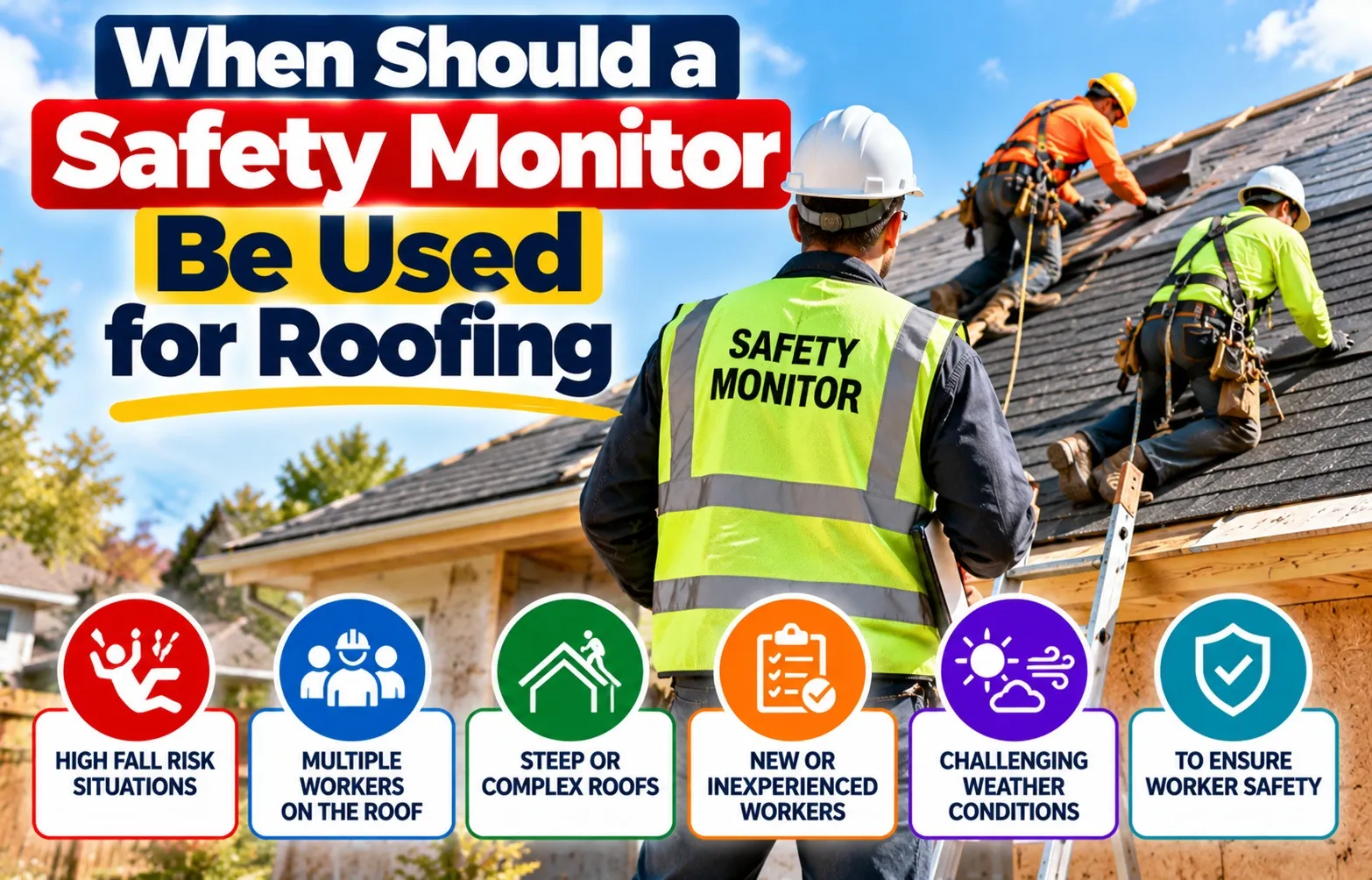 Under OSHA Standard Interpretation 1926.501(b)(10), a safety monitor may only be used during roofing work on low-slope roofs with a pitch of 4:12 or less. This administrative fall protection control is strictly allowed when conventional fall protection systems—such as guardrails, safety nets, or a Personal Fall Arrest System (PFAS)—are infeasible or create a greater safety hazard on the job site.
For roofs 50 feet or less in width, a safety monitor can serve as a standalone fall protection technique. On low-slope roofs wider than 50 feet, a safety monitoring system cannot be used alone and must be combined with a warning line system to legally comply with federal workplace safety standards.
Detailed OSHA Conditions: Roof Geometry, Pitch, and Width Thresholds
Navigating federal safety mandates requires strict adherence to precise dimensional boundaries. OSHA regulations do not permit safety monitors on all elevated surfaces; specific geometrical thresholds dictate where human oversight satisfies compliance.
The 50-Foot Rule: Standalone vs. Combined Safety Monitoring
Roof width is the primary metric determining whether a safety monitor can operate as a standalone fall protection system. On low-slope walking/working surfaces that measure 50 feet or less in total width, a designated safety monitor may be deployed entirely on their own without auxiliary perimeter barriers.
However, when a low-slope roof exceeds 50 feet in width, safety monitors can no longer function independently. Federal regulations mandate that they must be paired with an approved warning line system to restrict work zones and control exposure near the perimeter edge.
Low-Slope vs. Steep-Slope Thresholds (4:12 Pitch Explained)
Roof slope represents another critical divider in safety classification. OSHA defines a low-slope roof as having a pitch of 4:12 or less (a rise of 4 inches vertically for every 12 inches horizontally). Safety monitoring systems are legally restricted exclusively to these low-slope categories during roofing work.
Steep-slope roofs present exponential gravitational risks that invalidate administrative controls like safety monitors. Any roof pitch exceeding 4:12 requires physical engineering controls such as guardrails, safety nets, or a personal fall arrest system (PFAS).
Strict Prohibitions: When Safety Monitors Are Illegally Deployed
Understanding when safety monitors are prohibited prevents costly OSHA citations and catastrophic workplace incidents. Inspectors look closely at task types, equipment use, and slope parameters to ensure monitors are never misused as a shortcut.
- Pitch Greater Than 4:12: Steep roofs prohibit safety monitors entirely, necessitating 100% tie-off with personal fall arrest systems, guardrails, or safety nets.
- Non-Roofing Trades and Substrate Work: Monitors are restricted strictly to roofing work. They cannot protect workers performing roof deck construction, framing, carpentry, or structural substrate replacement.
- Active Mechanical Equipment: Operating or storing mechanical equipment near the perimeter edge zone invalidates safety monitor usage unless proper warning lines and clearance barriers are established.
- Compromised Hazard Zones: Environments featuring loose decking, structural rot, or severe weather conditions introduce physical slip and structural failure hazards that require active physical restraints rather than verbal warnings.
OSHA Safety Monitor Requirements: Duties, Training, and Restrictions
Designating an individual to serve as a safety monitor carries strict legal responsibilities under OSHA 29 CFR 1926.502(h). Site managers must ensure that the designated worker fulfills specific regulatory criteria and operational conditions to maintain job site compliance and protect crew members from fall hazards.
Competent Person Criteria & Qualifications
According to federal guidelines, a safety monitor must be a designated Competent Person who possesses the specialized training required to recognize existing and predictable fall hazards on a roof.
- Hazard Recognition: Must be fully capable of identifying dangerous working conditions, unsafe worker behaviors, and perimeter edge risks.
- Corrective Authority: Must possess prompt authorization from the employer to take immediate corrective measures or halt work when fall risks escalate.
- Dedicated Safety Officer: Serves as the primary administrative authority on low-slope roofs where physical fall protection systems are absent.
The Zero-Distraction Rule (Sole Responsibility)
OSHA standard 29 CFR 1926.502(h)(1)(v) mandates that a safety monitor cannot have any other responsibilities that could distract from their primary duty of watching workers. Eliminating distraction hazards is essential to preventing accidental falls along roof perimeters.
- No Material Handling: Monitors are prohibited from carrying shingles, moving insulation, or stocking roofing supplies.
- No Tool Operation: Monitors cannot operate nail guns, power brooms, hot-asphalt kettles, or mechanical equipment.
- No Roofing Tasks: Monitors cannot lay felt, fasten roof panels, apply adhesives, or perform manual labor while actively monitoring crew members.
Surface Proximity, Line of Sight, and Communication Limits
Physical positioning is a non-negotiable component of an compliant safety monitoring system. The monitor must remain positioned to see and communicate with workers without delay.
- Same Surface Rule: The monitor must be located on the same walking/working surface as the workers being observed.
- Visual Sighting Distance: The monitor must maintain an unobstructed, direct line of sight to all monitored crew members at all times.
- Verbal Warning Proximity: The monitor must stay close enough to communicate instantly via direct verbal warnings without relying on radios, air horns, or secondary devices.
The 8-Worker Maximum Ratio Standard
To preserve visual oversight and rapid reaction time, OSHA limits the worker-to-monitor ratio on a active job site. A single safety monitor may supervise a maximum of 8 workers performing roofing operations at any given time. If a roofing crew exceeds 8 individuals, the site supervisor must assign additional safety monitors or implement conventional physical fall protection systems.
Practical Site Management: Audit-Proofing Your Safety Monitoring System
Bridging the gap between official regulatory text and real-world job-site execution requires rigorous field discipline. During federal site audits, safety inspectors frequently evaluate whether a safety monitoring system is functioning as a legitimate control or merely a paper-tiger administrative workaround.
High-Risk Field Errors That Trigger OSHA Citations
Compliance failures during roofing operations usually stem from subtle operational drift on the active work deck. OSHA compliance officers routinely issue severe citations when designated safety monitors abandon their primary oversight responsibilities for minor physical tasks.
- Multi-Tasking Violations: Monitors caught picking up scrap material, sweeping debris, or handing tools up to roofing crews instantly violate the sole-responsibility mandate.
- Compromised Line of Sight: Allowing workers to move behind equipment stacks or structural obstructions breaks visual confirmation and invalidates the monitor’s protective function.
- Unqualified Personnel: Appointing a junior worker who lacks formal Competent Person training or lacks the employer’s explicit authority to stop unsafe work leads to immediate fines.
Weather and Site Condition Constraints
Environmental factors dictate whether a safety monitor can maintain effective supervision. Adverse weather conditions instantly strip away the viability of administrative controls, requiring a pivot to physical tie-offs or work suspension.
- Severe Weather Risks: Heavy rain, sleet, or accumulated ice create extreme slip hazards that render verbal warnings completely ineffective against sudden losses of footing.
- High Wind Obstructions: High wind speeds distort voice projection and prevent monitors from issuing clear verbal warnings across the roofing perimeter.
- High-Noise Environments: Excessive industrial noise from nearby machinery, pneumatic hammers, or traffic drowns out verbal alerts, violating the proximity and communication standard.
Daily Documentation & Site Setup Checklist
Protecting your company from liability requires maintaining verifiable documentation prior to every shift. Incorporating a structured daily safety log into your Job Site Hazard Analysis (JHA) proves active compliance during safety audits.
- Pre-Shift Competent Person Sign-Off: Document the designated monitor’s name, verification training, and explicit acknowledgment of sole-responsibility duties.
- Perimeter and Width Verification: Record roof measurements to verify that the 50-foot threshold is met or that proper warning lines are installed beyond that width.
- Weather and Communication Check: Log daily environmental conditions, wind thresholds, and verify that unobstructed lines of sight are maintained across the work zone.
Frequently Asked Questions About Roofing Safety & Fall Protection
Workplace fall safety regulations contain overlapping guidelines that frequently trigger confusion during job-site planning. Clarifying these critical safety thresholds ensures full regulatory compliance and maintains safe job sites.
What is the OSHA 6-foot rule in roofing?
Under OSHA 29 CFR 1926.501(b)(1), the 6-foot rule is the general fall protection threshold for construction workers. Anytime a worker performs tasks on a walking/working surface with an unprotected side or edge that is 6 feet or more above a lower level, the employer must provide adequate fall protection.
- Applicability: Covers residential and commercial construction, including roofing operations.
- Required Controls: Guardrails, safety nets, personal fall arrest systems (PFAS), or a safety monitoring system (where permitted).
What is the 25-foot rule in roofing fall protection?
The 25-foot rule under OSHA 29 CFR 1926.105 mandates safety net installation when workplaces are elevated more than 25 feet above the ground or lower levels where other fall protection systems—such as guardrails, scaffolds, or safety belts—are impractical.
- Extensiveness: Safety nets must extend outward from the outermost edge of the work surface to catch falling workers effectively.
- Inspection Mandates: Requires drop-test verification and routine inspections to maintain structural integrity.
At what height is edge protection or guardrails required?
Perimeter guardrails and edge protection systems are required whenever employees work at or above the 6-foot height threshold. OSHA standard 29 CFR 1926.502(b) specifies strict dimensional and structural criteria for guardrail construction.
- Top Rail Height: The top edge of top rails must be 42 inches above the walking/working level, plus or minus 3 inches (39 to 45 inches).
- Midrails and Toeboards: Midrails must be installed at a height of 21 inches, and toeboards must be placed along the perimeter edge to prevent tools and materials from falling.
Can safety monitors be used during adverse weather conditions?
Safety monitors cannot be legally or safely deployed during adverse weather conditions. Extreme weather introduces environmental hazards that disrupt the core functions required of a safety monitoring system.
- Impaired Visual/Auditory Line: Heavy rain, fog, snowfall, or severe winds impair visual oversight and prevent clear verbal warnings from being heard.
- Elevated Slip Hazards: Accumulations of ice, frost, or water drastically increase slipping risks, making administrative supervision insufficient to protect workers.
What is the difference between a warning line system and a safety monitor?
A warning line system is a physical barrier set up along a roof deck, whereas a safety monitor is a trained human administrative control.
- Warning Line System: Consists of ropes, wires, or chains supported by stanchions erected at least 6 feet from the roof edge (10 feet if mechanical equipment is in use) to designate a safe working zone visually and physically.
- Safety Monitor: A designated Competent Person whose sole responsibility is to visually observe crew members and issue prompt verbal warnings when workers approach dangerous fall zones.

Oscar Vance | Master Plumber & Drainage Expert
Meet Oscar Vance, a licensed master plumber sharing practical solutions on residential repairs, preventive maintenance, and thoughtful home upkeep.