What Is an Angle Stop in Plumbing?
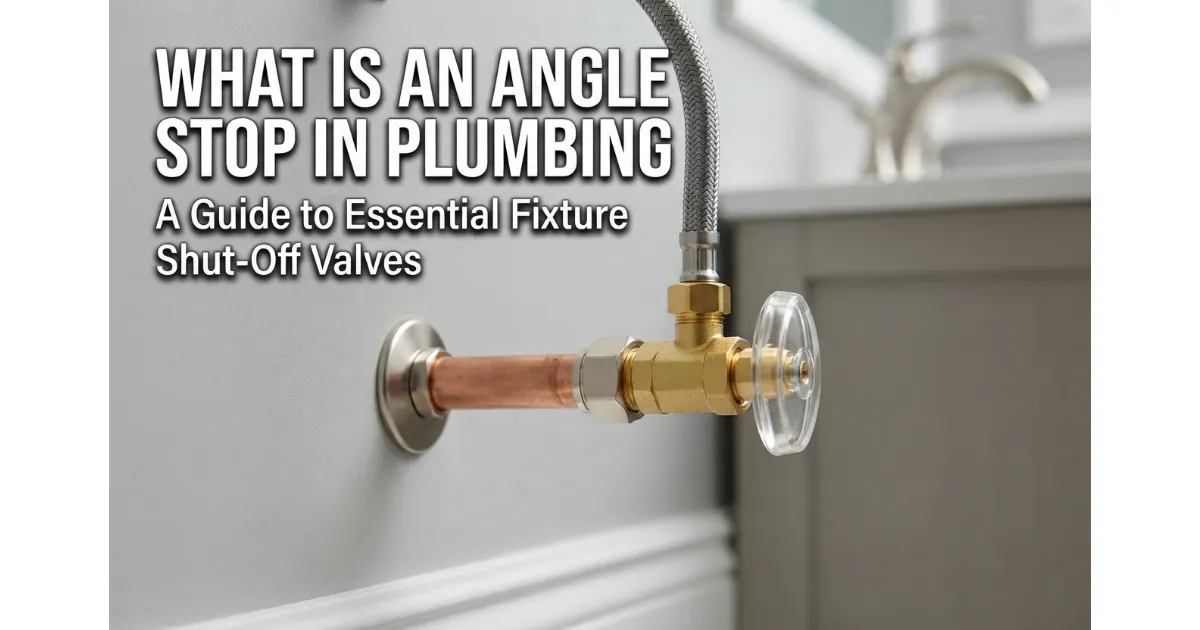 An angle stop is a specialized shut-off valve located directly beneath plumbing fixtures like sinks and toilets. It controls the water supply to a single fixture, allowing you to perform maintenance or emergency repairs without shutting off the main water line to your entire home.
Angle Stop Definition in Simple Words
An angle stop valve acts as a localized gatekeeper for your household water lines. When turned off, it stops water from flowing specifically to one faucet, toilet, or appliance while keeping the rest of the plumbing system fully functional and active.
- Connected directly to the water supply pipe emerging from the wall or floor.
- Features a rotating handle or knob to manually regulate water flow.
- Essential for preventing catastrophic water damage during plumbing emergencies.
Why Is It Called an Angle Stop?
The name comes from the distinct 90-degree bend built into the valve’s body. Water travels horizontally out of the wall and makes a sharp 90-degree upward turn toward the plumbing fixture.
- Bridges the gap between horizontal wall pipes and vertical fixture supply lines.
- Saves precious physical space in cramped areas underneath bathroom vanities and kitchen sinks.
- Reduces pipe stress by aligning smoothly with the threaded inlet of the faucet connector.
Facts at a Glance
- Primary Purpose: Isolate water flow to individual fixtures for quick repairs or replacements.
- Common Locations: Underneath kitchen sinks, bathroom lavatories, toilets, and behind washing machines.
- Key Varieties: Multi-turn compression valves, quarter-turn ball valves, and push-to-connect models.
- Replacement Schedule: Typically recommended for inspection every 5 to 10 years to prevent stuck handles or sudden leaks.
Angle Stop vs Angle Valve vs Supply Stop
Yes, these terms are largely interchangeable within the residential plumbing industry. Plumbers and hardware stores use them to describe the same category of localized control valves.
- Angle Stop: The most common industry term for a 90-degree shut-off valve.
- Supply Stop: A broader term that includes both straight valves and angled versions used at fixture supply lines.
- Angle Valve: A technical manufacturing term highlighting the right-angle fluid redirection design.
How an Angle Stop Works and What It Looks Like
An angle stop operates as a mechanical barrier that halts water movement through a precise internal sealing mechanism. Understanding its physical layout and operation helps you diagnose leaks and handle minor plumbing maintenance safely.
Anatomy of an Angle Stop
An angle stop comprises several precision-engineered metal parts working in unison to regulate pressure and fluid flow. Each component plays a specific role in maintaining a watertight seal.
- Inlet: The connection point attached to the rigid copper, PEX, or iron pipe emerging from the wall.
- Outlet: The threaded connection point where water exits the valve toward the fixture.
- Handle: The external knob or lever you turn manually to open or close the valve.
- Stem: The internal metal rod connecting the handle to the sealing mechanism inside the body.
- Packing Nut: A threaded nut tightened around the stem to prevent water from leaking upward past the handle.
- Escutcheon / Flange: A decorative metal plate that covers the hole in the wall where the pipe emerges for a clean look.
What Happens Inside When You Turn the Handle
Turning the handle shifts internal components to block or clear the water pathway. Depending on the valve design, this sealing action uses one of two primary mechanisms.
- Compression Valve (Multi-Turn): Rotating the handle lowers a rubber washer onto a metal seat, physically pinching off water flow with several full turns.
- Quarter-Turn Ball Valve: Turning the handle 90 degrees rotates a polished brass ball with a drilled hole, aligning or blocking the channel instantly.
- Seal Integrity: Both designs rely on tight tolerances and secure packing components to prevent pressurized leaks around the moving stem.
How It Connects the Wall Pipe to the Fixture
The angle stop serves as the vital link between your home’s hidden infrastructure and your visible plumbing fixtures. It adapts rigid architectural piping to flexible user connections.
- Flexible Supply Line: A braided hose or vinyl tube that attaches securely to the valve outlet and the fixture’s threaded tailpiece.
- Compression Fitting: Commonly compresses a brass ring (ferrule) tightly against the pipe wall to lock the valve in place without soldering.
- Seamless Transition: Absorbs minor vibrations and slight misalignments safely while maintaining a dependable high-pressure seal.
What Does an Angle Stop Do and Where Is It Located?
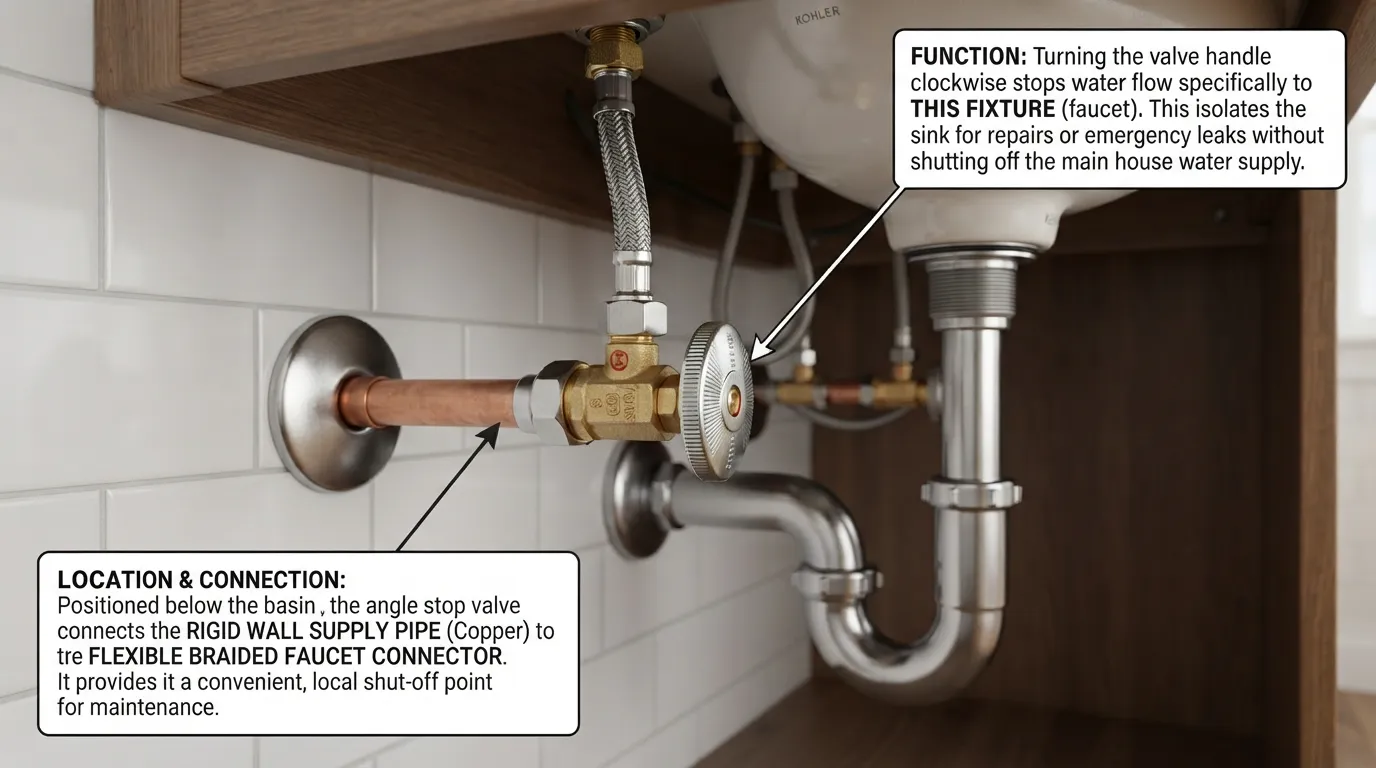 An angle stop acts as your home’s frontline defense against unexpected water damage by isolating water flow to individual fixtures. Knowing its exact function and location allows you to respond immediately when plumbing emergencies occur.
What an Angle Stop Does
An angle stop serves three crucial operational purposes in your residential plumbing layout. It provides localized control so you never have to shut down your entire household water system for minor fixes.
- Isolate a Single Fixture: Cuts off water exclusively to one appliance or faucet while keeping the rest of the house fully operational.
- Stop Emergency Leaks: Instantly halts high-pressure water surges when a flexible supply line bursts or a fixture fails unexpectedly.
- Simplify Repairs and Upgrades: Allows you to safely replace faucets, flush toilets, or service components without hassle.
Where to Find Angle Stops in Your Home
Angle stops are positioned strategically wherever pressurized water lines terminate at a visible plumbing fixture. Scanning your utility zones will reveal them in specific areas.
- Kitchen and Bathroom Sinks: Tucked neatly inside the base cabinet or vanity right against the wall beneath the basin.
- Toilets: Located near the floor directly behind the toilet tank where the flexible supply hose meets the wall pipe.
- Washing Machines: Positioned in the laundry box recessed into the wall behind the washer.
- Water Heaters and Icemakers: Mounted along feed lines near the appliance inlet connection.
Why It Matters: Real-Life Example
Imagine a flexible braided hose suddenly splitting under your bathroom sink late at night, spraying water everywhere. Instead of panicking to find your main water meter outside in the dark, you simply reach underneath the vanity and turn the angle stop clockwise.
- Instant Mitigation: The flow stops in under three seconds, preventing thousands of dollars in structural floor damage.
- Stress-Free Repair: You can sleep peacefully and replace the faulty supply line the next morning without rushing.
Why Every Fixture Should Have One
Unvalved fixtures force complete household water shutdowns for minor maintenance, turning a simple ten-minute fix into a major ordeal. Properly installed angle stops ensure safety, compliance, and ultimate convenience across your entire plumbing system.
- Protects building materials from prolonged moisture exposure and mold growth.
- Reduces downtime during routine fixture maintenance or cartridge replacements.
- Increases overall home value and plumbing system reliability.
Types of Angle Stops
Choosing the correct angle stop for your plumbing project depends on your existing pipe material, desired durability, and ease of operation. Different valve types offer unique mechanical advantages for various household applications.
Quarter-Turn Ball Valve Angle Stops: Pros and Cons
Quarter-turn valves use an internal drilled ball that opens or blocks water flow with a simple 90-degree twist of the handle. They are widely preferred by modern professional plumbers for their reliability and speed.
- Pros: Extremely durable, unlikely to seize up over time, and shuts off instantly with a fast 90-degree turn.
- Cons: Generally more expensive upfront than traditional multi-turn valves.
Multi-Turn Compression Washer-Type Angle Stops: Pros and Cons
Multi-turn valves require several full rotations of the handle to lower or raise an internal rubber washer against a seat. While common in older construction, they require periodic maintenance.
- Pros: Inexpensive, widely available at local hardware stores, and allows precise fine-tuning of water flow rates.
- Cons: Internal rubber washers degrade over time, leading to leaks, stuck handles, or failure to shut off completely.
By Connection Type
Angle stops attach to your supply pipes using several distinct mechanical connection methods tailored to different piping materials.
- Compression Fittings: Securely tighten a brass ferrule ring around copper or PEX pipes without requiring any soldering.
- Push-Fit Connections: Use internal stainless-steel teeth and O-rings to push straight onto copper, PEX, or CPVC pipes instantly.
- Sweat / Solder Valves: Permanently soldered directly onto bare copper pipes using a torch and lead-free solder.
- Threaded Connections: Screw directly onto male-threaded iron or specialty nipples using PTFE pipe tape.
By Material and Durability
The manufacturing material directly dictates how long your angle stop will resist corrosion, mineral buildup, and high water pressure.
- Solid Brass: The gold standard for residential plumbing due to its exceptional strength and natural corrosion resistance.
- Chrome-Plated Brass: Offers the rugged durability of solid brass underneath a polished, aesthetically pleasing silver finish.
- Stainless Steel: Highly resistant to aggressive water chemistry and mineral scale, though higher in cost.
- Plastic (PEX / PVC): Found in budget applications but prone to cracking or brittleness under prolonged thermal stress.
Quick Comparison Table
Angle Stop vs Shut-Off Valve vs Straight Stop Valve
Understanding the distinctions between various plumbing valves prevents sizing mistakes and installation errors. While many terms are used interchangeably in casual conversation, their physical configurations and specific applications differ significantly.
Is an Angle Stop the Same as a Shut-Off Valve?
An angle stop is a specific type of shut-off valve, but not all shut-off valves are angle stops. While a shut-off valve is any device designed to stop water flow anywhere in a plumbing system, an angle stop specifically refers to a localized 90-degree valve installed right beneath fixtures.
- Broad Category: Main water shut-off valves and ball valves control large zones or entire buildings.
- Localized Purpose: Angle stops isolate single fixtures like toilets and faucets for safe, targeted maintenance.
Angle Stop vs Straight Stop Valve
The primary difference between an angle stop and a straight stop lies in how they direct water from the supply pipe to the connecting hose.
- Angle Stop: Redirects water flow through a 90-degree angle, commonly used when supply pipes exit the wall directly beneath the fixture.
- Straight Stop: Keeps water flowing in a straight line without bending, typically used when supply pipes emerge upward straight out of the floor.
- Selection Rule: Match your valve choice directly to whether your rough-in plumbing pipe comes out of the wall or the floor.
Other Names for an Angle Stop
Plumbing terminology varies across regions and trade disciplines, leading to several alternative names for the exact same device.
- Common Industry Aliases: Isolation valve, service valve, supply stop, and water stop.
- Regional Terminology: North American plumbers typically say “angle stop” or “stop valve,” whereas international plumbers in the UK and Australia frequently refer to them as “isolating valves” or “service valves.”
Angle Stop vs Safety and Relief Valves
Angle stops must never be confused with pressure relief or safety valves. While angle stops are manually operated isolation controls, safety valves operate automatically to protect systems from dangerous over-pressurization.
- Safety / Relief Valves: Found on water heaters and boilers to release excess pressure or temperature automatically.
- Operating Difference: Safety valves are mechanical safety devices; angle stops are user-operated flow controllers.
Quick Comparison Table
Which Way to Turn an Angle Stop to Shut Off Water?
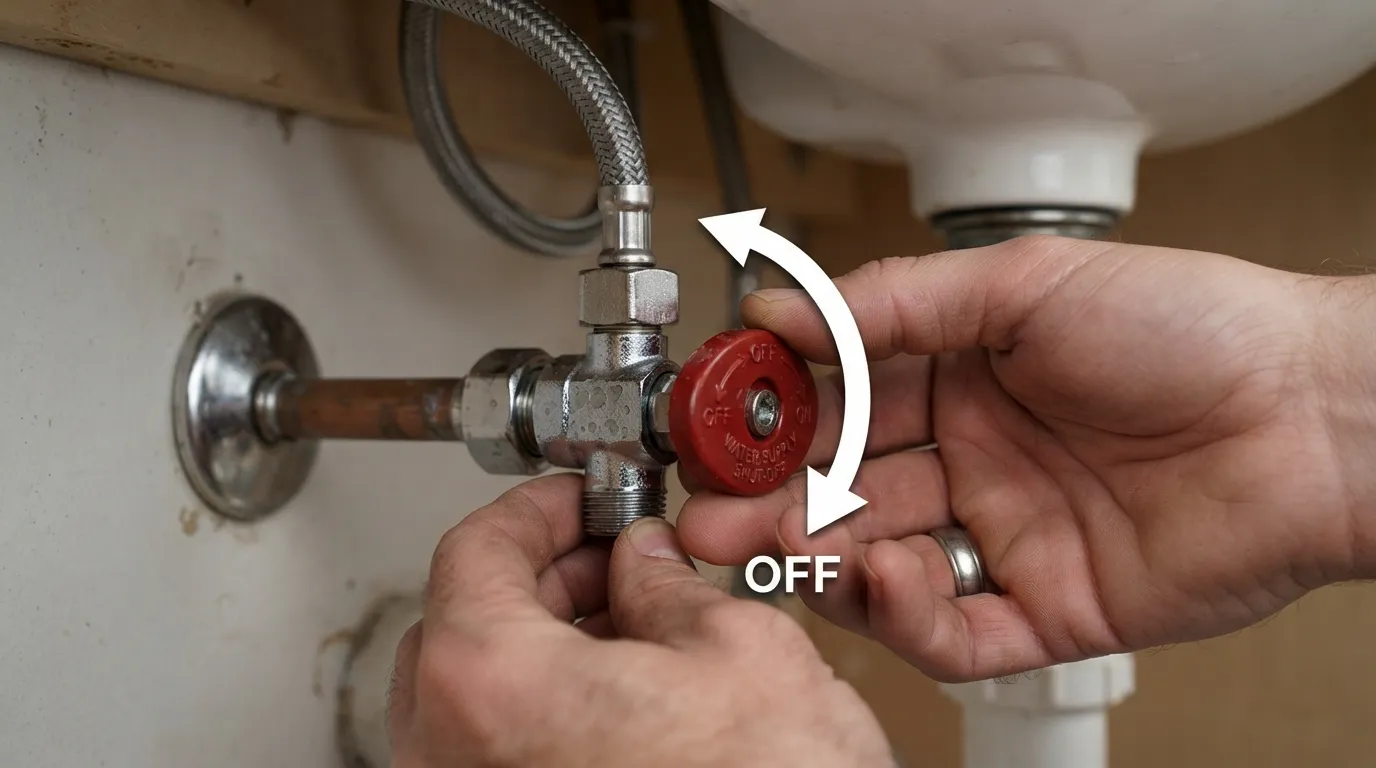 Knowing exactly which direction to turn an angle stop prevents panic during plumbing emergencies. Standard plumbing valves follow universal mechanical rules that make turning off water fast and foolproof.
Clockwise to Close Counterclockwise to Open
To shut off the water supply using an angle stop, turn the handle firmly clockwise. This traditional directional rule applies to virtually all standard threaded valves and multi-turn handles in residential plumbing.
- Righty-Tighty: Twisting the handle to the right (clockwise) tightens the internal mechanism against the valve seat to stop water flow.
- Lefty-Loosey: Twisting the handle to the left (counterclockwise) opens the valve and restores water flow to your fixture.
Quarter-Turn Valve: How to Tell if It Is On or Off
Modern quarter-turn ball valves use a flat lever handle instead of a round knob, making it instantly clear whether water is flowing.
- Valve Is ON: The lever handle runs parallel and in line with the supply pipe and water hose.
- Valve Is OFF: The lever handle is turned perpendicular (forming a 90-degree cross shape) across the pipe.
Multi-Turn Valve: How Many Turns and Why Not to Force It
Older multi-turn compression valves require several full rotations of a round handle to completely open or close the internal rubber washer.
- Full Rotation Count: Usually takes between two to four complete 360-degree turns from fully open to tightly closed.
- Do Not Over-Tighten: Never force a stuck handle with pliers or excessive physical strength, as this can snap the internal brass stem and trigger a major leak.
Safety Tip: Test the Fixture Tap
Never assume the water is completely off just because you finished turning the valve handle. Always perform a quick live test before starting any disassembly or repair work.
- Open the Faucet: Turn on the sink faucet or flush the toilet handle immediately after closing the angle stop.
- Verify Flow Cessation: Wait a few seconds to ensure the water stream drops completely to zero and the pressure bleeds out fully.
Common Problems with Angle Stops and Signs It Is Time to Replace
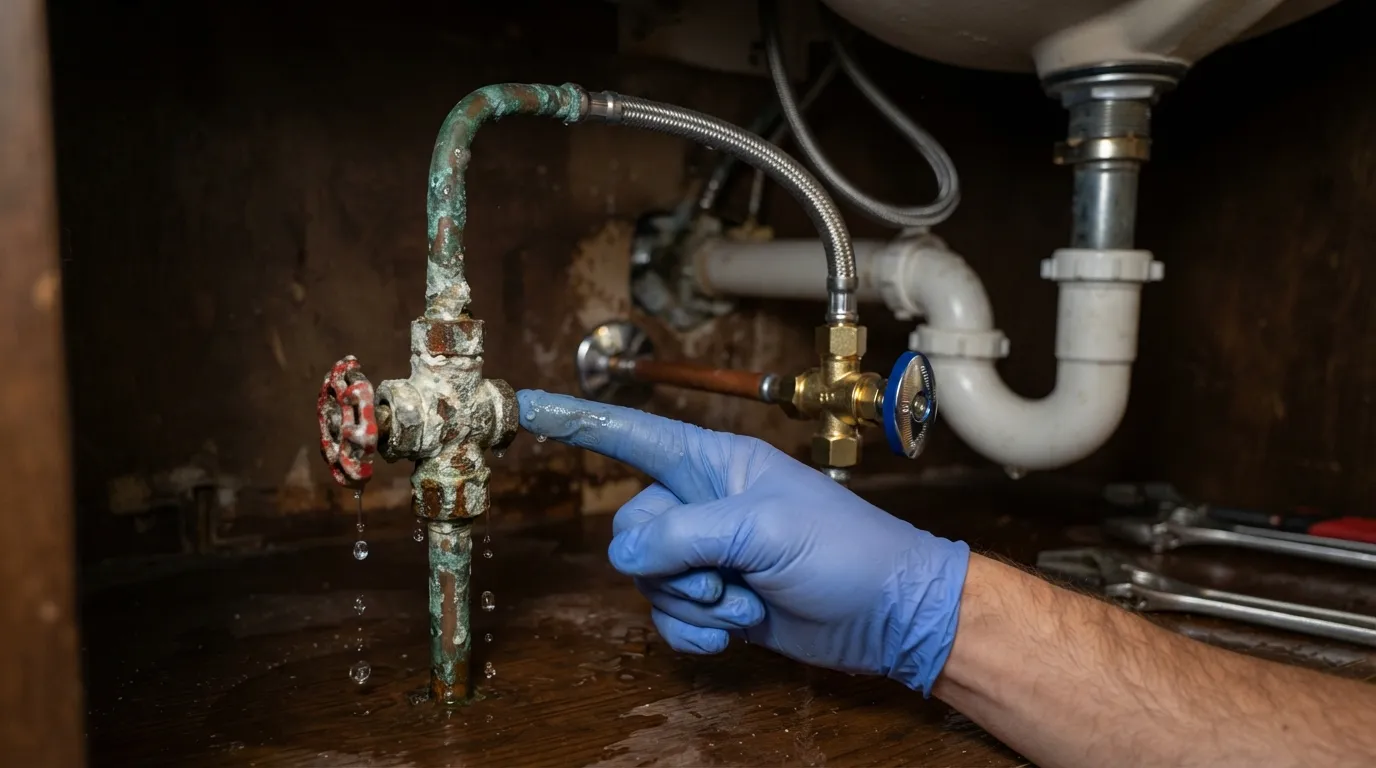 Angle stops endure constant water pressure and mineral exposure, making them prone to mechanical wear over time. Recognizing early failure signs prevents unexpected leaks and catastrophic water damage under your sinks.
Common Problems
Plumbing valves encounter several recurring mechanical issues as internal components age, degrade, or accumulate hard water scale. Understanding these issues helps you pinpoint the exact source of a leak.
- Stem Leaks: Water seeps out around the handle stem and packing nut whenever the valve is adjusted or turned on.
- Outlet Drips: Water continuously leaks from the threaded outlet connection even when the valve handle is in the fully closed position.
- Seized Handles: Mineral deposits and corrosion lock round or lever handles in place, making them impossible to turn by hand.
- Mineral Buildup: Limescale restricts internal water flow passages and prevents complete closure of rubber washers.
- External Corrosion: White, green, or powdery oxidation eats away at the brass body, weakening structural integrity.
Warning Signs You Should Not Ignore
Ignoring minor plumbing symptoms often leads to sudden valve failure during an emergency when you need reliability most. Watch out for these critical danger signs.
- Damp wood, warped cabinet bases, or musty odors underneath bathroom and kitchen vanities.
- Discolored mineral crust or greenish-white buildup forming around the valve packing nut or joints.
- A handle that spins endlessly without tightening or completely stopping water flow.
- Visible hairline cracks in the brass body or compression nut.
How Often Do Angle Stops Need to Be Replaced?
Standard brass angle stops typically last between 5 to 10 years before internal seals and washers degrade significantly. However, their actual lifespan depends heavily on environmental and chemical factors.
- Hard Water Impact: High concentrations of calcium and magnesium accelerate scale buildup, shortening valve lifespans.
- Material Quality: Cheap plastic or inferior metal alloy valves may fail in under 3 to 5 years.
- Replacement Rule: Plumbers recommend replacing all angle stops whenever you install a new sink, faucet, or toilet supply line.
Disadvantages of Angle Valves
While angle stops are essential plumbing fixtures, certain design types carry inherent disadvantages that homeowners should keep in mind.
- Multi-Turn Wear: Traditional washer-based valves degrade faster due to friction and aggressive tightening.
- Seldom-Used Jamming: Valves left untouched for years frequently cement themselves shut with mineral scale.
- Low-Cost Vulnerabilities: Budget composite or plastic models are highly susceptible to thermal cracking under pressure spikes.
Pro Tip: Establish a Routine Maintenance Habit
Prevent seized handles and mineral lockup by exercising your angle stops every six months. Simply close the valve halfway and reopen it fully a couple of times to clear out fresh mineral accumulation and keep internal parts moving smoothly.
How to Choose the Best Angle Stop for Residential Plumbing
Selecting the correct angle stop ensures a leak-free installation that meets code requirements and lasts for years. Follow this practical framework to evaluate your piping infrastructure before buying replacement valves.
Step 1: Match the Pipe Size and Outlet Size
Accurately measuring your existing water supply pipe and flexible connector prevents mismatched threads and catastrophic leaks. Standard residential sizing requires checking both ends of the valve.
- Inlet Measurement: Most residential wall supply pipes measure either 1/2-inch nominal pipe size (roughly 5/8-inch outer diameter) or 3/8-inch.
- Outlet Measurement: Standard fixture connectors almost universally require a 3/8-inch OD compression thread to match standard faucet and toilet supply lines.
- Metric Alternative: Homes with metric piping systems typically utilize 15mm inlets paired with standard 3/8-inch or 1/2-inch fixture connections.
Step 2: Pick the Connection Type
Your choice of valve attachment method must match the exact pipe material emerging from your home’s walls or floors to create a secure seal.
- Compression Fittings: Ideal for copper and PEX piping, tightening securely with a brass ferrule ring without requiring open flames or solder.
- Push-Fit Connectors: Great for quick DIY repairs on copper, PEX, or CPVC pipes, gripping firmly onto clean pipe ends instantly.
- Sweat / Solder Valves: Required for permanent, professional-grade copper installations where soldering directly onto bare pipe is preferred.
Step 3: Choose Quarter-Turn Over Multi-Turn
Modern plumbing best practices strongly favor specific valve mechanisms based on reliability, safety, and operational speed.
- Prioritize Quarter-Turn: Choose brass ball valves for almost all modern residential applications due to their superior longevity and quick 90-degree shut-off.
- Reserve Multi-Turn: Consider traditional multi-turn washer valves only if you need precise flow control or are matching existing historic infrastructure.
Step 4: Material and Finish
The external finish and internal body composition determine how well your valve resists corrosion, mineral scale, and physical impact.
- Solid Forged Brass: Provides maximum structural integrity and natural resistance to rust under high water pressure.
- Chrome-Plated Finish: Essential for exposed installations beneath sinks or toilets where visual aesthetics and matching fixtures matter.
Size and Compatibility
Buyer’s Checklist
- Verify your existing pipe material (copper, PEX, iron, or PVC) before shopping.
- Measure outer pipe diameters carefully with a caliper or tape measure.
- Select lead-compliant solid brass or chrome-plated brass body construction.
- Opt for quarter-turn ball valve mechanisms to eliminate future washer wear.
- Purchase matching flexible braided stainless steel supply lines for the complete installation.
How to Replace an Angle Stop Valve
Replacing a worn or leaking angle stop is a straightforward DIY project that saves costly plumbing bills. Following a methodical, safety-first workflow ensures a watertight installation and protects your home from sudden water damage.
Tools and Materials You Will Need
Gathering the correct tools before starting prevents unnecessary mid-project trips to the hardware store. Keep these items close at hand:
- Two adjustable wrenches (one to hold the pipe steady, one to turn the nut).
- A specialized puller tool or pliers for removing old brass compression rings/ferrules if necessary.
- PTFE plumber’s tape (for threaded connections, if applicable).
- A bucket and old towels to catch residual water remaining trapped in the line.
- A replacement quarter-turn brass angle stop matching your pipe size.
Before You Start: Shut Off the Main Water Supply
Never attempt to remove an angle stop without first shutting off the main water valve to your home. Locate your main meter or indoor shut-off gate, turn it firmly clockwise to close, and open a lower-level bathtub faucet to drain residual pressure.
- Double-check that water flow has completely stopped across the entire house before proceeding.
- Place a towel and bucket right beneath the target valve to catch any remaining trapped droplets.
Step by Step Replacement
- Disconnect the Supply Line: Use your wrenches to loosen and disconnect the flexible braided hose running from the top of the angle stop to your fixture faucet or toilet.
- Remove the Old Valve: Hold the supply pipe firmly with one wrench to prevent twisting or bending inside the wall, and use the second wrench to loosen the compression nut securing the valve.
- Inspect and Clean the Pipe: Slide off the old compression nut and brass ring. Wipe the copper or PEX pipe clean with a scouring pad, removing any scale or old pipe compound.
- Install the New Ferrule and Valve: Slide the new compression nut and brass ferrule onto the pipe, then push the new angle stop fully onto the pipe end.
- Tighten Connections: Finger-tighten the compression nut, then use your wrenches to turn it an additional 3/4 to 1 full turn to lock the ferrule securely. Reattach the flexible supply line.
Common Mistakes to Avoid
Avoiding common installation pitfalls prevents frustrating leaks and structural damage down the road.
- Over-Tightening: Cracking the brass fitting or crushing the copper pipe by applying excessive force with oversized wrenches.
- Reusing Old Ferrules: Trying to force a new valve onto an old, deformed brass ring instead of installing a fresh one.
- Skipping the Leak Test: Failing to perform a pressurized live test before leaving the work area unattended.
When to Call a Professional Plumber
While DIY replacement is simple on standard exposed copper or PEX lines, certain scenarios require professional expertise and adherence to local plumbing code requirements.
- The existing valve is permanently soldered directly onto copper pipe and requires a torch.
- The supply pipe emerging from the wall is severely corroded, warped, or structurally compromised.
- Your home’s main water shut-off valve is broken or fails to close completely.
- Water is actively leaking from inside the drywall cavity rather than the visible valve connection.
Final Leak Check and Aftercare
Slowly turn your home’s main water supply back on, keeping the new angle stop in the closed position to check for pipe joint leaks. Once confirmed dry, open the angle stop and check all connections again with dry paper towels while running the fixture tap for two full minutes.
How Much Does It Cost to Change an Angle Stop Valve?
Understanding the financial breakdown of replacing an angle stop helps you decide whether to tackle the project as a DIY weekend task or hire a professional plumber. Costs vary depending on labor rates, valve quality, and your home’s plumbing setup.
Typical Cost Range
Replacing an angle stop typically ranges between 150 to 350 dollars (USD) when hiring a licensed professional, including both labor and basic hardware. If you choose to DIY, the raw cost drops significantly since you only pay for the individual valve.
- Professional Replacement: Average total cost spans 150 to 350 dollars per valve for standard installations.
- DIY Material Cost: A high-quality brass quarter-turn valve generally costs between 10 and 25 dollars at any local hardware store.
Valve Cost vs Labour Cost
Plumber billing structures typically combine a standard service call fee with hourly labor rates or flat-rate pricing per fixture.
- Valve Hardware: Premium solid brass quarter-turn ball valves represent a very small fraction of the total expense.
- Labor & Overhead: Professional plumbers charge primarily for their expertise, insurance, travel time, and specialized tools required to guarantee a leak-free seal.
DIY vs Hiring a Plumber: Cost and Risk Comparison Table
Can a Plumber Install an Angle Stop?
Yes, installing and replacing angle stops is a routine service provided by every residential plumber. Hiring a professional is especially recommended when dealing with complex wall connections or fragile old infrastructure.
- Ensures compliance with local plumbing codes and backflow prevention regulations.
- Guarantees professional liability coverage if unexpected pipe fractures occur during replacement.
Factors That Change the Price
Several situational variables can increase or decrease the final cost of an angle stop replacement project.
- Pipe Material: Soldered copper pipes or corroded galvanized steel require more labor time than modern compression fittings.
- Valve Selection: Premium stainless steel or designer finishes cost more upfront than standard chrome-plated brass.
- Accessibility: Tight, cramped vanity spaces or recessed laundry boxes can increase labor time.
- Emergency Rates: Calling a plumber late at night or during holidays significantly increases service call surcharges.
Expert Tips and Common Mistakes
 Mastering angle stop maintenance goes beyond basic repairs. Implementing professional-grade habits and avoiding common pitfalls protects your plumbing system from premature failure and unexpected water emergencies.
5 Practical Tips from Real-World Plumbing Jobs
Drawing from hands-on field experience, professional plumbers recommend specific practices to ensure long-lasting, leak-free performance across your home.
- Label Your Shut-Offs: Tag angle stops inside cluttered vanity cabinets so family members can identify them instantly during a crisis.
- Never Reuse Old Ferrules: Always remove and replace brass compression rings when swapping out valves to guarantee a proper seal.
- Support the Wall Pipe: Always brace copper or PEX pipes with a backup wrench when tightening compression nuts to prevent twisting inside the wall.
- Inspect Braided Hoses: Replace old rubber supply lines with braided stainless steel hoses every five to seven years alongside your valves.
- Keep Main Shut-Offs Accessible: Never block access to your primary home water meter with storage boxes or heavy furniture.
Mistakes Homeowners Make with Angle Stops
DIY plumbing mishaps usually stem from rushing steps or using incorrect tools. Avoiding these frequent errors saves time, money, and structural damage.
- Over-Torquing Nuts: Cracking brass bodies or crushing soft copper pipes by applying excessive leverage with heavy pipe wrenches.
- Ignoring Seized Handles: Forcing stuck multi-turn valves with pliers instead of lubricating them or replacing the unit entirely.
- Skipping Pressure Tests: Turning the water back on and leaving the room before verifying that all new joints are completely bone dry.
- Using Thread Sealant Incorrectly: Applying PTFE tape to compression ferrule threads where sealing relies purely on mechanical ring compression, not thread friction.
Should You Install a Quarter-Turn Valve on Every Fixture?
Upgrading older multi-turn compression valves to modern quarter-turn ball valves is one of the single best plumbing investments a homeowner can make.
- Instant Emergency Shutdown: Eliminates the risk of stuck, frozen, or stripped washers during high-pressure pipe bursts.
- Superior Longevity: Polished brass ball mechanisms resist mineral scaling and withstand decades of reliable operation.
- Best Practice: Plumbers universally recommend replacing every aging multi-turn valve with a quarter-turn alternative during bathroom or kitchen remodels.
Identify All Shut-Off Points
Take ten minutes this weekend to locate and test every water control point in your residence. Knowing where your main meter, water heater valve, and individual fixture angle stops are located transforms potential panic into calm, controlled action when leaks happen.
Frequently Asked Questions
What is an angle stop in plumbing?
An angle stop is a localized shut-off valve located beneath sinks and toilets. It features a 90-degree bend that connects the water supply pipe emerging from the wall to the flexible hose of a fixture, allowing you to turn off water to a single unit without shutting down your whole house.
Is an angle stop the same as a shut-off valve?
An angle stop is a specific type of shut-off valve. While a shut-off valve can refer to any control device in a plumbing network—including main water meters—an angle stop specifically designates a 90-degree valve used directly beneath individual fixtures like toilets and faucets.
Which way do you turn an angle stop to shut off?
To shut off the water supply, turn the valve handle firmly clockwise (following the traditional “righty-tighty” rule). For modern quarter-turn ball valves, rotate the lever handle 90 degrees so it rests perpendicularly across the pipe to completely block water flow.
What are common problems with angle stop valves?
Common issues include water leaking around the packing nut or stem, persistent drips from the outlet, seized or stuck handles caused by hard water mineral buildup, and external brass corrosion. These symptoms indicate that internal rubber seals or the valve body have degraded.
How often do angle stops need to be replaced?
Standard residential brass angle stops typically last between 5 to 10 years. However, their lifespan varies based on water hardness and frequency of use; plumbers recommend replacing them whenever you install a new faucet, toilet, or supply line.
Can a plumber install an angle stop valve?
Yes, installing and replacing angle stops is a standard service provided by all residential plumbers. Hiring a professional is especially recommended for soldered copper connections, severely corroded wall pipes, or when emergency pipe repairs are required.
How much does it cost to change an angle stop valve?
Professional replacement generally costs between 150 and 350 dollars (USD) per valve for labor and standard materials. If you choose a DIY approach, raw material costs range from 10 to 25 dollars for a high-quality brass quarter-turn valve.
What is another name for an angle valve?
An angle stop is commonly referred to by several alternative names depending on regional terminology and trade preferences, including isolation valve, service valve, supply stop, and water stop valve.
What are the disadvantages of using angle valves?
Disadvantages include the vulnerability of traditional multi-turn washer valves to degrade and leak over time, the tendency of seldom-used valves to seize up with mineral scale, and the risk of thermal cracking in cheap plastic models.
Do I need an angle stop on every sink and toilet?
Yes, building codes and plumbing best practices require an independent angle stop for every fixture. Having dedicated shut-off valves ensures you can perform targeted repairs or handle plumbing emergencies without cutting off water to the rest of your home.
Conclusion
Mastering the fundamentals of angle stops empowers you to protect your home from sudden plumbing emergencies and manage basic fixture repairs with confidence. These small valves play a massive role in overall residential safety.
Key Takeaways
- Angle stops isolate water to individual sinks and toilets, preventing the need for whole-house shut-offs.
- Quarter-turn ball valves provide superior longevity and instant emergency shut-offs compared to old multi-turn valves.
- Routine checks and periodic handle exercises prevent mineral scaling and seized mechanisms.
- Replacing aging valves every 5 to 10 years prevents catastrophic supply line failures and expensive water damage.

Oscar Vance | Master Plumber & Drainage Expert
Meet Oscar Vance, a licensed master plumber sharing practical solutions on residential repairs, preventive maintenance, and thoughtful home upkeep.