How SEO for Plumbing Services Boosts Online Visibility and Trust
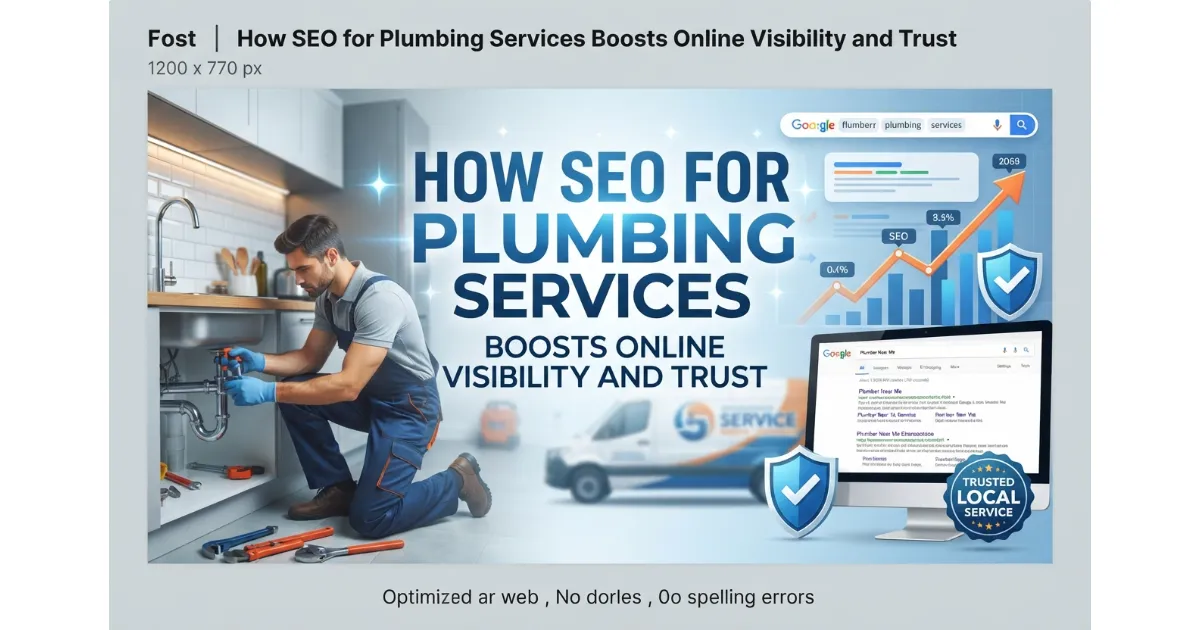 SEO (Search Engine Optimization) is the strategic process that elevates your plumbing business to the top of Google Search and Google Maps when local customers urgently search for terms like “plumber near me.” By optimizing your online presence, you secure high-intent local traffic, build immediate credibility through authentic reviews, and turn casual web visitors into high-paying plumbing leads.
When an unexpected pipe bursts or a water heater fails, customers rarely scroll past the top results. They want fast solutions from providers who look established, professional, and reliable right from the search engine results page (SERP).
- Maximized Local Visibility: Dominate the local map pack and organic rankings so your plumbing company is the first option visible during critical customer emergencies.
- Unshakable Brand Trust: Leverage optimized Google Business Profiles, localized service pages, and positive customer testimonials to establish instant market authority.
- Consistent High-Quality Leads: Drive targeted website traffic that converts into inbound phone calls, booking requests, and steady residential or commercial contracts.
What Is SEO for Plumbing Services?
Plumbing SEO is a targeted digital marketing strategy designed to help plumbing contractors rank higher in search engine results and local map packs. Unlike standard website optimization, plumbing SEO focuses heavily on hyper-local intent, capturing urgent queries from homeowners who need immediate repairs.
By optimizing your website and digital footprint around specific services like drain cleaning and water heater repair, you ensure your business captures ready-to-buy customers at the exact moment they need assistance.
How Plumbing SEO Differs from General SEO
General SEO often targets national or global audiences looking for informational content, products, or software. In contrast, plumbing SEO is strictly tied to physical service areas and geographic boundaries.
Because plumbing is an offline, location-bound trade, winning the Google Map pack and optimizing for local service area pages is just as important as traditional on-page optimization. Your digital strategy must align with how local homeowners operate during emergencies.
Local SEO vs Organic SEO for Plumbers
How Customers Actually Search for Plumbers
Homeowners facing plumbing issues rarely browse leisurely; they use transactional phrases with explicit location modifiers or urgent distress words. Understanding these exact search patterns helps structure your website content effectively.
- Emergency Searches: Phrases like “emergency plumber near me” or “burst pipe fix tonight” indicate immediate panic and high intent.
- Service-Specific Queries: Searches such as “water heater repair [city]” or “drain cleaning service” target specialized, higher-ticket plumbing jobs.
- DIY to Pro Intent: Queries like “how to fix leaking tap” can be captured via helpful blog content that funnels DIYers to professional services when complications arise.
Why Plumbing Is a High-Intent Urgent Niche
Unlike retail or B2B industries where buyers spend weeks researching options, plumbing is driven by crisis. A overflowing toilet or broken main water line demands an immediate solution, leading to a phone call within minutes of searching.
Because the search intent is hyper-focused and urgent, ranking at the top translates directly into booked jobs and immediate revenue. Effective plumbing SEO positions your brand as the fastest, most reliable rescue option available.
How SEO Boosts Online Visibility for Plumbers
SEO elevates your plumbing business across multiple digital touchpoints, ensuring your brand dominates local search results when customers face urgent needs. By aligning your digital footprint with how search engines evaluate trade contractors, you secure steady, high-intent visibility.
Consistent local optimization ensures your business is present across organic search, maps, and emerging AI-driven discovery platforms.
Winning the Google Local Pack and Maps
The Google Local Pack is prime digital real estate for emergency plumbing services, capturing the top three map positions on mobile and desktop screens. Winning this spot requires rigorous optimization of your Google Business Profile (GBP).
- Accurate Categorization: Select primary and secondary categories like “Plumber” and “Plumbing Supply Store” or “Septic System Service” to match search intent.
- Optimized Service Areas: Explicitly define your geographic radius to prevent map misalignments and target surrounding high-value neighborhoods.
- Operational Consistency: Keep business hours, NAP (Name, Address, Phone) details, and emergency availability updated to maintain consumer and algorithmic trust.
Ranking Service Pages for High-Intent Keywords
General homepage optimization is rarely enough to capture specific transactional searches. Creating dedicated, siloed pages for distinct services allows you to rank for high-ticket plumbing jobs.
- Targeted Service Architecture: Build separate landing pages for core offerings like drain cleaning, water heater repair, and sewer line replacement.
- Keyword Integration: Naturally weave semantic variations, localized terms, and pricing/scope details into each page layout.
- Conversion Architecture: Equip every individual service page with clear call-to-action buttons for instant booking or emergency phone calls.
City and Neighborhood Pages That Capture Near Me Searches
Expanding your geographic footprint requires targeted city and neighborhood pages without falling into the trap of low-quality, duplicate content. Each local page must offer genuine value to users in that specific area.
- Unique Local Content: Highlight localized municipal guidelines, common regional plumbing challenges, and specific suburb names.
- Proximity Signals: Reference local landmarks and specific service routes to establish authentic regional authority.
- Avoiding Thin Pages: Ensure each location page has distinct paragraphs and customer testimonials rather than just swapping out the city name in a template.
Showing Up in AI Overviews and AI Mode
Modern search relies heavily on AI Overviews and conversational AI models that pull direct, authoritative answers from structured web content. Optimizing for these surfaces requires structured formatting and clear facts.
- Direct Definitions: Answer common troubleshooting questions concisely in the opening paragraphs of your guides or FAQ sections.
- Structured Data (Schema): Implement
LocalBusinessandPlumberschema markup to feed search engines precise operational data. - Consistent Citations: Maintain uniform business listings across high-authority directories to reinforce brand entities in AI knowledge graphs.
How Video Content Increases Visibility and Dwell Time
Embedding optimized video content on your website and platforms like YouTube significantly increases user engagement, dwell time, and trust signals. Visual walkthroughs of minor fixes or plumbing tips convert cautious readers into confident callers.
- Local Video Titles: Incorporate geo-targeted keywords into your video titles, such as “How to Fix a Leaky Faucet | City Name Plumbing.”
- Enhanced User Engagement: Educational video content keeps users on your page longer, signaling high quality to search engine crawlers.
- Multimodal Discovery: Capitalize on video carousels appearing directly within standard search results for home maintenance queries.
How SEO Builds Trust for Plumbing Businesses
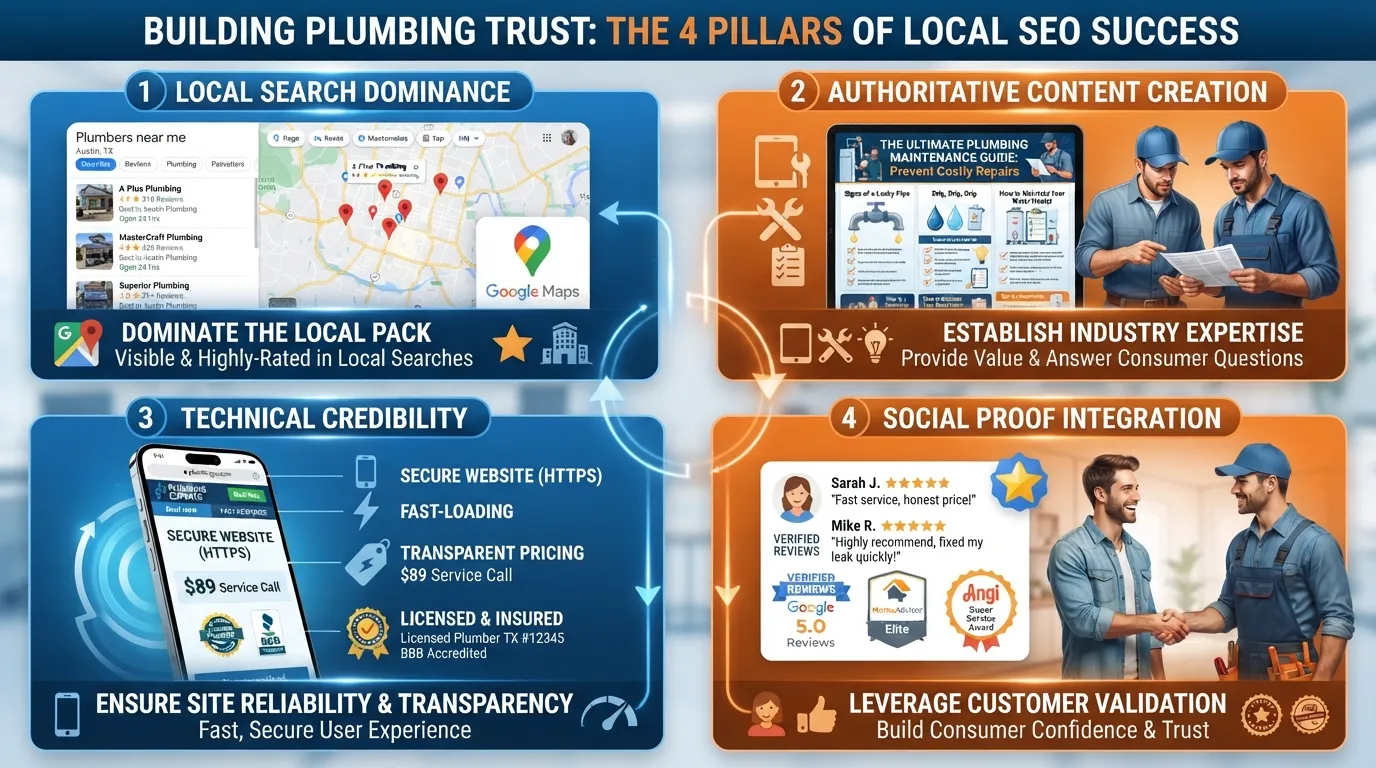 Trust is the ultimate conversion metric in the plumbing industry. When a homeowner faces an overflowing toilet or a burst pipe, they invite a complete stranger into their home, making brand reputation and verified authority paramount.
Strategic SEO elevates your digital presence by packaging verifiable proof of quality, licensing, and reliability directly into search engine results, helping you win over panicked customers instantly.
Reviews and Ratings: The Strongest Trust Signal
Customer reviews act as modern word-of-mouth recommendations, heavily influencing both your Google Map rankings and consumer decision-making. High star ratings and glowing testimonials lower perceived hiring risk during stressful crises.
- Proactive Review Requests: Automate SMS or email follow-ups immediately after a successful service call to capture fresh, positive reviews.
- Strategic Review Responses: Reply professionally to every review—thanking happy customers and calmly addressing any negative feedback to show accountability.
- Highlighting Social Proof: Showcase top-tier testimonials prominently on your homepage and dedicated service landing pages.
A Complete Accurate Google Business Profile
An optimized and fully fleshed-out Google Business Profile signals to potential clients and search algorithms that your business is active, legitimate, and professional.
- Rich Visual Assets: Regularly upload high-resolution photos of your team, branded trucks, and completed projects to build immediate visual authenticity.
- Detailed Services Menu: List every specific repair offering with transparent descriptions so customers know you handle their exact problem.
- Up-to-Date Operations: Keep holiday hours, emergency availability, and regular business details strictly synchronized.
Showing Real Expertise on Your Website
Google’s E-E-A-T (Experience, Expertise, Authoritativeness, and Trustworthiness) guidelines require plumbing sites to clearly display real-world credentials rather than generic stock content.
- Licensing and Insurance Badges: Prominently display state license numbers, bonding details, and liability insurance badges across your site headers.
- Technician Bios: Feature short biographies, certifications, and years of experience for your core plumbing crew to humanize your brand.
- Industry Accreditations: Highlight affiliations with recognized trade organizations or local chamber of commerce memberships.
Before-and After Photos and Real Job Stories
Visual proof of complex repairs validates your technical competence and provides tangible evidence of your craftsmanship to cautious homeowners.
- Original Media Assets: Use authentic, unedited photos of actual job sites—such as messy pipe replacements versus clean finished work.
- Descriptive Alt Text: Optimize all image alt attributes with local keywords and project descriptions (e.g., “copper pipe leak repair in [City]”).
- Case Study Snippets: Briefly explain the diagnosis and solution for complex jobs to demonstrate deep technical mastery.
Consistent Name Address Phone Across the Web
NAP consistency across local directories, social profiles, and citation sources eliminates consumer confusion and prevents algorithmic penalties from search engines.
- Unified Data Formatting: Ensure your business name, street address, and phone number match identically on your website, Yelp, and Google Maps.
- Directory Auditing: Regularly clean up outdated listings or old phone numbers from defunct directory profiles.
- Local Signal Reinforcement: Consistent data anchors your business firmly to your target geographic service area.
Website Quality as Trust
A poorly designed, slow, or cluttered website projects unprofessionalism, causing anxious prospects to bounce to a competitor.
- Secure Browsing (HTTPS): Protect user data with an active SSL certificate to prevent browser warning screens.
- Mobile Speed Optimization: Ensure lightning-fast load times on smartphones, where the majority of emergency plumbing searches originate.
- Clutter-Free Layouts: Keep navigation clean, distraction-free, and centered around a single tap-to-call phone number.
Why Trust Matters More in Emergencies
Emergency plumbing situations compress the buyer’s journey into mere seconds, forcing consumers to make high-risk decisions under pressure.
- Risk Minimization: Homeowners look for clear signs of legitimacy to avoid scams, overcharging, or shoddy workmanship.
- Immediate Reassurance: Transparent pricing, professional branding, and prominent licenses ease panic and trigger an immediate phone call.
- Long-Term Loyalty: Trust built during a high-stress emergency transforms a one-time panicked caller into a lifelong, recurring maintenance customer.
Step by Step Plumbing SEO Playbook
Implementing a successful plumbing SEO strategy does not require a massive tech budget or an expensive agency. By following a clear, methodical roadmap, you can establish local dominance, outrank competitors, and keep your phone ringing consistently [00:00:21].
Step 1: Set Up and Optimize Your Google Business Profile
Your Google Business Profile (GBP) is the engine of your local visibility. An incomplete profile means missing out on prime map pack real estate when local customers need immediate help.
- Select 5-8 Additional Categories: Go beyond just “Plumber.” Include relevant sub-categories like Emergency Plumber, Plumbing Supply Store, Water Heater Repair Service, Drain Cleaning Service, Rooter Service, Plumbing Contractor, and Sewer Cleaning Service.
- Build a Services Menu: List every specific repair offering with transparent descriptions so prospects know you handle their exact issue.
- Visuals and Updates: Regularly upload high-resolution photos of your team, branded trucks, and completed jobs, and keep your hours strictly up to date.
Step 2: Do Keyword Research Around Services and Locations
Stop guessing what customers type into Google. Effective keyword research focuses on intent-driven phrases that real homeowners use during a crisis [00:04:14].
- Long-Tail Keywords: Target specific phrases like “how to fix a running toilet” or “emergency slab leak detection.”
- Service-Area Keywords: Combine core plumbing terms with your target locations, such as “drain cleaning in [City Name]” or “water heater repair [Neighborhood].”
- Intent Alignment: Prioritize search terms that indicate high intent to hire rather than generic, low-conversion informational terms [00:04:14].
Step 3: Build Dedicated Service Pages
Avoid cramming all your services onto a single homepage. Create unique, robust landing pages for each major offering.
- Targeted On-Page SEO: Optimize your title tags, meta descriptions, and header tags with your primary service-area keywords.
- Internal Structure: Link your service pages logically to each other and your homepage to guide users and search bots smoothly through your site structure.
- Conversion Focus: Feature clear call-to-action buttons, local trust badges, and click-to-phone numbers on every page.
Step 4: Create Helpful Content That Answers Real Customer Questions
Answering common homeowner questions builds organic authority and captures traffic from people researching minor issues before they escalate.
- Targeted Guides: Write troubleshooting articles for common pain points like a leaky faucet, low water pressure, a burst pipe, or water heater problems.
- Multimedia Integration: Supplement your written guides with short-form visual content like YouTube Shorts demonstrating quick shut-off valve locations.
- Expert Positioning: Position your business as the go-to regional educator, building trust long before a customer needs a paid repair.
Step 5: Build Local Citations and Earn Local Links
Off-page signals confirm to search engines that your plumbing business is an established, trusted pillar of the local community.
- Local Citations: Ensure your business name, address, and phone number (NAP) are listed uniformly across directories like Yelp, YellowPages, and Angi.
- Authoritative Backlinks: Earn local links from chambers of commerce, plumbing equipment supplier sites, and local community event sponsorships.
- Trust Amplification: High-authority local links validate your geographical relevance and boost your map rankings.
Step 6: Get Reviews Consistently
Fresh customer feedback is vital for beating local competitors and converting hesitant website visitors into booked jobs.
- Automated Follow-Ups: Set up automated SMS or email requests to go out right after a technician wraps up a successful service call.
- Review Responses: Actively respond to every review—thanking happy clients and professionally managing any negative feedback [00:06:02].
- Reputation Management: Consistent review generation signals active customer satisfaction to both search algorithms and prospects.
Step 7: Fix Technical Basics
A fast, seamless, and error-free website ensures that eager prospects don’t bounce before calling you.
-
- Page Speed & Mobile Optimization: Compress images and streamline code so your site loads instantly on mobile devices, where emergency searches happen.
- Schema Markup: Implement local business and plumber schema markup to help search engines understand your hours, service areas, and reviews.
- Core Web Vitals: Ensure a stable visual layout and smooth interactivity to meet Google’s technical performance standards.
Real-World Example: What Plumbing SEO Looks Like in Practice
To fully grasp how plumbing SEO transforms a struggling local operation into a dominant market leader, let’s examine a detailed, anonymized scenario modeled after real-world plumbing campaigns.
Case Snapshot: A Local Plumber Before and After SEO
The Business: “Apex Flow Plumbing,” a mid-sized residential and emergency plumbing contractor operating in a competitive suburban market of roughly 300,000 residents.
The Problem: Despite having 15 years of industry experience and exceptional on-the-job craftsmanship, Apex Flow was completely invisible online. Their outdated website received less than 50 organic visits a month, their Google Business Profile lacked reviews and secondary categories, and their phone only rang when they ran expensive, low-converting pay-per-click ads.
The Transformation: After implementing a structured 6-month local SEO campaign focusing on technical cleanup, Google Business Profile optimization, and targeted service pages, their digital footprint shifted dramatically.
What We Changed
The turnaround didn’t require a total corporate rebrand; rather, it came down to executing fundamental local optimization tactics systematically:
- Google Business Profile Overhaul: Fully claimed and verified the GBP, added 7 secondary categories (including Emergency Plumber and Drain Cleaning Service), uploaded 40+ authentic job photos, and embedded regular weekly posts.
- Dedicated Service Landing Pages: Replaced a single cluttered homepage with optimized, individual pages for high-margin services like water heater replacement, slab leak detection, and trenchless sewer repair.
- Review Generation Engine: Integrated an automated post-service SMS review request system that lifted their total reviews from 4 to over 120, pushing their star rating from 3.8 to 4.9.
- Technical & Content Upgrades: Improved mobile page speed, fixed broken links, implemented clean local business schema, and published monthly troubleshooting guides answering specific homeowner questions.
Calls Direction Requests and Map Rankings
By tracking performance metrics through Google Search Console, call-tracking software, and GBP insights, the measurable impact over a 9-month period included:
- Map Rankings: Climbed from position 18 in local search results into the coveted local 3-pack for core keywords like “plumber near me” across 80% of their target zip codes.
- Direction Requests & Website Clicks: Direction requests on Google Maps surged by 240%, while organic website traffic grew from ~45 visits/month to over 1,400 targeted monthly visitors.
- Phone Calls & Leads: Inbound phone calls attributed directly to organic search and maps increased by roughly 180%, significantly lowering their reliance on costly paid ads and boosting overall lead conversion rates.
Lessons Learned: What Moved the Needle and What Didn’t
Every SEO campaign offers unique takeaways about where to allocate time and energy for maximum ROI:
- What Moved the Needle: Aggressive Google Business Profile optimization, consistent review acquisition, and fast, mobile-friendly service pages produced 80% of the quick wins and immediate call growth.
- What Didn’t Move the Needle: Spending weeks arguing over minor logo tweaks, purchasing low-quality directory spam packages, or writing generic 500-word blog posts on national plumbing trivia yielded virtually zero return. Focus strictly on local intent and technical health.
SEO vs Google Ads vs Local Services Ads for Plumbers
When you need immediate plumbing jobs, choosing the right digital marketing channel can make or break your budget. While paid ads deliver instant visibility, organic strategies build enduring market dominance. Understanding how these channels work together helps you maximize your marketing ROI without wasting cash.
SEO vs Google Ads: Speed Cost and Long-Term Value
Both search engine optimization and traditional pay-per-click (PPC) ads place you on Google’s search engine result pages, but they operate on fundamentally different economic and timeline models.
| Feature | Plumbing SEO | Google Ads (PPC) |
|---|---|---|
| Speed to Results | Slower (takes 3 to 6 months to build momentum) | Instant (live the moment your campaign is approved) |
| Cost Model | One-time investment or ongoing agency retainer; clicks are free | Pay-per-click (you pay every time a user clicks your ad) |
| Long-Term ROI | Compound growth; rankings persist even if you pause spending | Stops immediately the moment you stop paying for ads |
| Cost Per Lead | Decreases over time as organic authority and rankings improve | Often rises over time due to increasing competition and high keyword CPCs |
Where Local Services Ads Fit
Local Services Ads (LSAs) sit right at the top of Google search results—even above standard Google Ads—and are specifically designed for service-area businesses like plumbers.
- Pay-Per-Lead Model: Unlike traditional Google Ads where you pay per click, LSAs charge you only when a customer actually calls or messages you through the ad.
- Google Guaranteed Badge: LSAs feature the prominent “Google Guaranteed” badge, which builds immediate trust by signaling that Google has pre-screened and verified your business license and background.
- Ideal for Emergencies: Because they occupy prime above-the-fold screen real estate on mobile devices, LSAs capture high-urgency emergency searches instantly while your organic SEO campaign is still maturing.
When Plumbers Should Combine SEO and Paid
Relying on a single marketing channel can leave your plumbing business vulnerable to algorithm shifts or sudden budget crunches. A hybrid approach often yields the most balanced growth.
- Launch Phase: Run Google Ads or LSAs from day one to generate immediate cash flow and emergency calls while your long-term SEO foundation is being built.
- Peak Seasons: Scale up paid ads during high-demand periods (like winter freeze warnings or heavy storm seasons) to capture overflow traffic.
- Maturity Phase: As your organic rankings climb and your map pack presence solidifies, gradually reduce your PPC spend and reallocate budget into high-converting content and review acquisition.
Which Is Better for Trust?
When a homeowner is facing a stressful plumbing disaster, consumer psychology heavily influences who they decide to call.
- The Organic Advantage: Organic search results and glowing map pack reviews are frequently perceived as more authentic and trustworthy than sponsored ads, because users know companies cannot simply “buy” a top organic ranking.
- The Nuance of Trust: While organic listings and reviews generally command higher long-term consumer trust, a paid LSA backed by the Google Guaranteed badge can still overcome skepticism during an urgent midnight crisis. Combining strong organic proof with verified paid badges creates an airtight trust profile.
How Long Does Plumbing SEO Take and How to Measure It?
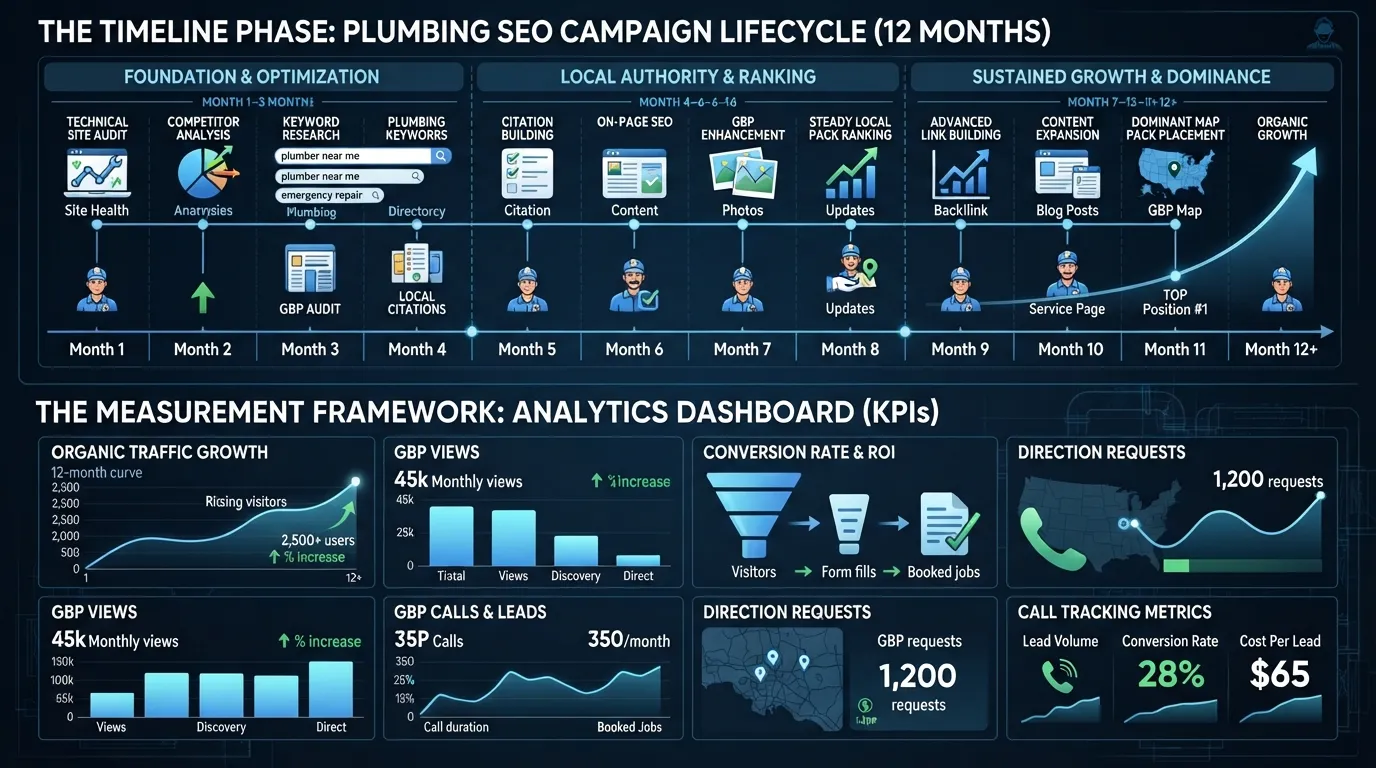 One of the most common questions plumbing business owners ask is, “When will I start seeing new calls from my website?” Because SEO is an organic, cumulative strategy rather than an overnight switch, setting realistic timeline expectations and tracking the right metrics are essential for measuring your return on investment.
How Long Until You See Results?
SEO progress happens in stages, and different elements of your digital footprint respond at different speeds:
- Quick Wins (Days to Weeks): Optimizing your Google Business Profile, fixing basic on-page errors, and launching a review collection campaign can spark noticeable improvements in local map visibility almost immediately.
- Organic Rankings (Months): Climbing the traditional organic search engine result pages for competitive keywords generally takes 3 to 6 months of consistent optimization and content creation.
- Full Market Authority (1 Year+): Achieving dominant, sustained market saturation across multiple service areas and neighborhoods can take a full year or more, as search engines gradually trust your domain’s authority and backlink profile.
What Affects the Timeline
No two plumbing SEO campaigns move at the exact same pace. Several unique local market variables dictate how quickly you will see top-tier rankings:
- Local Market Competition: High-population metropolitan areas with dozens of established, aggressive competitors require more time and effort to outrank than smaller suburban or rural markets.
- Website Age and History: An aged website with clean historical data ranks faster than a brand-new domain with zero trust built with Google.
- Existing Review Count: Plumbers starting with dozens or hundreds of positive reviews will see map pack traction much faster than businesses starting from scratch.
- Current Technical Health: Sites bogged down by broken links, slow mobile speeds, or poor architecture require extensive remediation before search engines can crawl and rank them efficiently.
KPIs That Matter
Vanity metrics like total website traffic or keyword impressions do not pay the bills. To accurately gauge the business impact of your plumbing SEO campaign, focus on high-intent conversion Key Performance Indicators:
- Inbound Phone Calls: The ultimate measure of success for emergency and residential plumbers.
- Form Submissions: Online quote requests and service booking inquiries submitted through your landing pages.
- Direction Requests & Map Actions: The frequency with which local users ask for navigation or tap to view your physical business details on Google Maps.
- Map Visibility & Rankings: Your average position within the local map pack across your targeted neighborhood zip codes.
- Review Metrics: Your total volume of new reviews and your overall star rating trajectory.
- Organic Lead Quality: The ratio of qualified service inquiries to spam calls or irrelevant queries.
Tools to Track Results
Accurate measurement requires a reliable, integrated stack of free and professional digital marketing tools:
- Google Search Console: Monitors organic search impressions, average ranking positions, and click-through rates for your target keywords.
- GBP Insights: Tracks how customers find your Google Business Profile, whether through direct brand searches or discovery queries like “plumber near me.”
- Google Analytics 4 (GA4): Measures user behavior, session durations, and conversions across your website pages.
- Call Tracking Software: Attributes inbound phone calls precisely to your organic search efforts, map listings, or paid campaigns so you know exactly which channel drove the job.
Signs Your SEO Is Working
Before your phone starts ringing off the hook, you will notice subtle digital milestones that indicate your SEO momentum is building:
- Your Google Business Profile views and photo impressions begin trending upward week over week.
- You notice a steady rise in impressions for long-tail service keywords inside Google Search Console.
- Your business starts appearing on page one or inside the local map pack for neighboring towns where you previously had zero visibility.
- Organic website traffic begins replacing paid ad clicks, gradually lowering your overall cost per lead and boosting your campaign ROI.
Common Plumbing SEO Mistakes and Staying Safe in 2026
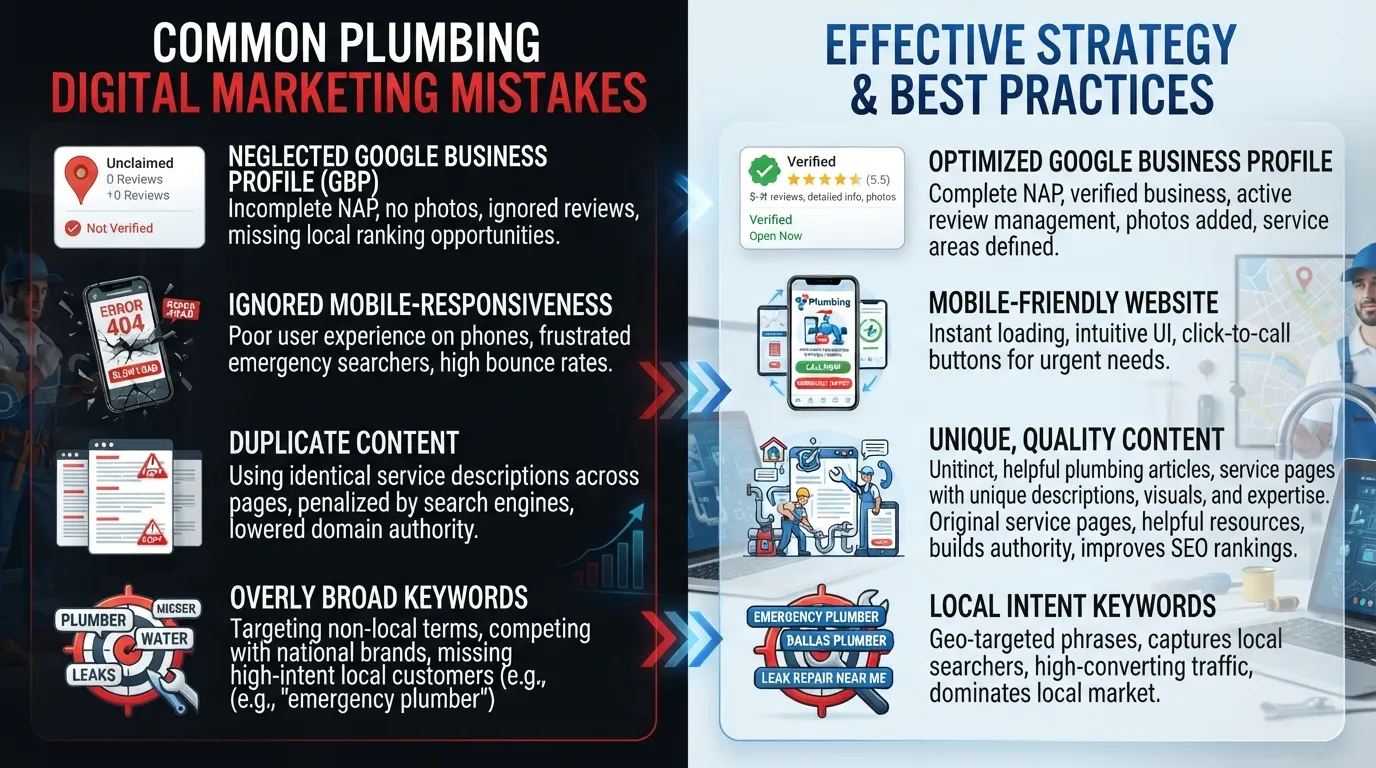 As search engines grow increasingly sophisticated, outdated or aggressive shortcuts can result in algorithmic penalties or long-term visibility drops. Avoiding common traps ensures your plumbing business stays resilient against modern search updates.
Mistakes That Hurt Visibility and Trust
Many local plumbing companies sabotage their own digital marketing efforts by relying on spammy tactics or lazy shortcuts. Avoid these major pitfalls:
- Fake Reviews: Buying bulk reviews or incentivizing fake testimonials is easily detected by modern filters and can get your Google Business Profile suspended overnight.
- Thin City Pages: Publishing dozens of low-effort, doorway city pages with identical text just to manipulate local search results.
- Inconsistent NAP: Having conflicting business names, old addresses, or mismatched phone numbers scattered across the web.
- Keyword Stuffing: Overloading your service pages with unnatural phrases like “best plumber in [City] emergency plumbing [City]” until the text becomes unreadable.
- The Single-Page Trap: Cramming emergency repairs, water heaters, and drain cleaning all onto one generic homepage instead of building dedicated service pages.
Why AI-Generated Generic Content Is Risky
Relying completely on unedited, AI-generated text to mass-produce plumbing articles often backfires under Google’s strict automated spam and quality systems.
- Lack of Real-World Experience: Generic AI content regurgitates surface-level information without demonstrating first-hand plumbing expertise or practical diagnostics.
- Algorithmic Demotions: Search engines reward original, high-value insights, penalizing unhelpful pages that exist solely to game search rankings.
- Loss of Brand Voice: Cookie-cutter text fails to build genuine rapport or trust with panicked homeowners looking for a reliable local professional.
What Google’s 2026 Core Updates Mean for Plumbers
Recent core algorithm updates have heavily prioritized people-first, helpful content that genuinely satisfies user intent rather than prioritizing search engine manipulation. For plumbing companies, this means your strategy should align closely with Google’s guidance on creating helpful, reliable, people-first content. Google’s systems reward authentic field experience, clear local answers, and robust E-E-A-T signals over automated volume.
Preparing for AI Overviews and AI Mode
As search evolves with AI Overviews and conversational AI assistants handling local queries, your website must be structured to feed these systems accurate data.
- Direct Answer Formats: Structure your content with clear, concise answers to common troubleshooting questions so AI models can easily parse and cite your business.
- First-Hand Expertise: Showcase real technician bios, actual project stories, and authentic imagery that AI cannot replicate.
- Consistent Information: Maintain a rock-solid, uniform digital footprint across your Google Business Profile and website so AI assistants can verify your legitimacy instantly.
FAQs: Plumbing SEO
Here are clear, direct answers to the most common questions plumbing business owners ask about search engine optimization, local rankings, and digital marketing costs.
How does SEO help a plumbing business get more customers?
SEO places your plumbing business at the top of search engine results when local homeowners actively search for urgent repairs. By capturing high-intent traffic through optimized service pages and Google Maps, SEO consistently drives inbound phone calls, emergency leads, and booked jobs without relying solely on paid advertising budgets.
How does SEO build trust for plumbers?
SEO builds trust by prominently displaying verified customer reviews, clear licensing credentials, and real-world project photos across your digital footprint. When search algorithms rank your optimized Google Business Profile and authoritative website at the top, panicked homeowners perceive your company as an established, reliable local expert.
Is local SEO enough for a plumbing company?
Local SEO is the core foundation for any plumbing company because service jobs depend strictly on geographic proximity. However, combining local Google Business Profile optimization with broader service-area landing pages and educational troubleshooting content ensures you capture both immediate emergency calls and long-term regional demand.
How long does it take for plumbing SEO to work?
Plumbing SEO typically takes between 3 to 6 months to generate significant movement in organic search rankings and steady lead flow. While Google Business Profile optimization can yield quick local visibility wins within weeks, achieving dominant market authority across competitive zip codes often requires six months to a full year of consistent effort.
How much does SEO for plumbers cost?
Plumbing SEO costs vary widely depending on your market competition, city size, and whether you manage it yourself or hire a professional. DIY efforts cost only your time, while quality freelance or agency retainers generally range from $1,000 to $3,000+ per month based on the scope of technical work, content creation, and link building required.
What is the most important ranking factor for plumbers on Google Maps?
Proximity, relevance, and prominence are the core pillars of Google Maps rankings, with proximity and review signals holding the most weight. Having an fully optimized Google Business Profile with exact-match service categories, a strong review rating, and consistent local NAP citations is crucial for ranking in the local 3-pack.
Are reviews important for plumbing SEO?
Reviews are vital for plumbing SEO because high star ratings and positive testimonials directly influence both Google Map rankings and consumer conversion rates. Fresh, consistent reviews act as powerful social proof that reassures panicked homeowners and signals ongoing business legitimacy to search algorithms.
Can a plumber do SEO without hiring an agency?
A plumber can successfully handle foundational SEO tasks—such as optimizing their Google Business Profile, gathering customer reviews, and updating service hours—without an agency. However, highly technical aspects like schema markup, site speed optimization, and advanced keyword strategy often require specialized tools or professional guidance.
Is SEO better than Google Ads for plumbers?
SEO is generally better for long-term ROI and brand trust because organic rankings continue to drive free leads even when you pause your active marketing spend. Google Ads offer instant visibility for immediate cash flow, so many successful plumbing companies combine both strategies to balance short-term emergencies with sustainable growth.
Conclusion and Next Step
In the plumbing industry, digital success boils down to a powerful combination: maximum local visibility and rock-solid consumer trust. When your Google Business Profile and organic search rankings put you at the top, and your stellar reviews and verified expertise convince panicked homeowners to call, your calendar stays booked with high-margin jobs without draining your budget on ads.
Your First Action Step: Go claim or open your Google Business Profile today. Check that your primary and secondary categories are fully optimized, your phone number and address are completely accurate, and you have an easy system ready to request a review from your very next happy customer.
Ready to stop losing emergency repair calls to your local competitors? Implement these foundational SEO strategies today, establish your authority, and watch your plumbing business become the trusted go-to choice in your service area.
Home Improvement Researchers & Guides Editors
Meet the Nest Team, a collective of dedicated researchers, home improvement enthusiasts, and industry writers sharing practical guides, thorough category research, and trusted solutions for residential repairs and thoughtful home upkeep.