Typical HVAC Equipment Markups Explained
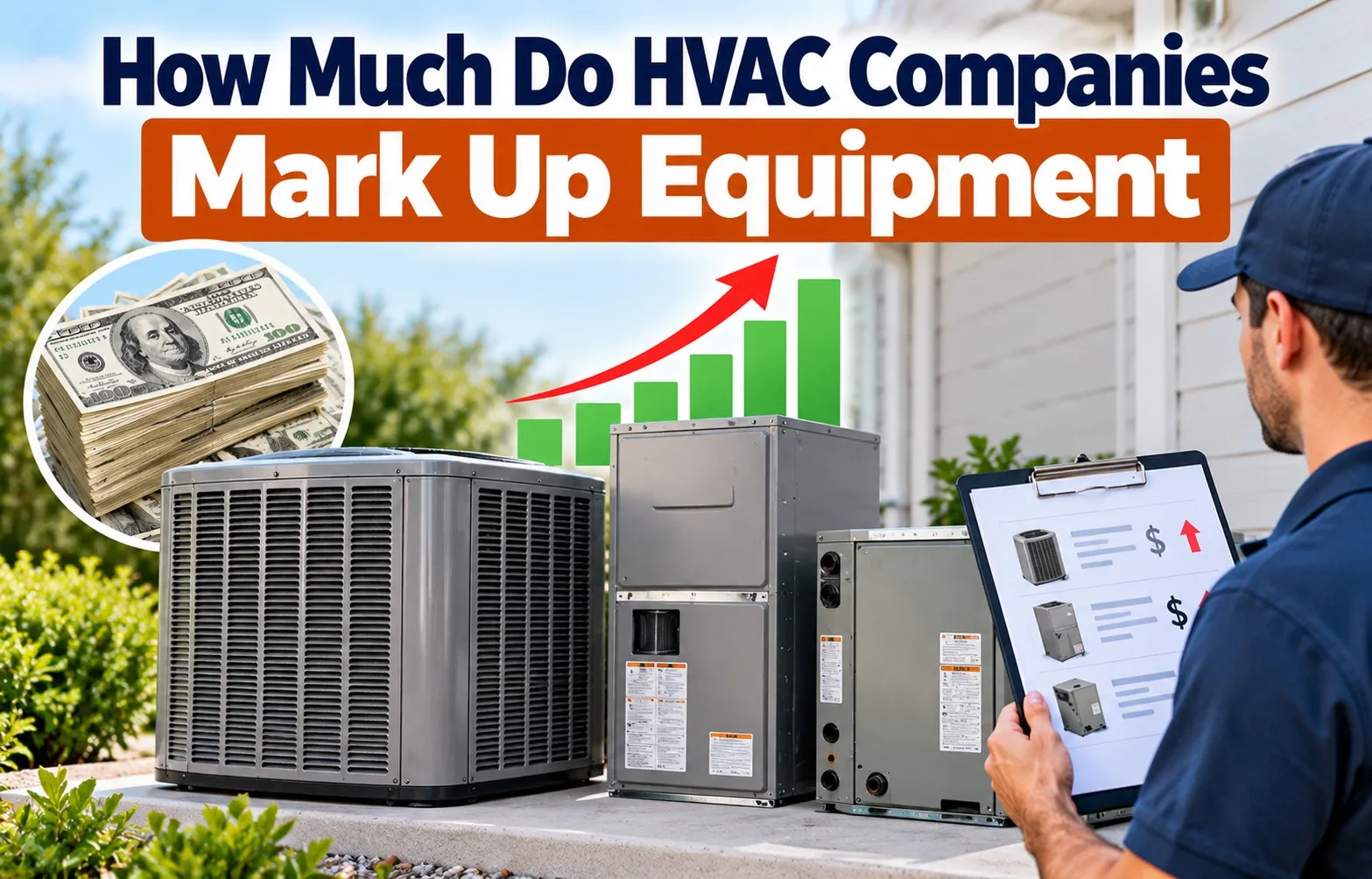 H typicVAC companiesally mark up major heating and cooling equipment by 25% to 100%, while individual replacement parts often carry markups between 100% and 300%. For a complete system, contractors commonly apply a 2x to 3x multiplier to the wholesale cost to calculate the final installed price.
This markup structure covers critical operational expenses that extend far beyond the physical hardware. The final price tag accounts for specialized labor, transit, licensed installation, warranty reserves, and ongoing business overhead required to run a compliant service operation.
Major Equipment vs. Small Replacement Parts
HVAC contractors categorize items into distinct pricing tiers based on initial wholesale cost and handling requirements. Heavy mechanical units and small electrical components follow vastly different pricing scales:
- Major Equipment (25% to 100% Markup): High-ticket items like a furnace, central AC unit, or heat pump carry lower percentage markups due to their high baseline cost, though the dollar amount remains substantial.
- Minor Parts & Components (100% to 300%+ Markup): Small items like capacitors, contactors, flame sensors, and expansion valves carry higher percentage markups to cover inventory holding, immediate truck stocking, and swift dispatch costs.
Because stocking thousands of small parts carries continuous administrative and storage costs, a $15 capacitor may be priced at $100 to $150 on a service call. Conversely, a $3,000 heat pump wholesale unit might be quoted at $4,500 to $6,000 before comprehensive labor charges are factored in.
The 2x to 3x Multiplier Rule: What Contractors Charge
In residential HVAC sales, contractors frequently use a system multiplier—typically ranging from 2.0 to 3.0—when converting raw wholesale cost into a retail estimate. This formula establishes the baseline price for the job before factoring in extraordinary site modifications.
For example, applying standard multipliers to a wholesale furnace purchase yields predictable retail figures:
- 2.0x Multiplier (100% Markup): A wholesale furnace priced at $2,000 is calculated at $4,000.
- 2.5x Multiplier (150% Markup): A wholesale furnace priced at $2,000 is calculated at $5,000.
- 3.0x Multiplier (200% Markup): A wholesale furnace priced at $2,000 is calculated at $6,000.
This multiplier helps contractors hit target gross profit margins required to sustain operations, support technical staff, and provide multi-year workmanship guarantees.
Why Bare Wholesale Prices Are Misleading to Consumers
Looking up the retail price of a furnace or AC unit online often creates unrealistic expectations. Online HVAC distributors display uninstalled hardware costs that exclude the essential resources needed to turn equipment into a functioning, safe system.
Comparing wholesale prices directly to a professional installation estimate overlooks critical operational realities:
- Lack of Consumer Access: Top-tier manufacturers sell exclusively through licensed wholesale distributors, restricting direct sales to uncertified buyers.
- Unbundled Supplies: Bare equipment pricing omits necessary installation materials like sheet metal transition ducts, line sets, electrical disconnects, drain lines, and gas piping.
- Risk and Liability Transfer: A wholesale seller provides zero installation safety guarantees, whereas a licensed contractor assumes full technical liability for code compliance and safe operation.
Purchasing an HVAC unit involves buying a fully operational, warrantied thermal system tailored to a building’s specific load calculations, rather than merely acquiring a box of metal parts.
Markup vs. Gross Profit Margin: What Is the Difference?
Confusing markup with profit margin is the single largest source of friction between homeowners and HVAC contractors. While a 100% markup on equipment sounds like massive overcharging, it does not mean the contractor is pocketing half of your quote as personal income.
Understanding how pricing models work reveals that markup is simply an addition to hardware costs, whereas profit margin reflects the actual money remaining to cover operational expenses and business survival.
Defining Markup vs. Gross Profit Margin
Markup and gross profit margin use the exact same financial numbers, but they measure completely different operational ratios within a business balance sheet:
- Markup Percentage: The percentage added directly to the wholesale equipment price (Cost of Goods Sold or COGS) to establish a base selling price. It looks backward from cost to price.
- Gross Profit Margin: The percentage of total revenue that remains after paying for the direct equipment and material costs (COGS). It looks forward from total revenue to actual revenue kept.
In flat-rate pricing systems—where customers are quoted a single upfront price for the entire installation—contractors calculate margin to ensure the total ticket price absorbs labor, overhead, and warranty risks while leaving a small net profit margin.
Mathematical Breakdown: How a 50% Margin is Calculated
To see how markup and gross margin diverge in practice, consider a standard central AC replacement project using standard time & materials accounting.
Applying a 100% markup to a wholesale unit results in a significantly lower gross profit margin than most consumers expect:
- Wholesale Equipment Cost (COGS): $3,000
- Markup Applied (100%): +$3,000
- Final Selling Price to Customer: $6,000
- Gross Profit Dollar Amount: $3,000 ($6,000 total price minus $3,000 wholesale cost)
- Calculated Gross Profit Margin: 50% ($3,000 profit divided by $6,000 selling price)
While the equipment was marked up by 100%, the gross profit margin is only 50%. Out of that 50%, the contractor must still pay installation labor, truck fuel, insurance, shop rent, and technician benefits before any net profit is realized.
Why HVAC Companies Target a 40% to 50% Gross Margin
Running a specialty mechanical contracting business carries extraordinary overhead expenses compared to traditional retail stores. HVAC companies target a 40% to 50% gross margin on every project simply to break even on corporate operating expenses.
Maintaining a target gross margin protects the company from unexpected job site liabilities and operational costs:
- High Fixed Overhead: Fleet vehicles, specialized diagnostic tools, EPA certifications, warehouse storage, and ongoing technician training rapidly consume revenue.
- Unbilled Labor Hours: Drive time, equipment pickup, site measuring, and administrative dispatching are non-billable hours that must be funded through job margins.
- Net Profit Reality: After all operating expenses, overhead, and labor costs are deducted from a 50% gross margin, a typical HVAC business retains only a 5% to 15% actual net profit margin.
Without maintaining a minimum 40% gross profit margin, an HVAC company risks insolvency after encountering a single major warranty dispute or unpredicted installation delay.
What Does the HVAC Equipment Markup Actually Pay For?
HVAC equipment markup is not pure profit; it is the financial engine that funds the complex infrastructure required to install, test, and maintain heavy thermal machinery safely. Contractors must use these margins to absorb real-world business operating costs that go far beyond delivering a metal box to a home.
Every dollar added to wholesale equipment cost directly supports technical labor protection, specialized logistical handling, environmental compliance, and legal liability coverage.
Labor Warranties and Service Call Reserves
Equipment markups function as an internal insurance fund that covers free warranty labor calls and unexpected post-installation part failures during the first year of operation. While manufacturers supply replacement parts under warranty, they do not pay technicians to drive to a home, diagnose the failure, and install the new part.
Key financial protections funded by markup reserves include:
- Labor Guarantee Backing: Contractors commit to backing their installation work for one to ten years, absorbing 100% of the labor cost if a factory component fails prematurely.
- Callback Reserves: A portion of equipment margin covers return service visits to fine-tune refrigerant charges or balance airflow after initial startup.
- Technician Labor Continuity: Ensuring skilled labor remains compensated even when seasonal weather swings slow down daily installation volume.
Without this financial buffer, an HVAC company would face immediate bankruptcy the moment multiple early-season equipment failures required extensive free labor hours to resolve.
Unseen Installation Materials (Copper lines, sheet metal, electrical whips)
Wholesale equipment pricing reflects only the core mechanical unit, omitting hundreds of dollars of custom fabrication hardware and auxiliary materials required for a complete system connection. A functional installation demands numerous peripheral components that add up quickly behind the scenes.
Essential unbundled materials absorbed by project pricing include:
- Refrigerant Line Sets: Heavy-gauge insulated copper tubing required to connect indoor evaporators to outdoor condensing units safely.
- Custom Sheet Metal: Hand-fabricated transitions, plenums, and filter racks tailored to fit exact residential ductwork configurations.
- Electrical Hardware: Outdoor disconnect boxes, weatherproof whips, heavy-duty electrical wiring, and surge protectors.
- Drainage & Venting: PVC piping, condensate pumps, safety float switches, and high-temperature flue pipes for combustion gases.
Supplying these components requires contractors to maintain fully stocked warehouses and service vehicles, turning raw equipment into a fully integrated thermal network.
Equipment Staging Heavy Transport and EPA Refrigerant Recovery
Heavy mechanical units require specialized industrial logistics, secure warehouse staging, and strict adherence to federal environmental disposal laws before they ever reach a homeowner’s basement or rooftop. Managing hundreds of pounds of steel and pressurized chemicals involves significant risk and regulatory overhead.
Logistical and environmental responsibilities covered by project margins include:
- Freight & Staging Costs: Forklifts, heavy-duty liftgate trucks, and secure warehouse facilities needed to store multi-ton systems safely prior to installation.
- EPA Compliance: Mandatory federal certification and recovery machinery required under EPA rules to extract, contain, and recycle old ozone-depleting refrigerants.
- Old Equipment Disposal: Safe removal, hauling, and eco-friendly recycling fees for heavy defunct furnaces and air conditioners.
Failing to handle refrigerant recovery or heavy transport according to legal standards results in severe federal fines and environmental hazards for the contracting business.
Corporate Overhead (Insurance licensing, specialized diagnostic tools fleet fuel)
Running a licensed mechanical trade business demands immense fixed overhead costs that must be distributed across equipment and labor sales to maintain ongoing operations. Professional-grade equipment, legal compliance, and mobile operations require continuous capital investment.
Core overhead expenses funded through overall business margins include:
- High-Limit Liability Insurance: Comprehensive commercial property and general liability policies protecting homeowners against property damage during major construction work.
- Licensing & Bonding: Mandatory state contractor licenses, local municipal permits, and mandatory surety bonds for every job site.
- Specialized Diagnostic Gear: Digital manifold gauges, combustion analyzers, thermal imaging cameras, and nitrogen pressure testing kits.
- Fleet Maintenance & Fuel: GPS-tracked service vans equipped with specialized shelving, ladders, and daily inventory restocks.
These operational expenditures ensure that a qualified, insured, and properly equipped technician arrives at a property ready to resolve complex mechanical issues safely and legally.
HVAC Parts Markup Chart & Multiplier Matrix
Understanding standard pricing matrices allows homeowners to evaluate quotes objectively without getting blinded by individual line items. HVAC contractors utilize sliding-scale multiplier tables to ensure smaller parts absorb truck-stocking overhead while keeping whole-system replacement costs fair and competitive.
The lower the base cost of an item, the higher the markup percentage required to cover the administrative, holding, and trip costs associated with installing that part.
Standard HVAC Parts vs. System Markup Matrix
The following benchmark matrix illustrates how markups, multipliers, and resulting target gross margins scale based on the wholesale value of the equipment or replacement component.
Low-Cost Components (Capacitors Fuses) vs. High-Cost Hardware
Sliding scales prevent business losses on minor repair service calls. Replacing a dual-run dual-value capacitor or a burnt contactor requires a skilled technician to diagnose the fault, pull the part from a mobile inventory, and test system electrical draw.
This sliding scale creates distinct pricing tiers across standard components:
- Capacitor or Contactor: Wholesale cost is $10 to $25. Marked up at 300%+ (priced at $75 to $150) to cover the logistics of stocking that exact specification on every service truck.
- Blower Motor or Evaporator Coil: Wholesale cost is $300 to $700. Marked up at 70% to 100% (priced at $600 to $1,400) balancing higher component cost with specialized labor requirements.
- Compressor or Whole AC Condenser: Wholesale cost ranges from $1,200 to $3,500. Marked up at 30% to 50% to maintain overall job profit margins without pricing the customer out of a necessary system upgrade.
If a contractor charged only a 30% markup on a $15 capacitor, they would earn $4.50—failing to cover the fuel spent driving the truck to the distributor.
How Contractors Use Multiplier Tables for Transparent Estimates
Modern service contractors rely on structured flat-rate pricing software to maintain consistency across technical teams and eliminate guesswork. These systems automate the conversion of wholesale inventory feeds into transparent consumer estimates.
Using a standardized parts markup chart guarantees several pricing controls:
- Standardized Matrix Billing: Every customer receives identical pricing based on established company margins rather than technician discretion in the field.
- Automated Cost Indexing: Prices automatically
Can You Buy Your Own HVAC Equipment to Avoid the Markup?
Attempting to bypass contractor markups by purchasing HVAC systems directly online is one of the most common shortcuts homeowners explore. While ordering a discounted furnace or condenser directly from an online distributor appears to save thousands upfront, it almost always leads to significant financial losses and legal headaches down the road.
Understanding the strict operational, legal, and warranty frameworks of mechanical contracting reveals why buying your own equipment usually backfires.
The Dangers of Sourcing Your Own AC Unit Online
Sourcing heavy mechanical equipment without professional guidance introduces immense technical and financial hazards. Online retailers often sell liquidized, outdated, or slightly damaged units without verifying if the hardware actually matches your home’s structural requirements.
Key risks involved in purchasing equipment independently include:
- Incorrect Sizing Risks: Homeowners typically rely on square footage rules of thumb rather than a engineering-grade Manual J load calculation, resulting in oversized systems that short-cycle or undersized units that fail to cool.
- Shipping and Transit Damage: Heavy freight deliveries frequently arrive with micro-fractures in copper coils or bent internal frames that are impossible to inspect until the unit is pressurized.
- Missing Peripheral Components: Online listings rarely include match-tested evaporator coils, correct metering devices, or compatible high-voltage electrical disconnects required for safe operation.
When an independently purchased unit arrives damaged or mismatched, the homeowner bears 100% of the financial burden for return freight and restocking fees.
Warranty Void Risks: Manufacturer Policies Explained
Major HVAC manufacturers—including Carrier, Trane, Lennox, and Rheem—maintain strict distribution policies regarding who can purchase and commission their machinery. Buying equipment unbundled from an authorized dealer channel almost always voids factory coverage immediately.
Manufacturer policies strictly regulate warranty validity through clear guidelines:
- Voided Warranty Policies: Most top-tier brands explicitly state in their warranty documentation that equipment purchased online or installed by an unlicensed party carries zero factory warranty protection.
- No Parts Coverage: If a compressor or heat exchanger fails six months after installation, the manufacturer will refuse to supply replacement parts under warranty if the serial number traces back to an unauthorized internet seller.
- Unprotected Labor Claims: Without factory backing, any component failure requires the homeowner to pay out-of-pocket for both the replacement component and the technician’s labor hours.
Saving $1,000 on initial equipment markup can easily cost $3,000 to $5,000 later in un-warrantied repair bills.
Why Reputable Contractors Refuse Labor-Only Jobs
Licensed contractors almost universally decline requests to perform “labor-only” installations on homeowner-supplied equipment. Professional installers operate under high liability risks and cannot risk their business reputation on unverified hardware.
Reputable HVAC companies refuse customer-provided equipment due to several core operational factors:
- Liability Risks: If a homeowner-supplied furnace leaks carbon monoxide or causes an electrical fire, the installing contractor remains legally liable in court, regardless of who bought the unit.
- Inability to Honor Labor Guarantees: Contractors cannot offer a 1-year or 5-year labor guarantee on a system when they cannot guarantee the factory integrity of the internal parts.
- Uncompensated Downtime: If a technician uncrates a customer-supplied AC unit and finds a factory defect midway through the job, the contractor loses thousands in wasted crew labor hours while waiting for replacement parts.
Contractors who do agree to install customer-supplied equipment are often unlicensed, uninsured, or forced to charge inflated hourly labor rates to offset their liability exposure.
How Homeowners Can Tell If an HVAC Quote Is Fair
Evaluating an HVAC estimate requires shifting your focus from individual part markups to the total value delivered by the installation team. A fair HVAC quote balances quality hardware, proper system sizing, comprehensive warranty coverage, and code-compliant workmanship to protect your home’s long-term comfort and property value.
By learning how to analyze estimates holistically, homeowners can make confident decisions without getting bogged down in line-item skepticism.
Evaluating Total System Value Over Isolated Line Items
Focusing strictly on wholesale equipment markups ignores the critical engineering and installation labor that determines how well a system performs. A high-end AC unit installed incorrectly will underperform and fail prematurely compared to a mid-tier unit installed with precision.
When assessing overall quote value, review the complete scope of work rather than isolated line items:
- Design and System Sizing: Verify if the contractor performed a Manual J heat load calculation to match the system to your home’s square footage, insulation levels, and climate zone.
- Energy Efficiency Standards: Confirm the energy efficiency rating (SEER2 rating) matches your climate requirements to maximize long-term utility savings.
- Scope of Installation Materials: Ensure the total system replacement cost covers critical accessories, such as new copper line sets, duct transitions, smart thermostats, and updated electrical disconnects.
- Warranty Protections: Compare both the manufacturer’s parts warranty (typically 10 years) and the contractor’s written labor guarantee (1 to 10 years).
Evaluating these elements together provides a realistic picture of the total value provided by a professional contractor.
Red Flags to Watch Out For When Reviewing Quotes
Not all low quotes represent a bargain, and not all high quotes indicate quality. Identifying common red flags during the estimate process helps protect homeowners from uncertified labor and predatory pricing.
Watch out for these critical warning signs when reviewing proposals:
- Vague or Unwritten Scope of Work: Quotes that list only a flat price without specifying equipment model numbers, SEER2 ratings, or included installation materials.
- Lack of Permitting: Contractors who suggest skipping local building permits to save money, leaving you vulnerable to safety risks and uninspected work.
- “Rules of Thumb” System Sizing: Estimators who select equipment capacity solely based on square footage without evaluating ductwork, windows, or insulation.
- Extremely Low Bid Prices: Quotes significantly lower than competitors often indicate cut corners, uncertified labor, or missing insurance coverage.
A reputable contractor welcomes questions and provides clear, documented details for every phase of the project.
Understanding Standard Deposit and Payment Rules
Understanding payment expectations helps homeowners protect their funds and spot illegitimate operators. Reliable contractors follow standard financial practices that align with state trade regulations.
Follow these standard payment guidelines when committing to a project:
- Reasonable Contractor Deposit: Standard upfront deposits typically range between 10% and 30% of the total quote (or up to 50% for specialty custom equipment). Be cautious of contractors demanding 100% upfront before work begins.
- Defined Payment Milestones: Larger commercial or residential projects should follow a clear schedule, such as a deposit upon signing, a mid-point payment after rough-in, and final payment upon completion.
- Final Sign-Off After Inspection: Always withhold the final payment until the system is fully commissioned, operational, and passes local building code inspection.
Adhering to structured payment terms protects your financial investment and ensures the job is finished to professional standards.
Frequently Asked Questions
Understanding contractor pricing models and standard industry practices helps homeowners evaluate proposals with confidence. Below are direct, authoritative answers to the most common financial questions asked by consumers and property owners.
What is a typical markup on a new HVAC furnace or AC unit?
A typical markup on a major HVAC unit ranges from 25% to 100% (a 1.25x to 2.0x multiplier) over wholesale cost. While individual replacement parts may be marked up 100% to 300%, complete heating and cooling systems carry lower percentage markups due to their higher baseline equipment cost.
Key factors influencing standard system markups include:
- Equipment Tiers: Standard single-stage units feature lower markups, whereas high-efficiency, multi-stage, or variable-speed systems involve specialized staging and higher technical liability.
- Regional Market Rates: Local labor costs, overhead expenses, and municipal permitting requirements dictate baseline markup thresholds across different zip codes.
- Bundled Installation Services: Overall markup covers staging, delivery, EPA-compliant refrigerant handling, and custom ductwork transitions needed for installation.
What is the 20% rule in HVAC business management?
The 20% rule in HVAC business management refers to the financial benchmark target of achieving a 20% net profit margin after all direct labor, job materials, and fixed corporate overhead expenses have been paid. It serves as an essential metric in contractor financial planning.
Core components of the 20% rule metric include:
- Gross Margin Allocation: Generating a 45% to 50% gross profit margin on jobs to absorb overhead demands.
- Overhead Cap: Keeping fixed overhead costs (fleet maintenance, insurance, rent, utilities, office personnel) at or below 25% to 30% of total revenue.
- Business Sustainability: Retaining a net profit buffer to re-invest in specialized tools, technician training, and capital reserves during mild seasonal weather.
Is a 40% to 50% gross profit margin normal for contractors?
Yes, a 40% to 50% gross profit margin is standard across the residential HVAC industry. Because mechanical contracting involves heavy physical risk, mobile fleets, and long-term labor warranties, high gross margins are mandatory to maintain solvent operations.
Reasons high gross margins are required for daily operations include:
- Unbilled Labor Costs: Compensating technical staff for travel time, site safety checks, and continuous code training.
- Warranty Reserves: Setting aside financial reserves to cover no-charge labor calls during the initial 1-year to 10-year warranty period.
- Capital Maintenance: Maintaining fleet reliability, safety equipment, and high-tech diagnostic tooling.
Should you put a large deposit down before HVAC installation?
No, you should never pay a 100% deposit before an HVAC system is delivered and fully commissioned. Standard contractor deposit limits range between 10% and 30% upon contract signing to cover initial equipment order processing and scheduling.
Recommended deposit and payment guidelines include:
- Standard Upfront Percentage: Paying 10% to 30% down (or up to 50% only for custom-fabricated or commercial equipment orders).
- Progress Milestones: Paying an interim installment when heavy machinery arrives on-site or after initial rough-in work is verified.
- Final Payment Holdback: Withholding the final payment until the system is fully operational, passes local municipal code inspection, and matches your written HVAC pricing guide proposal.

Oscar Vance | Master Plumber & Drainage Expert
Meet Oscar Vance, a licensed master plumber sharing practical solutions on residential repairs, preventive maintenance, and thoughtful home upkeep.