Core Coverage Overview
 Planning a re-roofing project or repairing a section of your home requires accurate material estimation to control costs and eliminate project delays. Understanding exact bundle measurements ensures you order the correct quantities before installation begins.
How Many Square Feet Are Covered by One Bundle of Shingles?
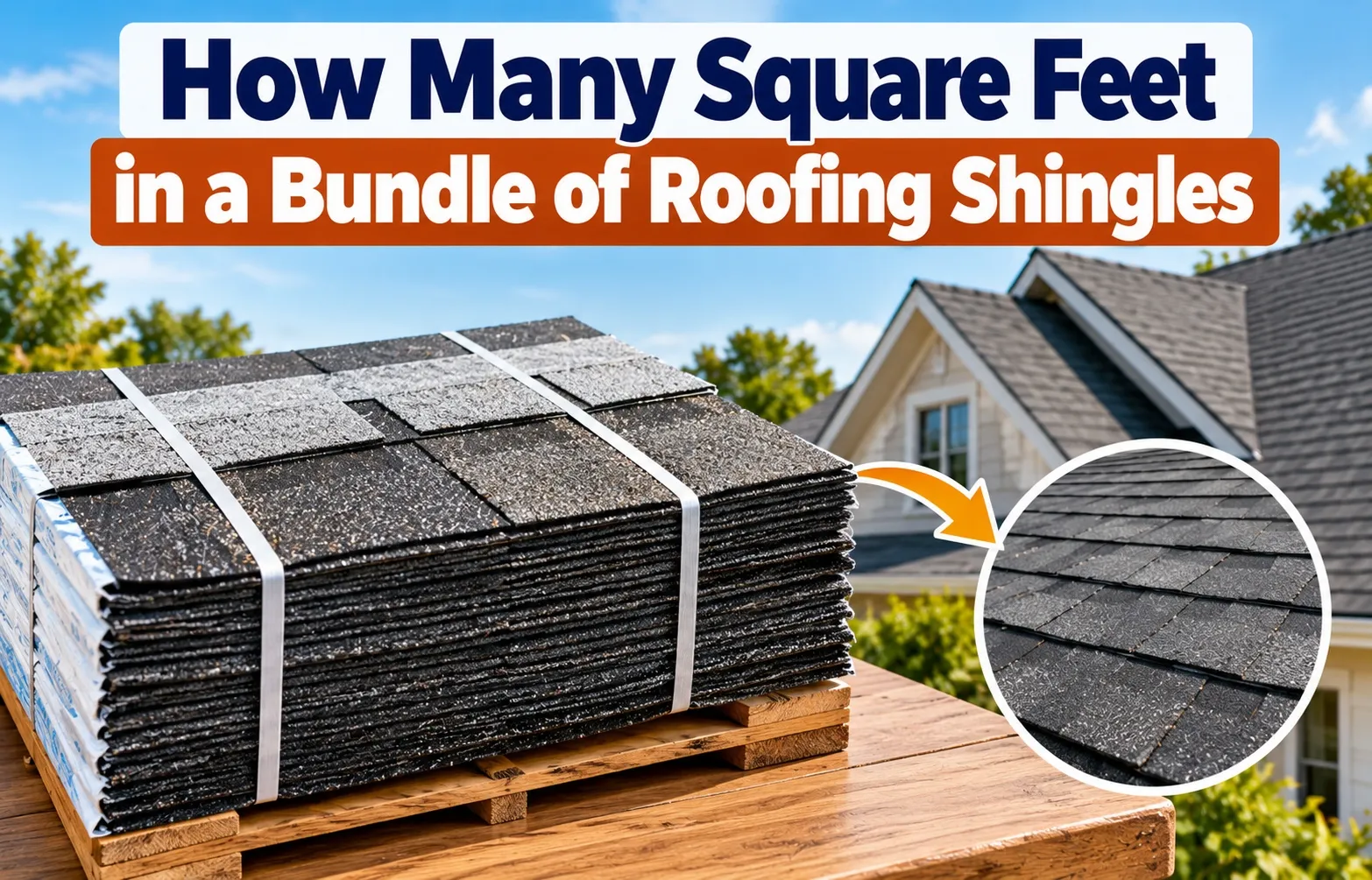
A single standard bundle of shingles provides 33.3 square feet of effective roof coverage once laid and overlapped according to manufacturer specifications.
While physical product dimensions vary between manufacturers, coverage calculations rely on standardized industry metrics:
- Standard 3-Tab Shingles: 33.3 sq. ft. per bundle (3 bundles required per square).
- Architectural / Dimensional Shingles: 33.3 sq. ft. per bundle (3 bundles required per square).
- Luxury / Heavyweight Shingles: 20 to 25 sq. ft. per bundle (4 to 5 bundles required per square due to increased material thickness and weight).
For verified manufacturer specifications and technical installation guidelines, consult the official GAF Roofing Specifications Guide.
Understanding Roofing Terms: Bundles vs. Squares
Roofing contractors measure surface areas in units called “squares” rather than individual square feet to simplify material orders on large surfaces.
To convert your total roof area into ordered materials, use this standard industry conversion formula:
- 1 Roofing Square = 100 Square Feet: The universal measurement unit for residential roofing estimates.
- 3 Bundles = 1 Roofing Square: Standard 3-tab and architectural laminated shingles require 3 bundles to complete 100 square feet of coverage.
- Total Bundle Calculation: Multiply total roof squares by 3 to calculate your base bundle requirement before adding waste factor allowances.
Coverage Breakdown by Shingle Type
Shingle bundle coverage varies depending on the design, material density, and thickness of the product you choose. Knowing the specific type of shingle you intend to install prevents underordering and ensures your roof structure can support the total weight of the material.
Standard 3-Tab Shingles Coverage
Standard 3-tab shingles feature a flat, single-layer asphalt design cut into three distinct tabs. They offer clean lines and represent the most lightweight, budget-friendly roofing option.
Key coverage specifications for 3-tab asphalt shingles include:
- Coverage Area: Exactly 33.3 square feet per bundle.
- Quantity per Square: 3 bundles required for 100 square feet of coverage.
- Bundle Weight: Lightweight construction averaging 50 to 65 lbs per bundle, making manual transport easier during DIY projects.
Architectural Dimensional Shingles Coverage (GAF Timberline, Owens Corning)
Architectural shingles (also called dimensional or laminated shingles) are constructed with multi-layered asphalt to create a textured, wood-shake aesthetic. They are the most popular choice for modern residential roof installations.
Leading architectural lines maintain standard coverage dimensions while delivering enhanced durability:
- Industry Standard Coverage: Popular product lines like GAF Timberline HDZ, Owens Corning Duration, and CertainTeed Landmark cover 33.3 square feet per bundle.
- Material Density: Laminated construction increases bundle weight to approximately 60 to 80 lbs per bundle without requiring additional bundles per square.
- Ordering Metric: Exactly 3 bundles make up 1 roofing square (100 sq. ft.).
Heavyweight & Luxury Shingles (Thicker Materials)
Luxury and designer shingles replicate natural slate or premium cedar shakes. Because these premium lines utilize thicker asphalt layers and deep dimensional profiles, individual shingles are significantly heavier and stiffer.
When calculating material requirements for high-end luxury shingles, standard ratios do not apply:
- Reduced Bundle Coverage: Heavyweight shingles cover only 20 to 25 square feet per bundle to keep individual bundle weights manageable for job site transport.
- Increased Bundle Count: Requires 4 to 5 bundles to complete 1 roofing square (100 sq. ft.) instead of the standard 3.
- Structural Considerations: Bundle weights often exceed 80 to 100 lbs each, meaning a full square can add up to 400 lbs or more to your roof deck.
Estimation Chart for Common Roof Sizes
Estimating total shingle orders requires matching your roof surface area to standard package counts. Using a quick reference chart helps you determine baseline material needs and calculate complete delivery volume before placing an order.
Bundle Calculator Chart for Common Home Sizes
When placing bulk orders with suppliers, manufacturers ship shingles on wooden pallets. Planning orders around full pallet quantities streamlines delivery logistics and prevents freight damage on-site.
Standard delivery packing metrics follow strict weight and volume parameters:
- Pallet Capacity: Most manufacturers stack 36 to 42 bundles per pallet depending on individual product weight.
- Full Pallet Coverage: A single pallet containing 36 bundles covers 12 roofing squares (1,200 sq. ft.) without waste.
- Delivery Weight: One full pallet weighs between 2,20
Waste Pitch and Starter Courses
Calculating roofing materials strictly by square footage division often leads to unexpected shortages on actual job sites. Real-world installation requires accounting for material trimming, geometric slopes, and specialized edge components that basic math misses.
Experienced contractors know that ordering exact net square footage guarantees you will run short before finishing the roof. Factoring in precise waste percentages and specialized components ensures your project stays on budget and finishes without delays.
Adding the Necessary Waste Factor (10% to 15%)
Every roofing installation generates cut-offs, end trimmings, and off-cuts when fitting shingles around roof intersections, chimneys, and vents. Adding a standard waste percentage prevents costly material re-orders.
The universal mathematical formula used by professional roofers to determine total bundle requirements is:
- Standard Formula:
- Simple Gable Roofs: Add a 10% waste factor because straight edge layouts produce minimal scrap.
- Complex Roofs (Hips & Valleys): Add a 15% to 20% waste factor due to diagonal cutting along hip and valley intersections.
Roof Pitch and Complexity Adjustments (Gable vs. Hip/Valley Roofs)
Roof slope and structural complexity directly influence how many shingles are consumed during cutting and fitting. Steeper angles require extra footing care and generate more off-cuts along rake edges.
Understanding structural variables helps refine your material estimates before ordering supplies:
- Gable Roofs: Feature simple two-sided slopes with minimal diagonal cuts, allowing efficient material usage close to the 10% waste threshold.
- Hip and Valley Roofs: Incorporate multiple intersecting planes that demand angled cuts, increasing material waste significantly.
- Steep Slopes (Exceeding 6:12 Pitch): Steep pitch installations require roof jacks, staging, and careful shingle alignment, increasing labor and material handling waste.
Starter Strips and Ridge Caps: The Hidden Materials Trap
A frequent mistake made by DIY homeowners is attempting to calculate field shingles while forgetting specialized starter courses and ridge caps. Ripping standard field shingles to create starter rows ruins structural integrity and voids manufacturer warranties.
Always purchase dedicated perimeter and peak accessories separately from your standard field bundle calculations:
- Starter Strip Shingles: Installed along the eaves and rakes to lock down the first course and resist high winds. Sold in linear foot bundles (typically 100–116 linear feet per bundle).
- Hip and Ridge Cap Shingles: Pre-cut or foldable architectural pieces installed along the peaks and ridges to seal vulnerable junctions. Sold in bundles covering approximately 20 to 33 linear feet.
- Avoid Field Shingle Ripping: Cutting standard 3-tab or architectural shingles into makeshift starter strips leaves exposed adhesive strips and compromises wind resistance ratings.
Practical DIY Questions (Plywood Test & Insurance Rules)
Homeowners and DIYers frequently encounter unique structural and regulatory questions when planning a roof repair or full replacement. Addressing material coverage limits alongside local building codes ensures your repair project complies with legal requirements and avoids unexpected expenses.
Will 1 Bundle of Shingles Cover a 4×8 Sheet of Plywood?
Mathematically, yes. A standard 4×8 sheet of plywood has a surface area of 32 square feet (4 ft × 8 ft = 32 sq. ft.), while one standard bundle of shingles provides 33.3 square feet of coverage.
However, in practical installation scenarios, one bundle may fall short if you are starting from scratch on a bare deck:
- Overlapping Layers: Shingles must overlap vertically and horizontally to create a watertight seal, consuming more total area than a flat surface measurement implies.
- Starter Edge Requirements: Installing shingles on an isolated 4×8 panel requires a starter strip along the bottom edge, which uses additional shingle material or dedicated starter strips.
- Trimming Waste: Off-cuts along the rakes and side borders mean you need slightly more than 32 raw surface square feet of product to cover the panel completely.
What Is the 25% Rule in Roofing?
The 25% Rule is a building code standard enforced across many states and municipalities (including section 1511.1 of the International Building Code). It governs whether a storm-damaged or aging roof can be partially repaired or requires a total replacement.
Key legal and structural implications of the 25% rule include:
- The Core Threshold: If more than 25% of a total roof system or roof section is damaged, repaired, or replaced within a 12-month period, building codes require the entire roof section to be brought up to current code through a total replacement.
- Insurance Impact: Insurance adjusters use this rule during storm damage assessments; if damage exceeds 25% of the roof area, insurance claims typically cover full replacement rather than localized spot repairs.
- Matching Regulations: Beyond structural codes, local laws often mandate uniform appearance, making partial repairs impossible if matching shingles are discontinued.
Average Cost per Bundle and Project Budgeting
Budgeting for roofing materials requires balancing baseline shingle bundle prices with additional component costs like underlayment, drip edges, nails, and disposal fees.
Current retail pricing benchmarks for shingle bundle materials average:
- 3-Tab Shingles: Range between $30 and $40 per bundle (approx. $90 to $120 per roofing square).
- Architectural / Dimensional Shingles: Range between $35 and $60 per bundle (approx. $105 to $180 per roofing square).
- Luxury / Specialty Shingles: Range between $60 and $100+ per bundle (approx. $240 to $500+ per roofing square due to requiring 4–5 bundles per square).
Frequently Asked Questions
How Many Individual Shingles Are Inside One Bundle?
A standard bundle contains approximately 26 individual shingles for 3-tab designs and between 20 and 22 shingles for architectural lines. Because architectural shingles are laminated and thicker, fewer individual units are packed into a bundle to keep the total weight manageable.
How Many Bundles of Shingles Are on a Full Pallet?
A standard shipping pallet contains 36 to 42 bundles of shingles, depending on the manufacturer’s weight specifications and shingle density. Ordering a full pallet typically covers 12 to 14 roofing squares (1,200 to 1,400 sq. ft.) of net surface area before accounting for waste.
How Many Bundles Do I Need for a 20×20 Garage Roof?
A 20×20 garage roof measures 400 square feet (4 roofing squares), requiring a baseline of 12 bundles (4 × 3 = 12). Adding a standard 10% to 15% waste allowance brings the total recommendation to 14 bundles to cover edge cuts and starter rows.
Does a 30-Year Shingle Actually Last 30 Years?
While labeled as “30-year shingles,” architectural shingles typically last between 20 and 25 years in real-world conditions. Factors such as severe weather exposure, roof deck ventilation, attic insulation, and annual maintenance directly impact actual material longevity.

Oscar Vance | Master Plumber & Drainage Expert
Meet Oscar Vance, a licensed master plumber sharing practical solutions on residential repairs, preventive maintenance, and thoughtful home upkeep.