Visual Identification Matrix: TPO vs. PVC Roofing
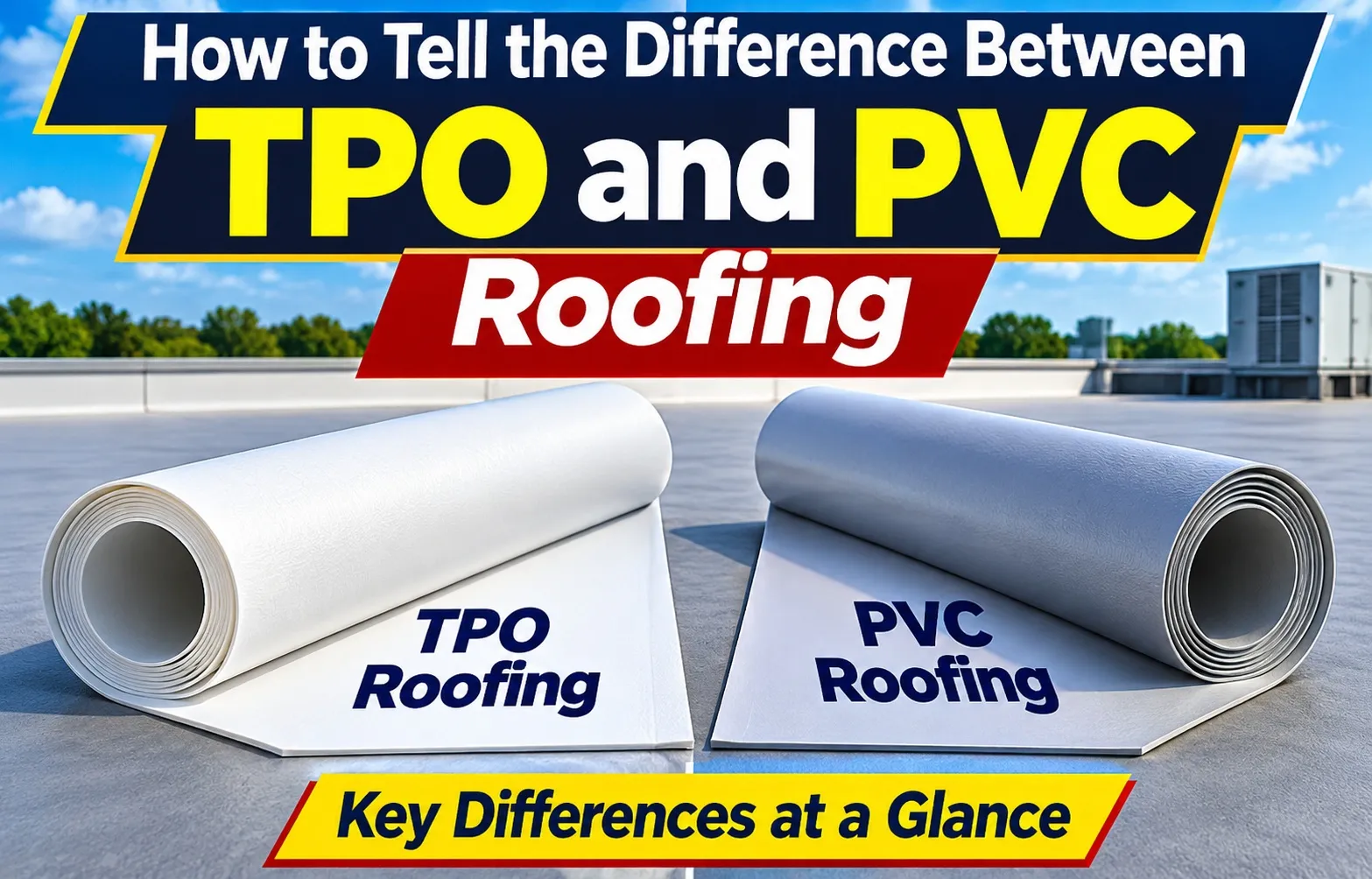 TPO (Thermoplastic Polyolefin) and PVC (Polyvinyl Chloride) are single-ply commercial roofing membranes that look almost identical from a distance. However, you can instantly distinguish them on-site by testing material flexibility, inspecting heat-welded seam edges for dark bleed-out lines, and measuring sheet roll width.
30-Second Field Checklist: TPO vs. PVC at a Glance
When standing on a commercial roof, perform these three physical checks to quickly verify whether the installed membrane is TPO or PVC:
- Tactile Feel & Flexibility: Fold a loose edge or press firm thumb pressure into the sheet surface. PVC contains added plasticizers, giving it a pliable, rubbery, and smooth texture. TPO utilizes a rigid polypropylene-rubber blend, making it noticeably stiffer, harder, and resistant to bending.
- Seam Edge Bleed-Out: Inspect the heat-welded seams along the membrane overlap. PVC melts easily under hot-air welding tools, causing dark gray or black plasticized bleed-out along the seam seam edge. TPO welds cleaner without dark liquid bleed-out along welded edges.
- Roll Width Measurements: Measure the width of an unpenetrated membrane sheet between parallel seams. TPO is manufactured in wide rolls ranging from 10 to 12 feet, whereas PVC is produced in narrower roll widths typically spanning 5 to 6 feet.
Why TPO and PVC Look Identical to the Untrained Eye
Both TPO and PVC fall under the category of single-ply thermoplastic membranes. Their outer appearance frequently tricks property managers, building inspectors, and facility technicians during initial visual audits.
Commercial roof designs intentionally use identical surface colors and manufacturing styles across both product lines:
- Reflective Surface Colors: Both membranes feature bright white, light gray, or tan top sheets engineered to meet Energy Star and cool roof reflectivity guidelines.
- Internal Polyester Scrim: Each sheet encases a woven polyester fabric scrim core sandwiched between top and bottom polymer layers to deliver tear strength.
- Hot-Air Welded Seams: Neither membrane relies on liquid adhesive or lap tape for field seams. Installers hot-air weld lap joints using thermal hot-air equipment for both systems.
Because surface reflection and installation methods overlap completely, identifying your building’s existing single-ply membrane requires checking underlying chemical formulation and physical material characteristics.
The Preliminary Rule-Out: Eliminating EPDM Before Testing
Before testing whether a white or light-colored membrane is TPO or PVC, you must first confirm that the roof is not EPDM (Ethylene Propylene Diene Monomer). Misidentifying an EPDM rubber membrane as a thermoplastic sheet often leads to incorrect repair materials, failed patches, and costly roof leaks.
Is It Really TPO or PVC? How to Rule Out EPDM First
EPDM is a synthetic vulcanized rubber membrane that behaves fundamentally differently from thermoplastic sheets like TPO and PVC. While older EPDM roofs are predominantly black, modern commercial buildings frequently feature white EPDM sheets, causing confusion during visual inspections.
Inspect these key features to instantly rule out an EPDM roof before performing TPO or PVC physical tests:
- Seam Assembly Method: EPDM seams are never heat-welded. Look closely at lap joints: EPDM relies strictly on double-sided seam tape or liquid contact adhesive, leaving a distinct black tape lip or adhesive bead along the seam edge.
- Flashing and Detail Work: EPDM roof penetrations, curb corners, and drain boots use thick, uncured rubber flashing material secured with lap sealant rather than rigid molded boots heat-welded directly to the field sheet.
- Surface Elasticity: EPDM exhibits high rubber-like elasticity. Pulling a loose sample edge stretches it significantly like a heavy rubber band, whereas TPO and PVC resist stretching due to their rigid internal reinforcement scrim.
Key Differences: Vulcanized Rubber (EPDM) vs. Thermoplastic Membranes (TPO/PVC)
Understanding the structural difference between thermoset vulcanized rubber and heat-weldable thermoplastics prevents critical mistakes during field diagnostics and maintenance.
Once you confirm that the roof lacks taped lap joints and black rubber elasticity, you can rule out EPDM and proceed with material-specific physical and chemical testing to identify TPO versus PVC.
4 Physical & Field Tests to Distinguish TPO from PVC Roofing
Professional roofing inspectors use precise diagnostic tests to separate TPO and PVC membranes when visual cues alone are insufficient. Conducting physical pliability checks, analyzing weld bleed-out patterns, inspecting internal reinforcement scrims, and performing chemical solvent evaluations yield definitive material identification on any commercial roof.
Test 1: Pliability, Plasticizers, and Surface Texture (Feel & Grid Pattern)
Testing material flexibility provides an immediate tactile indicator of polymer composition. PVC contains liquid plasticizers that yield a soft, smooth, and highly pliable feel when bent, whereas TPO combines polypropylene and ethylene-propylene rubber into a stiffer, harder, and more rigid sheet.
- Thumb Pressure Test: Press your thumb firmly into the membrane surface. PVC depresses softly and cushions slightly under pressure, while TPO feels rigid and resists indentation.
- Surface Sheen and Scrim Texture: Inspect the sheet face closely under sunlight. PVC often reveals a smooth texture with faint, subtle square grid lines from its underlying polyester reinforcement scrim, whereas TPO features minor dimpling or a slightly pebbled finish.
- Cold-Weather Flexibility: In colder temperatures, PVC retains better low-temperature flexibility due to its plasticizer content, while TPO stiffens noticeably and becomes significantly harder to flex.
Test 2: Hot-Air Weld Seam “Bleed-Out” Analysis (Dark Edge Lines)
Inspecting factory and field heat-welded seams reveals how the underlying polymers respond to thermal fusion. Because PVC softens readily under a hot-air welder, molten plasticized material squeezes out along joint edges, creating a distinctive dark gray or black seam bleed-out line.
- Seam Edge Discoloration: Look for a contrasting dark ribbon of polymer squeezed out along the edge of welded overlaps. This prominent seam bleed-out is a signature marker of PVC installation.
- Clean TPO Welds: TPO formulations require precise thermal energy and resist excessive melting. Consequently, TPO heat-welded seams fuse cleanly without producing messy dark color bleed-out lines along the overlap edge.
- Weld Integrity Check: Probing a PVC seam with a blunt seam tester often catches the soft bleed-out lip, whereas a TPO seam transition feels uniform and sharp-edged.
Test 3: Roll Width and Reinforcement Scrim Edge Inspection
Examining factory roll dimensions and cutting a tiny edge snippet to inspect the internal reinforcement scrim provides absolute verification. TPO and PVC differ significantly in both standard manufacturing roll widths and internal polyester fabric construction.
- Manufacturing Roll Widths: Measure the distance between parallel field seams. TPO is predominantly produced in wide rolls ranging from 10 to 12 feet wide, while PVC is typically manufactured in narrower roll formats spanning 5 to 6.5 feet.
- Internal Scrim Inspection: Examine a small cut sample edge or an exposed blister. Both membranes feature a woven polyester reinforcement scrim sandwiched between polymer layers, but TPO fibers are generally encapsulated in a harder, less soluble matrix.
- Edge Layer Delamination: TPO layers resist separating from the central scrim without intense mechanical pulling, whereas PVC top and bottom coats peel away cleanly when heated.
Test 4: Solvent Reaction Test (MEK / Acetone Exposure)
Chemical reactivity testing offers the ultimate scientific verification for roofing contractors. Applying a solvent like MEK (Methyl Ethyl Ketone) or acetone to a hidden sample scrap tests the material’s chemical reactivity and polymer solubility.
- MEK Application: Apply a small amount of MEK (Methyl Ethyl Ketone) to a clean cloth and rub a non-critical edge of the membrane sample for several seconds.
- PVC Chemical Reactivity: PVC exhibits high chemical solubility when exposed to MEK or strong solvents, quickly softening, becoming tacky, and dissolving its top layer into a sticky residue.
- TPO Chemical Resistance: TPO displays strong chemical inertness against standard PVC solvents, remaining relatively resistant and failing to dissolve or soften rapidly under MEK exposure.
Technical & Performance Comparison: TPO vs. PVC
Evaluating single-ply commercial membranes requires comparing long-term physical characteristics alongside initial installation costs. While TPO and PVC share similar reflective white appearances, their underlying chemical formulations drive vastly different performance outcomes in chemical resistance, fire retardancy, UV weathering, and operational lifespan.
Side-by-Side Performance Matrix (Table)
The operational metrics below detail how standard commercial grade thickness choices impact long-term roof stability across both system types:
Chemical & Grease Resistance: Restaurant Vents vs. Standard Commercial Roofs
Chemical exposure represents the single largest factor determining membrane survivability on commercial facilities. PVC features high chemical resistance to hydrocarbons, acids, animal fats & industrial grease, making it the industry standard for restaurants, commercial kitchens, and manufacturing sites.
- Rooftop Exhaust Exhaust Vulnerability: Animal fats discharged from commercial kitchen exhaust fans rapidly dissolve TPO compounds, leading to membrane swelling, delamination, and seam failure within months.
- PVC Chemical Stability: The chlorine backbone of PVC prevents oils and harsh chemicals from breaking down its plasticized polymer structure, preserving membrane integrity around kitchen hoods.
- Standard Warehouse Applications: For standard storage warehouses, retail buildings, or office complexes lacking chemical exhaust, TPO provides sufficient environmental resistance at a lower cost per square foot.
Fire Resistance & Chlorine Content
Fire ratings differ substantially based on chemical elements present within each material’s polymer chain. PVC naturally contains over 50% chlorine content by weight, conferring inherent fire retardancy without heavy reliance on external fire-proofing additives.
- Self-Extinguishing Behavior: When exposed to direct flame, PVC produces a char layer and self-extinguishes as soon as the ignition source is removed.
- TPO Flame Retardant Additives: TPO consists of ethylene-propylene rubber and polypropylene, which naturally burn similarly to paraffin wax. Manufacturers must blend flame-retardant chemicals into the top ply during production to meet UL Class A fire codes.
- Building Code Compliance: Both systems achieve UL Class A assembly ratings when installed over compliant substrate insulation, but PVC offers superior base material fire performance.
Weathering, UV Degradation, and Surface Chalking Over Time
Constant exposure to thermal cycling and solar UV radiation degrades thermoplastic materials through separate chemical degradation pathways over their 15–30 year lifespans.
- TPO Surface Chalking: Under extreme ultraviolet (UV) radiation and concentrated heat, lower-tier TPO formulations can experience surface erosion, resulting in white powder chalking and micro-cracking over time.
- Plasticizer Migration in PVC: As PVC ages over two to three decades, liquid plasticizers gradually migrate out of the sheet, causing the membrane to lose flexibility and become brittle in cold conditions.
- Thickness Choice (Mil Ratings): Selecting an 80-mil thick membrane over a standard 45-mil sheet adds a substantially thicker weatherable top layer above the reinforcement scrim, extending puncture resistance and weathering life for both TPO and PVC systems.
The Repair Compatibility Trap: Can You Weld TPO and PVC Together?
You can never hot-air weld TPO directly to PVC. Attempting to thermally fuse these two distinct single-ply membranes creates a temporary surface bond that quickly fails, leading to severe roof leaks, material delamination, and costly warranty voids.
Why Hot-Air Welding TPO Directly to PVC Causes Immediate Roof Failure
Although TPO and PVC both appear as white, smooth thermoplastic sheets, their underlying polymer chemistries are completely different. A hot-air welder might initially soften both surfaces, but they do not share a true molecular affinity.
- False Thermal Bonding: While the heated seams may look fused together initially, the materials lack chemical compatibility and will easily peel apart under normal wind uplift and thermal expansion.
- Shear Stress Failures: Commercial roofs undergo constant thermal movement and building expansion. Incompatible welded joints cannot withstand shear stresses and quickly crack open along the lap edge.
- Cross-Contamination Risks: Using the same silicone roller or weld tip across both membrane types without thorough cleaning transfers chemical residues that ruin subsequent welds.
Chemical Incompatibility: What Happens When Plasticizers Migrate into TPO
The primary barrier to material compatibility lies in PVC’s heavy reliance on liquid plasticizers. Over time, these mobile chemical additives migrate out of PVC membranes and interact destructively with adjacent TPO materials.
- Plasticizer Migration: Plasticizers constantly shift outward from aging PVC sheets. When they contact a TPO membrane patch or lap joint, they degrade the surrounding TPO polymers.
- Softening and Delamination: Migrated plasticizers cause TPO rubber blends to swell, soften, and lose structural tensile strength, completely destroying the waterproof membrane integrity.
- Adhesive Breakdown: Standard pressure-sensitive roofing tapes and contact adhesives fail prematurely when exposed to migrating plasticizers from incompatible single-ply sheets.
How to Properly Repair or Transition Between Mixed Single-Ply Membranes
When servicing a commercial roof featuring mixed membranes or executing emergency leak patching, technicians must bypass direct thermal welding entirely to establish a durable, watertight transition detail.
- Mechanical Separation Lines: Separate mixed membrane zones using a dedicated expansion joint, metal divider curb, or termination bar to prevent direct physical contact between TPO and PVC.
- Pressure-Sensitive Cover Tape: Use specialized, wide pressure-sensitive flashing tape paired with approved primer to bridge dissimilar materials mechanically rather than relying on thermal fusion.
- Mechanical Attachment: Secure transition patches with batten bars and fasteners anchored into the structural deck, ensuring the repair relies on mechanical clamping instead of chemical bonding.
Building-Specific Selection Guide: Which Membrane Belongs on Your Roof?
Selecting the optimal single-ply roofing membrane depends entirely on your building’s operational use, internal environmental exposure, and budget structure. Matching the correct membrane to your facility’s specific structural stressors prevents premature failure and ensures maximum long-term value.
Restaurants, Food Processing Plants, and Chemical Facilities (Why PVC Wins)
Restaurants, commercial kitchens, and industrial manufacturing plants must install PVC roofing because its superior chemical resistance protects against continuous animal fats, cooking oils, and exhaust greases that rapidly degrade standard roofing polymers.
- Grease Trap & Exhaust Protection: Rooftop HVAC exhaust fans and kitchen vents continuously discharge animal fats and organic oils that dissolve alternative single-ply sheets, making PVC the mandatory choice for food service structures.
- Chemical Compatibility Standards: Industry safety guidelines mandate resilient polymer barriers where industrial chemical discharge occurs, aligning with specifications found in authoritative resources like the Sika Sarnafil Technical Documentation regarding single-ply chemical performance.
- Inherent Fire Retardancy: The natural chlorine content of PVC provides enhanced fire safety around industrial equipment and high-heat rooftop exhaust configurations.
Warehouses, Big-Box Stores, and Office Buildings (Why TPO Wins)
Warehouses, distribution centers, big-box retail stores, and standard office buildings achieve the highest return on investment by installing TPO roofing. TPO delivers exceptional energy efficiency and puncture resistance at a lower initial capital expenditure across massive roof surfaces.
- Upfront Budget vs. Long-Term ROI: TPO offers a lower installed cost per square foot, making it the preferred economical solution for expansive commercial structures where chemical exhaust exposure is minimal.
- Reflective Energy Savings: High-reflectivity white TPO surfaces bounce solar radiation away from the building envelope, significantly lowering interior cooling loads and reducing peak summer HVAC energy consumption.
- Flexibility and Durability: Modern TPO sheets accommodate structural thermal expansion and building movement efficiently across large open-span roof decks.
RV Roofs: TPO vs. PVC for Recreational Vehicles
Recreational vehicle (RV) owners evaluating replacement membranes must weigh weight tolerances, cost, and puncture resistance against constant highway vibration and low-branch impacts.
- TPO for Recreational Vehicles: TPO is widely used by RV manufacturers due to its lightweight profile, bright white UV reflectivity, and lower replacement cost compared to heavy-duty commercial membranes.
- PVC Alternatives: Premium RV owners sometimes opt for fleece-backed PVC for enhanced puncture resistance against tree limbs, though it adds slight structural weight and higher material expenses.
- Adhesive and Decking Compatibility: RV roof installations require specialized low-VOC bonding adhesives compatible with thin wood or aluminum roof decks to prevent bubbling during travel.
Frequently Asked Questions About TPO and PVC Roofing
Property owners and facility managers frequently evaluate specific technical and installation factors when selecting between single-ply thermoplastic roofing systems. Clear, authoritative answers to common roofing questions simplify material selection and maintenance planning.
What does a TPO roof look like when installed?
A TPO roof typically appears as a smooth, bright white, gray, or tan sheet featuring clean heat-welded seams and flush mechanical fastening plates across flat or low-slope commercial structures. The surface reflects sunlight intensely and displays neat perimeter flashing details around rooftop penetrations.
- Reflective Surface: Bright white or light-colored sheets maximize solar reflectance and building energy efficiency.
- Seam Lines: Clean, uniform thermal welds join adjacent sheets without dark asphaltic mess or heavy edge distortion.
Are PVC and TPO roofing membranes compatible?
No, PVC and TPO roofing membranes are chemically incompatible and cannot be directly heat-welded or patched over one another. Attempting direct thermal fusion causes weak bonding, plasticizer migration degradation, and rapid roof failure.
- Chemical Separation: Incompatible polymer blends prevent a true molecular bond from forming during hot-air welding.
- Transition Methods: Mixed membrane repairs require mechanical separation bars or specialized cover tapes instead of direct welding.
Can TPO membrane go directly on top of plywood decking?
Installing TPO membrane directly over raw plywood decking is strongly discouraged because wood expansion, uneven substrates, and lack of protective insulation can puncture the sheet and void your manufacturer warranty. A proper substrate layer or cover board is always required.
- Substrate Protection: Cover boards safeguard the underside of the TPO membrane against sharp plywood edges and fastener back-out.
- Thermal Expansion: Appropriate insulation layers buffer structural movement and dimensional changes caused by thermal expansion.
How long does a TPO roof last compared to PVC?
A standard TPO roof typically lasts between 15 to 25 years, whereas a high-grade PVC roof generally provides a longer lifespan ranging from 20 to 30 plus years. Actual durability depends heavily on membrane thickness, environmental exposure, and routine upkeep.
- Mil Thickness Selection: Opting for thicker 60-mil or 80-mil options extends the overall weathering lifespan for both systems.
- Environmental Stressors: Chemical and grease exposure heavily reduces TPO lifespan while PVC handles those conditions better.
What is another common name for TPO roofing?
TPO roofing is commonly referred to as thermoplastic polyolefin roofing, single-ply white rubber membrane, or flexible thermoplastic sheeting within the commercial construction industry. Contractors often group it broadly under single-ply reflective roofing systems.
- Technical Class: It belongs to the thermoplastic elastomer family of single-ply commercial roofing materials.
- Market Terms: Frequently designated as a “cool roof membrane” due to its high solar reflectance index (SRI).
Do TPO and PVC single-ply roofs require periodic cleaning?
Yes, both TPO and PVC single-ply roofs require periodic maintenance and cleaning to remove dirt accumulation, organic debris, and standing water algae, ensuring maximum solar reflectance and prolonged membrane performance.
- Maintenance & Cleaning: Annual washing with approved mild detergent prevents organic staining and preserves reflective energy savings.
- Drainage Inspections: Routine clearing of internal roof drains and scuppers protects against ponding water and structural overload.

Oscar Vance | Master Plumber & Drainage Expert
Meet Oscar Vance, a licensed master plumber sharing practical solutions on residential repairs, preventive maintenance, and thoughtful home upkeep.