How to Say Where Is the Bathroom in French
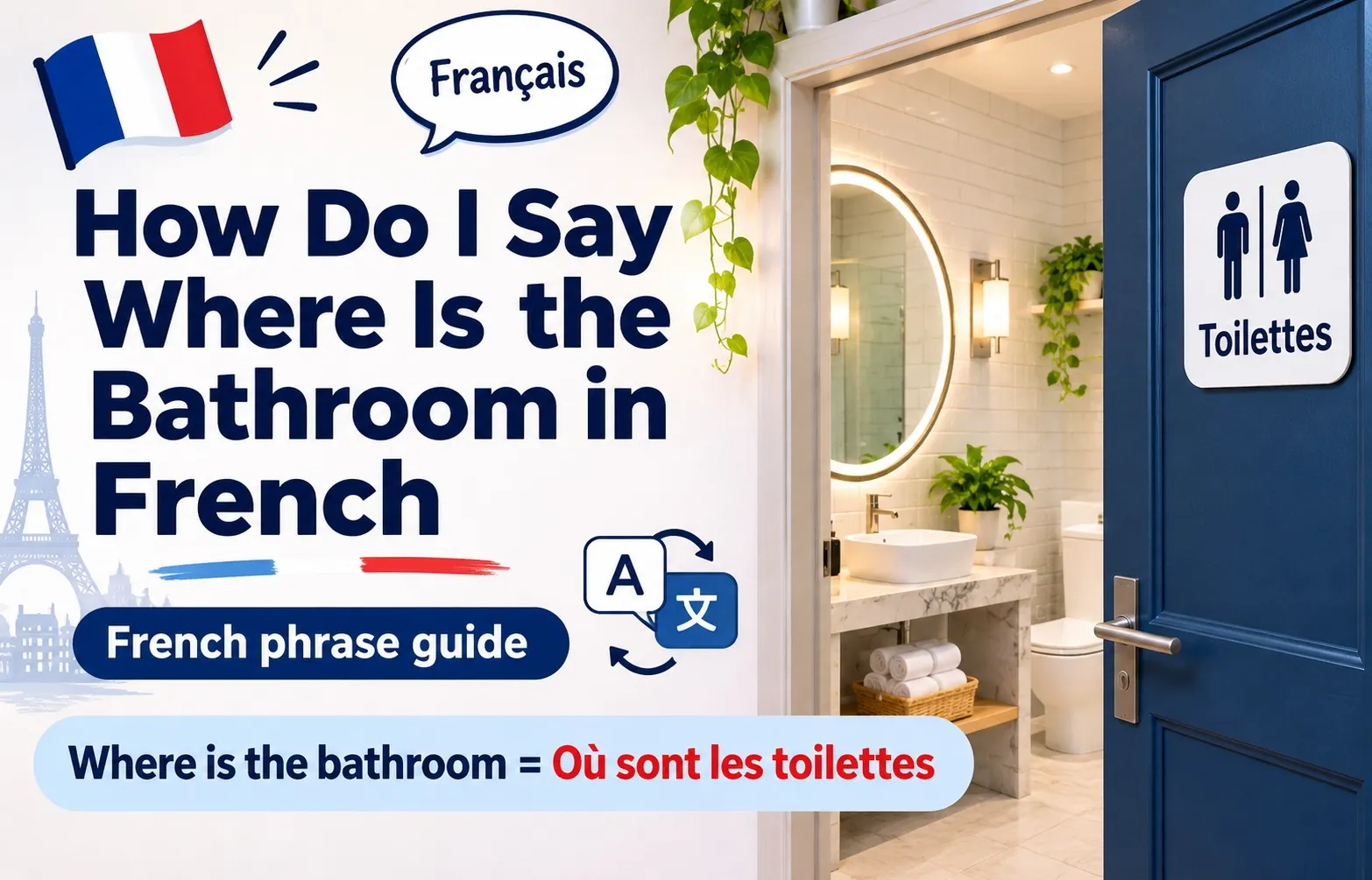 To ask “where is the bathroom” in French, say “Où sont les toilettes ?” (pronounced oo sohn lay twah-let) or “Où se trouvent les toilettes ?” (pronounced oo suh troov lay twah-let). Both phrases are understood everywhere in France and across French-speaking regions.
The Standard & Most Natural Phrase (Où se trouvent les toilettes ? vs. Où sont les toilettes ?)
In French, the word for restroom (les toilettes) is almost always treated as a plural noun, even when you are looking for a single stall. Because of this grammatical rule, you pair it with plural verb forms like sont (are) or se trouvent (are located) rather than the singular est.
- Où sont les toilettes ? (oo sohn lay twah-let) — Literally translates to “Where are the toilets?” This is the quickest, most direct way to ask in everyday conversation.
- Où se trouvent les toilettes ? (oo suh troov lay twah-let) — Literally means “Where are the toilets located?” Native speakers frequently use this phrasing in cafés, museums, and shops because it sounds slightly more polished.
- C’est où, les toilettes ? (say oo, lay twah-let) — A casual, spoken phrasing you will often hear among friends or in relaxed settings.
Adding Mandatory French Politeness (Excusez-moi & S’il vous plaît)
Walking up to a waiter, shopkeeper, or stranger in France and immediately asking a question without a greeting is considered impolite. Always open your interaction with Bonjour (Hello) or Excusez-moi (Excuse me) and close with s’il vous plaît (please).
- In a café, restaurant, or store: “Bonjour, excusez-moi, où se trouvent les toilettes, s’il vous plaît ?” (Hello, excuse me, where is the restroom, please?)
- When passing someone quickly in a busy venue: “Excusez-moi, où sont les toilettes, s’il vous plaît ?” (Excuse me, where is the bathroom, please?)
- With close friends or family: “Où sont les toilettes, s’il te plaît ?” (Swap vous for the informal te when speaking to someone you know well.)
How to Sound Natural Out Loud: French Bathroom Pronunciation
Mastering French phonetics for oo sohn lay twah-let and oo suh troov lay twah-let comes down to dropping final consonants and keeping syllable stress smooth and even. Unlike English, French rarely stresses one single syllable heavily, which makes natural rhythm just as important as individual sounds.
Syllable-by-Syllable Breakdown & Common Mistakes
English speakers often over-pronounce word endings when reading French spelling out loud. Watching for silent letters and smooth sound connections will help you achieve clear, native French pronunciation right away.
- Silent s in sont (oo sohn): The final s is silent before a consonant, and the on produces a nasal vowel sound without a hard n at the end.
- Silent ent in trouvent (oo suh troov): The third-person plural verb ending -ent is silent, so pronounce trouvent simply as troov with a soft uh sound on se.
- Silent s in toilettes (lay twah-let): Both les (lay) and toilettes (twah-let) drop their final s in standard speech, with a crisp twah glide and a clean let ending.
- Smooth word linking (liaison) and avoiding an English r: Connect words smoothly without choppy pauses, and keep the French r subtle in the back of the throat rather than rolling or curling your tongue like an American r.
Listen to Native French Pronunciation
Hear the exact rhythm, vowel shapes, and polite intonation in the video walkthrough below before using the phrase in a café or train station. Repeating the line aloud once or twice will lock in the natural cadence before you speak in public.
The #1 Vocabulary Trap: Les Toilettes vs. La Salle de Bain
Never ask a café waiter or museum attendant for la salle de bain unless you are looking for a room with a bathtub or shower. In France, les toilettes is the universal term for a public restroom or toilet, whereas la salle de bain refers strictly to a bathing room inside a home or hotel.
Why La Salle de Bain Confuses French Locals in Public
In many French apartments and older hotels, the toilet and the bathing area are located in completely separate rooms. Because la salle de bain (also spelled la salle de bains) literally translates to “the bath room,” asking for it in a Parisian restaurant sounds like you are asking staff where you can take a shower.
- Use les toilettes in public venues: Always choose les toilettes (or institutional terms like les sanitaires on public maps and les cabinets in older usage) when you need a toilet in restaurants, shops, airports, or someone’s house.
- Reserve la salle de bain for bathing: Only use la salle de bain when checking into a hotel, renting an apartment, or asking a host where you can wash up or take a shower.
French Bathroom Terms Ranked by Register & Social Risk
French offers several distinct expressions for the restroom, ranging from standard polite phrasing to blunt street slang. Choosing the right register ensures you sound natural without accidentally offending staff or hosts.
Situational French Bathroom Phrases: Restaurants, Permission & Urgency
Beyond asking where the restroom is located, real-world travel often requires asking permission to use a café’s facilities, checking if a small shop even has a toilet, or expressing urgent need. Choosing the exact phrase for your setting ensures polite, immediate cooperation from locals.
At a Café, Restaurant, or Shop (Asking Permission & Availability)
In smaller French bistros, bakeries, or boutiques, restrooms are sometimes reserved for paying guests or hidden behind staff doors. Always begin with Bonjour before asking if a restroom is available or requesting permission to use it.
- “May I use the restroom, please?” (Formal & Polite): “Puis-je utiliser les toilettes, s’il vous plaît ?” (pronounced pweezh oo-tee-lee-zay lay twah-let, seel voo play) — Best when entering a café or shop without ordering first.
- “Can I go to the bathroom, please?” (Everyday Natural): “Est-ce que je peux aller aux toilettes, s’il vous plaît ?” (pronounced ess-kuh zhuh puh ah-lay oh twah-let, seel voo play) — The most natural spoken way to ask permission in casual restaurants.
- “Do you have a restroom?” (Checking Availability): “Vous avez des toilettes, s’il vous plaît ?” (pronounced voo zah-vay day twah-let, seel voo play) or “Est-ce qu’il y a des toilettes ici ?” (pronounced ess-keel yah day twah-let ee-see) — Ideal for small shops, markets, or outdoor kiosks.
At a Friend’s House or Hotel (Casual vs. Shower Needs)
When visiting someone’s home, switch from the formal vous to the familiar tu (and s’il te plaît instead of s’il vous plaît) by asking, “Où sont tes toilettes, s’il te plaît ?” (oo sohn tay twah-let, seel tuh play). If you are staying overnight at a friend’s place or checking into a guesthouse and specifically need to wash up or take a shower, ask for the bathing room instead: “Où est la salle de bain ?” (oo ay lah sal duh ban).
Expressing Urgency (I Need the Toilet I Need to Pee)
When you cannot wait and need to communicate urgency clearly, match your phrasing to the social setting so you stay polite around adults while keeping child-friendly options handy.
- Polite & Standard Urgency (“I need to go to the bathroom”): “J’ai besoin d’aller aux toilettes” (pronounced zhay buh-zwan dah-lay oh twah-let) — Appropriate for any adult, tour guide, or restaurant host when you need directions fast.
- Casual & Child-Friendly (“I need to pee”): “J’ai envie de faire pipi” (pronounced zhay ahn-vee duh fair pee-pee) — Very common among children or in relaxed family settings, though best avoided in formal business or fine-dining environments.
- Quick Interjection (“Excuse me, urgent!”): “Pardon, excusez-moi, les toilettes ?” (pronounced par-dohn, ex-kyoo-zay mwah, lay twah-let) — Shortening the sentence while maintaining a polite opener signals immediate urgency without sounding rude.
Understanding the Reply & Decoding French Restroom Signs
Asking where the restroom is located only solves half the problem—locals will usually answer with quick directional phrases while pointing toward a hallway or staircase. Recognizing a handful of core direction words and French door labels lets you navigate straight to the right stall without hesitation.
Common Directions Waiters & Locals Will Say Back
In busy Parisian cafés, museums, and train stations, restrooms are frequently tucked into basement corridors or at the very rear of the building. Listen for these six high-frequency directional phrases when staff reply to your question:
- Au fond à gauche (oh fohn ah gohsh) — “At the back on the left,” one of the most common replies in French cafés and restaurants.
- Au fond à droite (oh fohn ah drwaht) — “At the back on the right,” indicating you should walk all the way to the rear wall and turn right.
- Tout droit (too drwah) — “Straight ahead,” meaning the facilities are directly down the hallway in front of you.
- En bas (ahn bah) — “Downstairs,” signaling a staircase leading to basement restrooms (very common in central Paris).
- En haut (ahn oh) — “Upstairs,” directing you to the floor above.
- C’est par là (say par lah) — “It’s that way,” typically paired with a hand gesture pointing toward an alcove or corridor.
How to Read French Restroom Door Signs
Once you reach the restroom area, doors in France often rely on text abbreviations or formal French gender labels rather than universal pictograms. Check these door and lock markers before pushing a door open:
- WC (pronounced vay-say) — The standard abbreviation for “water closet,” used across highway rest stops, train stations, and public signage to mark toilets.
- Femmes (fam) or Dames (dam) — Marks the women’s restroom (literally “Women” or “Ladies”).
- Hommes (om) or Messieurs (may-syuh) — Marks the men’s restroom (literally “Men” or “Gentlemen”).
- Mixte (meekst) — Indicates a unisex or all-gender restroom facility.
- Libre vs. Occupé (lee-bruh vs. oh-kyoo-pay) — Lock indicators on stall doors; green Libre means vacant, while red Occupé means occupied.
Practical French Restroom Etiquette & Cultural Tips
Navigating restrooms in France involves a few local customs that surprise first-time visitors, from receipt door codes in fast-casual cafés to paid station facilities. Knowing these unwritten rules before you step inside saves awkward moments at the counter and helps you find clean, accessible public toilets across French cities.
Café Rules, Receipt Codes & Paid Public Toilets (Sanisettes)
In France, café and restaurant restrooms are generally reserved for paying customers rather than passersby off the street. Ordering an espresso at the bar (au comptoir) costs very little and gives you legitimate access to the facilities, though you should keep a few practical logistics in mind:
- Check your receipt for the keypad code (le code): Many modern cafés, bakeries, and fast-food spots lock their restroom doors with a numeric keypad, printing the four- or five-digit entry code directly at the bottom of your register receipt.
- Carry €0.50 and €1 coins for train stations and department stores: Restrooms in major rail hubs (like Gare du Nord), highway service areas, and older shopping centers frequently charge between €0.50 and €1.00 via turnstile or attendant—not all machines accept contactless cards.
- Use free automated street Sanisettes: Major cities like Paris operate hundreds of self-cleaning street pods called Sanisettes that are completely free to use; you can locate public facilities and plan practical city logistics through the official France.fr travel guide.
- Wait for the green light on automated pods: When using a street Sanisette, wait until the automatic wash cycle finishes and the indicator turns green before pressing the button to open the door.
Plumbing & Toilet Paper Etiquette in France
Yes, you put toilet paper directly into the toilet in France. Standard French plumbing and municipal sewer systems are fully equipped to handle normal toilet paper, so you do not need to place used paper in a side bin during everyday travel.
- Watch for rare historic or rural exceptions: In centuries-old stone buildings, mountain refuges, or rural properties running on delicate septic tanks (fosse septique), owners occasionally post a polite sign asking guests to place paper in a covered wastebasket next to the toilet.
- Never flush wet wipes or hygiene products: Even in modern Parisian hotels, flushable wipes, tissues, and sanitary products should always go into the bathroom bin to prevent costly pipe blockages.
Frequently Asked Questions About Asking for the Bathroom in French
What do French people call the restroom?
In everyday spoken French, native speakers refer to a public restroom as les toilettes, which is always used in the plural form. On directional signs, café doors, and train station maps across France, you will most commonly see the abbreviation WC (standing for water-closet) or simple pictograms.
- Les toilettes: Standard spoken term for any public or guest restroom.
- WC: Universal shorthand displayed on signage in restaurants, museums, and transit hubs.
- La salle de bain: Reserved strictly for a private home room containing a shower or bathtub.
What is a polite or classy way to say bathroom in French?
The most polite and natural way to ask for the restroom in French is: “Excusez-moi, où se trouvent les toilettes, s’il vous plaît ?” (Excuse me, where are the restrooms, please?). In casual social gatherings, native speakers also use the lighthearted, discreet euphemism le petit coin (the little corner).
- Formal phrasing: Using où se trouvent (where are located) elevates politeness compared to a blunt question.
- Le petit coin: A charming, indirect expression suitable for dinner parties or stepping away from friends.
How do I ask for a toilet in a restaurant in France?
To ask a server for the restroom in a French restaurant or café, always start with a polite greeting before making your request: “Bonjour, excusez-moi, où se trouvent les toilettes, s’il vous plaît ?” Opening with Bonjour is an essential cultural rule in French hospitality before asking any question.
- Step 1: Make eye contact and say Bonjour (or Bonsoir in the evening).
- Step 2: Add Excusez-moi to politely get the staff member’s attention.
- Step 3: Ask Où se trouvent les toilettes, s’il vous plaît ? to receive clear directions or a door code.
What is a slang word for toilet in French?
The most common French slang terms for the toilet are les chiottes and les gogues. While les gogues is an old-fashioned, informal term similar to “the loo,” les chiottes is vulgar street slang comparable to “the shitter” and should only be used among close friends.
- Les chiottes: Crude, everyday slang used strictly in casual, non-professional company.
- Les gogues: Colloquial, slightly dated slang that sounds less harsh than les chiottes.
- Usage warning: Never use either term with waiters, hotel staff, or strangers; stick to les toilettes.

Oscar Vance | Master Plumber & Drainage Expert
Meet Oscar Vance, a licensed master plumber sharing practical solutions on residential repairs, preventive maintenance, and thoughtful home upkeep.